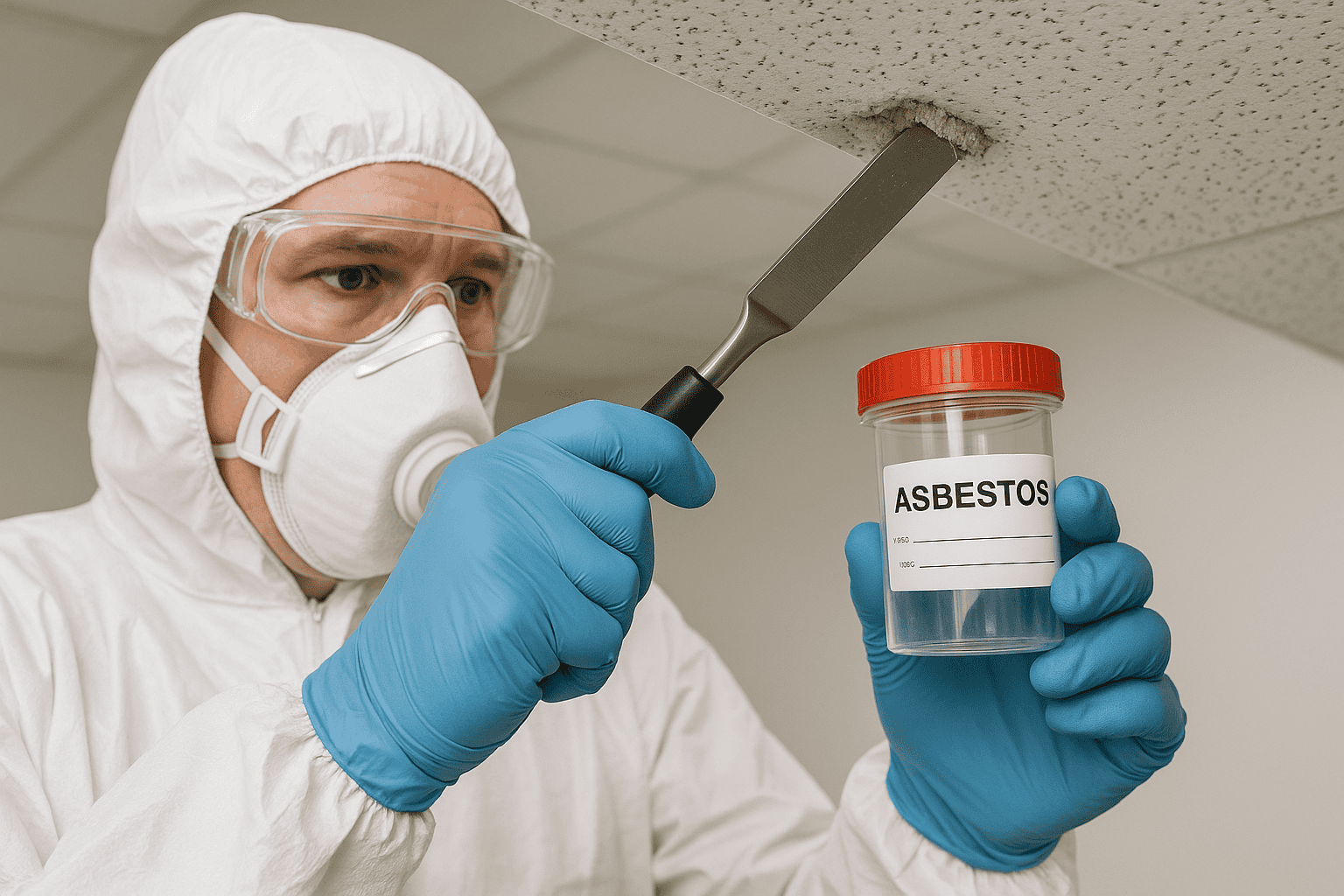
Do I Need an Asbestos Survey? Tips to Protect Your Employees From Asbestos
If you’re asking yourself “do I need an asbestos survey?” — and what you can actually do to protect your employees from asbestos — here’s the straight answer: you almost certainly do need one, and the steps to protect your workforce begin the moment that survey is in your hands.
Under the Control of Asbestos Regulations, anyone responsible for non-domestic premises built before 2000 has a clear legal duty to manage asbestos. A professional survey is the foundation of that duty — not a box-ticking exercise, but the difference between knowing exactly what’s in your building and gambling with your employees’ health.
Asbestos fibres are invisible, odourless, and can remain airborne for hours after disturbance. By the time symptoms of asbestos-related disease appear, the damage was done decades earlier. The guidance below will help you understand your legal obligations, what a survey involves, and what practical steps you can take to protect your workforce right now.
Do I Need an Asbestos Survey? Understanding Your Legal Duty
The Control of Asbestos Regulations place a duty to manage asbestos on anyone who owns, occupies, or manages non-domestic premises. If your building was constructed before 2000, you must assume asbestos-containing materials (ACMs) are present until proven otherwise.
An asbestos survey carried out by a competent, accredited surveyor is the only reliable way to identify where ACMs are located, what condition they’re in, and what risk they pose to anyone working in or around the building. Without that survey, you are legally exposed and your employees are physically at risk.
The Two Main Types of Asbestos Survey
There are two principal survey types, and choosing the right one matters:
- Management survey: Used for buildings in normal occupation. This survey identifies ACMs that could be disturbed during routine maintenance and day-to-day activities, forming the basis of your ongoing asbestos management plan.
- Demolition survey: Required before any major refurbishment or demolition work. This survey is more intrusive and locates all ACMs, including those concealed within the building’s structure.
HSE guidance under HSG264 sets out exactly how these surveys should be conducted. Using a UKAS-accredited surveying firm ensures the work meets those standards and will stand up to regulatory scrutiny.
If you manage premises across multiple locations, working with a firm that has genuine regional reach makes a real difference. Whether you need an asbestos survey London businesses can rely on, or coverage further afield, an accredited national provider with local expertise ensures consistency and quality across every site.
Tip 1: Handle Asbestos-Containing Materials Properly
If ACMs are identified in your building, the first rule is straightforward: don’t disturb them unnecessarily. Asbestos in good condition and left undisturbed poses a low risk. It’s when materials are cut, drilled, sanded, or damaged that fibres become airborne and dangerous.
When work does need to take place near ACMs, strict handling protocols must be followed:
- Keep the material wet wherever possible — wetting ACMs before and during work significantly reduces dust generated.
- Use a HEPA-filter vacuum to collect dust immediately — standard vacuums will simply recirculate fibres into the air.
- Seal all asbestos waste in clearly labelled, double-bagged, heavy-duty polythene sacks designed specifically for asbestos disposal.
- Never use power tools on ACMs unless under strictly controlled conditions with appropriate extraction in place.
Asbestos waste is classified as hazardous waste under UK law. It cannot go into general waste skips, licensed carriers must be used, and waste transfer notes must be kept on record.
If you’re planning refurbishment or demolition, the survey must be completed before a single tool is picked up. Skipping this step isn’t just dangerous — it’s a criminal offence. In some cases, asbestos removal will be required before any works can safely proceed, and this must be carried out by a licensed contractor.
Tip 2: Ensure the Right Personal Protective Equipment Is Used
Anyone working directly with or near ACMs must be properly equipped. The right personal protective equipment (PPE) and respiratory protective equipment (RPE) must be provided, correctly fitted, and used consistently — every time, without exception.
What PPE Is Required for Asbestos Work?
At a minimum, workers should have access to:
- A disposable coverall (Type 5, Category 3) — full body coverage with no skin exposed
- Disposable gloves and boot covers
- A correctly fitted FFP3 disposable mask or a half-face respirator with a P3 filter — as a minimum for lower-risk work
- For higher-risk activities, a full-face respirator or powered air-purifying respirator (PAPR) may be required
Fit-testing for RPE is not optional. An ill-fitting mask provides little to no protection. Under HSE guidance, all tight-fitting RPE must be fit-tested before use.
PPE is the last line of defence, not the first. Engineering controls — such as enclosures, extraction systems, and wet suppression — should be in place before relying on PPE alone. If your controls are robust, PPE becomes a safety net rather than your primary protection.
Tip 3: Dispose of Contaminated Clothing Correctly
One of the most overlooked risks in asbestos management is secondary exposure — where fibres are carried away from the worksite on clothing, hair, or skin and subsequently inhaled by someone who was never near the original source. Family members of workers are particularly vulnerable to this route of exposure.
Strict clothing protocols must be in place on any site where asbestos work is being carried out:
- Workers must change out of contaminated coveralls on site — never travel home wearing them.
- Disposable coveralls should be removed carefully by rolling them inward to contain fibres, then placed directly into a sealed asbestos waste bag.
- Reusable clothing that may have been contaminated must be laundered at a specialist facility — never taken home for domestic washing.
- Personal items such as shoes, bags, and mobile phones should be kept well away from the work area to prevent cross-contamination.
Secondary exposure has been responsible for a significant number of asbestos-related disease cases in the UK. Robust decontamination procedures on site are the most effective way to prevent it happening to your workforce or their families.
Tip 4: Provide Adequate Decontamination Facilities
Showering after asbestos work is not a recommendation — for licensable asbestos work, it is a legal requirement. Asbestos fibres cling to skin and hair and can be easily transferred. Providing proper decontamination facilities is part of your duty as an employer.
What Decontamination Facilities Are Required?
For licensed asbestos removal work, a three-stage decontamination unit (DCU) is typically required. This consists of a dirty end, a shower unit, and a clean end — ensuring workers are fully decontaminated before leaving the controlled area.
For lower-risk, non-licensed work, at a minimum you should:
- Provide access to shower facilities on or near the site
- Ensure workers wash hands and face thoroughly before eating, drinking, or smoking
- Remind workers not to eat, drink, or smoke in or near the work area at any point
If you’re unsure what decontamination facilities are required for a specific type of work, HSE guidance sets out clear requirements based on the nature of the job. When in doubt, contact a specialist or your local HSE office for clarification.
Businesses operating across multiple regions should ensure their decontamination protocols are consistent regardless of location. If you’re arranging an asbestos survey Manchester properties require, a reputable surveyor will also be able to advise on the appropriate controls for your specific situation.
Tip 5: Keep Communication Clear and Consistent
Your asbestos management plan is only effective if the people who need to act on it actually understand it. Clear, regular communication with your workforce is one of the most practical and cost-effective things you can do to reduce risk.
What Should You Communicate to Your Team?
- The location of any known or suspected ACMs in the building
- The condition of those materials and any restrictions on working near them
- The correct procedures for reporting damage or disturbance to ACMs
- What to do if asbestos is unexpectedly discovered during maintenance or building work
- Where to find the asbestos register and management plan
Asbestos awareness training is a legal requirement for anyone who could come into contact with ACMs during their work — including maintenance staff, cleaners, and contractors. This training must be refreshed regularly and records kept.
Contractors working on your premises must also be informed of any known ACMs before they start work. Failing to do so puts them at risk and exposes you to serious legal liability.
Don’t assume a notice on a wall is sufficient. Hold toolbox talks, provide written briefings, and make sure your asbestos register is accessible to those who need it. Good communication is what turns a written management plan into a living, effective system.
Why the Survey Must Come First
Every tip above depends on one thing: knowing where asbestos is in your building. Without a survey, you’re working blind. You cannot protect your employees from a hazard you haven’t identified, and you cannot manage something you don’t know is there.
A professional asbestos survey gives you:
- A full asbestos register detailing the location, type, and condition of all ACMs
- A risk assessment for each identified material
- Recommendations for management or removal
- The foundation for a legally compliant asbestos management plan
Once the survey is complete, you have the information you need to make decisions — whether that’s leaving low-risk materials in place and monitoring them, arranging remediation, or commissioning removal ahead of planned works.
For businesses in the West Midlands, getting an asbestos survey Birmingham teams can access quickly from an accredited local firm means faster turnaround, regional expertise, and a surveyor who understands the building stock in your area.
What Happens If You Don’t Get a Survey?
The consequences of failing to survey a pre-2000 building are serious on multiple fronts. From a legal standpoint, you are in breach of the Control of Asbestos Regulations, which can result in enforcement action, prohibition notices, and prosecution. The HSE takes non-compliance seriously, and the penalties reflect that.
From a health standpoint, the consequences can be catastrophic. Mesothelioma, asbestosis, and asbestos-related lung cancer are all fatal diseases with no cure. The latency period between exposure and diagnosis can be 20 to 40 years, meaning that by the time anyone becomes ill, the exposure happened long ago — under your watch.
From a financial standpoint, the cost of a professional survey is a fraction of the cost of an enforcement action, a civil claim, or the remediation required after an uncontrolled disturbance. The survey isn’t an expense — it’s risk management.
Choosing the Right Asbestos Surveying Company
Not all asbestos surveys are equal. The surveyor you choose must be competent, and for most commercial and public sector buildings, UKAS accreditation is the benchmark you should insist on. This means the organisation has been independently assessed against recognised standards and their work is subject to ongoing quality oversight.
When selecting a surveying company, look for:
- UKAS accreditation for asbestos surveying and/or air monitoring
- Surveyors holding relevant qualifications such as the BOHS P402 certificate
- A clear, detailed survey report that meets HSG264 requirements
- Experience across a range of property types — commercial, industrial, educational, healthcare
- Transparent pricing with no hidden costs
- A track record you can verify through case studies, reviews, or client references
A good surveying firm won’t just hand you a report and walk away. They’ll explain their findings clearly, answer your questions, and help you understand what action — if any — is required. That ongoing support is part of what you’re paying for.
Be wary of unusually low quotes. A cut-price survey that misses ACMs, produces a report that doesn’t meet regulatory standards, or is carried out by an unqualified operative is worse than no survey at all — because it gives you a false sense of security.
Building an Ongoing Asbestos Management Culture
Getting the survey done is the start, not the finish. Asbestos management is an ongoing responsibility that requires regular review, updating records when building works are carried out, and re-surveying if conditions change or materials deteriorate.
Your asbestos register must be kept up to date and made available to anyone who needs it — including contractors, maintenance teams, and emergency services. A register that sits in a filing cabinet and never gets reviewed is a liability, not an asset.
Schedule regular inspections of known ACMs to check their condition. If a material deteriorates, the risk profile changes and your management plan must reflect that. Don’t wait for someone to report damage — build proactive checks into your maintenance schedule.
Embed asbestos awareness into your wider health and safety culture. New starters should receive asbestos induction training as a matter of course. Refresher training should be timetabled, not left to chance. And when contractors come on site, make briefing them on ACMs a non-negotiable part of your permit-to-work process.
The organisations that manage asbestos well aren’t the ones with the thickest binders — they’re the ones where every relevant person knows what the hazard is, where it is, and what to do about it.
Get Your Asbestos Survey Booked Today
Supernova Asbestos Surveys has completed over 50,000 surveys across the UK. Our UKAS-accredited surveyors operate nationwide, delivering management surveys, demolition surveys, and specialist services to commercial, industrial, and public sector clients.
We provide clear, HSG264-compliant reports, practical guidance on next steps, and the kind of straightforward advice that helps you make informed decisions — not just a document that satisfies the regulator.
To book a survey or discuss your requirements, call us on 020 4586 0680 or visit asbestos-surveys.org.uk. Our team is ready to help you protect your employees and meet your legal obligations — starting today.
Frequently Asked Questions
Do I legally need an asbestos survey for my building?
If you own, occupy, or manage non-domestic premises built before 2000, the Control of Asbestos Regulations require you to manage the risk of asbestos. A professional asbestos survey is the only reliable way to identify what ACMs are present, where they are, and what condition they’re in. Without one, you cannot fulfil your legal duty to manage asbestos, and you risk enforcement action from the HSE.
What is the difference between a management survey and a demolition survey?
A management survey is used for buildings in normal day-to-day use. It identifies ACMs that could be disturbed during routine maintenance and forms the basis of your asbestos management plan. A demolition survey is required before any major refurbishment or demolition work and is more intrusive — it locates all ACMs, including those hidden within the building’s structure. HSG264 sets out the requirements for both survey types.
Can I carry out an asbestos survey myself?
No. An asbestos survey must be carried out by a competent surveyor — someone with the appropriate qualifications, training, and equipment. For most commercial properties, UKAS accreditation is the recognised standard. Attempting to survey your own building without the necessary expertise could result in missed ACMs, an invalid report, and continued legal and health risk.
How often does an asbestos survey need to be updated?
Your asbestos register and management plan must be kept up to date whenever building works are carried out, when materials deteriorate, or when new information comes to light. Known ACMs should be inspected regularly to monitor their condition. If you’re planning refurbishment or demolition work, a new demolition survey will be required even if a management survey already exists for the building.
What should I do if asbestos is found during building work?
Stop work immediately. The area should be secured and access restricted. Do not attempt to clean up or disturb the material further. Contact a UKAS-accredited asbestos surveying or removal company to assess the situation. Depending on the type and condition of the material, specialist removal by a licensed contractor may be required before work can safely resume. The HSE should be notified if a notifiable asbestos job is involved.
Leave a Reply