Buying a House with Asbestos: What You Really Need to Know
House hunting is stressful enough without a survey throwing up the word “asbestos” and sending your plans into freefall. Many buyers walk away at that point — but walking away is not always the right call.
If you’re asking yourself should I buy a house with asbestos, here’s what you need to consider: the honest answer is that it depends entirely on the condition of the materials, what you’re planning to do with the property, and whether you get proper professional advice before you exchange contracts. Asbestos alone is not a dealbreaker — but it does demand clear-eyed assessment.
Below you’ll find the full picture: the real risks, what surveys reveal, how UK regulations apply, what lenders and insurers think, and how to use asbestos findings to your advantage at the negotiating table.
A Brief History of Asbestos in UK Homes
Asbestos is a naturally occurring fibrous mineral that was used extensively in UK construction throughout much of the twentieth century. Builders valued it for its heat resistance, durability, and insulating properties — and it was cheap to source.
It found its way into an enormous range of building materials: roof tiles, floor tiles and adhesives, pipe lagging, textured ceiling coatings (commonly known as Artex), soffit boards, guttering, and insulation products. If a property was built or significantly refurbished before 2000, there is a realistic chance it contains asbestos-containing materials (ACMs) somewhere.
The UK progressively banned different types of asbestos through the 1980s and 1990s, with a complete prohibition on all asbestos use coming into force in 1999. That means an enormous proportion of the UK’s existing housing stock pre-dates the ban.
The danger is not simply the presence of asbestos — it’s disturbance. When ACMs are damaged, degraded, or disturbed during building work, they release microscopic fibres into the air. Inhaling those fibres over time can cause serious and often fatal conditions, including mesothelioma, asbestos-related lung cancer, and asbestosis.
These diseases can take decades to develop after exposure, which is part of what makes asbestos so insidious. Intact, undisturbed asbestos in good condition poses a significantly lower risk. The critical question is always: what is the condition of the material, and what are you planning to do with the property?
Should I Buy a House with Asbestos? The Key Factors to Weigh Up
Thousands of properties containing asbestos are bought and sold across the UK every year without incident. The presence of ACMs is not unusual — it is the norm for pre-2000 properties. What matters is understanding exactly what you’re dealing with before you commit.
The Condition of the Asbestos-Containing Materials
Asbestos in good condition — bonded, sealed, and undamaged — is far less hazardous than asbestos that is crumbling, flaking, or visibly deteriorating. The latter is known as friable asbestos, and it is friable material that releases fibres most readily into the air.
If a professional survey reveals well-maintained ACMs that are unlikely to be disturbed, managing them in situ — leaving them safely in place with appropriate monitoring and labelling — is often the most sensible and cost-effective approach. Removal is not always necessary or even advisable.
Your Plans for the Property
Do you intend to renovate, extend, rewire, or carry out significant DIY work? If so, there is a genuine risk of disturbing asbestos-containing materials, and that changes the risk profile considerably.
Any planned building work on a pre-2000 property should be preceded by a professional management survey at minimum. If the work is more intrusive — stripping out kitchens or bathrooms, removing ceilings, or carrying out structural alterations — a demolition survey will be required before work begins. Under the Control of Asbestos Regulations, this is not optional.
Disclosure and Your Legal Position
Sellers are not currently required by law to proactively disclose asbestos in a residential property in the same way they would declare a planning dispute or boundary issue. However, knowingly concealing a material fact that affects the value or habitability of a property may give rise to a misrepresentation claim.
If you discover asbestos through your own enquiries and the seller has denied its presence, speak to your solicitor immediately. Your conveyancer can also raise specific enquiries about asbestos as part of the pre-contract process — it is worth asking them to do so on any pre-2000 property.
The Cost Implications
Professional asbestos removal is a known, manageable cost — and it can be a powerful negotiating tool. A professional survey gives you an accurate picture of the extent and condition of any ACMs. A removal quote then gives you a concrete figure to put to the seller.
Many buyers have used asbestos findings to negotiate meaningful reductions in the asking price, or to require the seller to arrange professional asbestos removal before completion. Either way, knowledge puts you in control rather than leaving you exposed to an unquantified liability after you’ve moved in.
How Does Asbestos Affect Property Value?
The presence of asbestos can reduce a property’s market value, particularly where materials are in poor condition or widespread throughout the building. Prospective buyers may be deterred by the perceived risk and the anticipated cost of professional remediation.
That said, a well-documented survey report demonstrating that ACMs are in good condition and being properly managed can go a long way towards reassuring both buyers and lenders. The key is transparency and documentation — an unknown risk is always more alarming than a known, managed one.
If you are the buyer, use the survey findings as a basis for negotiation. If removal is required, get a quote from a licensed contractor and factor that figure into your revised offer. If management in situ is appropriate, the ongoing cost is likely to be modest — periodic monitoring and an up-to-date asbestos register.
What UK Regulations Apply to Houses with Asbestos?
The Control of Asbestos Regulations is the primary piece of legislation governing the management and removal of asbestos in the UK. It sets out strict requirements for how asbestos work must be carried out, who is licensed to undertake it, and how asbestos waste must be disposed of.
The duty to manage asbestos under the regulations applies primarily to non-domestic premises — so the legal obligation on a private homeowner differs from that on a commercial landlord or employer. However, the regulations governing safe removal and handling apply to residential properties too.
If you are commissioning removal work on your home, it must be carried out by a licensed contractor for higher-risk licensable materials. Using an unlicensed operative is not only illegal — it could expose you and your family to serious harm.
HSE guidance, including the document known as HSG264, provides detailed technical guidance on asbestos surveying and is the standard to which professional surveyors work. When commissioning a survey, ensure the company you use works to HSG264 and that their surveyors hold appropriate qualifications — typically through the British Occupational Hygiene Society (BOHS) or an equivalent accrediting body.
Can You Get a Mortgage on a House with Asbestos?
Asbestos does not automatically make a property unmortgageable. Many lenders will proceed with a mortgage on a property containing ACMs, provided they have sufficient information about the extent and condition of the materials.
However, lenders will want to see detailed survey information, and some may require evidence that a management plan is in place or that removal has been arranged before they release funds. If a property has significant quantities of asbestos in poor condition, a lender may place a retention on the mortgage until remediation work is completed and evidenced.
The practical advice here is straightforward: commission a professional asbestos management survey early in the buying process, before your mortgage application reaches the valuation stage. If the surveyor or valuer flags asbestos as a concern, having a professional report already in hand demonstrates that you have taken the matter seriously and gives the lender the information they need.
It is also worth speaking to a mortgage broker who has experience with non-standard properties. Some lenders are more comfortable than others with asbestos-containing properties, and a broker can help you approach the right one.
Will Home Insurance Cover Asbestos-Related Issues?
This varies significantly between insurers and individual policy terms, and it is an area where many buyers are caught out. Many standard home insurance policies exclude asbestos-related claims, particularly those arising from gradual deterioration or pre-existing conditions.
Before you exchange contracts, read your proposed policy carefully and speak directly with your insurer about how asbestos is treated under your cover. Ask specifically whether accidental disturbance of asbestos during home improvements would be covered, and whether any remediation costs would be met.
Some specialist insurers do offer policies that include asbestos-related provisions. If this is a significant concern — particularly if the property has a known history of ACMs — it is worth shopping around rather than defaulting to a standard policy.
Common Materials That May Contain Asbestos in Residential Properties
You cannot identify asbestos by sight alone. Many ACMs look completely ordinary and give no visual indication of their composition. The only reliable way to confirm whether a material contains asbestos is through laboratory analysis of a physical sample taken by a qualified surveyor.
That said, it helps to know where asbestos was commonly used in residential properties. The following materials are among the most frequently encountered:
- Textured coatings — Artex and similar textured ceiling and wall finishes applied before the 1990s frequently contain chrysotile (white asbestos)
- Floor tiles and adhesives — vinyl floor tiles and the black bitumen adhesive used to bond them often contain asbestos
- Pipe lagging and boiler insulation — older heating systems may have asbestos insulation around pipework and boilers
- Roof tiles and slates — cement-based asbestos roof tiles were widely used on garages, outbuildings, and extensions
- Soffit boards and fascias — particularly on properties built in the 1960s to 1980s
- Insulating board — used in partition walls, ceiling tiles, and around fireplaces
- Guttering and downpipes — asbestos cement was commonly used for external drainage components
- Cavity wall insulation — some older insulation materials contain asbestos
This list is not exhaustive. A professional asbestos survey will systematically inspect accessible areas of the property and take samples for laboratory analysis where materials are suspected to contain asbestos.
What Happens During a Residential Asbestos Survey?
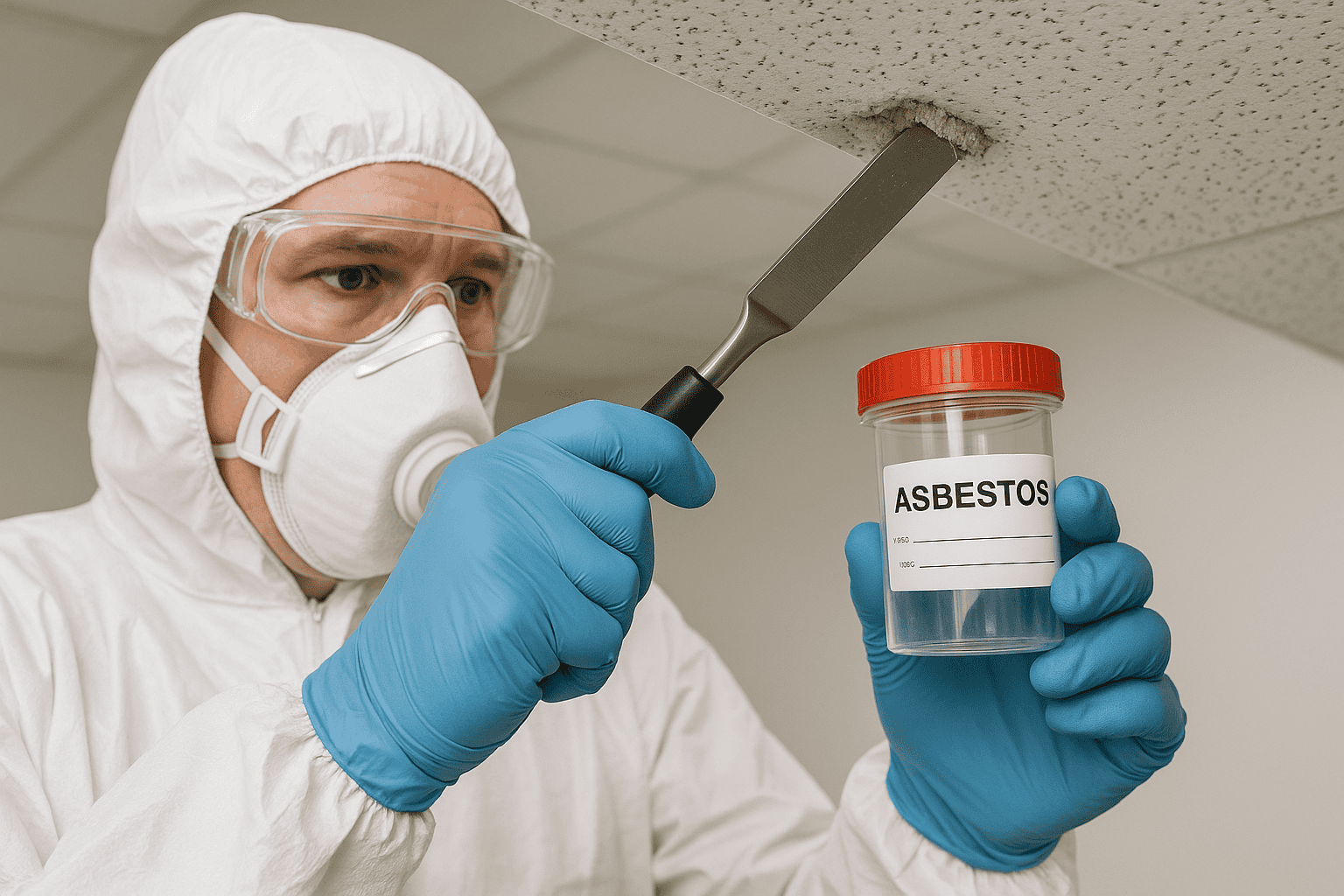
A qualified asbestos surveyor will inspect all accessible areas of the property, recording the location, type, and condition of any suspected ACMs. Where materials are suspected to contain asbestos, the surveyor will take small physical samples for laboratory analysis — this is the only definitive way to confirm or rule out asbestos content.
The resulting report will identify each ACM found, its condition, its risk rating, and recommended actions — whether that is management in situ, encapsulation, or removal. This report becomes a critical document for your solicitor, your mortgage lender, and any contractors you appoint to carry out work on the property.
For a property you are considering purchasing, a management-type survey is typically the appropriate starting point. If you subsequently plan major refurbishment or structural work, a more intrusive refurbishment and demolition survey will be needed before those works commence.
Using Asbestos Findings to Your Advantage as a Buyer
Many buyers treat an asbestos finding as a reason to panic or withdraw. Experienced buyers treat it as information — and information is leverage.
Here is a practical approach to handling asbestos findings during a property purchase:
- Commission your own survey — do not rely solely on information provided by the seller or their agent. An independent professional report gives you an objective basis for any negotiation.
- Get a removal quote — if the survey identifies ACMs that will need to be removed before or during planned works, obtain a written quote from a licensed contractor. This is your negotiating figure.
- Engage your solicitor — raise asbestos formally through the conveyancing process. Your solicitor can request the seller’s disclosure and document any representations made.
- Renegotiate the price — use the survey findings and removal quote to seek a reduction in the asking price that reflects the cost and disruption of remediation.
- Request seller remediation — in some cases, particularly where ACMs are in poor condition, it may be appropriate to require the seller to arrange and fund removal before completion.
- Confirm your insurance position — before exchanging contracts, confirm in writing with your insurer how asbestos is treated under your proposed policy.
The worst outcome is exchanging contracts without understanding the full picture and then discovering the scale of the issue after you have legal title. A survey commissioned before exchange costs a fraction of what remediation can cost — and it may save the purchase entirely if the findings are more serious than anticipated.
Asbestos Surveys Available Nationwide
Supernova Asbestos Surveys carries out residential asbestos surveys across the UK. Whether you’re buying in the capital and need an asbestos survey London buyers can rely on, purchasing in the north-west and require an asbestos survey Manchester team to attend quickly, or completing a purchase in the Midlands and need an asbestos survey Birmingham residents trust — our qualified surveyors are available nationwide.
With over 50,000 surveys completed, our team works to HSG264 standards and produces reports that satisfy mortgage lenders, solicitors, and insurers. We provide clear, jargon-free findings and practical recommendations so you can make an informed decision about your purchase.
Frequently Asked Questions
Is it safe to live in a house with asbestos?
In most cases, yes — provided the asbestos-containing materials are in good condition, undamaged, and not being disturbed. Asbestos that is intact and sealed poses a low risk in day-to-day living. The risk arises when ACMs are disturbed, drilled into, sanded, or damaged, which can release fibres into the air. A professional survey will assess the condition of any ACMs and advise whether management in situ, encapsulation, or removal is the appropriate course of action.
Do I have to declare asbestos when selling a house in the UK?
There is no specific statutory requirement for residential sellers to proactively declare asbestos in the same way as certain other property defects. However, knowingly concealing a material fact that affects a property’s value or habitability can give rise to a misrepresentation claim. Buyers should raise asbestos specifically through their solicitor’s pre-contract enquiries on any pre-2000 property, and should not rely on the absence of a disclosure as confirmation that no ACMs are present.
Will a mortgage lender refuse a property because of asbestos?
Not automatically. Many lenders will proceed on a property containing asbestos if they have adequate information about the extent and condition of the materials. Where ACMs are in poor condition or present in significant quantities, a lender may impose a retention until remediation is evidenced. Commissioning a professional asbestos management survey early in the buying process — before the lender’s valuation — puts you in a much stronger position and demonstrates that the issue is understood and being managed.
How much does it cost to remove asbestos from a house?
Costs vary considerably depending on the type, quantity, location, and condition of the materials involved. Removing a small area of asbestos cement roof on a garage outbuilding is a very different undertaking from removing insulating board from a ceiling or pipe lagging from a boiler room. The only reliable way to obtain an accurate cost is to have a professional survey carried out first, and then obtain written quotes from licensed removal contractors based on the survey findings. Get a quote from Supernova today to understand your survey costs before you proceed.
What is the difference between a management survey and a demolition survey for a residential property?
A management survey is designed to locate ACMs in a property that is in normal occupation and use, so that they can be managed safely. It involves inspection of accessible areas and sampling of suspected materials. A refurbishment and demolition survey is more intrusive — it is required before any major refurbishment, structural alteration, or demolition work begins, and involves accessing areas that would not be inspected during a standard management survey. If you are buying a property with significant renovation plans, you will need both: a management survey to understand what is present, and a refurbishment and demolition survey before intrusive works commence.
Get Expert Help Today
If you need professional advice on asbestos in your property, our team of qualified surveyors is ready to help. With over 50,000 surveys completed across the UK, Supernova Asbestos Surveys delivers clear, actionable reports you can rely on.
Call us on 020 4586 0680 or visit asbestos-surveys.org.uk for a free, no-obligation quote.