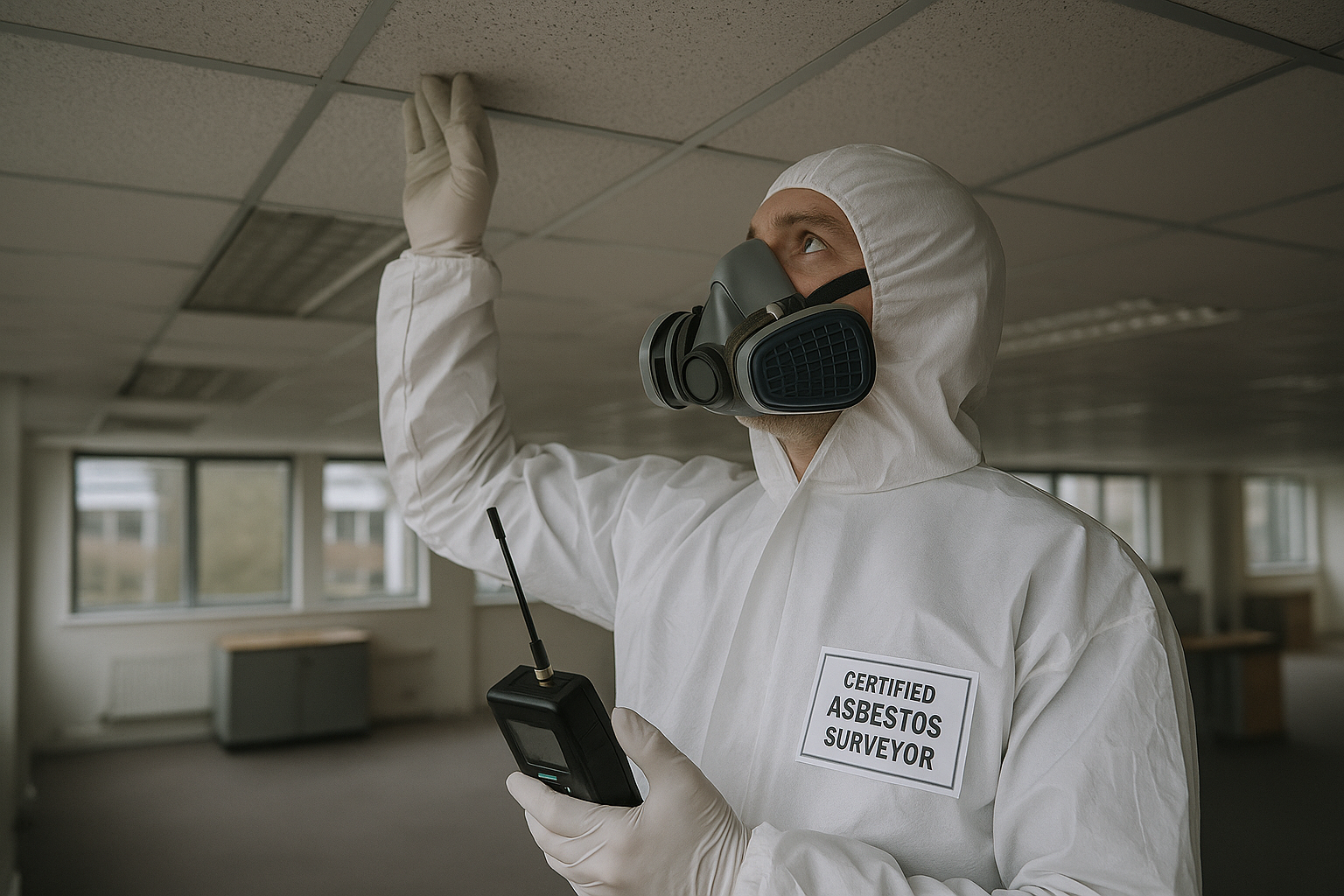
Category: The Role of Asbestos Inspections in Industrial Settings

  • Who is responsible for conducting asbestos inspections in industrial settings?

    Who is responsible for conducting asbestos inspections in industrial settings?

    One missing asbestos register can turn routine maintenance into a costly, dangerous mistake. If contractors drill into a wall, lift ceiling tiles, or open a riser without accurate asbestos information, the result can be exposure, work stoppages, enforcement action, and a serious compliance problem for the dutyholder.

    For any non-domestic premises that may contain asbestos, the asbestos register is one of the most important documents you hold. It sits at the centre of asbestos management under the Control of Asbestos Regulations, and it needs to be accurate, accessible, and kept up to date.

    If you manage an office, warehouse, school, industrial unit, retail site, or the common parts of a residential block, you need to know what an asbestos register is, what it should contain, and how to maintain it properly. Done well, it protects contractors, occupants, and your organisation. Done badly, it leaves gaps that can quickly become liabilities.

    What is an asbestos register?

    An asbestos register is a written record of asbestos-containing materials, or presumed asbestos-containing materials, within a building. It identifies where those materials are, what they are, what condition they are in, and the risk they present if disturbed.

    It is usually created following an asbestos survey and forms part of the wider asbestos management plan. The register is not just a list. It is a working document used to inform maintenance, repairs, contractor control, and day-to-day safety decisions.

    In practical terms, your asbestos register should help someone answer a simple question before work begins: is there asbestos here, and what do I need to do about it?

    Why an asbestos register matters in non-domestic buildings

    Asbestos is still present in many UK buildings, particularly those built or refurbished before asbestos use was fully prohibited. It may be found in insulation board, pipe lagging, textured coatings, floor tiles, cement products, sprayed coatings, ceiling panels, and many other materials.

    If those materials remain in good condition and are not disturbed, they can often be managed in place. The problem starts when nobody knows they are there, or when the information held is vague, outdated, or inaccessible.

    A proper asbestos register helps you:

    • identify asbestos-containing materials before work starts
    • reduce the risk of accidental disturbance
    • brief contractors and maintenance teams properly
    • prioritise repairs, encapsulation, or removal
    • demonstrate compliance with the Control of Asbestos Regulations
    • show HSE inspectors that asbestos risks are being managed

    For property managers, facilities teams, landlords, and managing agents, this is not paperwork for its own sake. It is a practical control measure that supports safe occupation and maintenance of the building.

    Who is responsible for the asbestos register?

    Responsibility usually sits with the dutyholder. Under the Control of Asbestos Regulations, the dutyholder is the person or organisation responsible for maintenance and repair of non-domestic premises, or the person with control over that part of the premises.
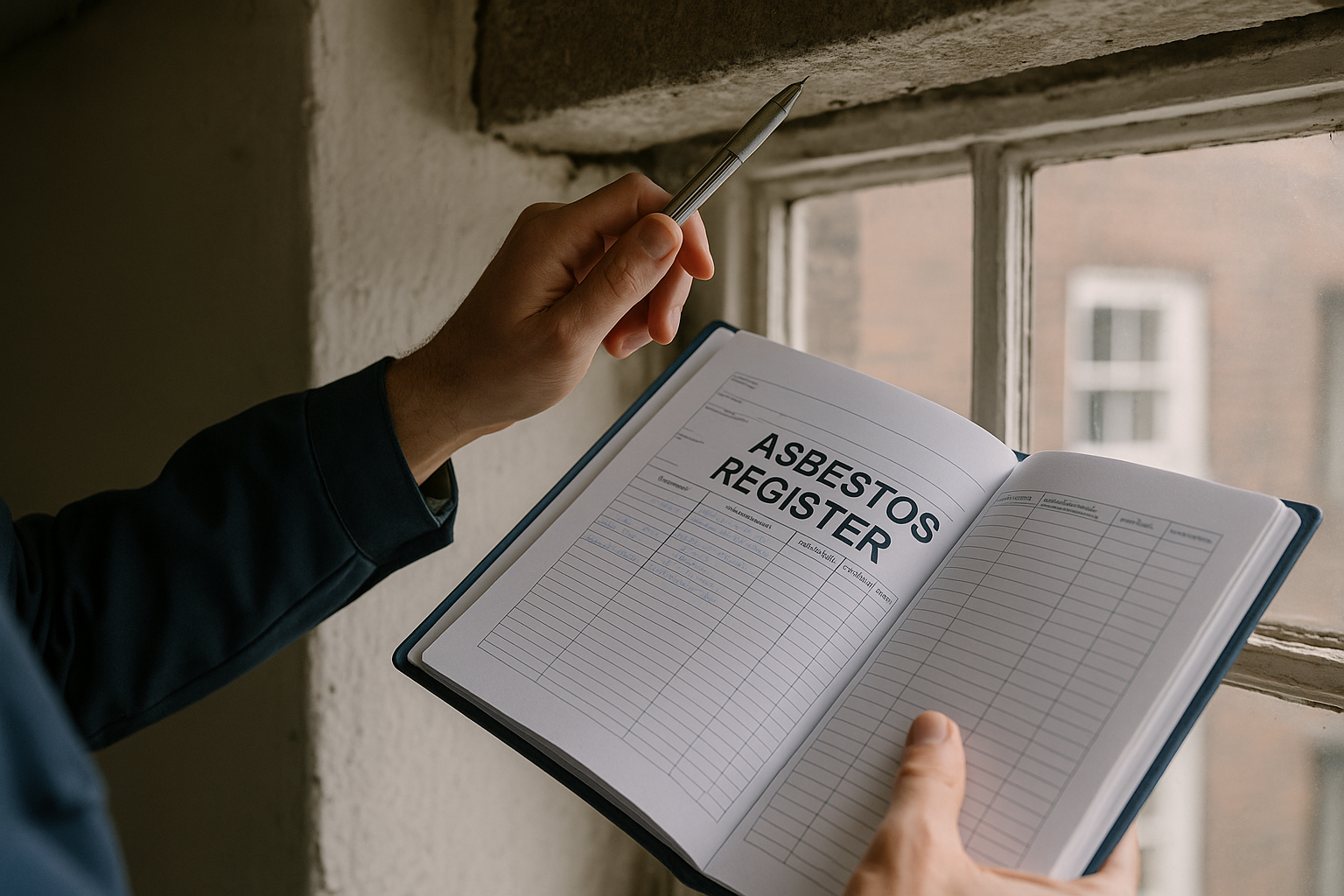
    asbestos register - Who is responsible for conducting asbest

    That may be:

    • the building owner
    • a landlord
    • a tenant, depending on lease terms
    • a managing agent acting on behalf of the owner or landlord
    • a facilities management team with delegated responsibilities

    In multi-occupied buildings, duties can be shared. Common areas in residential blocks, such as plant rooms, stairwells, corridors, service risers, and lift motor rooms, are also covered.

    The key point is simple: if you control maintenance or repair, you may also carry responsibility for ensuring the asbestos register exists and is maintained. If lease terms or management arrangements are unclear, get that clarified early. Confusion over responsibility does not remove the legal duty.

    What the dutyholder must do

    The dutyholder should make sure reasonable steps are taken to find out if asbestos is present, assess the risk, and keep records up to date. They also need to make sure information from the asbestos register is provided to anyone liable to disturb asbestos.

    That means the register must not sit forgotten in a file. It should be part of your contractor control process, permit systems, and planned maintenance procedures.

    What should an asbestos register include?

    HSE guidance, including HSG264, sets out the standard expected from asbestos surveys and the records that follow from them. A useful asbestos register should be detailed enough for someone on site to understand exactly what is present and where.

    1. Precise location of each material

    Descriptions need to be specific. “Ceiling panel in warehouse” is not enough. A good entry should identify the building, floor, room, element, and where helpful, the position within that room.

    For example:

    • asbestos insulation board to soffit within first-floor electrical riser, north core
    • textured coating to ceiling in ground-floor office 3
    • asbestos cement flue on external elevation above loading bay

    Floor plans, photographs, and reference numbers make the asbestos register much easier to use.

    2. Product type and asbestos type where known

    The register should record the material or product identified, such as asbestos insulation board, cement sheet, floor tile, lagging, or sprayed coating. Where sampling and analysis have been carried out, it should also note the asbestos type identified.

    If no sample has been taken, the material may be recorded as a presumed asbestos-containing material. That is acceptable where appropriate, but it must be clearly marked as presumed rather than confirmed.

    3. Condition of the material

    Condition is central to risk. A sealed and undamaged material in a locked service area presents a different issue from damaged debris in a frequently accessed plant room.

    The asbestos register should record whether the material is:

    • in good condition
    • showing minor damage or surface wear
    • poor, friable, or deteriorating
    • sealed, painted, or encapsulated
    • exposed or vulnerable to impact

    Condition assessments should be clear enough to support management decisions and future re-inspections.

    4. Material and priority risk information

    The register should include the risk information arising from the survey. This often reflects both the material assessment and the likelihood of disturbance in normal occupation or maintenance.

    That helps you decide what needs urgent action, what can be managed in place, and where contractor controls need to be tighter.

    5. Recommended action

    An asbestos register should not stop at identification. It should say what needs to happen next. Common recommendations include:

    • leave in place and monitor
    • label where appropriate
    • repair minor damage
    • encapsulate to protect the surface
    • restrict access
    • arrange removal by a competent contractor
    • carry out further inspection or sampling

    These actions should feed directly into the asbestos management plan.

    6. Survey details

    You should be able to see who carried out the survey, when it was completed, and what areas were inspected. Any limitations are especially important. If certain rooms, voids, or service areas were not accessed, the asbestos register should make that clear.

    That avoids a common mistake: assuming “not inspected” means “asbestos not present”. It does not.

    How an asbestos register is created

    The asbestos register is normally produced from the findings of a professional asbestos survey. The right survey depends on what is happening at the property.

    asbestos register - Who is responsible for conducting asbest

    Management survey

    For occupied buildings in normal use, the starting point is usually a management survey. This is designed to locate, as far as reasonably practicable, asbestos-containing materials that could be disturbed during routine occupation, maintenance, or installation work.

    It is generally non-intrusive or only lightly intrusive, depending on access and the building layout. The information gathered is then used to create or update the asbestos register for ongoing management.

    Refurbishment survey

    If you are planning renovation, strip-out, reconfiguration, or major upgrades, you will usually need a refurbishment survey. This is more intrusive because it must identify asbestos in the areas affected by the planned works.

    It does not replace the asbestos register for the whole building, but its findings must be reflected in your records. If new asbestos-containing materials are identified, or if presumed materials are confirmed through sampling, your register should be updated before works proceed.

    Demolition survey

    Where a structure is due for full or partial demolition, a demolition survey is required. This is the most intrusive survey type and aims to locate all asbestos-containing materials, so they can be dealt with before demolition starts.

    Again, the findings affect the asbestos register and wider project planning. Demolition should never proceed on assumptions.

    How to keep an asbestos register up to date

    An asbestos register is not a one-off document. It needs regular review and updating, because buildings change, materials deteriorate, and new information becomes available.

    This is where many organisations fall short. They commission a survey, file the report away, and assume the job is done. It is not.

    When to update the asbestos register

    Your asbestos register should be reviewed and updated when:

    • known asbestos-containing materials are re-inspected
    • their condition changes
    • maintenance work affects the area
    • refurbishment reveals additional materials
    • sampling confirms or disproves presumed asbestos
    • encapsulation, repair, or removal has been completed
    • areas previously inaccessible become accessible and are surveyed

    If the building has had years of reactive maintenance, tenant alterations, or undocumented changes, a review of the existing asbestos register is often sensible. Older registers can contain vague room descriptions, outdated layouts, or references to materials that have since been removed.

    Re-inspections

    Known or presumed asbestos-containing materials should be re-inspected at suitable intervals. The exact frequency depends on the material, its condition, its location, and the likelihood of disturbance.

    Annual re-inspection is common for many premises, but higher-risk materials or busy environments may justify more frequent checks. Lower-risk materials in stable, secure areas may support a different schedule if that decision is properly reasoned and recorded.

    Each re-inspection should confirm:

    • whether the material is still present
    • whether its condition has changed
    • whether the risk of disturbance has altered
    • whether the existing management action remains suitable

    If anything has changed, the asbestos register should be amended straight away.

    After works are completed

    Any building work, however small, should trigger a review of the asbestos register if it affected an area with known or presumed asbestos. If asbestos has been removed, repaired, enclosed, or made inaccessible, the record should reflect that.

    This is especially important after fit-outs, M&E upgrades, partition changes, and service installations. Those are the jobs most likely to expose gaps between what the register says and what is actually on site.

    Who needs access to the asbestos register?

    The asbestos register must be available to anyone who may disturb asbestos in the course of their work. That includes internal teams and external contractors.

    As a minimum, consider access for:

    • maintenance engineers
    • electricians, plumbers, and HVAC contractors
    • IT and cabling installers
    • fire alarm and security engineers
    • cleaning and facilities teams working in service areas
    • project managers planning intrusive works
    • emergency responders where relevant

    Access does not always mean handing over the full report to every visitor. It means making sure the relevant information is provided before work starts, in a format they can understand and use.

    Practical ways to manage access

    Good practice includes:

    1. keeping the asbestos register in a central digital system or controlled site file
    2. checking it during contractor induction and permit-to-work processes
    3. highlighting affected rooms and building elements on plans
    4. briefing contractors on presumed asbestos as well as confirmed findings
    5. making sure site staff know how to find the latest version

    If your process relies on one person remembering to email a PDF every time work is booked, it is fragile. Build the asbestos register into your normal maintenance workflow.

    Common asbestos register mistakes to avoid

    Even where a register exists, it is not always good enough. The most common failures are practical rather than technical.

    Using an out-of-date register

    Old room numbers, missing tenant fit-outs, and removed materials still listed as present can all undermine the value of the document. Review the register whenever the building changes.

    Assuming inaccessible areas are asbestos-free

    If an area was not accessed, that should be clearly recorded. Arrange follow-up inspection when access becomes possible. Do not let “no information” become “no risk” by default.

    Failing to brief contractors

    Having an asbestos register is not enough if nobody checks it before work starts. Build a mandatory review step into maintenance planning and permits.

    Not recording presumed asbestos properly

    Presumed asbestos-containing materials need to be managed just as carefully until proven otherwise. Make sure they are clearly identified in the register and communicated to anyone working nearby.

    Separating the register from the management plan

    The asbestos register tells you what is there. The management plan sets out how it will be controlled. If those two documents do not align, action points can be missed.

    What happens if you do not have an asbestos register?

    If you are responsible for a non-domestic building and there is no suitable asbestos register in place, you may be in breach of the Control of Asbestos Regulations. The HSE can require improvements, stop unsafe work, or take enforcement action where dutyholders fail to manage asbestos risk properly.

    The legal issue is only part of the problem. Operationally, the absence of an asbestos register can lead to:

    • work delays while emergency surveys are arranged
    • contractors refusing to proceed
    • unexpected project costs
    • contamination incidents after accidental disturbance
    • tenant complaints and reputational damage
    • difficulties during property transactions and compliance audits

    For industrial settings in particular, where plant rooms, ducts, service runs, roof sheets, and older insulation materials are common, the risk of accidental disturbance can be higher if records are poor.

    Practical steps to improve your asbestos register today

    If you are not confident your asbestos register is current and usable, start with a simple review.

    1. Check the survey date. If it is old, or the building has changed since it was produced, it may need updating.
    2. Review limitations. Look for areas marked inaccessible, not inspected, or presumed.
    3. Compare the register to the building. Make sure room names, layouts, and tenancy arrangements still match reality.
    4. Check re-inspection records. Confirm known materials have been revisited at suitable intervals.
    5. Test your contractor process. Ask how an engineer booked for tomorrow would access asbestos information before starting work.
    6. Plan the right survey. Use a management survey for ongoing occupation, and the correct intrusive survey before refurbishment or demolition.

    If you operate across multiple sites, standardise your approach. A consistent asbestos register format, regular review cycle, and clear contractor briefing process will make compliance far easier to manage.

    Local support for asbestos surveys and registers

    If your property portfolio spans different regions, local survey support can speed up inspections and reporting. Supernova provides survey services across the country, including asbestos survey London, asbestos survey Manchester, and asbestos survey Birmingham.

    That means you can arrange the right survey type quickly, whether you need to establish an asbestos register for a newly acquired building, update records after tenant changes, or prepare for intrusive works.

    Frequently Asked Questions

    Is an asbestos register a legal requirement?

    For non-domestic premises where asbestos is present or likely to be present, the duty to manage under the Control of Asbestos Regulations means you need an accurate record of asbestos-containing materials or presumed materials. In practice, that record is your asbestos register, and it is a core part of compliance.

    Does every building need an asbestos register?

    Not every building automatically needs one, but many non-domestic buildings do, particularly older premises where asbestos may still be present. The duty applies to non-domestic properties and the common parts of residential blocks. If asbestos is present or presumed present, it should be recorded and managed.

    How often should an asbestos register be updated?

    It should be updated whenever there is new information, such as re-inspection findings, changes in condition, sampling results, removal works, or refurbishment activity. Periodic review is essential, and many buildings require regular re-inspections of known materials.

    Can I create an asbestos register without a survey?

    Not reliably. An asbestos register should be based on competent inspection and, where appropriate, sampling and analysis. Without a survey, you are likely to miss materials, misdescribe risks, or fail to identify inaccessible areas that need further attention.

    What is the difference between an asbestos register and an asbestos management plan?

    The asbestos register records what asbestos-containing materials are present, where they are, and what condition they are in. The asbestos management plan explains how those materials will be controlled, monitored, communicated, and reviewed over time. You need both working together.

    If you need a new asbestos register, an update to an existing one, or the right survey before works begin, Supernova Asbestos Surveys can help. We provide management, refurbishment, and demolition surveys nationwide. Call 020 4586 0680 or visit asbestos-surveys.org.uk to arrange expert support.

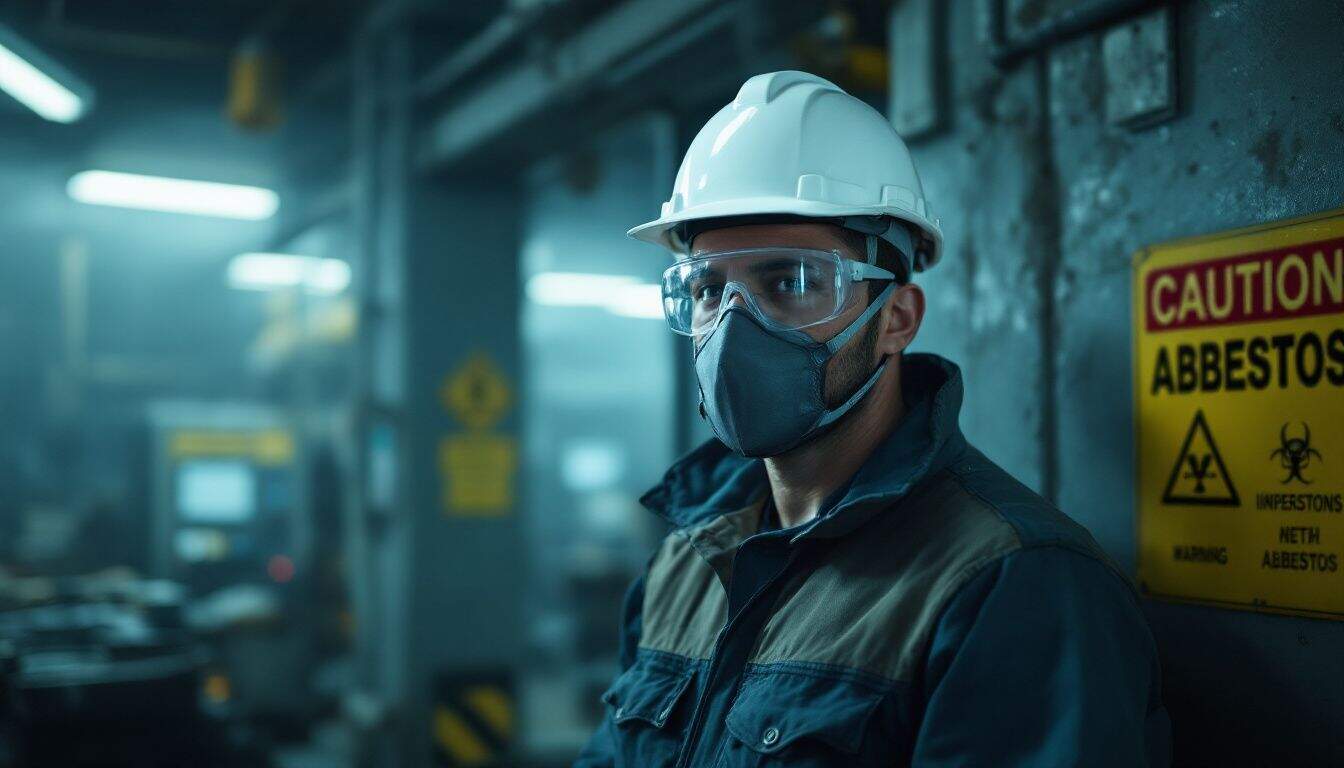
  • Why are asbestos inspections important in industrial settings?

    Why are asbestos inspections important in industrial settings?

    Why Asbestos Inspections Matter in Industrial Settings

    Industrial buildings are among the most likely places in the UK to contain asbestos. Factories, warehouses, power stations, and manufacturing plants built or refurbished before 2000 routinely used asbestos-containing materials (ACMs) in insulation, roofing, pipe lagging, and fireproofing. Without regular asbestos inspections, those materials go unmonitored — and that creates serious risk for everyone on site.

    Asbestos-related diseases kill thousands of people in the UK every year. Mesothelioma, lung cancer, and asbestosis are all linked to fibre inhalation, and symptoms can take decades to appear. By the time a worker is diagnosed, the exposure happened years — sometimes decades — earlier.

    This is precisely why structured, routine asbestos inspections are not optional. They are a legal duty, a moral obligation, and one of the most effective tools available for protecting your workforce.

    The Real Health Risks of Asbestos in Industrial Workplaces

    Industrial environments present a higher risk than most property types. Maintenance work, drilling, cutting, and general wear and tear on ageing structures can all disturb ACMs and release fibres into the air. Once inhaled, those fibres become embedded in lung tissue and cannot be expelled.

    The diseases caused by asbestos exposure include:

    • Mesothelioma — a cancer of the lining of the lungs, almost exclusively caused by asbestos exposure
    • Asbestos-related lung cancer — particularly prevalent among workers who also smoked
    • Asbestosis — scarring of the lung tissue that progressively restricts breathing
    • Pleural thickening — thickening of the membrane surrounding the lungs, causing breathlessness

    There is no safe level of asbestos exposure. Even short-term, low-level contact carries risk, which is why identifying and managing ACMs through proper asbestos inspections is so critical in high-activity industrial settings.

    Legal Duties: What the Regulations Require

    The Control of Asbestos Regulations places a clear legal duty on those who manage non-domestic premises. If you own, manage, or have responsibility for an industrial site, you are likely a dutyholder under these regulations — and that comes with specific obligations.

    The duty to manage asbestos requires you to:

    1. Take reasonable steps to find out whether ACMs are present in your premises
    2. Assess the condition of any ACMs found
    3. Prepare and maintain a written asbestos management plan
    4. Share information about ACMs with anyone who may disturb them
    5. Ensure the management plan is implemented and reviewed regularly

    The HSE’s guidance document HSG264 sets out how asbestos surveys should be conducted and what they need to cover. Failing to comply can result in enforcement action, substantial fines, and — in serious cases — prosecution.

    Beyond the legal consequences, non-compliance puts your workers’ lives at risk. No fine or improvement notice can undo the harm caused by preventable asbestos exposure.

    Types of Asbestos Inspections for Industrial Sites

    Not all asbestos inspections are the same. The type of survey you need depends on the current use of your premises and what work is planned. Choosing the wrong type means you may not get the information you actually need — and that gap in knowledge can have serious consequences.

    Management Survey

    A management survey is the standard inspection for premises in normal use. It locates ACMs in accessible areas that could be disturbed during day-to-day activities or routine maintenance, and assigns a risk rating to help prioritise management actions.

    For most industrial sites, this is the baseline inspection that should be in place and kept up to date. It forms the foundation of your asbestos management plan and is the starting point for all ongoing compliance activity.

    Refurbishment Survey

    If you are planning any refurbishment, fit-out, or intrusive maintenance work, you need a refurbishment survey before work begins. This is a more invasive inspection that examines areas that will be disturbed — including within walls, above ceilings, and beneath floors.

    Carrying out refurbishment work without this survey puts contractors and workers at direct risk of disturbing hidden ACMs. It also exposes the dutyholder to serious legal liability that cannot be mitigated after the fact.

    Demolition Survey

    Before any demolition work can proceed, a demolition survey must be completed. This is the most thorough type of asbestos inspection, covering the entire structure including all areas that will be demolished.

    Every ACM must be identified so it can be removed safely before demolition begins. This is a legal requirement — demolition cannot lawfully proceed if ACMs have not been identified and appropriately managed or removed.

    Re-Inspection Survey

    Where ACMs are being managed in place rather than removed, they must be monitored over time. A re-inspection survey checks the current condition of known ACMs, identifies any deterioration, and updates your asbestos register accordingly.

    These inspections should be conducted at regular intervals — typically annually, though the frequency may vary depending on the condition and risk rating of the materials involved. The worse the condition, the more frequently they need checking.

    Asbestos Testing: Confirming What You’re Dealing With

    Visual inspection alone cannot confirm whether a material contains asbestos. Sampling and laboratory analysis are essential to identify the presence and type of asbestos fibres in suspected materials.

    There are several types of asbestos — including chrysotile (white), amosite (brown), and crocidolite (blue) — and each carries a different risk profile. Accurate identification through asbestos testing ensures that the correct management or removal approach is applied.

    Samples must be analysed by an accredited laboratory using polarised light microscopy or electron microscopy techniques. If you suspect a material may contain asbestos and need a faster answer, standalone asbestos testing services allow you to submit samples for rapid analysis without commissioning a full survey.

    Never attempt to collect samples yourself without proper training and equipment. Disturbing ACMs without the right precautions can release fibres and create the very exposure risk you are trying to avoid.

    Building and Maintaining Your Asbestos Risk Register

    Every industrial site with ACMs — or where ACMs cannot be ruled out — should have an asbestos risk register. This document records the location, type, condition, and risk rating of every identified ACM on the premises.

    The register is not a one-off exercise. It must be actively maintained and updated whenever:

    • A new inspection or re-inspection is completed
    • ACMs are removed or encapsulated
    • The condition of a known ACM changes
    • Refurbishment or maintenance work affects areas where ACMs are present

    Critically, the register must be accessible to anyone who could disturb ACMs — including contractors, maintenance workers, and emergency services. Keeping this information locked away defeats its purpose entirely.

    Your asbestos management plan should sit alongside the register and set out clearly how each ACM will be managed, who is responsible, and what actions are required. These two documents work together — one without the other is insufficient.

    What Happens When Asbestos Is Found

    Finding asbestos during an inspection does not automatically mean it needs to be removed. In many cases, ACMs that are in good condition and are unlikely to be disturbed can be safely managed in place. The key is knowing what you have, where it is, and what condition it is in.

    Where removal is necessary — because materials are damaged, deteriorating, or located in areas that will be disturbed — it must be carried out by appropriately licensed contractors. Licensed asbestos removal is required for the most hazardous materials, including sprayed coatings, lagging, and loose-fill insulation.

    Removed asbestos is classified as hazardous waste and must be double-bagged, clearly labelled, and transported to a licensed disposal facility with the correct documentation. Improper disposal carries its own set of legal consequences — there are no shortcuts available to dutyholders.

    Protecting Workers During and After Asbestos Inspections

    Even during the inspection process itself, worker safety must be front of mind. Surveyors conducting asbestos inspections in industrial premises should hold appropriate qualifications and follow strict protocols to minimise fibre release during sampling.

    For any work that involves disturbance of ACMs — whether during inspections, maintenance, or removal — workers need:

    • Appropriate respiratory protective equipment (RPE), typically FFP3 masks as a minimum
    • Disposable protective coveralls that prevent fibre contamination of clothing
    • Face-fit testing to ensure their RPE creates an effective seal
    • Clear decontamination procedures before leaving the work area

    Face-fit testing is not optional. A mask that does not fit correctly offers little meaningful protection. All workers required to wear RPE must be individually tested, and records of that testing should be maintained as part of your wider health and safety documentation.

    Training and Awareness for Industrial Workers

    The Control of Asbestos Regulations requires that anyone liable to disturb asbestos — or to supervise others who may — receives appropriate training. In an industrial setting, this extends well beyond specialist asbestos workers to include maintenance staff, facilities managers, and contractors.

    Training should cover:

    • What asbestos is and where it is commonly found in industrial buildings
    • The health risks associated with exposure
    • How to recognise potentially ACM-containing materials
    • What to do if asbestos is suspected or disturbed unexpectedly
    • How to access and use the site’s asbestos register
    • Safe working procedures and the correct use of PPE

    Training should be refreshed regularly — awareness that becomes stale is awareness that gets ignored. New starters, new contractors, and anyone moving into a role where asbestos contact is possible should be trained before they begin work, not after an incident has occurred.

    Notifiable Non-Licensed Work: A Category You Cannot Ignore

    Not all asbestos work requires a full licence, but some non-licensed work must still be notified to the relevant enforcing authority before it begins. This is known as notifiable non-licensed work (NNLW) and applies to specific activities involving lower-risk ACMs.

    For NNLW, employers must:

    1. Notify the enforcing authority before work starts
    2. Ensure workers have received appropriate training
    3. Provide suitable RPE and protective clothing
    4. Carry out health surveillance for workers involved
    5. Maintain records of the work carried out

    If you are unsure whether a specific task falls under licensed, notifiable non-licensed, or non-licensed categories, take advice from a qualified asbestos professional before proceeding. Getting this wrong is not a minor administrative error — it is a regulatory breach with real consequences for both workers and dutyholders.

    Asbestos Inspections Across the UK: We Work Nationwide

    Supernova Asbestos Surveys operates across the whole of the UK, delivering asbestos inspections to industrial and commercial clients in every region. Whether your site is in the capital or further afield, our qualified surveyors are ready to help.

    We regularly carry out asbestos survey London projects across the capital’s industrial and commercial stock, as well as providing asbestos survey Manchester services across the North West. Our team also covers the Midlands, with asbestos survey Birmingham work forming a core part of our regional operations.

    With over 50,000 surveys completed, we have the experience and capacity to handle industrial sites of any size and complexity. Our surveyors are fully qualified, our reports are clear and actionable, and our turnaround times are designed to keep your projects moving.

    Frequently Asked Questions

    How often should asbestos inspections be carried out in an industrial building?

    The frequency depends on the type of inspection and the condition of any ACMs present. A management survey should be in place as a baseline, with re-inspection surveys carried out at least annually for known ACMs. Materials in poor condition or high-traffic areas may need checking more frequently. Your asbestos management plan should specify the review schedule based on the risk ratings assigned during the original survey.

    Do I need an asbestos inspection if my industrial building was built after 2000?

    The import and use of all asbestos types was banned in the UK in 1999, so buildings constructed entirely after that date are very unlikely to contain ACMs. However, if your building underwent refurbishment using older materials, or if you are unsure of its full construction history, a precautionary inspection is advisable. If there is any doubt, it is always safer to confirm rather than assume.

    Who is legally responsible for arranging asbestos inspections in an industrial workplace?

    Under the Control of Asbestos Regulations, the duty to manage asbestos falls on the dutyholder — typically the owner, employer, or person with responsibility for maintaining the premises. In some cases, this responsibility may be shared between a landlord and a tenant, depending on the terms of the lease. Both parties should be clear on who holds the duty before any work or inspection is arranged.

    Can I manage asbestos in place rather than having it removed?

    Yes — in many cases, ACMs that are in good condition and are not likely to be disturbed can be safely managed in place rather than removed. This approach must be backed by a current asbestos register, a written management plan, and regular re-inspection surveys to monitor the condition of the materials over time. Where materials deteriorate or are at risk of disturbance, removal by a licensed contractor becomes necessary.

    What qualifications should an asbestos surveyor hold?

    Asbestos surveyors should hold a P402 qualification as a minimum, which is the industry-recognised certificate for building surveys and bulk sampling. Surveying organisations should ideally be accredited by UKAS (United Kingdom Accreditation Service) to demonstrate that their processes meet the required standards. Always ask to see qualifications and accreditation details before commissioning any asbestos inspection work.

    Book Your Asbestos Inspection with Supernova

    Supernova Asbestos Surveys has completed over 50,000 surveys across the UK, working with industrial clients, facilities managers, and property owners who need accurate, reliable asbestos inspections they can act on.

    Our team covers the full range of survey types — from management and refurbishment surveys through to demolition surveys and ongoing re-inspections. We also provide laboratory-confirmed asbestos testing and can advise on next steps if ACMs are found.

    Call us on 020 4586 0680 or visit asbestos-surveys.org.uk to book your inspection or request a quote. Don’t leave your workforce’s safety to chance.

  • In what ways do asbestos inspections impact industrial operations?

    In what ways do asbestos inspections impact industrial operations?

    How Asbestos Inspections Shape Industrial Operations — and Why Neglecting Them Costs Far More Than You Think

    Asbestos is still present in a significant proportion of UK industrial buildings constructed before 2000. If your site has never been properly assessed, you are operating with unknown risks embedded in your walls, above your head, and beneath your feet. Asbestos inspections are not a bureaucratic formality — they are the foundation of a safe, legally compliant, and financially sound industrial operation.

    Whether you manage a manufacturing facility, a warehouse, a power plant, or any other industrial premises, understanding what asbestos inspections involve — and what happens when they are neglected — is essential knowledge for anyone responsible for a site.

    Why Asbestos Inspections Are a Legal Requirement for Industrial Sites

    The Control of Asbestos Regulations places a legal duty on those who manage non-domestic premises to identify asbestos-containing materials (ACMs), assess their condition, and put a management plan in place. For industrial operators, this is not optional — it is the law.

    Only surveyors accredited by UKAS (United Kingdom Accreditation Service) are qualified to carry out formal asbestos surveys. This matters because the quality of an inspection directly determines the quality of the risk information you are working with.

    Failure to comply can result in prosecution, substantial fines, and — most critically — workers developing life-limiting diseases that could have been prevented. The HSE takes enforcement in industrial settings seriously, and ignorance of the law is not a defence.

    What the Duty to Manage Requires

    • A suitable and sufficient survey of the premises to locate ACMs
    • A written asbestos register recording the location, type, and condition of any ACMs found
    • A risk assessment for each ACM identified
    • An asbestos management plan detailing how each ACM will be managed, monitored, or removed
    • Regular reviews of the plan to ensure it remains current

    HSG264, the HSE’s guidance on asbestos surveys, sets out the standards surveyors must meet and distinguishes between different survey types depending on the purpose and scope of the work.

    A management survey is required for the routine occupation and maintenance of a building. A refurbishment survey is required before any intrusive work takes place, and a demolition survey must be completed before any part of a structure is demolished. Industrial sites undergoing renovation or partial demolition must have the appropriate survey completed before work begins — no exceptions.

    The Health Risks That Make Asbestos Inspections Non-Negotiable

    Asbestos-related disease remains one of the leading causes of occupational death in the UK. Mesothelioma, asbestosis, and asbestos-related lung cancer are all caused by inhaling asbestos fibres — and none of these conditions develop immediately. Symptoms can take decades to appear, which means exposure happening today may not manifest as illness until much later.

    This delayed onset is precisely what makes proactive asbestos inspections so critical. By the time illness appears, it is too late to undo the exposure.

    Industrial workers face elevated risks. Maintenance engineers, electricians, plumbers, demolition crews, and HVAC technicians are all regularly exposed to the kinds of materials — pipe lagging, ceiling tiles, insulation boards, fire-resistant panels — that are most likely to contain asbestos in older industrial buildings.

    High-Risk Trades in Industrial Environments

    Certain roles carry a disproportionate risk of asbestos exposure on industrial sites:

    • Maintenance engineers — frequently work in plant rooms, roof voids, and service ducts where asbestos insulation is common
    • Electricians — may disturb asbestos insulation boards when accessing distribution boards or cable runs
    • Plumbers — pipe lagging in older industrial buildings often contains amosite or chrysotile asbestos
    • Demolition and refurbishment workers — at the highest risk when structures are being altered without a prior survey
    • Firefighters — attending industrial fires in older buildings face significant secondary exposure risks

    An up-to-date asbestos register, produced through thorough asbestos inspections, allows all contractors and in-house maintenance teams to check for ACMs before starting any task. This is how sites reduce accidental exposure in practice.

    How Asbestos Inspections Affect Industrial Maintenance and Renovation Planning

    Planned maintenance is the backbone of industrial operations. Unplanned downtime is expensive. What many site managers underestimate is how significantly an asbestos management plan shapes what maintenance work can be done, when, and by whom.

    When ACMs are identified through asbestos inspections, maintenance schedules must account for them. Work that would disturb asbestos — even minor tasks like drilling into a wall or replacing a ceiling tile — must be planned with appropriate controls in place, or the asbestos must be removed first.

    Integrating Asbestos Management into Maintenance Programmes

    1. Catalogue all ACMs — your asbestos register should be accessible to all contractors and maintenance staff before any work begins
    2. Assess risk by location and condition — ACMs in good condition and unlikely to be disturbed can often be managed in situ; damaged or friable materials require more urgent action
    3. Plan removal in phases — prioritise ACMs in areas scheduled for renovation or where condition is deteriorating
    4. Budget appropriately — factor asbestos removal costs into capital expenditure planning, not just reactive maintenance budgets
    5. Train your workforce — everyone working on site should know what asbestos looks like, where it is likely to be found, and what to do if they suspect they have disturbed it
    6. Review the register regularly — the condition of ACMs changes over time, and your register must reflect current reality

    Sites that integrate asbestos management into their broader maintenance strategy avoid the costly scenario of discovering asbestos mid-project, halting work, and scrambling for emergency removal. That kind of reactive response is far more expensive — and far more disruptive — than proactive planning.

    Emergency Procedures: What Happens When Asbestos Is Discovered Unexpectedly

    Even on well-managed sites, unexpected asbestos discoveries happen. A contractor breaks through a wall, a floor tile is lifted, or pipe lagging is damaged. Having a clear emergency procedure in place before this happens is a legal and operational necessity.

    Steps to Follow When Asbestos Is Found Unexpectedly

    1. Stop work immediately — all activity in the affected area must cease
    2. Isolate the area — restrict access using physical barriers and clear signage; do not allow anyone to re-enter until the area has been assessed
    3. Do not attempt to clean up — disturbing suspected asbestos further increases fibre release; leave the material undisturbed
    4. Notify your health and safety officer — document the discovery and circumstances in writing
    5. Contact a UKAS-accredited surveyor — samples must be taken and analysed before any decision is made about the material
    6. Arrange licensed removal if required — certain asbestos types and conditions require a licensed contractor under the Control of Asbestos Regulations
    7. Review your asbestos management plan — update your register and assess whether adjacent areas require further investigation

    Having this procedure documented, communicated, and rehearsed with your team means that when the unexpected happens, the response is calm and controlled rather than chaotic and potentially dangerous.

    The Financial Case for Regular Asbestos Inspections

    Some industrial operators view asbestos inspections as a cost. The reality is that they are an investment — and the return is measurable in avoided expenditure, reduced liability, and lower insurance costs.

    The Cost of Not Inspecting

    The financial consequences of neglecting asbestos management can be severe:

    • Enforcement action — HSE improvement notices and prohibition notices can halt operations entirely
    • Prosecution and fines — courts have imposed substantial fines on businesses that failed to manage asbestos properly
    • Civil claims — workers or contractors who develop asbestos-related disease as a result of exposure on your site may pursue compensation claims
    • Emergency removal costs — reactive asbestos removal during a live project is significantly more expensive than planned removal
    • Project delays — discovering asbestos mid-renovation can delay completion by weeks, with associated cost overruns
    • Increased insurance premiums — insurers price risk based on the quality of your management systems; poor asbestos management raises your risk profile

    How Regular Inspections Save Money

    Businesses that invest in regular asbestos inspections benefit from:

    • Early identification of deteriorating ACMs, allowing planned rather than emergency removal
    • Accurate information for capital expenditure planning
    • Reduced workers’ compensation and liability exposure
    • Demonstrable compliance, which supports favourable insurance terms
    • Smoother project delivery, with no unexpected asbestos-related stoppages

    The cost of a professional asbestos survey is modest relative to any of the financial risks it mitigates. For industrial sites, where the scale of potential exposure and the complexity of building services are both significant, the argument for regular inspections is overwhelming.

    Asbestos Inspections and Long-Term Risk Management

    Asbestos management is not a one-off exercise. Industrial buildings change — new plant is installed, structures are modified, materials age and deteriorate. Your asbestos management plan must evolve with your site.

    Insurers increasingly expect to see evidence of proactive asbestos management as part of broader health and safety governance. A well-maintained asbestos register and a current management plan demonstrate that your organisation takes its duty of care seriously — and that has a direct bearing on your risk profile and, in many cases, your premiums.

    Beyond insurance, asbestos management forms part of your overall occupational health strategy. It connects directly to other safety obligations — including the requirement to carry out a fire risk assessment, which may itself identify asbestos-containing fire-resistant materials that require specialist attention. These disciplines overlap, and a joined-up approach to building safety delivers better outcomes than treating each obligation in isolation.

    Asbestos and Property Value

    For industrial operators who own their premises, asbestos management also has implications for asset value. A building with a clear, current asbestos register and a managed — or remediated — ACM profile is a more attractive asset than one with unknown or poorly documented asbestos risks.

    Buyers and lenders conducting due diligence will scrutinise asbestos records. A well-managed asbestos position supports transaction values; an unmanaged one creates uncertainty and can depress offers or delay completions.

    Choosing the Right Surveyor for Industrial Asbestos Inspections

    Not all asbestos surveys are equal. Industrial sites present particular challenges — complex building services, multiple occupancies, restricted access areas, and materials that may not be immediately recognisable as ACMs. The surveyor you choose must have the experience and accreditation to handle this complexity.

    Key Criteria When Selecting a Surveyor

    • UKAS accreditation — this is a baseline requirement, not a differentiator; any surveyor without it should be disqualified immediately
    • Industrial sector experience — ask specifically about their experience with sites similar to yours
    • Clear reporting — the asbestos register and management plan they produce must be practical and usable, not just a compliance document that sits in a drawer
    • Ongoing support — the best surveying firms offer reinspection services and will update your register as your site changes
    • Nationwide coverage — for multi-site operators, consistency of surveying standards across all locations matters

    Supernova Asbestos Surveys operates across the UK, with dedicated teams covering major industrial centres. Whether you need an asbestos survey in London, an asbestos survey in Manchester, or an asbestos survey in Birmingham, our UKAS-accredited surveyors bring the same rigorous standards to every site.

    Frequently Asked Questions

    What types of asbestos inspections are available for industrial sites?

    There are three main types of asbestos survey used in industrial settings. A management survey is carried out on occupied buildings to identify ACMs that could be disturbed during normal use or maintenance. A refurbishment survey is required before any intrusive or structural work takes place. A demolition survey is required before any part of a building is demolished. The type of survey your site needs depends on what you are planning to do with the premises.

    How often should industrial sites have asbestos inspections?

    There is no single prescribed frequency, but the HSE expects asbestos management plans — and the registers underpinning them — to be reviewed regularly. Most industrial sites should have their asbestos register reviewed at least annually, and immediately following any structural changes, maintenance work that may have disturbed ACMs, or changes in building use. Sites with ACMs in deteriorating condition may require more frequent monitoring.

    Who is legally responsible for asbestos management on an industrial site?

    The duty to manage asbestos falls on the person or organisation in control of the premises — typically the owner, landlord, or facilities manager. If responsibility is shared between a landlord and a tenant, this should be clearly defined in the lease or a separate agreement. Ignorance of the duty is not a legal defence, and both parties can face enforcement action if asbestos management obligations are not met.

    What should I do if a contractor discovers asbestos during works on my site?

    Work must stop immediately in the affected area. The area should be isolated with physical barriers and clear signage, and no one should re-enter until a UKAS-accredited surveyor has assessed the material. Do not attempt to clean up or remove the suspected asbestos. Notify your health and safety officer, document the discovery, and arrange for samples to be taken and analysed. If licensed removal is required, only an HSE-licensed contractor can carry out that work.

    Does asbestos management affect my industrial site’s insurance?

    Yes, directly. Insurers assess risk based on the quality of your health and safety management systems, and asbestos management is a significant factor for older industrial buildings. Sites with a current asbestos register, an up-to-date management plan, and evidence of regular asbestos inspections are demonstrably lower risk. Poor or absent asbestos management can increase premiums, limit cover, or create grounds for insurers to dispute claims following an asbestos-related incident.

    Get Expert Asbestos Inspections from Supernova

    Supernova Asbestos Surveys has completed over 50,000 surveys across the UK, working with industrial operators, property managers, and facilities teams who need reliable, accurate asbestos inspections they can act on. Our UKAS-accredited surveyors understand the specific challenges of industrial sites — from complex building services to restricted access areas — and produce registers and management plans that are genuinely useful, not just compliant on paper.

    To book an asbestos inspection or discuss your site’s requirements, call us on 020 4586 0680 or visit asbestos-surveys.org.uk. We cover the whole of the UK and can typically arrange surveys at short notice for urgent requirements.

  • How are asbestos inspections carried out in industrial settings?

    How are asbestos inspections carried out in industrial settings?

    Why Industrial Buildings Demand a Specialist Asbestos Survey

    Industrial buildings present some of the most complex asbestos challenges of any property type. Factories, warehouses, power stations, and manufacturing plants built before 2000 were routinely constructed using asbestos-containing materials (ACMs) — and many of those materials are still in place today, hidden in roof panels, pipe lagging, floor tiles, and machinery insulation.

    An industrial building asbestos survey is not just a regulatory formality. It is the foundation of every safe decision made on that site — from routine maintenance to full-scale demolition. Get it wrong, and the consequences range from enforcement action to worker fatalities.

    This post walks through exactly how these surveys are carried out, what to expect at each stage, and what your legal obligations are as a dutyholder.

    Why Industrial Sites Carry Higher Asbestos Risk

    Industrial buildings are not like offices or schools. The sheer variety of materials used across decades of construction and modification means ACMs can appear in dozens of locations — many of which are not immediately obvious.

    Common asbestos-containing materials found in industrial settings include:

    • Sprayed asbestos coatings on structural steelwork
    • Asbestos insulating board (AIB) on fire doors, ceilings, and partition walls
    • Pipe and boiler lagging
    • Corrugated asbestos cement roofing and cladding
    • Textured coatings on walls and ceilings
    • Gaskets and seals in older industrial machinery
    • Floor tiles and adhesives
    • Electrical cable insulation

    Industrial sites are also more likely to have undergone multiple phases of construction, extension, and refurbishment over the years — each one potentially disturbing or concealing existing ACMs. That layered history makes a thorough survey even more critical.

    The risk is compounded by the nature of industrial work itself. Maintenance teams regularly access roof voids, plant rooms, and service ducts. Contractors drill, cut, and grind through building fabric without always knowing what lies beneath the surface. Without an up-to-date asbestos register, every one of those tasks carries an unnecessary and avoidable risk.

    The Legal Framework: What the Regulations Require

    Under the Control of Asbestos Regulations, any non-domestic premises must have a dutyholder who manages asbestos risk. For industrial buildings, that is typically the employer, building owner, or whoever holds responsibility for maintenance and repair.

    The dutyholder’s legal obligations include:

    • Identifying whether ACMs are present, or presuming their presence where doubt exists
    • Assessing the condition and risk level of any ACMs found
    • Producing and maintaining a written asbestos management plan
    • Ensuring anyone liable to disturb ACMs is informed of their location and condition
    • Reviewing and updating the plan at regular intervals

    HSE guidance, particularly HSG264, sets out the technical standards for how surveys should be planned and executed. Surveyors working on industrial buildings must understand not just the standard methodology but also the specific challenges of industrial environments — confined spaces, working-at-height requirements, and the presence of hazardous processes or materials.

    Failure to comply with the Control of Asbestos Regulations can result in prohibition notices, unlimited fines, and in serious cases, prosecution of individuals as well as organisations.

    Types of Industrial Building Asbestos Survey

    Not every survey is the same. The type you need depends on what the building is being used for and what work is planned.

    Management Survey

    A management survey is the standard survey required for any industrial building that is in normal use. Its purpose is to locate ACMs that could be disturbed during routine maintenance or occupancy, assess their condition, and inform the asbestos management plan.

    The survey is intrusive to a limited degree — surveyors will access areas likely to be disturbed but will not cause significant damage to the building fabric. It is designed to be carried out while the building is occupied and operational, though access to certain areas may need to be coordinated with site management.

    Refurbishment and Demolition Survey

    If any part of an industrial building is being refurbished, extended, or demolished, a demolition survey is required before work begins. This is a fully intrusive survey — surveyors will access all areas, including those that will be disturbed by the planned works, breaking into building fabric where necessary to locate all ACMs.

    This type of survey must be completed before contractors move in. Carrying out refurbishment or demolition without one is a serious breach of the regulations and puts workers at immediate risk.

    Preparing for an Industrial Building Asbestos Survey

    Good preparation makes a significant difference to the quality and efficiency of an industrial asbestos survey. As dutyholder, there are several things you should do before the surveyor arrives.

    Gather Existing Documentation

    Pull together any existing asbestos information — previous survey reports, asbestos registers, building plans, and records of any remedial work already carried out. Even if the information is incomplete or out of date, it gives the surveyor a useful starting point.

    Speak to long-standing employees, facilities managers, and anyone who has worked on the building over the years. Their knowledge of past modifications and maintenance work can flag areas that might otherwise be missed.

    Notify Staff and Contractors

    All employees and contractors working on site must be informed about the survey before it takes place. They need to know the purpose of the survey, which areas will be accessed, and any temporary restrictions on movement around the site.

    This is not just good practice — it is a requirement under the Control of Asbestos Regulations. Workers have a right to know about asbestos risks in their workplace, and clear communication helps prevent accidental disturbance of ACMs during the survey itself.

    Arrange Site Access

    Industrial sites often have areas that require special access arrangements — locked plant rooms, rooftop access, confined spaces, or areas with live electrical or mechanical systems. Arrange for the appropriate keyholders and, where necessary, a site escort to accompany the surveyor.

    If any areas will be inaccessible during the survey, these must be recorded as presumed to contain asbestos until a further inspection can be carried out.

    How the Industrial Building Asbestos Survey Is Conducted

    A qualified asbestos surveyor will carry out the inspection in line with HSG264 guidance. Here is what the process looks like in practice.

    Visual Inspection

    The surveyor begins with a systematic walk-through of the entire site, recording the location, extent, and apparent condition of any materials that may contain asbestos. In an industrial building, this will typically cover the roof, external cladding, structural steelwork, plant rooms, service areas, office spaces, welfare facilities, and any specialist process areas.

    The surveyor will note the accessibility of each area and any factors that affect the likelihood of disturbance — for example, whether pipe lagging is in a heavily trafficked corridor or a sealed plant room rarely accessed by maintenance staff.

    Sampling

    Where materials are suspected to contain asbestos, the surveyor will take bulk samples for laboratory analysis. Sampling is carried out using appropriate personal protective equipment (PPE), including FFP3 respirators and disposable coveralls, to prevent fibre release and protect the surveyor.

    Samples are carefully labelled, sealed, and transported to a UKAS-accredited laboratory for analysis. The laboratory will identify the type of asbestos present — chrysotile (white), amosite (brown), or crocidolite (blue) — and confirm whether the material is an ACM. UKAS accreditation is essential; results from non-accredited laboratories are not acceptable for regulatory purposes.

    Risk Assessment

    For each ACM identified, the surveyor will carry out a risk assessment that considers:

    • The type of asbestos present — some types carry a higher hazard than others
    • The condition of the material — whether it is intact, damaged, or friable
    • The likelihood of disturbance during normal use or maintenance
    • The accessibility of the material and the number of people who could be exposed

    This assessment produces a priority score for each ACM, which informs the recommendations in the survey report and helps the dutyholder prioritise action.

    Documentation and Reporting

    The surveyor will produce a written report that includes a scope of works, a full register of all ACMs identified — including their location, type, condition, and risk score — laboratory analysis results, photographs, and site drawings marking the location of each ACM.

    This report becomes the basis of your asbestos management plan. It should be kept on site, made available to anyone who may disturb the materials, and reviewed and updated whenever work is carried out or conditions change.

    Acting on Survey Findings

    Receiving the survey report is not the end of the process — it is the beginning of your ongoing management obligations.

    Understanding Your Risk Profile

    Not all ACMs require immediate removal. Materials in good condition that are unlikely to be disturbed can often be managed safely in situ, with regular monitoring to check their condition has not deteriorated. The survey report will make clear which materials fall into this category and which require more urgent attention.

    Your asbestos management plan should set out a clear schedule for monitoring, maintenance, and any remedial work required. It must be reviewed at least annually and updated whenever circumstances change.

    When Removal Is Required

    Where ACMs are damaged, deteriorating, or in locations where disturbance is unavoidable, asbestos removal will be necessary. Licensed asbestos removal contractors must be used for the most hazardous materials, including sprayed asbestos, AIB, and any material containing crocidolite or amosite.

    Before licensed removal work begins, the contractor must notify the HSE. Workers must be provided with appropriate PPE and undergo health surveillance. All asbestos waste must be double-bagged in labelled polythene sacks and disposed of at a licensed waste facility — it cannot be mixed with general industrial waste.

    Communicating with Workers and Contractors

    Every person who works in or on the industrial building — whether a permanent employee, a maintenance contractor, or a visiting tradesperson — must be informed about the location and condition of ACMs. This information should be readily accessible, and anyone planning to carry out work that could disturb ACMs must be briefed before they start.

    This is a legal requirement, not a courtesy. Employers who fail to share asbestos information with workers face serious regulatory consequences.

    Industrial Asbestos Surveys Across the UK

    Industrial sites are spread across every region of the UK, and the regulatory requirements apply equally whether you are managing a factory in the capital or a warehouse in the north of England.

    If you need an asbestos survey London for an industrial property, our teams operate across Greater London and the surrounding counties. For sites in the north west, we provide a full asbestos survey Manchester service covering industrial and commercial premises throughout the region. In the midlands, our asbestos survey Birmingham team handles everything from small industrial units to large multi-site manufacturing facilities.

    Wherever your site is located, the same standards apply — HSG264-compliant methodology, UKAS-accredited laboratory analysis, and a clear, actionable report.

    Choosing the Right Surveying Company

    For an industrial building asbestos survey, experience matters enormously. Industrial sites present challenges that a surveyor accustomed only to residential or light commercial work may not be equipped to handle — from working safely around live plant and machinery to navigating complex multi-storey structures.

    When selecting a surveying company, look for:

    • UKAS accreditation or use of UKAS-accredited laboratories for sample analysis
    • Surveyors holding the P402 qualification (Buildings Surveys and Bulk Sampling for Asbestos) as a minimum
    • Demonstrable experience working in industrial environments — not just commercial or residential settings
    • Clear, detailed reporting that goes beyond a tick-box exercise
    • The capacity to support you through the full process, from survey through to management planning and, where necessary, remediation

    Ask to see example reports before you commission a survey. A high-quality report will be site-specific, clearly structured, and immediately usable as the foundation of your asbestos management plan. A poor-quality report — vague, incomplete, or produced without proper sampling — creates more risk than it resolves.

    It is also worth considering whether the company can support you beyond the survey itself. If ACMs are identified that require removal or encapsulation, having a surveying partner with established relationships with licensed contractors can streamline the process considerably.

    Frequently Asked Questions

    How long does an industrial building asbestos survey take?

    The duration depends on the size, complexity, and accessibility of the site. A small industrial unit may be completed in a single day, while a large multi-building facility could require several days of on-site inspection. Your surveyor should be able to give you a realistic time estimate once they have reviewed the site details and any existing documentation.

    Do I need a new asbestos survey if one was carried out years ago?

    Existing surveys do not automatically become invalid, but they must be reviewed and updated whenever the building is modified, refurbished, or when conditions change. If the previous survey was carried out before significant works took place, or if it did not cover all areas of the building, a new or supplementary survey will be required. HSE guidance is clear that asbestos management is an ongoing duty, not a one-off exercise.

    Can industrial buildings be occupied during an asbestos survey?

    For a management survey, yes — the process is designed to be carried out with minimal disruption to normal operations. Certain areas may need to be temporarily vacated during sampling, but the survey should not require a full site shutdown. A refurbishment and demolition survey is more intrusive and may require restricted access to specific zones. Your surveyor will advise on the practical arrangements before work begins.

    What happens if asbestos is found in a poor condition?

    The survey report will assign a priority score to each ACM based on its condition and the likelihood of disturbance. Materials in poor condition that pose an immediate risk will be flagged for urgent action — either encapsulation or removal by a licensed contractor. Materials that are damaged but not immediately dangerous may be subject to interim controls, such as signage and restricted access, while remediation is planned.

    Are there different regulations for asbestos in industrial buildings compared to other commercial premises?

    The Control of Asbestos Regulations apply to all non-domestic premises, including industrial buildings. There is no separate regulatory framework for industrial sites, but HSG264 guidance acknowledges that industrial environments present specific practical challenges — confined spaces, working at height, and the presence of live plant and equipment — that must be factored into how surveys are planned and conducted. A surveyor with industrial experience will understand these requirements and plan accordingly.

    Get Your Industrial Building Asbestos Survey Booked Today

    Supernova Asbestos Surveys has completed over 50,000 surveys across the UK, including industrial sites of every size and complexity. Our surveyors are fully qualified, our laboratory analysis is UKAS-accredited, and our reports are built to be used — not filed and forgotten.

    Whether you need a management survey to underpin your ongoing asbestos management plan, a refurbishment and demolition survey ahead of major works, or expert advice on how to act on existing survey findings, we are here to help.

    Call us on 020 4586 0680 or visit asbestos-surveys.org.uk to request a quote or speak to a member of our team.

  • What role do asbestos surveys play in industrial settings?

    What role do asbestos surveys play in industrial settings?

    Why Industrial Asbestos Surveys Are Non-Negotiable for UK Workplaces

    Industrial buildings sit at the sharp end of asbestos risk in the UK. Factories, warehouses, power stations, shipyards, and manufacturing plants built before 2000 are highly likely to contain asbestos-containing materials (ACMs) — often in locations that get disturbed during routine maintenance, refurbishment, or demolition work.

    Industrial asbestos surveys are the essential first step in understanding exactly what you’re dealing with and keeping your workforce safe. This isn’t simply about ticking a legal box.

    Mesothelioma and other asbestos-related diseases continue to claim thousands of lives every year in Britain, and the vast majority of those cases trace back to occupational exposure. Getting a proper survey carried out is the single most effective action a duty holder can take to protect workers and stay on the right side of the law.

    What Industrial Asbestos Surveys Actually Do

    At their core, industrial asbestos surveys identify and assess ACMs within a building or site. That sounds straightforward, but in an industrial setting it’s anything but.

    These environments are complex — multiple structures, extensive pipework, plant rooms, roof spaces, and materials that have been modified, repaired, and layered over decades. A qualified surveyor will inspect every accessible area of the site, collect representative samples for laboratory analysis, and produce a detailed report documenting the location, type, and condition of any ACMs found.

    Where areas cannot be safely accessed, those zones are recorded as presumed to contain asbestos until proven otherwise. This isn’t a loophole — it’s a requirement under HSE guidance to ensure nothing is overlooked.

    Identifying Asbestos-Containing Materials

    In industrial premises, ACMs can appear in a wide range of locations and forms. Surveyors are trained to recognise materials that commonly contain asbestos, including:

    • Pipe and boiler lagging
    • Sprayed coatings on structural steelwork
    • Insulating board used in partitions and ceiling tiles
    • Roof sheets and guttering made from asbestos cement
    • Floor tiles and adhesives
    • Gaskets and rope seals in industrial plant
    • Thermal insulation around ducts and vessels

    Each of these materials carries a different risk profile depending on the type of asbestos present — whether chrysotile, amosite, or crocidolite — and its current condition. The survey report captures all of this in a format that allows duty holders to make informed decisions.

    Assessing the Condition of ACMs

    Finding asbestos is only part of the job. The condition of an ACM determines how urgently action is needed.

    A sealed, intact asbestos cement roof sheet in good condition presents a very different risk from damaged pipe lagging that is actively shedding fibres into the air. Surveyors carry out a visual assessment of each identified material and assign a risk score based on factors such as surface condition, accessibility, and the likelihood of disturbance.

    This scoring system feeds directly into the asbestos management plan, helping prioritise remediation work and ensuring resources are directed where the risk is greatest.

    The Two Main Types of Industrial Asbestos Survey

    Not every survey is the same, and choosing the right type for your situation is critical. The HSE’s guidance document HSG264 sets out the framework for asbestos surveying in the UK, distinguishing between two primary survey types used across industrial settings.

    Management Surveys

    A management survey is the standard survey required to manage ACMs in a building that is in normal use. It’s designed to locate ACMs that could be disturbed during everyday activities — maintenance, repairs, minor works — and assess their condition so they can be monitored over time.

    For industrial premises, management surveys should be carried out by a competent, accredited surveyor, and the resulting register kept up to date. The duty holder — typically the employer or building owner — is legally required under the Control of Asbestos Regulations to have a management plan in place, and that plan must be based on accurate survey data.

    Management surveys are not a one-off exercise. As conditions change, materials deteriorate, or works are carried out, the register needs to be reviewed and updated. Regular re-inspection of known ACMs is part of responsible asbestos management in any industrial environment.

    Refurbishment and Demolition Surveys

    Before any significant building work takes place — whether that’s a full demolition, a major refurbishment, or even targeted work in a specific area — a demolition survey is legally required. This is a more intrusive survey type, designed to locate all ACMs in the areas affected by the planned works.

    Unlike a management survey, a refurbishment and demolition survey may involve breaking into walls, lifting floors, and accessing voids that would not normally be disturbed. The aim is to ensure that no ACM is encountered unexpectedly during construction work, which could expose contractors and workers to serious harm.

    In industrial settings, this type of survey is particularly important given the scale and complexity of the structures involved. Failing to commission one before works begin is not just a legal breach — it’s a direct risk to lives.

    How Industrial Asbestos Surveys Are Carried Out

    A well-conducted industrial asbestos survey follows a clear, structured process. Understanding what’s involved helps duty holders prepare their sites and get the most accurate results possible.

    Pre-Survey Planning and Documentation

    Before any surveyor sets foot on site, thorough preparation is essential. This stage involves reviewing existing documentation — previous asbestos surveys, construction drawings, maintenance records, and any known history of asbestos-related work on the premises.

    Stakeholders including employees, tenants, and relevant contractors should be notified in advance. The scope of the survey needs to be clearly defined, covering which areas will be inspected and what access arrangements are needed.

    In large industrial sites, this coordination stage can take considerable time and is not something to rush. Getting it right at the outset avoids costly gaps in the survey findings later.

    On-Site Inspection

    The surveyor conducts a systematic walk-through of the entire site, examining all accessible areas and recording the location and condition of any suspect materials. In industrial settings, this often means working in confined spaces, at height, or in areas with limited natural light — all of which require appropriate risk controls.

    Where areas cannot be safely accessed, they are documented as inaccessible and presumed to contain asbestos. This is a requirement of HSG264 and ensures that nothing is overlooked simply because it was inconvenient to inspect.

    Sample Collection and Laboratory Analysis

    When a material is suspected to contain asbestos, a small sample is taken by the surveyor using safe, controlled methods to minimise fibre release. Samples are then sent to an accredited laboratory for analysis, where experts confirm the presence and type of asbestos using polarised light microscopy or other approved techniques.

    Every sample is accompanied by a photographic record showing its exact location. The laboratory returns a certificate of analysis for each sample, which forms part of the official survey documentation. This chain of evidence is important for both regulatory compliance and future management decisions.

    The Survey Report

    All findings are compiled into a detailed survey report. This document identifies every ACM found, records its location and condition, includes photographic evidence, and provides a risk assessment to guide next steps.

    It also flags any areas that were inaccessible during the survey, as required by the Control of Asbestos Regulations. The report is not just a record — it’s a working document. It forms the basis of the asbestos management plan and must be made available to anyone who might disturb the building, including contractors and maintenance staff.

    Acting on Survey Findings: Remediation and Management

    Receiving a survey report is not the end of the process — it’s the beginning of an ongoing management responsibility. What happens next depends on the severity and location of the ACMs identified.

    When to Manage Asbestos in Place

    Not all asbestos needs to be removed. If an ACM is in good condition, unlikely to be disturbed, and can be effectively monitored, leaving it in place and managing it through regular inspection is often the safest and most practical option. This approach is explicitly supported by HSE guidance.

    The key is ensuring that the material is clearly labelled, recorded in the asbestos register, and inspected at appropriate intervals. Any deterioration must be acted upon promptly — delays create risk and potential legal liability.

    Encapsulation and Sealing

    Where an ACM is showing early signs of damage but removal is not immediately necessary, encapsulation — applying a specialist coating or sealant — can extend its safe life. This must be carried out by a competent contractor and documented fully in the asbestos register.

    Encapsulation is not a permanent fix. It needs to be monitored and re-assessed as part of the ongoing management programme, particularly in industrial environments where physical wear and tear is higher than in office or residential settings.

    When Removal Is Required

    Some ACMs present a risk that cannot be managed in place. Heavily damaged materials, those in areas of high activity, or those that must be disturbed for planned works will need to be removed.

    For the most hazardous asbestos types, licensed contractors must be used and the work notified to the HSE in advance. Professional asbestos removal ensures the work is carried out safely, legally, and with clearance testing completed before the area is reoccupied. That final clearance test is a critical step that should never be skipped.

    Legal Duties for Industrial Duty Holders

    The legal framework governing asbestos management in the UK is clear and enforceable. The Control of Asbestos Regulations place a duty on those responsible for non-domestic premises — including industrial sites — to manage asbestos. This means identifying ACMs, assessing the risk they present, and putting in place a written management plan.

    Failure to comply can result in prosecution, significant fines, and in the most serious cases, imprisonment. Beyond the legal consequences, the human cost of asbestos-related disease is devastating — and entirely preventable with the right management in place.

    Duty holders should also be aware that asbestos information must be made available to contractors before they begin any work on the premises. Handing over an up-to-date asbestos register is a legal obligation, not a courtesy.

    Who Is the Duty Holder?

    In most industrial settings, the duty holder is the employer, building owner, or the person or organisation with control over the premises through a tenancy or contract. In some cases, duty may be shared — for example, between a landlord and an occupying business.

    If you’re unsure who holds responsibility for asbestos management at your site, take legal advice and clarify this before any works are planned or carried out. Ambiguity is not a defence under the Control of Asbestos Regulations.

    Keeping Records and Reviewing the Register

    The asbestos register is a live document. It must be updated whenever new information comes to light — whether that’s following a re-inspection, after remediation work, or when a previously inaccessible area is surveyed for the first time.

    Good record-keeping is also essential when sites change hands. Buyers, incoming tenants, and new duty holders need access to accurate asbestos information from day one. Gaps in the records can create significant legal and safety risks that fall squarely on the new responsible party.

    Choosing the Right Surveying Company for Industrial Sites

    Industrial asbestos surveys require a level of expertise and resource that not every surveying firm can provide. Large, complex sites demand surveyors with experience of industrial environments — people who understand confined space working, plant room access, and the particular challenges of surveying structures that have been in continuous use for decades.

    When selecting a surveyor, look for UKAS-accredited organisations with a demonstrable track record in industrial settings. Accreditation matters because it provides independent assurance that the surveying body operates to recognised standards — something that becomes important if survey findings are ever challenged.

    Ask prospective surveyors about their experience with sites similar to yours, their approach to inaccessible areas, and how they handle the logistics of surveying a live industrial site without disrupting operations. A good surveyor will have clear answers to all of these questions.

    Industrial Asbestos Surveys Across the UK

    Industrial premises requiring asbestos surveys are spread across every region of the UK, from large manufacturing facilities in the North to commercial estates in the South. Wherever your site is located, using a surveying company with genuine national reach and local knowledge makes a real difference.

    For industrial sites in the capital, our asbestos survey London service covers the full range of commercial and industrial premises across Greater London and the surrounding area.

    In the North West, our asbestos survey Manchester team has extensive experience with the region’s industrial heritage — including former textile mills, engineering works, and large-scale warehousing.

    In the Midlands, our asbestos survey Birmingham service supports duty holders across one of the UK’s most industrially diverse regions, from automotive supply chains to food manufacturing facilities.

    Frequently Asked Questions

    Do I legally need an asbestos survey for my industrial premises?

    Yes. If you have responsibility for a non-domestic building — including any industrial premises — the Control of Asbestos Regulations require you to manage the risk from asbestos. This begins with identifying whether ACMs are present through a suitable survey. Operating without this information is a legal breach and a serious risk to anyone working on or in the building.

    How long does an industrial asbestos survey take?

    The duration depends on the size and complexity of the site. A straightforward industrial unit may be completed in a day, while a large multi-building facility could require several days of on-site work plus additional time for laboratory analysis and report preparation. A reputable surveying company will give you a realistic timeline before work begins.

    What is the difference between a management survey and a refurbishment and demolition survey?

    A management survey is used to locate and assess ACMs in a building that remains in normal use, focusing on materials that could be disturbed during routine activities. A refurbishment and demolition survey is required before any significant building works take place and is more intrusive — it may involve opening up walls and floors to locate all ACMs in the affected areas. Both are defined in HSG264, the HSE’s guidance on asbestos surveying.

    Can asbestos be left in place rather than removed?

    Yes, in many cases. HSE guidance supports managing asbestos in situ where the material is in good condition, unlikely to be disturbed, and can be monitored effectively. Removal is not always the safest option — disturbing intact ACMs to remove them can actually increase the risk of fibre release. Your survey report will indicate which materials can be managed and which require remediation or removal.

    What qualifications should I look for in an industrial asbestos surveyor?

    Look for surveyors working within a UKAS-accredited body, as this provides independent verification that they operate to the required standard. Individual surveyors should hold relevant qualifications such as the BOHS P402 certificate. For industrial sites specifically, ask about the surveyor’s experience with complex or large-scale premises — the technical demands are considerably higher than for standard commercial buildings.

    Get Your Industrial Asbestos Survey Booked Today

    Supernova Asbestos Surveys has completed over 50,000 surveys across the UK, with extensive experience in industrial, commercial, and public sector premises. Our UKAS-accredited surveyors understand the specific challenges of industrial environments and deliver thorough, accurate reports that give duty holders the information they need to act confidently.

    Whether you need a management survey to underpin your ongoing compliance programme or a refurbishment and demolition survey ahead of planned works, we’re ready to help. We operate nationwide, with dedicated teams covering London, Manchester, Birmingham, and all regions in between.

    Call us today on 020 4586 0680 or visit asbestos-surveys.org.uk to request a quote or find out more about our industrial asbestos survey services.