
Category: The Legal Side of Asbestos Exposure in the UK

  • Asbestos Exposure Compensation Claims UK: Your Rights and Options

    Asbestos Exposure Compensation Claims UK: Your Rights and Options

    Breathlessness that creeps up on you, a cough that will not settle, and then a diagnosis tied to work you did years ago can feel brutally unfair. If you are looking into asbestosis compensation, the key is to act methodically: confirm the diagnosis, gather your work history, and understand which routes to financial support may apply.

    Asbestosis is a serious industrial disease caused by inhaling asbestos fibres, usually over a prolonged period at work. Asbestosis compensation may be available through a civil claim against an employer or insurer, through state-backed support, or through a combination of both depending on your circumstances.

    What asbestosis compensation can include

    Asbestosis compensation is financial redress for the harm caused by avoidable asbestos exposure. It is not limited to a single payment for the diagnosis itself.

    A successful claim or award may take account of the effect the illness has had on your health, income, independence, and family life. The exact amount depends on medical evidence, exposure history, and the route used to pursue the case.

    • Pain, suffering, and loss of amenity
    • Past and future loss of earnings
    • Care provided by relatives or paid carers
    • Travel costs for treatment and appointments
    • Medical expenses and equipment
    • Home adaptations where breathing problems affect daily living
    • Support for dependants in some circumstances

    In practice, the strongest asbestosis compensation claims are built on clear records. Keep letters from your GP, consultant reports, scan results, fit notes, and evidence of how symptoms affect everyday tasks.

    How asbestosis develops after asbestos exposure

    Asbestosis happens when asbestos fibres are inhaled and become lodged in the lungs. Over time, the lung tissue can scar, reducing lung function and making breathing harder.

    Most people pursuing asbestosis compensation were exposed at work in environments where dust control was poor or absent. Common industries include construction, shipbuilding, insulation, demolition, manufacturing, rail engineering, maintenance, and heavy industry.

    Common workplace exposure scenarios

    Exposure was not always limited to people directly handling asbestos. Many workers inhaled fibres simply by working nearby, cleaning up dust, or carrying contaminated clothing home.

    • Cutting or drilling asbestos-containing materials
    • Removing lagging or insulation boards
    • Working near damaged pipe insulation
    • Disturbing textured coatings during maintenance
    • Cleaning dust in plant rooms, boiler rooms, or workshops
    • Working in enclosed spaces with poor ventilation
    • Using inadequate or unsuitable respiratory protection
    • Receiving no asbestos warning, training, or supervision

    The delay between exposure and illness can be very long. That is why asbestosis compensation cases often depend on detailed employment histories, witness evidence, and old records that show where and how exposure happened.

    Symptoms and why asbestosis is treated seriously

    Asbestosis can cause progressive and permanent breathing problems. In more advanced cases, it affects mobility, sleep, work, and the ability to manage normal daily activities without help.

    asbestosis compensation - Asbestos Exposure Compensation Claims UK

    That is why asbestosis compensation claims often need to consider not just the diagnosis, but the wider impact on quality of life and future care needs.

    • Shortness of breath, especially on exertion
    • A persistent cough
    • Chest tightness or discomfort
    • Fatigue
    • Wheezing
    • Clubbing of the fingertips in some cases

    If symptoms are becoming more limiting, ask your consultant or respiratory team to record that clearly in your notes. That medical detail can be useful when assessing asbestosis compensation and related benefits.

    How asbestosis is diagnosed

    There is no single stand-alone test that proves asbestosis in isolation. Diagnosis usually comes from a combination of symptoms, imaging, lung function testing, and a credible occupational history of asbestos exposure.

    Your doctor or consultant may arrange several investigations before confirming the condition.

    • Chest X-rays
    • CT scans for more detailed imaging
    • Lung function tests
    • Blood oxygen checks
    • Specialist respiratory assessment

    Doctors will usually ask where you worked, what materials you handled, whether visible dust was present, and what protection was provided. If you may pursue asbestosis compensation, keep copies of every medical letter and test result from the start.

    Practical steps after diagnosis

    Early organisation makes a real difference. Companies can close, records can disappear, and memories can fade.

    1. Request copies of diagnosis letters and scan reports
    2. Write down your full work history, including agency or subcontract roles
    3. List site names, employers, contractors, and approximate dates
    4. Note names of former colleagues who remember the conditions
    5. Keep receipts for travel, prescriptions, care, and equipment
    6. Record how symptoms affect work and daily life week by week

    These steps can strengthen an asbestosis compensation case and also help with benefit applications.

    Government support and state-backed routes

    Many people assume compensation only means suing an employer. In reality, some forms of state support may also be available if your condition is linked to work.
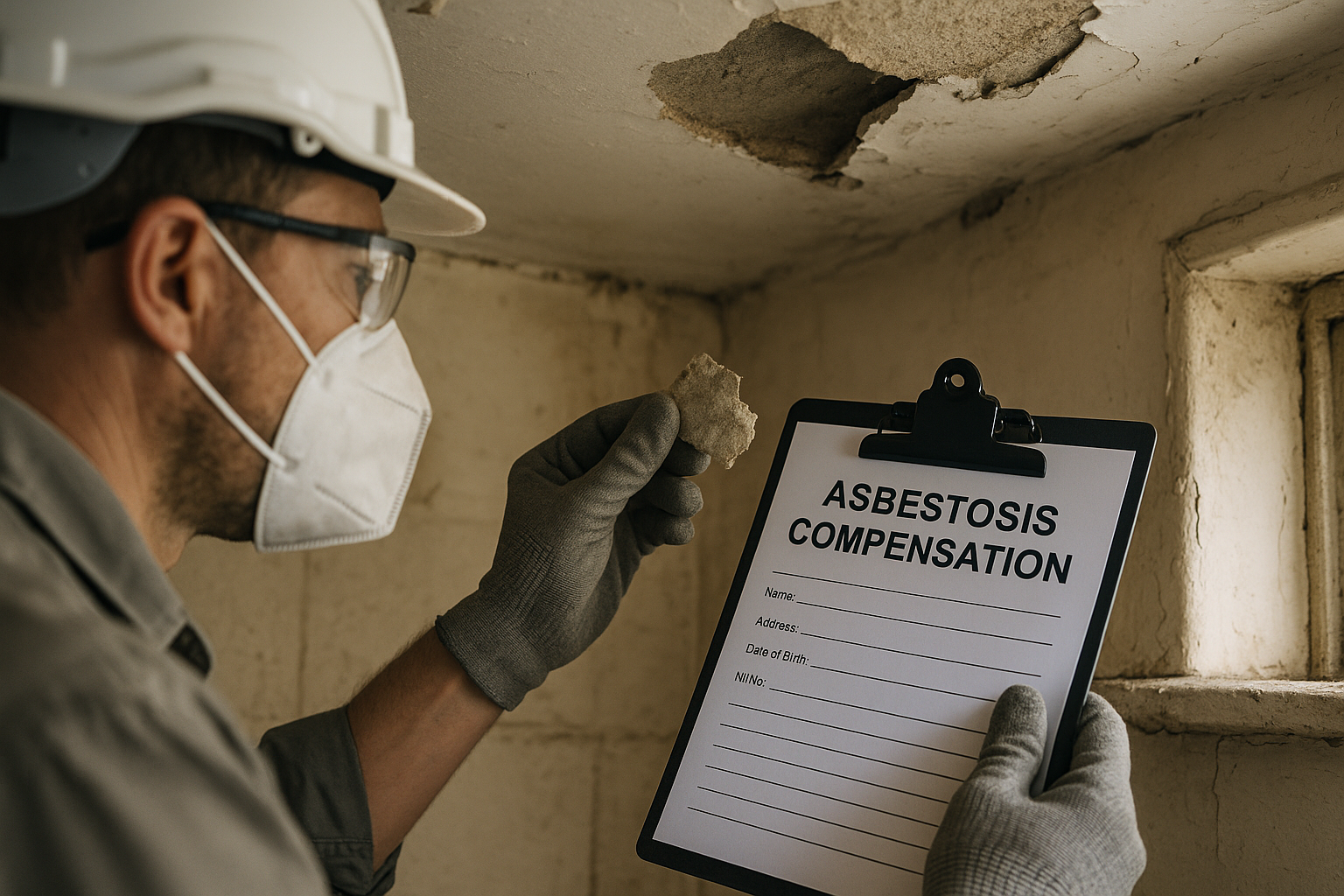
    asbestosis compensation - Asbestos Exposure Compensation Claims UK

    Depending on eligibility, people with asbestosis may be able to claim:

    • Industrial Injuries Disablement Benefit for a prescribed industrial disease caused by work
    • Lump sum payments under relevant dust-related disease schemes where the criteria are met

    These routes are separate from a civil claim. They have their own rules, evidence requirements, and decision-making process.

    If you are exploring asbestosis compensation, do not assume you must choose only one route. In some cases, a civil claim and state-backed support can run alongside each other, although the interaction between payments should be checked carefully.

    What to gather before making enquiries

    • Written confirmation of diagnosis from your GP or consultant
    • Your National Insurance and employment details
    • A list of employers, agencies, and job sites
    • Any existing benefit paperwork
    • Records showing how your condition limits daily activities

    Getting these documents together early can save time and reduce stress later.

    How civil claims for asbestosis compensation work

    A civil claim is usually made against the employer that exposed you to asbestos, or against that employer’s liability insurer. The argument is generally that proper precautions were not taken to protect workers from a known hazard.

    To succeed, asbestosis compensation claims usually need evidence linking the illness to workplace exposure and showing that reasonable steps to control the risk were missing or inadequate.

    Evidence commonly used in civil claims

    • Medical records confirming asbestosis
    • Employment records, wage slips, or tax documents
    • Witness statements from former colleagues
    • Details of dusty conditions and the work carried out
    • Evidence of missing, poor, or unsuitable protective equipment
    • Expert medical opinion linking the disease to asbestos exposure

    Time limits can apply. In many cases, they are linked to the date you knew, or could reasonably have known, that your illness was connected to asbestos exposure rather than the date you were exposed.

    That makes early advice sensible. If you delay, it may become harder to trace insurers, locate witnesses, or recover records needed for asbestosis compensation.

    Can medical negligence also be relevant?

    Sometimes, yes. Most asbestosis compensation cases focus on the original workplace exposure, but there can be separate issues if there was an avoidable delay in diagnosis or treatment and that delay made the outcome worse.

    That would usually fall under medical negligence rather than the original industrial disease claim. The two issues are legally distinct, although they can exist at the same time.

    If you suspect a delayed diagnosis has affected your health, keep all appointment letters, referral dates, and test results in order. A specialist adviser can then assess whether there is a separate claim to consider.

    Managing life with asbestosis while a claim is ongoing

    Asbestosis compensation matters, but so does day-to-day health management. The condition cannot simply be reversed, so practical steps to protect lung function and reduce complications are essential.

    Doctors commonly advise people with asbestosis to:

    • Stop smoking if they smoke
    • Keep up with flu and pneumococcal vaccination where clinically advised
    • Attend follow-up appointments with the respiratory team
    • Stay active within medical guidance
    • Seek prompt help if breathing worsens or infection is suspected

    These steps do not reduce your right to seek asbestosis compensation. They are sensible measures to support your health while legal, financial, and practical issues are being dealt with.

    Why asbestos management still matters for property owners and duty holders

    Anyone researching asbestosis compensation is often looking backwards at exposure that happened years ago. Property managers, landlords, employers, and duty holders also need to look forwards and stop the same thing happening again.

    Asbestos remains present in many UK buildings. Under the Control of Asbestos Regulations, those responsible for non-domestic premises must manage asbestos risk properly. Survey work should follow HSG264 and current HSE guidance.

    The biggest risk arises when asbestos-containing materials are disturbed during maintenance, refurbishment, or demolition. Assumptions are not enough. Before intrusive work starts, the building needs the right level of asbestos information.

    Practical prevention steps for property managers

    • Check whether the building is old enough to contain asbestos
    • Review the asbestos register and management plan
    • Make sure contractors see relevant asbestos information before they start
    • Stop work immediately if suspect materials are damaged or uncovered
    • Commission the correct survey before any intrusive works

    If planned works will disturb the fabric of the building, arrange a refurbishment survey before the project begins. This is one of the clearest ways to prevent fresh exposure and avoid the kind of failures that later lead to asbestosis compensation claims.

    For organisations managing sites across the capital, Supernova can help with an asbestos survey London service tailored to commercial and industrial premises. If your portfolio includes the North West, you can also arrange an asbestos survey Manchester appointment. For Midlands properties, Supernova provides an asbestos survey Birmingham service for duty holders who need clear, compliant reporting.

    Action points if you are considering asbestosis compensation

    When a diagnosis is new, it is easy to feel overwhelmed. A simple checklist can help you move forward without missing key evidence.

    1. Get written confirmation of the diagnosis and keep all medical correspondence
    2. Prepare a full employment history, including short-term and agency work
    3. Write down where asbestos dust was present and what tasks created it
    4. Identify former colleagues who may support your account
    5. Keep records of financial losses and care needs
    6. Check whether you may qualify for state-backed support as well as a civil claim
    7. Seek specialist legal advice promptly rather than relying on assumptions

    For property professionals reading this, the action point is equally clear: do not allow refurbishment or intrusive maintenance to start without suitable asbestos information. Good asbestos management today helps prevent future illness and future asbestosis compensation claims.

    Why specialist asbestos surveying supports legal compliance

    Not every reader will be making a claim personally. Many will be employers, managing agents, housing providers, or facilities teams trying to avoid exposing workers and occupants in the first place.

    That means asbestos surveys need to be accurate, clearly reported, and appropriate for the work planned. A management survey is not a substitute for a refurbishment survey where intrusive works are involved. Acting on the wrong survey type can create serious risk.

    Supernova Asbestos Surveys works with organisations across the UK to identify asbestos-containing materials, support compliance, and reduce the chance of dangerous disturbance. If you are responsible for a building, treat asbestos information as a live safety document, not paperwork to file away.

    Frequently Asked Questions

    Can I claim asbestosis compensation if I was exposed decades ago?

    Yes. Asbestosis often develops many years after exposure. Time limits are usually considered from the point when you knew, or could reasonably have known, that the illness was linked to asbestos rather than from the date the exposure happened.

    What evidence is useful for asbestosis compensation?

    Helpful evidence includes diagnosis letters, scan reports, lung function tests, employment records, wage slips, witness statements, and any notes showing dusty conditions or poor protection at work. A written timeline of jobs and sites is also very useful.

    Can I receive government support as well as making a civil claim?

    Often, yes. Some people may qualify for Industrial Injuries Disablement Benefit or a relevant lump sum scheme while also pursuing a civil claim. The detail depends on eligibility and how different payments interact.

    Does smoking prevent an asbestosis compensation claim?

    No. Smoking can worsen respiratory symptoms and increase other health risks, but it does not automatically remove your right to claim if workplace asbestos exposure caused asbestosis.

    How can property owners reduce the risk of future asbestos disease claims?

    By following the Control of Asbestos Regulations, commissioning surveys in line with HSG264 and HSE guidance, keeping asbestos records up to date, and making sure no refurbishment or intrusive work begins without the right asbestos information.

    If you need expert help identifying asbestos before maintenance, refurbishment, or demolition, speak to Supernova Asbestos Surveys. We provide surveying services nationwide, with practical advice for duty holders who need clear answers fast. Call 020 4586 0680 or visit asbestos-surveys.org.uk to arrange support.


  • Recent Asbestos Prosecution Cases UK: Key Outcomes and Legal Implications

    Recent Asbestos Prosecution Cases UK: Key Outcomes and Legal Implications

    Asbestos Prosecution Cases UK: Real Sentences, Fines, and What They Mean for You

    Asbestos prosecution cases in the UK are no longer reserved for large corporations or reckless demolition firms. Sole traders, company directors, landlords, and facility managers have all faced criminal charges, prison sentences, and six-figure fines. The Health and Safety Executive (HSE) is prosecuting more aggressively than ever, and the courts are backing them up.

    If you own, manage, or work on pre-2000 buildings, understanding what has happened to others is the clearest way to understand what is at stake for you.

    Why Asbestos Prosecution Cases in the UK Are Increasing

    The Control of Asbestos Regulations sets out clear legal duties for anyone who manages, disturbs, or removes asbestos-containing materials (ACMs). These duties apply to non-domestic premises, construction sites, and any building work on properties built before 2000.

    The HSE enforces these regulations through inspections, tip-offs, and joint operations with local authorities and Trading Standards. Where breaches are found, prosecution follows — and the courts have shown they are willing to impose custodial sentences, not just fines.

    Several factors are driving the increase in prosecutions:

    • Greater public awareness of asbestos risks leading to more reports to the HSE
    • Doorbell cameras and mobile phones providing evidence of unlicensed work
    • Joint enforcement operations between the HSE, Trading Standards, and local authorities
    • Stricter judicial attitudes toward health and safety violations involving hazardous materials
    • Unlicensed contractors undercutting licensed firms and cutting corners on safe removal

    The result is a prosecution landscape where ignorance of the law is no defence, and where the penalties are severe enough to end businesses and careers.

    Recent Asbestos Prosecution Cases UK: Case by Case

    The following cases illustrate the range of offences being prosecuted and the outcomes courts are handing down. These are real cases that demonstrate the legal and financial consequences of non-compliance.

    Roofing Contractor Fined for Uncontrolled Asbestos Spread

    In February 2022, self-employed roofing contractor Stephen Wilks — trading as S Wilks Roofing — removed a garage roof in Bowden, Altrincham without adequate controls. Doorbell footage captured asbestos cement sheets being removed with no protective measures in place.

    Debris fell into neighbouring gardens and later tested positive for chrysotile asbestos. HSE inspectors found ripped waste bags left open near the public, with hazardous material contaminating nearby plants. Two workers were seen placing asbestos debris into domestic bins rather than using licensed disposal routes.

    Wilks pleaded guilty to breaching Regulation 11(1) — which requires prevention of exposure — and Regulation 16, which requires preventing the spread of asbestos. At Ashton-Under-Lyne Magistrates’ Court in March 2025, he received a twelve-month Community Order with 200 hours of unpaid work, plus costs of £3,582.

    This case is significant because it shows that even small, low-value jobs carry serious legal exposure. The evidence came from a domestic doorbell camera. You do not need a formal complaint for the HSE to build a case.

    Company Director Jailed for Fraudulent Asbestos Removal

    Daniel Luke Cockcroft, director of Asbestos Boss Limited, was jailed after his company claimed to hold a licence for asbestos removal work — but never did. The company operated across Great Britain, carrying out licensed removal activities without the legal authority to do so.

    Prohibition notices issued by the HSE were ignored. Falsified training certificates were used to mislead clients about worker competence. Stockport Trading Standards worked alongside HSE officers to pursue both fraud and health and safety charges.

    At Manchester Magistrates’ Court, Cockcroft pleaded guilty to breaching Section 37 of the Health and Safety at Work etc. Act and to fraud. He received a six-month sentence for the health and safety breaches, with a further four months added after the fraud conviction — a total of ten months in immediate custody. Compensation for affected clients was also ordered.

    This case underlines a critical point: operating without a licence is not a technicality. It is a criminal offence, and courts treat it as one.

    Major Electricity Provider Facing Over 1,000 Asbestos Claims

    RWE, the UK’s largest power producer, has faced more than 1,000 lawsuits relating to asbestos exposure following its takeover of National Power. Defence costs per case range from £20,000 to £60,000. The company’s insurance fund has paid out over £140 million across 25 years of asbestos litigation.

    Successful claimants typically receive around £150,000 in compensation. However, many cases have been delayed or disputed, with company-commissioned medical research criticised for undermining valid claims for pleural mesothelioma and other asbestos-related diseases.

    This case is a reminder that corporate liability for historic asbestos exposure does not disappear with time. If your organisation has inherited buildings or operations from earlier entities, you may carry inherited liability too.

    London Construction Firm Fined £1.1 Million

    A London-based construction company received a record fine of £1.1 million after an uncontrolled release of asbestos fibres during renovation works. Workers and members of the public were exposed. The prosecution highlighted failures at management level, not just on the tools.

    The scale of the fine reflects the courts’ willingness to impose penalties that genuinely hurt large organisations. A fine that represents a rounding error on a company’s turnover is not a deterrent. Courts are now calibrating penalties to the size and resources of the defendant.

    Property Manager Fined £120,000 for Failure to Manage Known Risks

    A property management company was ordered to pay £120,000 after failing to manage known asbestos risks in residential buildings. The company was aware of the presence of ACMs but had not put adequate management plans in place, had not carried out regular risk assessments, and had not ensured that maintenance workers were informed of the risks.

    This case is particularly relevant for commercial landlords and managing agents. Knowledge of a risk creates a legal duty to act. Inaction is not a neutral position — it is a breach.

    Demolition Directors Imprisoned for Unsafe Removal

    Directors of a demolition company received 14-month prison sentences after unsafe asbestos removal work put both workers and the public at risk. The breaches were described as gross negligence rather than simple oversight.

    Personal liability for directors is a consistent theme across recent asbestos prosecution cases in the UK. You cannot hide behind a limited company if you were personally involved in, or aware of, the breach.

    What the Law Actually Requires

    The Control of Asbestos Regulations place specific duties on dutyholders — the people or organisations responsible for maintaining non-domestic premises. Those duties include:

    • Identifying ACMs: You must find out whether asbestos is present in your premises, where it is, and what condition it is in. A management survey is the standard tool for doing this.
    • Assessing the risk: Not all asbestos is equally dangerous. Condition, accessibility, and likelihood of disturbance all affect risk level.
    • Producing a written management plan: The plan must set out how risks will be managed, monitored, and communicated to anyone who might disturb the material.
    • Keeping records: Records of surveys, risk assessments, and any work involving ACMs must be maintained and made available to contractors before they begin work.
    • Using licensed contractors: Most asbestos removal work must be carried out by a contractor licensed by the HSE. Commissioning asbestos removal without verifying the correct licence is a criminal offence.
    • Training: Anyone likely to encounter ACMs in the course of their work must receive appropriate information and training.

    HSG264, the HSE’s guidance document on asbestos surveys, sets out the technical standards surveyors must meet. It is the benchmark against which survey quality is judged — both by the HSE and by courts in the event of a prosecution.

    The Legal Implications for Organisations and Individuals

    The cases above carry clear messages about how liability is distributed and how courts approach asbestos offences.

    Directors Face Personal Liability

    Section 37 of the Health and Safety at Work etc. Act allows the HSE to prosecute individual directors and managers where an offence by the company was committed with their consent, connivance, or neglect. This means a prison sentence is a personal risk, not just a corporate one.

    The Cockcroft case is the clearest recent example, but it is not unique. Where directors are shown to have known about non-compliance and done nothing, courts treat that as an aggravating factor.

    Unlimited Fines Apply in the Crown Court

    Magistrates’ courts can impose fines up to £20,000 for individual breaches. But serious cases are referred to the Crown Court, where there is no upper limit on fines. The £1.1 million fine imposed on the London construction firm was a Crown Court outcome.

    Sentencing guidelines for health and safety offences take into account the culpability of the defendant, the likelihood of harm, the actual harm caused, and the financial means of the defendant. Large organisations face proportionately larger fines.

    Civil Claims Run Alongside Criminal Prosecutions

    A criminal conviction does not end the matter. It typically makes civil claims easier to bring, because the conviction establishes that a breach occurred. Victims of asbestos exposure — or their families — can pursue personal injury or industrial disease claims separately.

    Mesothelioma, asbestosis, and pleural plaques are all conditions linked to asbestos exposure that can give rise to substantial compensation claims. Settlement amounts vary considerably based on the condition and circumstances of each case.

    Insurance May Not Cover You

    Where an organisation has negligently breached its legal duties, insurers may decline to cover legal costs or compensation payouts. Some policies specifically exclude liability arising from regulatory non-compliance.

    If you are found to have knowingly ignored duties under the Control of Asbestos Regulations, your insurer may have grounds to refuse your claim entirely. Do not assume your policy will protect you if you have not met your legal obligations.

    Practical Steps to Avoid Prosecution

    The pattern across asbestos prosecution cases in the UK is consistent: prosecutions arise from identifiable, preventable failures. Most could have been avoided with straightforward compliance measures.

    Get a Survey Before Any Work Begins

    If your property was built before 2000, an asbestos survey is not optional — it is a legal precondition for any refurbishment or demolition work. Do not rely on visual inspection or assumptions about building materials.

    For planned refurbishment or demolition projects, a refurbishment survey is required before any intrusive work begins. This goes beyond a standard management survey and identifies ACMs in areas that will be disturbed.

    Supernova Asbestos Surveys provides both management and refurbishment surveys across the UK, with reports delivered within 24 hours. Whether you need an asbestos survey in London, an asbestos survey in Manchester, or an asbestos survey in Birmingham, our local surveyors can be with you within 24 to 48 hours.

    Use Licensed Contractors

    Check that any contractor you engage for asbestos removal holds a current HSE licence. You can verify this on the HSE’s public register. Engaging an unlicensed contractor does not just expose workers to risk — it exposes you to liability as the dutyholder who appointed them.

    Maintain Your Asbestos Register

    Your asbestos register must be kept up to date and made available to all contractors before they begin work on your premises. If a contractor disturbs ACMs because you failed to inform them, you share legal responsibility for the consequences.

    Review your register whenever building works are planned, whenever new tenants take occupation, and whenever the condition of known ACMs changes.

    Train Your Staff

    Anyone who might encounter asbestos in the course of their work — maintenance staff, facilities managers, contractors — must receive appropriate asbestos awareness training. This is a specific duty under the Control of Asbestos Regulations, not a general best practice recommendation.

    Training records should be kept alongside your asbestos register. If the HSE asks, you need to be able to demonstrate that training has taken place.

    Act on Survey Findings Promptly

    Commissioning a survey and then ignoring the findings is not compliance. The property management case above — where a company was fined £120,000 — involved exactly this failure. The ACMs were known. The risk was documented. Nothing was done.

    If a survey identifies ACMs in poor condition, or in locations where disturbance is likely, you have a legal duty to act. That may mean encapsulation, repair, or removal, depending on the risk assessment.

    What Happens When the HSE Investigates

    HSE investigations following asbestos incidents typically move through a defined process. Understanding that process helps you appreciate why early compliance is so much better than reactive damage control.

    When an incident is reported — whether through a complaint, a tip-off, or an accident — HSE inspectors will attend the site. They have powers to take samples, seize documents, interview witnesses under caution, and issue prohibition notices stopping all work immediately.

    If inspectors find evidence of a breach, the investigation moves to a formal stage. Interviews under caution are conducted. Evidence is compiled. A decision is then made on whether to prosecute, issue an improvement notice, or take no further action.

    Prosecution decisions are based on the severity of the breach, the risk to public health, the culpability of those involved, and whether there is sufficient evidence to secure a conviction. The HSE’s prosecution rate in asbestos cases is high — because the evidence is usually clear and the legal duties are unambiguous.

    If you receive a visit from HSE inspectors, do not attempt to minimise, conceal, or destroy evidence. Obstruction of an HSE investigation is itself a criminal offence and will be treated as an aggravating factor in any subsequent prosecution.

    Frequently Asked Questions

    What are the most common reasons for asbestos prosecution cases in the UK?

    The most common reasons are: failing to carry out a survey before starting work on a pre-2000 building, using unlicensed contractors for licensed asbestos removal work, failing to manage known ACMs in non-domestic premises, and failing to prevent the spread of asbestos fibres during removal or disturbance. Many prosecutions also arise from directors or managers ignoring HSE prohibition notices.

    Can an individual director be personally prosecuted for asbestos offences?

    Yes. Section 37 of the Health and Safety at Work etc. Act allows the HSE to prosecute individual directors and managers where an offence was committed with their consent, connivance, or neglect. Directors have received custodial sentences in asbestos cases — a limited company does not provide personal immunity from prosecution.

    What is the maximum fine for an asbestos offence in the UK?

    In the Magistrates’ Court, fines for individual breaches can reach £20,000. However, serious cases are referred to the Crown Court, where there is no upper limit on fines. Courts use sentencing guidelines that take into account the defendant’s culpability, the harm caused, and their financial means — meaning large organisations can face fines running into millions of pounds.

    Does a criminal prosecution prevent civil claims from asbestos exposure?

    No — civil claims can be brought alongside or after a criminal prosecution. A criminal conviction can actually make civil claims easier to pursue, because it establishes that a breach of duty occurred. Victims or their families can claim compensation for conditions including mesothelioma, asbestosis, and pleural plaques through separate civil proceedings.

    How can I check whether an asbestos removal contractor is licensed?

    The HSE maintains a public register of licensed asbestos contractors, which is freely searchable online. You should check this register before appointing any contractor for licensed asbestos removal work. As the dutyholder who appointed them, you carry shared legal responsibility if an unlicensed contractor is used on your premises.


    Supernova Asbestos Surveys has completed over 50,000 surveys across the UK. Our UKAS-accredited surveyors work to HSG264 standards, delivering clear, actionable reports within 24 hours of survey completion. If you need a survey, an updated asbestos register, or advice on managing ACMs in your property, call us on 020 4586 0680 or visit asbestos-surveys.org.uk to book online.

  • Asbestos Fines and Penalties UK: What You Need to Know to Stay Compliant

    Asbestos Fines and Penalties UK: What You Need to Know to Stay Compliant

    Asbestos Fines and Penalties in the UK: The Real Cost of Getting It Wrong

    Asbestos fines and penalties in the UK are not abstract threats — they are handed down regularly, and the sums involved can be devastating for businesses of every size. Property owners, landlords, and facilities managers who fail to manage asbestos risks face unlimited fines, criminal prosecution, and in serious cases, imprisonment.

    Understanding exactly what the law requires, and what happens when it is breached, is the clearest way to protect your business, your staff, and the people who use your buildings.

    The Legal Framework: What UK Asbestos Regulations Actually Require

    The Control of Asbestos Regulations establish a clear duty for anyone responsible for non-domestic premises. If you own, manage, or have maintenance obligations for a building constructed before 2000, you are almost certainly a duty holder under these regulations.

    Your core obligations are straightforward in principle, even if they require careful execution in practice:

    • Identify all asbestos-containing materials (ACMs) in the building
    • Assess the condition and risk posed by each ACM
    • Record findings in a written asbestos register
    • Produce and maintain an asbestos management plan
    • Inform anyone who may disturb ACMs — contractors, maintenance staff, and tenants
    • Monitor ACMs on a regular schedule and update records accordingly

    Regulation 4 places the duty to manage asbestos squarely on duty holders. Regulations 5 and 6 set out the requirements for surveys and safe working methods before any work that could disturb ACMs. These are legal minimums, not optional guidance.

    Who Counts as a Duty Holder?

    Responsibility does not always sit with the building owner alone. It can fall to a managing agent, a facilities manager, or even a tenant if the lease or contract assigns maintenance duties to them.

    If you are unsure where your obligations begin and end, take legal advice. Ignorance of your duty is not a defence the HSE or the courts will accept.

    The Role of the HSE in Enforcement

    The Health and Safety Executive enforces asbestos regulations across Great Britain. Inspectors can visit your premises unannounced, examine your asbestos register and management plan, and interview your staff and contractors.

    If they find a breach, they have a range of enforcement tools at their disposal. These include improvement notices requiring you to fix a problem within a set timeframe, and prohibition notices that stop work immediately. Where the breach is serious, the HSE can refer the case for prosecution — and the penalties that follow can be severe.

    Asbestos Fines and Penalties in the UK: What the Courts Can Impose

    The scale of asbestos fines and penalties in the UK has increased significantly in recent years, reflecting the seriousness with which courts treat asbestos-related offences. There is no upper limit on fines in the Crown Court — judges can impose whatever sum they consider proportionate to the breach and the financial position of the defendant.

    Magistrates’ Court Penalties

    For less serious breaches heard in the Magistrates’ Court, fines can reach £20,000 per offence. Custodial sentences of up to six months are also available.

    While these figures may seem modest compared to Crown Court outcomes, multiple offences tried together can quickly accumulate into a significant financial penalty.

    Crown Court Penalties

    The Crown Court handles the most serious asbestos offences and has no ceiling on the fines it can impose. Custodial sentences of up to two years are available for individuals found guilty of serious breaches.

    Courts weigh the level of risk created, the harm caused, the defendant’s culpability, and any history of non-compliance. Real-world outcomes illustrate just how severe these penalties can be:

    • A London construction firm was fined £1.1 million after unsafe asbestos removal exposed workers to ACMs
    • A property management company received a £200,000 fine for maintaining a poor asbestos register and failing its duty to manage
    • A school trust paid £50,000 after staff and pupils were exposed to airborne fibres due to inadequate management controls

    These are not exceptional cases — they reflect routine enforcement activity by the HSE.

    Imprisonment for Asbestos Offences

    Prison sentences are not reserved for cases where someone has already been harmed. The courts can and do imprison individuals where serious risk was created, even if no illness has yet resulted.

    • A company director received a suspended sentence and a £25,000 personal fine after workers were exposed to airborne asbestos fibres
    • Directors at a construction firm received 14-month custodial sentences and 10-year disqualification orders following unsafe demolition work

    The personal consequences for company directors and senior managers can be as severe as the financial penalties imposed on the business itself.

    Specific Scenarios That Trigger Prosecution

    Enforcement action tends to follow predictable patterns. Knowing which failures attract the most scrutiny helps you focus your compliance efforts where they matter most.

    Failing to Commission an Asbestos Survey

    Carrying out refurbishment or maintenance work on a pre-2000 building without first completing an appropriate survey is one of the most common triggers for prosecution. An management survey is required to manage asbestos in a building during normal occupation, while a demolition survey is needed before any intrusive refurbishment or demolition work begins.

    Britannia Hotels Ltd was fined £200,000 after failing to assess asbestos risks at a hotel site before work commenced. The absence of a survey meant workers were exposed to ACMs without any protection in place.

    Unlicensed Asbestos Removal

    Certain categories of asbestos work require a licence from the HSE. Using unlicensed contractors — or attempting removal without proper controls — is a serious offence that courts treat with little sympathy.

    An asbestos removal firm was convicted for carrying out unlicensed work without air monitoring or a certificate of reoccupation. Fines for unlicensed removal can reach £100,000, and custodial sentences are a real possibility. Where unlicensed or unsafe asbestos removal results in widespread contamination or, in the most extreme cases, death, charges of corporate manslaughter become a possibility.

    Poor Record-Keeping and Inadequate Management Plans

    A Hertfordshire film studio was fined £6,000 for failing to maintain proper records and skipping regular surveys. While this is a relatively modest penalty, it illustrates that even smaller organisations are not beneath HSE scrutiny.

    An incomplete or out-of-date asbestos register is itself a breach of the regulations. The HSE does not need to wait for an exposure incident to take action — poor paperwork alone is enough.

    Exposing Workers and the Public to Airborne Fibres

    Any work that disturbs ACMs without appropriate controls — proper containment, suitable PPE, air monitoring, and decontamination procedures — creates a risk of prosecution. The Newport industrial property prosecution demonstrates that failing to protect workers from asbestos hazards, even on a single site, can result in criminal charges for the property owner.

    Civil Compensation Claims: The Financial Risk Beyond Regulatory Penalties

    Regulatory fines are only part of the financial exposure. Individuals who develop asbestos-related diseases as a result of exposure on your premises can bring civil negligence claims against you. These claims are entirely separate from any HSE enforcement action and can run concurrently with criminal proceedings.

    What Civil Claims Can Cost

    The sums involved in civil compensation reflect the devastating impact of asbestos-related disease:

    • Mesothelioma — the cancer most closely associated with asbestos exposure — can attract settlements approaching £900,000 in serious cases
    • Asbestosis claims vary by age and severity, with awards ranging from around £42,500 to £90,000
    • Lung cancer linked to asbestos exposure has resulted in awards of £60,000 and above
    • Even conditions like pleural thickening, which may cause no immediate symptoms, can attract provisional damages of around £15,000

    Total compensation typically covers pain and suffering, care costs, and loss of earnings — and claims can be brought years or even decades after the original exposure.

    The combination of a regulatory fine, legal costs, and a civil compensation award can be financially ruinous for a business that has failed to manage asbestos properly. No insurance policy makes this risk disappear entirely, and some insurers will challenge or limit coverage where negligence is established.

    How to Stay on the Right Side of UK Asbestos Law

    Compliance is not complicated, but it does require consistent effort and proper documentation. The following steps form the foundation of any sound asbestos management approach.

    Commission a Professional Asbestos Survey

    If you manage or own a non-domestic building constructed before 2000, a professional asbestos survey is your starting point. Do not rely on visual inspection or the assumption that previous owners dealt with the issue — asbestos cannot be identified by sight, and only laboratory analysis of samples can confirm its presence.

    Use surveyors who are UKAS-accredited or hold the P402 qualification. Their findings form the basis of your asbestos register and management plan. Professional surveys are readily available across the country — whether you need an asbestos survey London property owners trust, an asbestos survey Manchester businesses rely on, or an asbestos survey Birmingham facilities managers book regularly, qualified professionals can be on site quickly.

    Build and Maintain an Asbestos Management Plan

    Your asbestos management plan should name a responsible person and a deputy, include your full asbestos register, set out control measures for each ACM, and establish a monitoring timetable. It should also include emergency procedures for accidental disturbance.

    Review the plan after any refurbishment, change of contractor, or near-miss incident. An out-of-date plan is almost as problematic as having no plan at all — the HSE will want to see that your records reflect the current state of the building.

    Inform Everyone Who Needs to Know

    Your asbestos register must be shared with any contractor, maintenance worker, or tenant who could disturb ACMs. This is a specific legal requirement, not just good practice.

    Keeping the register locked in a filing cabinet where no one can access it defeats its purpose entirely and leaves you exposed to enforcement action. Consider a digital register that relevant parties can access easily and that generates an audit trail of who has viewed it.

    Use Licensed Contractors for Notifiable Work

    Not all asbestos work requires a licence, but higher-risk tasks — including the removal of sprayed coatings, lagging, and certain insulation boards — must be carried out by HSE-licensed contractors. Verify your contractor’s licence before work begins, and ensure they provide a certificate of reoccupation after removal is complete.

    Never accept a quote that seems unusually low for asbestos removal work. Cutting corners on licensed removal is precisely the kind of decision that leads to prosecution.

    Keep Records Meticulously

    Documentation is your primary defence if the HSE investigates. Keep copies of survey reports, risk assessments, management plans, contractor records, training logs, and air monitoring results.

    Store these securely and ensure they are accessible to the relevant people. Good records demonstrate that you took your duty seriously — and that can make a material difference to enforcement outcomes. Courts and the HSE both look favourably on organisations that can show a genuine commitment to compliance, even where a breach has occurred.

    The Bottom Line on Asbestos Fines and Penalties in the UK

    The financial and personal consequences of asbestos non-compliance in the UK are severe, well-documented, and entirely avoidable. Unlimited Crown Court fines, custodial sentences, director disqualification, and civil compensation claims running into hundreds of thousands of pounds are the real-world outcomes for those who fail to take their duty seriously.

    The cost of getting a professional survey, maintaining an up-to-date register, and using licensed contractors is a fraction of what a single enforcement action could cost your business. There is no commercial logic in cutting corners on asbestos management — only significant legal, financial, and reputational risk.

    If you are unsure whether your current asbestos management arrangements are adequate, the time to find out is before the HSE visits, not after.

    Get Expert Help from Supernova Asbestos Surveys

    Supernova Asbestos Surveys has completed over 50,000 surveys nationwide. Our UKAS-accredited team provides management surveys, refurbishment and demolition surveys, sampling, and removal coordination for commercial and residential clients across the UK.

    Whether you need to establish your duty holder position, update an out-of-date register, or commission a survey before planned works, we can help you stay compliant and avoid the very real penalties that come with getting it wrong.

    Call us on 020 4586 0680 or visit asbestos-surveys.org.uk to book a survey or speak to one of our specialists today.

    Frequently Asked Questions

    What are the maximum asbestos fines and penalties in the UK?

    In the Crown Court, there is no upper limit on fines for asbestos offences. Individuals can receive custodial sentences of up to two years. In the Magistrates’ Court, fines can reach £20,000 per offence and custodial sentences of up to six months are available. Civil compensation claims for asbestos-related illness can add further significant costs on top of any regulatory penalty.

    Can I be prosecuted personally as a director or manager?

    Yes. The HSE prosecutes both companies and individuals. Directors and senior managers who are found to have consented to, connived in, or been negligent about asbestos breaches can face personal fines, custodial sentences, and disqualification from acting as a company director. Personal liability is a real and regularly exercised enforcement tool.

    Do I need an asbestos survey if the building looks fine?

    Appearance is entirely irrelevant. Asbestos-containing materials can be in excellent visual condition and still release dangerous fibres if disturbed. The only way to establish whether ACMs are present is through a professional survey with laboratory analysis of samples. Assuming a building is safe because it looks well-maintained is not a defence under the Control of Asbestos Regulations.

    What is the difference between a management survey and a demolition survey?

    A management survey is used to locate and assess ACMs in a building during normal occupation and day-to-day maintenance. A refurbishment and demolition survey is required before any intrusive work — including major refurbishment, structural alterations, or demolition — begins. The demolition survey is more intrusive and must inspect areas that would be disturbed by the planned works. Using the wrong type of survey for the work being carried out is itself a breach of the regulations.

    How long do I have to keep asbestos records?

    There is no single fixed statutory retention period for all asbestos records, but given that asbestos-related diseases can develop decades after exposure, it is strongly advisable to retain records indefinitely or for as long as you have an interest in the property. Survey reports, management plans, contractor records, and air monitoring results should all be stored securely and remain accessible. The HSE guidance in HSG264 makes clear that records must be kept up to date and available to anyone who needs them.