Category: The Future of Asbestos: Is There Still a Risk?

  • Are there any ongoing efforts to educate the public about the risks of asbestos?

    Are there any ongoing efforts to educate the public about the risks of asbestos?

    The UK’s Ongoing Efforts to Educate the Public About the Risks of Asbestos

    Asbestos kills more people in the UK each year than road accidents. Yet a significant portion of the public still cannot identify where asbestos is found, what it looks like, or what to do when they encounter it. So are there any ongoing efforts to educate the public about the risks of asbestos — and are those efforts actually reaching the people who need them most?

    The answer is yes, and the scale of activity is broader than most people realise. From government-backed campaigns and legally mandated worker training to school curricula and community outreach, a wide network of initiatives operates across the UK. Here is exactly what is happening, who is driving it, and what you can do to protect yourself and the people around you.

    Why Public Education About Asbestos Cannot Stop

    The UK banned all types of asbestos in 1999. Many people take that to mean the problem is solved. It is not.

    Around half of all non-domestic buildings in the UK are estimated to contain asbestos-containing materials (ACMs). Millions of homes built before 2000 also contain asbestos in floor tiles, roof sheets, pipe lagging, textured coatings, and more. The material is not inherently dangerous when left undisturbed — but drill into it, sand it, or demolish the structure it sits in, and it releases microscopic fibres capable of causing mesothelioma, asbestosis, and lung cancer.

    The latency period between exposure and diagnosis is typically 20 to 40 years. That long gap is precisely why education cannot slow down. People making decisions today about DIY projects, building refurbishments, or property purchases need accurate information now, even if the consequences of getting it wrong will not become apparent for a generation.

    Public Awareness Campaigns: Who Is Doing What

    The Health and Safety Executive (HSE) runs ongoing public awareness activity under its asbestos safety programme. This includes digital content, downloadable guidance, and targeted campaigns aimed at tradespeople — most notably the “Hidden Killer” campaign, which focuses on the risks faced by plumbers, electricians, carpenters, and other workers who regularly encounter ACMs in older buildings.

    The HSE’s approach is deliberately practical. Rather than relying on abstract warnings, it tells workers and property owners what asbestos looks like in real-world settings, which building materials are likely to contain it, and what steps to take before starting any work.

    Social Media and Digital Outreach

    Asbestos charities and advocacy organisations have taken public education onto social media platforms. Mesothelioma UK, for example, runs awareness campaigns reaching patients, families, and the general public through Facebook, Instagram, and other channels. These campaigns serve a dual purpose: raising awareness of the disease and directing people towards support services.

    Online asbestos awareness courses are also widely available, many of them accredited and freely accessible. These allow anyone — not just professionals — to learn the basics of asbestos identification, risk assessment, and safe behaviour around suspect materials.

    Physical Messaging and Community Events

    Physical public health messaging still plays a meaningful role, particularly in areas with high concentrations of older housing stock or industrial heritage. Posters in trade and builders’ merchants remind tradespeople of their legal duties and the risks of disturbing ACMs without proper assessment.

    Community events — including health fairs and local council-run safety days — sometimes include asbestos awareness stands, particularly in regions historically associated with asbestos-heavy industries such as shipbuilding and construction. These face-to-face encounters can be more effective than digital content alone for reaching older demographics or those less engaged with online resources.

    Mandatory Training: Education as a Legal Requirement

    For anyone whose work is likely to disturb asbestos, education is not optional — it is a legal requirement under the Control of Asbestos Regulations. The regulations define three categories of work, each requiring a different level of training and certification.

    • Non-licensed work requires asbestos awareness training as a minimum.
    • Notifiable non-licensed work requires additional training, medical surveillance, and notification to the relevant enforcing authority.
    • Licensed work — the highest-risk category — can only be carried out by contractors holding an HSE licence, with workers completing comprehensive certified training programmes.

    What Asbestos Awareness Training Covers

    Asbestos awareness training is the baseline level required for any worker who might inadvertently disturb asbestos during their normal duties. It typically covers:

    • The properties of asbestos and why it is hazardous
    • The types of asbestos and which are most dangerous
    • Where asbestos is commonly found in buildings
    • How to recognise materials that may contain asbestos
    • The legal duties placed on employers and workers
    • What to do if asbestos is discovered or accidentally disturbed
    • The correct use of personal protective equipment (PPE)

    The HSE recommends annual refresher training to ensure knowledge stays current and safety protocols remain embedded in day-to-day practice. This regular renewal is important — building stock changes, regulations are updated, and familiarity can breed complacency.

    Certified Removal Training

    Workers carrying out licensed asbestos removal complete far more intensive programmes. These include theoretical instruction, practical assessments, risk assessment methodology, containment procedures, decontamination protocols, and correct disposal of asbestos waste.

    If you need removal carried out on your property, verifying that contractors hold the appropriate HSE licence and a trained workforce is non-negotiable. Do not accept assurances without evidence.

    The Role of Government and Regulatory Bodies

    The legislative framework underpinning asbestos management in the UK is robust. The Control of Asbestos Regulations places a legal duty on those responsible for non-domestic premises — known as duty holders — to manage asbestos. This means identifying ACMs, assessing their condition, producing a written management plan, and keeping that plan up to date.

    HSG264, the HSE’s guidance document on asbestos surveying, sets out the standards that surveyors and duty holders must follow. It defines the two main types of survey — management surveys and refurbishment and demolition surveys — and specifies how they should be conducted and documented.

    Enforcement and Compliance

    The HSE and local authority environmental health officers enforce compliance with asbestos regulations. Businesses and landlords who fail to manage asbestos appropriately face significant penalties, including improvement notices, prohibition notices, and prosecution.

    This regulatory pressure is itself a driver of education — organisations must train staff and engage surveyors simply to remain compliant. Compliance and awareness are, in this sense, mutually reinforcing.

    Government-Backed Guidance and Resources

    The HSE website hosts an extensive library of free guidance on asbestos management, covering everything from duty holder responsibilities to advice for homeowners carrying out DIY work. Local authorities also publish asbestos guidance tailored to their areas, and many signpost residents towards professional services when asbestos is suspected.

    For property managers and duty holders, commissioning a professional management survey is the most reliable way to understand what ACMs are present in a building and how they should be managed going forward.

    Asbestos Education in Schools and Vocational Training

    Schools occupy a particular place in the asbestos conversation — both as locations where education about asbestos takes place and as buildings that frequently contain asbestos themselves.

    The National Education Union (NEU) has been vocal in advocating for mandatory asbestos surveys in all schools built before 2000. Their position is that asbestos management plans should be visible and accessible to all staff, not filed away in an office where they serve no practical awareness purpose. The NEU’s campaign has helped push asbestos into mainstream education policy debate.

    Integrating Asbestos Awareness into Vocational Curricula

    Some vocational and technical education programmes now include asbestos awareness as part of their health and safety modules. Construction, plumbing, electrical installation, and other trade apprenticeships regularly incorporate asbestos training, ensuring the next generation of tradespeople enters the workforce with baseline knowledge before they ever pick up a drill in an older building.

    Health and safety representatives in schools also play an important role, consulting with management on asbestos matters and ensuring that the asbestos register is properly maintained and acted upon.

    Community Outreach and Reaching Private Homeowners

    Beyond formal regulation and workplace training, community-level outreach helps reach people who may not be covered by occupational requirements — homeowners, private tenants, and members of the public who might encounter asbestos during home improvements.

    The rise of DIY home improvement has created a significant awareness gap. Homeowners tackling older properties may have no idea that the materials they are cutting, sanding, or removing could be releasing asbestos fibres. Public-facing campaigns and accessible resources are critical for this audience.

    Asbestos Testing: Putting Identification in the Public’s Hands

    One of the most practical ways to translate awareness into action is through professional asbestos testing. Testing by an accredited laboratory provides definitive identification of whether a material contains asbestos and, if so, what type.

    For homeowners uncertain about a textured ceiling, old floor tiles, or pipe lagging, testing removes the guesswork. For those who want a first step before commissioning a full survey, an asbestos testing kit allows samples to be collected safely at home and sent to an accredited laboratory for analysis. This puts the means of identification directly in the hands of the public, lowering the barrier to action significantly.

    If you are unsure about a specific material in your property, asbestos testing is the definitive way to find out — and it costs far less than the consequences of disturbing an unidentified ACM.

    Where Awareness Is Most Urgently Needed

    Public education efforts are increasingly targeted at the settings where exposure risk is highest. Understanding these locations helps direct awareness activity where it will have the most impact.

    Older Schools and Public Buildings

    Schools, hospitals, libraries, and civic buildings constructed before 2000 frequently contain asbestos across a wide range of materials. The risk is not limited to maintenance workers — teachers, support staff, and pupils can be affected if asbestos is disturbed or deteriorating.

    Awareness campaigns specifically targeting school governors, headteachers, and facilities managers are a priority area. In buildings undergoing significant works, a demolition survey is required before any structural work begins — this is a legal requirement, not a recommendation.

    Construction and Maintenance Workers

    Construction workers, electricians, plumbers, and heating engineers remain among the most at-risk groups. These are the workers most likely to drill into an asbestos ceiling tile, cut through asbestos-insulated board, or disturb pipe lagging without realising what it contains.

    Occupational health programmes, toolbox talks, and trade body guidance all contribute to reducing this risk. Employers in these sectors have a legal duty to ensure workers receive appropriate training before undertaking any work that could disturb ACMs.

    Private Homeowners

    Homeowners are arguably the group most underserved by existing education efforts. They are not subject to the same regulatory requirements as businesses, yet they face real exposure risks when renovating properties built before 2000.

    Practical guidance — on what materials to suspect, how to use a testing kit safely, and when to call a professional — is the most effective form of outreach for this audience. Awareness campaigns that lead directly to actionable steps are far more effective than those that simply raise alarm without providing direction.

    Best Practices for Safe Asbestos Management

    Whether you manage a commercial property, a school, or a block of flats, the principles of safe asbestos management are consistent. Follow these steps to protect occupants, comply with regulations, and reduce liability:

    1. Commission an asbestos survey from a UKAS-accredited surveyor before any refurbishment or demolition work begins.
    2. Develop a written asbestos management plan that identifies all ACMs, assesses their condition, and sets out how they will be managed or removed.
    3. Re-inspect ACMs at least every 12 months and update the management plan accordingly.
    4. Ensure all relevant staff and contractors are made aware of the asbestos register before starting any work.
    5. Never disturb suspected asbestos materials without first having them tested or assessed by a professional.
    6. Use licensed contractors for any work involving higher-risk asbestos types or quantities.
    7. Dispose of asbestos waste correctly through licensed waste carriers and designated disposal sites.

    If you are based in a major city, professional surveying services are readily accessible. Whether you need an asbestos survey in London, an asbestos survey in Manchester, or an asbestos survey in Birmingham, Supernova Asbestos Surveys operates nationwide with over 50,000 surveys completed.

    What More Needs to Be Done

    Existing efforts to educate the public about the risks of asbestos are meaningful, but gaps remain. Private homeowners are still largely outside the reach of formal training requirements. Awareness campaigns can struggle to cut through in a crowded information environment. And the long latency period of asbestos-related diseases means that the consequences of today’s education failures will not be visible for decades.

    The most effective education combines regulatory pressure, accessible resources, and practical tools. When a homeowner can order a testing kit online, a tradesperson can complete accredited training on their phone, and a duty holder can find clear guidance on the HSE website, the barriers to safe behaviour drop significantly.

    The challenge is ensuring that awareness translates into action — and that the people most at risk are the ones being reached.

    Frequently Asked Questions

    Are there any ongoing efforts to educate the public about the risks of asbestos in the UK?

    Yes. The HSE runs ongoing awareness campaigns, including the “Hidden Killer” campaign targeting tradespeople. Asbestos charities such as Mesothelioma UK run public-facing digital campaigns. Vocational training programmes include mandatory asbestos awareness modules, and free guidance is available through the HSE website for homeowners and duty holders alike.

    Who is legally required to receive asbestos awareness training?

    Under the Control of Asbestos Regulations, any worker whose duties could reasonably lead to the disturbance of asbestos must receive asbestos awareness training. This includes tradespeople such as plumbers, electricians, carpenters, and construction workers. Employers are responsible for ensuring this training is provided and refreshed regularly.

    What should a homeowner do if they suspect asbestos in their property?

    Do not disturb the material. If you need to identify it, use an accredited asbestos testing kit to collect a sample safely and send it to a laboratory for analysis. If you are planning renovation work, commission a professional asbestos survey before any work begins. A UKAS-accredited surveyor will identify all ACMs and advise on how to manage them safely.

    Is asbestos still a risk in UK buildings today?

    Yes. Although all types of asbestos were banned in the UK in 1999, a large proportion of non-domestic buildings and homes built before that date still contain asbestos-containing materials. The material is not dangerous when left undisturbed, but renovation, maintenance, or demolition work can release fibres that cause serious diseases including mesothelioma and asbestosis.

    How can I find out if a building has asbestos?

    The only reliable way to confirm whether a material contains asbestos is through laboratory analysis. For non-domestic premises, a management survey or refurbishment and demolition survey carried out by a UKAS-accredited surveyor is the standard approach. For homeowners, a professional survey or a testing kit for individual materials are both practical options. Never assume a material is safe based on appearance alone.

    Speak to Supernova Asbestos Surveys

    Supernova Asbestos Surveys has completed over 50,000 surveys across the UK, working with property managers, landlords, schools, local authorities, and homeowners. Whether you need a management survey, a demolition survey, professional testing, or advice on next steps, our UKAS-accredited team is ready to help.

    Call us on 020 4586 0680 or visit asbestos-surveys.org.uk to book a survey or request a quote.

  • What is the current status of asbestos in the UK?

    What is the current status of asbestos in the UK?

    When Was Asbestos Banned in the UK — and Why Does It Still Matter?

    Ask most people when was asbestos banned in the UK and they expect a single, clean date. The reality is a little more complicated — but the short answer is 1999, when all types of asbestos were finally prohibited from importation, supply and new use. What that date does not tell you is what happened to the millions of buildings where asbestos had already been installed across decades of widespread use. That is the part that still matters enormously to landlords, dutyholders, facilities managers and contractors today.

    If your building was constructed or significantly refurbished before 2000, asbestos may still be present. The legal duty under the Control of Asbestos Regulations is to identify it and manage the risk properly, in line with HSG264 and relevant HSE guidance. The ban date is history. The asbestos itself is not.

    When Was Asbestos Banned in the UK — The Timeline Explained

    The UK did not move from full use to full prohibition in a single step. Restrictions came in stages over a number of years, with the more hazardous amphibole forms of asbestos banned before the final prohibition on chrysotile, commonly known as white asbestos.

    Understanding that staged process helps explain why some buildings contain one type of asbestos and not another, and why the age of a building alone does not always tell the full story.

    The UK Asbestos Ban in Simple Terms

    • Blue asbestos (crocidolite) — banned earlier due to its particularly high hazard profile
    • Brown asbestos (amosite) — banned earlier alongside crocidolite
    • White asbestos (chrysotile) — remained in use for longer and was the last to be prohibited
    • Complete ban — all asbestos types prohibited from importation, supply and new use in 1999

    So when people search for when was asbestos banned in the UK, 1999 is the correct answer for a complete ban. But for anyone responsible for a building, the more useful question is whether asbestos is still present on site — and what condition it is in.

    Why Asbestos Was Banned

    Asbestos was banned because the health evidence became impossible to ignore. When asbestos-containing materials are damaged or disturbed, they can release microscopic fibres into the air. Those fibres, once inhaled, can lodge deep in the lungs and remain there for decades.

    Exposure to asbestos fibres is associated with a number of serious and often fatal diseases, including mesothelioma, asbestos-related lung cancer and asbestosis. One of the factors that allowed asbestos to remain in widespread use for so long was the long latency period between exposure and the development of disease — sometimes stretching to twenty or thirty years. By the time the scale of harm became clear, asbestos had already been used extensively across almost every sector of construction and industry.

    The ban focused on stopping new use, importation and supply. But because asbestos was already embedded in the built environment on such a vast scale, current law focuses equally heavily on preventing disturbance, assessing risk and managing materials that remain in place.

    Why Asbestos Was Used So Widely Before the Ban

    To understand the scale of the legacy problem in UK buildings, it helps to understand why asbestos was so attractive to builders, manufacturers and engineers in the first place. It was not simply cheap — it genuinely solved multiple technical problems at once.

    Properties That Made Asbestos Popular

    • Excellent fire resistance
    • Effective thermal insulation
    • Good sound insulation
    • High tensile strength and durability
    • Resistance to moisture, chemicals and corrosion
    • Low cost compared with alternatives available at the time
    • Ease of mixing into cement, board, textiles and coatings

    Because of those qualities, asbestos appeared in homes, schools, hospitals, factories, offices, warehouses and public buildings across the entire country. It was used in roof sheets, floor tiles, pipe lagging, ceiling tiles, textured coatings, fire doors, boiler components and dozens of other applications. Knowing when was asbestos banned in the UK only tells part of the story — the other part is just how thoroughly it was embedded in the buildings that still stand today.

    Where Asbestos Is Still Found in UK Buildings

    Asbestos is still present in a large proportion of pre-2000 buildings across the UK. It may be immediately visible — such as corrugated cement sheets on a garage roof — or completely hidden behind finishes, inside service ducts or above suspended ceilings.

    Do not assume that because a material looks ordinary, it is asbestos-free. Some asbestos-containing materials are visually indistinguishable from non-asbestos equivalents, which is why professional sampling and laboratory analysis are often necessary before any judgement can be made.

    Common Asbestos-Containing Materials in UK Buildings

    • Asbestos cement sheets, panels and roof coverings
    • Wall cladding, soffits and rainwater goods
    • Pipe lagging and thermal insulation on boilers and plant
    • Asbestos insulating board in partitions, risers and ceiling voids
    • Textured coatings on ceilings and walls
    • Vinyl floor tiles and bitumen adhesives beneath them
    • Fire doors and fire protection panels
    • Gaskets, seals and boiler components
    • Lift shafts, ducts and plant rooms
    • Ceiling tiles and service enclosures

    If you need to confirm whether a suspect material contains asbestos before work starts, professional asbestos testing is the safest and most reliable route. Guessing — or relying on visual inspection alone — is not an acceptable approach when the consequences of getting it wrong can be serious.

    What the Ban Did Not Do

    A common and potentially dangerous misunderstanding is that the 1999 ban meant asbestos had to be removed from every building immediately. It did not. The ban stopped new use, importation and supply. It did not require existing asbestos-containing materials to be stripped out of buildings where they had already been installed.

    That remains the legal position today. In many cases, asbestos can lawfully remain in place if it is in good condition, has been properly assessed and is managed so that it will not be disturbed. The duty is to manage, not automatically to remove.

    For dutyholders and property managers, the practical question is therefore not just when was asbestos banned in the UK. It is whether asbestos is present in your building, what condition it is in, and how you will prevent people from disturbing it.

    What the Law Expects From Dutyholders and Property Managers

    Under the Control of Asbestos Regulations, those responsible for non-domestic premises have a legal duty to manage asbestos. Survey work must be carried out in accordance with HSG264, with decisions informed by wider HSE guidance. This is not optional, and it applies regardless of whether you are a landlord, facilities manager, employer or managing agent.

    In practical terms, the duty to manage means being able to answer a set of basic questions about every building you are responsible for:

    • Is asbestos present, or reasonably likely to be present?
    • Where is it located within the building?
    • What type of material is it and what condition is it in?
    • Who might disturb it during normal occupation or maintenance?
    • What controls are in place to prevent disturbance?

    Practical Steps for Building Managers

    1. Check the construction date and any refurbishment history for the building.
    2. Assume asbestos may be present in any pre-2000 premises unless a proper survey has confirmed otherwise.
    3. Ensure the correct type of survey has been completed for the building and for any planned works.
    4. Keep an asbestos register and management plan up to date and accessible.
    5. Share asbestos information with contractors before any work begins.
    6. Review known materials regularly and record any change in condition.
    7. Stop any work immediately if suspect materials are disturbed, and keep people away from the affected area.

    Most asbestos incidents in buildings do not happen because someone ignored the law deliberately. They happen because the right information was not available to the right person at the right time — a contractor drills into a wall, opens a ceiling void or removes flooring without checking the asbestos register first.

    Choosing the Right Asbestos Survey

    The type of survey you need depends on what you plan to do in the building. Using the wrong survey type can leave asbestos hidden in exactly the area where work is about to happen — which defeats the purpose entirely.

    Management Survey

    For occupied buildings and routine use, a management survey is usually the starting point. It is designed to locate accessible asbestos-containing materials that could be damaged or disturbed during normal occupation, maintenance or minor installation work. It underpins the asbestos register and management plan that dutyholders are legally required to maintain.

    Refurbishment Survey

    If you are planning to alter the building fabric in any way — opening walls, ceilings, risers or floors — you need a refurbishment survey. This is an intrusive survey targeted to the areas where planned works will take place. A management survey is not sufficient for refurbishment work, regardless of how thorough it was when it was carried out.

    Demolition Survey

    Before any structure is demolished, a demolition survey is required. It is fully intrusive and aims to locate asbestos throughout the entire building so that all materials can be dealt with safely before demolition proceeds. This is a legal requirement, not a discretionary step.

    Re-Inspection Survey

    Known asbestos should never be left unchecked indefinitely. A re-inspection survey confirms whether previously identified materials remain in good condition and whether your asbestos register still accurately reflects the site as it actually is. The condition of asbestos-containing materials can change over time, and regular re-inspection is part of responsible asbestos management.

    When Sampling Is Enough — and When It Is Not

    There are situations where a full survey is not the immediate requirement. If there is a single suspect board, tile, coating or cement sheet and you simply need to know whether it contains asbestos before a decision is made, targeted sampling may be the most efficient first step.

    For that kind of standalone material check, this approach to asbestos testing can be a practical and cost-effective option. But sampling a single material does not replace a proper survey and asbestos register for a building as a whole.

    A simple rule of thumb:

    • One suspect material, no planned works: testing may be sufficient
    • Managing an occupied building: a management survey is usually required
    • Refurbishment or demolition planned: you need the correct intrusive survey for the scope of work

    What to Do If Your Building May Contain Asbestos

    If your property predates 2000, take a cautious and organised approach. The most expensive and disruptive asbestos problems almost always start with a small assumption — that someone else has already checked, that the old survey is still valid, or that the material looks fine so it probably is fine.

    A Practical Checklist for Property Managers

    1. Review the construction date and any major refurbishment history.
    2. Check whether an asbestos survey already exists and when it was carried out.
    3. Confirm that the survey type matches the work you are planning.
    4. Read the asbestos register rather than assuming someone else has reviewed it.
    5. Prevent contractors from starting intrusive work until asbestos information has been reviewed and shared.
    6. Arrange sampling or a new survey if records are missing, incomplete or out of date.
    7. Update the asbestos register and management plan after any change to the building or known materials.
    8. Communicate findings clearly to maintenance staff, contractors and tenants where relevant.
    9. If suspect materials are damaged or disturbed, stop work immediately and isolate the area.
    10. Where removal is necessary, use competent specialists for asbestos removal rather than attempting any DIY approach.

    Why Asbestos Remains a Live Issue Decades After the Ban

    One reason the question of when was asbestos banned in the UK continues to be asked so frequently is that asbestos-related disease has an exceptionally long latency period. Conditions such as mesothelioma can take many years — sometimes decades — to develop after the original exposure. That long delay was one of the reasons asbestos remained in use for so long, even as evidence of harm accumulated.

    It also explains why asbestos continues to carry significant legal, medical and public health importance today, long after the ban date has passed. For property professionals, the lesson is straightforward: do not judge risk by the ban date alone. Judge it by the materials in your building, their current condition, and the realistic likelihood of disturbance during normal use or planned works.

    Common Mistakes That Lead to Asbestos Problems

    Most asbestos failures in buildings are not caused by ignorance of the law. They happen because processes break down, information is not passed on, or assumptions are made without evidence. Recognising the most common mistakes makes them easier to prevent.

    • Assuming a post-ban refurbishment removed all asbestos from the building
    • Using an old management survey to cover intrusive refurbishment works
    • Allowing contractors to start before the asbestos register has been reviewed
    • Relying on visual identification of materials without laboratory analysis
    • Leaving known asbestos uninspected for extended periods
    • Storing asbestos information in a location that site teams cannot quickly access
    • Failing to inform maintenance staff what lies behind ceilings, walls or risers

    If your internal process for managing asbestos information is unclear, address that first. Every relevant person should know who to contact, where the register is held, who has authority to stop works, and which surveyor to call if urgent attendance is needed.

    Local Asbestos Survey Support Across the UK

    When asbestos is suspected or work is about to begin, speed of response matters. Supernova Asbestos Surveys provides local attendance across the country. If you need an asbestos survey London, an asbestos survey Manchester or an asbestos survey Birmingham, our teams can attend promptly — whether contractors are waiting on site, a fit-out is about to begin, or a damaged material needs urgent assessment.

    With over 50,000 surveys completed nationwide, Supernova Asbestos Surveys has the experience and accreditation to handle everything from routine management surveys to complex demolition projects. Call us on 020 4586 0680 or visit asbestos-surveys.org.uk to arrange a survey or discuss your requirements.

    Frequently Asked Questions

    When was asbestos banned in the UK completely?

    All types of asbestos were fully banned from importation, supply and new use in the UK in 1999. Earlier restrictions had already prohibited the more hazardous amphibole forms — blue (crocidolite) and brown (amosite) — but 1999 is the date that represents the complete ban, including white asbestos (chrysotile).

    Does the 1999 ban mean my building is asbestos-free?

    No. The 1999 ban stopped new use, importation and supply of asbestos. It did not require existing asbestos-containing materials to be removed from buildings. If your property was built or refurbished before 2000, asbestos may still be present and must be properly identified and managed under the Control of Asbestos Regulations.

    Is asbestos dangerous if it is left in place and not disturbed?

    Asbestos-containing materials that are in good condition and are not being disturbed present a much lower risk than damaged or deteriorating materials. The primary risk arises when fibres become airborne — typically when materials are drilled, cut, sanded, broken or otherwise disturbed. This is why the law focuses on management and prevention of disturbance rather than automatic removal.

    What type of asbestos survey do I need?

    The correct survey depends on what you plan to do in the building. A management survey covers occupied buildings and routine maintenance. A refurbishment survey is required before any work that opens up the building fabric. A demolition survey is mandatory before any structure is demolished. A re-inspection survey confirms the current condition of previously identified materials. Using the wrong survey type for the work planned can leave asbestos undetected in exactly the areas where work is about to happen.

    What should I do if I suspect asbestos has been disturbed in my building?

    Stop all work in the affected area immediately and prevent access until the area has been assessed by a competent professional. Do not attempt to clean up dust or debris yourself, and do not resume work until you have received professional advice. Contact a qualified asbestos surveyor as soon as possible and follow HSE guidance on managing potential exposure incidents.

  • How does the UK handle the removal and disposal of asbestos?

    How does the UK handle the removal and disposal of asbestos?

    Asbestos Waste Removal in the UK: What You Need to Know

    Asbestos waste removal is one of the most tightly regulated processes in the UK construction and property management sector — and for good reason. Get it wrong, and you’re not just risking a fine; you’re putting lives at risk. Whether you’re a landlord, facilities manager, or contractor dealing with a building that contains asbestos-containing materials (ACMs), understanding how removal and disposal works is essential.

    This post walks you through the entire process, from the moment a licensed contractor steps on site to the point where asbestos waste is safely buried in an approved landfill. No fluff — just the facts you need to stay compliant and protect people.

    Why Asbestos Waste Is Classified as Hazardous

    In the UK, asbestos waste is legally classified as hazardous waste. This classification exists because asbestos fibres, when disturbed, become airborne and can be inhaled — leading to serious and often fatal diseases including mesothelioma, asbestosis, and lung cancer.

    These diseases typically develop decades after exposure, which makes asbestos particularly dangerous. Someone who worked around disturbed asbestos in the 1980s may only now be showing symptoms. That long latency period is precisely why the regulatory framework around asbestos waste removal is so strict.

    The Health and Safety Executive (HSE) enforces the Control of Asbestos Regulations, which set out clear duties for anyone who manages, removes, or disposes of asbestos. Alongside this, the Environmental Protection Act governs how hazardous waste — including asbestos — must be handled from the point of removal through to final disposal.

    Who Can Legally Carry Out Asbestos Removal?

    Not just anyone can remove asbestos. The law is clear: certain types of asbestos work require a licence issued by the HSE, while other lower-risk work is notifiable but may be carried out without a full licence. Understanding the difference matters.

    Licensed Contractors

    For the removal of most asbestos-containing materials — particularly those that are friable (crumbly) or in poor condition — you need a licensed asbestos removal contractor. These contractors hold an HSE licence and are typically members of industry bodies such as the Asbestos Removal Contractors Association (ARCA), which sets professional standards across the sector.

    Licensed contractors are trained to work safely with ACMs, set up controlled work areas, and manage asbestos waste from start to finish. They also hold a Hazardous Waste Carriers Licence, which authorises them to transport asbestos off-site legally.

    If you need professional asbestos removal carried out to the correct legal standard, always verify that the contractor holds a current HSE licence before any work begins.

    Notifiable Non-Licensed Work (NNLW)

    Some lower-risk asbestos work — such as minor repairs to asbestos cement or working with textured coatings — falls into the category of Notifiable Non-Licensed Work. This still requires prior notification to the relevant enforcing authority, health surveillance for workers, and strict controls, but does not require a full HSE licence.

    Even for NNLW, asbestos waste must be handled and disposed of as hazardous waste. The classification of the material doesn’t change just because the work category is lower risk.

    Safety Protocols During Asbestos Removal

    Before any asbestos waste removal begins, licensed contractors establish a controlled work area. This typically involves sealing off the affected zone with polythene sheeting and creating a negative pressure enclosure — essentially a contained environment where asbestos fibres cannot escape into the wider building.

    Personal Protective Equipment (PPE)

    All workers involved in asbestos removal must wear appropriate PPE throughout the process. This includes:

    • Disposable coveralls (Type 5, Category 3)
    • Respiratory protective equipment (RPE) with a suitable protection factor — typically a full-face mask with a P3 filter or powered air-purifying respirator
    • Disposable gloves
    • Protective boot covers

    PPE is not reusable in the traditional sense. Contaminated coveralls and gloves are treated as asbestos waste themselves and must be bagged and disposed of accordingly. Workers pass through a decontamination unit — a three-stage airlock system — when leaving the work area to prevent fibres from being carried out on clothing or skin.

    Wetting and Suppression Techniques

    To minimise the release of fibres during removal, contractors wet the ACMs before and during the removal process. Water — sometimes combined with a surfactant — is applied to suppress dust. This is a fundamental technique set out in HSE guidance document HSG264 and is non-negotiable on licensed sites.

    Materials are removed carefully to avoid unnecessary breakage. The goal is always to keep ACMs as intact as possible to reduce fibre release.

    How Asbestos Waste Must Be Packaged

    Once asbestos has been removed, it must be packaged correctly before it leaves the work area. This is not optional — improper packaging is a serious breach of the Control of Asbestos Regulations and can result in significant enforcement action.

    Double-Bagging Requirements

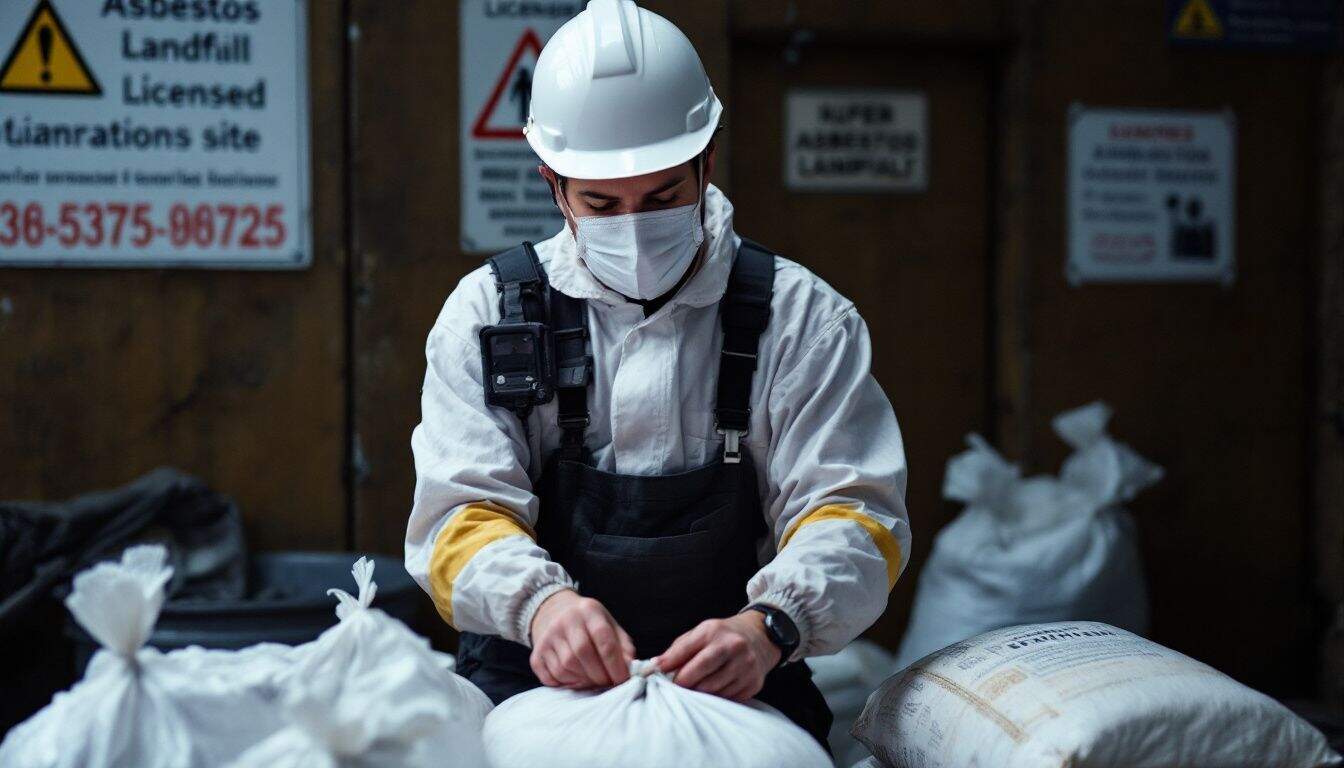
    Asbestos waste must be double-bagged in heavy-duty polythene bags (minimum 500-gauge thickness). Each bag must be sealed securely — typically with tape and a goose-neck tie — to prevent any leakage of fibres or dust.

    Larger pieces of ACM that cannot be bagged must be wrapped in at least two layers of heavy-duty polythene sheeting and sealed in the same way. The packaging must be robust enough to withstand normal handling during transport without tearing or splitting.

    Labelling Requirements

    Every package of asbestos waste must be clearly labelled. The label must include:

    • The word “ASBESTOS” prominently displayed
    • The type of asbestos contained (where known)
    • A warning that the material is hazardous
    • The name and address of the producer of the waste

    Labels must be durable and remain legible throughout transport and disposal. Using the correct UN hazard labels for hazardous goods is also required where loads are subject to ADR (transport of dangerous goods) regulations — typically when loads exceed 1,000kg of bonded asbestos.

    Asbestos Skips

    Where asbestos waste is placed in a skip for collection, the skip must be fitted with a lockable lid that remains secured during transport. Open-top skips are not acceptable for asbestos waste. The skip itself must be clearly marked to indicate it contains hazardous asbestos waste.

    Transporting Asbestos Waste Legally

    Moving asbestos waste from a site to a disposal facility is not something that can be done in an ordinary van without the right documentation and licensing. The law requires certified carriers who hold a valid Waste Carriers Licence issued by the Environment Agency (or SEPA in Scotland, or Natural Resources Wales in Wales).

    Waste Transfer Documentation

    Every movement of asbestos waste must be accompanied by a Hazardous Waste Consignment Note. This document records:

    1. The nature and quantity of the waste being transported
    2. The producer of the waste (the contractor or site owner)
    3. The carrier transporting it
    4. The destination facility receiving it

    Consignment notes must be kept for a minimum of three years. This creates an auditable paper trail — often called the duty of care chain — that demonstrates the waste was handled responsibly from site to final disposal.

    Failure to produce proper documentation is a criminal offence. The Environment Agency and local authorities carry out spot checks on waste carriers, and penalties for non-compliance can be severe.

    Disposal of Asbestos Waste: Licensed Landfill Sites

    Once packaged and transported correctly, asbestos waste in the UK can only be disposed of at licensed landfill sites that are authorised to accept hazardous waste. Not all landfills accept asbestos — only those with the appropriate environmental permit and dedicated asbestos disposal cells.

    How Licensed Landfills Handle Asbestos

    Asbestos is buried in dedicated cells within the landfill that are designed to contain hazardous materials long-term. These cells are lined to prevent leachate from contaminating groundwater, and asbestos layers are covered with non-asbestos material to suppress any dust.

    In Scotland, the Scottish Environment Protection Agency (SEPA) oversees the operation of these cells, carrying out regular inspections to ensure compliance with the Landfill Directive. Similar oversight is provided by the Environment Agency in England and Natural Resources Wales in Wales.

    Once a cell reaches capacity, it is capped and left undisturbed. The site’s environmental permit includes long-term aftercare obligations — the landfill operator cannot simply walk away once the cell is full.

    What Landfills Can and Cannot Accept

    Licensed landfill sites that accept asbestos must be permitted to receive waste containing more than 0.1% asbestos by weight. Below this threshold, some materials may be treated differently, but in practice, any material suspected of containing asbestos should be treated as hazardous until confirmed otherwise.

    It is illegal to dispose of asbestos waste at unlicensed sites, in skips not authorised for hazardous waste, or in general waste streams. Fly-tipping asbestos is a serious criminal offence carrying unlimited fines and potential imprisonment.

    Regulatory Framework: What the Law Requires

    Asbestos waste removal in the UK sits at the intersection of several pieces of legislation. Understanding which regulations apply — and when — is essential for anyone managing asbestos-containing materials.

    Control of Asbestos Regulations

    The Control of Asbestos Regulations are the primary piece of legislation governing all asbestos work in Great Britain. They set out the duty to manage asbestos in non-domestic premises, the licensing requirements for removal work, the training requirements for workers, and the standards for protective equipment and waste management.

    HSE guidance document HSG264 provides detailed technical guidance on how surveys should be conducted, but the Control of Asbestos Regulations underpin all enforcement activity.

    Environmental Protection Act

    The Environmental Protection Act establishes the duty of care for waste producers and carriers. Anyone who produces asbestos waste — including property owners who commission removal work — has a legal duty to ensure that waste is handled, transported, and disposed of responsibly.

    This means that even as a building owner, you cannot simply hand asbestos waste over to an unlicensed carrier and consider your obligations discharged. You have a continuing duty of care until the waste reaches a licensed disposal facility.

    COSHH Regulations

    The Control of Substances Hazardous to Health (COSHH) Regulations also apply to asbestos work. They require employers to assess the risks from hazardous substances and implement appropriate control measures. For asbestos, this means proper packaging, labelling, and transport arrangements that prevent worker or public exposure.

    The Asbestos Register and Your Duty to Manage

    Before any asbestos waste removal can take place, you need to know what you’re dealing with. For non-domestic premises — and increasingly for residential properties with multiple occupants — the duty to manage asbestos requires the responsible person to maintain an asbestos register.

    This register records the location, type, condition, and risk assessment of all known or presumed ACMs in the building. It forms the basis for any remediation decisions, including removal. Without a current and accurate register, you cannot effectively plan asbestos waste removal or demonstrate compliance.

    If you manage properties in London, our asbestos survey London service can help you establish or update your asbestos register quickly and accurately. Similarly, if your properties are in the North West, our asbestos survey Manchester team is available to carry out management or refurbishment surveys ahead of any planned removal work. For properties across the Midlands, our asbestos survey Birmingham service provides the same thorough approach.

    Common Mistakes to Avoid

    Even well-intentioned property managers and contractors make errors when it comes to asbestos waste removal. Here are the most common — and how to avoid them:

    • Using an unlicensed contractor: Always verify HSE licence status before work begins. Check the HSE’s public register of licensed contractors.
    • Inadequate packaging: Single-bagging or using standard bin bags is not acceptable. Use the correct gauge polythene and double-bag everything.
    • Missing documentation: Every movement of asbestos waste requires a consignment note. Keep copies for at least three years.
    • Disposing via general waste: Asbestos waste cannot go into general skips or household waste streams. It must go to a licensed hazardous waste facility.
    • No prior survey: Commencing removal work without a refurbishment and demolition survey (as required by HSG264) is a regulatory breach and a safety risk.
    • Assuming low-risk means no regulation: Even notifiable non-licensed work generates hazardous waste that must be disposed of correctly.

    Costs and Practical Considerations

    Asbestos waste removal costs vary considerably depending on the volume of material, the type of asbestos, the accessibility of the affected area, and the disposal facility used. Licensed removal work is more expensive than unlicensed work — but the cost of non-compliance, including enforcement notices, fines, and potential prosecution, is far greater.

    When budgeting for asbestos removal, factor in:

    • The cost of the pre-removal survey (refurbishment and demolition survey)
    • Licensed contractor fees for the removal itself
    • PPE and decontamination equipment
    • Packaging materials (specialist bags, polythene sheeting)
    • Transport by a licensed waste carrier
    • Disposal fees at a licensed landfill
    • Air monitoring during and after the work (required for licensed work)
    • A four-stage clearance procedure including a final air test before the area is reoccupied

    Getting multiple quotes from licensed contractors is sensible, but price should never be the only consideration. Check licences, insurance, and references before appointing anyone to carry out asbestos waste removal on your behalf.

    Frequently Asked Questions

    What makes asbestos waste different from other hazardous waste?

    Asbestos waste is classified as hazardous specifically because of the risk posed by airborne fibres. Unlike many other hazardous materials, asbestos fibres are microscopic, odourless, and invisible — meaning exposure can occur without any obvious warning. This is why packaging, transport, and disposal requirements are so stringent. The fibres do not break down in the environment, making proper containment at licensed landfill sites essential for long-term safety.

    Can I remove asbestos myself and dispose of it at a tip?

    For most asbestos-containing materials, no — you cannot legally remove or dispose of asbestos yourself without the appropriate licences and training. Some household waste recycling centres do accept small quantities of asbestos cement from domestic properties, but this varies by local authority and strict conditions apply. For any commercial property or significant quantity of ACMs, licensed contractors and licensed landfill disposal are legally required.

    How do I know if a waste carrier is licensed to transport asbestos?

    You can check whether a waste carrier is registered by searching the Environment Agency’s public register of waste carriers, brokers, and dealers in England. Similar registers exist in Scotland (SEPA) and Wales (Natural Resources Wales). A legitimate licensed carrier will also provide you with a copy of their Hazardous Waste Carriers Licence on request. Never allow asbestos waste to be collected by a carrier who cannot produce this documentation.

    What happens if asbestos waste is fly-tipped?

    Fly-tipping asbestos is a serious criminal offence in the UK. Penalties include unlimited fines and up to 12 months’ imprisonment on summary conviction, or up to five years on conviction on indictment. Local authorities and the Environment Agency have powers to investigate and prosecute fly-tipping, and they actively do so. If you discover fly-tipped asbestos, do not disturb it — contact your local authority or the Environment Agency immediately.

    Do I need an asbestos survey before removal work starts?

    Yes. Before any refurbishment or demolition work that may disturb asbestos, a refurbishment and demolition survey is required. This is set out in HSE guidance HSG264 and is a legal requirement under the Control of Asbestos Regulations. The survey identifies the location, type, and condition of all ACMs that may be disturbed, allowing the removal contractor to plan the work safely and compliantly. Skipping this step is both a regulatory breach and a significant safety risk.

    Work With Supernova Asbestos Surveys

    Supernova Asbestos Surveys has completed over 50,000 surveys across the UK, helping property owners, managers, and contractors stay compliant and keep people safe. Whether you need a management survey to update your asbestos register, a refurbishment and demolition survey ahead of planned works, or advice on the asbestos waste removal process, our experienced team is here to help.

    We operate nationwide, with specialist local teams covering London, Manchester, Birmingham, and beyond. To discuss your requirements, call us on 020 4586 0680 or visit asbestos-surveys.org.uk to request a quote or find out more about our services.

  • Are there any restrictions or regulations in place regarding asbestos in the UK?

    Are there any restrictions or regulations in place regarding asbestos in the UK?

    Get this wrong and you create two problems at once: unsafe asbestos work and a breach of the law. If you are asking how should you contact the health and safety executive to notify them if you intend to undertake notifiable non-licensed work?, the correct route is to notify the HSE online before the work starts, using the appropriate asbestos notification process for notifiable non-licensed work.

    That sounds straightforward, but the detail matters. For property managers, dutyholders, landlords, contractors and facilities teams, the issue is not just sending a form. You need to know whether the job is actually notifiable non-licensed work, what information the HSE expects, what records must be kept, and what employer duties continue after the notification is submitted.

    These duties sit within the wider framework of the Control of Asbestos Regulations, supported by HSE guidance and survey standards in HSG264. A poor decision at planning stage can delay works, expose staff and contractors, and lead to enforcement action that was entirely avoidable.

    How should you contact the health and safety executive to notify them if you intend to undertake notifiable non-licensed work?

    The accepted method is to contact the HSE through its online notification system before the work begins. For notifiable non-licensed work, there is no fixed waiting period in the same way as licensed asbestos work, but the notification still has to be made before the task starts.

    In practical terms, that means notification should be built into your pre-start process. Do not leave it until operatives are on site, tools are unpacked and access has been arranged. By that point, you are already too close to the line.

    A sensible order is:

    1. Review the asbestos information.
    2. Classify the work correctly.
    3. Prepare the risk assessment and plan of work.
    4. Confirm training, equipment and waste arrangements.
    5. Submit the HSE notification.
    6. Start work only once everything is in place.

    If anything changes before the job starts, review the classification again. A change in material condition, work method or scope can move a task from ordinary non-licensed work into notifiable non-licensed work, or from NNLW into licensed work.

    What is notifiable non-licensed work?

    Notifiable non-licensed work, usually shortened to NNLW, is asbestos work that does not require a licence but still carries enough risk to trigger additional legal duties. Those duties include notifying the HSE before the work starts, keeping records of the work, and arranging medical surveillance for workers who carry out NNLW.

    This matters because asbestos work generally falls into three broad categories:

    • Licensed work – higher-risk asbestos work that must be carried out by a licensed contractor.
    • Notifiable non-licensed work – lower risk than licensed work, but still notifiable and subject to extra duties.
    • Non-licensed work – lower-risk tasks that do not require a licence or notification, though they still require suitable controls, training and assessment.

    NNLW often applies where the material is in poor condition, where the task is likely to cause deterioration, or where the work is more than minor and short duration. The type of asbestos-containing material also matters, because some products are far more likely to release fibres than others.

    Examples of work that may fall under NNLW

    Every task needs its own assessment, but examples can include:

    • Removing asbestos cement sheets or products that are substantially damaged
    • Disturbing textured coatings in a way that is not minor and short duration
    • Lifting asbestos-containing floor tiles where backing or adhesive is significantly disturbed
    • Repairing or removing asbestos insulating board in limited circumstances that do not fall into licensed work but still create a notifiable risk
    • Cleaning up asbestos debris where the material condition increases the potential for exposure

    Do not rely on assumptions such as “cement is always low risk” or “small jobs never need notification”. The condition of the material, the work method and the likely fibre release are what count.

    When do you need to notify the HSE?

    You notify the HSE before work starts if the task has been correctly assessed as notifiable non-licensed work. You do not notify simply because asbestos is present in a building. Notification depends on the category of work being undertaken.

    how should you contact the health and safety executive to notify them if you intend to undertake notifiable non-licensed work? - Are there any restrictions or regulation

    If the task is licensed work, a different notification regime applies. If the task is genuinely non-licensed work and does not meet the threshold for NNLW, notification is not required. Even then, the rest of your asbestos duties still apply, including assessment, training and proper control measures.

    Questions to ask before deciding

    • What asbestos-containing material is involved?
    • What condition is it in?
    • Will the task cut, break, abrade or otherwise damage it?
    • Is the work sporadic and of low intensity?
    • How long will the task take?
    • Is fibre release likely to increase because of the planned method?
    • Could the work category change if the material is worse than expected once exposed?

    If you cannot answer those questions with confidence, stop and get competent advice. Classifying asbestos work by guesswork is one of the quickest ways to create a compliance problem.

    Reliable survey information is critical here. For occupied buildings and routine management, a current management survey helps identify asbestos-containing materials and their condition so maintenance teams are not working blind.

    What information should be included in the notification?

    The exact fields can vary depending on the HSE form, but the information must be clear, accurate and specific to the job. The HSE will expect enough detail to understand what is being done, where it is happening and how exposure will be controlled.

    You should be ready to provide:

    • The address where the work will take place
    • The nature of the asbestos-containing material
    • The type of task being carried out
    • The planned start date and expected duration
    • The number of workers involved
    • The control measures being used to limit fibre release
    • Decontamination arrangements
    • Waste handling and disposal arrangements
    • Employer and contractor details, where required by the form

    Keep the wording factual. Do not guess the asbestos product, extent or condition if you are not sure. Check the asbestos register, survey findings and any sampling information first.

    If there is uncertainty, resolve it before you notify. A weak notification usually reflects weak planning, and weak planning is what causes most asbestos failures on site.

    The legal framework behind notifiable non-licensed work

    NNLW sits under the Control of Asbestos Regulations. Those regulations place duties on employers, dutyholders and anyone controlling maintenance, repair or refurbishment work in premises where asbestos may be present.

    how should you contact the health and safety executive to notify them if you intend to undertake notifiable non-licensed work? - Are there any restrictions or regulation

    The aim is simple: prevent exposure where possible, and where exposure cannot be avoided, reduce it to the lowest level reasonably practicable. HSE guidance supports those duties by explaining how work should be assessed, classified and controlled.

    For survey work, HSG264 remains the recognised guidance for how asbestos surveys should be planned, carried out and reported. If you are relying on poor-quality survey information, the rest of your compliance process is built on weak foundations.

    Core duties that regularly affect property managers

    • Identify whether asbestos is present
    • Assess the risk from asbestos-containing materials
    • Maintain an up-to-date asbestos register
    • Provide relevant information to anyone liable to disturb asbestos
    • Ensure work is planned and carried out by competent people
    • Review whether the proposed task is licensed, notifiable non-licensed or non-licensed work

    If maintenance or refurbishment is planned without reliable asbestos information, the risk of accidental disturbance rises sharply. That can turn a manageable project into a site shutdown, with added cost and avoidable disruption.

    How to prepare before notifying the HSE

    Notification is not a substitute for planning. The HSE expects the work to be properly assessed before the notification is sent, not worked out afterwards.

    1. Check the asbestos information

    Start with the asbestos register and relevant survey report. If the information is old, unclear or does not cover the exact work area, update it before approving the job.

    If you are planning works in the capital, a current asbestos survey London service can help confirm the material type, location and condition before contractors attend site.

    The same principle applies elsewhere. For northern commercial sites, arranging an asbestos survey Manchester inspection can prevent assumptions being made about older premises and hidden materials.

    For projects in the Midlands, an asbestos survey Birmingham assessment is often the first practical step before any intrusive work is approved.

    2. Carry out a task-specific risk assessment

    Do not copy a generic risk assessment from another site. The assessment should deal with the exact material, its condition, the proposed work method, likely fibre release, who may be affected and what happens if the condition is worse than expected.

    A useful risk assessment should answer:

    • Why the work has been classified as NNLW
    • What controls will prevent or reduce exposure
    • How the work area will be segregated
    • What PPE and RPE are required
    • How waste will be handled
    • What emergency arrangements are in place

    3. Produce a clear plan of work

    The plan of work should explain exactly how the task will be completed. If the document is vague, the job is not ready to start.

    It should include:

    • The sequence of the task
    • The tools and methods to be used
    • How dust and debris will be controlled
    • Access restrictions and signage
    • Decontamination steps
    • Waste packaging, labelling and removal arrangements

    4. Verify competence and training

    Anyone carrying out NNLW must have suitable asbestos training for the work they do. Supervisors should also understand how to recognise when actual site conditions no longer match the plan.

    Ask for evidence. Do not assume training is in place because a contractor says they “deal with asbestos jobs all the time”.

    5. Arrange waste handling in advance

    Asbestos waste cannot be treated like standard construction waste. Packaging, labelling, transport and disposal arrangements need to be confirmed before work begins.

    If the task is likely to escalate, or if the material condition is poor, using a specialist asbestos removal contractor may be the safer and more practical option.

    Records, medical surveillance and employer duties after notification

    Once work is classified as NNLW, the employer takes on duties that go beyond simply submitting the form. This is where many smaller contractors fall short.

    Record keeping

    You should keep a record of each notifiable non-licensed job. That record should allow you to show:

    • What work was done
    • Where it took place
    • When it was carried out
    • Who carried it out
    • What asbestos-containing material was involved
    • What control measures were used

    Those records should be organised and easy to retrieve. If the HSE asks for them, you should not be searching through old emails, permit files and site diaries trying to rebuild the sequence.

    Medical surveillance

    Workers who carry out NNLW are subject to medical surveillance requirements. Employers should make sure this is arranged through an appropriate occupational health route and that records are retained as required.

    This is one of the clearest signs that NNLW is not “light-touch” asbestos work. Even where a licence is not needed, the law still treats the exposure risk seriously.

    Information sharing

    Facilities managers should make sure that contractors, in-house maintenance teams and project managers all have access to the same asbestos information. Many incidents happen because one party assumed someone else had checked the register.

    A practical rule works well on most sites: no intrusive work starts until the asbestos information has been reviewed, the work category has been confirmed and the controls have been signed off.

    Common mistakes when dealing with NNLW notification

    Most failures are avoidable. They usually happen because the classification was rushed, the survey information was poor, or asbestos paperwork was treated as an afterthought.

    Frequent errors to avoid

    • Using the wrong work category – classifying licensed work as NNLW, or NNLW as ordinary non-licensed work
    • Notifying too late – sending the notification after the work has started
    • Relying on old survey data – using reports that do not reflect the actual work area or current material condition
    • Submitting vague information – incomplete descriptions of the material, task or controls
    • Weak plans of work – no clear method, decontamination steps or waste procedure
    • Poor contractor checks – assuming competence without verifying training and experience
    • No clear records – being unable to show what was done and by whom

    If your organisation regularly undertakes maintenance in older buildings, build an asbestos review into every permit-to-work or pre-start checklist. That single step prevents a large share of avoidable mistakes.

    Practical advice for property managers and dutyholders

    If you oversee multiple sites, consistency matters more than good intentions. A repeatable process helps you make the right decision every time, even when different contractors and project managers are involved.

    A workable site process

    1. Check whether the age and history of the building suggest asbestos is likely to be present.
    2. Review the asbestos register and relevant survey report.
    3. Confirm whether the proposed task is non-licensed, notifiable non-licensed or licensed work.
    4. Require a task-specific risk assessment and plan of work.
    5. Check contractor competence, training and supervision.
    6. Confirm waste arrangements and emergency procedures.
    7. Submit the HSE notification where the work is NNLW.
    8. Keep records of the work and monitor completion.

    This process is especially useful across portfolios that include schools, offices, retail sites, industrial units and residential blocks. The details of the job may change, but the decision-making structure should not.

    When to pause the job

    Stop and review the work if:

    • The material is in worse condition than expected
    • The scope expands beyond the original plan
    • The contractor wants to change the method on site
    • The survey does not clearly cover the work area
    • There is disagreement about whether the work is NNLW or licensed

    Pausing for a proper review is far better than pressing ahead with the wrong classification. Most asbestos enforcement problems start with someone deciding to “just get on with it”.

    Why good survey information matters before any notification

    You cannot classify asbestos work properly if you do not know what material is present, what condition it is in or how likely it is to release fibres. That is why survey quality matters so much.

    HSG264 sets the standard for how asbestos surveys should be planned, carried out and reported. A reliable survey gives you the information needed to decide whether work is licensed, notifiable non-licensed or non-licensed. A poor survey leaves too much room for assumption.

    For property managers, the practical takeaway is simple:

    • Keep your asbestos register current
    • Make sure surveys match the planned works
    • Do not send contractors into areas that are not properly assessed
    • Review survey findings before approving any intrusive task

    If the information is incomplete, update it first. Notification should be based on evidence, not optimism.

    Frequently Asked Questions

    How should you contact the health and safety executive to notify them if you intend to undertake notifiable non-licensed work?

    You should contact the HSE through its online asbestos notification system before the work starts. Notifiable non-licensed work must be notified in advance, even though it does not follow the same notification timetable as licensed asbestos work.

    Do you need to notify the HSE every time asbestos is present?

    No. The presence of asbestos alone does not trigger notification. You notify the HSE when the planned task has been correctly assessed as notifiable non-licensed work. Some lower-risk non-licensed tasks do not require notification, although they still require proper controls and training.

    What happens if you start NNLW before notifying the HSE?

    Starting notifiable non-licensed work before notification creates a compliance breach and may expose workers to unmanaged risk. If this happens, stop the work, review the classification and planning, and take competent advice before any restart is considered.

    Does notifiable non-licensed work require a licensed contractor?

    Not always. By definition, NNLW does not require a licence, but it still requires competent people, suitable training, proper controls, records and medical surveillance. If the risk is higher than first thought, the work may actually fall into the licensed category and should be reassessed immediately.

    What records should be kept for notifiable non-licensed work?

    You should keep records showing what work was carried out, where and when it happened, who completed it, what asbestos-containing material was involved and what control measures were used. Employers also need to address medical surveillance duties for workers carrying out NNLW.

    Need expert help with asbestos compliance?

    If you are unsure whether a task is non-licensed, notifiable non-licensed or licensed work, get the asbestos information checked before anyone starts. Supernova Asbestos Surveys carries out surveys nationwide for commercial, public sector and residential clients, helping dutyholders make clear, compliant decisions before work begins.

    For expert advice, asbestos surveys and support with planning works safely, call 020 4586 0680 or visit asbestos-surveys.org.uk.