Category: Asbestos

  • Legislation and Enforcement: The UK’s Efforts to Tackle Asbestos

    Legislation and Enforcement: The UK’s Efforts to Tackle Asbestos

    How UK Legislation Enforcement Tackles Asbestos — What Every Dutyholder Must Know

    Asbestos still kills around 5,000 people every year in the UK — more than any other single work-related cause of death. Despite a complete ban on its use, asbestos-containing materials (ACMs) remain present in millions of buildings constructed before 2000. Legislation enforcement in the UK’s efforts to tackle asbestos has evolved considerably over the decades, and understanding where the law stands today is essential for anyone responsible for a non-domestic property.

    Whether you manage a school, an office block, a warehouse, or a block of flats, the legal framework is clear — and the consequences of getting it wrong are serious. This post sets out exactly what the law requires, who enforces it, and what you should be doing right now to stay on the right side of it.

    The Core Legal Framework: Control of Asbestos Regulations

    The Control of Asbestos Regulations consolidate earlier legislation into a single, coherent set of rules governing how asbestos must be identified, managed, and worked with safely across Great Britain. These regulations apply to employers, building owners, contractors, and anyone who has control over premises where asbestos may be present.

    The key obligations under the regulations include:

    • Identifying all asbestos-containing materials in non-domestic premises
    • Assessing the condition and risk posed by those materials
    • Maintaining an up-to-date asbestos register and management plan
    • Ensuring workers who may disturb ACMs are properly trained
    • Providing appropriate personal protective equipment (PPE) and health surveillance
    • Conducting regular air monitoring during notifiable work

    Certain types of asbestos work require a licence issued by the Health and Safety Executive (HSE). Licensed work typically involves materials more likely to release fibres — such as asbestos insulating board, lagging, and sprayed coatings. Unlicensed work still carries strict obligations, including notification requirements in some cases.

    The Duty to Manage: Regulation 4 Explained

    Regulation 4 of the Control of Asbestos Regulations places a legal duty to manage asbestos on those who own or are responsible for non-domestic premises. This duty requires the responsible person to take reasonable steps to find out whether ACMs are present, assess their condition, and put in place a written management plan.

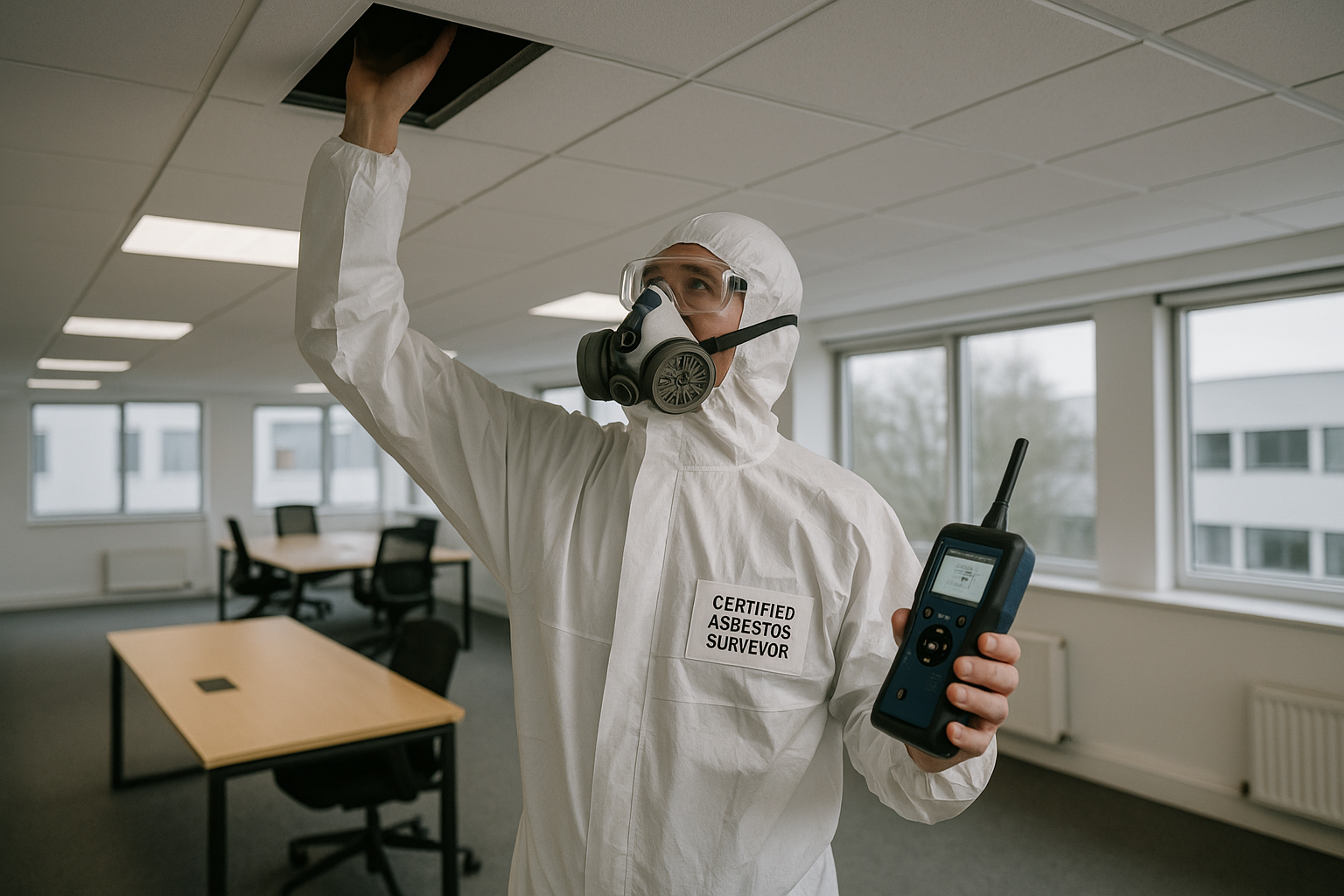
    A management survey is the standard method for fulfilling this duty. It involves a qualified surveyor inspecting accessible areas of the building, taking samples from suspect materials, and producing a risk-rated asbestos register — the backbone of your legal compliance.

    Failing to meet the duty to manage is a criminal offence. It is not a technicality — it is a fundamental legal obligation that protects everyone who enters or works in your building.

    Who Enforces Asbestos Legislation in the UK?

    Enforcement responsibility is divided between several bodies, depending on the type of premises and the nature of the work taking place. Knowing which authority oversees your premises is the first step to understanding your compliance obligations.

    The Health and Safety Executive (HSE)

    The HSE is the primary enforcer of asbestos legislation across most sectors. It oversees licensed asbestos work, construction sites, and industrial premises, and maintains the licensing regime for contractors carrying out the most hazardous asbestos removal work.

    In practice, the HSE’s enforcement activity includes:

    • Inspecting new licence holders within four to six months of a licence being granted
    • Prioritising visits to licence holders with a history of poor performance or previous warnings
    • Directing a significant proportion of site visits to premises where asbestos insulating board work is being carried out
    • Investigating complaints and incidents involving asbestos exposure
    • Issuing improvement notices, prohibition notices, and prosecutions where breaches are found

    The penalties available to the HSE are substantial. Courts can impose unlimited fines for serious breaches of asbestos regulations, and individuals — including directors and managers — can face up to two years’ imprisonment. Enforcement notices are recorded on a public register, which can damage a contractor’s or employer’s reputation and affect their ability to win future contracts.

    Local Authorities

    Local Authority Environmental Health Officers take on enforcement responsibility for a broad range of commercial premises. These include retail outlets, wholesale operations, warehousing facilities, hotels, catering businesses, offices, and leisure facilities.

    If you manage any of these types of premises, your primary point of contact for asbestos compliance is likely to be your Local Authority rather than the HSE directly. Local Authorities have the same legal powers as the HSE — they can issue notices, prosecute dutyholders, and require immediate remedial action where an imminent risk to health is identified.

    The Office of Rail and Road (ORR)

    The Office of Rail and Road holds enforcement responsibility for asbestos management across the rail network, covering railway stations, maintenance depots, and other railway premises. Given the age of much of the UK’s rail infrastructure, asbestos remains a significant concern in this sector, and the ORR works closely with the HSE to ensure consistent standards are applied.

    What Triggers an Enforcement Visit?

    Understanding what draws regulatory attention helps dutyholders take a proactive approach rather than waiting to be caught out. The HSE and Local Authorities do not rely solely on reactive investigations — they carry out planned inspection programmes targeting higher-risk premises and activities.

    Common triggers for enforcement visits include:

    • Complaints from workers or members of the public about suspected asbestos disturbance
    • Notification of licensed asbestos work (all licensable work must be notified to the enforcing authority in advance)
    • A history of non-compliance or previous enforcement action
    • Incidents or near-misses involving potential asbestos exposure
    • Routine sector-specific inspection campaigns
    • Intelligence gathered from other regulatory activity

    If your premises are subject to a visit and your asbestos management arrangements are found to be inadequate — whether that means no asbestos register, an out-of-date management plan, or workers disturbing ACMs without proper controls — enforcement action is likely to follow.

    In higher-risk locations such as older commercial buildings in major cities, this scrutiny is particularly acute. If you manage property in the capital, arranging an asbestos survey London from an accredited provider is an essential starting point for demonstrating compliance. Similarly, dutyholders managing properties in the Midlands should ensure they have current surveys in place — an asbestos survey Birmingham from a qualified team gives you the documented evidence you need. For those responsible for properties in the North West, an asbestos survey Manchester is equally important before enforcement officers come knocking.

    Survey Requirements: Matching the Right Survey to the Situation

    One of the most common compliance failures is using the wrong type of asbestos survey for the situation. The HSE’s guidance document HSG264 sets out clearly what is required and when. Getting this right is not optional — it is a legal requirement.

    Management Surveys

    A management survey is required for the ongoing management of ACMs in a building during normal occupation. It covers all accessible areas and provides the information needed to maintain an asbestos register and management plan.

    This is the survey most dutyholders need as a baseline, and it forms the foundation of any credible compliance programme. Without one, you cannot demonstrate that you have taken reasonable steps to identify ACMs — and that alone is enough to attract enforcement action.

    Refurbishment and Demolition Surveys

    Before any refurbishment, renovation, or demolition work begins, a refurbishment survey is legally required for the areas to be disturbed. This is a more intrusive survey — it involves destructive inspection to locate ACMs that would not be accessible during normal occupation.

    Starting refurbishment work without this survey in place puts workers at serious risk and leaves the dutyholder exposed to prosecution. For full demolition projects, a demolition survey is required — the most thorough type of survey, covering the entire structure before any demolition activity begins.

    Re-inspection Surveys

    Where ACMs are known to be present and are being managed in situ rather than removed, they must be re-inspected at regular intervals to check their condition has not deteriorated. A re-inspection survey provides the updated condition data needed to maintain an accurate management plan and demonstrate ongoing compliance with the duty to manage.

    Skipping re-inspections is a common oversight — and one that enforcement officers will pick up on immediately if they visit your premises. If your last re-inspection was more than twelve months ago, it is time to book another one.

    Legislation Enforcement in the UK’s Efforts to Tackle Asbestos: Recent and Proposed Updates

    The legislative landscape around asbestos is not static. There is ongoing discussion in the UK about strengthening existing controls to better reflect the scale of the risk that remains in the built environment. Legislation enforcement in the UK’s efforts to tackle asbestos is moving in one direction: tighter, not looser.

    Proposals under consideration and areas of active regulatory development include:

    • Stricter controls on lower-risk ACMs — Growing pressure to extend tighter controls to materials currently classified as non-licensed, particularly where cumulative exposure over time may be significant.
    • Enhanced training requirements — Proposals for more rigorous and standardised training for workers who may encounter asbestos during maintenance and refurbishment activities.
    • Improved survey standards — Calls for higher minimum standards in asbestos surveying, including greater consistency in how risk is assessed and reported.
    • Digital asbestos registers — Increasing support for a move towards digital record-keeping, making asbestos information more accessible to contractors, emergency services, and new building occupants.
    • Higher penalties for non-compliance — Proposals to increase financial penalties as a more effective deterrent, particularly for repeat offenders and larger organisations.

    The direction of travel is clear: the regulatory burden on dutyholders is likely to increase, not decrease. Getting your compliance arrangements in order now puts you in a much stronger position regardless of how the legislation develops.

    The Link Between Asbestos Management and Fire Safety

    Asbestos management and fire safety are more closely connected than many dutyholders realise. Disturbing ACMs during a fire — or during fire-stopping and compartmentation work — can release fibres and create a secondary hazard alongside the fire risk itself.

    If your building contains known ACMs, this information must be factored into your fire risk assessment and shared with any contractors carrying out fire safety upgrades. Failing to do so is not only a breach of asbestos regulations — it may also constitute a failure under fire safety legislation.

    The two compliance regimes reinforce each other, and a joined-up approach is both legally sound and practically sensible. Any competent fire risk assessor working in a pre-2000 building should be asking about your asbestos register before they begin.

    When ACMs Must Be Removed Rather Than Managed

    Not all ACMs can or should be managed in place indefinitely. Where materials are in poor condition, are at high risk of disturbance, or are located in areas that are about to be refurbished or demolished, asbestos removal by a licensed contractor is the appropriate course of action.

    Licensed removal must be notified to the relevant enforcing authority — either the HSE or your Local Authority — at least 14 days before work begins. The contractor must hold a current HSE licence, and the work must be carried out in accordance with a written plan of work that details the methods, controls, and supervision arrangements.

    Once removal is complete, a four-stage clearance procedure is required before the area can be reoccupied. This includes a thorough visual inspection, air testing by an independent analyst, and the issue of a certificate of reoccupation. Cutting corners at this stage is a serious regulatory breach — and one that enforcement bodies actively look for.

    Practical Steps to Ensure You Are Compliant Right Now

    Compliance with asbestos legislation is not a one-off exercise — it is an ongoing obligation. If you are unsure where you stand, the following steps will help you identify any gaps quickly.

    1. Check whether you have a current asbestos register and management plan. If your building was constructed before 2000 and you do not have one, commissioning a management survey should be your immediate priority.
    2. Confirm your last re-inspection date. ACMs being managed in situ must be re-inspected regularly — typically annually, though the frequency should reflect the risk. If you are overdue, arrange a re-inspection now.
    3. Ensure your management plan is being actively followed. An asbestos register sitting in a filing cabinet that nobody reads is not compliance. Your plan must be communicated to relevant staff and contractors, and reviewed whenever circumstances change.
    4. Check survey coverage before any building work begins. If you are planning any maintenance, refurbishment, or demolition work, confirm whether a refurbishment or demolition survey is needed before work starts — not after.
    5. Integrate asbestos information into your fire safety arrangements. Make sure your fire risk assessor and any fire safety contractors have access to your asbestos register.
    6. Verify that any contractors working with ACMs are appropriately licensed and notified. Using an unlicensed contractor for licensable work is a criminal offence for both the contractor and the dutyholder who appointed them.

    The Cost of Getting It Wrong

    The financial and reputational consequences of asbestos non-compliance are significant. Courts have consistently handed down substantial fines to organisations — and individuals — found to have breached their asbestos duties, particularly where workers or members of the public have been exposed to fibres as a result.

    Beyond the financial penalties, enforcement notices are publicly recorded. For businesses that rely on contracts, tenders, or public sector work, a notice on the public register can be damaging in ways that go well beyond the immediate fine. Directors and senior managers can face personal liability, including custodial sentences in the most serious cases.

    The reputational damage of being associated with an asbestos exposure incident — particularly one involving employees or members of the public — can be long-lasting and difficult to recover from. The cost of maintaining proper compliance is a fraction of the cost of getting it wrong.

    Frequently Asked Questions

    Who is responsible for managing asbestos in a non-domestic building?

    The duty to manage asbestos falls on the person or organisation that has control over the premises. This is typically the building owner, employer, or managing agent. Under Regulation 4 of the Control of Asbestos Regulations, this person — known as the dutyholder — must take reasonable steps to identify ACMs, assess their condition, and put in place a written management plan.

    What happens if I do not have an asbestos register?

    Operating a non-domestic premises without an asbestos register — where one is required — is a breach of the Control of Asbestos Regulations and a criminal offence. Enforcement action can include improvement notices, prohibition notices, prosecution, and unlimited fines. The HSE or your Local Authority can require you to commission a survey and produce a register as a condition of continued lawful operation of the premises.

    Do I need a new survey before refurbishment work?

    Yes. A management survey is not sufficient for refurbishment or demolition work. HSG264 requires a refurbishment survey — or demolition survey for full demolition projects — to be carried out before work begins in the affected areas. Starting work without the appropriate survey in place exposes workers to potential asbestos fibre release and leaves you personally liable for prosecution.

    How often do ACMs need to be re-inspected?

    There is no single fixed interval prescribed in law, but in practice most asbestos management plans require re-inspection at least annually. The appropriate frequency depends on the condition, type, and location of the ACMs, and the level of activity in the building. Your management plan should specify re-inspection intervals, and these must be followed to maintain compliance with the duty to manage.

    Can I manage asbestos myself, or does it require a licensed contractor?

    Some lower-risk asbestos work can be carried out by trained but unlicensed workers, subject to strict conditions. However, work involving materials such as asbestos insulating board, lagging, and sprayed coatings — or any work likely to result in significant fibre release — must be carried out by an HSE-licensed contractor. Using an unlicensed contractor for licensable work is a criminal offence for both the contractor and the dutyholder who commissioned the work.

    Get Your Asbestos Compliance Right With Supernova

    Supernova Asbestos Surveys has completed over 50,000 surveys across the UK, helping dutyholders in every sector stay compliant, protect their people, and avoid enforcement action. Our UKAS-accredited surveyors work to HSG264 standards and cover the full range of survey types — from routine management surveys to pre-demolition inspections.

    Whether you need a first-time survey, an overdue re-inspection, or advice on how to bring your asbestos management arrangements up to standard, our team is ready to help. Call us on 020 4586 0680 or visit asbestos-surveys.org.uk to book your survey or request a quote today.

  • The History of Asbestos Use and its Deadly Consequences

    The History of Asbestos Use and its Deadly Consequences

    From Ancient Wonder to Modern Hazard: The History of Asbestos Use and Its Deadly Consequences

    Few materials have travelled as far in human esteem as asbestos — from revered wonder of the ancient world to one of the most tightly regulated substances on the planet. The history of asbestos use and its deadly consequences spans thousands of years, multiple continents, and an industrial boom that left a legacy of disease still claiming lives today.

    Understanding how we got here matters — not just for historical curiosity, but because millions of UK buildings still contain asbestos-containing materials (ACMs) installed during the peak decades of use. If you manage, own, or work in a property built before 2000, this history is directly relevant to your legal duties right now.

    The Ancient Origins of Asbestos: A Mineral Wrapped in Myth

    Long before asbestos became an industrial commodity, ancient civilisations were already putting it to work. Artisans in what is now Finland mixed asbestos fibres with clay to produce flame-resistant pottery as far back as 2500 BC. In Egypt, the material appeared in embalming practices, and it was used in lamp and candle wicks thousands of years before the modern era.

    The Greek historian Herodotus documented asbestos shrouds, noting how they kept cremated ashes separate from wood embers. Chrysotile asbestos from Cyprus and tremolite asbestos from Italy were both in use across the ancient Mediterranean world. The Romans reportedly wove it into napkins that could be cleaned simply by throwing them into fire.

    The myths surrounding asbestos were as durable as the fibre itself. Some ancient writers claimed it came from the fur of a salamander that lived in flame. Others believed it was the hair of a creature that thrived in volcanoes. These stories speak to just how extraordinary the material seemed — a substance that would not burn, would not rot, and could be spun like wool.

    Even military applications emerged early. During the First Crusade in 1095, knights reportedly used asbestos bags in flaming trebuchet projectiles, combining the material’s fire resistance with devastating effect on enemy fortifications. The ancient world’s relationship with asbestos was one of wonder — but the consequences of that relationship would not become clear for centuries.

    The Industrial Revolution: When Asbestos Became Big Business

    The ancient world’s fascination with asbestos was nothing compared to what the Industrial Revolution unleashed. As factories multiplied, steam engines roared, and cities expanded at pace, the demand for fireproofing and insulation became urgent. Asbestos answered that call perfectly.

    The first commercial asbestos mines opened in the 1870s in Quebec, Canada. Industrial-scale mining quickly followed in Scotland, Germany, and England, and Australia joined the extraction boom in the 1880s. By the early 1900s, global asbestos production exceeded 30,000 tonnes annually — and by 1910, world production had reached 109,000 metric tonnes, more than triple the figure from just a decade earlier.

    The trajectory only steepened from there. US asbestos consumption alone peaked at over 800,000 tonnes in the early 1970s, a figure that reflects just how thoroughly the material had embedded itself into construction, manufacturing, and shipbuilding worldwide.

    Where Was Asbestos Used?

    During the peak decades of use, asbestos turned up in an extraordinary range of applications across virtually every sector of the built environment:

    • Pipe and boiler insulation in factories, power stations, and ships
    • Sprayed coatings on structural steelwork for fire protection
    • Ceiling and floor tiles in schools, offices, and hospitals
    • Roof sheeting and guttering on commercial and domestic buildings
    • Insulating board used as partition walls and around heating systems
    • Textured decorative coatings such as Artex on ceilings
    • Gaskets, brake linings, and clutch pads in vehicles and machinery
    • Fire blankets, protective clothing, and theatre curtains

    In the UK, asbestos use in construction was at its height from the 1950s through to the mid-1980s. Any building constructed or significantly refurbished during this period is likely to contain ACMs somewhere. That is why a management survey remains the essential first step for any dutyholder responsible for a non-domestic property built before 2000.

    The First Warnings: When Evidence of Harm Began to Emerge

    The history of asbestos use and its deadly consequences is also a history of warnings ignored. The first documented death from asbestos-related pulmonary failure was recorded by Dr Montague Murray in London in 1906. The victim was a young man who had spent years working in an asbestos textile factory, and his lungs — examined post-mortem — were found to contain asbestos fibres.

    The British Medical Journal published warnings about the hazards of asbestos dust in the 1920s. Factory inspectors in the UK were raising alarms through the same decade, and by 1931, the UK had introduced the Asbestos Industry Regulations — some of the earliest occupational health legislation in the world specifically addressing asbestos dust.

    Yet production continued to climb. The economic incentives were enormous, the material was genuinely useful, and the latency period of asbestos-related diseases — often 20 to 50 years between exposure and diagnosis — meant that the full scale of the harm was slow to become visible in public health data.

    The gap between what was known in medical and regulatory circles and what was acted upon industrially remains one of the most troubling aspects of this story. Manufacturers and employers had access to evidence of harm long before meaningful action was taken to protect workers.

    The Diseases Asbestos Causes

    Asbestos fibres, when disturbed, release microscopic particles that can be inhaled deep into the lungs. Once lodged there, the body cannot expel them. Over years and decades, they cause serious and often fatal disease.

    Mesothelioma

    Mesothelioma is a cancer of the lining of the lungs, abdomen, or heart, almost exclusively caused by asbestos exposure. It is aggressive, incurable, and typically diagnosed late — often decades after the original exposure. There is no meaningful treatment that offers a cure, only management of symptoms and life extension in some cases.

    Asbestos-Related Lung Cancer

    Similar in presentation to lung cancer from other causes, asbestos-related lung cancer is directly linked to fibre inhalation. It carries a particularly elevated risk in those who also smoked — the combination of asbestos exposure and smoking dramatically multiplies the risk compared to either factor alone.

    Asbestosis

    Asbestosis is a chronic scarring of lung tissue that causes progressive breathlessness and, in severe cases, respiratory failure. It develops after prolonged, heavy exposure and has no cure. Those affected face a slow deterioration in lung function that significantly affects quality of life.

    Pleural Disease

    Pleural plaques and pleural thickening are changes to the lining of the lungs that can restrict breathing and serve as markers of past exposure. While pleural plaques themselves are not cancerous, their presence indicates that asbestos fibres have reached the pleura — and that the risk of more serious disease remains elevated.

    There is no safe level of asbestos exposure. Even relatively brief contact with high concentrations of fibres carries risk, and the diseases it causes are irreversible. This is why the regulatory response, when it finally came, was so sweeping — and why the duty to manage asbestos in existing buildings remains so serious today.

    The Global Regulatory Response: Banning a Killer

    By the latter half of the twentieth century, the scientific evidence linking asbestos to fatal disease was overwhelming and irrefutable. Governments around the world began to act, though the pace varied considerably by country and by type of asbestos.

    The UK banned blue asbestos (crocidolite) and brown asbestos (amosite) in 1985. White asbestos (chrysotile) — long argued by industry to be less dangerous — was not banned in the UK until 1999. That ban brought the UK in line with a growing international consensus.

    The European Union prohibited asbestos entirely in 2005, and many other countries followed with full or partial bans through the 1990s and 2000s. In the United States, the process was considerably slower — a comprehensive federal ban on chrysotile asbestos was not finalised until 2024, a significant development for a country that had long resisted full prohibition.

    The bans, however significant, did not make the problem disappear. Decades of intensive use mean that asbestos is still present in an enormous number of buildings across the UK and around the world. The regulatory focus shifted from preventing new use to managing what remained in place.

    The UK Legal Framework Today

    In Great Britain, the management of asbestos is governed by the Control of Asbestos Regulations, which place a legal duty on the owners and managers of non-domestic premises to identify ACMs, assess their condition, and manage the risk they pose. This is known as the duty to manage, and it applies to a wide range of property types — from offices and schools to warehouses and communal areas of residential blocks.

    The HSE’s guidance document HSG264 sets out exactly how surveys must be conducted and what they must cover. Dutyholders who fail to comply face significant financial penalties and, more seriously, risk exposing workers, tenants, and visitors to a known carcinogen.

    Refurbishment and Demolition Work

    If you are planning renovation or demolition work, a refurbishment survey is legally required before work begins. This is a more intrusive survey that locates ACMs in the specific areas where work will take place, ensuring contractors are not unknowingly disturbing asbestos-containing materials.

    Ongoing Monitoring Duties

    For properties where an asbestos register already exists, a re-inspection survey must be carried out periodically to check whether the condition of known ACMs has changed. Asbestos in good condition and left undisturbed poses minimal risk — but that condition can change over time, and regular monitoring is a legal requirement under the Control of Asbestos Regulations.

    The Continuing Legacy: Asbestos in UK Buildings Today

    The ban on asbestos in the UK did not make the problem disappear overnight. Schools, hospitals, offices, warehouses, and residential properties all potentially contain ACMs — particularly those built or refurbished between the 1950s and 1980s. The HSE consistently identifies asbestos-related disease as the leading single work-related cause of death in the UK, and the long latency of mesothelioma means that exposure from decades past is still producing diagnoses today.

    Tradespeople are particularly at risk. Electricians, plumbers, joiners, and other construction workers who regularly work in older buildings may encounter asbestos without knowing it. Raising awareness of where ACMs are likely to be found — and ensuring that proper surveys are carried out before any intrusive work begins — is essential to preventing new cases of asbestos-related disease in the coming decades.

    The history of asbestos use and its deadly consequences is not simply a matter of the past. It is an active, ongoing public health issue that requires vigilance from every property owner, manager, and tradesperson working in the UK’s existing building stock.

    What to Do If You Suspect Asbestos in Your Property

    If you suspect a material in your property may contain asbestos, the first rule is straightforward: do not disturb it. Asbestos in good condition and left undisturbed is generally low risk. The danger arises when fibres are released into the air through cutting, drilling, sanding, or breaking.

    Your practical options are:

    1. Commission a professional survey — the most reliable way to identify and assess ACMs in your property, carried out by a qualified surveyor who will produce a written register and management plan.
    2. Do not attempt DIY sampling — taking samples without proper training and equipment can release fibres and is not recommended. A professional will collect samples safely and send them to an accredited laboratory for analysis.
    3. Keep records — once a survey has been completed, maintain the asbestos register and ensure anyone carrying out work on the premises is made aware of its contents before they begin.
    4. Review regularly — ACMs can deteriorate over time. A periodic re-inspection keeps your register accurate and your legal duties met.
    5. Act before any refurbishment — never commission building work in an older property without first establishing whether ACMs are present in the affected areas.

    Supernova Asbestos Surveys operates nationally, with specialist teams covering major urban areas. Whether you need an asbestos survey in London, an asbestos survey in Manchester, or an asbestos survey in Birmingham, our accredited surveyors can help you meet your legal obligations and protect the people who use your building.

    Speak to Supernova Asbestos Surveys

    With over 50,000 surveys completed across the UK, Supernova Asbestos Surveys has the experience, accreditation, and national reach to support property owners and managers at every stage — from initial identification through to ongoing monitoring and compliance.

    Call us on 020 4586 0680 or visit asbestos-surveys.org.uk to book a survey or speak to one of our qualified surveyors about your property’s specific requirements.

    Frequently Asked Questions

    When was asbestos banned in the UK?

    The UK banned blue asbestos (crocidolite) and brown asbestos (amosite) in 1985. White asbestos (chrysotile) was banned in 1999, completing a full prohibition on the import, supply, and use of all forms of asbestos in Great Britain.

    Why is asbestos still a problem if it has been banned?

    The ban prevented new asbestos from being installed, but it did not remove what was already in place. Decades of intensive use mean that ACMs remain present in a very large number of UK buildings, particularly those constructed or refurbished between the 1950s and 1980s. Managing that legacy material safely is an ongoing legal and public health responsibility.

    What diseases does asbestos exposure cause?

    Asbestos exposure is linked to several serious conditions, including mesothelioma (a cancer of the lung lining), asbestos-related lung cancer, asbestosis (chronic scarring of lung tissue), and pleural disease. All of these conditions have long latency periods, meaning symptoms may not appear until 20 to 50 years after exposure.

    Do I legally need an asbestos survey?

    If you are the owner or manager of a non-domestic property built before 2000, the Control of Asbestos Regulations place a legal duty on you to identify and manage ACMs. A management survey is the standard way to fulfil this duty. A refurbishment survey is additionally required before any renovation or demolition work takes place.

    Is asbestos dangerous if left undisturbed?

    Asbestos in good condition and left undisturbed poses a low risk, as fibres are only hazardous when they become airborne. However, ACMs can deteriorate over time, and their condition must be monitored regularly. The risk increases significantly when materials are damaged, disturbed, or subject to building work — which is why professional surveys and periodic re-inspections are so important.

  • Types of Asbestos: A Practical Guide

    Types of Asbestos: A Practical Guide

    Misidentifying suspect materials is one of the fastest ways to turn ordinary maintenance into an avoidable asbestos incident. When you are dealing with the types of asbestos that still exist in UK properties, the safest rule is simple: if a material could contain asbestos, do not disturb it until it has been properly surveyed and, where needed, sampled.

    That applies whether you manage a single rented house, a school estate, a retail unit, a warehouse or a multi-site commercial portfolio. You cannot confirm asbestos by eye, colour alone is not reliable, and the real risk depends on the material, its condition and the likelihood of disturbance as much as the mineral itself.

    What are the types of asbestos?

    Asbestos is the name used for a group of six naturally occurring silicate minerals that split into tiny fibres. Those fibres were widely used in building materials because they resist heat, chemicals and wear, and because they could be mixed into cement, insulation, coatings and manufactured products.

    When people talk about the types of asbestos, they usually mean these six minerals:

    • Chrysotile – often called white asbestos
    • Amosite – often called brown asbestos
    • Crocidolite – often called blue asbestos
    • Tremolite
    • Anthophyllite
    • Actinolite

    These six minerals fall into two families:

    • Serpentine – chrysotile only, with curly fibres
    • Amphibole – amosite, crocidolite, tremolite, anthophyllite and actinolite, with straighter, needle-like fibres

    The fibre structure affects how asbestos behaves in products and how fibres may be released if a material is damaged. From a practical and legal point of view, the key message is straightforward: all types of asbestos are hazardous and asbestos-containing materials must be identified, assessed and managed properly under the Control of Asbestos Regulations, supported by HSE guidance and survey standards such as HSG264.

    Why the types of asbestos still matter in UK buildings

    Asbestos was used so widely because it solved several construction problems at once. It provided fire resistance, insulation, durability and strength at relatively low cost, which is why it still appears in homes, offices, schools, hospitals, factories and public buildings across the UK.

    The types of asbestos still matter because different minerals were used in different products, and some asbestos-containing materials are far more likely to release fibres if they are disturbed. That affects survey planning, contractor controls, maintenance procedures and decisions on whether a material can be managed in place or needs removal.

    Why asbestos was used so extensively

    • It resists heat and flame
    • It provides thermal insulation
    • It can improve acoustic performance
    • It adds strength to cement and coatings
    • It withstands chemical exposure
    • It can be woven or mixed into other products

    Common asbestos-containing materials in the UK

    Different types of asbestos were used in different products, but common asbestos-containing materials include:

    • Asbestos cement roof sheets, wall panels, gutters and flues
    • Asbestos insulating board, often called AIB
    • Pipe lagging and boiler insulation
    • Sprayed coatings used for fire protection
    • Ceiling tiles and partition panels
    • Floor tiles and bitumen adhesives
    • Textured coatings
    • Gaskets, ropes and seals
    • Vinyl products and some older electrical components

    In practice, the material type and its condition often matter more than the mineral name on its own. An intact asbestos cement sheet may present a lower immediate risk than damaged AIB or deteriorating lagging because friable materials can release fibres more easily.

    How to identify the types of asbestos safely

    If you suspect asbestos in a property, the correct approach is to presume, assess and verify through a suitable survey and, where appropriate, laboratory testing. The wrong approach is scraping, drilling or breaking off a piece yourself.

    types of asbestos - Types of Asbestos: A Practical Guide

    Visual clues can help you decide whether a material is suspicious, but they cannot confirm the types of asbestos present or even prove that asbestos is there at all. Proper identification relies on a competent inspection, safe sampling where suitable, and analysis by a UKAS-accredited laboratory.

    What you can check without disturbing the material

    • The age of the building and any major refurbishments
    • Whether the product matches known asbestos-containing materials
    • The location, such as risers, plant rooms, ceiling voids, garages or service ducts
    • The condition of the material, including cracks, breaks, abrasion, dust or water damage
    • Whether maintenance staff or contractors could disturb it during routine work

    What not to do

    • Do not drill, sand, scrape or break suspect materials
    • Do not remove screws, panels or access hatches if asbestos may be present
    • Do not rely on internet photos for identification
    • Do not assume colour confirms the asbestos type
    • Do not ask untrained staff to take samples

    How asbestos is properly identified

    1. Choose the right survey for the work being planned
    2. Inspect suspect materials in line with HSG264
    3. Take samples safely where access and condition allow
    4. Send samples to a UKAS-accredited laboratory
    5. Record findings in the survey report and asbestos register
    6. Use the results to support your asbestos management plan

    For routine occupation and normal maintenance, a professional management survey is usually the right starting point. If a building is due to be stripped out or taken down, a demolition survey is required before intrusive work begins.

    If you manage property in the capital, booking an asbestos survey London inspection helps turn suspicion into evidence before contractors start work. The same applies to regional portfolios, whether you need an asbestos survey Manchester service for northern sites or an asbestos survey Birmingham visit for buildings in the Midlands.

    Colours of asbestos types: useful shorthand, not proof

    One of the most common misunderstandings about the types of asbestos is the idea that colour gives a reliable answer. It does not. The familiar labels are still used, but they are only rough shorthand.

    • Chrysotile is often called white asbestos
    • Amosite is often called brown asbestos
    • Crocidolite is often called blue asbestos

    That sounds simple, but real materials are not. Paint, binders, age, dust, weathering and contamination can all alter appearance. Some products may also contain mixed fibres, and many asbestos-containing materials do not show a clear colour that matches the informal name.

    Use colour as a clue, not a decision-making tool. If work planning, contractor safety or legal compliance depends on the answer, you need survey evidence and laboratory analysis.

    Chrysotile asbestos

    Chrysotile is the most commonly encountered of all the types of asbestos in UK buildings. It belongs to the serpentine family and has curly, flexible fibres rather than the straighter amphibole form.

    types of asbestos - Types of Asbestos: A Practical Guide

    Because chrysotile could be spun, woven and mixed into products so easily, it appeared in a huge range of domestic and commercial materials. Many properties still contain it today.

    Where chrysotile is often found

    • Asbestos cement roofing and wall sheets
    • Garage and outbuilding roofs
    • Floor tiles and adhesives
    • Textured coatings
    • Gaskets and seals
    • Some insulation products and linings
    • Older consumer and industrial products

    Why chrysotile still needs careful management

    There is a persistent myth that chrysotile is safe, or safe enough to ignore. It is not. Like all types of asbestos, chrysotile can cause serious asbestos-related disease if fibres are released and inhaled.

    For a property manager, the practical issue is not the nickname white asbestos. It is whether the material is present, what condition it is in, how friable it is, and whether planned work could disturb it.

    Amosite asbestos

    Amosite is one of the most significant types of asbestos found during UK surveys, particularly in non-domestic premises. It belongs to the amphibole family and is commonly associated with asbestos insulating board.

    This matters in practice because AIB is often hidden in places contractors need to access, such as risers, ceiling voids, fire protection linings and service cupboards. It is regularly mistaken for ordinary board by untrained staff.

    Where amosite is often found

    • Asbestos insulating board in partitions and ceiling voids
    • Fire protection panels and service risers
    • Soffits and ceiling tiles
    • Thermal insulation products
    • Some floor tiles and composite materials

    Why amosite creates so many site problems

    Amosite-containing products are often more friable than asbestos cement. If they are cut, drilled, broken or allowed to deteriorate, they can release fibres more readily.

    That is why unplanned maintenance is such a common trigger for asbestos incidents. Electrical work, fire stopping, plumbing alterations and data cabling can all disturb hidden AIB if the survey information is poor or ignored.

    What to do if amosite is suspected

    1. Stop intrusive work immediately
    2. Prevent access if the material is damaged
    3. Check the asbestos register and previous survey records
    4. Arrange targeted inspection or sampling if information is unclear
    5. Update the management plan before work restarts

    Crocidolite asbestos

    Crocidolite, often called blue asbestos, is another of the recognised types of asbestos. It is an amphibole asbestos known for very fine fibres and is associated with some of the higher-risk asbestos-containing materials found in older buildings and plant.

    Although it is not as commonly found as chrysotile in general building products, crocidolite remains highly significant where it does occur.

    Where crocidolite may be found

    • Some sprayed coatings
    • Pipe and thermal insulation products
    • Certain cement materials
    • Older insulation boards and specialist products
    • Some gaskets and industrial applications

    Practical risk points for crocidolite

    The issue with crocidolite is not just the mineral itself, but the kinds of materials it was used in. Sprayed coatings and insulation products can be highly friable, which means even minor disturbance may release fibres.

    If crocidolite is suspected in plant rooms, ducts, service areas or older industrial premises, work should pause until a competent surveyor has assessed the area and suitable controls are in place.

    Tremolite asbestos

    Tremolite is one of the less commonly discussed types of asbestos, but it still matters because it can appear as a contaminant in other materials. It is an amphibole asbestos with straight fibres and may not be obvious from appearance alone.

    Where tremolite may be encountered

    • As a contaminant in vermiculite insulation
    • Within some talc-based products
    • In certain sealants, fillers or coatings
    • In mixed mineral deposits used for manufactured products

    Why vermiculite needs caution

    Loose-fill vermiculite insulation in lofts and cavities should always be treated carefully. Not all vermiculite contains asbestos, but some sources have been associated with tremolite contamination.

    If you find lightweight granular insulation that looks like flaky mica, do not move it or bag it up. Isolate the area and arrange professional assessment and sampling.

    Anthophyllite asbestos

    Anthophyllite is among the rarer types of asbestos encountered in UK buildings. It is another amphibole asbestos and may appear in limited insulation products or as a contaminant in mineral-based materials.

    Where anthophyllite may appear

    • As a contaminant in talc products
    • In some insulation materials
    • In limited cement or composite products
    • In mineral-based products affected by natural contamination

    You are unlikely to identify anthophyllite by sight, and there is no practical reason to try. The right approach is to rely on survey findings, material assessment and laboratory analysis rather than guesswork.

    Actinolite asbestos

    Actinolite is another of the less common types of asbestos, but it is still part of the recognised asbestos group and should be treated with the same level of caution. Like tremolite and anthophyllite, it may appear as a contaminant rather than as the main mineral deliberately added to a product.

    Where actinolite may be found

    • In some mineral-based insulation materials
    • As a contaminant in certain sealants and coatings
    • In limited composite building products
    • In naturally contaminated mineral deposits used in manufacture

    The practical advice is the same as for all types of asbestos: do not make assumptions from appearance, and do not disturb suspect materials without proper assessment.

    Which types of asbestos are most likely to be found in UK properties?

    In day-to-day surveying across the UK, chrysotile, amosite and crocidolite are the asbestos types most people are likely to hear about. The remaining three minerals are less commonly identified in mainstream building materials, often appearing as contaminants rather than the primary fibre used in manufacture.

    That said, risk management should never depend on whether a mineral is common or rare. If a material contains asbestos, the duty to assess and manage it remains the same.

    What surveyors focus on in practice

    When surveyors inspect a building, they do not simply ask which of the types of asbestos might be present. They also assess:

    • The product type
    • The surface treatment or sealing
    • The condition of the material
    • The extent of damage or deterioration
    • The likelihood of disturbance during normal occupation
    • The likelihood of disturbance during maintenance, refurbishment or demolition

    This is why a damaged insulating board panel is usually a more urgent issue than an intact cement roof sheet. The material and the exposure potential drive the immediate risk.

    How the types of asbestos affect survey and management decisions

    Knowing the types of asbestos helps, but it is only one part of the decision-making process. Survey and management plans are based on the material assessment, the priority assessment and the planned use of the building.

    Under the Control of Asbestos Regulations, those responsible for non-domestic premises must identify asbestos-containing materials, assess their condition and put arrangements in place to manage the risk. HSE guidance supports a practical approach: know what is present, know where it is, assess the risk, and stop people disturbing it.

    When management in place may be suitable

    • The material is in good condition
    • It is sealed or enclosed
    • It is unlikely to be disturbed
    • Its location is recorded clearly in the asbestos register
    • Staff and contractors are given the right information
    • The material is inspected periodically

    When removal may need to be considered

    • The material is damaged or deteriorating
    • It is friable and exposed
    • Planned works will disturb it
    • It cannot be reliably protected in place
    • Repeated maintenance access creates ongoing risk

    Removal is not automatically the best option for every asbestos-containing material. In many cases, proper management is safer and more proportionate. The correct route depends on the survey findings, the building use and the work planned.

    Practical steps if you suspect asbestos in your building

    If you are responsible for a property and come across a suspicious material, speed matters, but guessing is where problems start. A few practical steps can prevent a minor concern becoming a reportable incident, a contractor exposure or a costly project delay.

    1. Stop work if the material might be disturbed.
    2. Keep people away from the immediate area if the material is damaged.
    3. Do not sample it yourself unless you are properly trained, equipped and authorised.
    4. Check existing records, including the asbestos register and previous surveys.
    5. Arrange the right survey for the building and the planned activity.
    6. Brief contractors properly before they start work.
    7. Update your records once new information is available.

    This matters just as much in a small office as it does in a hospital or industrial site. Most asbestos incidents are not caused by unusual materials. They happen because ordinary work starts without reliable asbestos information.

    Common mistakes people make with the types of asbestos

    Many asbestos problems start with assumptions. The most common errors are simple, avoidable and expensive.

    • Assuming a material is safe because it looks solid
    • Assuming colour proves the asbestos type
    • Believing only old industrial buildings contain asbestos
    • Thinking chrysotile is harmless
    • Relying on outdated survey information after refurbishment
    • Allowing contractors to open up hidden areas without the right survey
    • Failing to share the asbestos register before maintenance starts

    If you manage buildings, the practical fix is straightforward: keep records current, use competent surveyors, and make asbestos information part of every work planning process.

    Frequently Asked Questions

    What are the 3 main types of asbestos found in buildings?

    The three asbestos types most commonly associated with UK buildings are chrysotile, amosite and crocidolite. However, all six recognised types of asbestos are hazardous and should be managed in line with the Control of Asbestos Regulations and HSE guidance.

    Can you identify the types of asbestos by colour?

    No. Terms such as white, brown and blue asbestos are informal labels, not a reliable identification method. Paint, age, dust, weathering and product composition can all change appearance, so confirmation requires proper survey work and laboratory analysis.

    Which type of asbestos is most common in UK properties?

    Chrysotile is the asbestos type most commonly encountered in UK properties. It was used in a wide range of products, including cement sheets, floor tiles, textured coatings and seals. Even so, the risk depends heavily on the product and its condition.

    Are all types of asbestos dangerous?

    Yes. All types of asbestos are hazardous if fibres are released and inhaled. The level of immediate risk depends on the material, its friability, its condition and whether it is likely to be disturbed, but none of the asbestos types should be treated as safe.

    What should I do if I think a material contains asbestos?

    Stop work, prevent further disturbance, check existing asbestos records and arrange a suitable professional survey. Do not drill, scrape or break the material to investigate it yourself.

    If you need clear answers on suspect materials, Supernova Asbestos Surveys can help with surveying, sampling and practical advice for occupied buildings, refurbishment projects and demolition planning. Call 020 4586 0680 or visit asbestos-surveys.org.uk to arrange a survey anywhere in the UK.

  • The Dangers of Secondhand Asbestos Exposure

    The Dangers of Secondhand Asbestos Exposure

    When Work Brings Danger Home: Understanding Second Hand Asbestos Exposure

    Most people associate asbestos risk with builders, plumbers, and demolition workers. But for decades, a quieter and equally devastating risk has been unfolding in family homes across the UK — second hand asbestos exposure, where fibres travel from a workplace into domestic settings without anyone realising the harm being done.

    Spouses, children, and housemates of workers in asbestos-heavy industries have developed mesothelioma, lung cancer, and asbestosis — never having set foot on a construction site. Understanding how this happens, who is at risk, and what can be done to prevent it is not just useful knowledge. For some families, it could be life-saving.

    What Is Second Hand Asbestos Exposure?

    Second hand asbestos exposure — sometimes called secondary or para-occupational exposure — occurs when asbestos fibres are carried away from a work environment and inadvertently released in domestic or shared spaces.

    Workers in high-risk occupations can bring microscopic fibres home on their clothing, skin, hair, and tools without any visible sign of contamination. Once those fibres enter the home, they can settle on furniture, carpets, and soft furnishings — and become airborne again when disturbed.

    Who Carries the Risk Home?

    The occupations most associated with second hand asbestos exposure include:

    • Insulation installers and laggers
    • Shipyard and dockyard workers
    • Construction and demolition workers
    • Plumbers, electricians, and heating engineers
    • Automotive mechanics working with brake linings and gaskets
    • Asbestos miners and millers
    • Asbestos abatement and removal operatives
    • Factory workers in asbestos product manufacturing

    These workers were often unaware of the risk they were carrying home — particularly during the decades when asbestos use was at its height and safety awareness was minimal.

    How Do Fibres Travel From Workplace to Home?

    The routes of contamination are more varied than most people expect. Fibres do not simply fall off a work jacket — they can persist and spread through multiple pathways:

    • Work clothing: Overalls, boots, and gloves carry fibres into the car and home
    • Hair and skin: Fibres settle on the body and are transferred through physical contact
    • Vehicles: Car seats and interiors become contaminated when workers travel home in work clothes
    • Laundry: Washing contaminated clothing at home releases fibres into the air and water
    • Shared spaces: Offices, canteens, and changing rooms with inadequate decontamination facilities spread fibres further

    Children who hugged a parent returning from work, or partners who washed work clothes, were unknowingly at risk. This is the human reality behind second hand asbestos exposure.

    The Serious Health Risks Linked to Second Hand Asbestos Exposure

    There is no safe level of asbestos exposure. Even low-level, intermittent contact with asbestos fibres carries genuine health risks — and secondary exposure is no exception.

    second hand asbestos exposure - The Dangers of Secondhand Asbestos Expos

    Mesothelioma

    Mesothelioma is a rare and aggressive cancer of the lining of the lungs, abdomen, or heart. It is almost exclusively caused by asbestos exposure. What makes it particularly cruel in the context of second hand exposure is the latency period — the disease typically takes between 20 and 50 years to develop after initial exposure, meaning someone exposed as a child in the 1970s may only be receiving a diagnosis today.

    The rise in mesothelioma cases among women in the UK — many of whom had no occupational exposure but lived with workers in the asbestos industries — is a stark indicator of how significant secondary exposure has been historically.

    Lung Cancer

    Asbestos is a recognised cause of lung cancer, and the risk is compounded significantly in individuals who smoke. Secondary exposure may be at lower levels than direct occupational exposure, but repeated or prolonged contact still carries risk — particularly for those exposed over many years in a domestic setting.

    Asbestosis

    Asbestosis is a chronic lung condition caused by the scarring of lung tissue following asbestos fibre inhalation. It causes progressive breathlessness and has no cure. While it is most commonly associated with heavy occupational exposure, cases linked to domestic secondary exposure have been documented.

    Pleural Disease

    Pleural plaques — areas of thickened scar tissue on the lining of the lungs — are a marker of asbestos exposure. They are not themselves cancerous, but their presence indicates that significant fibre inhalation has occurred. Pleural effusions, where fluid accumulates around the lungs, can also result from asbestos-related disease and cause significant discomfort and breathing difficulty.

    Why the Risk Is Often Overlooked

    Second hand asbestos exposure is frequently underdiagnosed and underreported for several reasons. Many victims have no awareness of a potential link between their illness and a family member’s occupation — particularly when that occupation ended decades ago.

    GPs and specialists may not think to ask about a spouse’s or parent’s working history when assessing a patient for respiratory disease. And because the diseases linked to asbestos have long latency periods, the connection between cause and effect is not always obvious.

    If you or a family member has been diagnosed with mesothelioma, lung cancer, or asbestosis and there is no obvious occupational history, it is worth considering whether secondary exposure could be a factor. Legal and medical advice should be sought promptly.

    Asbestos in Buildings: A Related Risk for Families Today

    Second hand asbestos exposure is not only a historical issue tied to industrial workers. Asbestos-containing materials (ACMs) are still present in millions of UK properties built before the year 2000 — and poorly managed or disturbed ACMs in homes and workplaces continue to pose a risk today.

    second hand asbestos exposure - The Dangers of Secondhand Asbestos Expos

    If you live or work in a building constructed before 2000, asbestos may be present in:

    • Artex and textured ceiling coatings
    • Floor tiles and adhesives
    • Roof and wall panels (particularly cement sheets)
    • Pipe lagging and boiler insulation
    • Soffit boards and ceiling tiles
    • Garage roofs and outbuildings

    DIY work, renovation, and even routine maintenance can disturb these materials and release fibres — creating an indirect exposure risk for everyone in the building, including children and visitors who have no idea the work is taking place.

    A professional management survey is the most effective way to identify ACMs in a property, assess their condition, and put a plan in place to manage them safely. This is a legal requirement for non-domestic premises and strongly recommended for any residential property where work is planned.

    Protecting Your Family From Second Hand Asbestos Exposure

    Whether the concern is about a worker carrying fibres home or about ACMs in a building, there are practical steps that can significantly reduce the risk of second hand asbestos exposure.

    For Workers in High-Risk Occupations

    1. Change and shower at work — Never travel home in clothing worn during work with asbestos-containing materials. Dedicated on-site changing and shower facilities should be used where available.
    2. Use approved PPE — Wear appropriate respiratory protective equipment (RPE) and disposable overalls when working with or near ACMs.
    3. Do not wash contaminated clothing at home — Work clothing that may be contaminated with asbestos fibres should be laundered by specialist facilities, not in a domestic washing machine.
    4. Decontaminate tools and equipment — Tools used in asbestos-related work should be cleaned using wet methods or HEPA-filtered vacuum equipment before being transported.
    5. Follow your employer’s asbestos management procedures — Employers have legal duties under the Control of Asbestos Regulations to protect workers and prevent the spread of contamination.

    For Homeowners and Property Managers

    1. Do not disturb suspect materials — If you suspect a material in your property may contain asbestos, do not drill, sand, cut, or break it. Leave it undisturbed until it has been assessed.
    2. Get a survey before any renovation work — A refurbishment survey is legally required before any work that may disturb the fabric of a building. This protects workers, residents, and anyone else who may be affected.
    3. Arrange regular re-inspections — ACMs that are in good condition and left undisturbed are generally low risk. But their condition can change over time. A professional re-inspection survey ensures that any deterioration is caught early and managed appropriately.
    4. Use a licensed contractor for removal — If ACMs need to be removed, always use a licensed specialist. Professional asbestos removal carried out by qualified operatives is the only safe way to eliminate the material from a building.
    5. Test before you assume — Not every suspect material contains asbestos, and not every safe-looking material is clear. A testing kit allows you to collect a sample for laboratory analysis and get a definitive answer.

    Broader Building Safety

    Asbestos management sits alongside other building safety obligations. If you manage a commercial property, a fire risk assessment is also a legal requirement — and in some cases, asbestos and fire safety considerations overlap, particularly where fire-resistant boards or ceiling systems are involved.

    The Legal Framework: What UK Law Requires

    The Control of Asbestos Regulations set out the legal obligations for managing asbestos in the UK. The duty to manage asbestos applies to those responsible for non-domestic premises — including landlords, employers, and managing agents.

    Under these regulations, duty holders must:

    • Take reasonable steps to identify whether ACMs are present in their premises
    • Assess the condition and risk posed by any ACMs found
    • Produce and maintain an asbestos register
    • Implement and monitor an asbestos management plan
    • Share asbestos information with anyone who may work on or disturb the building

    HSG264 — the HSE’s definitive guidance on asbestos surveying — sets out the standards that surveys must meet. All Supernova Asbestos Surveys surveys are carried out in accordance with HSG264 by BOHS P402-qualified surveyors, with samples analysed at a UKAS-accredited laboratory.

    Failure to comply with these obligations is not just a legal risk — it puts workers, occupants, and their families at risk of the very second hand asbestos exposure this article addresses.

    Supernova Asbestos Surveys: Protecting Families Across the UK

    With over 50,000 surveys completed and more than 900 five-star reviews, Supernova Asbestos Surveys is one of the UK’s most trusted asbestos consultancies. Our BOHS-qualified surveyors operate nationwide, with dedicated teams covering major cities and surrounding areas.

    If you are in the capital, our asbestos survey London service provides fast, fully compliant surveys for residential and commercial properties alike. In the North West, our asbestos survey Manchester team offers the same high standard of service. And across the Midlands, our asbestos survey Birmingham team is ready to help with surveys, re-inspections, and removal coordination.

    Whatever your property type or location, we can provide a fixed-price quote with no hidden fees. Get a free quote online today, or call us on 020 4586 0680 to speak with a specialist.

    Frequently Asked Questions

    What is second hand asbestos exposure and how does it differ from direct exposure?

    Second hand asbestos exposure — also known as secondary or para-occupational exposure — occurs when asbestos fibres are carried away from a work environment by a worker and released in a domestic or shared setting. Unlike direct occupational exposure, the person affected has no contact with asbestos at source. They inhale fibres that have been transported on clothing, hair, skin, or tools. The health risks are the same — including mesothelioma, lung cancer, and asbestosis — even though the route of exposure is indirect.

    Can second hand asbestos exposure cause mesothelioma?

    Yes. There is well-established medical and legal recognition that second hand asbestos exposure can cause mesothelioma. Cases involving spouses and children of workers in the asbestos industries have been documented and litigated in the UK courts. The disease can develop decades after the exposure occurred, which is why cases continue to emerge today among people whose family members worked with asbestos in the mid-twentieth century.

    How can I tell if my home contains asbestos?

    You cannot identify asbestos by sight alone — many asbestos-containing materials look identical to non-asbestos alternatives. The only reliable way to determine whether a material contains asbestos is laboratory analysis of a sample. A professional asbestos survey is the most thorough approach for an entire property. For individual suspect materials, a postal testing kit allows you to collect a sample safely for analysis. Never attempt to collect samples from materials you believe may be heavily damaged or friable — contact a professional surveyor instead.

    Who is legally responsible for managing asbestos in a building?

    Under the Control of Asbestos Regulations, the duty to manage asbestos in non-domestic premises falls on the person or organisation responsible for the maintenance and repair of the building — this is typically the owner, landlord, or managing agent. They must take reasonable steps to identify ACMs, assess their condition, maintain an asbestos register, and implement a management plan. In domestic properties, there is no equivalent legal duty, but homeowners have a moral and practical responsibility to manage asbestos safely — particularly before undertaking any renovation or maintenance work.

    What should I do if I think I have been exposed to asbestos?

    If you believe you have been exposed to asbestos — whether directly or through second hand exposure — you should speak to your GP and mention the potential exposure history clearly. Early monitoring of lung health can be important, particularly if exposure was significant or prolonged. You should also seek legal advice if the exposure occurred in a workplace or through an employer’s negligence, as compensation claims may be possible. For your property, arrange a professional asbestos survey to understand whether ongoing exposure is a risk in your home or workplace.

  • Proper Asbestos Disposal: Why It Matters

    Proper Asbestos Disposal: Why It Matters

    Asbestos Is Still Killing People — Here’s Why Disposal Matters More Than You Think

    Asbestos remains present in millions of UK buildings, and the way it is handled when disturbed or removed can mean the difference between safety and serious illness. Despite a full ban on its use coming into force in 1999, decades of widespread use in construction mean that property owners, landlords, and contractors encounter it regularly. Getting disposal right is not optional — it is a legal requirement and a matter of life and death.

    The UK records close to 5,000 asbestos-related deaths every year, making it the single largest cause of work-related deaths in the country. Many of those deaths trace back to exposures that occurred years or even decades earlier, often during building work where asbestos was disturbed and not properly managed. If you are responsible for any property built before 2000, understanding correct disposal is not just useful — it is essential.

    What Is Asbestos and Why Is It Still a Problem?

    Asbestos is a naturally occurring fibrous silicate mineral used extensively in construction from the 1930s through to the late 1990s. Its fire resistance, durability, and insulating properties made it enormously popular with builders and manufacturers alike. It was added to floor tiles, ceiling tiles, pipe lagging, roof sheeting, spray coatings, textured decorative finishes, and dozens of other building products.

    The problem is that asbestos fibres, when released into the air, are microscopic and virtually invisible. They can be inhaled deeply into the lungs, where they become permanently lodged. Over time — often 20 to 40 years after exposure — this leads to devastating and often fatal diseases.

    Diseases Caused by Asbestos Exposure

    • Mesothelioma — an aggressive cancer of the lining of the lungs or abdomen, almost exclusively caused by asbestos exposure
    • Lung cancer — significantly increased in those exposed to asbestos, particularly in smokers
    • Asbestosis — a chronic scarring of lung tissue that causes progressive breathlessness
    • Pleural thickening and pleural effusion — conditions affecting the membrane surrounding the lungs
    • Ovarian cancer — recognised as linked to asbestos exposure in certain occupational settings

    There is no safe level of asbestos exposure. Any disturbance of asbestos-containing materials (ACMs) that releases fibres carries a risk, which is why disposal must be handled correctly every single time.

    The Legal Framework Governing Asbestos Disposal in the UK

    The UK has a robust set of regulations governing how asbestos must be managed, removed, and disposed of. These are not guidelines — they are enforceable law, and breaches can result in significant fines or criminal prosecution.

    Control of Asbestos Regulations

    The Control of Asbestos Regulations set out the duties of employers and building owners regarding asbestos management. They require that anyone liable to disturb asbestos during maintenance or construction work takes all reasonable steps to determine whether ACMs are present before work begins. They also establish licensing requirements for the most hazardous types of asbestos work.

    Not all asbestos removal requires a licensed contractor. However, work involving the most dangerous materials — such as sprayed coatings, lagging, and asbestos insulating board — must only be carried out by a contractor holding a licence issued by the Health and Safety Executive (HSE). Using an unlicensed contractor for this type of work is a criminal offence.

    Waste Regulations and Environmental Law

    Once asbestos has been removed, it becomes hazardous waste and must be handled accordingly. The Hazardous Waste Regulations and the Environmental Protection Act place strict obligations on how asbestos waste is packaged, labelled, transported, and disposed of.

    Asbestos waste must be double-bagged in heavy-duty polythene sheeting, clearly labelled, and transported only by registered waste carriers. It can only be deposited at licensed hazardous waste disposal sites. Fly-tipping asbestos waste is a serious criminal offence that has resulted in substantial fines and custodial sentences in prosecuted cases.

    HSE Guidance and HSG264

    The HSE’s guidance document HSG264 — Asbestos: The Survey Guide — provides detailed practical guidance for surveyors and duty holders. It outlines survey types, sampling procedures, and the information that must be recorded in an asbestos register. Following HSG264 is considered best practice and is frequently referenced in enforcement actions and legal proceedings.

    Why Improper Asbestos Disposal Creates Serious Risks

    When asbestos waste is not handled correctly, the consequences extend far beyond the immediate work site. Fibres released during careless removal or improper packaging can contaminate surrounding areas, affect neighbouring properties, and put members of the public at risk — not just the workers directly involved.

    Environmental contamination from poorly managed asbestos disposal is notoriously difficult and expensive to remediate. Once fibres settle into soil or are carried on the wind, the clean-up process can be lengthy and costly. This is why regulators take enforcement action seriously and why duty holders cannot afford to cut corners.

    The Risks to Workers

    Workers involved in asbestos removal are among the most at risk if proper procedures are not followed. Licensed contractors are required to follow specific control measures, including the use of appropriate respiratory protective equipment (RPE), disposable coveralls, air monitoring, and decontamination procedures before leaving the work area.

    Workers who carry out notifiable licensable work must also be enrolled in a health surveillance programme, which includes regular medical checks to detect early signs of asbestos-related disease. These measures exist because the consequences of exposure are so severe and so long-lasting.

    The Risks to Building Occupants

    In occupied buildings, poorly managed asbestos work can expose residents, office workers, or other building users to airborne fibres without their knowledge. There have been cases in the UK where asbestos disturbance during renovation work has led to widespread contamination of occupied spaces, requiring full decontamination and causing significant disruption and distress.

    This is one of the key reasons why a proper asbestos survey must always be completed before any refurbishment, demolition, or significant maintenance work begins. Knowing what is present — and where — allows work to be planned safely and disposal to be managed correctly from the outset.

    The Role of Asbestos Surveys in Safe Disposal

    You cannot safely dispose of what you have not identified. A professional asbestos survey is the essential first step in any safe removal and disposal process. Without one, contractors risk disturbing materials they did not know contained asbestos, with potentially catastrophic results.

    There are two main types of survey relevant to disposal:

    • A management survey is used to locate and assess ACMs that could be disturbed during normal occupation and routine maintenance. This survey supports the creation of an asbestos register and management plan.
    • A demolition survey is a more intrusive survey required before any refurbishment or demolition work. It locates all ACMs in the area to be worked on, including those that are hidden or inaccessible during normal use.

    Both survey types must be carried out by a competent surveyor with appropriate training and experience. The results directly inform the scope of any asbestos removal work and ensure that disposal is planned correctly and legally.

    What Correct Asbestos Disposal Actually Involves

    Proper disposal of asbestos is a structured process with clearly defined steps. Cutting corners at any stage undermines the safety of the entire operation.

    Step-by-Step Disposal Process

    1. Survey and identification — all ACMs in the work area are identified and documented before any work begins
    2. Risk assessment and method statement — a detailed plan is produced outlining how removal will be carried out safely
    3. Notification — for licensable work, the HSE must be notified at least 14 days before work starts
    4. Controlled removal — ACMs are carefully removed using appropriate equipment, with air monitoring and decontamination facilities in place
    5. Secure packaging — waste is double-wrapped in heavy-duty polythene, sealed with tape, and clearly labelled as asbestos waste
    6. Waste transfer documentation — a consignment note must accompany all hazardous asbestos waste during transportation
    7. Licensed disposal site — waste is transported by a registered carrier to a licensed hazardous waste facility
    8. Air clearance testing — after removal, air testing is carried out to confirm the area is safe before it is reoccupied

    Each of these steps exists for a reason. Skipping or rushing any of them creates a gap in the chain of safety that can have lasting consequences. If you need professional support, working with a licensed contractor for asbestos removal ensures every stage of this process is handled correctly and in full compliance with the law.

    Can Asbestos Be Recycled?

    There is growing interest in asbestos recycling as an alternative to landfill disposal. Certain processes can convert asbestos fibres into inert glass or ceramic materials that no longer pose a health risk, significantly reducing the volume of hazardous waste going to landfill.

    However, recycling of this kind is carried out by specialist facilities and is not a standard option available to most contractors or property owners. The vast majority of asbestos waste in the UK continues to be disposed of at licensed hazardous waste landfill sites, and any recycling must still be handled by appropriately authorised organisations following all relevant regulatory requirements.

    Responsibilities for Property Owners and Duty Holders

    If you own or manage a non-domestic property built before 2000, you have a legal duty to manage asbestos under the Control of Asbestos Regulations. This duty is not passive — it requires active steps.

    • Taking reasonable steps to find out whether ACMs are present
    • Assessing the condition of any ACMs found
    • Preparing and maintaining an asbestos register
    • Producing and implementing an asbestos management plan
    • Providing information about the location and condition of ACMs to anyone who may disturb them
    • Reviewing and monitoring the plan regularly

    Domestic landlords also carry responsibilities, particularly under housing legislation, to ensure tenants are not exposed to asbestos hazards. While the duty to manage does not formally apply to domestic premises in the same way, the obligations around safe removal and disposal still apply fully when any work is undertaken.

    Failure to fulfil these duties can result in enforcement action by the HSE or local authority, improvement notices, prohibition notices, or prosecution. The reputational and financial consequences of getting this wrong are significant.

    Asbestos Surveys and Disposal Across the UK

    The same legal framework applies across England, Wales, Scotland, and Northern Ireland, though there are some variations in devolved regulations relating to waste management. Regardless of location, the fundamental requirements — licensed contractors for high-risk work, registered waste carriers, licensed disposal sites, and proper documentation — remain consistent.

    Supernova Asbestos Surveys operates nationwide, providing surveys and supporting safe removal processes across all regions. For properties in the capital, our asbestos survey London service covers all property types across the city, from residential flats to large commercial buildings.

    For properties in the North West, our asbestos survey Manchester service covers commercial, residential, and industrial premises throughout the region. In the Midlands, our asbestos survey Birmingham team works with landlords, developers, and facilities managers to identify and safely manage asbestos-containing materials before any work begins.

    Wherever your property is located, the same rigorous standards apply — and Supernova’s surveyors are trained to deliver them consistently.

    What Happens If Asbestos Disposal Goes Wrong

    The consequences of improper asbestos disposal are serious on multiple fronts. From a health perspective, the long latency period of asbestos-related diseases means that people exposed today may not develop symptoms for another two or three decades — by which time the damage is irreversible.

    From a legal perspective, duty holders who fail to manage asbestos correctly face enforcement action from the HSE, which has the power to issue prohibition notices stopping work immediately, improvement notices requiring remedial action, and — in serious cases — prosecution. Fines for asbestos-related offences can run into hundreds of thousands of pounds, and custodial sentences are not unheard of in the most egregious cases.

    From a financial perspective, the cost of remediating a site where asbestos has been improperly handled — including decontamination, waste removal, and potential compensation claims — will almost always far exceed the cost of doing the job correctly in the first place. There is no economic case for cutting corners with asbestos.

    Choosing the Right Asbestos Contractor

    Not all asbestos contractors are equal. When selecting a contractor for any asbestos-related work, there are several checks you should carry out before agreeing to anything.

    • Check their HSE licence — for licensable work, verify that the contractor holds a current licence on the HSE’s public register
    • Ask for their method statement and risk assessment — a professional contractor will always produce these before work begins
    • Confirm their waste carrier registration — they must be registered with the Environment Agency (or equivalent devolved body) to transport hazardous waste
    • Request details of the disposal site — the waste must go to a licensed hazardous waste facility, and you should be able to obtain documentation confirming this
    • Check their insurance — adequate public liability and employers’ liability insurance is essential

    A reputable contractor will have no hesitation in providing all of this information. If a contractor is reluctant to share documentation or offers a price that seems significantly lower than others, treat that as a warning sign.

    Supernova Asbestos Surveys has completed over 50,000 surveys across the UK and works alongside trusted, licensed removal contractors to ensure that every project — from initial identification through to final disposal — is handled to the highest standard.

    Frequently Asked Questions

    Can I dispose of asbestos myself?

    In very limited circumstances, householders may be permitted to dispose of small quantities of certain lower-risk asbestos materials at licensed household waste recycling centres — but this varies by local authority and is subject to strict conditions. Any work involving the most hazardous types of asbestos, such as sprayed coatings or asbestos insulating board, must be carried out by a licensed contractor. Attempting to remove or dispose of asbestos without the appropriate knowledge, equipment, and authorisation puts you, your family, and others at serious risk.

    How do I know if my building contains asbestos?

    If your building was constructed or refurbished before 2000, there is a reasonable chance that asbestos-containing materials are present somewhere. The only reliable way to confirm this is through a professional asbestos survey carried out by a competent surveyor. Visual inspection alone is not sufficient — many ACMs look identical to non-asbestos alternatives, and laboratory analysis of samples is required to confirm the presence of asbestos fibres.

    What documentation do I need to keep for asbestos disposal?

    You are legally required to retain consignment notes for hazardous asbestos waste for a minimum of three years. These documents record details of the waste, the carrier, and the disposal site. You should also keep copies of the asbestos survey report, the removal contractor’s method statement and risk assessment, air clearance certificates, and any notifications submitted to the HSE. This documentation provides a clear audit trail and is essential if you are ever subject to an enforcement inspection.

    Does asbestos always need to be removed?

    Not necessarily. Asbestos that is in good condition and is unlikely to be disturbed can often be safely managed in place rather than removed. The Control of Asbestos Regulations require duty holders to assess the condition of ACMs and manage the risk — removal is one option, but encapsulation or ongoing monitoring may be appropriate in certain circumstances. A professional asbestos survey will provide the information needed to make this decision on a case-by-case basis.

    How long does asbestos removal take?

    The timescale for asbestos removal depends on the type, quantity, and location of the materials involved, as well as the complexity of the work area. Small-scale removals may be completed in a day; larger projects involving extensive ACMs in occupied or complex buildings can take several weeks. For notifiable licensable work, the HSE must be informed at least 14 days before work begins, which also factors into overall project planning. Your surveyor and removal contractor will be able to provide a realistic timescale once the scope of work has been established.

    Get Expert Help from Supernova Asbestos Surveys

    Asbestos management and disposal is not an area where guesswork is acceptable. Whether you are a property owner, landlord, facilities manager, or contractor, getting it right from the start protects people’s health, keeps you on the right side of the law, and avoids the significant costs of remediation after things go wrong.

    Supernova Asbestos Surveys has completed over 50,000 surveys across the UK and provides fast, professional, fully accredited asbestos surveying services for all property types. Our surveyors are experienced, our reports are thorough, and our advice is practical.

    Call us today on 020 4586 0680 or visit asbestos-surveys.org.uk to book your survey or speak to one of our team about your asbestos management requirements.

  • Asbestos Contamination: How to Avoid Spreading the Fibers

    Asbestos Contamination: How to Avoid Spreading the Fibers

    Asbestos Contamination: What It Is, Why It Spreads, and How to Stop It

    Asbestos contamination is one of the most serious hidden hazards in UK buildings — and one of the most consistently misunderstood. The fibres are invisible to the naked eye, have no smell, and cause no immediate symptoms, yet inhaling them can lead to mesothelioma, asbestosis, and lung cancer decades later.

    If you own, manage, or work in a building constructed before 2000, understanding how contamination occurs and how to prevent it from spreading is not optional — it is a legal and moral responsibility.

    What Is Asbestos Contamination?

    Asbestos contamination occurs when asbestos-containing materials (ACMs) release fibres into the surrounding environment — whether that is the air inside a building, soil around a demolition site, or surfaces within a room. This can happen gradually through wear and deterioration, or suddenly through disturbance during maintenance, renovation, or demolition work.

    The fibres themselves are microscopic. A single asbestos fibre is many times thinner than a human hair, which means it can remain suspended in the air for hours and travel considerable distances before settling. Once disturbed, fibres can spread rapidly through ventilation systems, on clothing, or simply through air movement — contaminating areas far beyond the original source.

    Three types of asbestos were widely used in UK construction: chrysotile (white), amosite (brown), and crocidolite (blue). All three are hazardous. Crocidolite and amosite are considered particularly dangerous due to the shape and durability of their fibres, but no form of asbestos should ever be treated as safe.

    How Does Asbestos Contamination Spread Through a Building?

    Understanding how asbestos contamination spreads is the first step to preventing it. Fibres do not stay put once released — they move, and they do so in ways that are easy to overlook.

    Air Movement and Ventilation

    Once fibres become airborne, standard ventilation systems can distribute them throughout an entire building. HVAC ducts, open doors, and even foot traffic can carry fibres from a disturbed ACM into areas that were never directly affected. This is why proper containment during any asbestos-related work is so critical.

    Clothing and Equipment

    Workers who handle or work near ACMs without proper protective equipment can carry fibres on their clothing, hair, tools, and footwear. This is known as secondary contamination, and it accounts for a number of domestic asbestos exposures — including family members of workers who unknowingly brought fibres home after a shift.

    Sweeping and Dry Cleaning

    Using a standard vacuum cleaner or dry sweeping a contaminated area is one of the most common mistakes made during asbestos cleanup. Ordinary vacuums cannot trap asbestos fibres — they simply redistribute them back into the air. The same applies to dry sweeping patios, floors, or surfaces where asbestos debris may have settled.

    Uncontrolled Demolition and Renovation

    Breaking, drilling, cutting, or sanding materials that contain asbestos releases fibres in large quantities. Without proper containment — sealed enclosures, negative pressure units, and licensed operatives — contamination can spread rapidly across an entire site and beyond. This is precisely why survey requirements exist before any significant building work begins.

    Practical Steps to Prevent the Spread of Asbestos Fibres

    Whether you are a property manager, a contractor, or a homeowner, there are concrete actions you can take to reduce the risk of asbestos contamination spreading. These steps are not just best practice — many are legally required under the Control of Asbestos Regulations.

    • Use HEPA-filtered vacuums: Standard vacuum cleaners cannot capture asbestos fibres. Only H-class HEPA vacuums designed specifically for hazardous dust should be used in any area where asbestos contamination is suspected.
    • Apply wet cleaning methods: Dampening surfaces before cleaning helps to suppress fibres and prevent them from becoming airborne. Wet wiping is far safer than dry sweeping or dusting.
    • Seal off the affected area: Use polythene sheeting and adhesive tape to isolate any area where asbestos work is taking place. Keep doors and windows closed to prevent cross-contamination.
    • Avoid sweeping outdoors on windy days: If you suspect asbestos debris on external surfaces, do not sweep or pressure-wash. Wet-wipe where possible and seek professional advice immediately.
    • Provide correct PPE: Workers in any area with suspected or confirmed asbestos contamination must wear fitted respiratory protective equipment (RPE) — specifically FFP3 masks or powered air-purifying respirators — along with disposable coveralls, gloves, and boot covers.
    • Never use compressed air: Blowing air across a contaminated surface is one of the quickest ways to spread fibres. It should never be used as a cleaning method around ACMs.
    • Double-bag all asbestos waste: All contaminated materials must be placed in clearly labelled, double-sealed polythene bags and disposed of at a licensed hazardous waste facility. Asbestos waste cannot go into standard skips or general waste bins.
    • Hire licensed contractors for high-risk work: Certain types of asbestos work — including work with pipe lagging, sprayed coatings, and loose-fill insulation — are classified as licensable work under the Control of Asbestos Regulations. Only contractors holding an HSE licence may carry out this work legally.

    When to Commission a Professional Asbestos Survey

    If you manage a non-domestic property built before 2000, you have a legal duty to manage asbestos under Regulation 4 of the Control of Asbestos Regulations. That duty begins with knowing what ACMs are present, where they are, and what condition they are in. A professional asbestos survey is the only reliable way to establish this.

    There are several types of survey, each suited to different circumstances.

    Management Survey

    A management survey is the standard survey for occupied, non-domestic premises. It identifies ACMs that could be disturbed during normal occupancy and maintenance, and provides the information needed to compile an asbestos register and management plan. This is the survey most duty holders need to satisfy their legal obligations under the Control of Asbestos Regulations.

    Refurbishment Survey

    Before any renovation, extension, or fit-out work begins, a refurbishment survey is required. This is a more intrusive inspection that accesses areas likely to be disturbed during the works. It ensures that contractors are not unknowingly cutting into ACMs and causing widespread asbestos contamination on site.

    Demolition Survey

    A demolition survey is the most thorough type of inspection and is required before any structure is demolished. It is fully destructive in nature — every part of the building is inspected and sampled. All ACMs must be identified and removed before demolition can begin, as required by the Control of Asbestos Regulations and supporting HSE guidance in HSG264.

    Re-Inspection Survey

    Once an asbestos register is in place, ACMs must be monitored regularly to ensure their condition has not deteriorated. A re-inspection survey — typically conducted every six to twelve months — updates the register and flags any materials that may require remediation. This ongoing monitoring is a legal requirement for duty holders, not an optional extra.

    Asbestos Testing: Confirming Contamination

    Surveys identify suspected ACMs, but confirmation requires laboratory analysis. If you discover a material you believe may contain asbestos — whether during maintenance, a refurbishment project, or routine inspection — professional asbestos testing will confirm whether fibres are present and identify the fibre type.

    Samples are analysed under polarised light microscopy (PLM) at a UKAS-accredited laboratory, providing results that are legally defensible and scientifically reliable. This is the standard required by HSE guidance and accepted by enforcing authorities.

    For property owners who want to carry out initial sampling themselves where appropriate, Supernova also offers a postal testing kit — a cost-effective way to get professional lab analysis from samples you collect yourself. For a broader overview of what the process involves and when it is appropriate, our asbestos testing guidance covers the full process in detail.

    If you are unsure whether a material contains asbestos, do not disturb it. Treat it as suspect until testing confirms otherwise.

    What Happens When Asbestos Contamination Is Confirmed?

    Once contamination is confirmed, the appropriate response depends on the condition of the material, the level of risk it poses, and the planned use of the building. Not all ACMs need to be removed immediately — in many cases, managing them in situ is the safer and legally compliant approach.

    Management in Place

    If an ACM is in good condition and unlikely to be disturbed, it can often be left in place, monitored through regular re-inspections, and recorded in the asbestos register. Encapsulation — sealing the surface to prevent fibre release — may also be appropriate in certain situations and should be assessed by a qualified professional.

    Remediation and Removal

    Where an ACM is damaged, deteriorating, or in an area where disturbance is unavoidable, professional asbestos removal is required. Licensed removal contractors follow strict procedures: erecting sealed enclosures, using negative pressure units, decontaminating personnel and equipment, and disposing of all waste at licensed facilities.

    Attempting to remove licensable asbestos materials without the appropriate HSE licence is illegal and extremely dangerous. This is not a grey area — the law is clear, and the health consequences of getting it wrong are severe and irreversible.

    The Legal Framework Around Asbestos Contamination in the UK

    Asbestos management in the UK is governed by the Control of Asbestos Regulations, supported by HSE guidance documents including HSG264 — the definitive guide to asbestos surveying. The regulations impose clear duties on employers, building owners, and those in control of premises.

    Key legal obligations include:

    • Duty holders in non-domestic premises must identify ACMs, assess their condition, and produce an asbestos management plan.
    • Licensable asbestos work must only be carried out by HSE-licensed contractors.
    • Certain non-licensable work still requires notification to the relevant enforcing authority and must be carried out using correct controls.
    • Asbestos waste must be classified as hazardous waste and disposed of at an authorised facility.
    • Workers who may encounter asbestos must receive appropriate asbestos awareness training.

    Failure to comply with these regulations can result in substantial fines, prosecution, and — most critically — serious harm to the people who live and work in your building. Ignorance of the law is not a defence, and the HSE takes enforcement in this area seriously.

    Other Property Risks to Consider Alongside Asbestos

    Asbestos contamination rarely exists in isolation. Older buildings that contain ACMs often have other legacy safety issues that require professional assessment. A fire risk assessment is a legal requirement for most non-domestic premises and should be carried out alongside asbestos management as part of a broader property safety strategy.

    The two disciplines complement each other — both are about identifying hidden hazards before they cause harm. Addressing them together is efficient, cost-effective, and demonstrates the kind of proactive duty of care that regulators and insurers expect from responsible property managers.

    What to Expect From a Supernova Asbestos Survey

    When you book a survey with Supernova Asbestos Surveys, you are engaging a team with over 50,000 surveys completed across the UK. Every survey is carried out by qualified, experienced surveyors working to the standards set out in HSG264 and the Control of Asbestos Regulations.

    You receive a clear, detailed report identifying any ACMs found, their condition, their risk rating, and recommended actions. If asbestos contamination is identified, we will advise you on the most appropriate next steps — whether that is management in place, encapsulation, or removal — without pushing you towards unnecessary remediation work.

    We cover the whole of the UK, with fast turnaround times and straightforward pricing. Whether you need a routine management survey for a single commercial unit or a full demolition survey for a large site, we have the capacity and expertise to deliver.

    Call us on 020 4586 0680 or visit asbestos-surveys.org.uk to get a quote today.

    Frequently Asked Questions

    What is asbestos contamination and how does it occur?

    Asbestos contamination occurs when asbestos-containing materials release microscopic fibres into the air, onto surfaces, or into soil. It can happen gradually as materials deteriorate with age, or suddenly when ACMs are disturbed by drilling, cutting, breaking, or renovation work. Once airborne, fibres can travel through ventilation systems and on clothing, spreading contamination well beyond the original source.

    How do I know if my building has asbestos contamination?

    You cannot identify asbestos contamination by sight, smell, or feel. The only reliable way to confirm whether a material contains asbestos is through professional laboratory testing or a formal asbestos survey carried out by a qualified surveyor. If your building was constructed before 2000, you should assume ACMs may be present until a survey confirms otherwise.

    Can I clean up asbestos contamination myself?

    For minor, non-licensable situations, certain controlled cleaning methods — such as wet wiping and the use of H-class HEPA vacuums — may be appropriate. However, any significant asbestos contamination, or work involving licensable materials such as pipe lagging or sprayed coatings, must be handled by HSE-licensed contractors. Attempting unlicensed removal of licensable materials is illegal and puts you and others at serious risk.

    What are the health risks of asbestos contamination?

    Inhaling asbestos fibres can cause mesothelioma (a cancer of the lining of the lungs and other organs), asbestosis (scarring of the lung tissue), and lung cancer. These conditions typically develop decades after exposure, which means people are often unaware of the damage being done at the time. There is no safe level of asbestos exposure — all types of asbestos fibre are classified as carcinogenic.

    Is asbestos contamination a legal issue for property managers?

    Yes. Under Regulation 4 of the Control of Asbestos Regulations, duty holders responsible for non-domestic premises have a legal obligation to manage asbestos. This includes identifying ACMs, assessing their condition, producing a management plan, and ensuring that anyone who may work on or near ACMs is informed. Failure to comply can result in prosecution, substantial fines, and — in the most serious cases — criminal liability.

  • The Reasons Behind the Continuing Asbestos Problem in the UK: Impact & Statistics

    The Reasons Behind the Continuing Asbestos Problem in the UK: Impact & Statistics

    Why the UK’s Asbestos Crisis Is Far From Over

    More than two decades after the UK’s complete ban on asbestos use, the material continues to kill thousands of people every single year. Understanding the impact and reasons behind the continuing asbestos problem in the UK is not a matter of historical curiosity — it is a live, urgent issue affecting workers, families, and entire communities right now.

    Over 5,000 asbestos-related deaths occur in the UK annually. Mesothelioma alone accounts for more than 2,500 of those fatalities — roughly thirteen people dying every day from conditions caused by asbestos exposure. That death rate outpaces road accident fatalities in this country.

    So why, after decades of regulation and increased public awareness, does this crisis persist? The answer lies in a combination of legacy building stock, the long latency of asbestos-related diseases, gaps in compliance, and the sheer volume of material still embedded in the UK’s built environment.

    The Scale of Asbestos in the UK’s Built Environment

    Asbestos was used extensively in UK construction from the 1950s through to the late 1990s. It appeared in insulation, roofing sheets, floor tiles, ceiling tiles, pipe lagging, fire blankets, and cement products. It was cheap, durable, and highly effective — which is precisely why it ended up in virtually every type of building imaginable.

    Blue and brown asbestos (crocidolite and amosite) were banned in 1985. White asbestos (chrysotile) continued to be used legally until 1999. That means any building constructed or refurbished before 2000 may contain asbestos-containing materials (ACMs) in some form.

    The UK has an enormous stock of pre-2000 buildings. Schools, hospitals, offices, factories, housing estates, and public buildings across the country were built during the peak decades of asbestos use. Estimates suggest that around 1.5 million non-domestic buildings in the UK still contain asbestos. The material does not simply disappear because it has been banned — it remains in place until it is properly managed or removed.

    Understanding the Impact: Why Asbestos Still Kills

    One of the most important reasons behind the continuing asbestos problem in the UK is the long gap between exposure and illness. Mesothelioma typically takes between 20 and 50 years to develop after initial exposure. People dying from asbestos-related conditions today were often exposed in the 1970s and 1980s.

    This latency period creates a dangerous illusion. Workers and building occupants who were exposed decades ago may feel perfectly healthy for years, only to receive a devastating diagnosis much later in life. It also means the full impact of more recent exposures — during the 1990s and beyond — has not yet been fully felt.

    Who Is Most at Risk?

    Occupational exposure remains the primary driver of asbestos-related disease in the UK. The workers at highest risk include:

    • Plumbers, electricians, and heating engineers working in older buildings
    • Construction and demolition workers
    • Carpenters and joiners undertaking refurbishment work
    • Maintenance staff in schools, hospitals, and public buildings
    • Roofing contractors working with older materials

    The danger extends well beyond those working directly with asbestos. Fibres cling to clothing, hair, tools, and equipment. Workers can carry asbestos home without knowing it, exposing partners and children to fibres in a domestic setting. This secondary exposure has been linked to mesothelioma diagnoses in people who never set foot on a construction site.

    Children are particularly vulnerable. Their developing respiratory systems and higher breathing rates relative to body size mean they absorb more airborne fibres per breath than adults. Deteriorating asbestos in school buildings is a specific and well-documented concern across the UK.

    The Full Spectrum of Asbestos-Related Conditions

    Mesothelioma is the most widely discussed asbestos-related disease, but it is far from the only one. People exposed to asbestos fibres may develop:

    • Asbestosis — scarring of the lung tissue that reduces capacity and causes chronic breathlessness and chest pain
    • Lung cancer — asbestos exposure significantly increases the risk, particularly in those who also smoke
    • Pleural thickening — thickening of the lining around the lungs, which restricts breathing
    • Pleural plaques — calcified areas on the pleura, often an indicator of past exposure
    • Chronic bronchitis — linked to long-term inhalation of asbestos particles

    All of these conditions can develop years or decades after exposure. Many have no effective cure, and treatment is largely palliative. Prevention and early management are the only realistic tools available.

    The Legal Framework: What UK Law Requires

    The UK has a robust legal framework governing asbestos management. The Control of Asbestos Regulations places a clear duty on those responsible for non-domestic premises — known as duty holders — to manage asbestos within their buildings.

    The duty to manage requires duty holders to:

    1. Identify whether asbestos is present in their premises
    2. Assess the condition of any ACMs found
    3. Produce and maintain an asbestos management plan
    4. Ensure anyone who may disturb ACMs is informed of their location and condition
    5. Arrange for regular monitoring and reassessment

    The Health and Safety Executive (HSE) enforces these regulations and provides detailed guidance through HSG264, which sets out the standards for asbestos surveys. Failure to comply can result in enforcement notices, prosecution, and significant fines.

    For most non-domestic buildings, the appropriate starting point is a management survey, which identifies the location and condition of ACMs in areas that are normally occupied or accessed. Where a building is due for refurbishment or demolition, a more intrusive demolition survey is required to locate all ACMs before any structural work begins.

    Why Compliance Gaps Persist Across the UK

    Despite clear legal obligations, compliance remains inconsistent. Several factors contribute to this persistent problem:

    • Cost pressures — smaller businesses and landlords sometimes defer surveys and management work due to financial constraints
    • Lack of awareness — not all duty holders fully understand their legal obligations, particularly in sectors outside construction
    • Complacency — where ACMs are in good condition and not causing obvious problems, some duty holders take a passive approach
    • Inadequate record-keeping — buildings change hands, and asbestos registers are not always passed on or kept up to date
    • Unlicensed work — some contractors undertake work on ACMs without the required HSE licence, putting workers and building occupants at risk

    The HSE carries out inspections and prosecutions, but with a vast number of buildings to oversee and limited resources, enforcement cannot catch every instance of non-compliance. Self-regulation and a genuine commitment to duty of care are therefore essential.

    Structural and Systemic Reasons Behind the Continuing Asbestos Problem

    Fully understanding the impact and reasons behind the continuing asbestos problem in the UK requires looking beyond individual cases of non-compliance. There are structural and systemic factors that make this problem particularly persistent — and particularly difficult to resolve.

    The Sheer Volume of Legacy Material

    The UK simply has too much asbestos in too many buildings to address quickly. Even with the best will and sufficient resources, removing every ACM from every pre-2000 building would take generations. The practical approach endorsed by the HSE — managing ACMs in good condition in place rather than removing them — is pragmatic, but it means the material remains present and must be actively monitored.

    When maintenance or refurbishment work disturbs undocumented or poorly managed ACMs, fibres are released. This is one of the most common routes to occupational exposure today, and it happens far more often than it should.

    The School Buildings Crisis

    The condition of asbestos in UK school buildings has attracted significant public attention in recent years. Many school buildings constructed during the 1950s to 1970s contain asbestos insulating board (AIB), one of the more hazardous forms of the material. As these buildings age and deteriorate, the risk of fibre release increases.

    Children and teachers spending extended periods in these buildings face ongoing exposure risks if ACMs are not properly managed. Regular surveys, condition monitoring, and prompt remediation where necessary are not optional extras in educational settings — they are essential safeguards.

    Changing Ownership and Incomplete Records

    Buildings are bought and sold, repurposed, and extended. Asbestos registers are not always transferred with the property, and previous survey records may be lost or incomplete. New owners and occupiers may be entirely unaware that ACMs are present, increasing the risk that maintenance or refurbishment work will disturb them without appropriate precautions.

    This is one reason why commissioning a fresh survey when taking on responsibility for a building is strongly advisable, regardless of what documentation exists from previous owners. Historical records can be a useful starting point, but they are rarely a substitute for a current, professionally conducted assessment.

    The Hidden Danger in Domestic Properties

    While the legal duty to manage asbestos applies specifically to non-domestic premises, domestic properties are far from immune. Homeowners undertaking DIY renovations in pre-2000 properties regularly disturb ACMs without realising it. Artex coatings, floor tiles, textured paints, and pipe lagging in older homes can all contain asbestos.

    Unlike commercial duty holders, homeowners have no legal obligation to survey their properties before undertaking work. This creates a significant and largely unregulated exposure risk, particularly as the housing stock continues to age.

    Practical Steps: What Property Managers and Duty Holders Should Do

    If you manage, own, or occupy a non-domestic building constructed before 2000, there are clear steps you should take to protect the people in your care and meet your legal obligations. None of these steps are optional — they are the minimum standard the law expects.

    Commission a Professional Asbestos Survey

    The first step is to establish what ACMs are present in your building and what condition they are in. A professional survey carried out to HSG264 standards will give you a clear, defensible picture of the risk.

    Do not rely on assumptions, verbal assurances, or incomplete historical records. None of these will protect you legally or practically if something goes wrong. Supernova Asbestos Surveys operates nationwide, with dedicated teams available for an asbestos survey in London, an asbestos survey in Manchester, and an asbestos survey in Birmingham — so wherever your property is located, qualified surveyors are available.

    Maintain and Act on Your Asbestos Register

    Once a survey has been completed, you need an up-to-date asbestos register and a written management plan. This must be communicated to anyone who may disturb ACMs — contractors, maintenance staff, and others working in the building.

    Review the register regularly and update it whenever circumstances change, including after any refurbishment work. A register that sits in a filing cabinet and is never consulted offers no real protection to anyone.

    Use Licensed Contractors for Removal

    Where ACMs need to be removed — either because they are deteriorating or because refurbishment work requires it — this must be carried out by licensed professionals. Asbestos removal is tightly regulated, and using unlicensed contractors puts workers, building occupants, and the public at serious risk, as well as exposing the duty holder to significant legal liability.

    Ensure Workers Are Informed and Trained

    Anyone who may work in or around areas where ACMs are present must be made aware of their location and condition before work begins. This is a legal requirement under the Control of Asbestos Regulations, not a courtesy.

    Tradespeople and maintenance staff working in older buildings should have appropriate asbestos awareness training. Knowing how to recognise potential ACMs and when to stop work and seek guidance can be the difference between a managed risk and a serious incident.

    Do Not Wait for Visible Deterioration

    ACMs do not have to be visibly damaged to pose a risk. Disturbance during routine maintenance — drilling, cutting, or even vigorous cleaning — can release fibres from materials that appear to be in reasonable condition. Proactive management is always preferable to reactive crisis management.

    If you are uncertain about the condition of materials in your building, treat them as suspected ACMs until proven otherwise. The cost of a professional assessment is trivial compared to the consequences of getting it wrong.

    The Path Forward: Reducing the UK’s Asbestos Death Toll

    Understanding the impact and reasons behind the continuing asbestos problem in the UK makes one thing clear: this will not resolve itself. The material is embedded in the built environment, the diseases it causes take decades to manifest, and the regulatory framework — though solid — cannot function without genuine commitment from duty holders.

    Progress requires consistent enforcement, better awareness among property owners and managers, improved record-keeping during property transactions, and sustained investment in surveying and remediation. It also requires the trades and construction sectors to treat asbestos management as a professional standard, not an inconvenience.

    Every survey commissioned, every register maintained, and every removal carried out correctly reduces the number of people who will receive a devastating diagnosis twenty or thirty years from now. The work done today determines the death toll of the future.

    Frequently Asked Questions

    Why is asbestos still such a major problem in the UK despite being banned?

    The ban on asbestos use does not remove the material that was already installed. Millions of pre-2000 buildings still contain asbestos-containing materials, and the diseases caused by past exposure — particularly mesothelioma — take 20 to 50 years to develop. This means the full consequences of historical exposure are still being felt today, and will continue to be for years to come.

    Who has a legal duty to manage asbestos in the UK?

    Under the Control of Asbestos Regulations, the duty to manage asbestos applies to those responsible for non-domestic premises — typically owners, employers, or managing agents. These duty holders must identify whether ACMs are present, assess their condition, maintain an asbestos management plan, and ensure anyone who may disturb ACMs is informed. Domestic property owners are not subject to the same legal duty, though they still face real exposure risks.

    What is the difference between a management survey and a demolition survey?

    A management survey is designed to locate ACMs in areas that are normally occupied or accessed, allowing duty holders to manage them safely in place. A demolition survey is a more intrusive assessment required before any refurbishment or demolition work, ensuring all ACMs are identified and safely removed before structural work begins. Both must be carried out in accordance with HSG264 guidance.

    Can asbestos in good condition be left in place?

    Yes — the HSE’s guidance acknowledges that ACMs in good condition and unlikely to be disturbed can often be managed safely in place rather than removed. However, this requires regular monitoring, a current management plan, and clear communication with anyone working in the building. Removal is necessary when materials are deteriorating, damaged, or located in areas where disturbance is likely.

    How do I know if my building contains asbestos?

    The only reliable way to establish whether a building contains asbestos is to commission a professional survey carried out to HSG264 standards. Visual inspection alone is not sufficient — many ACMs are not identifiable by appearance. If your building was constructed or refurbished before 2000, you should assume ACMs may be present until a qualified surveyor has assessed the property.


    Supernova Asbestos Surveys has completed over 50,000 surveys across the UK, working with property managers, employers, local authorities, schools, and housing providers to identify and manage asbestos risks. Whether you need a management survey, a demolition survey, or advice on asbestos removal, our qualified surveyors are available nationwide.

    Call us on 020 4586 0680 or visit asbestos-surveys.org.uk to arrange a survey or speak to a member of our team.

  • Fighting a Silent Killer: Efforts to Address Asbestos in the UK Today

    Fighting a Silent Killer: Efforts to Address Asbestos in the UK Today

    The Silent Killer Still Hiding in Britain’s Buildings

    Asbestos kills more people in the UK every year than road accidents. That is not a scare statistic — it is the lived reality of a building material used extensively for decades, now embedded in hundreds of thousands of structures across the country. Fighting silent killer efforts to address asbestos in the UK today remains one of the most pressing public health challenges we face, yet it rarely commands the attention it deserves.

    If you own, manage, or work in a building constructed before 2000, this issue affects you directly. Here is what is happening, what the law requires, and what practical steps you can take right now.

    The Scale of the Asbestos Problem Across the UK

    More than 5,000 people die every year in the UK from asbestos-related diseases. That figure has remained stubbornly high for years, driven largely by the long latency period of conditions like mesothelioma — a cancer of the lung lining that can take 20 to 40 years to develop after initial exposure.

    These are not historical figures. They reflect exposure that happened decades ago, which means the consequences of poor asbestos management today will continue to be felt well into the 2040s and beyond. The disease pipeline is already full.

    Mesothelioma alone accounts for thousands of deaths annually, and asbestos-related lung cancer adds significantly to that toll. The UK has one of the highest rates of mesothelioma in the world — a direct legacy of the country’s industrial past and the widespread use of asbestos in construction, shipbuilding, and manufacturing.

    Where Is Asbestos Still Hiding?

    The HSE estimates that between 210,000 and 410,000 non-domestic premises in the UK still contain asbestos-containing materials (ACMs). Any building constructed before 2000 is potentially affected — whether that is a Victorian terrace, a 1970s office block, or a postwar school.

    Approximately 80% of UK schools are believed to still contain asbestos in some form. As these buildings age and deteriorate, the risk of fibre release increases. Disturbance during routine maintenance or renovation is one of the most common causes of accidental exposure.

    Common locations for ACMs in older buildings include:

    • Ceiling tiles and textured coatings such as Artex
    • Pipe and boiler lagging
    • Insulating board used in partition walls and fire doors
    • Roof sheeting and guttering
    • Floor tiles and adhesives
    • Soffit boards and fascias
    • Sprayed coatings on structural steelwork

    The problem is that asbestos fibres are invisible to the naked eye. You cannot see them, smell them, or feel them — and by the time the health consequences emerge, the exposure happened long ago.

    Fighting Silent Killer Efforts: What the Law Requires

    The Control of Asbestos Regulations sets out clear legal duties for anyone who owns or manages a non-domestic building. Regulation 4 — the Duty to Manage — requires dutyholders to identify whether ACMs are present, assess the condition and risk they pose, and put in place a written management plan to control that risk.

    This is not optional guidance. Failure to comply can result in significant fines, enforcement notices, and in serious cases, criminal prosecution. The HSE’s guidance document HSG264 sets the standard for how surveys must be conducted, and any survey worth commissioning will be carried out in line with that guidance.

    Management Surveys

    A management survey is the standard requirement for occupied buildings. It identifies ACMs that could be disturbed during normal occupation and routine maintenance, and it forms the basis of your asbestos management plan.

    This is typically the starting point for any dutyholder who does not yet have a current survey in place. Without one, you are operating outside the law and without any clear picture of the risks present in your building.

    Refurbishment Surveys

    If you are planning any renovation, refurbishment, or demolition work, you will need a refurbishment survey before work begins. This is a more intrusive inspection of the specific areas to be disturbed, and it is a legal requirement under the Control of Asbestos Regulations before any licensed work can take place.

    Commissioning this survey after work has started is not compliance — it is an enforcement risk. Contractors who disturb ACMs without prior identification face serious legal consequences, as do the building owners who permitted the work.

    Re-Inspection Surveys

    Once you have a management plan in place, your obligations do not end there. A re-inspection survey is required at regular intervals — typically annually — to check whether the condition of known ACMs has changed and whether your risk assessment remains valid.

    Conditions change, buildings deteriorate, and a static management plan quickly becomes a liability. Annual re-inspections are not a formality; they are the mechanism by which your management plan stays meaningful.

    Enforcement and Compliance: Where Things Currently Stand

    The HSE has been active in enforcing asbestos regulations across the construction and facilities management sectors. There have been measurable improvements in compliance over the years, and the HSE maintains a strong prosecution record for asbestos-related offences.

    However, gaps remain. Research has found that a significant proportion of construction workers had never checked an asbestos register before starting work on a site. That is a failure not always of regulation, but of awareness and workplace culture.

    HSE funding has also been squeezed over the years, and the number of licensed asbestos removal inspections has fallen as a result. Fewer inspections mean less deterrence for those tempted to cut corners — and in an industry where the consequences of shortcuts are measured in human lives, that matters enormously.

    A persistent minority of construction sites continue to show poor compliance. Given the scale of the UK construction industry, even a small percentage represents a substantial number of sites and workers at risk.

    Trade Unions, Campaigners, and the Push for Stronger Action

    The campaign to tackle asbestos more aggressively in the UK has gained significant momentum, driven by trade unions, health campaigners, and MPs frustrated with the pace of progress. The TUC and GMB union have both pushed hard for more robust asbestos removal programmes and increased government funding.

    Their position is straightforward: managing asbestos in place is not the same as eliminating the risk. The UK’s current approach — which prioritises management over removal — leaves too many workers and building users exposed, particularly in schools, hospitals, and public offices where vulnerable people spend significant time.

    The Case for a National Asbestos Register

    One of the most significant proposals in recent years has been the creation of a central national asbestos register — a publicly accessible database recording the location and condition of ACMs in buildings such as schools, hospitals, and public offices.

    Proponents argue that such a register would dramatically improve transparency, reduce accidental disturbances, and give workers and building users far better information about the risks they face. France has already implemented a long-term asbestos removal plan, and Poland runs a government-backed asbestos abatement programme. The UK is increasingly out of step with comparable European nations on this issue.

    Parliamentary Pressure and the Airtight on Asbestos Campaign

    MPs have repeatedly raised asbestos in Parliament, with proposals to clear ACMs from all public and commercial buildings within a defined timeframe. The Airtight on Asbestos campaign has called for routine environmental air monitoring in buildings known to contain ACMs, arguing that passive management is insufficient when occupants — including children in schools — are present every day.

    The political will is growing. Whether it translates into funded, time-bound removal programmes remains to be seen, but the direction of travel is clear: the UK is moving — however slowly — towards a more proactive approach to asbestos elimination rather than indefinite management in place.

    What Building Owners and Managers Should Do Right Now

    Whatever the legislative landscape looks like in five or ten years, your obligations as a dutyholder exist today. Waiting for government policy to evolve is not a compliance strategy.

    Here is a practical checklist of what you should have in place:

    1. Conduct a management survey if you do not already have one — this is your legal starting point for any non-domestic building.
    2. Maintain an up-to-date asbestos register — document all known or presumed ACMs, their location, condition, and risk rating.
    3. Implement a written management plan — this must explain how ACMs will be monitored and controlled, and who is responsible.
    4. Schedule regular re-inspections — typically annual, or more frequently if conditions change or the building is heavily used.
    5. Commission a refurbishment survey before any building work — no exceptions, even for seemingly minor works that could disturb materials.
    6. Ensure contractors are informed — anyone working on your premises must be told about known ACMs before they start work.
    7. Arrange licensed removal where required — certain types of asbestos work can only be carried out by HSE-licensed contractors.

    If you are unsure whether a material contains asbestos, do not guess and do not disturb it. A testing kit can be used to collect samples from suspect materials for laboratory analysis — a straightforward and cost-effective first step before commissioning a full survey.

    When Management Is No Longer Enough: The Case for Removal

    Managing asbestos in place is legally acceptable when materials are in good condition and are not likely to be disturbed. But there are situations where removal is the right — or legally required — course of action.

    If ACMs are deteriorating, if you are planning significant building works, or if occupancy patterns mean that materials are regularly at risk of disturbance, asbestos removal by a licensed contractor may be the most appropriate solution. Removal eliminates the ongoing management burden and removes the liability from your hands permanently.

    It is also worth noting that asbestos surveys and fire safety obligations often go hand in hand in older buildings. Many asbestos-containing materials — particularly insulating board used in fire doors and fire-resistant partitions — are directly relevant to both your asbestos management obligations and your fire safety compliance.

    A fire risk assessment carried out alongside your asbestos survey gives you a clearer picture of the overall safety profile of your building, and helps ensure that the materials protecting you from fire are not simultaneously posing a different kind of risk. Addressing both at the same time makes practical and financial sense.

    Regional Compliance: The Picture Across the UK

    Asbestos is not a problem confined to any one part of the country. The legacy of heavy industry, postwar construction, and widespread commercial development means that ACMs are present in buildings from the Scottish Highlands to the south coast of England.

    In major cities, the volume of older commercial and residential stock means that the demand for professional surveying services is particularly high. If you manage property in the capital, an asbestos survey in London carried out by qualified, HSG264-compliant surveyors is essential before any building work or change of use.

    In the North West, the industrial heritage of the region means that many commercial and public buildings carry a significant ACM burden. Commissioning an asbestos survey in Manchester from experienced surveyors familiar with the local building stock is a sound first step for any dutyholder in the area.

    The Midlands presents a similar picture. An asbestos survey in Birmingham is frequently required by property managers and landlords dealing with the region’s substantial stock of postwar commercial and industrial buildings. In all cases, the principle is the same: know what is in your building before anyone disturbs it.

    The Long View: Why This Problem Will Not Resolve Itself

    There is a temptation to treat asbestos as a legacy issue — something from the past that is gradually working its way out of the system. That view is dangerously complacent. The materials are still there, in buildings that are still in use, being maintained and occasionally renovated by workers who may not always know what they are dealing with.

    The latency period of asbestos-related diseases means that the decisions made today — by building owners, facilities managers, contractors, and regulators — will determine the death toll of the 2040s and 2050s. That is a sobering responsibility, and it is one that the law places squarely on the shoulders of dutyholders.

    Fighting silent killer efforts to address asbestos in the UK today is not just a matter of regulatory compliance. It is a matter of protecting the people who use, maintain, and work in buildings every single day. The tools to do that exist. The legal framework is in place. What is required now is consistent, professional, and properly resourced action.

    The good news is that the path forward is clear. Commission the right surveys. Maintain your management plan. Act on what the surveys tell you. And when removal is the appropriate course of action, do not delay it.

    How Supernova Asbestos Surveys Can Help

    Supernova Asbestos Surveys has completed over 50,000 surveys nationwide, working with property managers, landlords, local authorities, schools, and commercial clients across the UK. Our surveyors are fully qualified and work in strict accordance with HSG264, delivering clear, actionable reports that give you everything you need to meet your legal obligations.

    Whether you need a management survey for an occupied building, a refurbishment survey ahead of planned works, annual re-inspections to keep your management plan current, or guidance on licensed removal, we can help. We also offer fire risk assessments alongside asbestos surveys, giving you a complete picture of your building’s safety profile in a single visit.

    To speak to a member of our team, call us on 020 4586 0680 or visit asbestos-surveys.org.uk to book a survey or request a quote. Do not wait for a near-miss or an enforcement notice — get the information you need to manage your building safely and legally, starting today.

    Frequently Asked Questions

    What is the Duty to Manage under the Control of Asbestos Regulations?

    Regulation 4 of the Control of Asbestos Regulations places a legal duty on anyone who owns or has responsibility for a non-domestic building to identify whether asbestos-containing materials are present, assess the risk they pose, and put in place a written management plan to control that risk. This applies to the vast majority of commercial, industrial, and public buildings constructed before 2000.

    How do I know if my building contains asbestos?

    The only reliable way to confirm whether a material contains asbestos is through laboratory analysis of a sample. A management survey carried out by a qualified surveyor in accordance with HSG264 will identify suspected ACMs and confirm their presence through sampling. If you want a preliminary indication before commissioning a full survey, a testing kit allows you to collect a sample safely for laboratory testing.

    Is managing asbestos in place always sufficient, or does it need to be removed?

    Managing asbestos in place is legally acceptable when materials are in good condition and are unlikely to be disturbed. However, removal becomes necessary when ACMs are deteriorating, when significant building works are planned, or when the ongoing risk to occupants cannot be adequately controlled through management alone. A licensed asbestos removal contractor must carry out any notifiable removal work.

    How often does asbestos need to be re-inspected?

    Once an asbestos management plan is in place, the condition of known ACMs must be reviewed at regular intervals — typically annually. The frequency may need to increase if the building is heavily used, if conditions change, or if maintenance activities create a higher risk of disturbance. Re-inspection surveys provide the evidence base for keeping your management plan current and legally defensible.

    Do asbestos regulations apply to residential properties?

    The Duty to Manage under the Control of Asbestos Regulations applies specifically to non-domestic premises. However, landlords of domestic properties still have obligations under the regulations when it comes to common areas of multi-occupancy buildings, and all employers have a duty to protect workers from asbestos exposure. If you are a landlord or managing agent, it is worth taking professional advice on your specific obligations.

  • From Mining to Building Materials: The History of Asbestos in the UK

    From Mining to Building Materials: The History of Asbestos in the UK

    When Was Asbestosis First Recorded? The History of Asbestos in the UK

    Long before asbestos became a byword for danger, it was celebrated as a wonder material — fireproof, flexible, and seemingly indispensable to modern industry. But the question of when asbestosis was first recorded by medical authorities reveals a darker truth: the warning signs were there far earlier than most people realise, and thousands of lives were lost before the UK finally acted. This is the story of how a mineral went from ancient curiosity to industrial staple to banned substance — and why its legacy still shapes property law and occupational health today.

    The Ancient Origins of Asbestos Use

    Asbestos has been part of human life for an extraordinarily long time. Archaeological evidence suggests that mineral fibres consistent with asbestos were present in debris dating back 750,000 years, making it one of the oldest materials ever used by human hands.

    By around 4000 BC, craftsmen were already using asbestos fibres for lamp wicks and candle holders, taking advantage of the material’s natural resistance to heat. Finnish potters mixed mineral fibres into clay around 2500 BC to strengthen their pottery and improve its fire resistance.

    Ancient Egyptians are believed to have wrapped pharaohs in asbestos cloth as a form of preservation, with records placing this practice somewhere between 2000 and 3000 BC. The Greek historian Herodotus wrote about asbestos shrouds being used during funeral pyres. Roman artisans reportedly cleaned asbestos tablecloths by throwing them into fire rather than washing them — a party trick that no doubt impressed guests. The name itself derives from the ancient Greek word meaning “indestructible.”

    Asbestos Mining and the Industrial Revolution in the UK

    The Industrial Revolution transformed Britain’s relationship with asbestos entirely. Steam engines, turbines, boilers, and electrical generators all demanded materials that could withstand extreme heat without catching fire. Asbestos was the obvious answer, and large-scale mining and processing industries emerged rapidly during the 1870s across Scotland, England, and continental Europe.

    Britain’s manufacturing sector embraced asbestos enthusiastically. It appeared in pipe insulation, boiler cladding, roofing sheets, floor tiles, ceiling panels, textiles, and brake linings. Factories producing asbestos-containing materials operated across the country, employing thousands of workers who handled raw fibres daily with little or no protective equipment.

    Global production reflected this industrial hunger. By the late 1970s, dozens of countries were collectively producing millions of metric tonnes of asbestos annually. The UK was both a major consumer and, through its colonies and trade networks, a significant player in the global asbestos supply chain.

    Where Was Asbestos Used in UK Buildings?

    The range of applications was vast. Asbestos-containing materials (ACMs) found their way into virtually every type of building constructed or refurbished during the 20th century. Common locations include:

    • Sprayed coatings on structural steelwork and concrete
    • Lagging around pipes and boilers
    • Asbestos insulating board (AIB) used in partition walls and ceiling tiles
    • Corrugated asbestos cement roofing and cladding
    • Floor tiles and the adhesives used to fix them
    • Textured decorative coatings such as Artex
    • Rope seals and gaskets in industrial machinery
    • Fire-resistant doors and panels

    Any building constructed or refurbished in the UK before the year 2000 may contain one or more of these materials. If you manage or own such a property, a management survey is the essential first step to understanding what you’re dealing with and fulfilling your legal obligations.

    When Was Asbestosis First Recorded by Medical Authorities?

    This is the question at the heart of asbestos history — and the answer is both earlier and more damning than many expect. When asbestosis was first recorded by medical authorities, it should have triggered an immediate and decisive response. Instead, it took decades of accumulating evidence, persistent campaigning, and immeasurable human tragedy before meaningful action was taken.

    The 1897 Austrian Medical Report

    An Austrian doctor published findings in 1897 linking asbestos dust directly to lung disease in factory workers. This is widely regarded as one of the earliest formal medical observations connecting asbestos exposure to pulmonary damage. The report described workers suffering from chronic respiratory conditions after prolonged contact with asbestos fibres in the workplace.

    The 1898 UK Factory Inspectorate Report

    Just a year later, in 1898, a report by the UK’s Chief Inspector of Factories acknowledged widespread lung damage among asbestos workers. Lucy Deane, one of the first female factory inspectors in Britain, documented the “evil effects” of asbestos dust on workers’ health. This was a formal government acknowledgement that the material posed a serious occupational hazard — yet comprehensive regulation was still many decades away.

    The First Recorded Asbestos-Related Death: London, 1906

    The first death formally attributed to asbestos-related disease occurred in London in 1906. Dr Montague Murray, a physician at Charing Cross Hospital, examined the body of a young asbestos textile worker who had died from pulmonary fibrosis. Murray noted that the man had worked in an asbestos factory for 14 years and that his lungs contained asbestos fibres.

    Murray gave evidence about this case to a parliamentary inquiry — making it the first recorded asbestos-related death in medical history. This case is significant not just as a medical milestone but as a legal and regulatory one. Murray’s testimony placed the danger of asbestos firmly on the record in a formal government setting. The evidence was there. The response, however, was inadequate and painfully slow.

    The 1930s: Asbestosis Named and Formally Defined

    The term “asbestosis” — referring specifically to the scarring of lung tissue caused by inhaled asbestos fibres — was formally coined and defined in the 1930s. A major study commissioned by the UK government and carried out by Dr E.R.A. Merewether and C.W. Price in 1930 examined asbestos textile workers and found that a significant proportion had developed fibrosis of the lungs.

    This report directly led to the Asbestos Industry Regulations of 1931, which were the first statutory controls on asbestos dust in the UK. These regulations required dust suppression measures and medical examinations for workers — a meaningful step forward, though one that still fell far short of what was needed given the scale of the hazard.

    The Long Road to a UK-Wide Asbestos Ban

    Despite the medical evidence accumulating from the late 19th century onwards, asbestos use in the UK continued to grow for much of the 20th century. The post-war building boom of the 1950s and 1960s saw asbestos used extensively in schools, hospitals, offices, and public housing. Many of those buildings are still standing today.

    The Link to Mesothelioma

    A critical turning point came when researchers established a definitive link between asbestos exposure and mesothelioma — a rare and aggressive cancer of the lining of the lungs, abdomen, or heart. Unlike asbestosis, which requires prolonged heavy exposure, mesothelioma can be triggered by relatively brief contact with certain types of asbestos fibre, particularly the amphibole varieties such as crocidolite (blue asbestos) and amosite (brown asbestos).

    This discovery fundamentally changed the regulatory conversation. The most dangerous forms of asbestos — the amphibole types — were banned in the UK in 1985. Chrysotile (white asbestos), which had been positioned by industry as a “safer” alternative, continued to be imported and used until a complete ban on all forms of asbestos came into force in 1999.

    The Scale of the Ongoing Crisis

    The consequences of decades of asbestos use continue to be felt today. Mesothelioma and asbestosis remain significant causes of occupational death in the UK. The latency period for these diseases — often 20 to 50 years between exposure and diagnosis — means that people exposed during the peak building years of the 1950s to 1970s are still being diagnosed today.

    If you’re planning renovation work on any pre-2000 building, a refurbishment survey is a legal requirement before any work begins that may disturb the fabric of the building. Disturbing asbestos-containing materials without proper precautions is one of the primary routes of exposure for tradespeople today.

    The UK Regulatory Framework: What the Law Says Now

    The legal framework governing asbestos in the UK today is built on hard-won lessons from over a century of medical evidence and industrial tragedy. The primary legislation is the Control of Asbestos Regulations, which sets out licensing requirements, notification duties, and the obligation to protect workers and others from asbestos exposure.

    Underpinning the regulations is HSG264 — the HSE’s definitive guidance on conducting asbestos surveys. This document sets the standard for how surveys must be planned, carried out, and reported. Every survey Supernova Asbestos Surveys conducts follows HSG264 precisely.

    The Duty to Manage

    Regulation 4 of the Control of Asbestos Regulations places a legal duty on the owners and managers of non-domestic premises to manage asbestos. This means:

    1. Identifying whether asbestos-containing materials are present in the building
    2. Assessing the condition and risk of those materials
    3. Producing and maintaining an up-to-date asbestos register
    4. Implementing a written asbestos management plan
    5. Ensuring that anyone who may disturb the materials is informed of their location

    Failure to comply can result in substantial fines and, far more seriously, harm to workers, tenants, and visitors. If your asbestos register hasn’t been reviewed recently, a re-inspection survey will confirm whether the condition of known ACMs has changed and update your management plan accordingly.

    Fire Risk and Asbestos: An Overlooked Connection

    Asbestos management and fire safety often intersect in older buildings in ways that are easy to overlook. Asbestos-containing materials were frequently installed around fire compartmentation points — in fire doors, ceiling voids, and around structural steelwork — precisely because of their fire-resistant properties.

    If your building requires a fire risk assessment, it should be carried out in conjunction with your asbestos management plan to ensure a complete picture of the building’s safety profile. These two areas of compliance are closely linked, and managing them in isolation can leave significant gaps.

    How to Check Whether Your Property Contains Asbestos

    If your property was built or significantly refurbished before 2000, there is a realistic possibility that asbestos-containing materials are present somewhere in the building. You cannot identify asbestos by sight alone — the only reliable method is laboratory analysis of a physical sample.

    For homeowners who suspect a small number of materials may be affected, a testing kit allows you to collect samples safely and send them to an accredited laboratory for analysis. This is a cost-effective first step for residential properties where a full survey may not yet be required.

    For commercial properties, landlords, and duty holders, a professional survey carried out by a BOHS P402-qualified surveyor is the appropriate route. Supernova Asbestos Surveys operates across the UK, with dedicated teams covering asbestos survey London, asbestos survey Manchester, and asbestos survey Birmingham — as well as nationwide coverage beyond these major cities.

    What an Asbestos Survey Involves

    When you book a survey with Supernova Asbestos Surveys, a BOHS P402-qualified surveyor will contact you to confirm a convenient appointment, often available within the same week. On arrival, the surveyor carries out a thorough visual inspection of the property and takes samples from any materials suspected to contain asbestos.

    Samples are sent to a UKAS-accredited laboratory for analysis under polarised light microscopy. You receive a detailed written report — including an asbestos register, risk assessment, and management plan — within 3 to 5 working days. The report is fully compliant with HSG264 and satisfies all legal requirements under the Control of Asbestos Regulations.

    Whether you’re a facilities manager, a landlord, a housing association, or a business owner, understanding your building’s asbestos status is not optional — it is a legal and moral obligation. The history of asbestosis, from its first medical recording in the late 19th century to the ongoing health crisis of today, makes that obligation impossible to ignore.

    Take Action Today

    Supernova Asbestos Surveys has completed over 50,000 surveys across the UK. Our BOHS P402-qualified surveyors deliver fast, accurate, HSG264-compliant reports that give you everything you need to manage your legal duties with confidence.

    Call us on 020 4586 0680, visit asbestos-surveys.org.uk, or book a survey online today. Appointments are typically available within the same week, with reports delivered within 3 to 5 working days.

    Frequently Asked Questions

    When was asbestosis first recorded by medical authorities?

    The earliest formal medical observations linking asbestos dust to lung disease date to 1897, when an Austrian doctor published findings on pulmonary damage in factory workers. In 1898, the UK’s Chief Inspector of Factories formally acknowledged lung damage among asbestos workers. The first death officially attributed to asbestos-related disease was recorded in London in 1906, when Dr Montague Murray documented the case of a young asbestos textile worker at Charing Cross Hospital. The term “asbestosis” itself was formally defined in the 1930s following a government-commissioned study.

    What is the difference between asbestosis and mesothelioma?

    Asbestosis is a chronic scarring of lung tissue caused by prolonged, heavy inhalation of asbestos fibres. Mesothelioma is a rare and aggressive cancer affecting the lining of the lungs, abdomen, or heart. Mesothelioma can be triggered by relatively brief exposure to asbestos — particularly the amphibole types such as blue and brown asbestos — and has a latency period of 20 to 50 years. Both conditions remain significant causes of occupational death in the UK today.

    Is asbestos still present in UK buildings?

    Yes. Asbestos was not fully banned in the UK until 1999, meaning any building constructed or significantly refurbished before that date may contain asbestos-containing materials. These include schools, hospitals, offices, industrial premises, and residential properties. The materials are not always dangerous in situ, but they must be identified, assessed, and properly managed under the Control of Asbestos Regulations.

    Do I legally need an asbestos survey?

    If you own or manage a non-domestic property built before 2000, you have a legal duty under Regulation 4 of the Control of Asbestos Regulations to manage asbestos. This requires identifying whether ACMs are present, assessing their condition, maintaining an asbestos register, and implementing a management plan. A professional survey carried out by a BOHS P402-qualified surveyor is the standard method for fulfilling this duty. A refurbishment survey is also legally required before any work that may disturb the fabric of a pre-2000 building.

    How quickly can I get an asbestos survey booked?

    Supernova Asbestos Surveys typically offers appointments within the same week of enquiry. Reports are delivered within 3 to 5 working days of the survey visit and are fully compliant with HSG264. You can book online at asbestos-surveys.org.uk or call 020 4586 0680 to speak with our team directly.

  • The Health Risks of DIY Asbestos Removal

    The Health Risks of DIY Asbestos Removal

    Testing Asbestos Yourself: The Risks and Realities You Need to Understand

    Every year, people across the UK pick up a screwdriver, head into the loft, or pull up old floor tiles — and unknowingly disturb materials that could kill them decades later. Testing asbestos yourself carries risks that go far beyond a DIY project gone wrong, and the realities of what happens when untrained hands disturb asbestos-containing materials (ACMs) are sobering.

    Whether you’ve found a suspicious material in your home or you’re managing a commercial property, here’s what you genuinely need to know before you touch anything.

    Why Asbestos Is Still a Serious Threat in UK Buildings

    Asbestos was widely used in UK construction until its full ban in 1999. Any building constructed or refurbished before that date could contain ACMs — and there are millions of such buildings still in use today.

    Materials that commonly contain asbestos include:

    • Textured coatings such as Artex on ceilings and walls
    • Floor tiles and the adhesive beneath them
    • Pipe lagging and boiler insulation
    • Roof sheeting and soffit boards
    • Ceiling tiles and partition boards
    • Sprayed coatings on structural steelwork

    The problem is that asbestos fibres are invisible to the naked eye. You cannot tell whether a material contains asbestos simply by looking at it, feeling it, or smelling it. That’s precisely where the danger of testing asbestos yourself begins.

    The Health Consequences of Asbestos Exposure

    Asbestos fibres, once airborne, can be inhaled deep into the lungs. The body cannot break them down or expel them, and over time — often 20 to 50 years after exposure — they can cause life-threatening diseases.

    These diseases include:

    • Mesothelioma — an aggressive cancer of the lining of the lungs or abdomen, almost exclusively caused by asbestos exposure and currently incurable
    • Asbestos-related lung cancer — carrying the same risk factors as smoking-related lung cancer
    • Asbestosis — a chronic scarring of the lung tissue that causes progressive breathlessness
    • Pleural thickening — a condition where the lining of the lungs thickens, restricting breathing capacity

    There is no known safe level of asbestos exposure. Even a single significant exposure event can be enough to trigger disease in later life. This is not a risk that can be mitigated by wearing a dust mask purchased from a hardware shop.

    Testing Asbestos Yourself: What the Risks Actually Look Like

    The idea of testing asbestos yourself seems straightforward — take a small sample, send it off, get a result. But the act of collecting that sample is precisely where the danger lies.

    Disturbing the Material

    When you cut, drill, scrape, or break into a material that contains asbestos, you release fibres into the air. Even a small disturbance — chipping a corner off a ceiling tile or scraping a section of floor adhesive — can generate a significant fibre release in an enclosed space.

    Without the correct respiratory protective equipment (RPE), a sealed work area, and proper decontamination procedures, those fibres don’t simply disappear. They settle on surfaces, on clothing, and in the air you breathe — and they can be carried to other areas of the building on your shoes and clothes.

    The Limits of Consumer Sampling Kits

    There are testing kit options available to the public that allow you to collect a sample and send it to a laboratory for analysis. These can be appropriate in very limited circumstances — for example, where a material is already damaged and a small sample can be taken without causing additional disturbance.

    However, they come with significant limitations:

    • They do not identify all ACMs in a property — only the specific material you’ve sampled
    • They don’t produce a legally compliant asbestos register or management plan
    • They cannot assess the condition or risk rating of materials
    • Improper sample collection can still release fibres and expose you to harm
    • A negative result from one sample does not mean the rest of the material is asbestos-free

    In short, a DIY testing kit is not a substitute for a professional survey. It can provide a single data point, but it cannot give you the full picture of what’s in your building or what you need to do about it.

    Cross-Contamination Risks

    One of the most underestimated dangers of testing asbestos yourself is cross-contamination. Fibres disturbed during amateur sampling can spread through a building via air currents, HVAC systems, and foot traffic.

    What starts as a localised problem in one room can quickly become a building-wide contamination issue — one that is significantly more expensive and disruptive to remediate than the original problem would have been.

    The Legal Position on DIY Asbestos Work

    The Control of Asbestos Regulations sets out a clear legal framework for asbestos work in the UK. Certain types of asbestos work require a licence from the Health and Safety Executive (HSE), and even unlicensed work must follow strict notification and procedural requirements.

    For homeowners carrying out work on their own domestic property, the regulations are somewhat different — but the health risks are identical. There is no legal exemption from the consequences of asbestos exposure simply because you own the building.

    For anyone carrying out work on commercial premises, or anyone employing others to do so, the legal obligations are stringent. Failure to comply can result in:

    • Unlimited fines in the Crown Court
    • Custodial sentences of up to 12 months in the Magistrates’ Court
    • Prohibition notices and enforcement action from the HSE
    • Civil liability claims from anyone who suffers harm as a result

    The financial risk of getting this wrong far exceeds the cost of doing it properly from the outset. Legal costs, remediation expenses, and reputational damage compound quickly when asbestos obligations are ignored.

    What a Professional Asbestos Survey Actually Does

    A professional asbestos survey does far more than confirm whether a single material contains asbestos. Depending on the type of survey required, it provides a complete picture of all ACMs in a property, their condition, their risk rating, and what action — if any — needs to be taken.

    Management Survey

    A management survey is the standard survey for occupied buildings. It identifies the location and condition of all ACMs that could be disturbed during normal occupation, maintenance, or minor works, and produces an asbestos register and management plan that satisfies the duty to manage under the Control of Asbestos Regulations.

    Refurbishment Survey

    A refurbishment survey is required before any significant renovation or refurbishment work. It is more intrusive than a management survey, accessing areas that will be disturbed during the works. It must be completed before work begins — not during or after.

    Demolition Survey

    Before any structure is demolished, a demolition survey is legally required. This is the most thorough type of survey, involving full access to all areas of the building to ensure no ACMs are missed before the structure comes down. Skipping this step is not only dangerous — it is a serious breach of the Control of Asbestos Regulations.

    Re-Inspection Survey

    If you already have an asbestos register in place, a re-inspection survey allows you to monitor the condition of known ACMs over time. This is a legal requirement for duty holders managing asbestos in non-domestic premises and ensures that any deterioration is identified and acted upon promptly.

    How Professional Surveyors Safely Collect Samples

    When a qualified surveyor collects a sample, it is not simply a case of chipping off a piece of material. The process involves a series of carefully controlled steps:

    1. Wetting the material before sampling to suppress fibre release
    2. Using a sealed container to capture the sample immediately
    3. Sealing and labelling the sample correctly for laboratory analysis
    4. Resealing the sampled area with appropriate filler or tape
    5. Decontaminating all equipment and the immediate area
    6. Sending samples to a UKAS-accredited laboratory for polarised light microscopy (PLM) analysis

    Each of these steps exists for a reason. Skip any one of them and you increase the risk of fibre release, contamination, and inaccurate results. This is the standard set out in HSG264 — the HSE’s definitive guidance on asbestos surveys — and it is the standard that every Supernova surveyor follows on every visit.

    What Happens When Asbestos Needs to Be Removed

    Not all ACMs need to be removed. In many cases, materials that are in good condition and are not at risk of disturbance are best left in place and managed. Removal itself carries risks — it’s the act of disturbing the material that releases fibres.

    Where removal is necessary, it must be carried out by qualified professionals following strict HSE-approved procedures. This includes setting up a sealed work area, using appropriate RPE and protective clothing, conducting air monitoring during and after the work, and disposing of waste at a licensed facility.

    Supernova’s asbestos removal service is carried out by trained, licensed operatives who follow every stage of this process. Attempting to replicate this at home is not simply inadvisable — in many cases, it is illegal.

    Fire Risk and Asbestos: An Overlooked Connection

    There is an often-overlooked connection between asbestos management and fire safety. Asbestos-containing materials were frequently used as fire-resistant insulation in older buildings. When those materials are disturbed — either during DIY work or in the event of a fire — they can release fibres that compound the health hazards already present in an emergency situation.

    If you manage a commercial or residential property, a fire risk assessment alongside your asbestos management plan provides a more complete picture of the hazards in your building. These two assessments complement each other and are both legal requirements for many premises.

    Supernova’s Survey Process: What to Expect

    When you book a survey with Supernova Asbestos Surveys, you can expect a straightforward, professional process from start to finish.

    1. Booking: Contact us by phone or online. We confirm availability and typically offer same-week appointments.
    2. Site visit: A BOHS P402-qualified surveyor attends at the agreed time and carries out a thorough visual inspection of the property.
    3. Sampling: Representative samples are collected from suspect materials using correct containment and suppression procedures.
    4. Lab analysis: Samples are analysed at our UKAS-accredited laboratory using polarised light microscopy.
    5. Report delivery: You receive a detailed asbestos register and risk-rated management plan in digital format within 3–5 working days, fully compliant with HSG264 and the Control of Asbestos Regulations.

    All pricing is transparent and fixed — no hidden fees. Surveys start from £195 for a standard residential or small commercial property.

    Asbestos Surveys Nationwide

    Supernova operates across the UK, with local teams available in every major city and region. If you need an asbestos survey London, our team covers the entire Greater London area with same-week availability. For those in the north, our asbestos survey Manchester service covers Manchester and the surrounding region with the same speed and professionalism.

    Wherever you are in England, Scotland, or Wales, we can get a qualified surveyor to you quickly. With over 50,000 surveys completed nationwide, we have the experience and reach to help any property owner or manager fulfil their asbestos obligations safely and legally.

    Ready to Get a Professional Survey?

    Don’t leave asbestos to chance. If you suspect ACMs in your property — or you simply want peace of mind — the safest and most legally sound step you can take is to book a survey with Supernova Asbestos Surveys today.

    Call us on 020 4586 0680 or visit asbestos-surveys.org.uk to get a fixed-price quote. Our team is ready to help you manage asbestos safely, legally, and without the risks that come with going it alone.

    Frequently Asked Questions

    Can I legally test for asbestos myself in my own home?

    There is no law that explicitly prohibits a homeowner from collecting a sample from their own domestic property. However, the act of disturbing an asbestos-containing material — even to take a small sample — carries genuine health risks. Consumer testing kits can provide a result for a single sample, but they cannot replace a professional survey, and improper sampling can release harmful fibres. The safest approach is always to have a qualified surveyor assess the material before anything is disturbed.

    What is the difference between a DIY testing kit and a professional asbestos survey?

    A DIY testing kit tells you whether one specific sample contains asbestos. A professional survey assesses the entire property, identifies all asbestos-containing materials, evaluates their condition and risk rating, and produces a legally compliant asbestos register and management plan. Only a professional survey satisfies the duty to manage requirements under the Control of Asbestos Regulations for non-domestic premises.

    Is it dangerous to be in a room where asbestos has been disturbed?

    Yes, potentially. Once asbestos fibres become airborne, they can remain suspended for hours and can be inhaled by anyone in the vicinity. The level of risk depends on the type of asbestos, the extent of the disturbance, and the duration of exposure. If you believe asbestos has been disturbed in your property, you should vacate the area, avoid spreading contamination by removing footwear before leaving the space, and contact a professional for advice before re-entering.

    Do I need an asbestos survey before renovation work?

    Yes. Before any refurbishment or renovation work on a building constructed or refurbished before 1999, a refurbishment survey is legally required. This applies to both commercial and domestic properties where contractors are engaged. Starting work without a survey not only puts workers at risk — it can expose the property owner to significant legal liability under the Control of Asbestos Regulations.

    How long does an asbestos survey take?

    The duration depends on the size and complexity of the property. A standard residential survey typically takes one to three hours on site. Larger commercial or industrial premises may require a full day or more. Supernova surveyors work efficiently to minimise disruption, and you’ll receive your full written report, including the asbestos register and management plan, within 3–5 working days of the site visit.

  • How to Stay Safe from Asbestos in the Workplace

    How to Stay Safe from Asbestos in the Workplace

    Asbestos Gloves: What You Actually Need to Know Before Working Near Asbestos

    If you’re working in or around a building that might contain asbestos, choosing the right protective equipment isn’t optional — it’s a legal requirement. Asbestos gloves are one piece of that puzzle, but they’re frequently misunderstood, underspecified, or relied upon as a false sense of security.

    Here’s what you genuinely need to know to stay safe and compliant when working near asbestos-containing materials (ACMs).

    Why Asbestos Gloves Matter — And What They Can’t Do

    Asbestos fibres are microscopic. When ACMs are disturbed, those fibres become airborne and can settle on every surface they touch — including your hands. Asbestos gloves serve a specific purpose: they prevent fibre transfer from contaminated surfaces to your skin, and crucially, they stop you from inadvertently carrying fibres to your face, clothing, or other areas.

    What gloves cannot do is protect your lungs. No glove will stop you from inhaling airborne fibres. That’s why gloves are always part of a wider personal protective equipment (PPE) system — never a standalone solution.

    Under the Control of Asbestos Regulations, employers are legally required to provide suitable PPE to anyone who may be exposed to asbestos during their work. Gloves are explicitly listed as part of that requirement alongside respirators and protective overalls.

    What Type of Asbestos Gloves Should You Use?

    The HSE guidance is clear: single-use disposable gloves are the standard for asbestos work. Reusable gloves are not recommended because fibres can become embedded in the material and are extremely difficult to decontaminate fully.

    Recommended Glove Specifications

    • Material: Nitrile or latex disposable gloves are most commonly used. Nitrile is generally preferred as it offers better chemical resistance and is suitable for those with latex allergies.
    • Type: Single-use only. Once removed, they must be treated as asbestos waste and disposed of accordingly.
    • Fit: Gloves must fit snugly. Loose gloves allow fibres to enter at the wrist and increase the risk of contamination.
    • Length: For most asbestos work, standard-length gloves are acceptable, but extended-cuff gloves provide additional protection where overalls and gloves must interface correctly.

    The gloves you use for asbestos work should be worn under the cuffs of your Type 5 disposable overalls. This prevents fibres from travelling up the sleeve and ensures the decontamination process is effective when you remove your PPE.

    Asbestos Gloves as Part of a Full PPE System

    No single item of PPE is sufficient on its own. The HSE and Control of Asbestos Regulations specify a complete system of protection that must be used whenever there is a risk of asbestos exposure.

    The Full PPE Requirement

    • Respirator: A P3-rated respirator with an Assigned Protection Factor (APF) of 20 or above. This can be a half-face, full-face, powered, or unpowered variant depending on the nature of the work. The fit must be tested — a poorly fitting respirator is as dangerous as no respirator at all.
    • Disposable overalls: Type 5 (category III) disposable coveralls. These must be single-use and disposed of as asbestos waste after the job.
    • Asbestos gloves: Single-use disposable gloves, worn under the coverall cuffs as described above.
    • Footwear: Laceless boots or overshoes. Laces trap fibres and are notoriously difficult to decontaminate. Rubber overshoes worn over laceless boots are a practical solution on many sites.

    Every element of this system works together. Removing one component — even something that seems minor, like skipping gloves — creates a gap in your protection and a potential route for fibre transfer.

    How to Put On and Remove Asbestos PPE Correctly

    Donning and doffing PPE is where many workers inadvertently contaminate themselves. The removal sequence is particularly critical — this is when most secondary exposure occurs.

    Donning (Putting On)

    1. Put on your disposable overalls first, ensuring the hood is up and the zip is fully sealed.
    2. Put on your laceless boots or overshoes.
    3. Put on your asbestos gloves, tucking the cuffs under the overall sleeves.
    4. Fit your respirator last, ensuring a proper seal before entering any contaminated area.

    Doffing (Removing)

    1. Before removing any PPE, use a Type H vacuum or damp wipe to remove visible surface contamination from your overalls.
    2. Remove your overalls carefully, rolling them inward to contain any fibres on the outer surface. Do not shake them.
    3. Remove your asbestos gloves last, using the standard inside-out technique so the contaminated outer surface is contained inside the removed glove.
    4. Your respirator stays on until you have left the work area and the overalls and gloves have been removed.
    5. Place all disposable PPE into a sealed, labelled asbestos waste bag immediately.

    This sequence ensures that the clean items you’re wearing protect you during the removal of contaminated ones. Skipping steps or rushing this process is a common cause of unnecessary asbestos exposure.

    Asbestos Waste Disposal: Used Gloves Are Contaminated Materials

    Once used in an asbestos environment, your gloves are classified as asbestos waste. This is not a formality — it carries legal weight under the Control of Asbestos Regulations and associated waste legislation.

    Used asbestos gloves must be:

    • Placed in a sealed, clearly labelled asbestos waste bag
    • Stored securely until collected by a licensed waste carrier
    • Transported only by a carrier holding the appropriate waste carriers licence
    • Disposed of at a licensed facility — they cannot go into general waste

    Failure to manage asbestos waste correctly is a criminal offence. Ensure your waste management procedures are documented and that everyone on site understands their responsibilities.

    When Asbestos Gloves Alone Are Not Enough: Know Your Limits

    There is a common misconception that with the right gloves and a dust mask, a competent tradesperson can handle asbestos safely. This is dangerously incorrect for most scenarios.

    Under the Control of Asbestos Regulations, work with asbestos is divided into three categories: licensable work, notifiable non-licensed work (NNLW), and non-licensed work. Only a narrow category of low-risk, short-duration tasks can be carried out without a licence. For anything beyond that, you must use a licensed contractor.

    If you suspect asbestos is present in a property, the first step is always a proper survey — not putting on gloves and investigating yourself. A management survey will identify the location, condition, and risk rating of any ACMs in the building, giving you the information you need to manage them safely.

    Before any refurbishment or demolition work, a refurbishment survey is legally required to identify all ACMs in the areas to be disturbed. No amount of PPE replaces the need for this survey — you cannot protect yourself from something you don’t know is there.

    Employer Responsibilities Around Asbestos PPE

    If you employ people who may come into contact with asbestos during their work, your legal obligations are substantial. Under the Control of Asbestos Regulations, employers must:

    • Carry out a suitable risk assessment before any work begins
    • Provide appropriate PPE — including asbestos gloves — at no cost to the worker
    • Ensure workers are trained in the correct use, fitting, and removal of PPE
    • Maintain and replace PPE as necessary (disposable items must never be reused)
    • Keep records of PPE provision and training
    • Ensure an asbestos management plan is in place and reviewed regularly

    Workers also carry responsibilities. They must use the PPE provided correctly, report any defects or shortfalls to their employer, and follow the established safe working procedures without shortcuts.

    If ACMs are identified during routine inspections, a re-inspection survey should be scheduled periodically to monitor their condition and ensure your management plan remains current.

    Buildings Built Before 2000: The Highest Risk Environments

    Asbestos was used extensively in UK construction from the 1950s through to the late 1990s, and was finally banned in 1999. Any building constructed or significantly refurbished before 2000 should be treated as potentially containing asbestos until proven otherwise.

    Common locations where ACMs are found include:

    • Ceiling tiles and floor tiles
    • Pipe lagging and boiler insulation
    • Textured coatings such as Artex
    • Roof sheets and guttering
    • Soffit boards and partition walls
    • Insulating board around structural steelwork

    Tradespeople working in these buildings — electricians, plumbers, plasterers, carpenters — are among those at highest risk because they regularly disturb building materials without always knowing what those materials contain. The HSE has consistently highlighted the construction and maintenance trades as facing disproportionate risk from asbestos exposure.

    If you’re unsure whether materials in a building contain asbestos, you can use a testing kit to collect samples for laboratory analysis before any work begins. This is a practical, low-cost step that can prevent serious harm.

    Asbestos Removal: Leave It to the Professionals

    For most asbestos removal work, a licensed contractor is legally required. This is not a grey area. Attempting to remove asbestos insulation, asbestos insulating board, or sprayed coatings without a licence is a serious criminal offence under the Control of Asbestos Regulations.

    Licensed asbestos removal contractors are trained, equipped, and legally authorised to carry out this work safely. They operate within strict controlled conditions — including enclosures, negative pressure units, and full decontamination facilities — far beyond what a pair of asbestos gloves and a respirator can provide.

    Even for non-licensed work, where the regulations permit limited asbestos disturbance, the work must be notifiable to the HSE in many cases, and records must be kept. Always seek professional advice before proceeding.

    Fire Safety and Asbestos: An Overlooked Interaction

    One area that often catches building managers off guard is the relationship between asbestos management and fire safety. In older buildings, ACMs were frequently used as fire-resistant barriers, lagging around heating systems, and insulation in fire doors and compartment walls.

    When a fire risk assessment identifies damaged or missing fire protection materials in a pre-2000 building, those materials may well contain asbestos. Any remediation work must account for this — removing or replacing fire protection without first surveying for asbestos creates a dual risk.

    Coordinating your asbestos management plan with your fire risk assessment is good practice and ensures that remediation work in one area doesn’t inadvertently create a hazard in another.

    Supernova Asbestos Surveys: Professional Support Across the UK

    Asbestos management is not something to navigate alone. With over 50,000 surveys completed nationwide and more than 900 five-star reviews, Supernova Asbestos Surveys provides the expertise, accreditation, and practical support you need to manage asbestos safely and legally.

    Our BOHS P402-qualified surveyors operate across the UK, including dedicated teams offering asbestos survey London, asbestos survey Manchester, and asbestos survey Birmingham services with same-week availability in most cases.

    All samples are analysed at our UKAS-accredited laboratory, and every report is fully compliant with HSG264 guidance and the Control of Asbestos Regulations. You’ll receive a clear, risk-rated asbestos register and management plan — everything you need to demonstrate legal compliance and keep your people safe.

    Ready to get started? Request a free quote online or call us directly on 020 4586 0680 to speak with a specialist. Visit asbestos-surveys.org.uk for more information.

    Frequently Asked Questions

    Are asbestos gloves enough to protect me when working near asbestos?

    No. Asbestos gloves are one component of a full PPE system, not a standalone solution. You must also wear a P3-rated respirator, Type 5 disposable overalls, and appropriate footwear. Gloves protect against fibre transfer via contact, but they offer no protection against inhaling airborne fibres — which is the primary route of harm.

    Can I reuse asbestos gloves if they look clean?

    No. Asbestos gloves must be single-use only. Even if a glove looks clean, microscopic fibres can be embedded in the material and impossible to see with the naked eye. Once used in an asbestos environment, gloves are classified as asbestos waste and must be disposed of in a sealed, labelled asbestos waste bag via a licensed waste carrier.

    What material should asbestos gloves be made from?

    Nitrile disposable gloves are the most widely recommended option. They offer good chemical resistance, are suitable for people with latex allergies, and provide a reliable barrier against surface fibre transfer. Latex gloves are also used but nitrile is generally the preferred choice for asbestos work.

    Do I need a survey before starting work in an older building?

    Yes. If a building was constructed or significantly refurbished before 2000, you should assume asbestos may be present until a proper survey confirms otherwise. A management survey is required for occupied buildings, while a refurbishment survey is legally required before any intrusive work or demolition begins. PPE — including asbestos gloves — cannot protect you from hazards you haven’t identified.

    Who is responsible for providing asbestos gloves and other PPE?

    Under the Control of Asbestos Regulations, the employer is legally responsible for providing appropriate PPE — including asbestos gloves — at no cost to the worker. Employers must also ensure workers are trained in correct donning and doffing procedures, and that disposable PPE is never reused. Workers have a corresponding duty to use the PPE provided correctly and to report any defects or shortfalls.

  • The Role of Employers in Protecting Workers from Asbestos

    The Role of Employers in Protecting Workers from Asbestos

    Asbestos kills more people in the UK every year than any other single work-related cause. The role employers play in protecting workers from asbestos is not a compliance formality — it is a legal duty with criminal consequences when ignored, and a moral obligation given the devastating diseases asbestos exposure causes. If your business operates from, or carries out work in, any building constructed or refurbished before 2000, asbestos is a risk that demands your full attention.

    The good news is that with the right approach, those risks are entirely manageable. The steps required are also clearer than many employers realise — once you understand what the law actually asks of you.

    Why Asbestos Remains a Live Threat in UK Workplaces

    Asbestos was banned from use in the UK in 1999, but it was used extensively throughout most of the twentieth century in construction and building maintenance. It remains present in millions of commercial and residential buildings across the country — in ceiling tiles, pipe lagging, floor tiles, roof sheeting, insulation boards, textured coatings, and a host of other materials.

    The danger is not simply from its presence. When asbestos-containing materials (ACMs) are disturbed, damaged, or deteriorate over time, they release microscopic fibres into the air. Those fibres, once inhaled, can cause mesothelioma, asbestosis, and lung cancer — diseases that frequently do not present symptoms until decades after the original exposure.

    There is no safe level of asbestos exposure. That is why the legal framework around employer responsibilities in this area is so stringent, and why ignorance is not a defence under UK law.

    The Legal Framework: What UK Law Requires of Employers

    The primary legislation is the Control of Asbestos Regulations, which set out clear duties for employers, building owners, and anyone responsible for managing non-domestic premises. These regulations are enforced by the Health and Safety Executive (HSE), and breaches can result in unlimited fines, prosecution, and imprisonment.

    The Health and Safety at Work Act also places a general duty on employers to ensure, so far as is reasonably practicable, the health, safety, and welfare of their employees. When it comes to asbestos, the Control of Asbestos Regulations make that general duty very specific indeed.

    The Duty to Manage

    Regulation 4 of the Control of Asbestos Regulations — commonly known as the duty to manage — applies to owners and managers of non-domestic premises. It requires them to identify whether ACMs are present, assess the condition and risk those materials pose, and produce a written management plan to control that risk.

    This is an ongoing obligation, not a one-off task. ACMs must be monitored regularly, the management plan must be kept up to date, and the information it contains must be shared with anyone liable to disturb those materials — including contractors, maintenance staff, and sub-contractors arriving on site.

    Licensing and Notification Requirements

    Not all asbestos work is treated equally under the law. Some work with ACMs requires a licence from the HSE. Other work is notifiable but does not require a licence. Some lower-risk tasks fall outside both categories entirely.

    Employers must establish which category applies to any planned work before it starts — getting this wrong is a criminal offence. Licensed work typically involves high-risk materials such as sprayed asbestos coatings or asbestos insulation. Employers arranging or supervising such work must ensure only appropriately licensed contractors carry it out. Checking a contractor’s licence before work begins is a basic but non-negotiable step.

    The Role Employers Play in Protecting Workers from Asbestos: Practical Steps

    Understanding the legal framework is one thing. Translating it into day-to-day actions is where most employers need practical guidance. Here is what that looks like in the real world.

    Step 1: Commission a Professional Asbestos Survey

    Before you can manage asbestos, you need to know where it is. For most non-domestic premises, the starting point is a management survey, which identifies the location, extent, and condition of any ACMs that could be disturbed during normal occupancy and routine maintenance.

    If your building is about to undergo renovation or significant alteration, you will need a refurbishment survey instead. This is a more intrusive inspection covering all areas to be disturbed — including voids, ceiling spaces, and structural elements — and it must be completed before any work begins, not during it.

    Where a building is being demolished entirely, a demolition survey is required. This is the most thorough form of inspection and must locate all ACMs in the structure before demolition proceeds.

    All survey types must be carried out by a competent surveyor following the HSE’s HSG264 guidance. At Supernova Asbestos Surveys, every surveyor holds the BOHS P402 qualification — the industry gold standard for asbestos surveying.

    Step 2: Produce and Maintain an Asbestos Management Plan

    Once ACMs have been identified, employers must produce a written asbestos management plan. This document records the location of all ACMs, their condition, the risk they pose, and the actions being taken to manage them. It must be accessible to anyone who might need it.

    The plan is a living document. It should be reviewed whenever there is a change in the condition of any ACM, whenever building work is planned, and at least annually as part of routine review. Keeping it current is part of the legal duty — not an optional extra.

    Step 3: Arrange Regular Re-Inspections

    ACMs that are in good condition and left undisturbed can often be safely managed in place. But their condition can change — through physical damage, water ingress, or gradual deterioration — and that change can go unnoticed without a formal monitoring process.

    A re-inspection survey checks the current condition of known ACMs against the previous record, flags any deterioration, and updates the risk rating accordingly. Most duty holders should arrange re-inspections at least annually, though higher-risk materials may warrant more frequent checks.

    Step 4: Control Access and Implement Engineering Controls

    Where ACMs are present, employers must take active steps to prevent accidental disturbance. This means clearly labelling materials, restricting access to areas where ACMs are located, and ensuring that any maintenance or building work is planned with asbestos in mind from the outset.

    Engineering controls — such as encapsulation, enclosure, or extraction ventilation — may be required where there is a realistic risk of fibre release. Personal protective equipment (PPE) and respiratory protective equipment (RPE) are also required for workers who may come into contact with asbestos, but these are a last line of defence, not a substitute for proper controls higher up the hierarchy.

    Step 5: Monitor Air Quality Where Disturbance Is Possible

    In environments where disturbance of ACMs is likely — during maintenance work or minor repairs, for example — employers should monitor air quality to ensure fibre concentrations remain within safe limits. Air monitoring must be carried out by a competent person using appropriate equipment, and records must be kept.

    If you are unsure whether a suspect material contains asbestos before commissioning a full survey, a testing kit allows you to collect samples safely for analysis at a UKAS-accredited laboratory, giving you the information you need to make informed decisions quickly.

    Asbestos Awareness Training: A Non-Negotiable Employer Duty

    Training is one of the most powerful tools available to employers protecting workers from asbestos. The Control of Asbestos Regulations require that anyone liable to disturb ACMs in the course of their work receives appropriate training before doing so — not after an incident has already occurred.

    General Awareness Training

    All employees who work in buildings where asbestos may be present — including maintenance staff, cleaners, and anyone carrying out minor repairs — should receive general asbestos awareness training. This covers what asbestos is, where it is commonly found, the health risks associated with exposure, and what to do if they suspect they have encountered it.

    This training should be refreshed regularly and documented. It is not a one-off event, and a single session delivered years ago does not fulfil the ongoing duty.

    Specialist Training for Higher-Risk Roles

    Workers who carry out non-licensed work with asbestos — such as certain types of maintenance or repair work — require more detailed training. This covers risk assessment, safe working methods, correct use of PPE and RPE, and the safe disposal of asbestos waste. Licensed workers require additional training specific to their licence category.

    Employers must keep records of all training provided, including dates, content covered, and the names of those who attended. These records may be requested by the HSE in the event of an inspection or following an incident.

    Hazard Communication in the Workplace

    Training alone is not sufficient. Employers must also ensure workers are kept informed about the specific asbestos risks in their workplace. That means sharing the asbestos register with relevant staff and contractors, labelling ACMs clearly, and establishing clear procedures for reporting suspected damage or deterioration.

    A worker who discovers what they think might be damaged asbestos needs to know exactly who to report it to and what not to do in the meantime. That clarity comes from good communication and well-documented procedures — not just a training course completed years ago.

    What Happens When Employers Fail in Their Duties

    The consequences of failing to manage asbestos properly are severe — and they fall on individual employers, not just the business as an abstract entity. The HSE takes enforcement action regularly, and prosecutions for asbestos-related breaches are not uncommon.

    Employers who breach the Control of Asbestos Regulations face unlimited fines in the Crown Court. Individuals — including directors and managers — can be imprisoned. Civil claims from workers who develop asbestos-related diseases can result in substantial compensation awards, and reputational damage can be long-lasting.

    Beyond the legal and financial consequences, the human cost is devastating. Mesothelioma and asbestosis are painful, progressive, and fatal. There is no cure. That reality should sit at the centre of every employer’s approach to asbestos management.

    It is also worth being clear: ignorance is not a defence. If asbestos is present in your building and you have not taken steps to identify and manage it, that failure itself constitutes a breach of your legal duty under the Control of Asbestos Regulations.

    Additional Compliance Considerations for Employers

    Asbestos management does not sit in isolation from other health and safety obligations. Employers should consider how their asbestos management plan interacts with other site safety documentation, including their fire safety provisions.

    A fire risk assessment is a separate legal requirement for most non-domestic premises, but it is worth arranging alongside your asbestos survey where possible — particularly because fire can damage ACMs and release fibres, creating a dual hazard that needs to be accounted for in both documents.

    Employers should also ensure that their asbestos records are transferred when a property changes hands or when management responsibilities change. The duty to manage follows the premises, not the individual — and gaps in the paper trail can leave incoming managers exposed to liability for risks they did not create.

    Core Employer Obligations: A Quick Reference Checklist

    • Commission a professional asbestos survey appropriate to your premises and planned activities
    • Produce and maintain a written asbestos management plan
    • Share the asbestos register with all relevant staff and contractors
    • Arrange regular re-inspections of known ACMs — at least annually
    • Provide appropriate asbestos awareness training to all relevant employees
    • Keep records of all training, surveys, and monitoring activity
    • Establish clear reporting procedures for suspected ACM damage
    • Ensure only licensed contractors carry out licensable asbestos work
    • Notify the HSE where required for notifiable non-licensed work
    • Review and update the management plan whenever circumstances change

    Supernova Covers the Whole of the UK

    Whether your premises are in the capital or further afield, Supernova Asbestos Surveys provides accredited, BOHS P402-qualified surveyors across the country. We have completed over 50,000 surveys nationwide, with dedicated teams serving major cities and surrounding regions.

    If you need an asbestos survey in London, our team covers all London boroughs and the surrounding area. For businesses in the North West, we provide a full range of survey types for those requiring an asbestos survey in Manchester. And for employers in the Midlands, our surveyors regularly carry out an asbestos survey in Birmingham and across the wider region.

    Wherever you are based, the obligations placed on you as an employer under the Control of Asbestos Regulations are the same. The support available to you should be too.

    Speak to Supernova Asbestos Surveys Today

    Supernova Asbestos Surveys is the UK’s leading asbestos surveying company, with over 50,000 surveys completed nationwide. Our BOHS P402-qualified surveyors provide management surveys, refurbishment and demolition surveys, re-inspection surveys, and air monitoring services — everything employers need to fulfil their legal duties and protect their workers.

    Call us on 020 4586 0680 or visit asbestos-surveys.org.uk to book a survey or speak to a member of our team. We will help you understand exactly what your premises require and ensure your compliance is watertight.

    Frequently Asked Questions

    What is the primary legal duty on employers regarding asbestos?

    The Control of Asbestos Regulations place a duty to manage asbestos on anyone responsible for non-domestic premises. This requires identifying ACMs, assessing the risk they pose, producing a written management plan, and keeping that plan up to date. Failure to comply can result in prosecution, unlimited fines, and imprisonment.

    Do employers need an asbestos survey even if they think their building is asbestos-free?

    If your building was constructed or refurbished before 2000, asbestos could be present even if it is not immediately visible. A professional management survey is the only reliable way to confirm whether ACMs are present. Assuming a building is clear without evidence is not a defensible position under the Control of Asbestos Regulations.

    How often should asbestos re-inspections be carried out?

    Most duty holders should arrange re-inspections at least once a year. Higher-risk materials, or those in areas subject to regular maintenance activity, may require more frequent monitoring. The outcome of each re-inspection should be recorded and used to update the asbestos management plan.

    What training do employees need regarding asbestos?

    Any employee who works in a building where asbestos may be present should receive general asbestos awareness training. Workers who carry out tasks that could disturb ACMs require more detailed training covering risk assessment, safe working methods, and correct use of PPE and RPE. Training must be documented and refreshed regularly.

    What is the difference between a management survey and a refurbishment survey?

    A management survey is designed for buildings in normal use and identifies ACMs that could be disturbed during routine occupancy and maintenance. A refurbishment survey is required before any renovation or alteration work and is more intrusive, covering all areas that will be disturbed. The two serve different purposes and are not interchangeable.

  • Asbestos and Home Renovations: What You Need to Know

    Asbestos and Home Renovations: What You Need to Know

    Why You Need an Asbestos Survey Before Renovation — And What Happens If You Skip It

    Picking up a sledgehammer without knowing what’s inside your walls is one of the most dangerous things a homeowner or contractor can do. If your property was built or refurbished before 2000, there’s a real chance asbestos-containing materials are hiding behind perfectly ordinary-looking surfaces — and a 247 asbestos services asbestos survey before renovation is the only reliable way to find out before the dust starts flying.

    Asbestos fibres are invisible to the naked eye. Once disturbed, they become airborne and can be inhaled without anyone realising. The diseases they cause — mesothelioma, lung cancer, asbestosis — can take decades to develop, which is exactly why so many people underestimate the risk when renovation work begins.

    Where Asbestos Hides in Older Properties

    Asbestos wasn’t used in just one or two building materials — it was used in hundreds. Its heat resistance, durability, and low cost made it a favourite across the construction industry for much of the twentieth century.

    In homes and commercial buildings built before 2000, you’re likely to encounter asbestos-containing materials in some or all of the following locations:

    • Textured coatings — Artex and similar ceiling finishes frequently contain chrysotile (white asbestos)
    • Floor tiles — Vinyl floor tiles and the adhesive beneath them are common sources
    • Pipe lagging and boiler insulation — Particularly in properties with older heating systems
    • Cement panels and soffits — Asbestos cement was widely used in garages, outbuildings, and flat roofs
    • Insulation boards — Found behind fireplaces, around boilers, and in ceiling voids
    • Roof tiles and guttering — Especially in properties with pre-1980s construction
    • Textiles and gaskets — Heat-resistant materials around older appliances

    You cannot identify asbestos by looking at it. A material can appear perfectly ordinary and still contain dangerous fibres. Sampling and laboratory analysis are the only definitive methods of confirmation — visual inspection alone is never sufficient.

    The Legal Position: What the Regulations Actually Require

    Many homeowners assume asbestos regulations only apply to commercial buildings or large contractors. That’s a misconception that can have serious consequences.

    The Control of Asbestos Regulations set out clear obligations for anyone carrying out work that could disturb asbestos-containing materials. These regulations apply to domestic properties as well as non-domestic premises, and they place duties on both employers and the self-employed.

    Key Legal Points to Understand

    • Before any refurbishment or demolition work, a refurbishment survey must be carried out in all areas to be disturbed
    • For non-domestic premises, the duty to manage asbestos under Regulation 4 requires an up-to-date asbestos register and management plan
    • Certain types of asbestos work — particularly involving higher-risk materials such as amosite or crocidolite — require a licensed contractor
    • Asbestos waste must be double-bagged, correctly labelled, and disposed of at a licensed facility

    The HSE’s HSG264 guidance sets out exactly how surveys should be conducted and what the resulting reports must contain. Any survey you commission should fully comply with this standard.

    For non-domestic premises, owners and managers also have an ongoing duty to maintain an asbestos management survey and keep it current. Failure to comply can result in enforcement action, significant fines, and — far more seriously — preventable harm to workers and occupants.

    What Type of Asbestos Survey Do You Need Before Renovation?

    Not all asbestos surveys are the same. The type you need depends on what you’re planning to do with the property and the nature of the works involved. Getting this wrong can leave you legally exposed and your workforce at risk.

    Refurbishment Survey

    If you’re planning any work that will disturb the building fabric — knocking down walls, replacing flooring, removing ceilings, upgrading heating systems — you need a refurbishment survey. This is a more intrusive inspection than a standard management survey, with the surveyor accessing all areas that will be affected by the planned works.

    The surveyor takes samples from suspect materials and provides a detailed, risk-rated report. This is the survey type that must legally be completed before renovation work begins — it’s not optional, and it cannot be substituted with a visual inspection alone.

    Demolition Survey

    If the entire structure is being demolished rather than refurbished, a demolition survey is required instead. This is a fully intrusive inspection covering the whole building, ensuring no asbestos-containing materials are missed before demolition proceeds.

    It is a legal requirement — not an optional precaution. No responsible demolition contractor should begin work without one in place.

    Management Survey

    A management survey is designed for properties that are in normal occupation and not undergoing major works. It identifies the presence, location, and condition of asbestos-containing materials that could be disturbed during routine maintenance.

    For non-domestic premises, this survey underpins the legal duty to manage asbestos. If you own or manage a commercial property and haven’t had one carried out, you may already be in breach of your legal obligations.

    Re-inspection Survey

    Once asbestos-containing materials have been identified and a management plan is in place, those materials need to be monitored over time. A re-inspection survey checks the condition of known ACMs and updates the risk assessment accordingly. This is typically required on an annual basis for commercial premises.

    What Happens During an Asbestos Survey?

    Understanding what to expect from the survey process helps you prepare properly and ensures nothing is missed. Here’s how the process works from start to finish.

    Step 1 — Booking

    Contact Supernova Asbestos Surveys by phone or through the website to discuss your requirements. We’ll confirm availability — often within the same week — and send a booking confirmation. You’ll be asked for details about the property type, age, size, and the scope of planned works.

    Step 2 — Site Visit

    A BOHS P402-qualified surveyor attends at the agreed time and carries out a thorough inspection of all relevant areas. For a refurbishment survey, this means accessing every part of the building that will be disturbed during the renovation.

    Step 3 — Sampling

    Representative samples are collected from suspect materials using correct containment procedures. This minimises disturbance and prevents fibre release during the sampling process itself.

    Step 4 — Laboratory Analysis

    All samples are sent for asbestos testing and analysed under polarised light microscopy at a UKAS-accredited laboratory. This is the only method that definitively identifies asbestos type and confirms its presence or absence.

    If you’d prefer to collect your own samples from clearly accessible materials, a testing kit is available to order — though for pre-renovation purposes, a full professional survey is always the recommended route.

    Step 5 — Report Delivery

    You receive a detailed written report within 3–5 working days. This includes a full asbestos register, photographs, risk ratings for each identified material, and a management plan. The report is fully compliant with HSG264 and satisfies all requirements under the Control of Asbestos Regulations.

    The Health Risks: Why This Goes Beyond Compliance

    Regulations exist for a reason. Asbestos-related diseases are among the most serious occupational health conditions in the UK, and renovation work is one of the most common ways that fibres are disturbed in domestic settings.

    When asbestos-containing materials are cut, drilled, sanded, or broken, microscopic fibres are released into the air. These fibres are so small they remain suspended for hours and can be inhaled without any obvious warning signs. There is no safe level of exposure.

    The diseases caused by asbestos inhalation include:

    • Mesothelioma — A cancer of the lining of the lungs or abdomen, almost exclusively caused by asbestos exposure. It is always fatal.
    • Asbestos-related lung cancer — Particularly associated with higher levels of exposure
    • Asbestosis — Scarring of the lung tissue that causes progressive breathing difficulties
    • Pleural thickening — Thickening of the membrane surrounding the lungs, causing breathlessness

    Symptoms can take anywhere from 15 to 60 years to appear after exposure. That long latency period means people often don’t connect their illness to work carried out decades earlier — and it also means that taking precautions now genuinely matters, even if consequences won’t be apparent for years.

    If Asbestos Is Found: What to Do Next

    Discovering asbestos in your property doesn’t automatically mean you’re in danger or that work has to stop indefinitely. Asbestos in good condition that won’t be disturbed can often be managed in place. But when renovation work is planned, materials in the affected areas must be addressed before work proceeds.

    Don’t Disturb the Material

    If asbestos is in good condition and won’t be touched during the works, it may be safe to leave it in place under a management plan. Review the risk assessment in your survey report carefully — each material will be risk-rated based on its condition, accessibility, and likelihood of disturbance.

    Engage a Licensed Contractor Where Required

    Higher-risk materials — particularly those containing amosite or crocidolite, or materials in poor condition — must be removed by a licensed contractor before any renovation work proceeds. Our asbestos removal service covers this work fully, from notification through to compliant waste disposal.

    Ensure Correct Waste Disposal

    Asbestos waste must be double-bagged in the correct packaging, labelled with hazard markings, and taken to a licensed disposal facility. This is a legal requirement, not a recommendation — and one that’s frequently overlooked by contractors unfamiliar with asbestos work.

    Update Your Asbestos Register

    Once removal or encapsulation work is complete, your records need to reflect the current state of the building. An up-to-date register is both a legal requirement for non-domestic premises and a practical safeguard for anyone working in the property in future.

    Asbestos Testing: When Sampling Alone Is the Answer

    Sometimes you don’t need a full survey — you need to know whether a specific material contains asbestos before deciding how to proceed. In these cases, targeted asbestos testing of a specific sample can provide a fast, cost-effective answer.

    Our testing service uses UKAS-accredited laboratory analysis to confirm the presence or absence of asbestos fibres in submitted samples, with results typically returned within a few working days.

    That said, for any planned renovation work, a full refurbishment survey is always the appropriate starting point. Targeted testing works best as a follow-up or for isolated queries about a specific material where the broader survey has already been completed.

    Don’t Overlook Fire Risk During Renovation

    Renovation projects — particularly in commercial properties — often trigger the need for an updated fire risk assessment as well. Changes to the building layout, the removal of fire-resistant materials (which may include asbestos-containing products), and alterations to escape routes can all affect your fire risk profile.

    If you’re planning significant works, addressing both asbestos and fire risk at the same time avoids delays further down the line and ensures you’re fully compliant before work begins. It’s a straightforward step that many project managers overlook until it causes problems.

    Survey Costs and What to Expect

    Supernova Asbestos Surveys offers transparent, fixed-price surveys across the UK. There are no hidden fees — you receive a clear quote before any work begins, based on the property type, size, and survey type required.

    Pricing varies depending on the scope of works, but the cost of a professional survey is negligible compared to the legal, financial, and health consequences of proceeding without one. A contractor who disturbs asbestos unknowingly faces potential prosecution, remediation costs, and civil liability — none of which are small numbers.

    We operate nationwide, with surveyors available across England, Scotland, and Wales. Appointments are typically available within the same week, and reports are delivered within 3–5 working days of the site visit.

    Common Mistakes Property Owners Make Before Renovation

    Even well-intentioned property owners and project managers make avoidable errors when it comes to asbestos and renovation work. Here are the ones we see most often — and how to avoid them.

    • Assuming a property is asbestos-free because it looks modern — Many buildings that appear to have been updated still contain original materials behind newer finishes. Age of the visible surface tells you nothing about what’s beneath.
    • Commissioning a management survey when a refurbishment survey is needed — These are not interchangeable. A management survey is not sufficient to satisfy legal requirements before renovation work begins.
    • Starting work before the report arrives — A verbal indication from a surveyor is not a substitute for the written report. Work must not begin until the full findings are in hand and reviewed.
    • Relying on a previous survey without checking its scope — An older survey may not have covered the areas being disturbed, or may not have been intrusive enough to meet refurbishment survey standards.
    • Using an unlicensed contractor for licensed work — Not all asbestos removal can be carried out by any contractor. Higher-risk materials require a Health and Safety Executive licensed contractor, and using an unlicensed one exposes everyone involved to serious legal risk.
    • Failing to notify the HSE where required — Certain licensable asbestos work requires advance notification to the HSE. This is a legal obligation, not a formality.

    Why Choose Supernova Asbestos Surveys

    Supernova Asbestos Surveys has completed over 50,000 surveys nationwide. Our surveyors are BOHS P402-qualified, our laboratory analysis is carried out by UKAS-accredited facilities, and every report we produce is fully compliant with HSG264 and the Control of Asbestos Regulations.

    We work with homeowners, landlords, property managers, contractors, and local authorities across the UK. Whether you need a single pre-renovation survey or ongoing asbestos management across a portfolio of properties, we can help.

    Our reports are clear, actionable, and written to be understood — not just filed away. You’ll know exactly what’s been found, where it is, what condition it’s in, and what needs to happen before your renovation can proceed safely and legally.

    To book a survey or discuss your requirements, call us on 020 4586 0680 or visit asbestos-surveys.org.uk. We’re available Monday to Friday and can usually confirm an appointment within 24 hours.

    Frequently Asked Questions

    Do I legally need an asbestos survey before renovating a domestic property?

    The Control of Asbestos Regulations require that a refurbishment survey is carried out before any work that will disturb the building fabric in areas where asbestos-containing materials may be present. While the duty to manage asbestos under Regulation 4 applies specifically to non-domestic premises, the requirement to survey before refurbishment work applies more broadly — and any contractor or self-employed person carrying out such work has legal obligations under the regulations. For domestic properties, the responsibility typically falls on the contractor rather than the homeowner, but commissioning a survey before work begins is the only way to ensure those obligations are met.

    What is the difference between a refurbishment survey and a management survey?

    A management survey is designed for properties in normal use and identifies asbestos-containing materials that could be disturbed during routine maintenance. It is not intrusive enough to satisfy the legal requirement before renovation work. A refurbishment survey is more invasive — the surveyor accesses all areas to be disturbed by the planned works and takes samples from suspect materials. This is the survey type legally required before any refurbishment or renovation begins. Substituting one for the other is a common and serious mistake.

    How long does an asbestos survey take?

    The duration of a site visit depends on the size and complexity of the property and the type of survey being carried out. A standard residential refurbishment survey typically takes between one and three hours. Larger commercial properties or those with complex layouts will take longer. The written report is usually delivered within 3–5 working days of the site visit and includes a full asbestos register, photographs, risk ratings, and a management plan.

    Can I remove asbestos myself?

    Some lower-risk asbestos work — such as the removal of small amounts of asbestos cement in good condition — can be carried out by a non-licensed contractor following specific HSE guidance. However, higher-risk materials, including sprayed coatings, lagging, and most insulation boards, must be removed by an HSE-licensed contractor. Attempting to remove licensable materials without the appropriate licence is a criminal offence. If you’re unsure which category your material falls into, the safest course of action is to commission a survey and follow the recommendations in the report.

    How much does an asbestos survey cost?

    Survey costs vary depending on the property type, size, and the type of survey required. Supernova Asbestos Surveys provides transparent, fixed-price quotes with no hidden fees. To get an accurate price for your specific requirements, call us on 020 4586 0680 or visit asbestos-surveys.org.uk. The cost of a professional survey is always considerably less than the consequences of proceeding without one.

  • Asbestos in Schools: A Danger to Students and Staff

    Asbestos in Schools: A Danger to Students and Staff

    Asbestos in Schools: What Every Duty Holder Must Know

    Thousands of children and teachers walk into school buildings every day without knowing what may be hidden in the walls, ceilings, and floor tiles around them. Asbestos in schools is not a historical footnote — it remains a live issue affecting a significant proportion of the UK’s educational estate. If you manage, own, or are responsible for a school building, understanding your obligations is not optional. It is the law.

    Why So Many Schools Contain Asbestos

    Asbestos was one of the most widely used construction materials in the UK throughout the mid-twentieth century. It was cheap, fire-resistant, and easy to work with — making it a natural choice for the rapid school-building programmes that expanded the educational estate in the post-war decades.

    Any school building constructed or refurbished before the year 2000 may contain asbestos-containing materials (ACMs). That covers an enormous proportion of the UK’s school stock. The UK banned white asbestos (chrysotile) in 1999, having already banned blue (crocidolite) and brown (amosite) asbestos in 1985 — but the ban on new use did not remove what was already in place.

    Common locations where asbestos is found in school buildings include:

    • Ceiling tiles and suspended ceiling systems
    • Pipe lagging and boiler insulation in plant rooms
    • Spray-applied coatings on structural steelwork
    • Textured coatings on walls and ceilings (such as Artex)
    • Floor tiles and the adhesive beneath them
    • Roof panels and external cladding on prefabricated buildings
    • Partition walls in older classroom blocks
    • Electrical switchgear and fuse boards

    Prefabricated CLASP (Consortium of Local Authorities Special Programme) buildings, rolled out across many schools from the 1950s onwards, are particularly associated with asbestos use. If your school has any of these structures, professional assessment is not a nicety — it is essential.

    The Health Risks of Asbestos Exposure in Educational Settings

    Asbestos fibres are microscopic. When ACMs are disturbed — whether by drilling, sanding, or simple wear and tear — fibres are released into the air and can be inhaled without anyone realising. There is no safe level of asbestos exposure.

    The diseases caused by asbestos exposure are serious and, in many cases, fatal. They include:

    • Mesothelioma — an aggressive cancer affecting the lining of the lungs, abdomen, or heart. It is almost exclusively caused by asbestos exposure and carries a very poor prognosis.
    • Asbestos-related lung cancer — the risk is significantly elevated in those exposed to asbestos, particularly among smokers.
    • Asbestosis — a chronic scarring of lung tissue that causes progressive breathing difficulties and reduces quality of life significantly.
    • Pleural thickening — a thickening of the membrane surrounding the lungs, which can restrict breathing over time.

    What makes asbestos particularly insidious is its latency period. Diseases caused by asbestos exposure typically take between 20 and 50 years to develop. Someone exposed in a school environment during childhood or early in their career may not receive a diagnosis until decades later.

    Teachers and support staff who spend years working in buildings with damaged or deteriorating ACMs face cumulative exposure over time. Maintenance workers who carry out repairs without knowing what materials they are working with are at particular risk of acute fibre release.

    Legal Responsibilities for Asbestos in Schools

    The legal framework governing asbestos in schools is clear and enforceable. The primary legislation is the Control of Asbestos Regulations, which places a duty on those responsible for non-domestic premises — including schools — to manage asbestos effectively.

    Who Is the Duty Holder?

    In a school setting, the duty holder is typically the employer — which may be the local authority, the academy trust, or the governing body, depending on the type of school. The duty holder is responsible for identifying ACMs, assessing the risk they pose, and putting in place a written asbestos management plan.

    Headteachers and site managers are often the people on the ground who implement these plans day to day. They must be trained to understand the asbestos register and know how to act when maintenance or building work is planned.

    What the Regulations Require

    Under the Control of Asbestos Regulations and the accompanying HSE guidance document HSG264, duty holders must:

    1. Identify whether ACMs are present through a professional survey
    2. Assess the condition and risk of any ACMs found
    3. Produce and maintain an up-to-date asbestos register
    4. Create a written asbestos management plan and act on it
    5. Ensure anyone who may disturb ACMs — including contractors — is made aware of their location and condition
    6. Arrange periodic re-inspections to monitor the condition of known ACMs

    Failure to comply can result in enforcement action from the HSE, including improvement notices, prohibition notices, and prosecution. More importantly, non-compliance puts lives at risk.

    Displaying the Asbestos Register

    Schools are expected to make their asbestos register accessible to anyone who may need it — particularly contractors carrying out maintenance or building work. Many schools keep a copy in the site manager’s office and display a summary in staff areas.

    This is not a tick-box exercise. It is a practical safety measure that prevents accidental disturbance of ACMs by people who simply did not know what was there.

    Types of Asbestos Survey Required for Schools

    Not all asbestos surveys are the same, and the type of survey a school requires depends on the circumstances. Getting the right survey is critical to meeting your legal obligations and protecting everyone in the building.

    Management Survey

    A management survey is the standard survey required for any school building in normal use. Its purpose is to locate, as far as reasonably practicable, ACMs that could be damaged or disturbed during everyday activities. The surveyor will inspect accessible areas and take samples from suspect materials for laboratory analysis.

    Every school that has not had a management survey — or has not had one updated in recent years — should commission one without delay. This is the foundation of your asbestos management plan.

    Refurbishment Survey

    Before any building work, renovation, or demolition takes place, a refurbishment survey is legally required for the areas to be affected. This is a more intrusive survey that accesses areas not reachable during a standard management survey — including inside wall cavities, above ceiling voids, and beneath floor coverings.

    Schools frequently undertake refurbishment projects during summer holidays. Planning for a refurbishment survey well in advance is essential to avoid delays to your programme.

    Re-inspection Survey

    Once ACMs have been identified and a management plan is in place, the condition of those materials must be monitored regularly. A re-inspection survey assesses whether known ACMs have deteriorated, been damaged, or had their risk rating changed since the last inspection. Annual re-inspections are standard practice for most school buildings.

    What Happens If Asbestos Is Found in a School?

    Finding asbestos in a school building does not automatically mean it needs to be removed. In many cases, ACMs that are in good condition and unlikely to be disturbed are best managed in place. Removal itself can be hazardous if not carried out correctly, releasing fibres that would otherwise remain safely contained.

    The decision to manage or remove ACMs should always be based on a professional risk assessment. Factors that influence this decision include:

    • The type of asbestos present — blue and brown asbestos carry a higher risk than white
    • The condition of the material — is it damaged, friable, or deteriorating?
    • The likelihood of the material being disturbed by normal activity
    • The accessibility of the material to pupils and staff
    • Planned maintenance or building works in the area

    Where removal is necessary, it must be carried out by a licensed contractor. Our asbestos removal service is delivered by fully licensed operatives following strict HSE protocols to protect building occupants and the surrounding environment.

    Asbestos Awareness for School Staff

    One of the most effective ways to reduce risk in schools is to ensure that all staff — not just site managers — have a basic awareness of asbestos. They do not need to be experts, but they should know the essentials.

    Every member of staff should understand:

    • That asbestos may be present in the building
    • Where the asbestos register is kept and how to access it
    • Not to drill, sand, or otherwise disturb suspect materials without checking first
    • Who to contact if they notice damaged materials that may contain asbestos

    Contractors working in school buildings must also be briefed on the asbestos register before they begin any work. This is a legal requirement under the Control of Asbestos Regulations — one that duty holders must actively enforce, not simply assume will happen.

    If there is any doubt about whether a particular material contains asbestos, a testing kit allows a sample to be collected safely for laboratory analysis before any work proceeds.

    Fire Risk and Asbestos: A Combined Consideration

    Schools have obligations beyond asbestos management. A fire risk assessment is also a legal requirement for all schools, and there is often a direct overlap between fire safety and asbestos management — particularly where fire-resistant materials are concerned.

    Many of the materials used for fire protection in older schools contain asbestos, including fire doors, fire-resistant boards, and insulation around structural elements. Managing these two areas of compliance together, rather than in isolation, leads to a more coherent and robust approach to building safety overall.

    How to Test Suspect Materials Before a Full Survey

    If you have concerns about a specific material in your school building but are not yet ready to commission a full survey, targeted sample analysis can provide a rapid answer. A sample is collected from the suspect material and sent to a UKAS-accredited laboratory for identification.

    This approach is particularly useful when a maintenance task is imminent and you need a quick answer before work begins. It does not replace a full management survey, but it can provide immediate clarity in time-sensitive situations.

    Practical Steps for School Duty Holders

    If you are responsible for a school building and are not certain your asbestos management is fully up to date, work through the following action plan:

    1. Commission a management survey if one has not been carried out, or if your existing survey is more than a few years old and conditions in the building have changed.
    2. Review your asbestos register and ensure it is current, accessible, and understood by all relevant staff.
    3. Put a written management plan in place that sets out how ACMs will be monitored, who is responsible, and what action will be taken if conditions change.
    4. Schedule annual re-inspections to keep the register current and catch any deterioration early.
    5. Brief contractors before any maintenance or building work takes place — every time, without exception.
    6. Commission a refurbishment survey before any planned building work, however minor it may seem.
    7. Arrange staff awareness training so that everyone in the building understands the basics of asbestos safety.

    None of these steps are optional. Each one forms part of a legally compliant asbestos management framework under the Control of Asbestos Regulations.

    Supernova Covers Schools Across the UK

    Supernova Asbestos Surveys has completed over 50,000 surveys across the UK, including a significant number in educational settings. Our BOHS P402-qualified surveyors understand the specific challenges that school buildings present — from prefabricated CLASP structures to ageing Victorian blocks and modern extensions built onto older cores.

    We work with local authorities, academy trusts, and independent schools to ensure their asbestos management meets the full requirements of the Control of Asbestos Regulations. Whether you need a first-time management survey, an overdue re-inspection, or specialist support ahead of a summer refurbishment programme, we can help.

    We operate nationally, with dedicated teams covering major urban areas. If you need an asbestos survey in London, an asbestos survey in Manchester, or an asbestos survey in Birmingham, our regional teams are ready to mobilise quickly.

    Call us on 020 4586 0680 or visit asbestos-surveys.org.uk to discuss your school’s requirements. Protecting your staff, pupils, and contractors starts with knowing what is in your building.

    Frequently Asked Questions

    Is asbestos still present in UK schools?

    Yes. The majority of UK school buildings constructed or refurbished before 2000 are likely to contain some form of asbestos-containing material. The HSE has acknowledged that asbestos remains present across a large proportion of the educational estate. Its presence does not automatically mean a building is unsafe, but it does mean active management is legally required.

    Who is legally responsible for managing asbestos in a school?

    The duty holder under the Control of Asbestos Regulations is typically the employer — which may be the local authority, the academy trust, or the governing body, depending on the school’s status. The duty holder must ensure that ACMs are identified, their risk assessed, and a written management plan is in place and acted upon.

    What should I do if asbestos is discovered during building work at a school?

    Work must stop immediately in the affected area. The site should be secured and the area kept clear of pupils and staff. A licensed asbestos contractor should be contacted to assess the situation, carry out any necessary remediation, and confirm it is safe to resume work. If a refurbishment survey had not been carried out before work began, this should be addressed as a priority going forward.

    How often does a school need an asbestos re-inspection?

    For most school buildings, annual re-inspections are considered standard practice and are consistent with HSE guidance. The frequency may be increased if ACMs are in poor condition, are located in areas of high activity, or if the building is subject to ongoing maintenance work. Your asbestos management plan should set out the re-inspection schedule appropriate for your building.

    Can a school manage asbestos in place rather than removing it?

    Yes, in many cases management in place is the correct approach. ACMs that are in good condition, are not likely to be disturbed, and are not accessible to pupils or staff can often be safely left and monitored. Removal is only necessary when materials are damaged, deteriorating, or when building work means they cannot be avoided. Any decision to remove must involve a licensed contractor operating under HSE-approved procedures.

  • A Future without Asbestos: The Fight to Eradicate the Material and its Legacy

    A Future without Asbestos: The Fight to Eradicate the Material and its Legacy

    The Fight to Build a Future Without Asbestos: Eradicating the Material and Its Legacy

    Asbestos does not announce itself. It hides inside walls, ceiling tiles, pipe lagging, and floor coverings — silent, invisible, and still deadly decades after the UK banned its use. The fight to build a future without asbestos, to eradicate the material and its legacy from our buildings and our communities, remains one of the most pressing public health challenges this country faces. Despite genuine progress, the work is far from over.

    Why Asbestos Remains a Live Threat Across the UK

    The UK banned asbestos in November 1999 — a genuinely significant milestone that placed Britain among the first major economies to impose a total prohibition. But banning the import and use of a material does not make the material already in place disappear.

    An estimated 1.5 million buildings across the UK still contain asbestos-containing materials (ACMs). Schools, hospitals, offices, factories, and homes built before the ban are all candidates. Every time someone drills a wall, cuts a tile, or disturbs an old ceiling, there is a risk of releasing fibres capable of causing mesothelioma, lung cancer, and asbestosis.

    Asbestos-related diseases kill around 5,000 people in the UK every year — more than road traffic accidents. What makes this figure particularly sobering is that many of those deaths are in people who never worked directly with the material. Teachers, nurses, office workers, and tradespeople who simply spent time in affected buildings are among those dying today from exposures that happened decades ago.

    The latency period for mesothelioma — often 20 to 50 years between exposure and diagnosis — means the consequences of past failures are still playing out. The fight to eradicate asbestos and its legacy is not historical. It is happening right now.

    The Regulatory Framework Driving the Fight Forward

    Regulation is the backbone of the UK’s approach to managing asbestos risk. The Control of Asbestos Regulations sets out the legal obligations for anyone who owns, manages, or works in non-domestic premises. At the centre of this framework is the duty to manage — the legal requirement for dutyholders to identify ACMs, assess their condition, and put a plan in place to manage the risk they present.

    The HSE’s guidance document HSG264 provides the definitive framework for how asbestos surveys should be conducted. It sets out the primary survey types and specifies the standards that surveyors must meet. Any survey that does not follow HSG264 is not fit for purpose — full stop.

    Regulation 4: The Duty to Manage

    Regulation 4 of the Control of Asbestos Regulations is arguably the most important provision in the entire framework. It places a clear, enforceable obligation on dutyholders to take asbestos management seriously — not as a box-ticking exercise, but as an ongoing responsibility.

    In practice, this means commissioning a management survey to identify and assess any ACMs within the building, creating a formal asbestos register, and reviewing that register regularly. It also means ensuring that anyone who might disturb those materials — contractors, maintenance workers, cleaning staff — is made aware of where the ACMs are and what precautions to take.

    Training and Awareness

    Regulation 4 also mandates that workers who may encounter asbestos receive appropriate training. Tens of thousands of individuals across the UK receive asbestos awareness training each year — covering construction, maintenance, demolition, and non-trade sectors including education and healthcare.

    This training is not optional. Workers who disturb asbestos without proper awareness put themselves and everyone around them at serious risk. Proper asbestos awareness training remains one of the most cost-effective interventions available to reduce exposure incidents across the country.

    The Global Picture: Why the Fight Is Bigger Than the UK

    The UK’s ban was a landmark achievement, but asbestos remains legal and widely used in many parts of the world. Countries including India, Russia, and Brazil continue to mine, export, and use asbestos — often in construction materials that are cheap and widely available. This creates a global public health problem that does not respect borders.

    There have been documented cases of asbestos-containing materials being imported into the UK from overseas — sometimes unknowingly, sometimes not. Enforcement at the border and throughout the supply chain is essential to ensure that banned materials do not re-enter the built environment through the back door.

    Internationally, governments, non-governmental organisations, and public health bodies continue to push for a global ban. The World Health Organisation has called for the elimination of asbestos-related diseases. Progress is being made — but the economic interests of asbestos-producing nations remain a significant obstacle.

    The UK can play a meaningful role in this global effort by maintaining rigorous import controls, supporting international advocacy, and demonstrating through its own regulatory model that a ban is both achievable and beneficial.

    The Buildings We Must Deal With Now

    Eradicating asbestos’s legacy means confronting the enormous stock of buildings that still contain it. This is not a problem that resolves itself. ACMs do not become safe simply because time passes — in many cases, ageing materials become more friable and more dangerous as they deteriorate.

    Schools and Hospitals

    Public buildings present a particular challenge. Many schools built between the 1950s and 1980s contain asbestos within their structure. The same is true of NHS hospitals and other healthcare facilities. The people inside these buildings — children, patients, teachers, nurses — are not there by choice in the way a construction worker might be. They have a right to expect a safe environment.

    Managing asbestos in occupied public buildings requires a careful, risk-based approach. Not all ACMs need to be removed immediately — materials in good condition that are unlikely to be disturbed are often best left in place and managed. But that management must be active, documented, and regularly reviewed.

    A re-inspection survey is the appropriate mechanism for ensuring that conditions have not changed and that the risk assessment remains current. Skipping re-inspections is not a cost saving — it is a liability waiting to materialise.

    Residential Properties

    The duty to manage applies to non-domestic premises, but asbestos is also present in millions of private homes — particularly those built or refurbished before 2000. Homeowners planning renovation work should treat any suspect material with caution before a single tool is picked up.

    An asbestos testing kit can be a practical first step for identifying whether a material contains asbestos before any work begins. It is a straightforward, accessible option that removes the guesswork from early-stage planning.

    Where renovation or demolition is planned, a refurbishment survey is the appropriate tool — a more intrusive inspection that identifies all ACMs in the areas to be disturbed, allowing contractors to plan the work safely and legally.

    Commercial and Industrial Properties

    Factories, warehouses, and commercial premises from the mid-twentieth century are among the most heavily contaminated building types. Many have changed hands multiple times, with asbestos registers lost or never created in the first place.

    Bringing these buildings into compliance — and ensuring that any future works are properly managed — is a significant ongoing task. Where full demolition is planned, a demolition survey is a legal requirement before any structural work begins. There are no exceptions to this rule.

    What Safe Asbestos Removal Looks Like

    Where ACMs are in poor condition, or where building works will disturb them, removal is often the right course of action. But asbestos removal is not a job for unqualified contractors. Done incorrectly, it creates far greater risk than leaving materials in place.

    Licensed asbestos removal — required for the most hazardous materials, including sprayed coatings, lagging, and most asbestos insulating board — must be carried out by a contractor holding a licence from the HSE. The work must be notified to the HSE in advance, conducted under controlled conditions, and followed by a thorough clearance inspection before the area is reoccupied.

    Cutting corners on removal is not just dangerous — it is a criminal offence. Any property owner or manager commissioning removal work should verify that their contractor is properly licensed and that all documentation is in order before work begins. Ask for the licence. Check it is current. Do not assume.

    The Role of Professional Surveys in the Eradication Effort

    You cannot manage what you do not know about. Professional asbestos surveys are the foundation of any credible asbestos management strategy — for individual buildings and for the country as a whole.

    A management survey, conducted by a qualified surveyor in line with HSG264, identifies the location, type, and condition of ACMs throughout a building. It produces an asbestos register and a risk assessment that tells the dutyholder exactly what they are dealing with and what action — if any — is required. Without this baseline, everything else is guesswork.

    Where there is uncertainty about a specific material, asbestos testing provides a definitive answer. Samples are analysed at a UKAS-accredited laboratory, producing results that are accurate, legally defensible, and fit for purpose. This removes all ambiguity from the equation.

    For those who want to carry out an initial check before engaging a full survey team, a testing kit allows samples to be collected and submitted for laboratory analysis — a straightforward, accessible option for homeowners and small landlords in particular.

    Beyond Asbestos: The Broader Building Safety Picture

    Asbestos management does not exist in isolation. Buildings that contain asbestos often have other legacy safety issues that need to be addressed alongside it. Fire safety is a prime example — many of the same buildings that contain asbestos also have fire protection systems or compartmentation measures that require professional assessment.

    A fire risk assessment is a legal requirement for most non-domestic premises and complements asbestos management as part of a thorough approach to building safety. Addressing both together is efficient, cost-effective, and demonstrates a genuine commitment to the safety of everyone who uses the building.

    What a Future Without Asbestos Actually Requires

    A future without asbestos — where the material and its legacy have been genuinely eradicated — will not arrive by accident. It requires sustained effort across several fronts simultaneously. Here is what that looks like in practice:

    • Continued enforcement: The HSE and local authorities must have the resources to investigate breaches of the Control of Asbestos Regulations and prosecute those who put workers and the public at risk. Regulation without enforcement is meaningless.
    • Investment in remediation: Public buildings — especially schools and hospitals — need dedicated funding to survey, manage, and where necessary remove asbestos. Leaving this to individual institutions with stretched budgets is not a credible long-term strategy.
    • Better data: A national picture of where asbestos is located, in what condition, and what is being done about it would allow resources to be targeted more effectively. Improved data sharing between dutyholders, local authorities, and the HSE would strengthen the overall response considerably.
    • Global leadership: The UK should use its experience and credibility as an early adopter of the asbestos ban to push for international progress. Supporting the global movement to end asbestos mining and use is both a moral obligation and a practical contribution to reducing the long-term burden of asbestos-related disease worldwide.
    • Professional standards: The quality of asbestos surveys, management plans, and removal work must remain high. Industry bodies, accreditation schemes, and professional training all play a role in ensuring that the people doing this work are genuinely competent.
    • Public awareness: Many property owners and occupiers still do not fully understand their legal obligations or the risks they face. Clear, accessible public information — from government, from industry, and from professionals — is essential to close this knowledge gap.

    None of these elements works in isolation. A future without asbestos requires all of them working together, consistently, over the long term. That is the scale of the challenge — and the scale of the opportunity to get this right.

    The Responsibility Starts With Individual Buildings

    Grand ambitions about eradicating asbestos nationally and globally ultimately come down to decisions made at the level of individual buildings, individual dutyholders, and individual contractors. Every asbestos register that is properly maintained, every survey that is correctly commissioned, and every removal job that is done to the required standard is a contribution to the broader effort.

    If you manage a building and do not have an up-to-date asbestos register, that is where the work starts. If you are planning works in a building built before 2000, commissioning the appropriate survey before work begins is not optional — it is a legal obligation and a basic duty of care to the people carrying out the work.

    The materials are still there. The diseases are still developing. The legal framework is clear. What is needed now is consistent, professional action — building by building, survey by survey, until the legacy of asbestos has genuinely been addressed.

    Frequently Asked Questions

    Is asbestos still found in UK buildings today?

    Yes. Despite the UK ban on asbestos use and importation, an estimated 1.5 million buildings across the country still contain asbestos-containing materials. These are predominantly buildings constructed or refurbished before 2000, including schools, hospitals, offices, factories, and private homes.

    What is the duty to manage and who does it apply to?

    The duty to manage is set out in Regulation 4 of the Control of Asbestos Regulations. It applies to anyone who owns, manages, or has responsibility for non-domestic premises. It requires dutyholders to identify ACMs, assess their condition, produce an asbestos management plan, and ensure that anyone who might disturb those materials is made aware of their location and condition.

    Do I need an asbestos survey before renovation or demolition work?

    Yes. A refurbishment survey is required before any work that will disturb the fabric of a building, and a demolition survey is a legal requirement before any structural demolition begins. These surveys identify all ACMs in the affected areas so that contractors can plan and execute the work safely and in compliance with the law.

    How do I find out if a specific material in my property contains asbestos?

    The only reliable way to confirm whether a material contains asbestos is through laboratory analysis of a sample. You can arrange professional asbestos testing through a qualified surveyor, or use a testing kit to collect a sample yourself and submit it to a UKAS-accredited laboratory. Visual inspection alone is not sufficient — many ACMs are indistinguishable from non-asbestos materials without testing.

    Can asbestos-containing materials be left in place rather than removed?

    In many cases, yes. ACMs that are in good condition and are unlikely to be disturbed are often best managed in place rather than removed. Removal itself carries risks if not done correctly. The key is to have a current, accurate asbestos register, a documented management plan, and a programme of regular re-inspections to monitor the condition of materials over time. Where materials are deteriorating or where works will disturb them, removal by a licensed contractor is typically the appropriate course of action.

    Work With Supernova Asbestos Surveys

    Supernova Asbestos Surveys has completed over 50,000 surveys across the UK. Our qualified surveyors operate in line with HSG264, covering everything from initial management surveys and refurbishment surveys through to demolition surveys, re-inspection surveys, and asbestos testing. We also work alongside licensed removal contractors to ensure that the full process — from identification through to clearance — is handled professionally and compliantly.

    If you are a property owner, manager, or dutyholder and you need to take the next step in managing asbestos safely, get in touch with our team today.

    Call us on 020 4586 0680 or visit asbestos-surveys.org.uk to find out how we can help.

  • The Deadly Legacy of Asbestos in the UK: Why the Problem Persists

    The Deadly Legacy of Asbestos in the UK: Why the Problem Persists

    Asbestos Consultants in Bentham: What Every Property Owner Needs to Know

    Bentham sits in the heart of the Lune Valley, surrounded by stone farmhouses, terraced homes, and commercial premises built during an era when asbestos was considered a wonder material. If you own or manage a property here, the chances are it contains asbestos-containing materials (ACMs) — and without qualified asbestos consultants in Bentham assessing your building, you could be putting yourself, your tenants, or your workers at serious risk.

    Asbestos-related diseases claim more than 5,000 lives every year in the UK, making asbestos the single largest cause of work-related deaths in the country. The hazard does not disappear on its own. It requires expert identification, proper management, and where necessary, safe removal.

    Why Asbestos Remains a Live Issue in Bentham

    The UK banned asbestos in phases — brown and blue asbestos were prohibited in 1985, with a full ban on all forms following in 1999. But the ban only stopped new asbestos being used. It did nothing to remove the material already embedded in millions of buildings across the country.

    Bentham, like many North Yorkshire towns, has a significant stock of pre-2000 properties. Farmhouses, terraced homes, commercial units, schools, and public buildings constructed before the ban are all candidates for containing ACMs.

    Common locations where asbestos is found in older properties include:

    • Roof tiles and corrugated roofing sheets
    • Floor tiles and the adhesive beneath them
    • Ceiling tiles and textured coatings such as Artex
    • Pipe lagging and boiler insulation
    • Partition walls and fire doors
    • Soffit boards and guttering

    Many of these materials are in stable condition and pose minimal risk if left undisturbed. The danger arises when they are damaged, deteriorating, or disturbed during building works — which is precisely why professional assessment is essential before any renovation or maintenance activity begins.

    The Health Consequences of Asbestos Exposure

    Asbestos fibres, when inhaled, lodge permanently in lung tissue. The body cannot expel them, and over time they cause inflammation, scarring, and cellular damage that leads to serious disease.

    The conditions associated with asbestos exposure include:

    • Mesothelioma — an aggressive cancer of the lining of the lungs or abdomen, almost exclusively caused by asbestos exposure. Fewer than 50% of patients survive one year after diagnosis.
    • Asbestosis — scarring of lung tissue that progressively reduces breathing capacity.
    • Asbestos-related lung cancer — particularly prevalent among those who also smoked.
    • Pleural thickening — a condition that restricts lung expansion and causes breathlessness.

    What makes asbestos particularly insidious is its latency period. Symptoms of mesothelioma typically do not appear until 20 to 50 years after exposure. Someone exposed during a renovation project today may not receive a diagnosis until decades from now.

    The UK has the highest per capita rate of mesothelioma deaths in the world. Women are increasingly affected, with cases among female teachers, healthcare workers, and clerical staff rising significantly in recent decades. Asbestos exposure is not just an industrial problem — it affects anyone who spends time in buildings where ACMs are present and disturbed.

    What Qualified Asbestos Consultants in Bentham Actually Do

    Engaging qualified asbestos consultants means working with professionals trained to locate, identify, assess, and advise on asbestos-containing materials in your property. It is not simply a matter of walking around with a checklist — it requires specialist knowledge, correct sampling techniques, and laboratory analysis to confirm findings.

    At Supernova Asbestos Surveys, all surveyors hold BOHS P402 qualifications — the British Occupational Hygiene Society standard that represents the benchmark for asbestos surveying competence in the UK. Our work complies fully with HSG264, the HSE’s definitive guidance on asbestos surveys, and satisfies the legal requirements under the Control of Asbestos Regulations.

    Management Surveys

    A management survey is the standard survey required for any non-domestic premises under the duty to manage asbestos set out in the Control of Asbestos Regulations. It identifies the location, condition, and extent of ACMs so that a management plan can be put in place.

    This is the survey you need if you are not planning any intrusive building work — it is about knowing what is in your building and keeping it safe.

    Refurbishment and Demolition Surveys

    Before any renovation, extension, or demolition work, a refurbishment survey is legally required. This is a more intrusive survey that accesses areas which will be disturbed during the planned works. It ensures that contractors are not unknowingly cutting, drilling, or breaking through asbestos-containing materials — one of the most common routes to uncontrolled fibre release.

    Where a building is to be fully demolished, a demolition survey must be completed before any work commences. No responsible contractor should proceed without one, and the law is unambiguous on this point.

    Re-inspection Surveys

    If your property already has an asbestos register in place, the law requires that the condition of known ACMs is monitored over time. A re-inspection survey revisits previously identified materials to check for deterioration, damage, or changed risk levels.

    The frequency of re-inspection depends on the condition and risk rating of the materials involved. This is not a one-off obligation — it is an ongoing duty that must be built into your property management routine.

    Your Legal Obligations as a Property Owner or Manager

    The legal framework governing asbestos in the UK is clear and carries real consequences for non-compliance. The Control of Asbestos Regulations impose a duty to manage asbestos on the owners and managers of all non-domestic premises.

    This means you must:

    1. Presume that materials contain asbestos unless there is strong evidence to the contrary or a survey has confirmed otherwise.
    2. Find out the location and condition of any ACMs in your building.
    3. Assess the risk from those materials.
    4. Produce a written asbestos management plan and act on it.
    5. Provide information about ACMs to anyone who may disturb them — including maintenance workers and contractors.
    6. Review and update the plan regularly.

    Failure to comply can result in significant financial penalties and, more seriously, criminal prosecution. Beyond the legal risk, there is the very real human cost of exposing workers or building occupants to asbestos fibres.

    Domestic landlords also have responsibilities under health and safety law, particularly where communal areas of multi-occupancy properties are concerned. If you rent out a property in Bentham built before 2000, it is worth seeking professional advice about your obligations sooner rather than later.

    Asbestos Testing: Confirming What Is in Your Building

    Visual inspection alone cannot confirm the presence of asbestos. The only way to be certain is through laboratory analysis of samples taken from suspect materials. Our asbestos testing service uses UKAS-accredited laboratory analysis under polarised light microscopy (PLM) — the recognised standard for asbestos fibre identification. Results are clear, evidenced, and legally defensible.

    If you suspect a specific material in your property but do not require a full survey, a testing kit is available for straightforward sampling situations. Samples are posted to our laboratory and results are returned promptly, giving you clear answers about what you are dealing with.

    For those who require broader testing support — particularly in commercial premises or ahead of planned works — our full testing service provides a complete picture of ACMs across your building, with a risk-rated report that tells you exactly what action is needed.

    When Asbestos Needs to Come Out

    Not all asbestos needs to be removed. In many cases, materials in good condition are better left in place and managed carefully. However, when ACMs are damaged, deteriorating, or located in areas that cannot be adequately protected from disturbance, asbestos removal by a licensed contractor is the right course of action.

    Licensed removal is required for the most hazardous asbestos materials, including sprayed coatings, lagging, and asbestos insulating board. Only contractors holding a licence from the HSE are permitted to carry out this work.

    At Supernova, we can advise on whether removal is necessary and connect you with the appropriate licensed contractors to carry out the work safely and legally. We will never recommend removal where it is not warranted — our job is to give you accurate, impartial advice.

    Fire Risk Assessments: The Other Legal Obligation You Cannot Ignore

    While asbestos management is the primary concern for many property owners, commercial premises also require a fire risk assessment under the Regulatory Reform (Fire Safety) Order. This is a separate but equally important legal requirement — and like asbestos surveys, it cannot be deferred indefinitely.

    Supernova Asbestos Surveys offers fire risk assessments from £195 for standard commercial premises, allowing you to address both legal obligations through a single trusted provider. It is a practical way to consolidate your compliance activity without juggling multiple contractors.

    How the Supernova Survey Process Works

    Booking a survey with Supernova is straightforward. Here is what to expect from the moment you get in touch:

    1. Booking — Contact us by phone or online. We confirm availability and often have appointments within the same week.
    2. Site Visit — A BOHS P402-qualified surveyor attends at the agreed time and carries out a thorough visual inspection of the property.
    3. Sampling — Representative samples are collected from suspect materials using correct containment procedures to prevent fibre release.
    4. Laboratory Analysis — Samples are analysed under PLM at our UKAS-accredited laboratory.
    5. Report Delivery — Within 3–5 working days, you receive a detailed asbestos register, risk assessment, and management plan in digital format, fully compliant with HSG264.

    There are no hidden fees. You receive a fixed-price quote before we begin, and the report you receive satisfies all legal requirements under the Control of Asbestos Regulations.

    Survey Pricing: What to Expect

    Supernova offers transparent, competitive pricing across all survey types:

    • Management Survey — from £195 for a standard residential or small commercial property
    • Refurbishment & Demolition Survey — from £295, covering all areas to be disturbed prior to works
    • Re-inspection Survey — from £150, plus £20 per ACM re-inspected
    • Bulk Sample Testing Kit — from £30 per sample
    • Fire Risk Assessment — from £195 for a standard commercial premises

    Pricing varies depending on property size and location. Book a survey online to get a fixed price tailored to your specific property and requirements.

    Why Property Owners in Bentham Choose Supernova

    Supernova Asbestos Surveys has completed over 50,000 surveys nationwide and has built a reputation on accuracy, speed, and clear communication. With more than 900 five-star reviews, our clients trust us to deliver results that are both legally defensible and genuinely useful for managing their properties safely.

    We cover the whole of the UK, including North Yorkshire and the surrounding areas. Whether you need a survey in Bentham or you are managing a portfolio of properties across the region, we have the capacity and expertise to help. Same-week appointments are regularly available.

    Our UKAS-accredited laboratory ensures that every sample is analysed to the highest standard, and every report we produce is written to be clear, actionable, and compliant.

    To speak with one of our qualified asbestos consultants in Bentham, call us on 020 4586 0680 or visit asbestos-surveys.org.uk. We are ready to help you understand your building and meet your legal obligations with confidence.

    Frequently Asked Questions

    Do I need asbestos consultants in Bentham even if my building looks fine?

    Yes. Asbestos-containing materials are not always visible or obviously damaged. Many ACMs look identical to non-asbestos materials, and some are hidden within floor coverings, wall cavities, or ceiling voids. Only a qualified surveyor with laboratory-confirmed sampling can tell you definitively what is in your building. A visual inspection by an untrained person is not sufficient and does not satisfy your legal obligations.

    What types of properties in Bentham are most likely to contain asbestos?

    Any property built or refurbished before 2000 may contain asbestos. In Bentham, this includes stone farmhouses, terraced residential properties, commercial units, agricultural buildings, and public sector premises such as schools and community halls. The older the building, the wider the range of ACMs that may have been used during construction.

    Is it illegal not to have an asbestos survey?

    For non-domestic premises, the Control of Asbestos Regulations place a legal duty on owners and managers to manage asbestos. This requires knowing the location and condition of ACMs, which in practice means commissioning a management survey. Failing to fulfil this duty can result in enforcement action by the HSE, financial penalties, or criminal prosecution. For domestic properties, the legal requirements are less prescriptive, but landlords of multi-occupancy buildings still have duties under health and safety law.

    How long does an asbestos survey in Bentham take?

    The duration depends on the size and complexity of the property. A standard residential or small commercial premises typically takes between one and three hours for the site visit. The full report, including laboratory analysis, is delivered within 3–5 working days. Supernova regularly has same-week availability for properties across North Yorkshire.

    Can I remove asbestos myself if I find it in my Bentham property?

    In most cases, no. Licensed removal by an HSE-licensed contractor is legally required for the most hazardous materials, including asbestos insulating board, sprayed coatings, and lagging. Even for lower-risk materials where some limited work is permitted without a licence, strict HSE guidance must be followed. Attempting to remove asbestos without the correct training and equipment is dangerous and potentially unlawful. Always seek professional advice before disturbing any suspected ACM.

  • Asbestos: A Lingering Threat in the UK’s Buildings and Communities

    Asbestos: A Lingering Threat in the UK’s Buildings and Communities

    Asbestos in Buildings UK: What Every Property Owner and Manager Needs to Know

    Asbestos in buildings across the UK is not a relic of the past — it is an active, present-day hazard affecting millions of properties right now. Despite the ban on its use in 1999, asbestos-containing materials (ACMs) remain embedded in the fabric of homes, schools, hospitals, offices, and industrial sites throughout the country.

    If you own, manage, or work in a building constructed before 2000, this affects you. Understanding where asbestos hides, what the law requires, and what happens when it is disturbed is not optional knowledge — it is essential.

    The Scale of the Problem: How Many UK Buildings Contain Asbestos?

    The numbers are stark. The Health and Safety Executive (HSE) estimates that asbestos is present in somewhere between 210,000 and 1.5 million buildings across Great Britain. That wide range reflects just how difficult it is to track a material that was incorporated into construction products for decades.

    The reality is that asbestos in buildings across the UK is not a niche concern — it is a mainstream public health challenge. Asbestos was prized for its fire resistance, durability, and insulating properties.

    From the post-war building boom through to the late 1990s, it was used in everything from ceiling tiles and floor coverings to pipe lagging, roof sheeting, and textured coatings such as Artex. The sheer variety of applications means it can turn up in places that catch even experienced contractors off guard.

    Where Asbestos Is Commonly Found in UK Buildings

    Knowing where to look is half the battle. Asbestos was incorporated into hundreds of different construction products, and its location varies depending on the building type, age, and original use.

    Residential Properties

    In homes built before 2000, ACMs are frequently found in:

    • Textured ceiling and wall coatings (Artex and similar products)
    • Floor tiles and the adhesive used to bond them
    • Roof and garage roof sheeting (cement-bonded asbestos)
    • Soffit boards, fascias, and rainwater guttering
    • Pipe lagging around boilers and in airing cupboards
    • Insulating board panels around fireplaces and in partition walls
    • Loft insulation products from certain manufacturers

    Commercial and Industrial Properties

    In workplaces, schools, and public buildings, ACMs are often found in larger quantities and in more hazardous forms:

    • Sprayed asbestos coatings on structural steelwork and ceilings
    • Thermal insulation on boilers, pipework, and calorifiers
    • Asbestos insulating board (AIB) in ceiling tiles, partition walls, and fire doors
    • Rope seals and gaskets in plant rooms
    • Vinyl floor tiles throughout corridors and communal areas
    • Roofing and cladding on industrial and agricultural buildings

    If your building was constructed or refurbished during the asbestos era, a professional management survey is the starting point for understanding what you are dealing with.

    The Health Risks: Why Asbestos in UK Buildings Demands Serious Attention

    Asbestos fibres are invisible to the naked eye. When ACMs are disturbed — during drilling, cutting, sanding, or demolition — those fibres become airborne and can be inhaled deep into the lungs. The body cannot expel them, and over time they cause irreversible damage.

    The diseases linked to asbestos exposure include:

    • Mesothelioma — a cancer of the lining of the lungs or abdomen, almost exclusively caused by asbestos exposure and with a very poor prognosis
    • Asbestos-related lung cancer — particularly prevalent in those who also smoked
    • Asbestosis — a chronic scarring of the lung tissue that causes progressive breathlessness
    • Pleural thickening — a thickening of the membrane surrounding the lungs, restricting breathing

    The HSE estimates that around 5,000 people die each year in the UK from asbestos-related diseases — equivalent to a major disaster occurring every five days. What makes this particularly troubling is the long latency period: diseases may not appear until 20 to 40 years after exposure, meaning people are still dying today from contact with asbestos decades ago.

    Tradespeople are at particular risk. Plumbers, electricians, joiners, and builders working in older properties may disturb ACMs without even knowing they are there. Awareness and proper survey data are the first lines of defence.

    Your Legal Obligations Under UK Asbestos Regulations

    The legal framework governing asbestos in buildings in the UK is clear, and ignorance of it is not a defence.

    The Control of Asbestos Regulations

    The Control of Asbestos Regulations set out the requirements for managing, working with, and disposing of asbestos-containing materials in Great Britain. They cover licensing requirements for high-risk work, notification duties, medical surveillance, and the responsibilities of both employers and building owners.

    The Duty to Manage (Regulation 4)

    Regulation 4 places a legal duty on the owners and managers of non-domestic premises to manage asbestos. This duty requires you to:

    1. Identify whether ACMs are present in your building
    2. Assess the condition and risk of those materials
    3. Produce and maintain an up-to-date asbestos register
    4. Create a written asbestos management plan
    5. Ensure anyone who may disturb the materials is informed of their location
    6. Monitor the condition of ACMs over time

    Failure to comply can result in prosecution, significant fines, and — far more seriously — preventable harm to workers and building occupants.

    HSG264: The Survey Standard

    The HSE’s HSG264 guidance document sets out the standards for conducting asbestos surveys in the UK. It defines the two main survey types, specifies sampling requirements, and outlines what a compliant survey report must contain. Any survey you commission should be carried out in full accordance with HSG264.

    Types of Asbestos Survey: Which One Do You Need?

    Not all surveys are the same, and choosing the right type is critical to both compliance and safety.

    Management Survey

    A management survey is the standard survey for occupied buildings. It identifies ACMs in accessible areas, assesses their condition, and produces an asbestos register and risk-rated management plan. This is the survey required to fulfil the Duty to Manage under the Control of Asbestos Regulations.

    Refurbishment Survey

    Before any building work, renovation, or demolition, a refurbishment survey is legally required in any area to be disturbed. This is a more intrusive survey that involves breaking into the fabric of the building to locate ACMs that would not be found during a standard management survey. It must be completed before work begins — not during it.

    Demolition Survey

    Where an entire structure is to be demolished, a demolition survey is required. This is the most intrusive survey type and covers the full extent of the building, including areas that would otherwise remain inaccessible. It must be completed before demolition contractors move in.

    Re-inspection Survey

    Once ACMs have been identified and a management plan is in place, those materials must be monitored regularly. A re-inspection survey checks whether known ACMs have deteriorated, been damaged, or had their risk profile changed. Most management plans require re-inspection at least annually.

    Asbestos Testing: Confirming Whether a Material Contains Asbestos

    Sometimes a specific material raises concern — perhaps during a renovation, a property purchase, or a routine maintenance check. In those cases, asbestos testing on a sample of the material can confirm whether asbestos is present and, if so, which type.

    Samples are analysed under polarised light microscopy (PLM) at a UKAS-accredited laboratory. The results identify the fibre type — chrysotile, amosite, crocidolite, or others — which informs the risk assessment and any subsequent management or removal decisions.

    If you would prefer to collect a sample yourself from a material in your own home, a testing kit can be posted to you with full instructions for safe collection and submission. This is a cost-effective option for homeowners who have a specific material they want checked.

    For a broader overview of the testing process and what to expect, visit our dedicated asbestos testing page.

    When Asbestos Needs to Be Removed

    Not all asbestos needs to be removed. In good condition and left undisturbed, many ACMs pose a low risk and are best managed in place. However, when materials are damaged, deteriorating, or in an area scheduled for refurbishment, asbestos removal by a licensed contractor is the appropriate course of action.

    High-risk materials — such as sprayed coatings, asbestos insulating board, and pipe lagging — must be removed by a contractor licensed by the HSE. Lower-risk materials, such as asbestos cement roofing, may be removed by a non-licensed contractor following specific control measures, though best practice often favours using licensed professionals regardless.

    Removal is not always the end of the story. Disposal of asbestos waste is tightly controlled under environmental legislation, and materials must be double-bagged, labelled, and taken to a licensed waste facility. Your removal contractor should handle all of this as part of the service.

    Community Challenges: Why Asbestos in UK Buildings Remains Unresolved

    Despite decades of regulation and awareness campaigns, asbestos in buildings across the UK continues to claim lives. Several systemic challenges explain why progress has been slow.

    Contractor awareness remains inconsistent. Tradespeople working in older properties may not recognise ACMs or understand when they are required to stop work and seek specialist advice. The consequences — for themselves and for building occupants — can be severe.

    Tenant awareness in social housing is often poor. Residents may not know that their home contains asbestos, where it is located, or what they should and should not do around it. The Control of Asbestos Regulations require that relevant information is shared with anyone who may disturb ACMs, but this duty is not always fulfilled in practice.

    Energy efficiency retrofitting presents a growing concern. As the UK pushes to improve the thermal performance of its existing housing stock, there is a real risk that renovation work will disturb ACMs in buildings that have never been properly surveyed. Government programmes that incentivise insulation upgrades and heat pump installations must be accompanied by mandatory asbestos checks — a point that industry bodies have pressed for repeatedly.

    Proposals for a national asbestos removal programme have been considered and rejected at government level. The result is a continuation of the manage-in-place approach, which places significant responsibility on individual duty holders and building managers.

    Fire Risk Assessments and Asbestos: An Overlooked Connection

    Asbestos management and fire safety are often treated as separate disciplines, but in older buildings they are closely linked. Asbestos-containing materials used as fire protection — such as sprayed coatings on structural steelwork or AIB panels in fire doors — may be in a condition that compromises their performance.

    Conversely, a fire in a building containing ACMs can release fibres into the environment, creating a secondary hazard for firefighters and occupants. If you are responsible for a commercial or public building, a fire risk assessment should sit alongside your asbestos management plan as part of a joined-up approach to building safety.

    Both are legal requirements for most non-domestic premises, and both benefit from being considered together. Treating them in isolation increases the risk of gaps that leave people exposed.

    Practical Steps for Property Owners and Managers

    If you are unsure where to start, the following steps provide a clear path forward:

    1. Establish whether your building was constructed before 2000. If it was, assume ACMs may be present until a survey proves otherwise.
    2. Commission a management survey for any occupied non-domestic premises to fulfil your Duty to Manage obligations.
    3. Ensure an asbestos register and management plan are in place and that they are kept up to date.
    4. Brief all contractors working on the building about the location of known ACMs before they begin any work.
    5. Commission a refurbishment or demolition survey before any invasive building work or structural changes.
    6. Schedule regular re-inspections — at least annually — to monitor the condition of known ACMs.
    7. Do not disturb suspect materials until they have been tested and the results are known.
    8. Arrange removal by a licensed contractor if materials are in poor condition or are to be disturbed by planned works.

    These steps are not optional for duty holders — they are the minimum required to comply with the Control of Asbestos Regulations and to protect the people who use your building.

    What to Expect From a Supernova Asbestos Survey

    At Supernova Asbestos Surveys, every survey is carried out by BOHS P402-qualified surveyors and reported in full compliance with HSG264. Here is how the process works:

    • Booking: Contact us by phone or online. We confirm availability — often within the same week — and send a booking confirmation.
    • Site visit: Your surveyor attends at the agreed time, carries out a thorough inspection of all accessible areas, and collects samples from suspect materials where required.
    • Laboratory analysis: All samples are sent to a UKAS-accredited laboratory for analysis under polarised light microscopy.
    • Report delivery: You receive a full HSG264-compliant report including an asbestos register, condition ratings, priority risk assessments, and a management plan — typically within a few working days of the site visit.
    • Follow-up support: Our team is available to discuss the findings, answer questions, and advise on next steps including remediation or removal if required.

    We have completed over 50,000 surveys nationwide, working with residential landlords, housing associations, local authorities, NHS trusts, schools, commercial property managers, and private homeowners.

    If you need a survey, a test, or advice on managing asbestos in a building you are responsible for, call us on 020 4586 0680 or visit asbestos-surveys.org.uk to book online or request a quote.

    Frequently Asked Questions

    Does my building definitely contain asbestos?

    If your building was constructed or significantly refurbished before 2000, there is a reasonable chance that some ACMs are present. The only way to know for certain is to commission a professional survey. Do not assume a building is asbestos-free simply because it looks modern or has been recently decorated — ACMs can be concealed beneath newer finishes.

    Is asbestos in buildings always dangerous?

    Not necessarily. Asbestos-containing materials that are in good condition and are not being disturbed generally pose a low risk. The danger arises when fibres become airborne — typically during drilling, cutting, sanding, or demolition. The priority is to identify what is present, assess its condition, and manage it appropriately rather than assuming that all asbestos must be removed immediately.

    Who is responsible for managing asbestos in a commercial building?

    Under Regulation 4 of the Control of Asbestos Regulations, the duty to manage asbestos falls on the person or organisation that has responsibility for maintaining or repairing non-domestic premises. This is typically the building owner, employer, or managing agent. In multi-occupancy buildings, the duty may be shared depending on the terms of individual leases.

    What is the difference between a management survey and a refurbishment survey?

    A management survey is designed for occupied buildings and covers accessible areas. It fulfils the Duty to Manage requirement and produces an asbestos register and management plan. A refurbishment survey is more intrusive and is required before any building work that will disturb the fabric of the structure. It must be completed before work begins and covers the specific areas to be affected by the planned works.

    Can I remove asbestos myself?

    Some lower-risk materials — such as small amounts of asbestos cement — can legally be removed by non-licensed contractors under specific conditions. However, high-risk materials including sprayed coatings, asbestos insulating board, and pipe lagging must only be removed by an HSE-licensed contractor. Attempting to remove these materials without the correct licence, training, and equipment is illegal and extremely dangerous. Always seek professional advice before disturbing any suspect material.

  • Hidden Dangers: The Ongoing Issue of Asbestos in the UK

    Hidden Dangers: The Ongoing Issue of Asbestos in the UK

    The Hazards of Asbestos: Why This Hidden Threat Still Matters in UK Buildings

    Asbestos was banned in the UK in 1999, but the hazards of asbestos haven’t gone anywhere. Millions of properties built before the turn of the millennium still contain asbestos-containing materials (ACMs), and many owners and occupants have no idea they’re living or working alongside them. When those materials are disturbed — during a renovation, a repair job, or even routine maintenance — microscopic fibres are released into the air. Once inhaled, they can lodge permanently in lung tissue and trigger diseases that may not appear for decades. The danger is invisible, odourless, and entirely preventable with the right approach.

    Why the Hazards of Asbestos Remain a Live Issue Today

    It’s tempting to think of asbestos as a problem from the past. The reality is very different. Asbestos was used extensively in UK construction throughout the twentieth century — in schools, hospitals, offices, factories, and homes. Because it was cheap, fire-resistant, and durable, it was woven into the fabric of the built environment.

    The ban stopped new asbestos from being imported or used, but it did nothing to remove what was already in place. The HSE estimates that asbestos is still present in around half a million non-domestic buildings across Great Britain — and that figure doesn’t account for the residential stock.

    Mesothelioma — the cancer most closely associated with asbestos exposure — continues to claim thousands of lives every year in the UK. The disease has a latency period of between 20 and 50 years, meaning people diagnosed today were often exposed in the 1970s, 1980s, or 1990s. The legacy of that era is still playing out in NHS wards and coroners’ courts.

    How Asbestos Damages the Body

    Understanding the health hazards of asbestos starts with understanding what happens when fibres are inhaled. Asbestos fibres are extremely fine — far thinner than a human hair — and the body’s natural defences cannot clear them effectively once they reach the lower airways. Over time, these fibres cause chronic inflammation and scarring.

    Depending on the level and duration of exposure, this can lead to several serious and often fatal conditions.

    Mesothelioma

    Mesothelioma is a cancer of the lining of the lungs, abdomen, or heart. It is almost exclusively caused by asbestos exposure and has no cure. Symptoms — including chest pain, breathlessness, persistent dry cough, fatigue, and unexplained weight loss — typically appear decades after the initial exposure, which makes early diagnosis extremely difficult.

    Asbestos-Related Lung Cancer

    Asbestos exposure significantly increases the risk of lung cancer, particularly in individuals who also smoke. The risk is multiplicative rather than additive — meaning the combination of asbestos exposure and smoking creates a far greater risk than either factor alone. Lung cancer linked to asbestos accounts for a substantial number of occupational disease deaths in the UK each year.

    Asbestosis

    Asbestosis is a chronic lung condition caused by prolonged inhalation of asbestos fibres. The fibres cause progressive scarring of lung tissue, leading to worsening breathlessness, a persistent cough, and reduced lung function. It is not cancerous, but it is debilitating and incurable, and it significantly increases the risk of developing other asbestos-related diseases.

    Pleural Thickening and Pleural Plaques

    Pleural plaques are areas of thickened tissue on the lining of the lungs. They are a marker of past asbestos exposure and, while not directly harmful in themselves, indicate that more serious conditions may develop. Diffuse pleural thickening is more extensive and can cause significant breathlessness, restricting the expansion of the lungs and reducing quality of life considerably.

    Where Asbestos Hides in UK Properties

    One of the most significant hazards of asbestos is that it is rarely obvious. It doesn’t look dangerous. It doesn’t smell. In many cases, it’s concealed beneath other materials or incorporated into products that appear entirely ordinary.

    In properties built or refurbished before 2000, asbestos may be present in any of the following locations:

    • Insulation boards and fireproof panels — used extensively in ceiling tiles, partition walls, and around boilers and fireplaces
    • Asbestos cement roofing and cladding — common on garages, outbuildings, and industrial units
    • Sprayed coatings on structural steelwork — applied for fire protection in commercial and industrial buildings
    • Pipe and boiler lagging — used to insulate hot water systems, heating pipes, and plant rooms
    • Floor tiles and adhesives — particularly vinyl floor tiles laid before the 1980s
    • Textured coatings — including Artex-style finishes on ceilings and walls
    • Roof felt and guttering — in older residential properties
    • Consumer goods — historically, asbestos was used in products including car brake pads and certain household items

    The condition of the material matters enormously. Asbestos that is in good condition and left undisturbed poses a much lower risk than asbestos that is damaged, deteriorating, or about to be disturbed by building work. This is why professional assessment is essential before any renovation or demolition project begins. Guessing is never an acceptable strategy when the consequences can be fatal.

    Who Is Most at Risk from the Hazards of Asbestos?

    While anyone can be exposed to asbestos, certain groups face a disproportionately higher risk. Historically, workers in the construction, shipbuilding, insulation, and manufacturing industries had the greatest exposure. Many of the mesothelioma deaths recorded today are among men who worked in these trades during the mid-twentieth century.

    Today, the groups most at risk include:

    • Tradespeople — electricians, plumbers, carpenters, and decorators who work in older buildings without knowing what’s in the walls, floors, or ceilings
    • Building and facilities managers — who may unknowingly commission work that disturbs ACMs
    • Landlords and property owners — who have a legal duty to manage asbestos in non-domestic premises
    • Family members of workers — secondary exposure occurs when asbestos fibres are carried home on clothing, skin, or hair

    Secondary exposure is a particularly sobering aspect of the asbestos hazard. Spouses and children of workers who handled asbestos have developed mesothelioma decades later, having never set foot on a worksite. The fibres travel home invisibly, and the consequences can be just as severe.

    The Legal Framework: What UK Regulations Require

    The UK has one of the most developed asbestos regulatory frameworks in the world, built around the Control of Asbestos Regulations. These regulations place clear legal duties on dutyholders — typically the owners or managers of non-domestic premises — to identify, assess, and manage asbestos risks.

    The key obligations include:

    1. Identifying ACMs — through a professional asbestos survey carried out by a competent surveyor
    2. Assessing the risk — based on the condition, location, and type of material
    3. Producing an asbestos register — a documented record of all ACMs found and their risk ratings
    4. Implementing a management plan — setting out how ACMs will be monitored, managed, or removed
    5. Keeping the register up to date — through regular re-inspections and updates when work is carried out
    6. Informing anyone who might disturb ACMs — including contractors, maintenance staff, and emergency services

    The HSE’s guidance document HSG264 sets out the standards for asbestos surveys and is the benchmark against which all professional surveys are assessed. Any survey that doesn’t follow HSG264 is unlikely to satisfy your legal duties or provide meaningful protection.

    Failure to comply with the Control of Asbestos Regulations can result in substantial fines and, in serious cases, criminal prosecution. More importantly, non-compliance puts lives at risk.

    The Different Types of Asbestos Survey Explained

    Not all asbestos surveys are the same. The type of survey you need depends on what you intend to do with the property and what information you require. Choosing the wrong type of survey can leave you exposed — legally and physically.

    Management Survey

    A management survey is the standard survey for occupied buildings. It identifies ACMs that could be disturbed during normal occupation and maintenance, and forms the basis of your asbestos register and management plan. This is the survey most dutyholders require to fulfil their legal obligations under the Control of Asbestos Regulations.

    Refurbishment Survey

    Before any renovation, alteration, or refurbishment work begins, a refurbishment survey is legally required. This is a more intrusive survey that involves accessing areas that will be disturbed by the planned works. It ensures that contractors are not unknowingly cutting into or demolishing materials that contain asbestos.

    Demolition Survey

    A demolition survey is required before a building is demolished. This is the most thorough type of survey, covering the entire structure and all materials. Because demolition disturbs every part of a building, a complete picture of all ACMs present is essential before work begins.

    Re-Inspection Survey

    Once an asbestos register is in place, it must be kept up to date. A re-inspection survey assesses the current condition of known ACMs and updates the risk ratings accordingly. This is typically carried out annually, though higher-risk materials may need more frequent monitoring.

    Safe Asbestos Removal: What the Process Involves

    When asbestos management is no longer sufficient — because materials are deteriorating, or because planned work will disturb them — asbestos removal becomes necessary. Removal must always be carried out by licensed contractors for the most hazardous materials, and the process is tightly regulated.

    Licensed contractors are required to notify the HSE at least 14 days before starting work with notifiable asbestos. The work area must be sealed and decontaminated, workers must wear appropriate respiratory protective equipment, and all waste must be disposed of as hazardous material at a licensed facility.

    Attempting to remove asbestos without the correct training, equipment, and licensing is not only illegal — it is extremely dangerous. Disturbing ACMs incorrectly can release far more fibres into the air than leaving them in place.

    Asbestos Testing: Understanding Your Options

    When it comes to confirming whether a material contains asbestos, there are several routes available depending on your situation and budget. Understanding which option is appropriate can save time and money while ensuring you have the information you need to act safely.

    For smaller properties or situations where you have a specific suspect material, an asbestos testing kit allows you to collect a sample safely and have it analysed by a UKAS-accredited laboratory. This can be a cost-effective first step for homeowners dealing with a single suspect material.

    If you’d prefer a fully managed approach, professional asbestos testing carried out by a qualified surveyor gives you a more complete picture and a formal report you can rely on. A surveyor will identify suspect materials, collect samples correctly, and provide written results that carry professional weight.

    For commercial properties or situations requiring a thorough assessment, the asbestos testing service from a specialist surveying company covers multiple materials across the whole building, with full documentation of findings. This is the appropriate route for dutyholders with legal obligations to fulfil.

    Whichever route you choose, the principle is the same: do not attempt to identify asbestos visually. Many ACMs look identical to non-asbestos materials. Only laboratory analysis can confirm the presence or absence of asbestos fibres.

    Asbestos and Fire Safety: Two Obligations, Not One

    Asbestos management doesn’t exist in isolation. If you manage a commercial property, you have obligations under both asbestos and fire safety legislation. These are separate legal requirements, but they often intersect — particularly when building work, alterations, or emergency access is involved.

    A fire risk assessment is a separate but equally important legal requirement for non-domestic premises. Both your asbestos register and your fire risk assessment should be kept current, shared with relevant contractors and emergency services, and reviewed whenever the building’s use or layout changes.

    Managing both obligations together reduces administrative burden and ensures that anyone working in or responding to an emergency in your building has access to the information they need to stay safe.

    What to Do If You Suspect Asbestos in Your Property

    If you’re unsure whether your property contains asbestos, the most important thing you can do is not disturb any suspect materials until you know what you’re dealing with. Drilling, sanding, cutting, or breaking materials that contain asbestos can release fibres immediately.

    Your next steps should follow this sequence:

    1. Stop any planned work that might disturb the suspect material until testing or surveying is complete
    2. Do not attempt to sample the material yourself without the correct equipment and guidance — disturbing ACMs without protection creates immediate exposure risk
    3. Arrange a professional survey — a management survey for occupied buildings, or a refurbishment or demolition survey if building work is planned
    4. Use a testing kit if you’re a homeowner with a single suspect material and want a cost-effective first step
    5. Act on the results — whether that means producing an asbestos register, arranging removal, or implementing a monitoring programme

    Property managers and landlords should also ensure that any contractors they commission are informed of known or suspected ACMs before work begins. This is a legal requirement under the Control of Asbestos Regulations, and failing to do so puts workers at risk.

    Practical Steps for Property Managers and Landlords

    If you manage non-domestic premises, your legal duties under the Control of Asbestos Regulations are non-negotiable. Here’s a practical checklist to ensure you’re meeting those obligations:

    • Commission a management survey if you don’t already have an asbestos register in place
    • Ensure your asbestos register is accessible to anyone who might work in or on the building
    • Schedule annual re-inspections to keep risk ratings current
    • Commission a refurbishment or demolition survey before any planned building work begins
    • Use only licensed contractors for the removal of high-risk ACMs
    • Keep records of all surveys, re-inspections, and removal works
    • Inform your insurer and any incoming tenants of the asbestos register
    • Review your fire risk assessment alongside your asbestos management plan

    These steps don’t just protect you legally — they protect the people who occupy and work in your building every day.

    Frequently Asked Questions

    What are the main hazards of asbestos?

    The primary hazards of asbestos relate to inhaling microscopic fibres released when asbestos-containing materials are disturbed. These fibres can cause mesothelioma, asbestos-related lung cancer, asbestosis, and pleural thickening — all serious and often fatal conditions. Because symptoms can take between 20 and 50 years to appear, the damage is done long before it becomes apparent.

    Is asbestos dangerous if left undisturbed?

    Asbestos-containing materials that are in good condition and left undisturbed pose a relatively low risk. The hazard arises when materials are damaged, deteriorating, or disturbed — for example during drilling, cutting, or demolition. A professional survey will assess the condition of any ACMs and advise on whether management or removal is appropriate.

    How do I know if my property contains asbestos?

    You cannot identify asbestos by sight. If your property was built or refurbished before 2000, it may contain asbestos-containing materials. The only reliable way to confirm whether a material contains asbestos is through laboratory analysis of a sample. For commercial properties, a management survey is the standard first step. For homeowners with a single suspect material, a testing kit can provide a cost-effective starting point.

    Who is legally responsible for managing asbestos?

    Under the Control of Asbestos Regulations, the dutyholder — typically the owner or manager of non-domestic premises — is legally responsible for identifying, assessing, and managing asbestos risks. This includes commissioning surveys, producing an asbestos register, implementing a management plan, and informing contractors of any known ACMs before work begins.

    When does asbestos need to be removed rather than managed?

    Asbestos does not always need to be removed. In many cases, managing ACMs in place — through monitoring and controlled access — is the appropriate approach. Removal becomes necessary when materials are in poor condition and deteriorating, when planned building work will disturb them, or when a demolition survey identifies ACMs that cannot remain in place. Removal must be carried out by licensed contractors for the most hazardous materials.

    Get Expert Help Today

    If you need professional advice on asbestos in your property, our team of qualified surveyors is ready to help. With over 50,000 surveys completed across the UK, Supernova Asbestos Surveys delivers clear, actionable reports you can rely on.

    Call us on 020 4586 0680 or visit asbestos-surveys.org.uk for a free, no-obligation quote.

  • A National Crisis: Asbestos in UK Homes and Workplaces

    A National Crisis: Asbestos in UK Homes and Workplaces

    The Asbestos Site Current Status in the UK: What Every Property Owner Needs to Know

    Asbestos doesn’t announce itself. It sits quietly behind plasterboard, beneath floor tiles, above suspended ceilings — and in thousands of UK buildings, nobody knows it’s there. Understanding the asbestos site current status of any property you own, manage, or work in isn’t just good practice. In many cases, it’s a legal obligation.

    Despite asbestos being banned from new use in the UK over two decades ago, the legacy of its widespread application remains very much a live issue. The scale of the problem is significant, the health consequences are severe, and the regulatory framework is unambiguous. Yet dangerous knowledge gaps persist across construction, education, healthcare, and commercial property sectors alike.

    How Widespread Is Asbestos Across UK Buildings?

    The numbers paint a sobering picture. Estimates suggest asbestos is present in somewhere between 210,000 and 410,000 premises across England alone, with close to 300,000 business sites potentially affected. These aren’t derelict warehouses — they include schools, hospitals, offices, and residential properties.

    Ninety-four per cent of English hospital trusts are known to contain asbestos. Around 80 per cent of state schools harbour asbestos-containing materials (ACMs) somewhere on their premises. These are buildings visited by millions of people every day.

    The construction industry tells its own story. A survey of 500 construction workers found that roughly one-third did not consult the asbestos register before starting work on a site. That’s a staggering compliance failure with potentially fatal consequences.

    If you’re responsible for a non-domestic building, understanding the asbestos site current status of your property is the starting point for everything that follows — from risk management to legal compliance.

    Why Asbestos Is Still Such a Serious Problem

    The ban on asbestos use doesn’t mean asbestos has gone away. Millions of tonnes of the material were incorporated into UK buildings throughout the 20th century, and the majority of it remains in place. Asbestos is only dangerous when fibres become airborne — when ACMs are disturbed, deteriorating, or damaged.

    The critical challenge is that many building owners and occupiers simply don’t know what they have. Without a current, accurate asbestos register, any maintenance work, renovation, or even routine inspection carries risk.

    Which Building Types Are Most Affected?

    • Schools and educational buildings — many constructed during peak asbestos use in the 1950s to 1980s
    • NHS hospitals and healthcare premises — among the highest recorded rates of ACM presence
    • Commercial offices and retail units — particularly those built or refurbished before 2000
    • Industrial and warehouse premises — asbestos cement roofing and cladding remain common
    • Residential properties — especially those built between 1930 and 1999, where textured coatings, floor tiles, and pipe lagging may contain asbestos

    If a building was constructed or significantly refurbished before the year 2000, the default assumption should be that asbestos may be present until a professional survey confirms otherwise.

    The Health Consequences of Asbestos Exposure

    Asbestos-related disease is the UK’s leading cause of occupational death. More than 5,000 people die each year from asbestos-related conditions — a figure that exceeds fatalities from all other work-related causes combined.

    Mesothelioma, an aggressive cancer of the lining of the lungs or abdomen caused almost exclusively by asbestos exposure, claims around 2,500 lives annually in the UK. Median survival following diagnosis is just 13 months. There is no cure.

    Who Is Most at Risk?

    Construction workers bear the highest occupational risk, given the frequency with which they encounter ACMs during renovation and maintenance work. But the risk extends well beyond the trades.

    • Education workers account for approximately 70 mesothelioma deaths per year
    • Healthcare workers see around 65 mesothelioma deaths annually
    • Pupils and students develop mesothelioma at rates around nine times higher than educational staff — a deeply troubling statistic

    One of the most insidious aspects of asbestos-related disease is the latency period. Symptoms may not appear for 10 to 70 years after exposure. Someone exposed to asbestos fibres during building work in the 1980s may only be receiving a diagnosis today.

    This long delay is precisely why the asbestos site current status of buildings must be actively managed — not assumed to be safe simply because no one is currently ill.

    The Legal Framework: What Duty Holders Must Do

    The legal obligations around asbestos management are clear and well-established. The Control of Asbestos Regulations sets out the requirements that apply to non-domestic premises in Great Britain, and the consequences of non-compliance can be severe — including significant fines and prosecution.

    The Duty to Manage

    Regulation 4 of the Control of Asbestos Regulations places a legal duty on the owners and managers of non-domestic premises to manage asbestos. This duty requires them to:

    1. Take reasonable steps to find out whether asbestos is present and assess its condition
    2. Presume materials contain asbestos unless there is strong evidence that they do not
    3. Make and keep up to date a written record of the location and condition of ACMs
    4. Assess the risk from those materials
    5. Prepare and implement a written plan to manage that risk
    6. Provide information about the location and condition of ACMs to anyone who may work on or disturb them

    The HSE’s guidance document HSG264 — Asbestos: The Survey Guide — provides the definitive framework for how surveys should be conducted. All Supernova surveys are carried out in full accordance with HSG264 standards.

    Licensing and Notification Requirements

    Certain types of asbestos work require a licence from the HSE, and all licensable work must be notified to the relevant enforcing authority in advance. Even non-licensable work involving ACMs must follow strict controls. Failure to adhere to these requirements is a criminal offence.

    Asbestos Site Current Status: What a Survey Actually Tells You

    A professional asbestos survey is the only reliable way to establish the current status of asbestos across any site. There are three primary survey types, each serving a different purpose.

    Management Survey

    A management survey is the standard survey required for the routine management of a building during normal occupation. It identifies the location, extent, and condition of ACMs that could be disturbed during normal activities, and provides the basis for an asbestos register and management plan.

    This is the survey most duty holders under Regulation 4 will need to commission first. If you haven’t had one carried out yet, this is where to start.

    Refurbishment and Demolition Survey

    A refurbishment survey is required before any work that will disturb the building fabric — whether that’s a kitchen refit, a full-scale renovation, or structural alterations. It is more intrusive than a management survey and may involve destructive inspection to locate all ACMs in the areas to be worked on.

    Where an entire structure is being taken down, a demolition survey is required. This is the most thorough survey type, covering every accessible area of the building. Commissioning the appropriate survey before any building work begins is not optional — it is a legal requirement under the Control of Asbestos Regulations.

    Re-inspection Survey

    Once an asbestos management plan is in place, the condition of known ACMs must be monitored over time. A re-inspection survey provides that ongoing monitoring, identifying any deterioration in ACM condition and updating the risk assessment accordingly.

    Annual re-inspections are typically recommended for ACMs that are not in pristine condition. Leaving known ACMs unmonitored is a compliance failure — and a risk management failure.

    What Happens During a Supernova Asbestos Survey?

    Knowing what to expect from a survey helps property managers plan effectively and ensures the process runs smoothly. Here’s how it works from booking to report.

    1. Booking: Contact Supernova by phone or via the website. We confirm availability — often within the same week — and send a booking confirmation.
    2. Site Visit: A BOHS P402-qualified surveyor attends at the agreed time and carries out a thorough visual inspection of the property.
    3. Sampling: Representative samples are collected from suspect materials using correct containment procedures to prevent fibre release.
    4. Laboratory Analysis: Samples are analysed under polarised light microscopy (PLM) at our UKAS-accredited laboratory.
    5. Report Delivery: You receive a detailed asbestos register, risk assessment, and management plan in digital format — typically within 3 to 5 working days.

    Every report is fully compliant with HSG264 guidance and satisfies all legal requirements under the Control of Asbestos Regulations.

    Asbestos Testing: When You Need a Sample Analysed

    Sometimes a full survey isn’t the immediate requirement. You may have a specific material you want to test, or need to verify whether a known ACM contains a particular fibre type. Professional asbestos testing provides laboratory-confirmed identification of asbestos in bulk samples.

    For those managing smaller properties or wanting to carry out initial checks, a testing kit allows samples to be collected and sent for laboratory analysis. This can be a cost-effective first step before commissioning a full survey — though it does not replace a professional survey for duty-to-manage compliance purposes.

    If you’re based in the capital and need rapid results, our asbestos testing service covers the full range of sample types with fast turnaround times. For full survey coverage across the capital, our asbestos survey London service is available with swift scheduling.

    The National Debate: Management Versus Removal

    One of the most significant ongoing discussions in the UK asbestos sector concerns whether the current approach — managing asbestos in place — is sufficient, or whether a more proactive removal programme is needed.

    Parliament’s Work and Pensions Committee has called for a plan to remove asbestos from non-residential buildings within a 40-year timeframe. A survey of asbestos samples from public buildings found that 71 per cent were in a damaged condition — a finding that significantly strengthens the case for accelerated removal.

    Research has suggested that removing asbestos from schools and hospitals over a defined period would generate benefits substantially greater than the costs involved. Campaigns including Airtight on Asbestos and Don’t Let the Dust Settle continue to push for stronger government action.

    The European Commission has also launched consultations on mandatory asbestos screening and registration requirements — a direction of travel that may influence UK policy in the years ahead.

    The UK Government has, to date, declined to implement a national asbestos register or a phased removal strategy, maintaining that current management arrangements are adequate when properly followed. Critics argue this position underestimates the risk posed by deteriorating ACMs in ageing public buildings.

    What Happens When Asbestos Needs to Come Out?

    Where ACMs are in poor condition, pose an unacceptable risk, or need to be removed ahead of refurbishment works, professional asbestos removal is required. This is not a job for general contractors — licensed removal must be carried out by HSE-licensed operatives using correct containment, personal protective equipment, and disposal procedures.

    Asbestos waste is classified as hazardous waste and must be disposed of at a licensed facility. Any contractor claiming to remove asbestos without an HSE licence should be treated with serious caution.

    Don’t Overlook Fire Risk in Asbestos-Containing Buildings

    Buildings with asbestos often present additional safety considerations. Older structures that contain ACMs may also have fire safety issues stemming from the same era of construction — inadequate compartmentation, outdated electrical systems, or non-compliant fire doors.

    A fire risk assessment should be carried out alongside asbestos management as part of a joined-up approach to building safety. Treating these as separate, unrelated concerns is a common oversight — one that can leave significant gaps in your overall risk management strategy.

    The Regulatory Reform (Fire Safety) Order places similar duties on responsible persons in non-domestic premises. Addressing fire risk and asbestos risk together makes practical and financial sense.

    Practical Steps for Property Owners and Managers

    If you’re unsure about the asbestos site current status of your building, here’s a clear action plan to follow:

    1. Check whether a survey has been carried out. If the building was constructed before 2000 and no survey exists, one is almost certainly required.
    2. Commission the right survey type. A management survey for occupied buildings; a refurbishment or demolition survey before any intrusive works.
    3. Review the asbestos register. If one exists, check when it was last updated and whether re-inspection surveys are up to date.
    4. Brief your contractors. Anyone working on the building must be informed of the location and condition of any known ACMs before work begins.
    5. Don’t disturb suspect materials. If you encounter a material you suspect may contain asbestos, stop work immediately and arrange for testing.
    6. Keep records. The duty to manage requires a written, up-to-date record. Digital records are acceptable — but they must be maintained.

    Proactive management is always cheaper, safer, and less disruptive than reactive responses to accidental asbestos disturbance.

    Get a Clear Picture of Your Property’s Asbestos Status

    Supernova Asbestos Surveys has completed over 50,000 surveys nationwide. Our BOHS P402-qualified surveyors operate across the UK, with fast scheduling and UKAS-accredited laboratory analysis as standard. Whether you need a first-time management survey, a pre-refurbishment inspection, or an urgent sample tested, we can help.

    Call us on 020 4586 0680 or visit asbestos-surveys.org.uk to book your survey or request a quote. Don’t leave the asbestos site current status of your property to chance — get the facts, meet your obligations, and protect everyone who uses your building.

    Frequently Asked Questions

    What does asbestos site current status mean?

    Asbestos site current status refers to the up-to-date record of whether asbestos-containing materials are present in a building, where they are located, what condition they are in, and what risk they pose. This information is typically held in an asbestos register and management plan, which must be kept current under the Control of Asbestos Regulations.

    Is it a legal requirement to know the asbestos status of my building?

    Yes, for non-domestic premises. Regulation 4 of the Control of Asbestos Regulations places a duty on owners and managers to take reasonable steps to identify whether asbestos is present, assess its condition, and manage the risk. Failure to comply can result in prosecution, significant fines, and — most importantly — serious harm to people working in or visiting your building.

    How often does an asbestos survey need to be updated?

    A management survey provides a baseline assessment, but the condition of known ACMs must be monitored regularly through re-inspection surveys. Annual re-inspections are generally recommended where materials are not in perfect condition. The asbestos register should also be updated whenever new information becomes available — for example, following refurbishment work or a change in the building’s use.

    Can I test for asbestos myself?

    You can collect a sample using a testing kit and send it to a UKAS-accredited laboratory for analysis. However, collecting samples incorrectly can release fibres, so the process must be done carefully following the instructions provided. A DIY sample test does not fulfil your duty-to-manage obligations under the Control of Asbestos Regulations — a professional survey carried out by a qualified surveyor is required for full compliance.

    What should I do if I suspect asbestos has been disturbed?

    Stop work in the affected area immediately. Prevent access to the area and do not attempt to clean up any debris yourself. Contact a licensed asbestos surveyor to assess the situation and, if necessary, arrange for air monitoring and remediation by a licensed contractor. If there is any possibility that fibres have been released into the air, the area should remain sealed until it has been professionally cleared.

  • Asbestos Reports: Essential for Identifying and Managing Risk

    Asbestos Reports: Essential for Identifying and Managing Risk

    What Is the Asbestos Risk Report — and Why Every Property Manager Needs One

    Asbestos doesn’t announce itself. It sits quietly inside walls, ceiling tiles, floor coverings, and pipe lagging — invisible until it’s disturbed. For anyone responsible for a building constructed before 2000, understanding what is the asbestos risk report isn’t just useful knowledge. It’s a legal obligation that underpins everything else you do to protect the people in your building.

    An asbestos risk report is the formal document produced following an asbestos survey. It tells you what asbestos-containing materials (ACMs) are present, where they are, what condition they’re in, and what level of risk they pose. Without one, you’re managing blind — and under the Control of Asbestos Regulations, that simply isn’t an option.

    Why Asbestos Reports Exist: The Purpose Behind the Paperwork

    Asbestos was widely used in UK construction until it was fully banned in 1999. Millions of buildings still contain it. The material itself isn’t dangerous when undisturbed — the problem arises when fibres become airborne and are inhaled, causing serious, life-threatening conditions such as mesothelioma, asbestosis, and lung cancer.

    The asbestos risk report exists to bridge the gap between what’s hidden in a building and what action needs to be taken. It gives duty holders — building owners, landlords, facilities managers — a documented, evidence-based foundation for managing risk responsibly.

    Reports also underpin your legal compliance. Under the Control of Asbestos Regulations, anyone with responsibility for non-domestic premises has a duty to manage asbestos. That duty cannot be met without a proper survey and a risk report to support it. The HSE’s guidance document HSG264 sets out exactly how surveys should be conducted and what the resulting report must contain.

    What Is the Asbestos Risk Report? Breaking Down the Key Components

    The report isn’t a single-page summary. It’s a structured document that captures everything found during the survey and translates it into actionable guidance. A properly produced asbestos risk report should include each of the following elements.

    Property and Survey Details

    Every report starts with the basics: the property address, the date of inspection, the type of survey carried out, and the name and qualifications of the surveyor. This information establishes the legal and evidential validity of the document.

    It also confirms which areas of the building were inspected — and critically, any areas that were inaccessible. Inaccessible areas must be noted and treated as presumed to contain asbestos until proven otherwise.

    The Asbestos Register

    The asbestos register is the core of the report. It lists every identified or presumed ACM in the building, along with its location, the type of asbestos found, its current condition, and the extent of the material.

    This register must be kept up to date and made available to contractors before any work begins on the premises. It’s a living document — not something you file away and forget about. If you commission a re-inspection survey at regular intervals, your register stays current and your compliance obligations remain satisfied.

    Sampling Methods and Laboratory Analysis

    Where materials are suspected to contain asbestos, the surveyor takes physical samples. These are sent to a UKAS-accredited laboratory for analysis under polarised light microscopy (PLM). The results confirm whether asbestos is present and identify the fibre type — whether chrysotile, amosite, or crocidolite.

    If you want to carry out preliminary checks yourself, a testing kit can be posted directly to you for sample collection from accessible materials, with results returned from an accredited lab. For standalone submissions, sample analysis is available without commissioning a full survey.

    Risk Assessment and Priority Scores

    Not all asbestos is equally dangerous. The risk assessment section of the report assigns each identified ACM a risk score based on several factors:

    • The type of asbestos — amphibole fibres such as amosite and crocidolite are generally considered higher risk than chrysotile
    • The material’s condition — whether it is intact, damaged, or deteriorating
    • Its accessibility and likelihood of disturbance during normal building use
    • The number of people potentially exposed and how frequently

    This scoring system allows you to prioritise action. A damaged ACM in a heavily trafficked area demands immediate attention. An intact, encapsulated material in a sealed void may be safely managed in place for years.

    Management Recommendations

    The report doesn’t just identify the problem — it tells you what to do about it. Recommendations typically fall into one of three categories:

    1. Monitor: The material is in good condition and poses low risk. Leave it in place and inspect it regularly.
    2. Encapsulate or seal: The material is showing signs of wear but removal isn’t immediately necessary. Encapsulation prevents fibre release.
    3. Remove: The material is damaged, deteriorating, or in a location where disturbance is unavoidable. Licensed removal is required.

    Emergency and Contingency Procedures

    A well-produced asbestos risk report will also include guidance on what to do if ACMs are accidentally disturbed — who to call, how to isolate the area, and how to arrange emergency remediation.

    This section is often overlooked but is essential for any building where maintenance or renovation work takes place. Having a clear procedure in place before an incident occurs can make a significant difference to outcomes.

    The Different Types of Asbestos Survey — and Which Report You’ll Receive

    The type of asbestos risk report you receive depends on the type of survey commissioned. They are not interchangeable, and using the wrong survey type can leave you legally exposed.

    Management Survey

    A management survey is the standard survey for occupied buildings. It identifies ACMs that could be disturbed during normal occupation and routine maintenance. The resulting report forms the basis of your asbestos management plan and is the starting point for your duty-to-manage obligations under the Control of Asbestos Regulations.

    This is typically what most commercial property managers, landlords, and facilities teams need to have in place as a minimum. If you haven’t yet commissioned one, this is where to start.

    Refurbishment Survey

    If you’re planning any structural work or renovation, you need a refurbishment survey before works begin. This is a more intrusive inspection that accesses areas a standard management survey would leave undisturbed — inside walls, beneath floors, above ceilings.

    The risk report produced is specifically designed to protect workers from exposure during the works. Carrying out refurbishment without this survey in place is a serious breach of the Control of Asbestos Regulations and puts contractors at direct risk.

    Demolition Survey

    Where a building is being fully or partially demolished, a demolition survey is required. This is the most intrusive survey type, designed to locate all ACMs throughout the entire structure before any demolition work begins. The resulting report must be available to all contractors involved in the project.

    Re-inspection Survey

    Once ACMs have been identified and a management plan is in place, the regulations require that those materials are monitored over time. A re-inspection survey revisits known ACMs to assess whether their condition has changed and whether the risk rating needs to be updated.

    Most duty holders schedule re-inspections annually or every two years, depending on the condition and risk rating of the ACMs in their building. The updated report keeps your asbestos register current and demonstrates ongoing compliance.

    Legal Requirements: What the Regulations Say

    The Control of Asbestos Regulations set out clear obligations for duty holders. Regulation 4 — the Duty to Manage — requires that those responsible for non-domestic premises take reasonable steps to find out if ACMs are present, assess their condition, and manage the risk they pose.

    HSG264, the HSE’s guidance for asbestos surveys, sets out in detail how surveys should be conducted and what the resulting report must contain. Supernova Asbestos Surveys follows HSG264 on every survey we carry out.

    Failure to comply isn’t a minor administrative issue. Duty holders who fail to manage asbestos properly can face significant financial penalties and, in serious cases, prosecution. More importantly, non-compliance puts real people at risk of developing fatal diseases decades down the line.

    All surveyors working on asbestos must hold relevant qualifications — typically BOHS P402 for surveyors and P403 or P404 for analysts. Laboratory analysis must be carried out by a UKAS-accredited facility to produce legally defensible results. When commissioning any survey, always confirm these credentials before work begins.

    What Happens During an Asbestos Survey with Supernova

    If you’re commissioning a survey for the first time, here’s exactly what to expect from the process:

    1. Booking: Contact us by phone or online. We confirm availability and issue a booking confirmation — surveys are often available within the same week.
    2. Site visit: A BOHS P402-qualified surveyor attends at the agreed time and carries out a thorough visual inspection of the property.
    3. Sampling: Representative samples are taken from suspect materials using correct containment procedures to prevent fibre release during collection.
    4. Laboratory analysis: Samples are analysed under polarised light microscopy at our UKAS-accredited laboratory.
    5. Report delivery: You receive a full asbestos risk report — including the asbestos register, risk assessment, and management recommendations — in digital format within 3–5 working days.

    The report is fully compliant with HSG264 guidance and satisfies all legal requirements under the Control of Asbestos Regulations. For properties requiring asbestos testing as a standalone service, we can arrange that separately without the need for a full survey.

    Survey and Testing Costs: What to Budget

    Supernova Asbestos Surveys offers transparent, fixed-price surveys across the UK. Here’s a guide to standard pricing:

    • Management survey: From £195 for a standard residential or small commercial property
    • Refurbishment and demolition survey: From £295, covering all areas to be disturbed prior to works
    • Re-inspection survey: From £150, plus £20 per ACM re-inspected
    • Bulk sample testing kit: From £30 per sample, posted directly to you for collection
    • Fire risk assessment: From £195 for standard commercial premises

    All prices are subject to property size and location. You can also book a fire risk assessment alongside your asbestos survey — many clients find it efficient to address both compliance obligations at the same time.

    Request a free quote online and we’ll provide a fixed price before any work begins. No hidden fees, no surprises.

    Keeping Your Asbestos Report Current: Ongoing Obligations

    An asbestos risk report is not a one-and-done document. Your obligations don’t end when you receive the report — they begin there.

    The asbestos register must be reviewed and updated whenever the condition of ACMs changes, whenever new materials are discovered, and at regular intervals as part of your ongoing management plan. Most duty holders schedule re-inspection surveys annually or every two years, depending on the risk ratings in their building.

    The report must also be made available to anyone who might disturb ACMs — contractors, maintenance teams, and emergency services. Failing to share this information before work begins is a breach of the regulations and could have serious consequences for everyone involved.

    For properties where asbestos testing has never been carried out, the first step is establishing a baseline — a full management survey and risk report that gives you a clear picture of what you’re dealing with. From there, your ongoing management obligations become far more manageable.

    Why Choose Supernova Asbestos Surveys

    With over 50,000 surveys completed and a nationwide team of BOHS-qualified surveyors, Supernova Asbestos Surveys is the UK’s most trusted asbestos surveying company. Every report we produce is fully compliant with HSG264, legally defensible, and written in plain language that makes your management obligations clear.

    We offer fast turnaround times, fixed pricing, and a straightforward booking process — with surveys often available within the same week. Whether you need a first-time management survey, a pre-refurbishment inspection, or an ongoing re-inspection programme, we have the expertise to support you at every stage.

    Call us on 020 4586 0680 or visit asbestos-surveys.org.uk to book your survey or request a free quote today.

    Frequently Asked Questions

    What is the asbestos risk report and who needs one?

    An asbestos risk report is the formal document produced following an asbestos survey. It identifies all asbestos-containing materials in a building, records their condition, assigns a risk score to each, and sets out management recommendations. Anyone with responsibility for a non-domestic building constructed before 2000 is legally required to have one under the Control of Asbestos Regulations.

    How long is an asbestos risk report valid for?

    There is no fixed expiry date on an asbestos risk report, but the asbestos register it contains must be kept up to date. The condition of ACMs can change over time, so the HSE recommends regular re-inspections — typically annually or every two years — to ensure the report remains accurate and your management plan reflects the current state of the building.

    What’s the difference between an asbestos survey and an asbestos risk report?

    The survey is the physical inspection carried out by a qualified surveyor. The asbestos risk report is the document produced as a result of that survey. The report contains the asbestos register, risk assessment scores, laboratory analysis results, and management recommendations. You cannot produce a legally compliant report without first carrying out a proper survey.

    Can I carry out asbestos sampling myself?

    You can collect samples from accessible materials yourself using a testing kit, which includes the equipment and instructions needed for safe collection. The samples are then submitted to a UKAS-accredited laboratory for analysis. However, a self-collected sample does not replace a full survey carried out by a qualified surveyor, which is required to meet your legal obligations under the Control of Asbestos Regulations.

    What happens if I don’t have an asbestos risk report?

    Without an asbestos risk report, you are unable to demonstrate compliance with your duty to manage asbestos under the Control of Asbestos Regulations. This can result in enforcement action by the HSE, financial penalties, and — in serious cases — prosecution. More critically, it means contractors and maintenance workers may unknowingly disturb ACMs, putting their health at serious risk.