Category: How Asbestos Surveys Protect Public Health

  • What information is included in an asbestos report?

    What information is included in an asbestos report?

    A clear asbestos survey report can save you from expensive delays, unsafe maintenance work and awkward conversations with contractors. When the report is accurate and easy to use, it becomes a practical site document. When it is vague, outdated or poorly structured, it creates risk.

    For duty holders, landlords, facilities managers and managing agents, the asbestos survey report is where survey findings turn into action. It tells you what has been found, where it is, what condition it is in and what should happen next. Under the Control of Asbestos Regulations, asbestos in non-domestic premises must be managed properly, and HSE guidance and HSG264 set out what a suitable survey should achieve and how findings should be recorded.

    The point is simple: a good report is not paperwork for a file. It is a working document for day-to-day management, contractor control and planning future works.

    Why an asbestos survey report matters

    The site inspection is only part of the job. The real value sits in the finished asbestos survey report, because that is the document your team will use long after the surveyor has left site.

    A reliable report helps you understand whether asbestos-containing materials are present, whether they are likely to be disturbed and what level of control is needed. It should also feed directly into your asbestos register and asbestos management plan.

    If asbestos remains in place, the asbestos survey report helps you manage it sensibly rather than reactively. That means fewer surprises during maintenance and a much lower chance of accidental disturbance.

    • Identify confirmed or presumed asbestos-containing materials
    • Understand the condition and extent of each item
    • Prioritise actions based on risk and likely disturbance
    • Brief contractors before they start work
    • Support your asbestos register and management plan
    • Demonstrate that asbestos risks are being managed properly

    For occupied buildings, this matters every day. For buildings heading into refurbishment or demolition, it matters before any intrusive work starts.

    How an asbestos survey report is produced

    A professional asbestos survey report starts well before the surveyor arrives on site. The survey scope needs to be agreed first, including the survey type, the areas to be inspected, access arrangements and any expected limitations.

    During the inspection, the surveyor looks for suspect asbestos-containing materials, records their locations, notes their condition and takes samples where appropriate. Those samples are then sent for sample analysis by a suitable laboratory.

    Once the inspection findings and laboratory results are complete, everything is compiled into the final asbestos survey report. The report should be technically accurate, easy to follow and practical enough for both compliance and site use.

    Typical stages in the process

    1. Scope agreed – the survey type, building areas and access restrictions are confirmed.
    2. Site inspection completed – accessible areas are inspected in line with the survey objective.
    3. Samples taken where needed – representative materials are collected safely for testing.
    4. Materials assessed – product type, extent, condition and surface treatment are recorded.
    5. Report issued – findings, plans, photographs, sample results and recommendations are brought together.

    If the premises remain occupied, the report needs to be usable by facilities teams and contractors. If major works are planned, it also needs to make clear whether a more intrusive survey is required before work begins.

    What should be included in an asbestos survey report

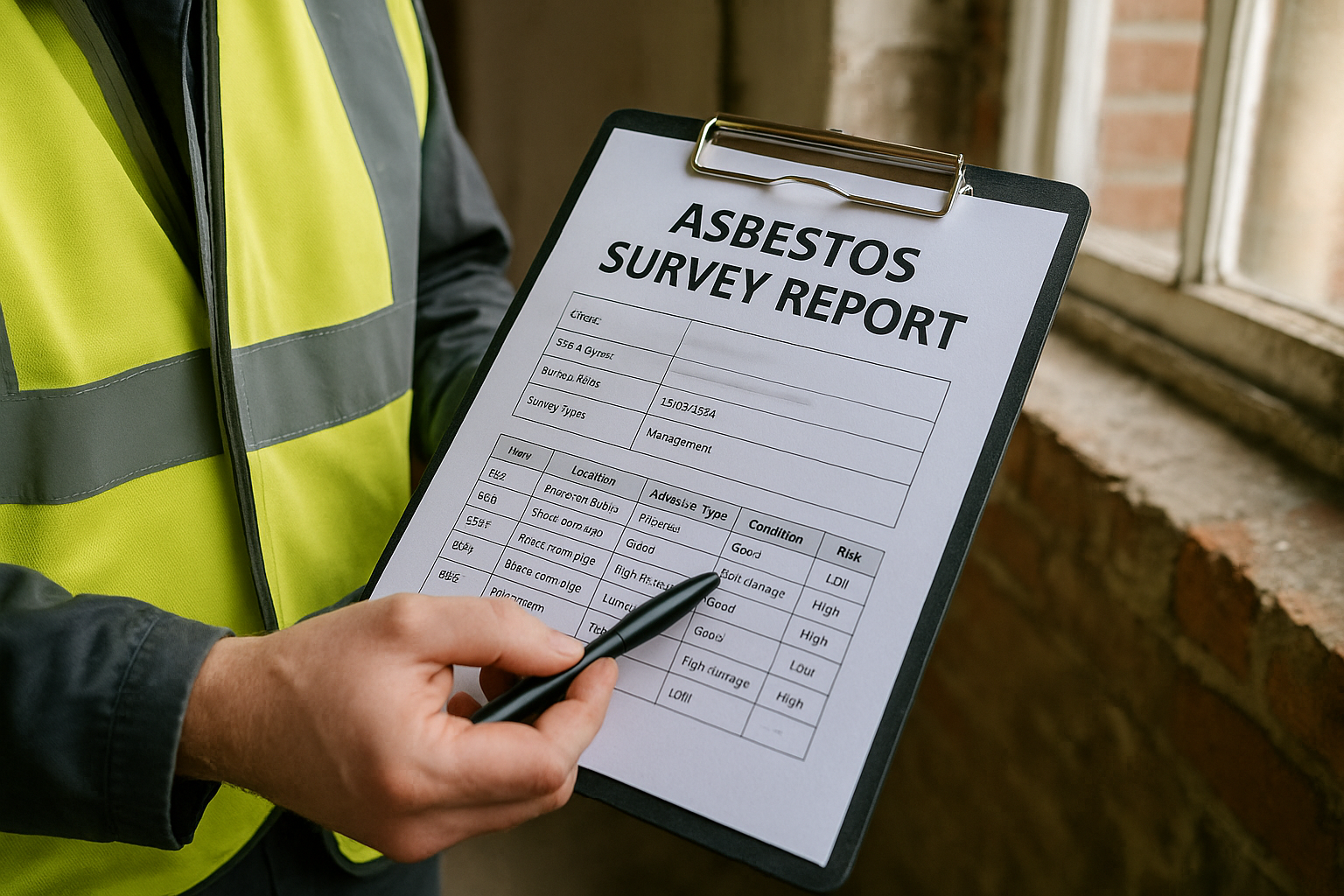
    A strong asbestos survey report should be clear enough for non-specialists to use but detailed enough to support legal duties and practical decision-making. The exact layout may vary, but the core content should be easy to find and consistent throughout.
    asbestos survey report - What information is included in an asbes

    Executive summary

    This section gives a concise overview of the premises, the survey type, the main findings and the key actions required. Senior decision-makers often read this first, so it should be direct and free from unnecessary jargon.

    Survey scope and methodology

    The report should explain what type of survey was completed, which areas were inspected, how access was achieved and what limitations applied. A survey is only reliable within its stated scope, so this section matters far more than many people realise.

    Building details

    The address, block names, floor references and room identifiers should match the site exactly. Even small errors can cause confusion later, especially when contractors are trying to locate materials quickly.

    Sample results

    Where samples have been taken, the asbestos survey report should include sample references and laboratory findings. This confirms whether asbestos is present and distinguishes between confirmed materials and those presumed to contain asbestos.

    Item-by-item asbestos register information

    This is often the section people use most. Each item should be recorded with enough detail for someone on site to find it without guesswork.

    Typical entries include:

    • Exact location
    • Product description
    • Extent or quantity
    • Condition
    • Surface treatment
    • Sample reference or presumption
    • Material assessment
    • Recommended action

    Plans and photographs

    Clear plans and sharp photographs make a huge difference. A contractor should be able to compare what they see on site with what is shown in the asbestos survey report and identify the right room, riser, void or plant area quickly.

    Recommendations

    The report should set out practical next steps. That might include managing the material in place, repairing minor damage, sealing exposed edges, restricting access, arranging removal or carrying out a more intrusive survey before works proceed.

    Limitations and exclusions

    If parts of the building were not accessed, the asbestos survey report must say so clearly. Locked rooms, live electrical areas, unsafe roofs, obstructed risers, sealed voids and heavy storage are common reasons for exclusion.

    These limitations should never be buried in small print. If an area was not inspected, it may still contain asbestos and should be treated accordingly until further investigation is completed.

    What the report should identify about asbestos-containing materials

    The core purpose of an asbestos survey report is not just to say whether asbestos is present. It should explain what the material is, where it is, how much of it exists, what condition it is in and how likely it is to be disturbed.

    That context is essential. A cement sheet on an external outbuilding usually presents a very different management issue from damaged insulating board in a service riser. A good report makes that distinction obvious.

    Common materials often recorded

    • Asbestos insulating board in risers, partitions and ceiling voids
    • Textured coatings on walls and ceilings
    • Vinyl floor tiles and bitumen adhesive
    • Pipe insulation and thermal lagging
    • Boiler and plant insulation
    • Asbestos cement sheets, soffits, gutters and flues
    • Roofing products and wall panels
    • Toilet cisterns, sink pads and other legacy items

    Key details that should be recorded for each item

    • Location – building, floor, room and exact position
    • Product type – for example insulating board, cement panel or textured coating
    • Extent – dimensions, quantity or approximate area
    • Condition – intact, worn, damaged or deteriorating
    • Surface treatment – painted, sealed, encapsulated or exposed
    • Material assessment – based on product type, damage, surface treatment and asbestos type where known
    • Sample result – positive, negative or presumed asbestos

    Where sampling is not possible, the asbestos survey report may record a presumption of asbestos. That is often the right approach where access is restricted or where sampling would cause unnecessary damage at that stage.

    Different survey types and how they affect the asbestos survey report

    Not every asbestos survey report should look the same. The level of detail, the amount of intrusion and the intended use all depend on the survey type.
    asbestos survey report - What information is included in an asbes

    Using the wrong survey for the wrong task is a common reason for delays. A report prepared for normal occupation may not be suitable if you are about to remove ceilings, replace services or strip out internal finishes.

    Management survey

    A management survey is usually the standard survey for normal occupation, routine maintenance and ongoing asbestos management. Its purpose is to locate, as far as reasonably practicable, the presence and extent of suspect asbestos-containing materials that could be disturbed during everyday use of the premises.

    The resulting asbestos survey report should support your asbestos register and management plan. It is not intended to fully expose hidden materials that may only become relevant during major building work.

    Refurbishment survey

    If intrusive works are planned, you will usually need a refurbishment survey. This is more intrusive and is designed to locate asbestos in the areas affected by the planned works, including materials hidden behind walls, ceilings, boxing and fixed finishes.

    The asbestos survey report for this type of survey should clearly define the work area and identify asbestos-containing materials that could be disturbed during refurbishment.

    Demolition survey

    Where a building, or part of it, is to be demolished, a demolition survey is usually required before work begins. This is a fully intrusive survey intended to identify asbestos-containing materials throughout the structure so they can be dealt with before demolition proceeds.

    The asbestos survey report for demolition works needs to be especially clear because contractors will rely on it during strip-out and enabling works.

    Re-inspection survey

    Asbestos records should not sit untouched for years. A re-inspection survey helps confirm whether previously identified materials remain in the same condition and whether earlier recommendations are still appropriate.

    An updated asbestos survey report supports ongoing management and helps keep your asbestos register accurate over time.

    How to check whether an asbestos survey report is reliable

    Not all reports are equally useful. Before relying on an asbestos survey report for compliance, maintenance planning or contractor control, check that the information is clear, consistent and fit for purpose.

    Accuracy matters because people will use the report to decide where they can work safely. If locations are wrong, plans do not match the register or exclusions are hidden away, the chance of accidental disturbance increases.

    What to review before using the report

    • Correct building details – address, block names, floors and room references should match the site
    • Clear survey type – management, refurbishment or demolition should be stated plainly
    • Accurate plans – item references on plans should match the register entries
    • Useful photographs – images should show the material and its position clearly
    • Consistent descriptions – wording in the register, sample list and plans should agree
    • Obvious exclusions – no-access areas should be clearly identified
    • Practical recommendations – next steps should be specific and usable

    If anything is unclear, ask for clarification before the asbestos survey report is circulated internally. A competent surveyor should be able to explain the findings, confirm the limitations and help you understand what action is required.

    What happens after the asbestos survey report is issued

    The report is not the end of the process. Once issued, the asbestos survey report should be reviewed promptly and turned into practical site actions.

    If higher-risk materials are identified, or if damaged asbestos-containing materials are found in vulnerable locations, immediate controls may be needed. That could include restricting access, isolating an area, arranging repairs or planning removal where required.

    Practical next steps for duty holders

    1. Review the findings straight away – do not leave the report unread in an inbox.
    2. Update or create the asbestos register – make sure the latest findings are reflected accurately.
    3. Revise the management plan – actions, responsibilities and review periods should be clear.
    4. Inform staff and contractors – anyone who may disturb materials should know what is present and where.
    5. Act on urgent recommendations – damaged or vulnerable materials need prompt control.
    6. Plan further surveys if needed – especially before refurbishment, strip-out or demolition.
    7. Schedule re-inspections – materials left in place should be checked at suitable intervals.

    This is where a good asbestos survey report proves its worth. It should make those next steps obvious rather than leaving your team to interpret vague wording.

    Common problems found in a poor asbestos survey report

    A weak asbestos survey report can create just as many problems as having no report at all. If the document is unclear, incomplete or badly organised, contractors may not trust it and projects can slow down while questions are answered.

    There are a few warning signs to watch for.

    • Room names on the report do not match the actual site layout
    • Plans are missing, unclear or inconsistent with the register
    • Photographs are too vague to identify the material properly
    • Recommendations are generic and not linked to specific items
    • Limitations are hidden at the back of the document
    • The survey type is unclear or unsuitable for the planned work
    • Older findings have not been reviewed or updated

    If you spot these issues, do not assume the report is good enough. Clarify the findings or commission the right survey before works proceed.

    Practical advice for property managers and duty holders

    If you manage multiple sites, consistency matters. Keep every asbestos survey report in a format your team can locate quickly, and make sure the latest version is the one contractors receive.

    Do not rely on memory, old PDFs buried in email chains or verbal briefings. If a contractor is due on site, they should have access to the relevant report, register information and any restrictions before work starts.

    Simple ways to use the report properly

    • Check the survey type matches the work being planned
    • Make sure inaccessible areas are followed up where necessary
    • Cross-check the report against current room numbering and site plans
    • Brief maintenance teams on known asbestos locations
    • Stop work if hidden materials are uncovered that are not covered by the report
    • Arrange a more intrusive survey before refurbishment or demolition

    If you are managing a portfolio across different locations, local support can help speed things up. Supernova provides services including asbestos survey London, asbestos survey Manchester and asbestos survey Birmingham, making it easier to keep reports and follow-up actions consistent across sites.

    Choosing the right report for the job

    The best asbestos survey report is the one that matches the actual risk and the planned use of the building. If the premises are occupied and only routine maintenance is taking place, a management survey report may be suitable. If walls, ceilings, floors or services are being opened up, it probably will not be.

    Before commissioning a survey, ask a few practical questions:

    • Is the building occupied or vacant?
    • Is the work routine maintenance, refurbishment or demolition?
    • Will hidden voids, ducts, risers or structural elements be disturbed?
    • Are there any access restrictions that could affect the findings?
    • Who needs to use the report once it is issued?

    Getting those points right at the start usually means a more useful asbestos survey report at the end.

    Frequently Asked Questions

    What is the purpose of an asbestos survey report?

    An asbestos survey report records where asbestos-containing materials have been identified or presumed, their condition, their extent and what action is recommended. It supports asbestos management, contractor briefing and compliance with the Control of Asbestos Regulations.

    Does an asbestos survey report tell me if work can start?

    Sometimes, but only if the survey type matches the planned work. A management report may be suitable for normal occupation and routine maintenance, but intrusive works usually require a refurbishment or demolition survey before work starts.

    What if parts of the building were not accessed?

    The asbestos survey report should list all limitations and exclusions clearly. Any area not inspected may still contain asbestos, so it should be treated with caution until further investigation is completed.

    How often should asbestos information be reviewed?

    Materials left in place should be checked periodically to confirm their condition has not changed. A re-inspection survey helps keep the asbestos register and management information current.

    What should I do if the report is unclear or out of date?

    Do not rely on it without clarification. Ask the surveyor to explain the findings, confirm the limitations or arrange an updated survey if the building layout, planned works or material condition has changed.

    If you need a clear, practical asbestos survey report that stands up to real site use, Supernova Asbestos Surveys can help. We provide management, refurbishment, demolition and re-inspection surveys nationwide. Call 020 4586 0680 or visit asbestos-surveys.org.uk to arrange a survey or discuss the right service for your property.
  • What training and certifications are necessary for conducting an asbestos survey?

    What training and certifications are necessary for conducting an asbestos survey?

    One weak report can leave an entire building exposed. When you are checking asbestos certifications, the real issue is not whether someone has attended a course, but whether they are genuinely competent to survey, sample, advise, or work safely around asbestos in line with UK requirements.

    For property managers, landlords, facilities teams and contractors, that distinction matters every day. The wrong training can lead to poor surveys, unsafe work, unreliable asbestos registers and avoidable compliance problems under the Control of Asbestos Regulations.

    Why asbestos certifications matter

    Asbestos is still present in many UK buildings, particularly those built or refurbished before asbestos-containing materials were banned. It can turn up in offices, schools, hospitals, warehouses, retail units, communal residential areas and older industrial premises.

    If the person inspecting the property or advising on risk does not hold suitable asbestos certifications, the consequences can be serious. A missed asbestos-containing material, poor sampling strategy or weak report can affect maintenance planning, refurbishment works and the safety of everyone on site.

    Under the Control of Asbestos Regulations, duty holders for non-domestic premises must manage asbestos risk. In practical terms, that means identifying asbestos-containing materials where present, assessing their condition, keeping records current and preventing accidental disturbance.

    Good asbestos certifications help you judge whether someone has training that matches the task they are being asked to do. They should support competence in:

    • Recognising likely asbestos-containing materials
    • Understanding where asbestos is commonly hidden
    • Inspecting a building methodically
    • Taking samples safely where appropriate
    • Producing reports that support compliant decisions
    • Advising whether materials should be managed, encapsulated or removed

    The key point is simple: not all asbestos certifications mean the same thing. Awareness training is not the same as surveying competence, and surveying competence is not the same as removal competence.

    Different types of asbestos certifications

    The phrase asbestos certifications is often used loosely. In reality, there are different levels of training and competence, each intended for a specific role.

    Asbestos awareness training

    This is the basic level of asbestos training. It is designed for people who may encounter asbestos during their work but are not expected to disturb it deliberately.

    Typical roles include electricians, plumbers, decorators, caretakers, maintenance staff, telecoms engineers and general contractors. Awareness training helps them recognise risk and avoid accidental disturbance.

    A proper awareness course should cover:

    • The types of asbestos and common uses in buildings
    • The health risks from inhaling asbestos fibres
    • Where asbestos may be found
    • What to do if suspect materials are discovered or damaged
    • How to avoid disturbing asbestos accidentally

    What it does not do is qualify someone to carry out an asbestos survey, take samples independently or remove asbestos-containing materials.

    Training for non-licensed work

    Some lower-risk tasks involving asbestos require more than awareness training. Depending on the material, its condition and the planned work, workers may need task-specific training for non-licensed work or notifiable non-licensed work.

    This training should cover safe systems of work, use of control measures, personal protective equipment, dust suppression, waste handling and decontamination procedures. It is still separate from surveyor qualifications.

    Surveying qualifications

    If someone is carrying out an asbestos management survey or a refurbishment and demolition survey, they need role-specific surveying competence. One of the best-known qualifications in the UK is BOHS P402, which is directly relevant to asbestos surveying.

    Equivalent qualifications may also be acceptable, provided they are specific to surveying and supported by robust assessment and practical experience. The aim is to ensure surveyors can inspect premises in line with HSG264 and produce reports that are accurate, clear and usable.

    Removal competence

    Surveying and removal are different disciplines. A surveyor may identify asbestos-containing materials and assess their condition, but that does not mean they are qualified to remove them.

    Where higher-risk work is involved, removal must be carried out by appropriately licensed contractors where required by law. If your survey identifies materials that need to come out, the next step is to arrange competent asbestos removal based on the survey findings and risk assessment.

    What qualifications should an asbestos surveyor hold?

    If you are appointing someone to inspect a building, update an asbestos register or advise on suspect materials, ask for evidence. Vague claims that a surveyor is “trained” or “certified” are not enough.

    asbestos certifications - What training and certifications are nec

    BOHS P402 or a suitable equivalent

    The BOHS P402 Certificate in Asbestos Surveying remains one of the clearest indicators that an individual has completed recognised training in asbestos surveying. It covers planning surveys, inspecting premises, identifying suspect materials, sampling and reporting.

    That said, a certificate on its own should never be the end of your checks. Competence also depends on practical experience, supervision and the systems used by the organisation they work for.

    Support from a quality-managed inspection organisation

    Individual qualifications matter, but the company behind the survey matters just as much. Surveying organisations should operate within a robust quality system, with documented procedures, technical review and competent management oversight.

    When reviewing asbestos certifications, check exactly what is being claimed. Some businesses use language that sounds official without clearly stating the scope of their accreditation or competence.

    Always verify what standards the organisation works to and what activities its systems actually cover. A good report depends on both the surveyor and the organisation supporting them.

    Ongoing refresher training and practical experience

    Competence is not fixed forever. Surveyors should keep their knowledge current with HSE guidance, current practice and continued inspection experience across different property types.

    Ask practical questions such as:

    • When did the surveyor last complete refresher training?
    • How often do they carry out surveys?
    • Do they regularly inspect buildings like yours?
    • Who reviews their reports before issue?
    • How are sampling and reporting quality checked?

    A surveyor who mainly inspects small domestic properties may not be the right fit for a hospital estate, school campus or large industrial site. Good asbestos certifications should always be backed by relevant experience.

    How to judge asbestos certifications when buying training

    Many people searching for asbestos certifications are actually trying to buy training for staff. That could be a single maintenance operative, an in-house estates team or a contractor workforce operating across multiple sites.

    When comparing providers, focus on what the training qualifies the learner to do. That sounds obvious, but it is where many buyers get caught out.

    What a credible asbestos awareness course should include

    A genuine awareness course should be clear about its purpose. It should explain the basics well, assess understanding properly and make it obvious that the certificate is for awareness only.

    Look for courses that cover:

    • Where asbestos may be found in UK buildings
    • The main asbestos-containing materials
    • How asbestos fibres are released
    • The health effects of exposure
    • Employer and duty holder responsibilities
    • What workers should do if they discover or damage suspect material

    If a provider blurs the line between awareness, surveying and removal, treat that as a warning sign. Clear boundaries are a sign of credible training.

    Questions to ask before booking

    Before paying for online or classroom training, ask a few direct questions:

    1. Who is the course designed for?
    2. What exactly does the certificate confirm?
    3. How is the learner assessed?
    4. How is identity checked for online training?
    5. Is learner support available if someone fails?
    6. How quickly are certificates issued?
    7. Does the provider explain refresher expectations?

    These checks are useful whether you are buying one licence or rolling training out across a large estate.

    Low-cost training: what should still be included?

    Budget-friendly asbestos certifications can be perfectly acceptable for awareness training. A low price is not automatically a problem, but the course still needs to be credible, current and suitable for the role.

    Even a low-cost single licence should normally include:

    • Prompt access to the course
    • A clear completion period
    • An assessment at the end
    • A downloadable certificate
    • Support if the learner has technical problems
    • Clear wording about what the certificate does and does not allow

    Read the terms carefully. Some providers advertise a low headline price, then charge extra for certificates, retests or administration.

    Free re-sits and auto-renewal

    Features such as free re-sits and auto-renewal can be useful, especially for employers managing multiple staff members. They are not essential, but they can reduce admin if the terms are transparent.

    Before relying on them, check:

    • How many re-sits are allowed
    • Whether there is a waiting period
    • Whether the learner repeats the whole course or only the assessment
    • Whether auto-renewal is optional
    • How much notice is given before renewal
    • How to cancel the service

    Good providers make these details easy to find. If the wording is vague, ask before you buy.

    How asbestos certifications fit into the wider compliance picture

    Training certificates are only one part of asbestos management. If you are responsible for a building, the practical issue is whether you have the right survey information for the work being carried out.

    asbestos certifications - What training and certifications are nec

    For normal occupation and routine maintenance, a management survey is usually the starting point. For intrusive work, major refurbishment or demolition, a more intrusive survey is needed so asbestos-containing materials can be identified before work begins.

    That is why appointing a competent surveyor matters more than collecting paperwork. The survey must be suitable for its purpose, completed thoroughly and reported clearly enough for contractors and duty holders to act on it.

    Management surveys

    An asbestos management survey is used to help duty holders manage asbestos-containing materials during normal occupation and routine maintenance. It identifies, as far as reasonably practicable, the presence and condition of materials that could be disturbed during everyday use of the building.

    The findings should support an asbestos register and management plan. If your building is occupied and in use, this is often the survey you need first.

    Refurbishment and demolition surveys

    If works will disturb the fabric of the building, a management survey is not enough. A refurbishment and demolition survey is required before the work starts in the relevant areas.

    This type of survey is more intrusive because it is designed to locate asbestos where it may be hidden within the structure. If a project involves major strip-out or full clearance, a demolition survey should be planned well in advance so work is not delayed.

    Sampling and reporting

    Competent surveying is about more than spotting obvious materials. Sampling strategy, site notes, photographs, material assessments and clear recommendations all affect the usefulness of the final report.

    When reviewing a survey report, check that it includes:

    • A clear description of the surveyed areas
    • Any limitations or exclusions
    • Material assessments where appropriate
    • Laboratory results for samples taken
    • Photographs and location details
    • Practical recommendations for management or further action

    If the report is vague, hard to follow or full of generic wording, ask questions before relying on it.

    Practical advice for property managers choosing asbestos surveyors

    Property managers rarely have time to decode technical jargon. The easiest way to assess asbestos certifications is to match the person’s training and experience to the exact job you need done.

    Start with the building, the planned works and the level of intrusion involved. Then check whether the surveyor and their organisation are equipped for that specific task.

    Use a simple appointment checklist

    Before instructing a survey, ask for:

    • The surveyor’s relevant qualifications
    • Evidence of recent surveying experience
    • Confirmation of the survey type proposed
    • Details of how samples will be analysed
    • An example report format
    • Expected timescales for inspection and reporting
    • Clarification of access requirements and limitations

    This avoids misunderstandings and helps you compare providers on quality rather than price alone.

    Make sure the survey scope is clear

    One of the most common problems is a mismatch between the survey ordered and the work planned. If contractors are opening ceilings, lifting floors, chasing walls or stripping out services, a routine management survey will not be enough.

    Explain the planned works in plain language. A competent surveyor should then recommend the correct scope and tell you if access arrangements, isolation or vacant areas are needed.

    Check how the report will support action on site

    A survey is only useful if the people managing the building can act on it. Ask whether the report will clearly identify material locations, sample results, condition, risk and next steps.

    Good reporting should help you brief contractors, update the asbestos register and decide whether to monitor, encapsulate or remove materials. If the report does not support decisions, the survey has not done its job properly.

    Common mistakes when relying on asbestos certifications

    Problems often arise when buyers assume all training is interchangeable. That is rarely the case.

    Here are some of the most common mistakes to avoid:

    • Assuming awareness training qualifies someone to survey: it does not.
    • Relying on a certificate without checking experience: practical competence matters.
    • Choosing the cheapest survey without reviewing sample reports: low cost can mean weak reporting or poor scope.
    • Ordering the wrong survey type: this can leave hidden asbestos unidentified before works begin.
    • Ignoring report limitations: excluded areas may still contain asbestos.
    • Failing to update records after works: registers and management plans need to reflect current site conditions.

    If you manage multiple sites, build these checks into your procurement process. A standard questionnaire for surveyors and training providers can save time and reduce risk.

    Understanding asbestos certifications in different locations and property portfolios

    Large property portfolios often need consistent surveying standards across different regions. Whether you manage one building or hundreds, the same principles apply: the right survey, the right competence and clear reporting.

    If you need local support, it helps to work with a provider that can deliver surveys across major cities while maintaining the same technical standards. For example, Supernova can arrange an asbestos survey London, an asbestos survey Manchester or an asbestos survey Birmingham depending on where your premises are located.

    This is especially useful for managing agents, national retailers, education providers and multi-site employers. Consistent survey quality makes it easier to maintain registers, plan works and demonstrate compliance.

    What competent asbestos advice should look like in practice

    Strong asbestos advice is practical, specific and easy to follow. It should not bury the key risks under generic wording.

    When reviewing survey findings or discussing asbestos certifications with a provider, expect clear answers to questions such as:

    • What materials were identified or presumed?
    • Where are they located?
    • What condition are they in?
    • Can they remain in place and be managed safely?
    • Do planned works change the level of risk?
    • What actions should happen next, and in what order?

    If advice is vague, ask for clarification before works begin. Clear communication is part of competence.

    Frequently Asked Questions

    Do asbestos certifications prove someone is competent to carry out a survey?

    Not on their own. Asbestos certifications can show that a person has completed relevant training, but competence also depends on practical experience, supervision, quality systems and the ability to survey in line with HSG264.

    Is asbestos awareness training enough for maintenance staff?

    It depends on the work they do. Awareness training is suitable for people who may come across asbestos but are not expected to disturb it. If their tasks involve planned work on asbestos-containing materials, they may need additional task-specific training.

    What is the difference between a management survey and a demolition survey?

    A management survey is used to help manage asbestos during normal occupation and routine maintenance. A demolition survey is intrusive and is required before demolition or major structural strip-out so hidden asbestos can be identified before work starts.

    Should I choose a surveyor based on qualifications alone?

    No. Qualifications are important, but you should also check recent experience, reporting quality, technical support, the suitability of the proposed survey scope and whether the organisation follows recognised guidance.

    When should asbestos-containing materials be removed rather than managed?

    That depends on the material type, condition, location and whether planned works will disturb it. Some materials can remain safely in place with proper management, while others need removal because of their condition or the nature of the project.

    If you need clear advice on asbestos certifications, survey requirements or the right inspection for your building, Supernova Asbestos Surveys can help. We provide practical, compliant surveying services nationwide, including management, refurbishment and demolition surveys, with clear reporting that supports action. Call 020 4586 0680 or visit asbestos-surveys.org.uk to book a survey or speak to our team.

  • How does an asbestos report assist in protecting public health?

    How does an asbestos report assist in protecting public health?

    What an Asbestos Report Actually Does — and Why It Matters

    Asbestos remains present in millions of UK buildings, and it continues to be the single largest cause of work-related deaths in the country. An asbestos report is the document that stands between a building’s occupants and that risk — identifying where asbestos-containing materials (ACMs) are located, what condition they’re in, and what action needs to follow.

    If you manage, own, or occupy a building constructed before the year 2000, understanding what an asbestos report contains — and how to act on it — is not optional. It’s a legal obligation and a moral one.

    What Is an Asbestos Report?

    An asbestos report is the formal output of an asbestos survey. It documents every ACM found within a building, records the condition and risk level of each material, and sets out the recommended actions for managing or removing them.

    The report forms the foundation of your asbestos management plan — the living document that duty holders are legally required to maintain under the Control of Asbestos Regulations. Without an accurate, up-to-date asbestos report, you cannot manage asbestos safely, and you cannot demonstrate compliance to the HSE or an enforcement officer.

    What Does an Asbestos Report Include?

    The contents of a properly produced asbestos report are detailed and specific. A competent surveyor will provide you with:

    • A full asbestos register listing every ACM found, its location, and its type
    • A condition assessment for each material — intact, damaged, or deteriorating
    • A risk priority rating to guide decision-making
    • Photographs of each ACM and its position within the building
    • Laboratory analysis results from any samples taken
    • Recommendations for management, repair, encapsulation, or removal
    • A site plan or floor plan showing ACM locations

    The level of detail will vary depending on the type of survey conducted, but any report produced by a competent surveyor should give you a clear, actionable picture of the asbestos situation in your building.

    The Different Types of Asbestos Survey — and Their Reports

    Not all asbestos surveys are the same, and neither are the reports they produce. The type of survey you need depends on what you’re doing with the building and its current status.

    Management Survey

    A management survey is the standard survey for occupied, non-domestic buildings. It locates ACMs that could be disturbed during normal occupation — routine maintenance, minor works, or everyday use.

    The resulting asbestos report feeds directly into your asbestos management plan and tells you which materials need monitoring and which require immediate attention. This is the survey most duty holders need to fulfil their legal obligations under the Control of Asbestos Regulations.

    It’s not a one-off exercise. The report should be reviewed and updated regularly, and re-inspections carried out to check that the condition of known ACMs hasn’t changed.

    Refurbishment and Demolition Survey

    Before any significant building work begins, a more intrusive survey is required. A demolition survey — or a targeted refurbishment survey — involves destructive inspection techniques to locate ACMs in areas that will be disturbed by the planned works.

    The report produced must be completed before work starts. Contractors and principal designers need it to plan safe working methods, and it’s a legal requirement under both the Construction (Design and Management) Regulations and the Control of Asbestos Regulations.

    Skipping this step puts workers at serious risk and exposes clients and contractors to significant legal liability.

    Re-inspection Survey

    Where ACMs have been identified but left in situ — managed rather than removed — a periodic re-inspection survey confirms that those materials remain in a stable, safe condition. The asbestos report from a re-inspection updates the existing register and flags any deterioration that requires action.

    HSG264, the HSE’s guidance on asbestos surveys, recommends that re-inspections are carried out at least annually, though higher-risk materials or busier premises may warrant more frequent checks.

    How Sample Analysis Feeds Into the Asbestos Report

    Visual identification alone is not sufficient to confirm the presence of asbestos. Where a surveyor suspects a material may contain asbestos, a sample is taken and sent for laboratory analysis. The results of that analysis are a critical component of the final asbestos report.

    Commissioning proper sample analysis from a UKAS-accredited laboratory gives the report its scientific and legal credibility. Laboratories use several analytical techniques to identify asbestos fibres and determine their type:

    • Polarised Light Microscopy (PLM) — the standard method for bulk sample analysis, identifying fibre type by optical properties
    • Transmission Electron Microscopy (TEM) — used for more detailed analysis, particularly for fine fibres
    • X-ray Diffraction (XRD) — identifies the mineral composition of fibres, useful for distinguishing asbestos from non-asbestos silicate materials

    A report based on presumption rather than confirmed analysis carries far less weight — and far less protection for the duty holder.

    The Health Risks That Make an Asbestos Report Essential

    The reason asbestos reports exist is straightforward: asbestos fibres kill people. When ACMs are disturbed, microscopic fibres are released into the air. Those fibres can be inhaled without any immediate sensation — there’s no smell, no obvious irritation — but the damage they cause is cumulative and irreversible.

    Immediate Risks to Workers

    Workers involved in refurbishment or maintenance who unknowingly disturb ACMs face the highest immediate risk. Inhalation of asbestos fibres can cause inflammation and scarring of lung tissue, leading to persistent coughing, breathlessness, and chest discomfort.

    The risk is particularly acute on construction sites and during building maintenance, where workers may not realise that the materials they’re cutting, drilling, or removing contain asbestos. An asbestos report — shared with all contractors before work begins — is the primary safeguard against this.

    Long-term Consequences

    The most serious asbestos-related diseases take decades to develop. Mesothelioma — a cancer of the lining of the lungs or abdomen — is almost exclusively caused by asbestos exposure and is invariably fatal. Asbestos-related lung cancer and asbestosis (progressive scarring of lung tissue) are similarly devastating.

    These diseases typically emerge 20 to 50 years after initial exposure, which means people being diagnosed today were often exposed in the 1970s and 1980s. The decisions made now — including whether to commission a proper asbestos report — will determine the health outcomes of people working in and around buildings today.

    When the report identifies removal as the appropriate course of action, asbestos removal must be carried out by licensed contractors using controlled procedures to prevent fibre release during the process itself.

    Legal Compliance and the Duty to Manage

    The legal framework around asbestos in non-domestic premises is unambiguous. The Control of Asbestos Regulations place a duty on those responsible for non-domestic premises to manage the risk from asbestos. That duty requires them to:

    1. Assess whether asbestos is present in the premises
    2. Determine the condition of any ACMs found
    3. Prepare and implement a written asbestos management plan
    4. Review and monitor the plan regularly
    5. Provide information about ACM locations to anyone who may disturb them

    An asbestos report is the mechanism through which steps one and two are fulfilled. Without it, you cannot produce a compliant management plan, and you cannot demonstrate that you’ve met your legal obligations.

    Non-compliance is treated seriously by the HSE. Enforcement action can include improvement notices, prohibition notices, and prosecution — with penalties including unlimited fines and custodial sentences for the most serious breaches. The reputational and financial consequences of a prosecution far outweigh the cost of commissioning a survey.

    Who Has a Legal Duty?

    The duty to manage applies to the person or organisation with responsibility for maintenance and repair of non-domestic premises. That typically includes:

    • Commercial landlords and property owners
    • Employers who own or occupy non-domestic buildings
    • Managing agents acting on behalf of property owners
    • Local authorities and housing associations for communal areas of residential blocks

    If you’re unsure whether the duty applies to you, the HSE’s guidance is clear: if you have any responsibility for the maintenance or repair of a building, you almost certainly have a duty to manage asbestos within it.

    Turning an Asbestos Report Into Action

    An asbestos report is only valuable if it’s acted upon. Receiving a report and filing it away without implementing its recommendations provides no protection — legal or practical.

    Immediate Actions Following a Report

    • Secure any areas where high-risk ACMs have been identified — restrict access and use appropriate signage
    • Arrange for damaged or deteriorating materials to be repaired, encapsulated, or removed by a licensed contractor
    • Ensure the asbestos register is accessible to anyone who may carry out work on the premises
    • Brief all maintenance staff, contractors, and relevant employees on the report’s findings
    • Provide asbestos awareness training to staff who work in or around areas where ACMs are present

    Long-term Management

    Managing asbestos is an ongoing responsibility, not a one-time exercise. Your asbestos management plan should be reviewed at least annually, and whenever significant changes occur — such as refurbishment works, a change in building use, or deterioration of known ACMs.

    Schedule re-inspection surveys at appropriate intervals. Update the asbestos register when new information becomes available. Keep records of all inspections, actions taken, and communications with contractors.

    This paper trail is your evidence of compliance and your defence if questions are ever raised about how asbestos was managed in your building.

    Choosing a Competent Surveyor for Your Asbestos Report

    The quality of an asbestos report depends entirely on the competence of the surveyor who produces it. HSG264 sets out clear expectations for surveyor competence, and the HSE expects duty holders to use surveyors who can demonstrate appropriate qualifications, experience, and quality assurance systems.

    When selecting a surveying company, look for:

    • UKAS accreditation to ISO 17020 for inspection bodies
    • Surveyors holding recognised qualifications such as the BOHS P402 certificate
    • Laboratory analysis carried out by a UKAS-accredited laboratory
    • Clear, detailed reports that meet the requirements of HSG264
    • Evidence of professional indemnity and public liability insurance

    An asbestos report from an unqualified or poorly equipped surveyor may not only fail to protect you legally — it may actively mislead you about the risks present in your building. Always verify credentials before commissioning a survey.

    Asbestos Reports Across the UK — National Coverage

    Asbestos surveys and the reports they produce are required across every region of the UK. The legal obligations are identical wherever your property is located, and the health risks are the same.

    If you need an asbestos survey London for a commercial or residential property, our surveyors cover the entire Greater London area. For properties in the north-west, our team provides a full asbestos survey Manchester service across the city and surrounding areas.

    For the Midlands, we offer a dedicated asbestos survey Birmingham service for properties of all types and sizes. Wherever your property is located, the asbestos report you receive will be produced to the same standard — compliant with HSG264, produced by qualified surveyors, and backed by UKAS-accredited laboratory analysis.

    Frequently Asked Questions

    What is an asbestos report and when do I need one?

    An asbestos report is the formal document produced following an asbestos survey. It records the location, type, and condition of all asbestos-containing materials found in a building, along with recommended actions. You need one if you own, manage, or are responsible for the maintenance of a non-domestic building constructed before the year 2000. It is a legal requirement under the Control of Asbestos Regulations.

    How long is an asbestos report valid for?

    An asbestos report does not have a fixed expiry date, but it must be kept up to date. The HSE’s guidance in HSG264 recommends that known asbestos-containing materials are re-inspected at least annually, and the report updated accordingly. Any significant change to the building — refurbishment, change of use, or damage to known ACMs — should also trigger a review and update of the report.

    Can I use a single asbestos report for multiple buildings?

    No. An asbestos report is specific to the building surveyed. Each property requires its own survey and its own report, as the presence, location, and condition of ACMs will differ between buildings. If you manage a portfolio of properties, each one must have its own compliant asbestos report and management plan.

    What happens if I don’t have an asbestos report?

    Operating without an asbestos report for a non-domestic building constructed before 2000 puts you in breach of the Control of Asbestos Regulations. The HSE can issue improvement notices, prohibition notices, and prosecute duty holders. Penalties include unlimited fines and, in serious cases, custodial sentences. Beyond the legal consequences, the absence of a report means workers and occupants may be exposed to asbestos fibres without any warning or protection.

    Who can produce a legally compliant asbestos report?

    A legally compliant asbestos report must be produced by a competent surveyor. HSG264 sets out the competence requirements, which include relevant qualifications — such as the BOHS P402 certificate — and ideally UKAS accreditation to ISO 17020. The laboratory analysis that underpins the report should also be carried out by a UKAS-accredited laboratory. Using an unaccredited surveyor or laboratory significantly undermines the report’s legal standing.

    Get Your Asbestos Report From Supernova

    Supernova Asbestos Surveys has completed over 50,000 surveys nationwide. Our surveyors are fully qualified, our laboratory analysis is UKAS-accredited, and every asbestos report we produce meets the requirements of HSG264 and the Control of Asbestos Regulations.

    Whether you need a management survey, a demolition survey, a re-inspection, or advice on what type of survey is right for your building, our team is ready to help. Call us on 020 4586 0680 or visit asbestos-surveys.org.uk to request a quote or speak to one of our surveyors.

  • What are the consequences of not conducting an asbestos survey?

    What are the consequences of not conducting an asbestos survey?

    The Real Cost of Skipping an Asbestos Survey

    Asbestos doesn’t announce itself. It sits quietly inside walls, ceiling tiles, floor coverings, and pipe lagging — completely invisible until someone disturbs it. For any building constructed or refurbished before 2000, the risk is real, and the consequences of ignoring it are severe.

    An asbestos survey isn’t a bureaucratic box-ticking exercise. It’s the legal and moral foundation of safe building management. Whether you’re a property manager, landlord, employer, or contractor, failing to arrange a proper survey exposes you to criminal prosecution, civil liability, and — most critically — genuine harm to the people who live or work in your building.

    Why an Asbestos Survey Is a Legal Requirement

    The Control of Asbestos Regulations place a clear duty on those who manage non-domestic premises to identify, assess, and manage asbestos-containing materials (ACMs). This duty holder obligation isn’t optional — it applies to anyone with responsibility for the maintenance or repair of a building.

    The HSE’s guidance document HSG264 sets out exactly how surveys should be conducted, by whom, and to what standard. Ignoring this framework doesn’t just put people at risk; it puts you directly in the crosshairs of enforcement action.

    Who Is Responsible?

    Duty holders include building owners, employers, managing agents, and facilities managers. If you have control over non-domestic premises — even partial control — you carry a share of this legal responsibility.

    Residential landlords also have obligations where communal areas are involved. You cannot delegate this duty away entirely. You can — and should — appoint a qualified, UKAS-accredited asbestos surveyor to carry out the work on your behalf, but the legal accountability remains with you.

    Legal Consequences of Not Conducting an Asbestos Survey

    The penalties for non-compliance are not theoretical. The HSE actively investigates and prosecutes duty holders who fail to meet their obligations, and the courts take asbestos breaches seriously.

    Fines and Imprisonment

    For summary offences heard in a magistrates’ court, fines can reach £20,000 and carry a custodial sentence of up to six months. Cases referred to the Crown Court carry the potential for unlimited fines and imprisonment of up to two years.

    Enforcement notices, improvement notices, and prohibition notices can also be issued — meaning your premises could be shut down entirely until compliance is demonstrated. That alone can be commercially catastrophic.

    Civil Liability and Compensation Claims

    Beyond criminal prosecution, duty holders face civil liability if workers, tenants, or visitors develop asbestos-related diseases as a result of exposure on their premises. Mesothelioma, asbestosis, and asbestos-related lung cancer are all serious, often fatal conditions with long latency periods — symptoms may not appear for 20 to 40 years after initial exposure.

    Compensation claims in these cases are substantial. Businesses can also face prosecution under corporate manslaughter legislation if a death results from gross negligence in managing asbestos risks. These are not outcomes that can be reversed after the fact.

    Enforcement Action and Reputational Damage

    HSE enforcement decisions are published publicly. Being named in a prosecution or receiving a formal enforcement notice can damage your organisation’s reputation with clients, insurers, and regulators for years.

    Insurance policies may also be invalidated if non-compliance is demonstrated. The financial and reputational fallout from a single enforcement action can far exceed the cost of arranging a survey in the first place.

    Health Risks: What Happens When Asbestos Goes Undetected

    Asbestos fibres are microscopic. When ACMs are disturbed — during drilling, cutting, sanding, or demolition — those fibres become airborne and can be inhaled without anyone realising. There is no safe level of asbestos exposure.

    Long-Term Diseases Caused by Asbestos Exposure

    The diseases caused by asbestos inhalation are among the most serious occupational health conditions recognised in the UK:

    • Mesothelioma — a cancer of the lining of the lungs or abdomen, almost exclusively caused by asbestos exposure and with a very poor prognosis
    • Asbestosis — scarring of the lung tissue that causes progressive breathing difficulties
    • Asbestos-related lung cancer — particularly prevalent in those with combined asbestos and smoking exposure
    • Pleural thickening — thickening of the membrane surrounding the lungs, causing breathlessness and chest pain

    Because these diseases take decades to develop, the harm caused by failing to manage asbestos today may not become apparent for a generation. That makes prevention — not remediation — the only responsible approach.

    Immediate Risks in the Workplace

    When damaged or deteriorating ACMs release fibres, the immediate environment becomes hazardous. Workers in construction, refurbishment, and maintenance trades are at particularly high risk, but anyone present in the building during disturbance can be affected.

    Without an asbestos survey in place, there is no way to know which materials are safe to work around and which are not. A single significant exposure event can be enough to trigger the development of a serious disease years down the line.

    The Main Types of Asbestos Survey — and Why Both Matter

    Not all asbestos surveys are the same, and using the wrong type for your circumstances is itself a compliance failure. HSG264 defines two principal survey types, each serving a distinct purpose.

    Management Survey

    A management survey is the standard survey required for all non-domestic premises in normal occupation. Its purpose is to locate ACMs that could be disturbed during everyday activities, assess their condition, and produce an asbestos register and management plan.

    This survey is the foundation of your ongoing asbestos management obligations. Without it, you have no legal basis for managing ACMs safely, and you cannot demonstrate compliance to the HSE, insurers, or prospective tenants.

    Refurbishment and Demolition Survey

    Before any significant refurbishment, alteration, or demolition work begins, a more intrusive survey is required. A refurbishment survey involves destructive inspection of areas that would not normally be accessed, and it must be completed before contractors begin work.

    Where a full demolition is planned, a demolition survey goes further still, ensuring every ACM within the structure is identified before any works commence. Failing to arrange either of these surveys before works begin is one of the most common causes of unexpected asbestos discoveries mid-project — with serious consequences for cost, programme, and safety.

    Impact on Renovation and Construction Projects

    Asbestos discovered unexpectedly during construction work doesn’t just create a health hazard — it creates a commercial crisis. Work must stop immediately. The site must be secured. Licensed contractors must be brought in to assess and, where necessary, remove the material safely.

    Cost Overruns and Project Delays

    Unplanned asbestos removal mid-project is significantly more expensive than planned removal carried out following a proper survey. Emergency licensed removal, hazardous waste disposal, and the cost of standing down other contractors while the issue is resolved can inflate project costs dramatically.

    Project timelines can be extended by weeks — sometimes longer — while remediation is carried out and the site is re-tested to confirm it is safe to re-enter. These delays have knock-on consequences for tenants, occupants, and the wider project programme.

    Restrictions on Property Use

    Without an asbestos survey and a current management plan, property owners face significant restrictions on what they can legally do with their buildings. Planning permissions and building regulations sign-off may be withheld.

    Contractors may refuse to work on sites without survey documentation. Prospective buyers and tenants will increasingly require evidence of asbestos management as part of due diligence. Carrying out a survey early — and keeping it up to date — removes these barriers and gives you the freedom to manage and develop your property without unnecessary obstruction.

    Workplace Safety: The Employer’s Responsibility

    Employers have a specific duty of care to their workforce. Under the Control of Asbestos Regulations, employers must ensure that workers are not exposed to asbestos above the control limit, and must provide information, instruction, and training to anyone who may work with or near ACMs.

    Without a current asbestos survey, you cannot fulfil these obligations. You cannot brief contractors on asbestos risks, and you cannot demonstrate to the HSE that you have assessed and managed the hazard. If a worker is subsequently diagnosed with an asbestos-related disease, your absence of documentation will be used as evidence of negligence.

    Informing Contractors and Maintenance Workers

    Anyone who may disturb ACMs in the course of their work — electricians, plumbers, decorators, HVAC engineers — must be informed of the location and condition of asbestos materials before they begin. This is only possible if a survey has been carried out and an asbestos register is in place.

    Handing a contractor a current asbestos register isn’t just good practice — it’s a legal requirement. Failing to do so makes you liable if that contractor is subsequently exposed.

    What Happens After an Asbestos Survey

    A survey doesn’t automatically mean asbestos has to be removed. In many cases, ACMs that are in good condition and unlikely to be disturbed can be safely managed in situ. The survey gives you the information you need to make that decision properly.

    Where removal is necessary — because materials are damaged, deteriorating, or in an area that will be refurbished — asbestos removal must be carried out by a licensed contractor in accordance with HSE requirements. The survey report will clearly indicate which materials require what level of action, allowing you to prioritise and plan accordingly.

    Your asbestos register and management plan must be kept up to date, reviewed regularly, and made available to anyone who needs it. This is an ongoing obligation, not a one-off task.

    Keeping Your Asbestos Register Current

    An asbestos register is only useful if it accurately reflects the current state of your building. If refurbishment work has been carried out, if materials have been disturbed, or if the condition of known ACMs has changed, your register must be updated accordingly.

    Periodic re-inspection of ACMs is a requirement under the Control of Asbestos Regulations — not something you can defer indefinitely. Building in a regular review cycle is the simplest way to stay compliant and avoid gaps in your documentation.

    Asbestos Surveys Across the UK: Coverage That Matches Your Portfolio

    For organisations managing properties across multiple locations, finding a surveying partner with genuine nationwide reach matters. Delays caused by limited geographic coverage can push projects off schedule and leave compliance gaps open longer than they need to be.

    If you need an asbestos survey London teams can rely on for a fast turnaround, Supernova’s local surveyors are available for urgent pre-refurbishment requirements and routine management surveys alike. We also provide an asbestos survey Manchester clients across the North West can book quickly, and an asbestos survey Birmingham property managers in the Midlands can arrange at short notice.

    Beyond these major cities, our surveyors operate across every region of the UK — from Scotland to the South West. Whether you manage a single commercial unit or a national estate, we have the capacity and coverage to support you.

    Supernova Asbestos Surveys: Expert Surveyors, Nationwide

    Supernova Asbestos Surveys has completed over 50,000 surveys across the UK, working with property managers, local authorities, housing associations, contractors, and private landlords. Our surveyors are UKAS-accredited, fully qualified, and experienced across all property types and sectors.

    Every survey we carry out is delivered to HSG264 standards, with a clear, actionable report and asbestos register provided promptly after the inspection. We don’t just find asbestos — we give you the information and guidance you need to manage it properly and stay on the right side of the law.

    To arrange a survey or discuss your requirements, call us on 020 4586 0680 or visit asbestos-surveys.org.uk.

    Frequently Asked Questions

    What are the legal consequences of not having an asbestos survey?

    Failing to carry out a required asbestos survey is a breach of the Control of Asbestos Regulations. Penalties include fines of up to £20,000 and up to six months’ imprisonment for summary offences, with unlimited fines and up to two years’ imprisonment for more serious cases heard in the Crown Court. Duty holders can also face civil compensation claims if individuals develop asbestos-related diseases as a result of exposure on their premises.

    Does every building need an asbestos survey?

    Any non-domestic building constructed or refurbished before 2000 is considered at risk of containing ACMs and requires an asbestos survey. Domestic properties are not subject to the same statutory duty, but landlords do have obligations in relation to communal areas of residential buildings. If you’re planning refurbishment or demolition work on any property of that age, a survey is required regardless of building type.

    How often does an asbestos survey need to be updated?

    A management survey doesn’t automatically expire, but the asbestos register it produces must be kept current. If the condition of ACMs changes, if building works have been carried out, or if new areas have been accessed, the register must be updated. Periodic re-inspection of known ACMs is required under the Control of Asbestos Regulations, and a full re-survey may be necessary if significant changes have been made to the building.

    What is the difference between a management survey and a refurbishment survey?

    A management survey is carried out on occupied premises to identify ACMs that could be disturbed during normal day-to-day activities. It is non-destructive and forms the basis of your ongoing asbestos management plan. A refurbishment survey is required before any intrusive works begin — it involves destructive inspection of areas that will be affected by the planned work and must be completed before contractors start on site.

    Can asbestos be left in place rather than removed?

    Yes — in many cases, ACMs that are in good condition and are unlikely to be disturbed can be safely managed in situ rather than removed. The decision should be based on the findings of a properly conducted asbestos survey, which will assess the condition and risk level of each material. Where materials are damaged, deteriorating, or located in areas subject to disturbance, removal by a licensed contractor will typically be recommended.