Category: Asbestos Exposure in the Construction Industry

  • What type of construction materials may contain asbestos and pose a risk of exposure?

    What type of construction materials may contain asbestos and pose a risk of exposure?

    Asbestos is still one of the most common hidden risks in UK property. It sits quietly in ceilings, risers, floor finishes, pipe insulation and roof sheets, and the real problem starts when someone drills, strips out or damages a material without knowing what it is.

    For property managers, landlords, contractors and dutyholders, asbestos is not a historical issue. It is a live compliance, health and project-planning issue in any building built or refurbished before 2000. If you are responsible for a premises, you need to know where asbestos may be found, which materials are more likely to release fibres, and what action to take before work begins.

    What is asbestos and why is it still a risk?

    Asbestos is the name given to a group of naturally occurring fibrous minerals. Those fibres are strong, heat resistant and chemically durable, which is exactly why asbestos was used so widely in construction, plant, insulation and fire protection.

    Those same properties also make asbestos dangerous. When asbestos-containing materials are damaged or disturbed, fibres can be released into the air and breathed in. Once inhaled, the fibres can lodge deep in the lungs and remain there for years.

    Exposure to asbestos is linked to serious diseases including mesothelioma, asbestos-related lung cancer and asbestosis. The health effects often take decades to develop, which is why asbestos remains such a serious issue long after its use was banned.

    Main types of asbestos found in UK buildings

    There are six recognised asbestos minerals, but three are most commonly encountered in UK buildings and industrial settings:

    • Chrysotile – often called white asbestos
    • Amosite – often called brown asbestos
    • Crocidolite – often called blue asbestos

    From a practical property management point of view, all asbestos should be treated seriously. The question is not whether one type sounds less alarming than another. The question is whether the material is present, what condition it is in, and whether planned activity could disturb it.

    The history of asbestos in UK buildings

    Asbestos has been used for far longer than most people realise. Ancient civilisations valued it because it would not readily burn, and small-scale uses appeared in pottery, cloth and heat-resistant items.

    The major expansion came with industrialisation. As factories, shipyards, railways, power stations and large building programmes grew, asbestos became a cheap and versatile answer to several problems at once. It offered insulation, fire resistance, durability and reinforcement.

    In the UK, asbestos use became especially widespread across the twentieth century. It was built into homes, schools, hospitals, offices, warehouses, factories and public buildings. That legacy is why asbestos is still found in so many premises today.

    The health risks were not discovered overnight. Evidence built up over many years, particularly among workers in insulation, manufacturing, shipbuilding, construction and maintenance. The lesson for modern dutyholders is simple: asbestos may be old, but the risk is current wherever those materials remain in place.

    Which construction materials may contain asbestos?

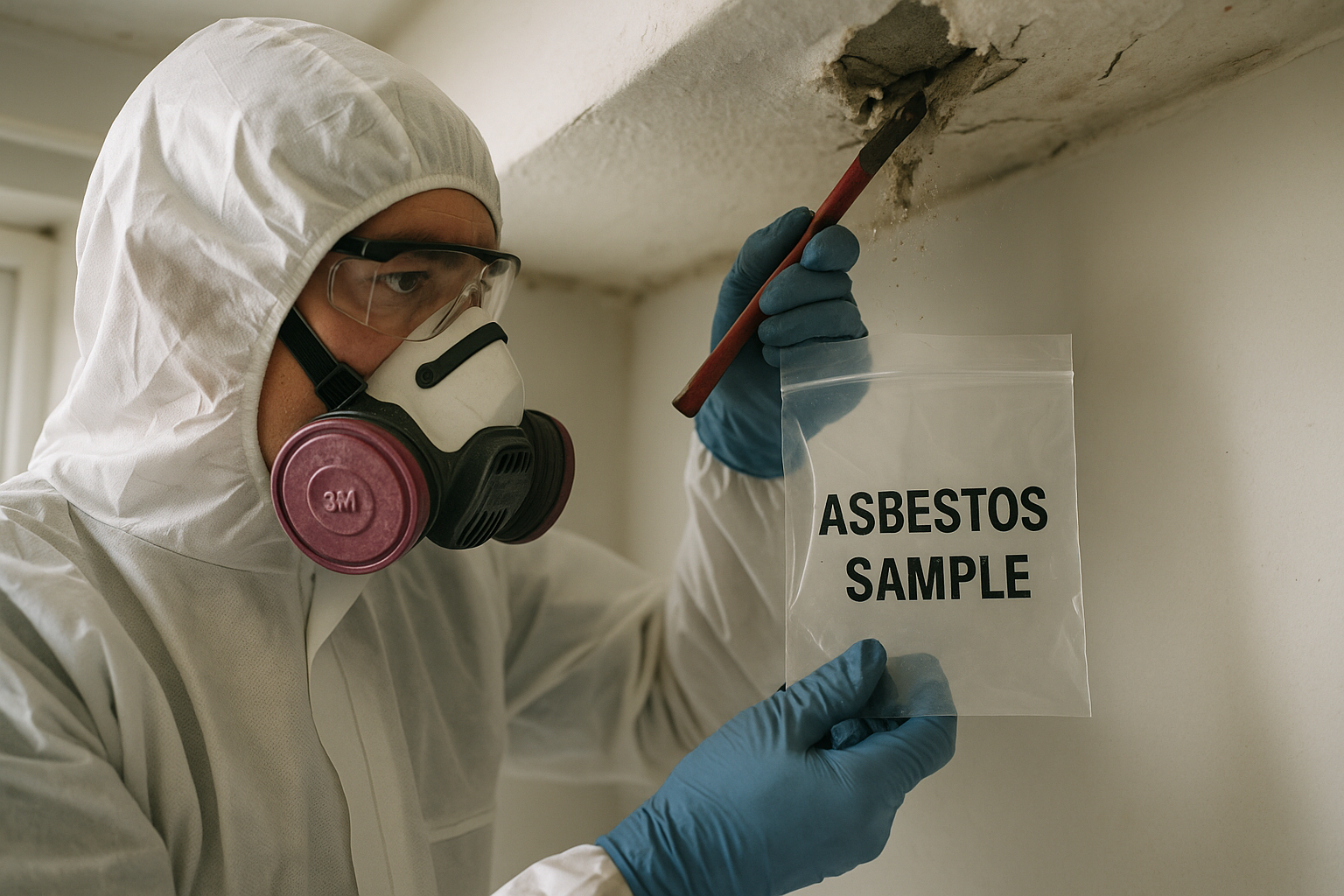
    One of the biggest challenges with asbestos is how many different products contained it. It was not limited to one obvious material. It appeared in high-risk insulation products, bonded boards, cement sheets, coatings, floor finishes and service components.
    asbestos - What type of construction materials may

    If a building was constructed or refurbished before 2000, asbestos may be present in visible areas and in concealed voids. You cannot confirm asbestos by eye alone, and you should never rely on age or appearance as proof that a material is safe.

    Common asbestos-containing materials in buildings

    • Pipe lagging and thermal insulation
    • Sprayed coatings on ceilings, walls and structural steel
    • Asbestos insulating board in partitions, ceiling tiles, risers and fire breaks
    • Textured coatings on walls and ceilings
    • Vinyl floor tiles and bitumen adhesives
    • Asbestos cement roof sheets, wall cladding and corrugated panels
    • Soffits, gutters and downpipes
    • Boiler insulation, gaskets and rope seals
    • Fire doors and fire protection panels
    • Toilet cisterns, bath panels and window infill panels
    • Electrical backing boards and fuse panel components
    • Lift shaft linings and plant room materials

    Some asbestos-containing materials are more friable than others. Pipe lagging, loose insulation and damaged insulating board generally present a higher risk because they can release fibres more easily. By contrast, intact asbestos cement is usually more tightly bound, but it can still become hazardous if broken, drilled, cut or badly weathered.

    Asbestos as a contaminant in other products

    In some cases, asbestos has also appeared as a contaminant in mineral-based products where the source material came from deposits close to asbestos-bearing rock. That is not the same as deliberate inclusion in mainstream construction products, but it reinforces the same practical point: if a material is suspect, it needs proper assessment, not guesswork.

    Where asbestos is commonly found in buildings

    Asbestos turns up in places that are easy to overlook. The highest-risk situations often arise when maintenance teams or contractors open up hidden areas without checking survey information first.

    Common locations include:

    • Ceilings and ceiling voids: insulating board, sprayed coatings, textured coatings
    • Walls and partitions: AIB panels, fire breaks, service duct linings
    • Floors: vinyl tiles, bitumen adhesive, insulation beneath finishes
    • Roofs and exteriors: cement sheets, soffits, rainwater goods
    • Heating systems: pipe lagging, boiler insulation, gaskets and rope seals
    • Plant and services: electrical backing boards, panels and duct materials
    • Outbuildings and industrial units: corrugated roofing, cladding and cement products

    Plant rooms, boiler rooms, service risers, roof spaces, lift shafts, undercroft areas and external stores are all common asbestos locations. Never assume a low-traffic area is low risk. In practice, those are often the spaces where asbestos remains undisturbed for years until work starts.

    Industries and property types where asbestos was widely used

    Asbestos was used across a huge range of sectors, which is why it still appears in so many types of property. It is not just an issue for heavy industry or large commercial sites.

    asbestos - What type of construction materials may

    You may encounter asbestos in:

    • Office buildings
    • Retail units and shopping parades
    • Schools, colleges and universities
    • Hospitals and healthcare premises
    • Council buildings and public sector estates
    • Factories, workshops and warehouses
    • Transport depots and railway properties
    • Agricultural buildings and outbuildings
    • Mixed-use developments
    • Common parts of residential blocks

    That is why asbestos planning should form part of routine property management, not just major capital works. If your organisation manages a varied estate, each building should be assessed on its own age, construction type, refurbishment history and current use.

    How asbestos risk changes depending on the material

    Not all asbestos-containing materials present the same level of risk at the same time. Risk depends on several factors, including the type of product, its condition, whether it is sealed or damaged, and the likelihood of disturbance.

    A board in poor condition inside a busy service riser may need urgent action. A cement sheet in good condition on a roof may be suitable for management in place, provided it is inspected and not disturbed. The material itself matters, but context matters just as much.

    Factors that affect asbestos risk

    • How easily the material releases fibres
    • Its current condition
    • Whether it has been damaged, drilled or broken
    • Its location and accessibility
    • The type of work planned nearby
    • Whether people regularly pass through or work in the area

    This is why accurate surveying and material assessment are essential. A label saying “asbestos present” is not enough on its own. You need to know what is there, where it is, what state it is in and how it should be managed.

    What to do if you suspect asbestos

    If you suspect asbestos, stop work immediately. Do not drill, cut, sand, scrape, remove or break the material to “see what is underneath”. That is exactly how exposure incidents happen.

    The safest approach is:

    1. Assume the material may contain asbestos until proven otherwise.
    2. Stop any work that could disturb it.
    3. Keep people away from the area if there is a risk of damage or dust release.
    4. Check the asbestos register and any existing survey information.
    5. Arrange a competent inspection, sampling or survey.
    6. Decide on management, encapsulation, repair or removal based on professional advice.

    If asbestos has already been accidentally disturbed, isolate the area as far as possible and report it straight away to the responsible person. Avoid sweeping debris or using a standard vacuum cleaner, as that can spread contamination.

    Choosing the right asbestos survey

    One of the most common mistakes in asbestos management is using the wrong survey type for the work planned. A survey must match the actual use of the building and the level of intrusion expected.

    For occupied premises, a management survey is used to locate and assess asbestos-containing materials that could be disturbed during normal occupation, routine maintenance or simple installation work.

    Where major upgrades, strip-out or intrusive works are planned, a refurbishment survey is required before the work begins. This type of survey is designed to identify asbestos in the specific area affected by the project, including hidden materials.

    If a building is due to be taken down, a demolition survey must be completed before demolition starts. This is a fully intrusive survey intended to locate asbestos throughout the structure so it can be dealt with safely in advance.

    Using the wrong survey can leave hidden asbestos directly in the path of contractors. That creates avoidable health risk, project delays, contamination incidents and legal exposure for the dutyholder.

    Practical advice for workers and contractors

    Workers do not need to remove asbestos to be exposed to it. Electricians, plumbers, joiners, telecoms engineers, decorators, roofers, caretakers and general maintenance teams can all disturb asbestos during routine tasks.

    If you work in pre-2000 premises, build these checks into every job:

    • Review the asbestos register before starting work
    • Read the survey information for the exact area you will enter
    • Do not assume familiar-looking boards or tiles are safe
    • Stop immediately if you uncover unexpected lagging, insulation, board material or dust
    • Report damage to asbestos-containing materials without delay
    • Never use power tools on suspect materials unless the task has been properly assessed and controlled
    • Do not sweep asbestos debris or use ordinary vacuum cleaners
    • Keep asbestos awareness training current if your role could disturb asbestos

    For property managers, the practical lesson is just as clear. Do not hand contractors keys and expect them to “be careful”. Make sure they have the relevant asbestos information before they start, and confirm that the scope of work matches the survey coverage.

    Legal duties for managing asbestos

    Asbestos management in the UK is governed by the Control of Asbestos Regulations, supported by HSE guidance and survey standards set out in HSG264. For dutyholders, this is not optional paperwork. It is a legal framework for identifying asbestos risk and controlling it properly.

    What dutyholders are expected to do

    • Find out whether asbestos is present in non-domestic premises
    • Assess the risk from asbestos-containing materials
    • Keep up-to-date records of location and condition
    • Prepare and implement an asbestos management plan where required
    • Provide information to anyone liable to disturb asbestos
    • Review and update arrangements as conditions change

    HSG264 sets out the recognised approach to asbestos surveying, including survey types, planning, inspection, sampling and reporting. HSE guidance also makes clear that survey information must be suitable, accessible and relevant to the work being carried out.

    If you manage non-domestic premises, or the common parts of certain residential buildings, you should be able to answer three questions at any time:

    1. Do we know whether asbestos is present?
    2. Do we know where it is and what condition it is in?
    3. Do the people working here have the information they need?

    If the answer to any of those is no, your asbestos arrangements need attention.

    Managing asbestos in place

    Finding asbestos does not automatically mean it must be removed. In many cases, asbestos can be managed safely in place if it is in good condition, unlikely to be disturbed and subject to proper control measures.

    Management in place may involve:

    • Clearly recording the material in the asbestos register
    • Labelling or otherwise identifying the location where appropriate
    • Restricting access to vulnerable areas
    • Encapsulating or sealing damaged surfaces
    • Inspecting the material periodically
    • Updating contractors and maintenance teams before work starts

    This approach only works if the information is accurate and actively used. A register stored in a drawer is not asbestos management. The register needs to inform day-to-day decisions, permits to work, maintenance planning and contractor control.

    When asbestos removal may be necessary

    Removal may be the right option where asbestos is damaged, deteriorating, repeatedly at risk of disturbance or directly affected by planned works. The decision should be based on risk assessment, survey findings and the scope of the project.

    In practice, removal is often considered when:

    • The material is in poor condition
    • Repair or encapsulation is not suitable
    • Refurbishment or demolition will disturb it
    • The location makes ongoing management impractical
    • There is a history of repeated accidental damage

    Some asbestos work must be carried out by licensed contractors, and all asbestos work needs the correct controls. Property managers should never treat asbestos removal as a general building task. It requires specialist planning, competent contractors and proper clearance arrangements where applicable.

    How to reduce asbestos risk across a property portfolio

    If you manage multiple sites, consistency matters. A reactive approach leads to missed information, duplicated surveys and avoidable incidents.

    A stronger asbestos system usually includes:

    • A clear asset register showing which buildings may contain asbestos
    • Survey records linked to exact locations and building plans
    • Regular reinspection of known asbestos-containing materials
    • A contractor control process that checks survey coverage before works
    • Escalation procedures for accidental disturbance
    • A review process after refurbishment, strip-out or removal works

    It also helps to work with a surveying company that understands how property teams actually operate. Survey reports should be clear, practical and easy to use on live sites, not just technically correct.

    Local asbestos survey support

    If your building is in the capital, arranging an asbestos survey London service can help you assess risk before maintenance, fit-out or compliance reviews.

    For sites in the North West, an asbestos survey Manchester can identify suspect materials and support safer project planning.

    If you manage property in the Midlands, an asbestos survey Birmingham can provide the survey information needed before routine works or major changes.

    Common mistakes that lead to asbestos exposure

    Most asbestos incidents are avoidable. They usually happen because information was missing, ignored or not shared with the right people.

    Watch out for these common failures:

    • Starting work before checking the asbestos register
    • Relying on an old survey that does not cover the work area
    • Assuming a domestic-looking material cannot contain asbestos
    • Using a management survey for intrusive refurbishment work
    • Failing to brief contractors properly
    • Leaving damaged materials unreported
    • Keeping records that are out of date after works

    Each of these problems can be prevented with better planning. Before any work starts, ask what is known about asbestos in that exact area, whether the survey is suitable for the planned task, and who has been briefed.

    Frequently Asked Questions

    What buildings are most likely to contain asbestos?

    Any building built or refurbished before 2000 may contain asbestos. That includes offices, schools, shops, warehouses, factories, hospitals, public buildings and common parts of residential blocks.

    Can you identify asbestos just by looking at it?

    No. Many asbestos-containing materials look similar to non-asbestos products. Reliable identification usually requires a suitable survey, and where necessary, sampling and laboratory analysis.

    Does asbestos always need to be removed?

    No. If asbestos is in good condition and unlikely to be disturbed, it can often be managed safely in place. The right approach depends on the material, its condition, its location and any planned work nearby.

    What is the difference between a management survey and a refurbishment survey?

    A management survey is used to locate asbestos that could be disturbed during normal occupation and routine maintenance. A refurbishment survey is needed before intrusive building work so hidden asbestos in the work area can be identified.

    What should I do if asbestos is accidentally disturbed?

    Stop work immediately, keep people away from the area, avoid spreading dust and report the incident to the responsible person. The area should then be assessed by competent specialists so the right cleaning, testing and next steps can be arranged.

    Need expert help with asbestos?

    Supernova Asbestos Surveys has completed more than 50,000 surveys nationwide, helping property managers, landlords, contractors and dutyholders identify asbestos and stay compliant with the Control of Asbestos Regulations, HSG264 and HSE guidance.

    If you need a management survey, refurbishment survey, demolition survey, sampling or practical advice on asbestos in your building, call 020 4586 0680 or visit asbestos-surveys.org.uk to arrange expert support.
  • What are the potential health risks associated with asbestos exposure in the construction industry?

    What are the potential health risks associated with asbestos exposure in the construction industry?

    Asbestos in Construction: Health Risks, High-Risk Trades, and How to Stay Protected

    Construction workers face a higher risk of asbestos exposure than almost any other workforce in the UK. That’s not scaremongering — it’s a straightforward consequence of decades of asbestos use in building materials, combined with the hands-on, disruptive nature of construction work itself.

    If you work in construction, manage a site, or commission refurbishment or demolition work, understanding how asbestos exposure happens — and what it does to the body — isn’t optional. It’s essential.

    Why Construction Is the UK’s Highest-Risk Sector for Asbestos

    Asbestos was used extensively in UK building materials from the 1950s through to its full ban in 1999. That means any building constructed or refurbished before the year 2000 could contain asbestos-containing materials (ACMs).

    In construction, workers regularly disturb these materials — cutting, drilling, sanding, demolishing — which is exactly when fibres become airborne and dangerous. Unlike a building manager who might occasionally encounter ACMs, construction workers face repeated, prolonged exposure across entire careers. That cumulative exposure is what drives the serious disease risk.

    Common Sources of Asbestos on Construction Sites

    Asbestos wasn’t used in just one or two products — it was embedded across a huge range of building materials. The following are among the most frequently encountered on UK construction sites:

    • Asbestos cement sheets and pipes used in roofing, cladding, and guttering
    • Textured coatings such as Artex on ceilings and walls
    • Sprayed asbestos insulation on structural steelwork
    • Pipe lagging and boiler insulation
    • Floor tiles, adhesives, and vinyl floor coverings
    • Ceiling tiles and partition boards
    • Rope seals, gaskets, and fire-resistant boards around heating systems

    None of these materials are dangerous simply by existing in a building. The risk comes when they’re disturbed — which is precisely what renovation, refurbishment, and demolition work involves.

    How Construction Workers Are Exposed to Asbestos

    Renovation and Refurbishment

    Older buildings undergoing renovation are among the most hazardous environments for asbestos exposure. Stripping out old insulation, removing floor coverings, cutting through partition walls, or even simply drilling fixings into textured ceilings can release fibres if ACMs haven’t been identified and managed first.

    A refurbishment survey should always be completed before any intrusive work begins on a pre-2000 building. Without one, workers are operating blind.

    Demolition

    Full or partial demolition of older structures carries an extremely high risk of asbestos fibre release. Demolition work is inherently aggressive — it disturbs materials at scale, often simultaneously, and across the entire fabric of a building.

    A demolition survey is a legal requirement before any licensed demolition work proceeds. Skipping this step isn’t just a regulatory failure — it puts every worker on site at risk.

    Inadequate Safety Measures

    Many exposure incidents still happen not because asbestos was unknown to be present, but because safety procedures weren’t followed. Workers begin tasks without appropriate respiratory protective equipment (RPE), ACMs aren’t properly contained before work starts, or staff aren’t trained to recognise materials that might contain asbestos.

    Under the Control of Asbestos Regulations, this is both a legal failure and a serious risk to life.

    Which Construction Trades Face the Highest Risk

    All construction workers on pre-2000 buildings can encounter asbestos, but certain trades have historically faced higher rates of exposure.

    Roofers

    Asbestos cement was one of the most widely used roofing and cladding materials in the UK. Roofers removing, cutting, or repairing older sheeting can release significant quantities of fibres. Even weathered asbestos cement, which may appear stable, can become friable when handled.

    Plumbers and Heating Engineers

    Pipe lagging, boiler insulation, and rope seals around older heating systems frequently contain asbestos. This work often takes place in confined spaces — loft voids, plant rooms, underfloor areas — where fibres can accumulate rapidly if disturbed.

    Painters and Decorators

    Textured decorative coatings like Artex — ubiquitous in UK homes and commercial buildings from the 1960s onwards — often contain chrysotile asbestos. Sanding, scraping, or drilling through these coatings without prior testing is one of the most common causes of accidental low-level asbestos exposure in the UK today.

    Bricklayers and Masons

    Asbestos was used in mortars, plasters, and rendering compounds. Cutting, chasing, or breaking into older masonry can disturb these materials without any obvious visual indication that asbestos is present.

    Drywall and Partition Installers

    Older partition boards, ceiling tiles, and insulation boards used in drylining systems can contain various asbestos types. Cutting or trimming these materials without proper controls releases fibres directly into the breathing zone.

    Tile Setters and Flooring Contractors

    Vinyl floor tiles and the adhesives used to fix them were commonly manufactured with asbestos content. Lifting, breaking, or grinding old floor tiles without an asbestos survey is a recognised exposure route.

    The Health Conditions Caused by Asbestos Exposure

    Asbestos fibres are microscopic, and once inhaled, they cannot be expelled by the body. They lodge in the lung tissue and the pleura — the lining surrounding the lungs — where they cause damage over time. The diseases that result are serious, progressive, and often fatal.

    Mesothelioma

    Mesothelioma is a cancer of the pleura or peritoneum caused almost exclusively by asbestos exposure. It has a long latency period — symptoms can take 20 to 50 years to appear after initial exposure, which means workers exposed decades ago are still being diagnosed today.

    There is no cure. Treatment focuses on extending life and managing symptoms. Mesothelioma is the UK’s most well-documented asbestos-related disease and continues to cause a significant number of deaths annually in this country.

    Asbestos-Related Lung Cancer

    Asbestos exposure significantly increases the risk of lung cancer. This risk is compounded dramatically in workers who also smoke. The link between occupational asbestos exposure and lung cancer is well established, even though it can be difficult to attribute clinically in individual cases.

    Asbestosis

    Asbestosis is a chronic, progressive scarring of the lung tissue caused by the inhalation of asbestos fibres over time. It reduces lung capacity, causes breathlessness, and significantly impairs quality of life. There is no treatment that reverses the scarring.

    Pleural Thickening and Pleural Plaques

    Diffuse pleural thickening causes the lung lining to stiffen and thicken, restricting breathing. It is a marker of significant past asbestos exposure.

    Pleural plaques are areas of calcified thickening on the pleura — while not themselves cancerous, their presence is evidence of asbestos exposure and is associated with increased disease risk.

    Other Respiratory Conditions

    Asbestos exposure has also been linked to conditions affecting the airways more broadly, including increased susceptibility to respiratory infections and reduced lung function over time. Workers with pre-existing respiratory conditions face compounded risks.

    The Latency Problem: Why Asbestos Is Still Killing People Now

    One of the most dangerous aspects of asbestos-related disease is the delay between exposure and diagnosis. A worker heavily exposed in the 1980s may only now be developing symptoms. This latency period — which can span decades — means the consequences of today’s inadequate safety practices won’t become fully apparent for years.

    It also means that current construction workers, if not properly protected, are unknowingly banking a future health risk. Getting asbestos management right now isn’t just about regulatory compliance — it’s about preventing deaths that would otherwise occur 20 or 30 years from now.

    Legal Responsibilities Under the Control of Asbestos Regulations

    The Control of Asbestos Regulations place clear duties on employers and those who commission construction work. Key requirements include:

    • Completing a suitable and sufficient asbestos survey before any refurbishment or demolition work on pre-2000 buildings
    • Providing adequate information, instruction, and training to workers who may encounter asbestos
    • Ensuring that any licensed asbestos removal is carried out by a licensed contractor notified to the HSE
    • Providing appropriate RPE and protective clothing for all work involving ACMs
    • Maintaining records of all asbestos work and any identified materials

    Failure to comply isn’t just a regulatory matter — it exposes employers to prosecution, civil claims, and the very real risk of having caused life-limiting disease in workers under their care.

    Protective Measures: What Proper Asbestos Safety Looks Like in Practice

    Before Work Starts

    Commission a refurbishment or demolition survey from a UKAS-accredited surveying company before any intrusive work begins on a pre-2000 building. This survey will identify the location, extent, and condition of ACMs in the areas to be worked on, and inform a safe method of work.

    Don’t rely on a management survey for this purpose. Management surveys are designed to manage asbestos in an occupied building — they are not intrusive enough to clear areas for refurbishment work.

    During Work

    • Use correctly specified RPE — typically a minimum of FFP3 for non-licensed asbestos work, with higher specification for licensed work
    • Wear disposable coveralls and change and bag them on site before leaving the work area
    • Use wet methods and HEPA-filtered vacuums to suppress and capture fibres
    • Establish controlled work areas with appropriate containment to prevent fibre spread
    • Never use power tools on suspected ACMs without prior testing and appropriate controls

    Health Surveillance

    Workers regularly exposed to asbestos should be enrolled in a health surveillance programme. This typically involves periodic medical examinations, lung function tests, and chest X-rays.

    Early detection of changes doesn’t reverse asbestos disease, but it can influence treatment decisions and — critically — creates a medical record that supports compensation claims if disease develops.

    Workers’ Legal Rights and Compensation

    If you have been diagnosed with an asbestos-related disease as a result of occupational exposure, you may be entitled to compensation. Legal routes in the UK include:

    • Personal injury claims against employers or former employers for negligence or breach of duty under the Control of Asbestos Regulations or predecessor legislation
    • Industrial Injuries Disablement Benefit (IIDB) — a government benefit available to those with prescribed asbestos-related diseases including mesothelioma, asbestosis, and diffuse pleural thickening
    • The Diffuse Mesothelioma Payment Scheme for those unable to trace a liable employer or insurer

    Specialist asbestos disease solicitors operate on a no-win, no-fee basis for these cases and are experienced in tracing historic employer liability insurance. If you or a colleague are affected, seeking legal advice promptly is important — limitation periods apply.

    When Asbestos Must Be Removed

    Not every instance of asbestos found in a building requires immediate removal. In good condition and left undisturbed, many ACMs can be safely managed in place. However, removal becomes necessary when:

    • Materials are damaged, deteriorating, or at risk of being disturbed during planned works
    • A building is being demolished or substantially refurbished
    • An asbestos register and risk assessment indicate that management in situ is no longer appropriate
    • ACMs are in high-traffic areas where accidental damage is likely

    Where removal is required, it must be carried out by a licensed contractor for most asbestos types. Supernova’s asbestos removal service ensures all work is completed safely, legally, and with full documentation — so your site is cleared and compliant before any further works proceed.

    Where Asbestos Surveys Are Needed Most: UK Locations

    Asbestos is a nationwide concern, but urban areas with large stocks of pre-2000 commercial, industrial, and residential buildings present particularly high demand for professional surveying. The principle is consistent wherever you’re working: identify before you disturb.

    If you need an asbestos survey London for a commercial refurbishment or residential conversion, Supernova’s London-based surveyors can mobilise quickly across the capital. For projects in the North West, our asbestos survey Manchester service covers the full Greater Manchester area and surrounding regions. And if you’re working in the Midlands, our asbestos survey Birmingham team operates across the city and the wider West Midlands.

    Supernova Asbestos Surveys operates nationally, so wherever your project is based, you’ll receive the same UKAS-accredited standard of service.

    Frequently Asked Questions

    What diseases can asbestos exposure cause?

    Asbestos exposure can cause mesothelioma, asbestos-related lung cancer, asbestosis, diffuse pleural thickening, and pleural plaques. All of these conditions result from inhaling asbestos fibres, and most have a long latency period — meaning symptoms may not appear until decades after the original exposure occurred.

    Which construction trades are most at risk from asbestos?

    Roofers, plumbers, heating engineers, painters and decorators, bricklayers, drywall installers, and flooring contractors all face elevated risk. Any trade working on pre-2000 buildings and disturbing existing materials — whether cutting, drilling, sanding, or stripping — can encounter asbestos-containing materials without prior warning.

    Is a survey legally required before construction work on older buildings?

    Yes. Under the Control of Asbestos Regulations, a refurbishment survey is required before any intrusive work on a pre-2000 building, and a demolition survey is required before any demolition work proceeds. A management survey alone is not sufficient for these purposes — it is not designed to clear areas for physical works.

    Can asbestos be left in place rather than removed?

    In many cases, yes. Asbestos-containing materials that are in good condition and unlikely to be disturbed can be managed safely in place, with their location and condition recorded in an asbestos register. Removal is required when materials are damaged, deteriorating, or will be disturbed by planned refurbishment or demolition works.

    What should I do if I think I’ve been exposed to asbestos on a construction site?

    Stop work immediately and inform your site manager or employer. The area should be assessed by a competent person before work resumes. You should also speak to your GP and seek enrolment in a health surveillance programme. If exposure resulted from your employer’s failure to comply with the Control of Asbestos Regulations, you may have grounds for a compensation claim — specialist solicitors can advise on this.

    Protect Your Workforce — Talk to Supernova Today

    Supernova Asbestos Surveys has completed over 50,000 surveys across the UK, working with construction companies, principal contractors, project managers, and building owners to identify and manage asbestos safely and legally.

    Whether you need a survey before a refurbishment, a full demolition survey, or advice on managing ACMs on an active site, our UKAS-accredited team is ready to help. Call us on 020 4586 0680 or visit asbestos-surveys.org.uk to book a survey or request a quote.

  • What measures can be taken to reduce or prevent asbestos exposure in the construction industry?

    What measures can be taken to reduce or prevent asbestos exposure in the construction industry?

    Asbestos Control Measures Every Construction Professional Must Know

    Construction workers face a higher risk of asbestos exposure than almost any other profession in the UK. Older buildings contain asbestos-containing materials (ACMs) in places you might never expect — insulation, floor tiles, roofing sheets, pipe lagging — and disturbing them without proper asbestos control measures in place puts lives at serious risk.

    Asbestos-related diseases, including mesothelioma and asbestosis, remain among the leading causes of occupational death in this country. These conditions develop decades after exposure, which means the decisions made on site today determine health outcomes years from now.

    Whether you are a site manager, contractor, or facilities professional, here is what you genuinely need to know — from identifying risk to meeting your legal obligations and protecting your workforce.

    Where Asbestos Hides in Construction Materials

    Any building constructed or refurbished before 2000 could contain ACMs. Asbestos was used extensively because it was cheap, durable, fire-resistant, and an excellent insulator. The problem is that it can be almost anywhere in the building fabric.

    Common ACMs Found on Construction Sites

    • Insulation boards and lagging — around boilers, pipes, and heating systems
    • Ceiling tiles and textured coatings — including Artex and similar spray-applied finishes
    • Roofing sheets and roof tiles — particularly corrugated asbestos cement
    • Floor tiles and adhesive backing — vinyl and thermoplastic floor coverings
    • Asbestos cement panels and soffits — common in commercial and industrial buildings
    • Pipe insulation and gaskets — throughout older mechanical and plumbing systems
    • Partition walls and fireproofing materials
    • Bitumen and mastics — used in waterproofing and expansion joints

    Not all of these materials carry the same level of risk. Friable asbestos — the kind that crumbles easily and releases fibres into the air — poses the greatest immediate danger. Asbestos cement is more stable but still requires careful management when drilled, cut, or broken.

    High-Risk Trades and Occupations

    Certain construction trades encounter ACMs more frequently simply because of the nature of their work. If your role involves disturbing older building fabric, you are in a higher-risk category.

    • Demolition workers
    • Bricklayers and stonemasons
    • Carpenters and joiners
    • Plasterers
    • Roofers
    • Plumbers and pipefitters
    • Electricians — especially when chasing walls or working in ceiling voids
    • HVAC and insulation engineers
    • Painters and decorators working on older surfaces

    The risk is not always visible. An electrician drilling into a partition wall may not realise it contains asbestos insulation board until fibres are already airborne. That is precisely why pre-work survey data and proper planning are non-negotiable.

    The Legal Framework Underpinning Asbestos Control Measures

    Asbestos management in the UK is governed by the Control of Asbestos Regulations, enforced by the Health and Safety Executive (HSE). These regulations apply to all non-domestic premises and impose clear duties on employers, building owners, and anyone responsible for maintaining a property.

    The Duty to Manage

    The duty to manage asbestos falls on anyone responsible for maintaining non-domestic premises — including commercial landlords, facilities managers, and employers with responsibility for the building. This duty requires you to:

    • Assess whether asbestos is present — or likely to be present — in the premises
    • Record the location, type, and condition of any ACMs in an asbestos register
    • Assess the risk those materials pose
    • Produce a written asbestos management plan and act on it
    • Make this information available to anyone who may disturb the materials

    Before any refurbishment or demolition work begins, a demolition survey or refurbishment survey must be carried out. A standard management survey is not sufficient for intrusive work — you need a more thorough investigation of all areas to be disturbed.

    Licensing Requirements for Removal Work

    The Control of Asbestos Regulations establish three categories of asbestos work, each with different requirements:

    1. Licensed work — required for high-risk ACMs such as asbestos insulation, asbestos insulating board (AIB), and sprayed coatings. Only contractors holding an HSE licence may carry out this work.
    2. Notifiable non-licensed work (NNLW) — lower-risk work that must still be notified to the HSE, with medical surveillance required for workers involved.
    3. Non-licensed work — limited, lower-risk activities that follow strict controls but do not require a licence.

    If you are unsure which category applies to a specific task, consult a qualified asbestos professional before proceeding. Getting this wrong carries serious legal and health consequences.

    Employer Obligations

    Employers carrying out construction work must ensure a suitable survey has been completed before work starts and provide adequate asbestos awareness training to all employees who could encounter ACMs. They must also supply appropriate PPE and respiratory protective equipment (RPE), maintain health surveillance records for workers involved in notifiable non-licensed or licensed work, and have a clear written plan of work identifying how asbestos risks will be managed.

    Failure to comply can result in HSE enforcement action, prohibition notices, significant fines, and — in serious cases — criminal prosecution.

    Practical Asbestos Control Measures That Make a Real Difference

    Regulation sets the minimum standard. Good practice goes further. These are the control measures that genuinely protect workers on site.

    1. Commission the Right Survey Before Work Begins

    This is the single most important step you can take. You cannot manage a risk you have not identified. Before any refurbishment or demolition project, commission the appropriate survey from a competent, accredited surveying company.

    A management survey is suitable for routine occupation and maintenance — it is not appropriate before intrusive work. Using the wrong survey type is a common and potentially fatal mistake. The survey report will tell you exactly where ACMs are located, their condition, and the risk they pose. This information must be shared with every contractor and worker on site before any work begins.

    2. Keep an Up-to-Date Asbestos Register

    The asbestos register is a live document, not a one-off exercise. Every time ACMs are disturbed, removed, or their condition changes, the register must be updated accordingly. It should be readily accessible to all relevant parties — contractors, facilities managers, and emergency services.

    An out-of-date or incomplete register is almost as dangerous as having no register at all. Ensure re-inspection survey visits are carried out at least every 12 months to check the condition of any ACMs left in place. This keeps your register accurate and your duty to manage compliant.

    3. Apply Engineering Controls First

    Before reaching for PPE, apply engineering controls to reduce fibre levels in the air at source. These are the most effective asbestos control measures available and should always be the first line of defence.

    • Wet methods — dampen ACMs before disturbing them to suppress fibre release
    • Local exhaust ventilation (LEV) — extract fibres at source using tools fitted with HEPA-filtered extraction
    • Enclosure and containment — for licensed work, erect a sealed work enclosure with negative pressure units to prevent fibre migration
    • Careful work techniques — avoid cutting, grinding, or drilling ACMs where possible; use hand tools rather than power tools to minimise fibre generation

    4. Use Appropriate Personal Protective Equipment

    PPE is a last line of defence, not the first. It must be used alongside other controls, never instead of them. When working with or near ACMs, workers need:

    • Respiratory protective equipment (RPE) — the type and class of respirator must match the level of exposure. For licensed asbestos work, a full-face powered air-purifying respirator (PAPR) or positive-pressure full-face mask is typically required. All respirators must pass a face-fit test for the individual wearer.
    • Disposable coveralls (Type 5) — single-use suits that prevent fibre contamination on clothing. Workers must change out of these before leaving the work area and bag the coveralls as asbestos waste.
    • Gloves and boot covers — to prevent fibre transfer via hands and footwear

    PPE must be inspected before every use, stored correctly, and replaced as soon as it shows signs of wear or damage. Employers must provide all PPE at no cost to the worker — this is a legal requirement, not a courtesy.

    5. Follow Strict Waste Disposal Procedures

    Asbestos waste is classified as hazardous waste under UK legislation. There are no shortcuts in how it must be handled and disposed of.

    • Double-bag all waste in heavy-duty polythene sacks, clearly labelled as asbestos waste
    • Transport only via licensed waste carriers
    • Dispose of only at a licensed hazardous waste facility
    • Retain all waste transfer documentation

    Improper disposal is a criminal offence. The paperwork, labelling, and approved disposal route are all mandatory — not optional extras.

    6. Ensure All Workers Receive Appropriate Training

    The Control of Asbestos Regulations require asbestos awareness training for all workers who could be exposed to asbestos as part of their normal work. A five-minute toolbox talk does not fulfil this requirement.

    Training must cover:

    • What asbestos is, where it is found, and how to recognise potential ACMs
    • The health risks associated with asbestos exposure
    • What to do if asbestos is discovered or accidentally disturbed
    • How to use PPE and RPE correctly
    • Site-specific procedures and emergency protocols

    Workers involved in notifiable non-licensed or licensed work require additional, more specialist training. Refresher training should be provided regularly — at minimum annually.

    Health Surveillance and Worker Monitoring

    For workers involved in notifiable non-licensed work or asbestos removal, regular health surveillance is a legal requirement. This involves medical examinations carried out by a doctor or occupational health professional, with records maintained throughout the worker’s employment and for a minimum of 40 years.

    The reason for the extended record-keeping period is the long latency of asbestos-related diseases. Mesothelioma can take 20 to 50 years to develop after initial exposure. Early detection through regular medical monitoring gives workers the best possible chance of timely diagnosis and treatment.

    Even for workers not covered by the formal health surveillance requirement, access to occupational health support is good practice. Employers should make it straightforward for workers to raise health concerns without fear of penalisation.

    What to Do If Asbestos Is Discovered Unexpectedly

    Despite the best planning, construction workers sometimes encounter suspected ACMs they were not expecting. If this happens, the steps are clear and must be followed immediately.

    1. Stop work immediately in the affected area
    2. Clear the area and prevent anyone else from entering
    3. Do not disturb the material further — leave it exactly as found
    4. Inform your supervisor or site manager immediately
    5. Arrange for a sample to be taken and tested by an accredited laboratory before work resumes

    Continuing to work around suspected asbestos without testing and proper assessment is both a serious health risk and a legal breach. The cost of stopping work temporarily is far outweighed by the potential consequences.

    Supernova Asbestos Surveys offers rapid asbestos testing services for exactly this situation. If you discover suspicious material on site, contact us on 020 4586 0680 and we can arrange fast, accurate results from a UKAS-accredited laboratory.

    Testing Options: From Site Sampling to Bulk Analysis

    Not every asbestos control situation requires a full survey. Sometimes you simply need to know whether a specific material contains asbestos before deciding how to proceed. In these cases, targeted sampling and laboratory analysis is the most efficient route.

    A qualified surveyor will take a small sample of the suspect material, which is then analysed under a microscope at a UKAS-accredited laboratory. Results can often be turned around within 24 to 48 hours, allowing work to resume quickly where no asbestos is found — or enabling you to implement the appropriate controls where it is.

    You can find out more about the full range of options available through our dedicated asbestos testing page, which covers everything from bulk sample analysis to air monitoring.

    Asbestos Control Measures Across Different Project Types

    The specific asbestos control measures you need depend heavily on the type of project you are undertaking. A minor maintenance task in an occupied office carries very different risks to a full strip-out before major refurbishment.

    Routine Maintenance and Minor Works

    For routine maintenance in occupied buildings, the priority is knowing where ACMs are before any work begins. The asbestos register should be consulted before every task that involves disturbing the building fabric — even something as simple as fixing a ceiling tile or running a cable through a void.

    If the register does not cover the area in question, or if the building has no register at all, a management survey should be commissioned before proceeding. Guessing is not an acceptable substitute.

    Refurbishment Projects

    Refurbishment work almost always involves disturbing building fabric to a degree that a management survey cannot adequately cover. Before any strip-out, fit-out, or structural alteration, a full refurbishment survey must be completed for all areas to be affected.

    This survey is more intrusive than a management survey — it involves accessing voids, lifting floors, and sampling materials that would not be disturbed under normal occupation. The results directly inform your plan of work and determine which licensed or non-licensed controls apply.

    Demolition Projects

    Demolition represents the highest-risk scenario for asbestos exposure. A full demolition survey is required before any structural demolition begins — this must cover the entire building, including all areas that will be affected by the works.

    HSG264, the HSE’s guidance on asbestos surveys, is clear that a demolition survey must be completed before the building is demolished or before a major refurbishment is carried out. All ACMs must be removed by a licensed contractor before demolition proceeds where required by the nature of the materials involved.

    Asbestos Surveys Nationwide: London, Manchester, Birmingham and Beyond

    Supernova Asbestos Surveys operates across the UK, providing accredited surveys, testing, and management support to construction professionals, facilities managers, and property owners in every region.

    If you are based in the capital, our team provides a full range of services through our dedicated asbestos survey London service. We also cover the north-west through our asbestos survey Manchester team, and the Midlands via our asbestos survey Birmingham operation.

    Wherever your project is located, we can mobilise quickly and provide the survey, testing, or management support you need to keep your site compliant and your workers safe.

    Get the Right Asbestos Control Measures in Place Today

    Asbestos control is not an area where cutting corners is ever acceptable. The legal framework is clear, the health consequences are severe, and the practical steps required are well established. What matters is whether those steps are actually followed on your site, on every project, every time.

    Supernova Asbestos Surveys has completed over 50,000 surveys across the UK. Our UKAS-accredited surveyors work with construction companies, facilities managers, and property owners to identify risk, produce accurate registers, and ensure the right controls are in place before work begins.

    Call us on 020 4586 0680 or visit asbestos-surveys.org.uk to book a survey, arrange testing, or speak with one of our specialists about your project requirements.

    Frequently Asked Questions

    What are the most important asbestos control measures for construction sites?

    The most critical asbestos control measures are: commissioning the correct type of survey before work begins, maintaining an up-to-date asbestos register, applying engineering controls such as wet methods and local exhaust ventilation, using appropriate RPE and PPE, ensuring all workers receive proper asbestos awareness training, and following strict procedures for waste disposal. PPE should always be used as a last line of defence alongside engineering controls, never as a substitute for them.

    Who is legally responsible for asbestos control measures on a construction site?

    Under the Control of Asbestos Regulations, responsibility is shared. The duty to manage asbestos in non-domestic premises falls on whoever is responsible for maintaining the building — typically the owner, landlord, or facilities manager. Employers carrying out construction work are responsible for ensuring their workers are protected, which includes providing training, PPE, and ensuring appropriate surveys have been completed before work starts. Principal contractors also have responsibilities under CDM regulations to coordinate asbestos risk management across the site.

    Do I need a licensed contractor for all asbestos removal work?

    No — the Control of Asbestos Regulations divide asbestos work into three categories. Licensed work is required for high-risk materials such as asbestos insulation, asbestos insulating board, and sprayed coatings. Notifiable non-licensed work covers lower-risk tasks that must still be reported to the HSE and require medical surveillance. Non-licensed work covers limited, lower-risk activities with strict controls but no licensing requirement. If you are unsure which category applies, consult a qualified asbestos professional before proceeding.

    What should I do if workers discover unexpected asbestos during construction?

    Stop work in the affected area immediately and prevent anyone else from entering. Do not disturb the material further. Inform your site manager and arrange for a sample to be taken and tested by a UKAS-accredited laboratory before any work resumes. Continuing to work around suspected asbestos without testing is both a serious health risk and a breach of the Control of Asbestos Regulations. Supernova Asbestos Surveys can arrange rapid testing — call 020 4586 0680 for fast turnaround results.

    How often should asbestos re-inspections be carried out?

    Where ACMs are left in place and managed rather than removed, the condition of those materials should be re-inspected at least every 12 months. This is a requirement under the duty to manage asbestos in non-domestic premises. The re-inspection ensures the asbestos register remains accurate and that any deterioration in the condition of ACMs is identified and acted upon promptly. If conditions change — for example, following building works or accidental damage — an additional re-inspection should be carried out sooner.

  • How prevalent is asbestos exposure in the construction industry?

    How prevalent is asbestos exposure in the construction industry?

    One hidden board behind a consumer unit or a single ceiling tile drilled without checking first can turn asbestos in construction from a paperwork issue into an immediate health and legal problem. Across the UK, asbestos still sits inside many older buildings, so anyone planning maintenance, refurbishment or demolition needs to treat it as a live risk, not a historic one.

    The biggest mistake is assuming asbestos only matters on major projects. In reality, asbestos in construction affects routine jobs every day: cable runs, boiler replacements, ceiling works, strip-out, plant upgrades, flooring, roofing and general maintenance. If the building predates the asbestos ban, the safest working assumption is that asbestos may be present until a suitable survey or analysis proves otherwise.

    Why asbestos in construction is still a daily issue

    Although asbestos is no longer used in new building products, it remains in a vast number of existing premises. That means asbestos in construction still affects property managers, contractors, duty holders, principal designers and principal contractors on ordinary jobs as much as on large-scale schemes.

    This is not a risk limited to one trade. Electricians, plumbers, decorators, joiners, roofers, telecoms engineers, maintenance teams and demolition crews can all disturb asbestos-containing materials during otherwise standard work.

    For property managers, the practical message is straightforward: do not rely on memory, old labels or assumptions. If records are incomplete, out of date or unclear, pause the work and verify what is actually in the fabric of the building.

    • Do not assume a previous refurbishment removed all asbestos
    • Do not let intrusive work begin without the correct survey
    • Do not treat unidentified materials as harmless
    • Do not issue contractors to site without current asbestos information
    • Do not confuse a management survey with a survey for refurbishment or demolition work

    Those simple checks prevent exposure, avoid project delays and reduce the chance of enforcement action.

    Where asbestos is commonly found in buildings

    Good decisions start with knowing what you may be dealing with. When people think about asbestos in construction, they often picture garage roofs or pipe lagging. In practice, asbestos can be found in a wide range of products, including materials that look ordinary and harmless.

    Common asbestos types

    Surveyors and analysts generally refer to three main asbestos types found in UK buildings:

    • Chrysotile – often called white asbestos, commonly found in cement sheets, textured coatings, floor tiles and some gaskets
    • Amosite – often called brown asbestos, frequently associated with asbestos insulating board, ceiling tiles and thermal insulation products
    • Crocidolite – often called blue asbestos, historically used in some sprayed coatings, insulation and specialist products

    All asbestos must be taken seriously. The level of risk depends on the product, its condition, how easily fibres can be released and what work is planned nearby.

    Typical locations on construction and maintenance projects

    On UK sites, asbestos in construction is often encountered in:

    • Asbestos cement roof sheets, wall cladding, soffits, gutters and downpipes
    • Asbestos insulating board in partitions, risers, boxing, service cupboards and fire breaks
    • Pipe lagging and old thermal insulation
    • Textured coatings on walls and ceilings
    • Vinyl floor tiles and bitumen adhesives
    • Ceiling tiles and backing boards
    • Bath panels, toilet cisterns and window boards
    • Fire doors, rope seals and gaskets
    • Plant room components and boiler insulation
    • Sprayed coatings on structural steel or concrete

    Friable materials such as lagging, sprayed coatings and damaged insulating board usually present a higher risk when disturbed than more bonded products like asbestos cement. That does not make bonded materials safe to drill, cut or remove without assessment.

    If a material is unknown, the safest route is laboratory confirmation. Supernova can assist with sample analysis, or you can order a testing kit if you need to submit a suspect sample correctly before work starts.

    The health risk from asbestos exposure

    The danger from asbestos in construction comes from breathing in airborne fibres. You cannot see them, smell them or taste them, which is why accidental exposure is so common on poorly planned jobs.

    asbestos in construction - How prevalent is asbestos exposure in th

    Diseases linked with asbestos exposure include mesothelioma, asbestos-related lung cancer, asbestosis and pleural thickening. These illnesses can take many years to develop, so the absence of immediate symptoms does not mean an exposure was minor or acceptable.

    From a site management point of view, prevention is everything. Once fibres have been released, the problem is already harder and more expensive to control.

    What workers and managers should do

    • Identify asbestos before work starts
    • Prevent disturbance wherever possible
    • Use competent surveyors and analysts
    • Use licensed contractors where the work requires it
    • Stop work immediately if suspect materials are uncovered unexpectedly
    • Isolate the area and prevent further access
    • Record what was found and who may have been affected

    Paper masks, rushed assumptions and verbal reassurance are not control measures. If there is any doubt, stop and get the material assessed properly.

    Legal duties around asbestos in construction

    The legal framework for asbestos in construction is clear. The Control of Asbestos Regulations place duties on those responsible for non-domestic premises and on employers whose staff may disturb asbestos during their work.

    HSG264 sets out how asbestos surveys should be commissioned, carried out and reported. HSE guidance supports the practical side of identifying materials, managing risk, planning work and selecting competent people.

    If you manage a commercial building, school, warehouse, office, retail unit or mixed-use site, your duty is not simply to hold a report. Your duty is to prevent exposure by making sure asbestos risks are identified, recorded, communicated and controlled.

    What the duty to manage means in practice

    If you are responsible for non-domestic premises, you should:

    • Take reasonable steps to find out whether asbestos is present
    • Record the location, extent and condition of asbestos-containing materials
    • Assess the likelihood of those materials being disturbed
    • Prepare and maintain an asbestos management plan
    • Share relevant information with contractors, staff and anyone liable to work on the building
    • Review records regularly and update them when changes occur

    A report hidden in a filing cabinet does not protect anyone. Contractors need current information before they start, not after they have opened up the area.

    Choosing the right asbestos survey for the job

    One of the most common failures in asbestos in construction is using the wrong survey type. A survey must match the work being planned. If it does not, hidden materials can be missed and disturbed.

    asbestos in construction - How prevalent is asbestos exposure in th

    Management surveys for occupied buildings

    If the building is in normal use and the aim is to manage asbestos during occupation, maintenance and routine access, a management survey is usually the right starting point. It helps duty holders identify asbestos-containing materials that could be damaged or disturbed during everyday use.

    This survey supports ongoing compliance and building management. It is not designed for major intrusive works.

    Refurbishment and demolition surveys

    When works become intrusive, the survey strategy must change. If the project involves opening up walls, lifting floors, removing ceilings, replacing services, stripping areas back or taking down a structure, a more intrusive survey is required.

    For full strip-out or structural takedown, a dedicated demolition survey helps identify asbestos that must be dealt with before the building comes down. This type of survey is designed to access hidden areas that a management survey would not normally disturb.

    Using the wrong survey usually leads to one of two outcomes: unsafe disturbance or expensive delay. Both are avoidable if asbestos planning is done early.

    Before intrusive work starts

    1. Define the exact scope of works
    2. Check whether existing asbestos information covers all affected areas
    3. Commission the correct survey for the planned activity
    4. Allow time for analysis, removal and any required clearance
    5. Brief all contractors on findings before mobilisation

    Managing asbestos in occupied premises

    Not all asbestos has to be removed. In many buildings, the safest option is to leave asbestos-containing materials in place and manage them properly, provided they are in good condition and unlikely to be disturbed.

    This is where a robust management plan matters. Without one, even known asbestos can become a problem during routine maintenance, tenancy changes or minor fit-out works.

    What a good asbestos management plan should include

    • An up-to-date asbestos register
    • The location and condition of known or presumed materials
    • Material and priority risk assessments
    • Control measures for contractors and maintenance teams
    • Permit or sign-off procedures for intrusive works
    • Emergency arrangements for unexpected discoveries
    • Inspection and reinspection dates
    • Clear responsibility for updating records

    For multi-site portfolios, consistency matters. Use the same reporting standards across your estate, make the register easy to access and require contractors to confirm they have reviewed asbestos information before starting work.

    Refurbishment, demolition and project planning

    Project teams often run into trouble when a building moves from routine maintenance into strip-out without anyone revisiting the asbestos plan. Asbestos in construction becomes most dangerous when the works are intrusive but the paperwork still reflects day-to-day occupation.

    Before tendering or appointing contractors, review the asbestos information against the actual scope of work. If the project affects hidden voids, risers, floor build-ups, service penetrations or structural elements, old records may not be enough.

    Practical steps for property managers and principal contractors

    • Review the latest survey and asbestos register at pre-planning stage
    • Map the work areas accurately
    • Identify gaps in asbestos information early
    • Commission intrusive surveys before final pricing where possible
    • Build time into the programme for analysis, removal and clearance
    • Share asbestos findings at pre-start meetings and in site inductions
    • Set a stop-work procedure for unexpected suspect materials

    If asbestos-containing materials need to be taken out, use competent specialists and make sure the scope is clearly defined. Supernova also supports projects requiring asbestos removal, helping clients move from identification to remediation without unnecessary delay.

    Air monitoring and clearance

    Air monitoring can play an important role in controlling asbestos in construction, especially where asbestos work has taken place or fibre release is a concern. It can help verify whether controls are working and whether an area is suitable for reoccupation.

    What it does not do is replace a survey. Air testing cannot tell you where asbestos is hidden in the building fabric.

    When air monitoring may be used

    • To establish background reassurance before certain works
    • To monitor fibre levels during some activities
    • To support leak testing around enclosures
    • As part of clearance procedures after licensed asbestos work

    If licensed work has been carried out, do not allow the area to be handed back casually. Make sure the relevant clearance process has been completed and the area is only reoccupied when it is safe to do so.

    Training and asbestos awareness on site

    Many incidents involving asbestos in construction happen because someone mistakes an asbestos-containing material for a modern product. A board is assumed to be plasterboard, a textured coating is treated as decorative only, or an old service riser is opened without checking.

    Asbestos awareness training helps reduce that risk. It is relevant for maintenance staff, tradespeople, supervisors, facilities teams, project managers and anyone who may come across suspect materials during their work.

    What awareness training should achieve

    Good training should help people answer three practical questions:

    1. What materials and locations should make me stop and check?
    2. What should I do if I uncover something suspect?
    3. Who needs to be told before work continues?

    Training does not qualify someone to carry out asbestos removal or to work on asbestos-containing materials beyond the limits of the task. It is there to help people recognise risk and avoid accidental disturbance.

    What to do if you unexpectedly find suspect asbestos

    Unexpected discoveries are common, especially in older buildings with poor records. The worst response is to carry on and hope for the best.

    If you uncover a suspect material:

    1. Stop work immediately
    2. Keep others away from the area
    3. Avoid further disturbance
    4. Report the issue to the site manager or duty holder
    5. Arrange inspection, sampling or survey input from a competent provider
    6. Review whether anyone may have been exposed and record the incident appropriately

    Do not sweep up debris, break off extra pieces or ask operatives to bag it up unless the work has been properly assessed and controlled. A fast pause is far safer than a rushed clean-up.

    Practical advice for property managers

    If you are responsible for buildings, asbestos in construction is best controlled before a contractor ever arrives on site. Clear information, the right survey and a simple approval process will prevent most avoidable incidents.

    Use these steps as a working checklist:

    • Keep your asbestos register current and accessible
    • Review survey coverage whenever the scope of works changes
    • Do not allow intrusive work on the basis of a general assumption
    • Issue asbestos information with permits, work orders and tender packs
    • Challenge contractors who have not read the asbestos information
    • Arrange sampling when materials are uncertain
    • Plan for removal early if refurbishment or demolition will disturb asbestos

    If you manage sites in the capital or across major regional portfolios, Supernova can help with local support including an asbestos survey London, an asbestos survey Manchester or an asbestos survey Birmingham.

    Frequently Asked Questions

    Is asbestos in construction still common in the UK?

    Yes. While asbestos is banned from new use, it remains present in many older buildings across the UK. That means maintenance, refurbishment and demolition work can still disturb asbestos-containing materials if the building has not been properly surveyed and managed.

    Do I always need to remove asbestos if it is found?

    No. If asbestos-containing materials are in good condition and unlikely to be disturbed, they can often be left in place and managed. Removal is usually considered when materials are damaged, deteriorating or likely to be affected by planned works.

    What survey do I need before refurbishment works?

    If the work is intrusive, a standard management survey is usually not enough. You need a survey that matches the planned activity and accesses the areas affected by the works. For major strip-out or structural takedown, a demolition survey is typically required.

    What should I do if a contractor finds a suspect material during works?

    Stop work immediately, isolate the area and prevent further disturbance. Then arrange for the material to be inspected and, where appropriate, sampled or surveyed by a competent asbestos professional before work resumes.

    Can I use a sample test instead of a full survey?

    Sample testing can confirm whether a specific material contains asbestos, but it does not replace a survey. A survey is used to assess the wider building, identify likely asbestos-containing materials and support safe planning for occupation, maintenance, refurbishment or demolition.

    Need clear advice on asbestos in construction? Supernova Asbestos Surveys delivers surveys, sampling, testing support and removal coordination across the UK. Call 020 4586 0680 or visit asbestos-surveys.org.uk to arrange the right service for your property or project.

  • Who is responsible for ensuring worker safety and protection from asbestos exposure in the construction industry?

    Who is responsible for ensuring worker safety and protection from asbestos exposure in the construction industry?

    Who Is Responsible for Managing the Risk of Asbestos in the Construction Industry?

    Asbestos remains the single biggest cause of work-related deaths in the UK. It is present in millions of buildings constructed before 2000, and construction workers disturb it every single day — often without realising it. Understanding who is responsible for managing the risk of asbestos is not a matter of box-ticking. It is a legal obligation with serious consequences when it goes wrong.

    The answer is not simple. Responsibility is shared across employers, employees, dutyholders, and the Health and Safety Executive (HSE). Each party carries distinct legal duties, and when those duties overlap, no one gets to pass the buck.

    The Legal Framework That Governs Asbestos Risk

    The Control of Asbestos Regulations

    The Control of Asbestos Regulations is the primary legislation governing asbestos management in Great Britain. It applies to anyone who owns, manages, or works in non-domestic premises — and to employers whose workers may encounter asbestos-containing materials (ACMs).

    Key duties under the Regulations include:

    • Identifying whether ACMs are present before construction, refurbishment, or demolition work begins
    • Carrying out a suitable and sufficient risk assessment
    • Producing and maintaining an asbestos management plan
    • Ensuring workers liable to disturb ACMs receive appropriate training
    • Providing adequate PPE and implementing exposure controls
    • Conducting air monitoring and health surveillance where required

    Any building constructed before 2000 must be treated as potentially containing asbestos until proven otherwise. This is an enforceable legal obligation — not a precautionary suggestion.

    The Health and Safety at Work Act

    The Health and Safety at Work Act sits above all specific regulations and places a broad general duty on employers to ensure, so far as is reasonably practicable, the health, safety, and welfare of their employees. For construction employers, this means asbestos risks cannot be ignored or delegated away.

    Ignorance of what a building contains is not a legal defence. Ultimate accountability sits firmly at employer level.

    Employer Responsibilities: The Heaviest Burden

    Employers carry the most significant share of responsibility for asbestos safety on construction sites. Before any work begins in a pre-2000 building, the right type of survey must be commissioned.

    A management survey is appropriate for routine maintenance and minor works. A demolition survey is required before any intrusive refurbishment or demolition work — it covers all areas of the building, including voids, ducts, and structural elements that a standard survey would not access.

    Relying on an outdated or inadequate survey puts workers at immediate risk and exposes the employer to significant legal liability.

    Risk Assessment and Management Planning

    Once ACMs have been identified, employers must produce a written risk assessment and an asbestos management plan. That plan must clearly state:

    • Where ACMs are located and what condition they are in
    • What work is planned near or involving those materials
    • What control measures are in place
    • Who is responsible for implementing and reviewing those measures
    • How workers will be informed of the risks

    This is a live document. It must be reviewed and updated whenever site conditions change, when new ACMs are discovered, or following any incident involving asbestos disturbance.

    Training: Mandatory, Not Optional

    All construction workers who could encounter asbestos must receive asbestos awareness training as a minimum. Workers need to understand what asbestos looks like, where it is commonly found, the health risks it presents, and what to do if they suspect they have encountered it.

    Workers carrying out non-licensable asbestos work require additional Category B training. Those undertaking licensable work — which includes higher-risk materials such as asbestos insulation, insulating board, and sprayed coatings — must work for an HSE-licensed contractor and hold appropriate licensed contractor training.

    Supervisors and site managers need advanced training that goes beyond awareness. They must know how to interpret asbestos surveys and management plans, implement control measures, and respond when unexpected ACMs are found. A supervisor who cannot read and enforce the asbestos management plan they are responsible for is a liability risk for the whole site.

    PPE and Decontamination

    Where asbestos work is being carried out, employers must provide appropriate PPE at no cost to the worker. This typically includes:

    • Disposable coveralls (Type 5/6 minimum) to prevent fibre contamination
    • Appropriate respiratory protective equipment (RPE), with the grade depending on the type of work
    • Gloves and boot covers where relevant

    PPE must be the correct specification, properly maintained, and workers must be trained in how to don and doff it safely. The removal process is where many exposures occur — it is routinely overlooked.

    Construction sites where asbestos work is taking place must also have adequate decontamination facilities: designated areas for removing and bagging contaminated PPE, washing facilities, and HEPA-filtered vacuum equipment. Asbestos waste must be double-bagged, correctly labelled, and disposed of as hazardous waste by an approved contractor.

    Employee Responsibilities: Workers Are Not Off the Hook

    Responsibility does not rest solely with employers. Employees have their own legal duties under both the Health and Safety at Work Act and the Control of Asbestos Regulations.

    Workers are required to:

    • Use the PPE and RPE provided to them correctly and consistently
    • Follow the asbestos management plan and any site-specific method statements
    • Report any suspected ACMs — including unexpected finds — to their supervisor immediately
    • Attend mandatory asbestos awareness training and any required refresher sessions
    • Participate in health surveillance programmes where required
    • Not undertake any work that is beyond their level of training or competency

    Self-employed contractors working on construction sites carry the same duties as employed workers. Being self-employed does not remove the obligation to follow safe systems of work or to report asbestos finds.

    The single most important action any construction worker can take is to stop work immediately if they disturb a material they suspect may contain asbestos. The area must be vacated, nobody should re-enter until the material has been assessed, and the supervisor must be informed straight away.

    Dutyholder Responsibilities: The Building Owner’s Role

    In non-domestic premises, the Control of Asbestos Regulations places a specific duty to manage asbestos on the dutyholder — typically the owner, landlord, or facilities manager responsible for maintaining the building. In a construction context, this creates a shared responsibility between the building owner and the principal contractor.

    The dutyholder must:

    • Know whether ACMs are present in the premises
    • Maintain an up-to-date asbestos register
    • Ensure that anyone working on the building — including all contractors — is made aware of where ACMs are located and their condition
    • Commission refurbishment or demolition surveys before intrusive work is commissioned

    Handing a construction team access to a building without providing them with an asbestos survey and register is a serious breach of the Regulations. The dutyholder does not escape liability simply because the employer of the workers failed to check.

    The Role of the HSE in Asbestos Enforcement

    The Health and Safety Executive is the UK’s national regulator for workplace health and safety. Its role in asbestos covers enforcement, guidance, and licensing.

    Enforcement Powers

    HSE inspectors carry out unannounced site inspections and respond to complaints and incidents. They have the power to issue improvement notices, prohibition notices, and prosecution. Where asbestos regulations are breached, the consequences can include:

    • Unlimited fines in the Crown Court
    • Custodial sentences for individuals in the most serious cases
    • Revocation of asbestos removal licences
    • Prohibition of ongoing work until breaches are remedied

    Employers should not assume that because asbestos exposures do not cause immediate visible symptoms, the risks will go unnoticed or unpenalised. The HSE takes asbestos enforcement seriously, and prosecutions are publicly reported.

    Licensing Requirements

    Any company carrying out licensable asbestos work must hold a current licence issued by the HSE. This licence is not automatically granted — it requires evidence of competent management, trained operatives, appropriate insurance, and compliant procedures. Licences are subject to renewal and can be suspended or revoked where standards slip.

    When appointing a contractor for asbestos removal, always verify their HSE licence number before any work begins. Do not take their word for it — check the HSE’s public register.

    Guidance and Resources

    The HSE publishes extensive guidance on asbestos management, including HSG264 on surveying and sampling, training requirements, and the distinction between licensable and non-licensable work. This guidance is freely available and should be the starting point for any employer developing an asbestos management approach.

    Health Surveillance and Air Monitoring

    Health Surveillance Requirements

    Workers engaged in licensable asbestos work must be placed under a health surveillance programme supervised by an appointed doctor. This involves periodic medical examinations to detect early signs of asbestos-related disease. Records must be kept and are the employer’s responsibility to maintain.

    For workers carrying out non-licensable asbestos work, employers must keep records of the work carried out, the materials involved, and the exposure levels. These records must be retained for 40 years.

    Air Monitoring

    During and after asbestos removal or disturbance work, air monitoring measures fibre concentrations in the environment. This determines whether control measures are working and whether it is safe for workers or building occupants to re-enter an area.

    Air monitoring must be carried out by a competent person using accredited methods. The results feed directly into the risk assessment and management plan — they are not a formality.

    What to Do When Unexpected Asbestos Is Found

    Unexpected discovery of ACMs during construction work is common — particularly in older buildings where previous surveys may have been incomplete or where materials were concealed behind later finishes.

    When this happens, the procedure is non-negotiable:

    1. Stop work immediately in the affected area
    2. Prevent anyone from entering the zone
    3. Report the find to the site supervisor and dutyholder
    4. Do not attempt to remove or disturb the material unless licensed and equipped to do so
    5. Commission sample analysis or a survey to confirm the presence and type of asbestos
    6. Update the risk assessment and management plan before work resumes

    Speed matters, but so does doing it correctly. Rushing back into work without confirming what you are dealing with is how workers get exposed.

    If you need rapid asbestos testing following an unexpected find, Supernova Asbestos Surveys provides fast-turnaround analysis and surveying services across the UK. We can arrange same-day or next-day attendance in most areas.

    Who Is Responsible for Managing the Risk of Asbestos? Shared Accountability in Practice

    Asbestos safety in the construction industry is not the sole responsibility of any one party. Employers, employees, dutyholders, and contractors all carry specific legal duties — and those duties overlap in ways that mean multiple parties can be found liable when something goes wrong.

    A dutyholder who fails to commission a survey, an employer who fails to provide training, a supervisor who ignores an unexpected find, and a worker who fails to report a suspected ACM — each of these failures can contribute to an exposure event. And each of these parties can face regulatory action as a result.

    The practical implication is this: everyone on a construction site has skin in the game. The dutyholder must provide an accurate asbestos register. The employer must commission the right surveys, train their workforce, and implement proper controls. The supervisor must enforce those controls on the ground. And every worker must follow safe systems of work and report anything suspicious immediately.

    When each party fulfils their role, asbestos risks can be managed effectively. When one party fails, the entire system breaks down — and the consequences can be fatal, even if the effects are not felt for decades.

    Asbestos Testing Across the UK

    Whether you are managing a construction project, carrying out due diligence on a property acquisition, or responding to an unexpected find, the starting point is always the same: get the right survey from a qualified, accredited surveyor.

    Supernova Asbestos Surveys operates nationwide. If you need asbestos testing for a site anywhere in the country, our teams are ready to mobilise quickly. We cover major cities including asbestos survey London, asbestos survey Manchester, and asbestos survey Birmingham, as well as locations across the rest of England, Scotland, and Wales.

    Frequently Asked Questions

    Who is legally responsible for managing the risk of asbestos on a construction site?

    Responsibility is shared between several parties. The dutyholder — typically the building owner or facilities manager — must maintain an asbestos register and provide it to contractors before work begins. The employer is responsible for commissioning appropriate surveys, training workers, and implementing control measures. Individual workers also carry legal duties to follow safe systems of work and report suspected ACMs. No single party bears sole responsibility; all must fulfil their role under the Control of Asbestos Regulations.

    What type of asbestos survey is required before construction or demolition work?

    A refurbishment and demolition survey is required before any intrusive construction, refurbishment, or demolition work. This type of survey is more thorough than a management survey — it accesses voids, structural elements, and concealed areas to locate all ACMs that could be disturbed during the works. A management survey alone is not sufficient for intrusive projects.

    What should a worker do if they discover suspected asbestos during construction work?

    Stop work immediately and vacate the area. Do not attempt to remove, disturb, or sample the material yourself. Report the find to your site supervisor and the dutyholder straight away. The material must be assessed — through sample analysis or a survey — before work can resume. Returning to work without confirmation of what the material is puts everyone at risk and may breach the Control of Asbestos Regulations.

    Does the duty to manage asbestos apply to domestic properties?

    The duty to manage under the Control of Asbestos Regulations applies specifically to non-domestic premises. However, employers whose workers enter domestic properties to carry out construction or maintenance work still have a duty to ensure those workers are not exposed to asbestos. If there is any reason to suspect ACMs are present in a domestic property, appropriate surveys and risk assessments should still be carried out before work begins.

    How long must asbestos exposure records be kept?

    Records relating to workers who have carried out licensable asbestos work must be retained for 40 years. For non-licensable asbestos work, employers must also keep records of the work done, the materials involved, and exposure levels. These long retention periods reflect the fact that asbestos-related diseases can take decades to develop after the initial exposure.

    Speak to Supernova Asbestos Surveys

    Supernova Asbestos Surveys has completed over 50,000 surveys across the UK. Whether you need a management survey, a demolition survey, sample analysis, or rapid-response testing following an unexpected find, our UKAS-accredited team is ready to help.

    Call us on 020 4586 0680 or visit asbestos-surveys.org.uk to book a survey or request a quote. We offer fast turnaround times and nationwide coverage — because when it comes to asbestos, waiting is never the right option.

  • Asbestos Exposure in the Construction Industry

    Asbestos Exposure in the Construction Industry

    Choosing the right replacement of asbestos fibre is rarely straightforward. In older UK buildings, plant rooms, workshops and refurbishment projects, the issue is not simply removing a hazardous material. It is making sure the substitute is suitable for fire performance, insulation, durability, maintenance and legal compliance without creating fresh problems later.

    That matters because asbestos was used in many different ways. It appeared in insulation, boards, cement sheets, coatings, gaskets, floor products, fire protection systems and friction materials. The replacement of asbestos fibre therefore needs a practical, application-led approach rather than a generic like-for-like swap.

    If you are responsible for a property, a construction project or a maintenance programme, start with one question: what is already in the building, and where could it be disturbed? Under the Control of Asbestos Regulations, dutyholders must manage asbestos risk in non-domestic premises and prevent exposure. HSE guidance and HSG264 make it clear that decisions should be based on suitable information, not assumptions.

    Why the replacement of asbestos fibre still matters

    Asbestos became widespread because it solved several technical problems at once. It offered heat resistance, tensile strength, durability and affordability across a wide range of products. Those same performance demands still exist today, which is why the replacement of asbestos fibre remains a live issue in construction, maintenance, engineering and manufacturing.

    The hazard is not simply the presence of asbestos. The real risk comes when asbestos-containing materials are damaged, cut, drilled, broken or allowed to deteriorate, releasing fibres into the air. That is why every decision about repair, removal and reinstatement has to consider both immediate safety and long-term building management.

    For dutyholders, there are three practical reasons to get this right:

    • Health protection for contractors, occupants, maintenance teams and visitors
    • Legal compliance with asbestos management duties and HSE expectations
    • Asset planning so replacement works do not store up future cost or disruption

    If your building was constructed or refurbished before 2000, do not rely on visual checks alone. Materials that look modern may sit next to older asbestos-containing materials, and some replacements installed years ago may not match current specifications or site conditions.

    Know the asbestos risk before choosing any replacement

    The replacement of asbestos fibre should never begin with a product catalogue. It begins with understanding the original material, where it is located, how it functions and whether planned work could disturb it.

    Common activities that can disturb asbestos include:

    • Drilling walls, ceilings or service risers
    • Removing partitions, linings or ceiling systems
    • Replacing boilers, pipework or electrical services
    • Lifting floor coverings and underlays
    • Accessing plant rooms, ducts and voids
    • Structural alteration and demolition

    In UK premises, asbestos may still be found in asbestos insulating board, pipe lagging, sprayed coatings, cement products, floor tiles, textured coatings, gaskets, seals and fire protection materials. Each of these applications places different demands on any substitute.

    That is why the replacement of asbestos fibre is not just about finding something asbestos-free. It is about checking whether the alternative can safely deliver the required thermal, acoustic, fire or mechanical performance in that exact location.

    What dutyholders should do before work starts

    Before maintenance, refurbishment or strip-out begins, take a structured approach:

    1. Check whether the building was built or refurbished before 2000
    2. Review the asbestos register and existing survey information
    3. Confirm whether that information is suitable for the planned work
    4. Commission the right survey where information is missing, limited or outdated
    5. Share asbestos information with all contractors before they start
    6. Make sure the work scope matches the survey type and findings

    For routine occupation and normal maintenance, a management survey helps identify asbestos-containing materials that could be disturbed during day-to-day use. If the work is intrusive, more targeted investigation is needed. For strip-out or structural change, a demolition survey is required before work proceeds.

    If you are planning works in the capital, arranging an asbestos survey London inspection early can help avoid emergency stoppages once contractors are on site. The same principle applies elsewhere. A pre-project asbestos survey Manchester visit can identify hidden asbestos before specifications are finalised, while an early asbestos survey Birmingham appointment can reduce programme delays on refurbishment and redevelopment work.

    Materials commonly used in the replacement of asbestos fibre

    There is no single universal substitute. The best replacement depends on what the original asbestos product was doing. Was it insulating pipework, resisting fire, reinforcing cement, reducing friction or sealing a joint? The answer determines the right material.

    Glass fibre and glass wool

    Glass wool is widely used for thermal and acoustic insulation in walls, ceilings, service voids and plant applications. It is a common part of the replacement of asbestos fibre where older insulation products once featured.

    It does not present the same risk profile as asbestos, but it can still cause temporary irritation during handling. Installers should follow the manufacturer’s instructions, control dust and use suitable PPE where required.

    Rock wool and mineral wool

    Rock wool and related mineral wool products are often chosen where stronger fire performance is needed. They are used in cavity barriers, partition systems, service penetrations, compartmentation and industrial insulation.

    For many building applications, mineral wool is a practical replacement of asbestos fibre because it can combine thermal performance with non-combustible or limited-combustibility characteristics, depending on the product and test evidence.

    Cellulose fibre

    Cellulose insulation is typically made from recycled paper or wood pulp with additives to improve fire performance. It is often selected where environmental considerations matter alongside insulation value.

    It is not suitable for every setting. Moisture exposure, installation method and product certification all need checking before it is specified as a replacement of asbestos fibre.

    Calcium silicate boards

    Calcium silicate products are widely used where heat resistance, dimensional stability and non-combustibility are required. They are common in fire protection systems, service enclosures, linings and certain industrial environments.

    Where asbestos insulating board once appeared, calcium silicate boards are often considered in the replacement of asbestos fibre, subject to the required fire rating, fixing method and system build-up.

    Aramid, PVA and other synthetic fibres

    These materials are often used in fibre cement products, gaskets, seals and friction materials. They provide reinforcement and durability without relying on asbestos.

    In many sectors, engineered blends of synthetic and mineral components now sit at the centre of the replacement of asbestos fibre. The mix is selected to suit the application rather than to imitate asbestos in a vague way.

    Basalt fibre and specialist mineral fibres

    Basalt fibre is used in some specialist applications because of its thermal and mechanical properties. It is not a universal substitute, but it can be useful where both strength and heat performance are important.

    Specialist mineral fibres may also be specified in technical environments. Selection should always be based on the actual duty required, not marketing claims.

    Refractory ceramic fibres

    Refractory ceramic fibres are used in very high-temperature industrial settings. They can perform well in the right environment, but they still require careful handling, proper risk assessment and suitable control measures.

    That is a useful reminder that asbestos-free does not automatically mean risk-free. The replacement of asbestos fibre should always include a wider review of installation, maintenance and occupational exposure issues.

    How to choose safer alternatives in buildings and construction

    Construction is one of the sectors most affected by the replacement of asbestos fibre. Many products once made with asbestos have been reformulated using mineral wool, cellulose, glass fibre, calcium silicate and synthetic binders.

    Common examples include:

    • Pipe and boiler insulation replaced with mineral wool or calcium silicate systems
    • Asbestos insulating board applications replaced with non-asbestos fire-resistant boards
    • Fibre cement sheets reinforced with cellulose or synthetic fibres
    • Flooring underlays and adhesives replaced with modern polymer-based systems
    • Textured coatings and finishes reformulated without asbestos
    • Gaskets and seals replaced with synthetic fibre or composite products

    When specifying a replacement, focus on the function the product must perform. Do not ask for an asbestos-free equivalent as if that alone settles the issue. Ask whether the product meets the required fire performance, moisture resistance, acoustic performance, load tolerance, durability and maintenance needs for that location.

    Questions to ask suppliers and contractors

    • What exactly is the product made from?
    • Does the technical data sheet match the intended application?
    • What fire classification or tested system evidence applies?
    • Are there substrate, fixing or installation limitations?
    • How should the product be inspected and maintained?
    • Is it compatible with surrounding materials and systems?
    • Will future access disturb adjacent asbestos-containing materials?

    These checks help avoid a common mistake: replacing one problem with another. A board may be asbestos-free but still be unsuitable for damp conditions, impact risk, service access or compartmentation requirements.

    Replacement of asbestos fibre in refurbishment and demolition projects

    The replacement of asbestos fibre becomes more complex during major refurbishment and demolition because hidden asbestos is far more likely to be exposed. Ceiling voids, risers, service ducts, floor build-ups, boxing, cladding and plant areas often contain materials that are not visible during normal occupation.

    This is where projects commonly go off track. A contractor starts strip-out based on incomplete information, asbestos is uncovered mid-job, work stops, areas are isolated and the programme slips while sampling, removal or redesign is arranged.

    To reduce that risk:

    1. Commission the correct survey before intrusive work starts
    2. Build asbestos findings into the specification and programme
    3. Sequence removal and reinstatement logically
    4. Choose replacement materials only after the original build-up is understood
    5. Allow enough time for licensed work where relevant
    6. Brief every trade on asbestos findings before they enter the area

    The replacement of asbestos fibre should never be treated as a late procurement decision. It needs to be part of project planning from the outset, especially where fire stopping, service upgrades, compartmentation or structural changes are involved.

    Practical tip for project managers

    Freeze the specification only after survey findings have been reviewed. Ordering substitute materials too early can lead to waste, redesign and delays if hidden asbestos changes the scope of work.

    Replacement of asbestos fibre in industrial and plant environments

    Industrial settings often present tougher conditions than ordinary commercial buildings. High temperatures, mechanical stress, vibration, moisture, chemicals and confined access points all affect the replacement of asbestos fibre.

    Historic asbestos use in plant and process environments included pipe insulation, boiler lagging, rope seals, gaskets, thermal boards and heat-resistant linings. Modern substitutes may involve mineral wool, calcium silicate, specialist sealing products, synthetic fibre composites or high-temperature engineered materials.

    When selecting a replacement in plant areas, check:

    • Operating temperature range
    • Resistance to compression and vibration
    • Moisture and chemical exposure
    • Maintenance access requirements
    • Compatibility with adjacent plant and housings
    • Whether future dismantling could generate dust or debris

    Do not allow procurement teams to substitute products on cost alone. In plant environments, a cheaper material can fail early, increase maintenance frequency or compromise thermal and fire performance.

    Replacement of asbestos fibre in the automotive sector

    The automotive industry once used asbestos extensively because it performed well under heat and friction. Historic applications included brake linings, clutch facings, gaskets and heat shields.

    Today, the replacement of asbestos fibre in automotive products usually relies on composite formulations rather than a direct one-for-one substitute. Manufacturers may use blends of aramid fibres, glass fibres, mineral fibres, cellulose fibres, ceramic materials, metallic compounds and engineered resins.

    These materials are selected to balance:

    • Heat tolerance
    • Friction stability
    • Wear resistance
    • Noise control
    • Durability
    • Cost

    If you manage vehicle fleets, workshops or procurement for older vehicles, take a cautious approach. Verify the specification of legacy stock, be careful with imported or historic parts and do not assume every replacement component is automatically asbestos-free. Use competent suppliers who can provide clear technical information.

    Replacement of asbestos fibre in textiles and heat-resistant products

    Asbestos was also used in textiles where heat and flame resistance were needed. Historic products included blankets, ropes, gloves, curtains and woven materials used around furnaces, plant and hot equipment.

    The replacement of asbestos fibre in these applications often involves glass fibre textiles, ceramic fibre products, aramid fabrics or other specialist heat-resistant materials. The right choice depends on operating temperature, flexibility, abrasion resistance and how often the item will be handled.

    For example, a static heat shield and a reusable protective blanket may require very different materials. Always check whether the product is intended for direct contact with hot surfaces, intermittent exposure or continuous service conditions.

    Common mistakes when specifying alternatives

    Many asbestos-related project problems are avoidable. The replacement of asbestos fibre tends to go wrong when the decision is rushed or treated as purely a purchasing exercise.

    Watch for these common mistakes:

    • Choosing a substitute before confirming what the original material was
    • Assuming asbestos-free means suitable for the job
    • Ignoring fire stopping or compartmentation requirements
    • Overlooking moisture, impact or maintenance conditions
    • Failing to brief contractors on nearby asbestos-containing materials
    • Using outdated survey information for intrusive works
    • Allowing substitutions without technical review

    A practical rule is simple: if the replacement affects fire performance, plant safety, insulation or structural detailing, get the technical information checked before installation. That is faster and cheaper than rectifying a poor specification later.

    Legal and compliance points UK dutyholders should remember

    The replacement of asbestos fibre sits within a wider legal framework. The key duty is to prevent exposure to asbestos and manage the risk in non-domestic premises. The Control of Asbestos Regulations set out those duties, while HSE guidance and HSG264 explain how asbestos information should be gathered and used.

    From a practical property management point of view, that means:

    • Knowing whether asbestos is present or likely to be present
    • Keeping survey information and registers accessible
    • Making sure the survey type matches the planned work
    • Sharing asbestos information with anyone liable to disturb materials
    • Reviewing whether replacement works could affect the asbestos management plan

    Do not confuse survey, removal and reinstatement as one single task. They are linked, but each needs proper planning. The replacement of asbestos fibre should follow reliable identification of existing asbestos-containing materials, not replace that step.

    Practical advice for property managers and dutyholders

    If you oversee offices, schools, warehouses, retail units, industrial premises or mixed portfolios, keep the process simple and disciplined.

    1. Review your asbestos records before any planned works
    2. Check whether the proposed work is routine, intrusive or destructive
    3. Commission the correct survey early
    4. Share findings with designers, contractors and maintenance teams
    5. Specify replacement materials based on function, not assumption
    6. Keep records of what was removed and what was installed
    7. Update the asbestos register and building information after the work

    This approach saves time later. It also helps future maintenance teams understand what remains in the building and what has already been replaced.

    If there is any uncertainty, pause before work starts. The cost of checking is usually far lower than the cost of accidental disturbance, emergency response and project delay.

    Frequently Asked Questions

    What is the best replacement of asbestos fibre?

    There is no single best option for every use. The right replacement of asbestos fibre depends on the original application, such as insulation, fire protection, cement reinforcement, gaskets or friction materials. Common alternatives include mineral wool, glass fibre, cellulose, calcium silicate and synthetic fibre composites.

    Is asbestos-free material always safe?

    No. Asbestos-free does not automatically mean risk-free or suitable for the task. Some substitute materials can still cause irritation, require dust control or be unsuitable for heat, moisture or fire conditions. Always check technical data, installation guidance and maintenance requirements.

    Do I need a survey before replacing asbestos materials?

    If work could disturb asbestos-containing materials, you need suitable asbestos information before it starts. For routine occupation and normal maintenance, a management survey may be appropriate. For intrusive refurbishment or demolition work, the survey requirement changes and a more intrusive survey is needed.

    Can I replace asbestos materials during refurbishment without stopping the project?

    Only if the asbestos risk has been identified and planned for properly in advance. If hidden asbestos is discovered mid-project, work may need to stop while the area is assessed and made safe. Early surveying and clear specifications are the best way to avoid disruption.

    What should I do if I am unsure which replacement material to specify?

    Start by confirming what the original material was and what function it performed. Then review the technical requirements for the replacement, including fire, insulation, durability and maintenance needs. If asbestos may be present, get a competent surveyor involved before works begin.

    If you need clear asbestos information before maintenance, refurbishment or demolition, Supernova Asbestos Surveys can help. We provide surveys nationwide, practical advice for dutyholders and fast support for projects of every size. Call 020 4586 0680 or visit asbestos-surveys.org.uk to arrange your survey.