Author: ☀️ Supernova

  • How does one dispose of asbestos safely and in accordance with regulations?

    How does one dispose of asbestos safely and in accordance with regulations?

    One torn sack is all it takes to turn a controlled job into a contamination problem. If asbestos waste is being handled on your site, the right asbestos disposal bag is not an optional extra. It is a basic control measure that helps contain fibres, protect people nearby and keep your organisation on the right side of UK asbestos and waste rules.

    Disposal does not begin when the waste reaches a tip. It starts the moment asbestos is disturbed, removed or cleaned up. That means choosing the correct asbestos disposal bag, sealing it properly, storing it securely and making sure the waste goes to an authorised facility under the right arrangements.

    Why the right asbestos disposal bag matters

    Asbestos becomes dangerous when fibres are released and inhaled. Materials can look solid enough, but once they are snapped, drilled, broken, cut or otherwise disturbed, fibres may spread quickly.

    A suitable asbestos disposal bag is designed to contain hazardous waste during handling, storage and transport. It helps reduce the chance of leaks, tears and cross-contamination in vehicles, communal areas, plant rooms, service yards and waste holding points.

    Using ordinary bin liners, rubble sacks or unmarked packaging is not acceptable for asbestos waste. Packaging must be suitable for hazardous material handling and used in line with the Control of Asbestos Regulations, HSE guidance and wider waste requirements.

    What an asbestos disposal bag is used for

    An asbestos disposal bag is generally used for smaller quantities of asbestos waste and contaminated disposable items. It is not a one-size-fits-all solution, and it should never be used as an excuse to break larger asbestos items into smaller pieces just to make them fit.

    Waste that may go into an asbestos disposal bag

    • Small pieces of asbestos cement
    • Dust and debris from controlled cleaning
    • Contaminated wipes and rags
    • Disposable coveralls
    • Used gloves
    • Selected disposable respiratory filters where appropriate
    • Small fragments from confirmed asbestos-containing materials

    Waste that usually needs wrapping instead

    • Full asbestos cement sheets
    • Large boards or panels
    • Long pipe sections
    • Bulky items likely to puncture a bag
    • Any item that cannot be bagged without breaking it up

    Larger waste often needs to be double-wrapped in heavy-duty polythene sheeting and sealed correctly. Trying to force oversized waste into an asbestos disposal bag often causes the very damage you are trying to avoid.

    Which UK rules apply to asbestos disposal

    Asbestos disposal sits within several overlapping duties. The legal framework starts with the Control of Asbestos Regulations. Identification and assessment are supported by HSG264 where surveying is concerned, and the HSE provides practical guidance on handling asbestos materials and waste.

    asbestos disposal bag - How does one dispose of asbestos safely

    The first question is not always disposal. It is whether the material has been properly identified, whether it should remain in place and be managed, or whether removal is necessary. Once waste is created, it must be treated appropriately as hazardous waste and handled so fibres cannot escape.

    Key compliance points to remember

    • Asbestos waste must be packaged so fibres are contained
    • Packaging must be clearly labelled as asbestos waste
    • Waste must be taken only to an authorised facility that accepts it
    • Transport arrangements must be lawful and suitable
    • Anyone doing the work must be competent for the task
    • Higher-risk materials may require a licensed contractor

    If there is any doubt about what the material is, stop work and get it checked. On occupied sites, that usually means arranging sampling or a survey before maintenance continues. If you are managing premises in the capital, booking an asbestos survey London service is a sensible first step before contractors start opening up ceilings, risers or service voids.

    How to use an asbestos disposal bag correctly

    Using an asbestos disposal bag properly is about process as much as packaging. The way waste is handled before it reaches the bag has a direct effect on fibre release.

    1. Wear suitable PPE and RPE

    Anyone handling asbestos waste should have the right protective equipment for the task. That may include disposable coveralls, gloves and suitable respiratory protective equipment.

    Contaminated clothing and disposable items should not be taken through clean areas. Where disposable PPE has been used during the work, it will often need to go into the asbestos disposal bag afterwards.

    2. Keep waste damp where appropriate

    Where HSE guidance allows, dampening asbestos waste can help reduce dust release. The aim is controlled dampening, not soaking the material until liquid leaks from the packaging.

    Do not sweep with a dry brush and do not use a standard vacuum cleaner. If cleaning is needed, use methods and equipment suitable for asbestos work.

    3. Fill the asbestos disposal bag carefully

    Place waste in gently. Do not drop sharp fragments from height, and do not overfill the asbestos disposal bag.

    Heavy loads and jagged edges can split the bag during lifting or transport. If the waste is awkward, use more bags or switch to wrapping where appropriate.

    4. Seal and double-bag

    Asbestos waste is commonly double-bagged. The first asbestos disposal bag is sealed, then placed inside a second bag and sealed again.

    This gives extra protection if the outer packaging is damaged. For larger items, double-wrapping in polythene sheeting may be the safer approach.

    5. Label the package clearly

    Every asbestos disposal bag should be clearly marked with asbestos hazard warnings. Anyone handling the package should be able to identify the risk immediately.

    Unmarked asbestos waste creates obvious compliance and safety problems. It should never be mixed with general rubbish, demolition arisings or ordinary builders’ waste.

    What type of asbestos waste can be bagged

    Not all asbestos-containing materials behave in the same way. The correct packaging depends on the material type, its condition and how likely it is to release fibres.
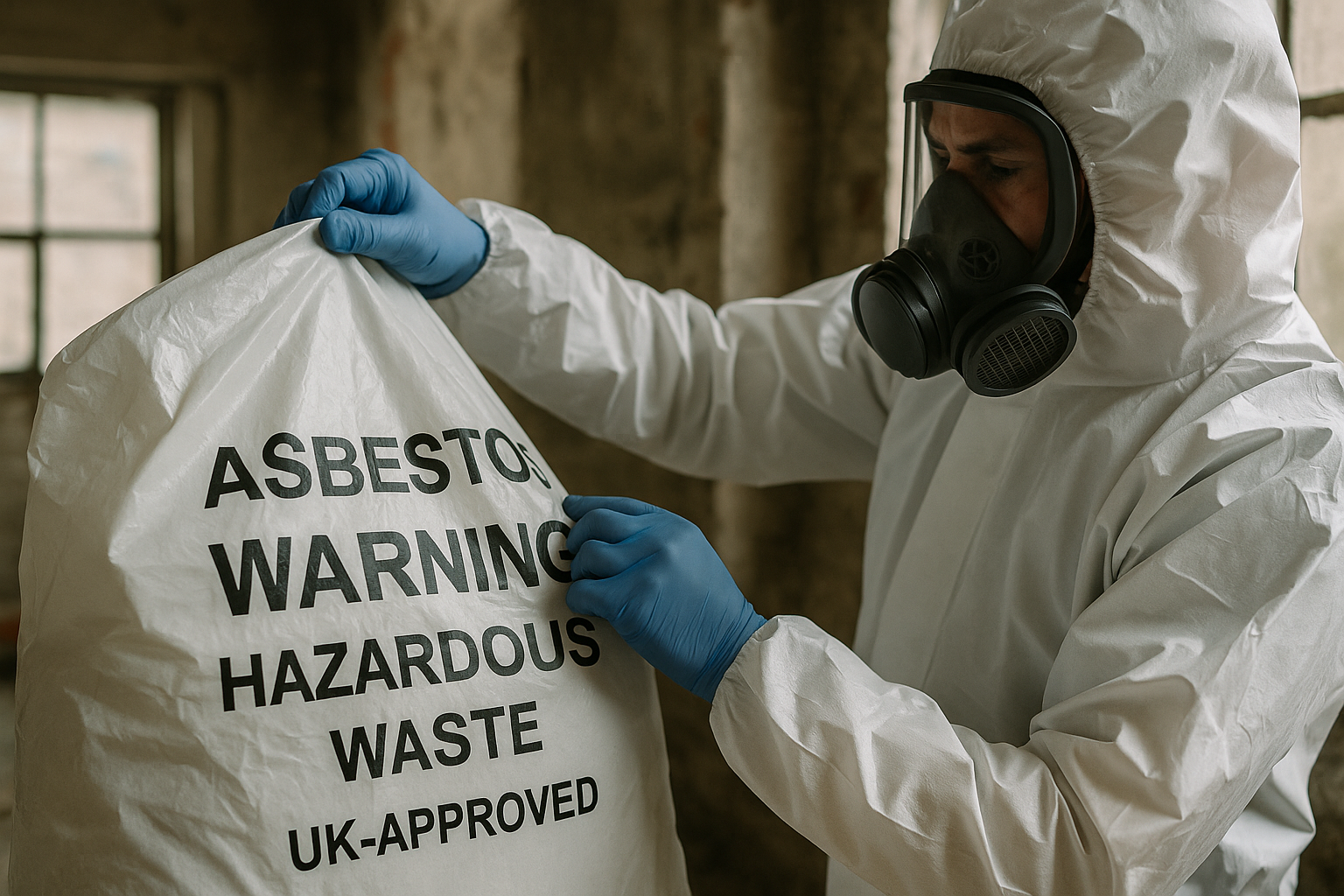
    asbestos disposal bag - How does one dispose of asbestos safely

    Lower-risk waste that may be suitable for bagging

    • Small offcuts of asbestos cement
    • Minor debris from controlled work
    • Contaminated disposable PPE
    • Cleaning materials used during the task
    • Small amounts of confirmed textured coating debris

    Higher-risk waste that needs specialist handling

    • Asbestos insulating board
    • Pipe lagging
    • Loose insulation
    • Sprayed coatings
    • Damaged friable debris

    Higher-risk asbestos materials are not a routine bagging job. They may require licensed work, enclosures, controlled cleaning and formal clearance procedures. Where removal is needed, using a professional asbestos removal service is the safest option for damaged, friable or legally restricted materials.

    Common mistakes people make with an asbestos disposal bag

    Most failures come from treating asbestos waste like ordinary building debris. That is when contamination spreads and paperwork problems follow.

    Using the wrong type of bag

    A household refuse sack is not an asbestos disposal bag. It may tear too easily, lacks the correct warning information and does not show that the contents are hazardous.

    Overfilling the bag

    If the bag is too heavy or packed with sharp fragments, it may split when lifted. Keep each asbestos disposal bag manageable and use more than one if needed.

    Breaking larger items to make them fit

    This is a common error with asbestos cement sheets and boards. Breaking them up creates more edges, more dust and more risk.

    If the item is too large for an asbestos disposal bag, wrap it instead. Do not reduce it in size just for convenience.

    Leaving waste unsecured on site

    Sealed asbestos waste should be stored in a secure area until collection or transport. It should not be left in public access areas, open skips, shared compounds or anywhere it can be tampered with.

    Mixing asbestos with other waste

    General construction waste should be kept separate. Once mixed, more material may be treated as contaminated, which increases disposal costs and site disruption.

    Taking it to the wrong facility

    Not every waste site accepts asbestos. Always check in advance that the destination is authorised to receive the type of asbestos waste you have.

    Transporting asbestos waste safely

    Once waste has been sealed in an asbestos disposal bag or wrapped package, transport becomes the next risk point. The fact that it is bagged does not mean the job is finished.

    Waste must remain secure throughout the journey. Packaging should be protected from puncture, crushing, movement and weather exposure.

    Practical transport checks

    • Make sure every asbestos disposal bag is fully sealed
    • Keep bags upright where possible
    • Do not crush bags under tools, rubble or equipment
    • Keep asbestos waste separate from clean materials
    • Use a suitable vehicle space that prevents movement and damage
    • Confirm the disposal site’s acceptance arrangements before travel

    Transport duties can become more involved depending on the type and quantity of asbestos and who is carrying it. If you are coordinating works across multiple properties, it is often more efficient to use a competent contractor who already understands the disposal chain and documentation.

    For property portfolios in the North West, arranging an asbestos survey Manchester appointment before maintenance starts can prevent accidental disturbance and avoid creating unmanaged asbestos waste in the first place.

    Where asbestos waste can be taken

    An asbestos disposal bag does not make asbestos suitable for ordinary disposal. The waste still has to go to a facility authorised to accept it.

    Some local authority arrangements accept limited domestic asbestos waste, but this varies by area. There may be booking requirements, quantity limits and strict packaging rules. Commercial waste follows its own obligations and should never be treated as if it were ordinary household waste.

    Check these points before you travel

    1. Does the site accept asbestos at all?
    2. Does it accept only bonded asbestos, or other types as well?
    3. What packaging standard does it require?
    4. Do you need to book in advance?
    5. Are there quantity restrictions?
    6. What paperwork must accompany the load?

    Turning up without checking is a frequent mistake. If the site refuses the load, you are left with hazardous waste still in your vehicle and a compliance problem to solve.

    Documentation and record keeping

    Safe disposal is not only about the physical asbestos disposal bag. You should also be able to show that the waste was identified, handled, moved and disposed of correctly.

    For businesses, landlords, managing agents and contractors, clear records matter. They support legal compliance, internal auditing and future maintenance planning.

    Useful records to keep

    • Survey reports and sampling results
    • Material and priority assessments where relevant
    • Risk assessments and method statements
    • Waste consignment documentation where required
    • Carrier and disposal site details
    • Photographs of packaging and labelling where helpful
    • Updates to the asbestos register or management plan

    If asbestos has been identified in a non-domestic building, the duty to manage does not disappear because one item has been removed. The wider asbestos risk across the premises still needs to be reviewed and recorded properly.

    For sites across the Midlands, booking an asbestos survey Birmingham service can help update records before refurbishment, maintenance or tenant alterations begin.

    When you should not handle asbestos waste yourself

    Understanding what an asbestos disposal bag is for does not automatically mean you should be the person using one. In many situations, the safest decision is to stop and bring in a specialist.

    Get professional advice if:

    • You do not know whether the material contains asbestos
    • The material is damaged, dusty or friable
    • The waste comes from insulation board, lagging or sprayed coating
    • The area is occupied or hard to isolate
    • You are dealing with commercial premises
    • You do not have the right PPE, RPE or packaging
    • You are not sure where the waste can legally go

    Property managers often run into asbestos during routine jobs such as boiler replacement, roof repairs, ceiling access, electrical works and refurbishments. The safest move is usually to identify the material first, then decide whether it should be managed in place or removed by a competent contractor.

    Practical advice for property managers and dutyholders

    If you manage buildings, the best disposal plan is the one you never need to improvise. Most asbestos waste problems begin with poor planning rather than bad intentions.

    Before any work starts

    • Check whether an up-to-date asbestos survey is already available
    • Review the asbestos register for the area affected
    • Make sure contractors have the relevant information before starting
    • Stop intrusive work if suspect materials are found
    • Arrange sampling or a survey instead of guessing

    If asbestos waste is created

    • Isolate the area if needed
    • Prevent others from walking through contamination
    • Use the correct asbestos disposal bag or wrapping method
    • Store waste securely pending collection or transport
    • Keep disposal paperwork with the job record

    That practical discipline matters just as much as the bag itself. A properly used asbestos disposal bag is one part of a wider control process, not a shortcut around it.

    Choosing the safest route for disposal

    If the waste is limited, low-risk and already properly identified, correct packaging and authorised disposal may be straightforward. If the material is damaged, friable, extensive or uncertain, the right answer is usually to stop and escalate.

    A good rule is simple: if you are relying on guesswork at any stage, you are already taking too much risk. Survey first, assess properly and only proceed when the method of handling, packaging and disposal is clear.

    Need help with asbestos identification, surveys or removal? Supernova Asbestos Surveys supports property owners, landlords and managers across the UK with expert advice, asbestos surveys and specialist project support. Call 020 4586 0680 or visit asbestos-surveys.org.uk to arrange the right service for your property.

    Frequently Asked Questions

    Can I use a normal rubble sack instead of an asbestos disposal bag?

    No. A normal rubble sack is not suitable for asbestos waste. An asbestos disposal bag should be fit for hazardous waste packaging, clearly labelled and used as part of the correct containment process.

    Can all asbestos materials go in an asbestos disposal bag?

    No. Smaller pieces of lower-risk waste may be bagged, but larger items such as full asbestos cement sheets usually need wrapping. Friable materials such as lagging or asbestos insulating board may require licensed handling and should not be treated as a simple bagging task.

    Do I need to double-bag asbestos waste?

    In many cases, yes. Double-bagging provides an extra layer of protection if the outer package is damaged. Larger items that cannot be bagged are often double-wrapped in suitable polythene instead.

    Can I take asbestos waste to my local tip?

    Only if that site is authorised to accept it and you meet its packaging and booking requirements. Many facilities do not accept asbestos, and domestic and commercial arrangements are not the same.

    When should I call a specialist instead of handling asbestos waste myself?

    Call a specialist if the material is unknown, damaged, friable, extensive or located in an occupied area. You should also get professional help if you are dealing with commercial premises or do not have the right equipment, packaging or disposal route.
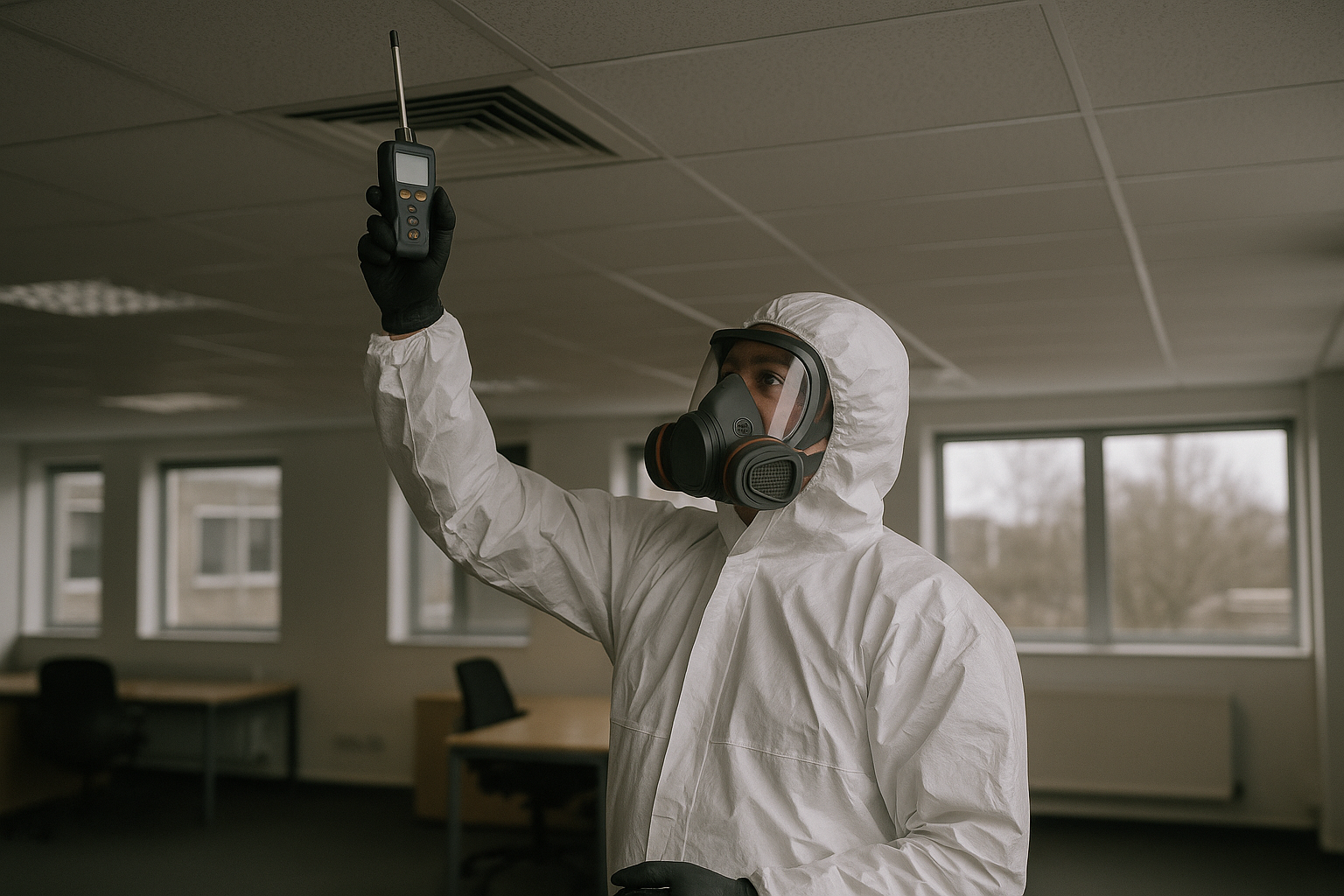
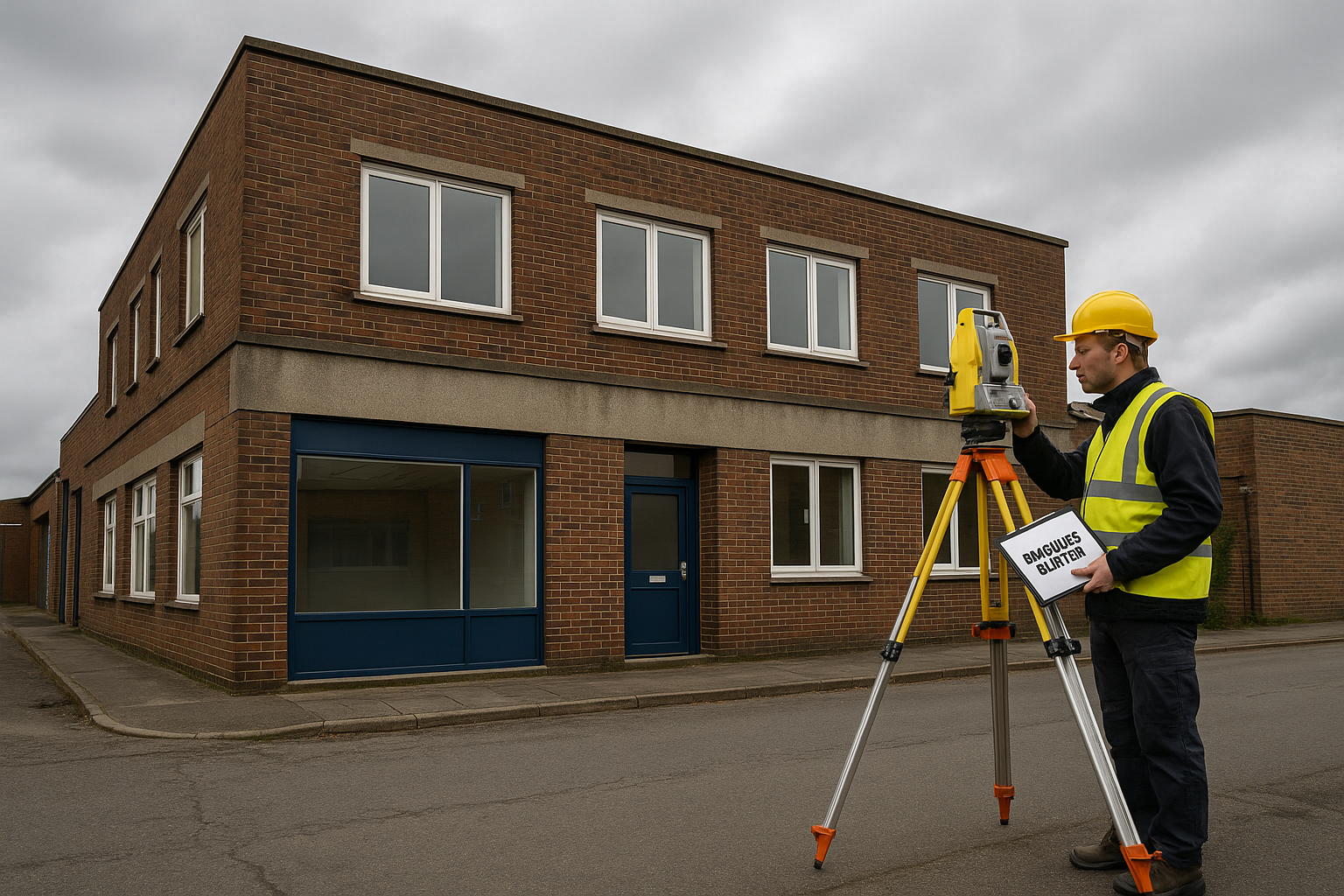
  • What factors are considered when developing an asbestos management plan?

    What factors are considered when developing an asbestos management plan?

    One missing document can turn a routine maintenance job into a compliance problem overnight. An asbestos management plan is the working document that tells your staff, contractors, and anyone responsible for the building where asbestos is, what condition it is in, and exactly what must happen next.

    For duty holders managing older non-domestic premises, the hard part is rarely just identifying asbestos-containing materials. The real challenge is controlling risk day to day, keeping records accurate, and making sure the right people see the right information before work starts. Under the Control of Asbestos Regulations, supported by HSE guidance and HSG264, that duty is ongoing.

    A survey identifies or presumes asbestos-containing materials. The asbestos management plan explains how those materials will be managed in practice. If your records are old, incomplete, or based on assumptions, start with a current management survey so your register and plan are built on reliable evidence.

    What is an asbestos management plan?

    An asbestos management plan is a site-specific document setting out how asbestos risks will be controlled in a non-domestic property. It should be based on the asbestos register, risk assessments, and the way the building is actually used.

    It is not the same as the survey report. The survey records what was found or presumed. The plan turns that information into action, with clear responsibilities, control measures, communication steps, and review arrangements.

    In practical terms, your asbestos management plan should answer a few simple questions:

    • What asbestos is present or presumed to be present?
    • Where is it located?
    • What condition is it in?
    • Who could disturb it?
    • What controls are in place?
    • Who is responsible for monitoring and review?

    If those questions are not answered clearly, the plan is unlikely to help when maintenance is planned, contractors arrive on site, or an auditor asks how asbestos is being managed.

    Who needs an asbestos management plan?

    The duty to manage asbestos usually falls on the person or organisation responsible for maintenance or repair of non-domestic premises. That may be a landlord, managing agent, employer, facilities manager, freeholder, tenant, or another party depending on lease terms and maintenance obligations.

    The duty also applies to common parts of certain residential buildings, including corridors, stairwells, risers, plant rooms, lift areas, and service cupboards. Shared responsibility should always be defined in writing, because unclear boundaries are where asbestos risk is often missed.

    Industries and property types where plans are essential

    Every sector with responsibility for older premises needs a workable asbestos management plan, not a template left in a folder. The exact format may vary, but the duty to manage remains the same.

    • Commercial offices and business parks
    • Schools, academies, colleges, and universities
    • Healthcare premises and care settings
    • Retail units, shopping centres, and hospitality sites
    • Industrial sites, warehouses, and factories
    • Local authority buildings and civic premises
    • Transport buildings and depots
    • Blocks with shared residential common parts

    If you manage several sites, each one needs its own asbestos management plan. A corporate template can help with structure, but it will never replace a building-specific document.

    Search HSE.GOV.UK: what the official guidance expects

    When duty holders search HSE.GOV.UK for asbestos advice, the message is consistent. You must find out whether asbestos is present, presume materials contain asbestos unless there is strong evidence otherwise, keep an up-to-date record, assess the risk of exposure, and prepare a plan for managing that risk.

    asbestos management plan - What factors are considered when develop

    That matters because many organisations stop at the survey stage. HSE guidance does not stop there. The expectation is active management, not passive record keeping.

    Your asbestos management plan should therefore:

    • Record known or presumed asbestos-containing materials
    • Assess the risk posed by each item
    • Set out the action required for each area or material
    • Explain how information will be shared
    • State how monitoring and review will be carried out

    HSG264 supports this by setting out what a management survey is designed to achieve and how asbestos information should be gathered and used. The plan then takes those findings and applies them to real building management.

    Related content and topics duty holders should pay attention to

    When reviewing HSE guidance and your own internal procedures, look beyond the survey report. Related content usually includes the duty to manage, asbestos registers, training, refurbishment work, emergency arrangements, and contractor control.

    These topics are connected. If one is weak, the whole asbestos management plan becomes less effective.

    6. Write your asbestos management plan and monitor it

    This is the stage where the register becomes a live control document rather than a technical report sitting unread in a folder. Writing the asbestos management plan means linking survey findings to decisions, responsibilities, and a timetable for action.

    The best plans are practical. They tell a contractor what they need to know before drilling a wall. They tell site staff what to do if debris falls from a ceiling void. They tell senior management what can stay in place and what needs budget, repair, enclosure, or removal.

    What writing the plan really involves

    To write a usable asbestos management plan, you need more than a list of asbestos locations. You need to connect each material to a clear management decision.

    • Will the material be left in place and monitored?
    • Does it need sealing or encapsulation?
    • Should access be restricted?
    • Does it need labelling?
    • Is repair required?
    • Should it be removed as part of planned works?
    • Who signs off each action?
    • How often will it be re-inspected?

    Without those decisions, an asbestos management plan is only a summary of a problem, not a method of controlling it.

    Why monitoring matters

    Asbestos risk changes over time. A material in good condition today may deteriorate because of vibration, water ingress, repeated access, poor housekeeping, accidental knocks, or minor maintenance works.

    That is why the asbestos management plan must include monitoring arrangements. If no one checks the materials, no one knows whether the original decision is still safe.

    What your plan should contain

    A strong asbestos management plan should be clear, site-specific, and easy for non-specialists to use. It must reflect the actual building, not a copied template that ignores how the premises are occupied and maintained.

    asbestos management plan - What factors are considered when develop

    At minimum, the plan should contain the following elements.

    1. Details of the premises

    • Building name and full address
    • Use of the premises
    • Areas covered by the plan
    • Name of the duty holder
    • Names of responsible persons and deputies

    2. The asbestos register

    The register is the backbone of the asbestos management plan. It should record the location, extent, product type, condition, accessibility, and any relevant notes for each known or presumed asbestos-containing material.

    Descriptions must be precise. “Asbestos in boiler room” is too vague. A contractor needs enough detail to identify the material before any work starts.

    3. Risk assessments

    Your plan should include or reference material risk and priority risk. Material risk considers product type, damage, surface treatment, and asbestos type where known. Priority risk considers occupancy, maintenance activity, accessibility, and likelihood of disturbance.

    4. Control measures

    For each asbestos-containing material, the asbestos management plan should state the control approach clearly. Typical options include:

    • Leave in place and monitor
    • Encapsulate or seal
    • Restrict access
    • Label the area or item
    • Repair minor damage under suitable controls
    • Arrange planned asbestos removal where the risk cannot be managed safely in place

    5. Re-inspection schedule

    The plan should state how often known or presumed asbestos-containing materials will be checked. The interval should reflect risk. Materials in vulnerable or busy areas may need more frequent review than sealed materials in controlled spaces.

    6. Communication procedures

    The asbestos management plan should explain how information is shared with:

    • In-house maintenance staff
    • External contractors
    • Cleaning teams
    • Project managers
    • Occupiers where relevant

    Contractors should see relevant asbestos information before arriving with tools, not after opening up an area.

    7. Training records

    If staff may encounter asbestos during their work, the plan should record what awareness training has been given and when refresher training is due.

    8. Emergency arrangements

    Your plan should include clear steps for accidental disturbance. That usually means stopping work, isolating the area, preventing spread, reporting internally, and obtaining specialist advice before anyone re-enters.

    9. Review arrangements

    Every asbestos management plan needs a review date and clear triggers for earlier revision. If the building changes, the document must change with it.

    Prioritising your actions

    Not every asbestos-containing material needs the same response. The point of an asbestos management plan is to help you prioritise action based on risk, not on guesswork or anxiety.

    A stable asbestos cement sheet in a locked service yard is very different from damaged asbestos insulating board near a busy corridor, plant room access route, or maintenance zone. The plan should make those differences obvious.

    Factors to consider when prioritising

    • Condition: intact, slightly damaged, or significantly deteriorated
    • Material type: higher-risk friable products generally need tighter controls
    • Surface treatment: sealed materials are often lower risk than unsealed ones
    • Accessibility: can staff, contractors, or occupants easily reach it?
    • Likelihood of disturbance: is drilling, vibration, access, or maintenance likely?
    • Occupancy: how often is the area used, and by whom?
    • Future works: is refurbishment, installation, or intrusive maintenance planned nearby?

    A practical way to rank actions

    Many duty holders find it useful to divide actions into categories:

    1. Immediate action – damaged or highly vulnerable materials needing urgent control
    2. Short-term planned action – items needing repair, encapsulation, labelling, or restricted access
    3. Long-term management – low-risk materials to remain in place with periodic inspection

    This makes the asbestos management plan easier to use during budgeting, contractor procurement, and maintenance planning.

    Monitor, repair, encapsulate, or remove?

    One of the most common mistakes is assuming asbestos must always be removed. In many cases, the safest option is to leave it in place and manage it properly. Removal creates disturbance, so it should be considered carefully and planned properly.

    When monitoring may be appropriate

    Monitoring is often suitable where the material is in good condition, sealed, unlikely to be disturbed, and located in a controlled area. The asbestos management plan should record the inspection frequency and who is responsible.

    When repair or encapsulation may be appropriate

    If a material has minor damage but can be made safe without full removal, sealing or encapsulation may be suitable. That decision should be made by a competent person and recorded clearly so future works do not disturb the area unknowingly.

    When removal may be necessary

    Removal may be the best option where the material is damaged, friable, difficult to protect, or likely to be disturbed during planned works. It may also make sense where repeated monitoring and access restrictions are no longer practical.

    Keep your asbestos management plan up to date

    An asbestos management plan loses value the moment it stops reflecting the building. Properties change constantly. Contractors open up hidden areas, tenants alter layouts, plant is replaced, leaks occur, and materials deteriorate.

    Keeping the plan current is one of the clearest expectations in HSE guidance. If the register or action list is out of date, the controls based on it may be wrong.

    When the plan should be updated

    • After removal, encapsulation, repair, or enclosure of asbestos-containing materials
    • After a new survey, sampling exercise, or re-inspection
    • After refurbishment or intrusive maintenance
    • After discovering previously hidden or presumed asbestos-containing materials
    • After accidental damage or an asbestos incident
    • When the duty holder or responsible person changes
    • When the use of the building changes

    How to keep it current in practice

    • Use a live register rather than relying on old printed copies
    • Make one person responsible for document control and version control
    • Require contractors to report any relevant findings from intrusive access works
    • Review the plan after re-inspections, not just at annual audit time
    • Withdraw outdated copies so the wrong information is not used on site
    • Check that emergency contacts, named persons, and escalation routes are still correct

    If your estate spans multiple locations, consistency matters. Whether you need an asbestos survey London service for a city office, an asbestos survey Manchester team for a regional portfolio, or support with an asbestos survey Birmingham instruction, the principle is the same: each site needs accurate records and a current asbestos management plan.

    Practical steps for building a workable asbestos management plan

    If your current arrangements feel patchy, do not start by rewriting policy language. Start with the building and the people who actually work in it.

    1. Check whether your survey information is current. If not, arrange an updated inspection.
    2. Review the asbestos register against real site conditions. Confirm rooms, access routes, and plant areas still match.
    3. Score material and priority risk properly. Focus on likelihood of disturbance, not just product type.
    4. Assign named responsibilities. Avoid vague wording such as “site team” or “management”.
    5. Set action deadlines. If an item needs repair or labelling, give it a date.
    6. Control contractor access. Make asbestos information part of permit-to-work and pre-start checks.
    7. Schedule re-inspections. Put dates in diaries and maintenance systems.
    8. Review after change. Any works, damage, or layout change should trigger a check of the asbestos management plan.

    This approach keeps the plan usable. A short, accurate document that people follow is far better than a long file nobody reads.

    Common mistakes that weaken an asbestos management plan

    Most compliance failures are not caused by the absence of paperwork. They happen because the paperwork does not match what is happening on site.

    • Using a generic template with no building-specific detail
    • Failing to update the register after works or re-inspection
    • Not sharing asbestos information with contractors before work starts
    • Leaving responsibility unclear between landlord, tenant, and managing agent
    • Missing common parts, risers, roof voids, or service areas
    • Confusing the survey report with the asbestos management plan itself
    • Not recording emergency procedures for accidental disturbance
    • Allowing outdated printed registers to remain in circulation

    If any of these sound familiar, fix them quickly. Small gaps in management arrangements are often what lead to accidental disturbance.

    Products, topics, and related content: what should sit around the plan?

    The asbestos management plan should not exist in isolation. It works best when it links to the wider products, topics, and related content your team relies on to manage compliance properly.

    Useful supporting documents

    • Asbestos survey reports
    • Asbestos register
    • Material and priority risk assessments
    • Re-inspection records
    • Contractor induction and permit-to-work documents
    • Training records
    • Incident reporting procedures
    • Refurbishment planning information
    • Removal or remediation certificates where relevant

    Think of these as the supporting documents behind the plan. The plan tells people what to do. The related content proves why that decision was made and how it should be followed.

    Footer links and document access

    Many organisations overlook simple access issues. If the asbestos management plan is buried in a shared drive or hidden in an old compliance folder, people will not use it when they need it.

    Make sure your internal systems include clear document access, whether that is through a compliance portal, intranet, facilities software, or controlled footer links in your document library. The key is that authorised people can find the current version quickly, while old versions are clearly withdrawn.

    What good asbestos management looks like in practice

    A good asbestos management plan is easy to understand under pressure. It helps a caretaker checking a leak, a contractor opening a ceiling, and a property manager planning next quarter’s maintenance budget.

    In practice, that means:

    • The register is current and specific
    • Actions are prioritised by risk
    • Named people are responsible for each task
    • Contractors get information before starting work
    • Re-inspections happen when they should
    • Changes to the building trigger updates
    • Emergency arrangements are clear and tested

    If those basics are in place, your asbestos management plan becomes a practical control measure rather than a paper exercise.

    Frequently Asked Questions

    What is the purpose of an asbestos management plan?

    The purpose of an asbestos management plan is to set out how known or presumed asbestos-containing materials will be managed safely. It turns survey findings and the asbestos register into practical actions, responsibilities, communication procedures, and review arrangements.

    Who is responsible for the asbestos management plan?

    Responsibility usually sits with the duty holder, meaning the person or organisation responsible for maintenance or repair of the premises. Depending on lease terms and management arrangements, that could be a landlord, managing agent, employer, tenant, or facilities manager.

    How often should an asbestos management plan be reviewed?

    The asbestos management plan should be reviewed regularly and whenever circumstances change. That includes after re-inspection, repair, removal, refurbishment, accidental damage, a change in building use, or a change in the responsible person.

    Does every asbestos-containing material need to be removed?

    No. If the material is in good condition, sealed, and unlikely to be disturbed, it may be safer to leave it in place and manage it through monitoring. Removal is usually considered where the material is damaged, higher risk, or likely to be disturbed by planned works.

    What is the difference between an asbestos survey and an asbestos management plan?

    An asbestos survey identifies or presumes asbestos-containing materials and records their location and condition. An asbestos management plan explains how those materials will be controlled in practice, including actions, responsibilities, communication, monitoring, and review.

    Need help with your asbestos management plan?

    If your records are outdated, your responsibilities are unclear, or you need a current survey to support a reliable asbestos management plan, Supernova Asbestos Surveys can help. We provide asbestos surveys, re-inspections, sampling support, and guidance for duty holders managing property portfolios across the UK.

    Call 020 4586 0680 or visit asbestos-surveys.org.uk to arrange expert support from Supernova.

  • How do asbestos management plans address emergency situations involving asbestos?

    How do asbestos management plans address emergency situations involving asbestos?

    When Asbestos Becomes an Emergency: What Your Management Plan Must Cover

    An asbestos emergency can unfold in minutes. A contractor drills through an unexpected ceiling panel, a flood saturates old pipe lagging, or a fire rips through a building concealing decades-old asbestos-containing materials (ACMs). When that happens, the quality of your asbestos emergency response — and the management plan sitting behind it — determines everything that follows.

    Buildings constructed before 2000 may contain asbestos in dozens of locations, many of them unmarked and unknown. Without a clear, rehearsed plan in place, the consequences for occupant health, legal compliance, and dutyholder liability can be severe and lasting.

    What Actually Counts as an Asbestos Emergency?

    Not every discovery of asbestos triggers a full emergency response, but certain situations demand immediate and structured action. Knowing the difference matters — both for proportionate response and for legal compliance under the Control of Asbestos Regulations.

    An asbestos emergency typically involves one or more of the following:

    • Accidental disturbance of ACMs during maintenance, refurbishment, or construction work
    • Physical damage to known asbestos materials through impact, water ingress, fire, or structural failure
    • Discovery of previously unrecorded ACMs in poor or deteriorating condition
    • Suspected fibre release into an occupied or partially occupied area
    • Fire or flood that may have disturbed asbestos insulation, lagging, or board materials

    In any of these scenarios, the risk of airborne asbestos fibre release is real. Chrysotile, amosite, and crocidolite fibres are all capable of causing mesothelioma, lung cancer, and asbestosis — diseases with no cure and latency periods spanning decades.

    That is precisely why the response must be immediate and methodical, not improvised.

    Immediate Asbestos Emergency Response: The First Steps

    The first minutes of any asbestos emergency response determine how much exposure occurs and how effectively the situation is contained. Speed matters enormously — but so does doing the right things in the right order.

    Stop All Work Immediately

    The moment a suspected ACM disturbance is identified, all work in the affected area must cease. This is non-negotiable under the Control of Asbestos Regulations. Anyone in the vicinity should leave the area calmly but promptly, without disturbing materials further.

    Do not attempt to clean up, collect samples, or investigate the damage yourself. Untrained handling of disturbed asbestos can dramatically increase fibre release and spread contamination far beyond the original site.

    Isolate the Affected Area

    Once the area is clear of people, it must be secured without delay. Effective isolation includes:

    • Restricting access with physical barriers at all entry points
    • Posting clear asbestos warning signs so nobody inadvertently enters
    • Switching off any ventilation or air conditioning systems that could spread fibres to other parts of the building
    • Preventing anyone without appropriate personal protective equipment (PPE) from entering under any circumstances

    The scale of isolation should reflect the nature of the disturbance. A small localised breach requires a very different response to a fire-damaged ceiling containing sprayed asbestos coating across a large floor plate.

    Emergency Decontamination of Exposed Individuals

    Anyone who may have been exposed to asbestos fibres must undergo decontamination without delay. Skipping or rushing this step risks spreading fibres beyond the incident zone and increasing personal exposure.

    The decontamination process should include:

    1. Removing outer clothing carefully, turning garments inside out to trap fibres
    2. Placing contaminated clothing in sealed, clearly labelled bags for disposal by a licensed carrier
    3. Wiping exposed skin with damp cloths — never dry brushing, which can re-suspend fibres
    4. Washing exposed skin and hair thoroughly with soap and water
    5. Seeking occupational health advice and ensuring the incident is formally recorded

    These steps must be embedded in every asbestos emergency response procedure — not left to improvisation on the day.

    Notification and Communication: Who You Must Tell and When

    Effective communication is as important as physical containment during an asbestos emergency. Delays in notification can worsen exposure, compound legal liability, and undermine any subsequent investigation by the HSE.

    Internal Notification

    The building manager or dutyholder must be informed immediately — at the same time as work stops, not after. If a responsible person has been appointed under your asbestos management plan, as required under the Control of Asbestos Regulations, they should be contacted in parallel.

    All relevant staff — facilities managers, health and safety officers, and senior management — should be made aware as quickly as possible. Internal communication chains should be pre-agreed and written into the management plan, not worked out under pressure during an incident.

    External Notification

    Depending on the severity of the incident, external notifications may include:

    • The Health and Safety Executive (HSE) — certain asbestos incidents must be reported under RIDDOR
    • A licensed asbestos contractor — for any work involving notifiable non-licensed work (NNLW) or licensed asbestos removal
    • Emergency services — if the incident involves fire, structural collapse, or immediate risk to life
    • A UKAS-accredited laboratory — to arrange sampling and analysis of suspect materials if not already confirmed

    An incident report must be completed as soon as practicable. This document should record the nature of the disturbance, who was present, what actions were taken, and when notifications were made. Accurate records protect both the dutyholder and the individuals involved.

    The Role of the Asbestos Management Plan in Emergency Preparedness

    Your asbestos management plan is not just a document produced to satisfy an inspector. When an emergency strikes, it becomes an operational tool — and its quality directly affects how well your team responds.

    Detailed Mapping of Asbestos-Containing Materials

    A well-maintained asbestos register is the foundation of any effective asbestos emergency response. It should include:

    • The precise location of all known ACMs, referenced to a site plan
    • The type and condition of each material
    • The risk assessment score for each ACM
    • Any areas not inspected and the reasons why
    • Dates of previous surveys and any remedial actions taken

    During an emergency, this information allows the responsible person to quickly identify what materials are at risk, what type of asbestos may have been disturbed, and what level of response is required. An out-of-date or incomplete register is a serious liability — not just a paperwork failure.

    An asbestos management survey carried out by a qualified surveyor is the standard method for producing and maintaining this register. It should be reviewed regularly and updated whenever building work, refurbishment, or changes in material condition are identified.

    Clear Emergency Procedures Written Into the Plan

    Your asbestos management plan must contain explicit emergency procedures — not vague references to contacting a contractor. The procedures should specify:

    • Who is responsible for making decisions during an emergency
    • The step-by-step response sequence for different types of incident
    • Contact details for licensed contractors, the HSE, and occupational health services
    • Decontamination protocols for exposed individuals
    • Procedures for securing and disposing of contaminated waste

    These procedures must be accessible to the people who need them. A plan buried in a shared drive folder or locked in a filing cabinet is functionally useless when an emergency unfolds in real time.

    Training and Emergency Drills

    Knowing the plan exists is not the same as knowing how to execute it. Under the Control of Asbestos Regulations, dutyholders are required to ensure that relevant staff receive appropriate asbestos awareness training. For those responsible for implementing the management plan, supplementary training is required on top of that baseline.

    Regular emergency drills should simulate realistic scenarios — an unexpected ACM discovery during maintenance work, a damaged ceiling panel, a fire-affected area with suspected asbestos lagging. Drills expose gaps in the plan before a real incident does.

    After each drill, review what worked and what did not. Update the plan accordingly. This cycle of training, testing, and revision is what separates a functional emergency plan from a compliance document that sits untouched on a shelf for years.

    Handling Contaminated Waste After an Asbestos Emergency

    Once the immediate emergency has been managed and the area secured, the safe removal and disposal of contaminated materials must be arranged through the correct channels. This stage is governed by strict legal requirements that cannot be bypassed.

    Asbestos waste — including contaminated clothing, PPE, cleaning materials, and ACM debris — must be:

    • Double-bagged in UN-approved asbestos waste sacks
    • Clearly labelled with the appropriate hazard warning
    • Stored securely until collection by a licensed waste carrier
    • Transported and disposed of at a licensed facility
    • Documented with a waste transfer note at every stage

    Improper disposal of asbestos waste is a criminal offence. The dutyholder is responsible for ensuring the entire waste chain is compliant — from bagging at the incident site through to final disposal. Ignorance of the requirements is not a defence.

    Where ACMs need to be physically removed from the building as part of the post-emergency clean-up, this must be carried out by a licensed contractor. Our asbestos removal service operates across the UK and can be mobilised rapidly following an emergency incident.

    After the Emergency: Review, Record, and Update

    Once the immediate situation is resolved and the area has been cleared by a licensed contractor following air clearance testing, the work is not finished. A thorough post-incident review is essential — and legally prudent.

    Update the Asbestos Register

    If the emergency revealed previously unrecorded ACMs, or if materials were removed or disturbed, the register must be updated immediately. Allowing the register to remain inaccurate after an incident is both a legal compliance failure and a practical safety risk for anyone working in the building going forward.

    Review and Revise the Management Plan

    What did the emergency reveal about the plan’s effectiveness? Were communication channels clear? Did staff know what to do without being told? Was isolation swift enough to prevent wider contamination?

    Every incident provides information that should feed directly back into a revised and strengthened management plan. If the incident highlighted that your existing management survey data was incomplete or out of date, commissioning an updated survey should be a priority action — not an afterthought.

    Report and Document Everything

    Comprehensive incident documentation serves multiple purposes: it supports any HSE investigation, protects the dutyholder legally, and provides a reference point for future training and plan revisions. Records should include timelines, actions taken, individuals involved, and the outcomes of any air testing or sampling carried out following the incident.

    The HSE’s HSG264 guidance is clear that documentation is a core component of asbestos management — not optional paperwork. Gaps in records can be interpreted as gaps in compliance.

    Asbestos Emergency Response Across the UK

    Asbestos emergencies can occur in any building constructed before 2000 — offices, schools, hospitals, residential blocks, and industrial premises alike. The principles of emergency response are consistent across the country, but having a local surveying partner who knows your building stock and can respond rapidly makes a genuine operational difference.

    For properties across the capital, our asbestos survey London service covers the full range of building types, from Victorian terraces to modern commercial premises with legacy materials hidden within refurbished interiors.

    In the North West, our asbestos survey Manchester team works across a wide variety of commercial, industrial, and residential properties — many of which were built during the period when asbestos use was at its peak.

    Across the Midlands, our asbestos survey Birmingham service supports dutyholders managing large and complex building portfolios where the risk of an unexpected ACM disturbance is an ongoing operational reality.

    Wherever your property is located, the ability to call on a qualified, experienced surveying team at short notice is a key part of any credible asbestos emergency response strategy.

    Frequently Asked Questions

    What should I do first if I suspect asbestos has been disturbed?

    Stop all work in the affected area immediately and evacuate everyone present. Do not attempt to clean up or investigate the disturbance yourself. Isolate the area using physical barriers and asbestos warning signs, switch off any ventilation systems that could spread fibres, and contact your asbestos management plan’s designated responsible person straight away. Speed of isolation is critical to limiting exposure.

    Do I have to report an asbestos emergency to the HSE?

    Depending on the nature of the incident, reporting to the HSE may be a legal requirement under RIDDOR. If workers or members of the public have been exposed to asbestos fibres as a result of the incident, you should seek immediate guidance on your reporting obligations. Failure to report a notifiable incident can result in enforcement action and prosecution. Always err on the side of reporting and document every step you take.

    Who is allowed to remove asbestos after an emergency?

    The type of contractor permitted to remove asbestos depends on the material involved and the scale of the disturbance. Many forms of asbestos removal — particularly those involving high-risk materials such as sprayed coatings, lagging, and insulation board — must be carried out by a contractor licensed by the HSE. Unlicensed removal of licensable materials is a criminal offence. Always verify a contractor’s licence status before allowing any removal work to proceed.

    How often should an asbestos management plan be reviewed?

    Under the Control of Asbestos Regulations, the asbestos management plan must be reviewed regularly and kept up to date. In practice, this means reviewing the plan at least annually and updating it whenever there is a change in building use, refurbishment activity, a change in the condition of known ACMs, or following any incident involving asbestos. An emergency is one of the most important triggers for a thorough plan review — it will almost always reveal something that needs to be strengthened.

    What is the difference between a management survey and a refurbishment survey?

    A management survey is designed to locate and assess ACMs that could be disturbed during normal occupation and routine maintenance. It forms the basis of your asbestos register and management plan. A refurbishment and demolition survey is required before any work that will disturb the fabric of a building — it is more intrusive and covers areas that a management survey does not. If your building is undergoing significant work, a management survey alone is not sufficient to meet your legal obligations.

    Speak to Supernova Asbestos Surveys

    Whether you need to commission an initial survey, update an existing management plan, or arrange rapid post-emergency support, Supernova Asbestos Surveys has the experience and national reach to help. With over 50,000 surveys completed across the UK, our qualified surveyors can assess your building, strengthen your emergency procedures, and ensure your asbestos register accurately reflects the current condition of your property.

    Call us on 020 4586 0680 or visit asbestos-surveys.org.uk to arrange a survey or discuss your asbestos emergency response requirements with our team.

  • What are the key responsibilities of individuals involved in the management of asbestos?

    What are the key responsibilities of individuals involved in the management of asbestos?

    Asbestos Management: Who’s Responsible and What Does It Actually Involve?

    If you own, manage, or occupy a non-domestic building constructed before 2000, asbestos management isn’t optional — it’s a legal duty. Asbestos-containing materials (ACMs) were used extensively in UK construction for decades, and millions of buildings still contain them today. When those materials are disturbed or begin to deteriorate, they release microscopic fibres capable of causing serious and often fatal respiratory diseases.

    Understanding who holds responsibility, what they’re required to do, and how to do it properly is the foundation of keeping people safe and staying on the right side of the law.

    What Is Asbestos Management and Why Does It Matter?

    Asbestos management refers to the ongoing process of identifying, assessing, recording, and controlling asbestos-containing materials within a building. It’s not a one-off task — it’s a continuous cycle of inspection, documentation, and action.

    The Control of Asbestos Regulations places a legal duty on those responsible for non-domestic premises to manage asbestos. This duty doesn’t fall on a vague collective — it lands squarely on the “dutyholder.” That could be a building owner, a leaseholder, an employer, or anyone who holds responsibility for the maintenance and repair of a building through a contract or tenancy agreement.

    Failing to manage asbestos properly isn’t just a regulatory infringement. It puts workers, contractors, visitors, and emergency services at genuine risk of exposure to one of the UK’s leading causes of work-related deaths.

    Who Is the Dutyholder?

    The dutyholder is the person or organisation with clear responsibility for maintaining or repairing non-domestic premises. In practice, this often means:

    • Building owners who occupy their own premises
    • Landlords of commercial or industrial properties
    • Managing agents acting on behalf of owners
    • Employers who control a workplace through a tenancy or licence
    • School governors or local authorities for educational buildings
    • Housing associations or local councils for the common parts of residential blocks

    Where more than one party shares responsibility — for example, a landlord and a tenant — both parties must cooperate. The regulations are explicit: dutyholders must work together to ensure the duty to manage is fulfilled.

    Private domestic properties are generally outside the scope of the duty to manage, but the common areas of residential blocks — stairwells, plant rooms, roof spaces — are very much included.

    The Core Responsibilities of Asbestos Management

    1. Identify and Assess Asbestos-Containing Materials

    The first step in any asbestos management programme is finding out what’s there. The HSE’s guidance document HSG264 sets out the methodology for asbestos surveys, and dutyholders are expected to follow it.

    There are two main types of survey relevant to management:

    • Management survey: The standard survey required to manage ACMs during normal building occupation and use. A management survey identifies materials that could be disturbed during routine maintenance and forms the bedrock of your compliance programme.
    • Refurbishment and demolition survey: Required before any major works, refurbishment, or demolition. A demolition survey is far more intrusive and aims to locate all ACMs that could be disturbed during planned works — it must be completed before any contractors move in.

    Unless there is strong documentary evidence that a material does not contain asbestos, the regulations require it to be assumed that it does. This precautionary approach protects workers who might otherwise disturb an unidentified ACM without taking appropriate precautions.

    2. Compile and Maintain an Asbestos Register

    Every identified ACM must be recorded in an asbestos register. This is a live document — not something you file away and forget. It needs to include:

    • The location of each ACM, precise enough to be genuinely useful
    • The type of asbestos material (e.g. ceiling tiles, pipe lagging, textured coatings)
    • The condition of each material — intact, damaged, or deteriorating
    • The extent or quantity of the material
    • An assessment of the risk it poses

    The register must be made available to anyone who might disturb those materials — contractors, maintenance staff, and emergency services. Keeping this information locked away defeats the entire purpose.

    3. Conduct a Risk Assessment for Each ACM

    Not all asbestos poses the same level of risk. A well-encapsulated, undamaged asbestos cement panel on an external wall is very different from crumbling pipe lagging in a boiler room that maintenance staff access daily.

    Risk assessments for ACMs should consider:

    • The type of asbestos — white, brown, or blue, with brown and blue being significantly more hazardous
    • The physical condition of the material
    • Its accessibility and how likely it is to be disturbed
    • The activities carried out nearby
    • Who might be exposed and how frequently

    The outcome of each risk assessment should directly inform the action taken — whether that’s monitoring in place, encapsulation, or removal. If undocumented asbestos is discovered during work, all activity must stop immediately and a qualified professional must be called in before work resumes.

    4. Develop an Asbestos Management Plan

    Once you’ve identified ACMs and assessed the risks, you need a written asbestos management plan. This document brings everything together and sets out:

    • What ACMs are present and where
    • The risk each poses and the control measures in place
    • Who is responsible for managing each element
    • What actions need to be taken and by when
    • How the plan will be communicated to relevant people
    • The schedule for re-inspection and review

    A management plan is only useful if it’s actually used. It should be a working document consulted before any maintenance or building work takes place — not a PDF gathering dust on a shared drive.

    5. Provide Information and Training

    Dutyholders must ensure that anyone who might work on or disturb ACMs is properly informed. That includes:

    • In-house maintenance staff
    • External contractors
    • Cleaning staff who work in areas where ACMs are present
    • Any other workers who regularly access the building

    Asbestos awareness training is a legal requirement for anyone liable to disturb asbestos during their normal work. It covers how to recognise ACMs, the health risks of exposure, what to do if asbestos is suspected or found, and the emergency procedures to follow.

    Training isn’t a tick-box exercise. A maintenance worker who doesn’t know that the floor tiles in a corridor might contain asbestos could drill through them without a second thought — putting themselves and others at serious risk.

    Monitoring, Review, and Ongoing Compliance

    Asbestos management is not a static process. Materials deteriorate over time, buildings change use, and work can disturb previously stable ACMs. The management plan must be reviewed and updated regularly.

    The HSE’s guidance recommends:

    • Re-inspecting ACMs at least every 12 months — more frequently for materials in poor condition or high-traffic areas
    • Updating the asbestos register after any disturbance, remediation, or removal
    • Reviewing the management plan whenever significant changes occur in the building’s use or occupancy
    • Ensuring the register is accessible to contractors before any work begins

    Some dutyholders choose to conduct condition checks every three to six months for ACMs in poorer condition or areas with high footfall. This is good practice and can prevent a manageable situation from becoming an emergency.

    Asbestos Management in Practice: Common Scenarios

    Commercial Office Buildings

    In a multi-tenanted office building, the landlord typically holds the duty to manage for common areas and the building fabric, while tenants may hold responsibility for fit-out works within their own demise. Both parties need to be clear on where their responsibilities begin and end — and both need access to the asbestos register.

    Schools and Educational Buildings

    School governors and local authorities have a specific duty to manage asbestos in school buildings. Given the age of much of the UK’s school estate, ACMs are common — and the presence of children makes rigorous management even more critical. The HSE has published specific guidance for the education sector, and compliance is closely monitored.

    Industrial and Warehouse Properties

    Older industrial premises often contain significant quantities of asbestos, particularly in roof sheets, pipe lagging, and wall panels. If you’re managing a property in the North West, an asbestos survey Manchester from a specialist team will establish exactly what you’re dealing with and ensure your management plan reflects reality on the ground.

    Residential Blocks and Housing

    For residential blocks, housing associations and local authorities are responsible for the common areas. Tenants in individual flats are not dutyholders under the regulations, but they should be informed if ACMs are present in areas they can access.

    If you’re managing a mixed-use building in the Midlands, an asbestos survey Birmingham will give you the detailed picture needed to discharge your duty effectively and protect everyone who uses the building.

    London Properties

    London’s commercial property stock includes a vast number of pre-2000 buildings across every borough. Whether you’re managing an office block in the City, a warehouse in Bermondsey, or a mixed-use development in Hackney, an asbestos survey London from a qualified specialist gives you the accurate, compliant baseline data you need to build your management plan on.

    What Happens If You Don’t Comply?

    The HSE takes enforcement of the duty to manage seriously. Dutyholders who fail to comply with the Control of Asbestos Regulations can face:

    • Improvement notices requiring specific actions within a set timeframe
    • Prohibition notices stopping work or use of premises
    • Prosecution and unlimited fines in serious cases
    • Custodial sentences for the most serious breaches

    Beyond the legal consequences, the reputational damage of a serious asbestos incident — and the human cost of preventable illness — far outweighs the investment in proper management.

    Asbestos-related diseases have a long latency period. Mesothelioma, for example, can take 20 to 50 years to develop after exposure. The harm caused by poor management today may not become apparent for decades — but the legal liability doesn’t disappear with time.

    Choosing the Right Asbestos Surveying Partner

    Effective asbestos management starts with accurate, reliable survey data. The quality of your asbestos register is only as good as the survey it’s based on — which is why choosing a competent, accredited surveying company matters enormously.

    Look for surveyors who:

    • Hold UKAS accreditation for asbestos surveying and testing
    • Follow HSG264 methodology rigorously
    • Provide clear, actionable reports rather than impenetrable technical documents
    • Can support you with ongoing management, not just a one-off survey
    • Have demonstrable experience with your type of property

    A good surveying partner won’t just hand you a report and walk away. They’ll help you understand what your findings mean, what action is required, and how to build a management plan that actually works in practice.

    At Supernova Asbestos Surveys, we’ve completed over 50,000 surveys nationwide. Our UKAS-accredited team works with building owners, landlords, managing agents, and local authorities across the UK to deliver surveys that are thorough, compliant, and genuinely useful. Call us on 020 4586 0680 or visit asbestos-surveys.org.uk to discuss your requirements with a specialist.

    Frequently Asked Questions

    Who is legally responsible for asbestos management in a commercial building?

    The legal duty falls on the “dutyholder” — the person or organisation responsible for maintaining and repairing the premises. This is typically the building owner, landlord, or managing agent. Where responsibility is shared, all parties must cooperate to ensure the duty is met. The Control of Asbestos Regulations sets out these obligations in detail.

    What is an asbestos management plan and is it a legal requirement?

    An asbestos management plan is a written document that records all identified ACMs, assesses the risk they pose, and sets out the control measures and actions required to manage them safely. Yes, it is a legal requirement for dutyholders of non-domestic premises. It must be kept up to date and made available to anyone who might disturb asbestos-containing materials during their work.

    How often does an asbestos register need to be updated?

    The asbestos register should be treated as a live document and updated whenever ACMs are disturbed, remediated, or removed. In addition, a formal re-inspection of all identified ACMs should take place at least every 12 months — and more frequently for materials in poor condition or located in high-traffic areas of the building.

    Does the duty to manage asbestos apply to domestic properties?

    Private domestic properties are generally outside the scope of the duty to manage under the Control of Asbestos Regulations. However, the common areas of residential blocks — including stairwells, plant rooms, and roof spaces — are covered. Housing associations and local authorities managing these areas are dutyholders and must comply with the regulations accordingly.

    What should I do if asbestos is discovered unexpectedly during building work?

    All work must stop immediately. The area should be secured and no further disturbance should take place until a qualified asbestos professional has assessed the situation. Workers who may have been exposed should be advised to seek guidance, and the discovery should be documented and added to the asbestos register. Resuming work without proper assessment and, where necessary, licensed remediation is a serious breach of the regulations.

  • What should be included in an asbestos management plan report?

    What should be included in an asbestos management plan report?

    What Should Be Included in an Asbestos Management Plan Report?

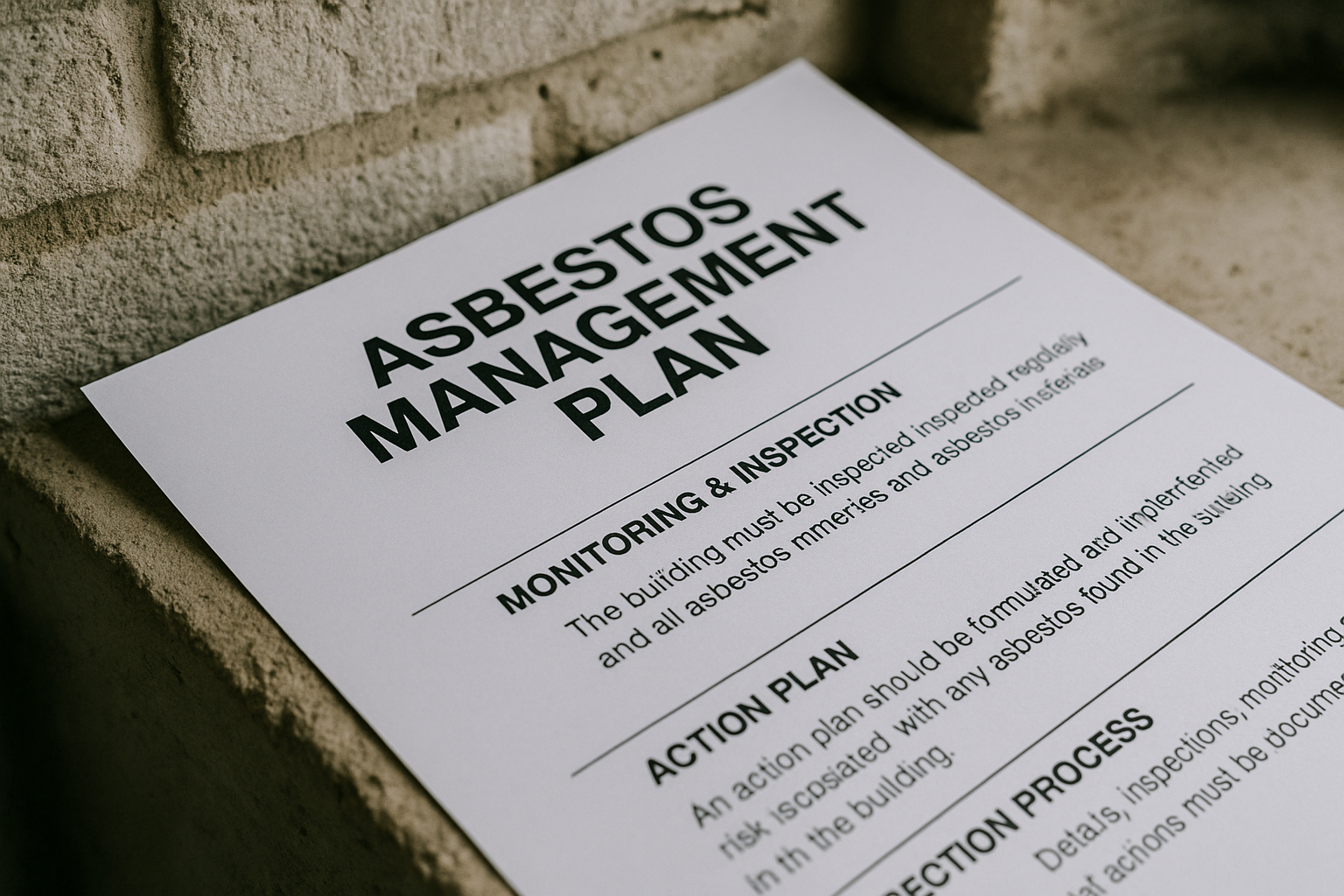
    One missing document can turn routine maintenance into a serious legal and health risk overnight. An asbestos management plan is very important — it includes details on monitoring and inspection, the action plan for dealing with any asbestos, and the practical controls needed to prevent accidental disturbance. If you manage a non-domestic property, or the common parts of a residential building, that plan sits at the centre of your asbestos duties.

    For many duty holders, the challenge is not recognising asbestos as a hazard. It is knowing what the plan should contain, who is responsible for it, how it links to the survey and register, and how to keep it active rather than letting it gather dust in a compliance folder.

    Why an Asbestos Management Plan Is Very Important

    An asbestos management plan is the written system for controlling asbestos-containing materials — or presumed asbestos-containing materials — within a building. It takes the findings from a survey and turns them into day-to-day instructions that people can actually follow.

    That is why an asbestos management plan is very important. It includes details on monitoring and inspection, the action plan for dealing with any asbestos, and communication arrangements for anyone who could disturb the building fabric. Without that structure, even a thorough survey can fail to protect staff, contractors and occupants.

    Under the Control of Asbestos Regulations, the duty holder must identify asbestos or presume it is present, keep an up-to-date record, assess the risk, and prepare a plan for managing that risk. HSE guidance and HSG264 make clear that asbestos management is an ongoing process, not a one-off exercise.

    In practical terms, the plan should help you answer three straightforward questions:

    • What asbestos is present, or presumed to be present?
    • What is the risk of it being disturbed?
    • What exactly are you doing to control that risk?

    If those answers are unclear, the plan is not doing its job.

    Who Needs an Asbestos Management Plan and Who Is Responsible?

    The person responsible is usually the duty holder — the person or organisation with responsibility for maintenance or repair of non-domestic premises, or access to them for that purpose. Depending on the property and lease arrangements, that could be a landlord, managing agent, employer, facilities manager, housing association or public sector estate team.

    an asbestos management plan is very important. it includes details on monitoring and inspection, the action plan for dealing with any asbestos, and… - What should be included in an asbestos m

    In shared arrangements, responsibilities must be clearly allocated. If everyone assumes someone else is checking the register or briefing contractors, that is where risk creeps in.

    Typical Duty Holders

    • Commercial landlords
    • Managing agents
    • Facilities managers
    • Employers occupying their own buildings
    • Housing associations managing common parts
    • Local authorities
    • Schools, trusts and healthcare estate teams

    What the Duty Holder Must Do

    The duty holder does not need to carry out every task personally, but they must ensure suitable systems are in place. That usually means:

    • Arranging a suitable asbestos survey where needed
    • Maintaining an asbestos register
    • Assessing the risk from known or presumed asbestos
    • Preparing and implementing the management plan
    • Providing information to anyone liable to disturb asbestos
    • Reviewing and updating the plan regularly

    Many organisations appoint an asbestos coordinator or asbestos manager to handle the day-to-day process. That can work well, but delegation does not remove the underlying legal duty.

    The Survey Is the Foundation of the Plan

    You cannot write a useful plan unless you know what is in the building. The normal starting point for occupied premises is a management survey carried out by a competent surveyor in line with HSG264. The purpose of the survey is to locate, as far as reasonably practicable, the presence and extent of suspect asbestos-containing materials that could be damaged or disturbed during normal occupation, including foreseeable maintenance and installation work.

    What a Survey Should Provide

    • Locations of suspect asbestos-containing materials
    • Description of the product or material
    • Assessment of condition
    • Extent and accessibility
    • Sampling results where appropriate
    • Presumptions where sampling has not been undertaken
    • Information that can be used to create the register and plan

    The survey is not the same as the management plan. It is the evidence base. The plan then uses that evidence to set controls, assign responsibilities and establish review arrangements.

    If you need a fresh asbestos management survey, make sure it is detailed enough to support real decision-making. Vague location notes or incomplete access information make the next stage much harder.

    When Survey Information May Need Updating

    Survey information can become outdated. A plan built on old or incomplete data is unreliable, even if the document itself looks polished. You may need a review, targeted re-inspection or further survey work when:

    • Previously inaccessible areas become accessible
    • Building fabric is altered
    • Materials deteriorate
    • New suspect materials are found
    • Planned works go beyond routine maintenance

    If refurbishment or demolition is planned, a management survey will not be sufficient. More intrusive survey work is usually required before work starts.

    Core Contents of an Asbestos Management Plan Report

    An asbestos management plan is very important — it includes details on monitoring and inspection, the action plan for dealing with any asbestos, and the procedures needed to keep people safe during routine occupation, maintenance and minor works. A strong report should be practical, property-specific and easy for others to follow.

    an asbestos management plan is very important. it includes details on monitoring and inspection, the action plan for dealing with any asbestos, and… - What should be included in an asbestos m

    At minimum, the plan should bring together the survey findings, asbestos register, risk assessments, control measures, communication procedures and review arrangements. It should also make clear who is responsible for each step.

    What the Report Must Include

    • Property details — address, building use and areas covered by the plan
    • Duty holder information — named responsible persons and contact details
    • Scope statement — what the plan applies to and any limitations
    • Summary of survey information — date, type and key findings
    • Asbestos register — listing known or presumed asbestos-containing materials
    • Risk assessment information — material assessment and priority considerations
    • Control measures — labelling, encapsulation, access restrictions and permit procedures
    • Monitoring and inspection arrangements — frequencies and recording methods
    • Action plan — repairs, removal, encapsulation or further investigation
    • Contractor communication procedures — how anyone likely to disturb asbestos is informed before work begins
    • Emergency arrangements — for accidental disturbance or suspected fibre release
    • Review process — when and how the plan will be updated

    If any of these parts are missing, the plan becomes much harder to use on site — and much harder to defend if something goes wrong.

    How to Create an Asbestos Management Plan That Works in Practice

    Creating the plan is not just a writing exercise. It is a process of collecting accurate information, assessing real-world risk and setting controls that people can follow without guesswork. The best plans are tailored to the building. Generic templates often miss critical details such as exact locations, named responsibilities and clear inspection intervals.

    Step 1: Gather the Latest Asbestos Information

    Start with the most recent survey, sampling results, re-inspection records and any removal or remedial work documents. Check whether the information is still current and whether inaccessible areas are clearly identified.

    If the data is old, contradictory or incomplete, resolve that before drafting the plan. A tidy report built on weak information is still a weak report.

    Step 2: Create or Update the Asbestos Register

    The asbestos register is the working record that supports maintenance, repairs and contractor control. Each item should be clear enough for someone on site to identify it without confusion. A good register will usually include:

    • Exact location
    • Material or product description
    • Asbestos type if known
    • Extent or quantity
    • Condition
    • Surface treatment or sealing
    • Accessibility
    • Risk assessment notes
    • Recommended action
    • Date of inspection or review

    If a material has not been sampled but is presumed to contain asbestos, say so clearly. Presumed asbestos still needs to be managed as asbestos.

    Step 3: Assess the Real Risk of Disturbance

    The survey may include a material assessment, but the plan also needs to consider priority risk in the context of the building and how each area is actually used. Ask practical questions such as:

    • Is the material in a busy corridor or a locked plant room?
    • Can staff, cleaners or contractors reach it easily?
    • Is the area subject to impact, vibration or routine maintenance?
    • Are future works likely to disturb it?

    A sealed asbestos cement sheet in a low-risk external area does not need the same response as damaged insulation board in a service cupboard visited every week.

    Step 4: Decide the Action for Each Item

    There is no single answer for every asbestos-containing material. The right action depends on condition, location and likelihood of disturbance. Common actions include:

    • Leave in place and monitor
    • Label or sign where appropriate
    • Restrict access
    • Repair minor damage
    • Encapsulate to protect the surface
    • Arrange removal where risk cannot be adequately controlled

    Removal is not automatically the best option. If a material is in good condition and unlikely to be disturbed, careful management may be the most proportionate approach.

    Step 5: Record Responsibilities and Communication Routes

    The plan should name the people responsible for maintaining the register, arranging inspections, approving works, briefing contractors and responding to incidents. If no one is named, tasks are more likely to be missed.

    It should also explain how asbestos information is shared before any work starts. Contractors should never be left to discover asbestos by accident.

    Step 6: Set Review and Monitoring Arrangements

    Writing the document is only half the job. The plan must explain when materials will be re-inspected, how findings will be recorded, and what events trigger an immediate review. This is where many plans fall short.

    Monitoring and Inspection: The Part Many Plans Get Wrong

    An asbestos management plan is very important — it includes details on monitoring and inspection, the action plan for dealing with any asbestos, and the triggers for changing course if material condition worsens. Without regular monitoring, the plan becomes a static document rather than a live control system.

    Inspection frequencies should reflect risk. There is no single interval that suits every building. Materials in vulnerable or busy areas may need more frequent checks than those in secure, low-traffic spaces.

    What to Check During Monitoring Visits

    • Whether the material condition has changed
    • Whether labels, barriers or encapsulation remain effective
    • Whether the use of the area has changed
    • Whether any work has been carried out nearby
    • Whether the register and plan still match what is on site

    Every inspection should be recorded. If condition has worsened, update the action plan straight away rather than waiting for a scheduled annual review.

    Practical Inspection Advice

    Keep inspection records simple and consistent. Use location references that match the register, note any visible damage clearly, and photograph changes where helpful.

    If your building has multiple floors, plant areas or risers, map out an inspection route so nothing is missed. For larger estates, assign responsibility site by site rather than assuming one central team will spot every issue.

    The Action Plan for Dealing With Any Asbestos

    The action plan is the working part of the report. It explains what needs to happen, who will do it, and how quickly. If the action section is vague, the rest of the plan loses value. A practical way to structure actions is by priority:

    1. Immediate action — materials in poor condition that pose a risk now. These should be addressed before further occupation or maintenance work continues in that area.
    2. Short-term action — materials that are deteriorating or in areas where disturbance is likely. Set a clear deadline and assign a named person.
    3. Planned action — materials that are currently stable but will need attention as part of future works or planned maintenance cycles.
    4. Monitor and review — materials in good condition in low-risk areas. These remain on the register and are checked at each inspection.

    Each action entry should include the location, the material, the recommended action, the person responsible and a target date. Without those details, the action plan is just a list of intentions.

    Contractor Communication and Permit to Work Procedures

    One of the most common points of failure in asbestos management is the handover of information to contractors. The duty holder has a legal obligation to provide relevant asbestos information to anyone who could disturb asbestos-containing materials during their work.

    That means before any contractor starts work, they should be given:

    • Access to the relevant sections of the asbestos register
    • Information on the location of any asbestos in their work area
    • Confirmation of any restrictions or special precautions that apply
    • A clear point of contact if they have questions or discover something unexpected

    A permit-to-work or pre-work asbestos check system formalises this process. It creates a record that information was shared and that the contractor acknowledged it before starting. That record matters if something goes wrong.

    Emergency Arrangements and Accidental Disturbance

    Every asbestos management plan should include a clear procedure for accidental disturbance or suspected fibre release. This is not a section to leave vague. People need to know exactly what to do if something unexpected happens.

    A basic emergency procedure should cover:

    • Stopping work immediately and leaving the area
    • Preventing others from entering
    • Contacting the named responsible person
    • Not attempting to clean up without specialist advice
    • Arranging air monitoring if required
    • Reporting the incident in line with your reporting obligations

    The plan should include emergency contact details and make clear who has authority to decide next steps. Delay in responding to a disturbance incident can significantly increase health risk and regulatory exposure.

    Keeping the Plan Current: Review and Update Requirements

    An asbestos management plan that is not reviewed regularly is not managing anything. The plan should be treated as a live document, not an archive. Under HSE guidance, the plan should be reviewed and updated whenever there is reason to believe it may no longer be valid.

    Common triggers for an immediate review include:

    • A change in the condition of any asbestos-containing material
    • Planned or completed building works
    • A change in building use or occupancy
    • An incident involving suspected asbestos disturbance
    • A change in the duty holder or responsible persons
    • New survey findings or sampling results

    Beyond those triggers, a scheduled annual review is good practice for most properties. Larger or more complex estates may need more frequent checks.

    Asbestos Management Across Different Property Types

    The principles of an asbestos management plan apply across all non-domestic premises, but the practical details vary considerably depending on the building type, age, use and condition.

    Office buildings, schools, hospitals, industrial units, retail premises and housing association common areas all present different challenges. A school with high footfall in corridors containing textured coatings needs a different monitoring approach to a low-occupancy warehouse with asbestos cement roofing panels.

    Location also affects how surveys and management plans are structured. Whether you need an asbestos survey London, an asbestos survey Manchester, or an asbestos survey Birmingham, the underlying regulatory requirements are the same — but local surveyors with knowledge of regional building stock can add real practical value.

    Frequently Asked Questions

    What is an asbestos management plan and who needs one?

    An asbestos management plan is a written system for controlling asbestos-containing materials or presumed asbestos-containing materials in a building. It is required under the Control of Asbestos Regulations for duty holders of non-domestic premises, and for those responsible for the common parts of residential buildings. Duty holders include landlords, managing agents, employers, facilities managers, housing associations and public sector estate teams.

    What must be included in an asbestos management plan?

    At minimum, the plan must include property and duty holder details, a summary of survey findings, the asbestos register, risk assessments, control measures, monitoring and inspection arrangements, an action plan for each material, contractor communication procedures, emergency arrangements and a review process. Each section should be specific to the building and assign named responsibilities.

    How often should an asbestos management plan be reviewed?

    The plan should be reviewed whenever there is reason to believe it may no longer be valid — for example, after building works, a change in material condition, an incident or a change in building use. An annual review is good practice for most properties. HSE guidance treats asbestos management as an ongoing process rather than a one-off compliance exercise.

    Does an asbestos management plan require a survey first?

    Yes. The plan depends on accurate information about what is present in the building. For occupied premises, the starting point is usually a management survey carried out by a competent surveyor in line with HSG264. The survey findings form the evidence base for the register, risk assessments and control measures in the plan. If planned works involve refurbishment or demolition, more intrusive survey work will also be required.

    Can I manage asbestos in place rather than removing it?

    Yes, and in many cases that is the most appropriate approach. The Control of Asbestos Regulations do not require removal unless the risk cannot be adequately controlled by other means. Materials in good condition that are unlikely to be disturbed can often be left in place, labelled, monitored and managed through the plan. Removal becomes necessary when materials are in poor condition, are at risk of disturbance, or when refurbishment or demolition work is planned.

    Work With Supernova Asbestos Surveys

    Supernova Asbestos Surveys has completed over 50,000 surveys across the UK and works with duty holders of all types — from single-site landlords to large multi-site estate teams. Whether you need an initial management survey, a re-inspection, or help reviewing an existing plan, our surveyors provide clear, practical reports that support real compliance rather than just paperwork.

    Call us on 020 4586 0680 or visit asbestos-surveys.org.uk to arrange a survey or discuss your asbestos management requirements.

  • How can an asbestos management plan be effectively communicated to all employees?

    How can an asbestos management plan be effectively communicated to all employees?

    What Is an Asbestos Register and Management Plan — and Why Does Every Duty Holder Need One?

    If you manage or own a non-domestic property built before the year 2000, you almost certainly have a legal obligation to produce and maintain an asbestos register and management plan. This isn’t a box-ticking exercise — it’s the cornerstone of how you protect workers, contractors, and visitors from one of the UK’s most persistent occupational health hazards.

    Yet despite the legal requirements being well established under the Control of Asbestos Regulations and the HSE’s HSG264 guidance, many duty holders still struggle with the same questions: What exactly goes in an asbestos register? What should a management plan contain? And critically — how do you communicate it effectively so that everyone who needs to act on it actually does?

    This post answers all of that in plain terms.

    Understanding the Legal Framework Behind Your Asbestos Register and Management Plan

    The duty to manage asbestos sits within the Control of Asbestos Regulations. Regulation 4 places a legal obligation on duty holders — typically employers, building owners, or those responsible for premises maintenance — to identify asbestos-containing materials (ACMs), assess the risk they pose, and put in place a written management plan.

    The HSE’s HSG264 guidance document sets out in detail how surveys should be conducted and how findings should be recorded. Failure to comply isn’t just a regulatory risk — it can result in enforcement action, improvement notices, or prosecution.

    The key point is this: having a survey done is only the first step. The asbestos register and management plan that flows from it must be kept up to date, made accessible, and actively used to manage ongoing risk.

    What Goes Into an Asbestos Register?

    An asbestos register is the formal record of all known or presumed ACMs within a building. It’s produced following a management survey (or in some cases a refurbishment and demolition survey) carried out by a qualified surveyor.

    A properly structured register will include:

    • Type of ACM — for example, sprayed coatings, pipe lagging, asbestos insulating board, ceiling tiles, or asbestos cement
    • Location — precise enough that a contractor or maintenance worker can identify it without ambiguity
    • Quantity — area or volume of material present
    • Condition — whether the material is in good condition, slightly damaged, or significantly damaged
    • Material assessment score — a risk score based on the type of asbestos, its condition, and how likely it is to release fibres
    • Priority assessment score — factoring in how frequently the area is accessed and by whom
    • Recommended action — manage in situ, repair, seal, or remove

    If areas were inaccessible during the survey, or if materials were presumed rather than sampled, this must also be recorded. A register that glosses over unknowns is not fit for purpose.

    Sampling and Confirmation

    Where materials are suspected but not confirmed, bulk sampling and laboratory analysis can confirm whether asbestos is present and which fibre type. This is particularly relevant for materials like textured coatings (artex), floor tiles, and some ceiling boards where asbestos content isn’t visually obvious.

    What Does an Asbestos Management Plan Actually Cover?

    The asbestos register tells you what’s there. The management plan tells you what you’re going to do about it — and who’s responsible for doing it.

    A robust asbestos management plan should include:

    1. Named duty holder and responsible person — who has overall accountability, and who manages day-to-day decisions
    2. Details of all ACMs — drawn directly from the register, with risk scores and recommended actions
    3. Control measures — how each ACM will be managed (in situ management, encapsulation, labelling, or removal)
    4. Monitoring schedule — how often each ACM will be inspected to check its condition hasn’t deteriorated
    5. Procedures for work that may disturb ACMs — including permit-to-work systems and contractor controls
    6. Emergency procedures — what to do if ACMs are accidentally disturbed or damaged
    7. Training requirements — who needs asbestos awareness training, and when it should be refreshed
    8. Review and update schedule — when the plan will be formally reviewed

    The plan isn’t a static document. It needs to evolve as conditions change, works are carried out, and new information becomes available.

    How to Communicate Your Asbestos Register and Management Plan Effectively

    Having a well-structured asbestos register and management plan is only half the battle. If the people who need to act on it — maintenance staff, contractors, facilities managers, and employees — don’t know it exists or can’t access it, it fails in its primary purpose.

    Make It Accessible in Multiple Formats

    Store the register and plan in both hard copy and electronic format. Many organisations now use electronic risk management systems or health and safety software that allows the register to be accessed on-site via a tablet or smartphone.

    For larger estates with multiple buildings, a centralised digital system that links each building’s register to its floor plans is particularly effective. Contractors arriving on site can be directed to the relevant section of the register before any work begins.

    Brief Contractors Before Work Starts

    One of the most common points of failure is the handover of asbestos information to contractors. Before any maintenance, refurbishment, or repair work begins, contractors must be shown the relevant section of the asbestos register and made aware of any ACMs in the area where they’ll be working.

    This should be a formal process — not a verbal mention in passing. A signed confirmation that the contractor has received and understood the relevant asbestos information is good practice and provides a clear audit trail.

    Asbestos Awareness Training for Staff

    Anyone who could disturb ACMs in the course of their work — maintenance operatives, cleaning staff, facilities teams — should receive asbestos awareness training. This doesn’t mean they’re qualified to work with or remove asbestos; it means they know what to look for, what to avoid, and what to do if they suspect they’ve encountered an ACM.

    Training should cover:

    • What asbestos is and where it’s commonly found in buildings
    • The health risks associated with asbestos fibre inhalation, including asbestosis, mesothelioma, and asbestos-related lung cancer
    • How to identify materials that may contain asbestos
    • What to do if ACMs are accidentally disturbed — including stopping work immediately and reporting to the responsible person
    • How to use and correctly remove personal protective equipment (PPE)

    Training should be refreshed regularly — annually is considered best practice for those with regular exposure risk. Toolbox talks are a practical way to keep asbestos safety front of mind between formal training sessions.

    Use Digital Tools to Keep Everyone Informed

    Company intranets, internal messaging platforms, and digital notice boards are all effective channels for communicating updates to the asbestos management plan. When a condition inspection reveals a change in an ACM’s status, or when planned works affect an area with known asbestos, a brief digital update ensures relevant staff are informed promptly.

    Digital notices work particularly well for shift-based workforces where face-to-face briefings aren’t always practical. The key is ensuring updates are clear, jargon-free, and directed at the right audience.

    Keeping Your Asbestos Register and Management Plan Up to Date

    The register and plan must be reviewed and updated whenever circumstances change. This includes:

    • After any planned or unplanned disturbance of ACMs
    • Following condition inspections that reveal deterioration
    • When ACMs are removed, encapsulated, or repaired
    • After refurbishment or demolition works in any part of the building
    • When there’s a change of duty holder or responsible person
    • At least annually as a formal review, even if no changes have occurred

    A register that reflects the building as it was five years ago is not just unhelpful — it creates a false sense of security and may leave workers exposed to risks that aren’t accounted for.

    Condition Monitoring

    ACMs that are being managed in situ — rather than removed — must be inspected periodically to check their condition hasn’t worsened. The frequency of these inspections should be proportionate to the risk: a damaged ACM in a high-traffic area warrants more frequent monitoring than an intact ACM in a sealed roof void.

    Each inspection should be recorded and the findings used to update both the register and the management plan. If a material’s condition has deteriorated, the recommended action may need to change accordingly.

    Asbestos Surveys Across the UK: Getting the Right Survey for Your Building

    The quality of your asbestos register and management plan depends entirely on the quality of the survey that underpins it. A poorly conducted survey — one that misses materials, fails to assess risk properly, or produces an unclear report — puts everyone at risk and may not satisfy your legal obligations.

    Supernova Asbestos Surveys operates nationwide, with specialist teams covering major cities and regions across England. If you’re based in the capital, our asbestos survey London service covers commercial, industrial, and residential properties across all London boroughs. For businesses and property managers in the North West, our asbestos survey Manchester team provides fast turnaround and detailed reporting. In the Midlands, our asbestos survey Birmingham service supports duty holders across the region with surveys that fully comply with HSG264 requirements.

    Wherever your property is located, the process is the same: a qualified surveyor visits the site, assesses all areas, samples suspect materials where appropriate, and produces a clear, actionable report that forms the basis of your asbestos register and management plan.

    Common Mistakes Duty Holders Make — and How to Avoid Them

    Even duty holders with good intentions make avoidable errors. The most common include:

    • Treating the register as a one-off document — it must be maintained and updated throughout the building’s life
    • Failing to share it with contractors — the duty to manage includes ensuring anyone working in the building has access to relevant information
    • Storing it somewhere inaccessible — a register locked in a filing cabinet that no one can find in an emergency is not serving its purpose
    • Not training staff — awareness training is a legal requirement for those who may encounter ACMs
    • Assuming no asbestos means no risk — if a building was constructed or refurbished before 2000 and hasn’t been surveyed, you cannot assume it’s asbestos-free
    • Relying on a survey that’s out of date — if significant works have been carried out since the last survey, a new or updated survey may be required

    Frequently Asked Questions

    What is the difference between an asbestos register and an asbestos management plan?

    The asbestos register is the record of all known or presumed asbestos-containing materials in a building — what they are, where they are, and what condition they’re in. The asbestos management plan is the document that sets out how those materials will be managed, who is responsible, and what procedures are in place to prevent exposure. Both are required under the Control of Asbestos Regulations, and they work together as a single management system.

    Who is legally responsible for maintaining an asbestos register and management plan?

    The duty holder — typically the building owner, employer, or person responsible for the maintenance and repair of the premises — holds legal responsibility under Regulation 4 of the Control of Asbestos Regulations. In practice, day-to-day responsibility is often delegated to a facilities manager or health and safety officer, but ultimate accountability remains with the duty holder.

    How often should an asbestos management plan be reviewed?

    The plan should be reviewed at least annually, and also whenever there is a change in circumstances — such as deterioration of an ACM, completion of works in an affected area, a change of duty holder, or following any accidental disturbance of asbestos. The HSE’s HSG264 guidance recommends that condition monitoring of ACMs being managed in situ is carried out at regular intervals proportionate to the risk they present.

    Do contractors need to see the asbestos register before starting work?

    Yes. Duty holders are legally required to share relevant asbestos information with anyone who may work on or disturb ACMs. Before any maintenance, repair, or refurbishment work begins, contractors must be made aware of any ACMs in the area where they’ll be working. It’s good practice to obtain a signed acknowledgement that this information has been received and understood.

    What should an employee do if they suspect they’ve disturbed asbestos?

    They should stop work immediately, leave the area, and report to the responsible person without delay. The area should be cordoned off until a qualified surveyor or asbestos analyst can assess the situation. No further work should take place in that area until it has been confirmed safe. This procedure should be clearly set out in the asbestos management plan and communicated to all relevant staff as part of their awareness training.

    Get Your Asbestos Register and Management Plan Right — First Time

    Supernova Asbestos Surveys has completed over 50,000 surveys nationwide. Our qualified surveyors produce clear, HSG264-compliant reports that give you everything you need to build and maintain a legally sound asbestos register and management plan.

    Whether you need a management survey, a refurbishment and demolition survey, or a review of an existing register, we can help. Call us on 020 4586 0680 or visit asbestos-surveys.org.uk to request a quote or speak to a member of our team.

  • Is a report required when disposing of asbestos?

    Is a report required when disposing of asbestos?

    Who Should Report Asbestos? Duties, Documentation and the Law

    Asbestos doesn’t just disappear when a building is renovated or demolished. Someone has a legal duty to report it, document it, and ensure it’s handled correctly — and getting that wrong can mean serious fines, prosecution, or worse, preventable harm to workers and the public.

    Understanding who should report asbestos is not a bureaucratic nicety. It’s a legal obligation with real consequences. Whether you’re a property owner, employer, contractor, or facilities manager, this post sets out exactly where the responsibilities lie, what the law requires, and how to stay on the right side of the Health and Safety Executive (HSE).

    Why Reporting Asbestos Matters

    Asbestos remains the single largest cause of work-related deaths in the UK. It’s present in a significant proportion of buildings constructed before 2000, and the risk doesn’t come from asbestos simply existing — it comes from disturbing it without proper controls in place.

    Reporting obligations exist to create a clear paper trail: who found the asbestos, what type it is, where it’s located, what risks it poses, and how it will be managed or removed. That trail protects workers, occupants, future contractors, and the environment.

    Without it, asbestos-containing materials (ACMs) get disturbed by workers who don’t know they’re there. Fibres become airborne. People are exposed. The diseases that follow — mesothelioma, asbestosis, lung cancer, diffuse pleural thickening — can take decades to develop but are invariably fatal or severely debilitating.

    Who Should Report Asbestos: The Legal Framework

    The primary legislation governing asbestos in the UK is the Control of Asbestos Regulations. These regulations establish a clear chain of responsibility and set out exactly who must report, notify, and document asbestos-related activity.

    The short answer to who should report asbestos is: anyone who has a duty of care over a building or its occupants, and anyone who carries out or manages work involving ACMs. In practice, this means:

    • Duty holders — building owners, landlords, and those responsible for the maintenance of non-domestic premises
    • Employers — anyone who directs workers to carry out tasks that could disturb asbestos
    • Principal contractors — those managing construction or refurbishment projects
    • Licensed asbestos contractors — when carrying out notifiable licensed work
    • Property managers and facilities managers — where they hold delegated responsibility for the building

    It’s worth noting that the duty to manage asbestos applies to non-domestic premises. Residential landlords also have obligations, particularly in communal areas of multi-occupancy buildings.

    The Duty Holder’s Reporting Obligations

    If you’re the duty holder for a building, your first obligation is to carry out — or commission — a suitable and sufficient asbestos survey. This must be done in line with HSG264, the HSE’s guidance on asbestos surveys.

    The survey identifies ACMs, assesses their condition, and informs a management plan. That management plan must be written down, kept up to date, and made available to anyone who might disturb the building fabric — including maintenance workers, contractors, and emergency services.

    This is itself a form of reporting: a formal record that asbestos has been identified, assessed, and is being managed. For most occupied buildings, the appropriate starting point is a management survey, which provides the baseline documentation your duty of care requires.

    What the Asbestos Register Must Include

    The asbestos register is the cornerstone of asbestos management. It must record:

    • The types of asbestos identified (chrysotile, amosite, crocidolite, etc.)
    • The precise location of each ACM within the building
    • The condition and risk rating of each material
    • Any decisions made about management, encapsulation, or removal
    • Dates of inspections and any changes to the register

    Failing to maintain an accurate, updated register isn’t just poor practice — it’s a breach of the Control of Asbestos Regulations and can result in enforcement action by the HSE.

    Employer Reporting Duties Before Asbestos Work Begins

    Before any asbestos work takes place, employers have specific notification duties depending on the type of work involved. The regulations divide asbestos work into three categories: non-licensed work, notifiable non-licensed work (NNLW), and licensed work. Each carries different obligations.

    Notifiable Non-Licensed Work (NNLW)

    For NNLW, employers must notify the relevant enforcing authority — usually the HSE — before work starts. This notification must be submitted at least 14 days in advance, unless there’s an emergency, and must be completed online through the HSE’s notification portal.

    Alongside the notification, employers must:

    1. Ensure workers have received appropriate training
    2. Provide suitable personal protective equipment (PPE)
    3. Arrange health surveillance for workers — required at least every three years
    4. Keep records of the work and the workers involved for a minimum of 40 years

    That 40-year record-keeping requirement reflects the long latency period of asbestos-related diseases. A worker exposed today might not develop symptoms for 20 or 30 years — and those records may be the only evidence of what happened.

    Licensed Asbestos Work

    For higher-risk activities — such as removing asbestos insulation, asbestos insulating board, or sprayed asbestos coatings — a licence from the HSE is required. Licensed contractors must notify the HSE before each job, maintain detailed records, and produce a written plan of work before any removal begins.

    Only licensed contractors can legally carry out this category of work. If you’re commissioning asbestos removal in your building, verifying that the contractor holds a current HSE licence is not optional — it’s a legal requirement on your part as the client.

    Reporting Asbestos Incidents Under RIDDOR

    The Reporting of Injuries, Diseases and Dangerous Occurrences Regulations (RIDDOR) create a separate but related reporting obligation. Under RIDDOR, certain asbestos-related events must be reported to the HSE.

    These include:

    • A diagnosis of an asbestos-related disease in a worker — including mesothelioma, asbestosis, and diffuse pleural thickening — where this is linked to their current or past employment
    • Accidental releases of asbestos fibres that could expose workers or members of the public
    • Dangerous occurrences involving asbestos during demolition or construction

    The responsibility to report under RIDDOR sits with the employer — or, in the case of self-employed workers, with the person in control of the premises. Failure to report is a criminal offence.

    What Must Be Included in an Asbestos Removal Report

    When asbestos is removed — whether by a licensed contractor or under NNLW conditions — documentation must accompany the work. An effective asbestos removal report is not a brief summary. It’s a detailed record that covers the entire process from survey to disposal.

    Identification and Risk Assessment

    The report must clearly identify the type and location of all ACMs removed. This should cross-reference the asbestos register and the pre-removal survey. It must also include a risk assessment — detailing the potential for fibre release, the proximity of other workers or building users, and the controls put in place to manage exposure.

    Safe Removal and Disposal Procedures

    The report must document the methods used to remove the asbestos safely. This includes the use of enclosures, airlocks, negative pressure units, RPE (respiratory protective equipment), and decontamination facilities. Air monitoring results — confirming that fibre levels remained within safe limits throughout — should be included where applicable.

    Disposal is equally important. Under the Control of Asbestos Regulations, asbestos waste must be properly packaged, labelled, stored, and transported to a licensed waste facility. Any asbestos waste containing more than 0.1% asbestos fibres is classified as hazardous waste and must be handled accordingly. Waste transfer notes must be retained — records of disposed asbestos waste should be kept for at least two years.

    Common Failures in Asbestos Reporting

    Despite clear legal obligations, asbestos reporting failures are common. The HSE regularly identifies the same recurring problems during inspections and investigations.

    Incomplete or Vague Survey Reports

    An asbestos survey that doesn’t clearly identify every ACM, or that uses imprecise language about location, is effectively useless as a management tool. If a contractor can’t determine from the survey whether a particular ceiling tile or floor covering contains asbestos, they may disturb it without taking precautions — with potentially serious consequences.

    Surveys must be conducted in line with HSG264 by a competent surveyor. The type of survey — management survey or refurbishment and demolition survey — must be appropriate to the work being planned.

    Failure to Update the Asbestos Register

    An asbestos register that was accurate when first compiled can become dangerously misleading if it’s not updated after removal work, building alterations, or re-inspection. Every time ACMs are removed, encapsulated, or their condition changes, the register must be updated to reflect this.

    The register itself should be reviewed at regular intervals — and immediately following any work that affects ACMs. Employers must also maintain health records for workers involved in licensed asbestos work for 40 years after their last entry.

    Not Notifying the HSE in Time

    The 14-day advance notification requirement for NNLW catches out many employers, particularly those who don’t realise the work they’re planning falls into this category. If you’re unsure whether a job requires notification, the safest course is to treat it as though it does — or to seek advice from a qualified asbestos consultant before work begins.

    Who Should Report Asbestos in Specific Settings

    The question of who should report asbestos becomes more nuanced depending on the type of property and the work being carried out.

    Commercial and Industrial Buildings

    In commercial premises, the duty holder is typically the building owner or the organisation with overall control of the premises. Where the building is let, the lease will usually determine whether responsibility sits with the landlord or the tenant — though this doesn’t override statutory duties.

    In practice, both parties may share obligations, and it’s worth seeking legal clarity on where responsibility falls before any refurbishment or maintenance work is commissioned.

    Schools and Public Buildings

    Schools, hospitals, and other public buildings have the same legal obligations as any other non-domestic premises. The duty holder is usually the governing body, trust, or local authority. Given the volume of people — including children — who use these buildings, robust asbestos management and reporting is especially critical.

    Any contractor working in a school or public building must be provided with the asbestos register before work begins. Failure to do so puts both the contractor and the duty holder at risk of prosecution.

    Residential Properties with Communal Areas

    For residential blocks of flats, the duty to manage asbestos applies to communal areas such as corridors, stairwells, and plant rooms. The landlord or managing agent is typically the duty holder for these areas.

    Individual domestic dwellings are not covered by the duty to manage, but landlords should still be aware of ACMs and manage them responsibly — particularly when planning maintenance or improvement works.

    When Refurbishment or Demolition Is Planned

    If your building is due for significant refurbishment or demolition, the reporting obligations change substantially. A standard management survey is no longer sufficient — you need a refurbishment and demolition survey before any intrusive or structural work begins.

    This type of survey is more invasive by design. It involves accessing areas that may be disturbed during the work — above ceilings, within wall cavities, beneath floors — to identify all ACMs that could be encountered. The findings feed directly into the removal plan and the notifications that must be submitted to the HSE.

    Skipping this step is one of the most serious failures in asbestos management. Workers who begin demolition or strip-out without a completed refurbishment survey are at significant risk of uncontrolled asbestos exposure.

    Getting the Right Survey in Place

    The foundation of any asbestos reporting obligation is a proper survey. Without knowing what’s in your building, you can’t manage it, report on it, or ensure contractors are kept safe.

    Supernova Asbestos Surveys provides surveys across the UK, including asbestos survey London, asbestos survey Manchester, and asbestos survey Birmingham — all carried out by qualified, experienced surveyors in line with HSG264.

    Both survey types produce the documentation you need to fulfil your reporting obligations, protect your workers, and demonstrate compliance to the HSE. Acting before work begins — not after an incident — is always the right approach.

    Frequently Asked Questions

    Who is legally responsible for reporting asbestos in a commercial building?

    The duty holder — typically the building owner, landlord, or the person or organisation with overall control of the premises — holds the primary legal responsibility. Where a building is leased, the lease terms may determine whether responsibility sits with the landlord or tenant, but statutory duties cannot be contracted away. Employers who direct workers in the building also carry reporting obligations for any work that could disturb ACMs.

    Does asbestos need to be reported to the HSE before removal work starts?

    Yes, in most cases. For notifiable non-licensed work (NNLW), employers must notify the HSE at least 14 days before work begins using the online notification portal. For licensed asbestos work — which covers higher-risk removal activities — licensed contractors must also notify the HSE before each job. Failure to notify in time is a breach of the Control of Asbestos Regulations.

    What records must be kept after asbestos is removed?

    After removal, duty holders and employers must retain waste transfer notes for at least two years. Health records for workers involved in licensed asbestos work must be kept for 40 years. The asbestos register must be updated to reflect any ACMs that have been removed, and the overall management plan should be reviewed to ensure it remains accurate and current.

    Do residential landlords have to report asbestos?

    The duty to manage asbestos under the Control of Asbestos Regulations applies to non-domestic premises. However, residential landlords do have obligations in communal areas of multi-occupancy buildings — such as corridors, stairwells, and plant rooms. For individual domestic dwellings, there is no formal duty to manage, but landlords should still identify and manage ACMs responsibly, particularly before any maintenance or refurbishment work is carried out.

    What happens if asbestos reporting obligations are not met?

    Failing to meet asbestos reporting obligations can result in enforcement action by the HSE, including improvement notices, prohibition notices, and prosecution. Penalties can include unlimited fines and, in serious cases, custodial sentences. Beyond the legal consequences, failure to report and manage asbestos correctly puts workers, building occupants, and the public at genuine risk of life-threatening disease.

    Speak to Supernova Asbestos Surveys

    If you’re unsure about your reporting obligations — or you need a survey carried out quickly and correctly — Supernova Asbestos Surveys can help. With over 50,000 surveys completed nationwide, our qualified surveyors provide management surveys, refurbishment and demolition surveys, and full asbestos consultancy services across the UK.

    Call us on 020 4586 0680 or visit asbestos-surveys.org.uk to book your survey or speak to a member of our team.

  • Do you need to have an asbestos survey before disposing of asbestos?

    Do you need to have an asbestos survey before disposing of asbestos?

    Pre Demolition Asbestos Survey: What You Need to Know Before a Single Wall Comes Down

    If you’re planning to demolish or significantly refurbish a building, a pre demolition asbestos survey isn’t optional — it’s a legal requirement. Skip it and you’re not just risking a fine; you’re potentially exposing workers and the public to one of the most dangerous substances ever used in UK construction.

    Asbestos was used extensively in British buildings right up until 1999. That means millions of properties still contain it, often hidden within floor tiles, ceiling panels, pipe lagging, and roof sheeting. Before any demolition work begins, the law requires you to know exactly what you’re dealing with.

    What Is a Pre Demolition Asbestos Survey?

    A pre demolition asbestos survey — formally known as a refurbishment and demolition survey — is a thorough, intrusive inspection of a building designed to locate all asbestos-containing materials (ACMs) before structural work begins. Unlike a standard management survey, which focuses on managing ACMs in an occupied building, a demolition survey leaves no stone unturned.

    Surveyors will access areas that are normally sealed off or inaccessible — wall cavities, floor voids, roof spaces, and structural elements. The inspection is deliberately destructive in places, because the goal is complete identification rather than minimal disruption.

    The result is a detailed report listing every ACM found, its location, condition, and extent. This document then guides safe asbestos removal before demolition can legally proceed.

    Why the Law Requires This Survey Before Demolition

    The Control of Asbestos Regulations place a clear legal duty on anyone planning demolition or major refurbishment work to commission a suitable and sufficient survey beforehand. The Health and Safety Executive (HSE) is unambiguous on this point, and its guidance document HSG264 sets out exactly what a compliant survey must include.

    The reasoning is straightforward. Demolition work — breaking down walls, removing roofing, cutting through floors — is precisely the kind of activity that releases asbestos fibres into the air. Once airborne, those fibres can be inhaled by workers on site and members of the public nearby. The consequences can be fatal.

    Asbestos-related diseases including mesothelioma, asbestosis, and asbestos-related lung cancer kill thousands of people in the UK every year. Many of those deaths are directly linked to occupational exposure during construction and demolition work. The pre demolition asbestos survey exists to prevent exactly this.

    Who Is Responsible?

    The duty to commission a pre demolition asbestos survey falls on the dutyholder — typically the building owner, employer, or the person in control of the premises. If you’re a principal contractor, you need to satisfy yourself that a compliant survey has been carried out before your workers set foot on site.

    Ignorance is not a defence. If asbestos is disturbed during demolition because no survey was carried out, the HSE will hold the responsible party accountable.

    Penalties for Non-Compliance

    The consequences of failing to carry out a pre demolition asbestos survey are serious. Magistrates’ courts can impose fines of up to £20,000 and sentences of up to six months in prison. In the Crown Court, fines are unlimited and custodial sentences can extend to two years.

    Beyond criminal penalties, there are significant civil liability risks. If a worker or member of the public develops an asbestos-related disease and it can be linked to demolition work where no survey was carried out, the financial and reputational consequences for the responsible party can be devastating.

    The HSE also has the power to issue improvement notices and prohibition notices, stopping work on site immediately. On a live demolition project, that kind of delay carries its own substantial costs.

    When Is a Pre Demolition Asbestos Survey Required?

    A demolition survey is required in any of the following situations:

    • Full demolition of a building, regardless of size
    • Major refurbishment where structural elements will be disturbed
    • Significant fit-out work that involves removing or altering the building fabric
    • Utility upgrades that require access to wall cavities, floor voids, or ceiling spaces
    • Conversion projects where the internal structure will be substantially altered

    The survey is mandatory for any building that was constructed or refurbished before the year 2000. If there is any doubt about when a building was built or what materials were used, you should treat it as potentially containing asbestos and commission a survey accordingly.

    What About Newer Buildings?

    Asbestos was banned from use in new construction in the UK in 1999. Buildings constructed entirely after that date are unlikely to contain asbestos, though there are edge cases — for example, if a post-2000 building incorporated salvaged materials or was refurbished using older stock. When in doubt, always survey.

    How the Survey Process Works

    Understanding what happens during a pre demolition asbestos survey helps you plan your project timeline effectively. The process is more involved than a standard management survey, and it requires the building to be vacant during the inspection.

    Step 1: Initial Review and Planning

    Before the surveyor sets foot on site, they will review any available building plans, maintenance records, and previous asbestos reports. This background research helps them identify areas of particular concern and plan the inspection efficiently.

    If previous asbestos reports exist for the property, they should be shared with the surveyor — but they do not replace the need for a new survey. Conditions change, materials deteriorate, and previous surveys may not have been sufficiently thorough for demolition purposes.

    Step 2: Intrusive Site Inspection

    The survey itself involves a thorough, hands-on inspection of the entire building. Unlike a management survey, this inspection is deliberately intrusive. Surveyors will lift floor coverings, open up ceiling voids, break into wall cavities, and access roof spaces.

    All areas of the building must be inspected, including:

    • Roof and roof spaces
    • External walls and cladding
    • Internal walls and partitions
    • Floor coverings and floor voids
    • Ceiling tiles and ceiling voids
    • Pipe and boiler lagging
    • Electrical ducts and risers
    • Staircases, basements, and plant rooms

    The building must be unoccupied during this process. The intrusive nature of the inspection creates a risk of disturbing any ACMs that are present, so keeping people out of the building during the survey is essential for their safety.

    Step 3: Sampling and Laboratory Analysis

    Where materials are suspected to contain asbestos, the surveyor will take physical samples. These are collected carefully, with appropriate controls to minimise fibre release, and sent to a UKAS-accredited laboratory for analysis.

    The laboratory will identify whether asbestos is present and, if so, which type. The three most commonly encountered types in UK buildings are chrysotile (white asbestos), amosite (brown asbestos), and crocidolite (blue asbestos). All three are hazardous, though their risk profiles differ.

    Step 4: Asbestos Register and Report

    Once the inspection and laboratory analysis are complete, the surveyor produces a detailed report. This includes:

    1. A full list of all ACMs identified, with precise locations
    2. The type, condition, and extent of each ACM
    3. A risk assessment for each material
    4. Photographs and annotated floor plans
    5. Recommendations for removal or management prior to demolition

    This report forms the basis of your asbestos management plan and must be made available to anyone carrying out work on the building — including demolition contractors and their subcontractors.

    Choosing a Competent Surveyor

    Not everyone who calls themselves an asbestos surveyor is qualified to carry out a pre demolition asbestos survey. The HSE’s guidance is clear: surveys must be carried out by a competent person with the appropriate training, knowledge, and experience.

    When selecting a surveyor, look for:

    • UKAS accreditation — the surveying organisation should hold accreditation from the United Kingdom Accreditation Service, confirming they meet recognised standards for asbestos surveying
    • Relevant qualifications — individual surveyors should hold a recognised asbestos surveying qualification, such as the British Occupational Hygiene Society (BOHS) P402 certificate
    • Experience with demolition surveys — refurbishment and demolition surveys require a different level of expertise than management surveys; check that the surveyor has specific experience in this area
    • Clear, detailed reporting — ask to see a sample report before commissioning the survey; it should be thorough, clearly laid out, and actionable

    Cutting costs on the survey is a false economy. A poorly conducted survey that misses ACMs creates far greater risks — legal, financial, and human — than the cost of doing it properly from the outset.

    What Happens After the Survey?

    The survey report is not the end of the process — it’s the beginning. Once you know where asbestos is present in the building, it must be safely removed by a licensed contractor before demolition work begins.

    For most types of asbestos, removal must be carried out by a contractor licensed by the HSE. This is not a task for general builders or demolition teams. Licensed contractors are trained to work safely with asbestos, use appropriate containment and extraction equipment, and dispose of waste correctly at licensed facilities.

    Asbestos waste is classified as hazardous waste and must be handled, transported, and disposed of in strict accordance with the relevant regulations. It cannot simply be mixed with general demolition rubble.

    Once all ACMs have been removed, a clearance certificate is issued by an independent analyst — this confirms the area is safe for demolition work to proceed. Only at this point should the demolition contractor begin structural work.

    Pre Demolition Asbestos Surveys Across the UK

    Asbestos surveys are required for properties across the entire country, from large commercial demolition projects in city centres to smaller residential conversions in rural areas. Supernova Asbestos Surveys operates nationwide, with local expertise in major urban areas.

    If you’re based in the capital, our team provides a fully accredited asbestos survey London service covering all boroughs and property types. For clients in the north-west, we offer a dedicated asbestos survey Manchester service across the Greater Manchester area. And for projects in the West Midlands, our asbestos survey Birmingham team is ready to help.

    Wherever your project is located, our surveyors are experienced in pre demolition asbestos surveys for all building types — industrial units, office blocks, schools, hospitals, retail premises, and residential properties.

    Frequently Asked Questions

    Do I legally need a pre demolition asbestos survey before knocking down a building?

    Yes. The Control of Asbestos Regulations require a refurbishment and demolition survey to be carried out before any demolition work begins on a building that may contain asbestos. This applies to all buildings constructed or refurbished before 2000, and the survey must be carried out by a competent, ideally UKAS-accredited surveyor. Failure to comply can result in significant fines and criminal prosecution.

    What is the difference between a management survey and a pre demolition asbestos survey?

    A management survey is designed for occupied buildings and focuses on identifying ACMs that could be disturbed during normal use or routine maintenance. It is not sufficiently thorough for demolition purposes. A pre demolition asbestos survey is far more intrusive — surveyors access concealed areas and take samples throughout the building fabric — because the aim is to identify every ACM before the building is taken apart.

    How long does a pre demolition asbestos survey take?

    The duration depends on the size and complexity of the building. A small commercial unit might be surveyed in half a day, while a large industrial site or multi-storey building could take several days. Laboratory analysis of samples typically adds a further five to ten working days before the final report is issued. Factor this into your project timeline well in advance of your planned demolition start date.

    Can demolition start before all the asbestos has been removed?

    No. All asbestos-containing materials identified in the survey must be removed by a licensed contractor and a clearance certificate issued before demolition work begins. Starting demolition before removal is complete is illegal and puts workers and the public at serious risk of asbestos exposure.

    What happens if asbestos is found unexpectedly during demolition?

    If asbestos is discovered during demolition that was not identified in the survey, work must stop immediately. The area should be cordoned off, and a specialist contractor contacted to assess and safely remove the material. This is exactly why a thorough pre demolition asbestos survey is so important — unexpected discoveries mid-demolition cause costly delays and create serious safety risks.

    Get Your Pre Demolition Asbestos Survey Booked Today

    Supernova Asbestos Surveys has completed over 50,000 surveys across the UK. Our UKAS-accredited team carries out pre demolition asbestos surveys that are thorough, legally compliant, and delivered with clear, actionable reporting.

    Don’t let an asbestos issue derail your demolition project. Get in touch with our team today to discuss your requirements and arrange a survey at a time that works for you.

    Call us on 020 4586 0680 or visit asbestos-surveys.org.uk to request a quote or find out more about our services.

  • How do asbestos management plans differ in various countries or regions?

    How do asbestos management plans differ in various countries or regions?

    Asbestos Consultants in Europe: How Asbestos Management Plans Differ Across Countries

    Asbestos doesn’t respect borders — but the rules governing it certainly do. If you manage property across multiple countries, or you’re simply trying to understand how the UK’s approach compares to the rest of the world, the differences can be striking. Working with experienced asbestos consultants in Europe means navigating a patchwork of regulations, enforcement cultures, and management philosophies that vary enormously from one jurisdiction to the next.

    For property managers, employers, and building owners, understanding these differences isn’t just academic. It has real implications for compliance, liability, and the safety of the people who live and work in your buildings.

    The International Regulatory Landscape for Asbestos

    At the international level, several key frameworks shape how countries approach asbestos management. The International Labour Organisation’s Asbestos Convention No. 162 sets baseline safety standards globally, covering risk assessment, worker protection, and safe handling procedures.

    The World Health Organisation has long called for a complete global ban on asbestos, citing its well-established links to mesothelioma, lung cancer, and asbestosis. Despite this, many countries continue to mine, manufacture with, or import asbestos-containing materials.

    In terms of outright bans, the picture is fragmented:

    • Australia banned asbestos in 2003
    • New Zealand followed in 2016
    • Canada implemented a comprehensive ban in 2018
    • Japan has a complete asbestos ban in place
    • The European Union prohibits the use of all asbestos types across member states

    Countries like China and India, meanwhile, continue to use chrysotile (white asbestos) in manufacturing, with enforcement of any existing regulations remaining inconsistent at best.

    Asbestos Regulations Across Europe: What Asbestos Consultants Need to Know

    For asbestos consultants in Europe, the primary regulatory reference point is the EU’s Asbestos at Work Directive (2009/148/EC). This directive sets out minimum requirements for the protection of workers from risks related to asbestos exposure, including exposure limit values, health surveillance obligations, and requirements for asbestos management plans.

    All EU member states are required to implement the directive into national law, though the depth of enforcement and the specific national guidance documents vary considerably. Having a directive on paper and enforcing it robustly in practice are two very different things.

    The UK: Control of Asbestos Regulations and HSE Enforcement

    The UK’s approach is governed by the Control of Asbestos Regulations, supported by HSE guidance documents including HSG264, which covers asbestos surveying in detail. The duty to manage asbestos applies to non-domestic premises, requiring dutyholders to identify asbestos-containing materials, assess their condition, and implement a written management plan.

    The Health and Safety Executive enforces these regulations through regular inspections, enforcement notices, and prosecution where necessary. Penalties for non-compliance are significant — and the HSE does not hesitate to act.

    Surveyors must hold BOHS P402 qualifications or equivalent, and all licensed asbestos work must be carried out by contractors holding an HSE licence. If you need an asbestos survey in London, you should expect your surveyor to work strictly within this framework — anything less is simply not acceptable.

    Germany: Federal Institute for Occupational Safety and Health

    Germany’s approach is shaped by the Federal Institute for Occupational Safety and Health (BAuA), which develops and enforces detailed guidance on managing asbestos in workplaces. German regulations are closely aligned with EU directives, but the BAuA adds a layer of nationally specific technical guidance that goes beyond the minimum requirements.

    Germany has been proactive in international collaboration on asbestos regulation, working to align safety standards with other countries — particularly around asbestos detection and monitoring technologies. This kind of bilateral engagement is increasingly important as building portfolios cross national boundaries.

    France, the Netherlands, and Sweden

    France has its own detailed technical regulations around asbestos surveys, particularly for buildings constructed before a specific cut-off date. French law requires property owners to hold a Dossier Technique Amiante (DTA) — essentially an asbestos technical file — for certain categories of building. This is broadly analogous to the UK’s asbestos register requirement, though the administrative detail differs.

    The Netherlands has been an active partner in asbestos training exchange programmes, focused on improving surveyor qualifications and management standards across both countries. Sweden is frequently cited as a country where strong regulation has contributed to measurable reductions in asbestos-related disease rates — a reminder of what consistent, well-enforced policy can achieve over time.

    Asbestos Management Beyond Europe: A Global Comparison

    Understanding how other regions handle asbestos helps put the European picture in context — and illustrates why consistent, expert guidance from qualified asbestos consultants in Europe and beyond matters so much.

    United States

    The US has a complex, multi-agency approach. The Occupational Safety and Health Administration (OSHA) sets and enforces workplace exposure standards, while the Environmental Protection Agency (EPA) operates the Asbestos Hazard Emergency Response Act (AHERA), which requires schools to inspect buildings for asbestos-containing materials and develop formal management plans.

    Notably, the US has never implemented a complete asbestos ban — attempts to do so have faced significant legal challenges. Asbestos is still permitted in certain products, which places the US considerably behind the UK and EU in terms of legislative protection for workers and building occupants.

    Australia

    Australia’s total ban on asbestos is backed by strict enforcement of removal and disposal requirements. The country uses a risk-based management approach and has developed innovative compliance tools, including automated monitoring systems for asbestos removal processes.

    Bilateral knowledge-sharing between the UK and Australia has been particularly productive around asbestos removal in heritage buildings — a complex challenge given the age and construction methods of many listed structures in both countries.

    Japan

    Japan enforces a comprehensive asbestos ban and has invested significantly in asbestos disposal technologies. Bilateral knowledge-sharing with the UK has focused on improving disposal methods and reducing illegal dumping.

    Japan’s approach to crisis preparedness — particularly around asbestos risks following natural disasters — is considered a model for other nations. When buildings collapse or are damaged, the risk of asbestos fibre release becomes an acute public health issue, and Japan has developed some of the most detailed emergency protocols in the world.

    Developing Nations: The Enforcement Gap

    In parts of Asia, Africa, and South America, the picture is far less encouraging. China and India remain significant consumers of asbestos, and workplace exposure levels in some industries remain dangerously high. Regulatory frameworks may exist on paper, but enforcement infrastructure is often inadequate.

    South Africa has relatively strong legislation against asbestos use, but enforcement challenges persist. The WHO estimates that millions of workers globally are still exposed to asbestos each year — a sobering reminder of how much progress remains to be made outside the heavily regulated environments of Europe, Australia, and Japan.

    How Enforcement Cultures Differ — and Why It Matters

    Having regulations on paper is one thing. Enforcing them consistently is another matter entirely. The UK’s HSE takes a proactive approach: regular inspections, unannounced site visits, enforcement notices, and prosecution where warranted.

    This culture of accountability is a significant reason why asbestos-related disease rates in the UK are beginning to reflect the impact of better management — though the legacy of past exposure means mesothelioma cases will sadly continue for some years yet.

    In contrast, some EU member states have less robust inspection regimes. While the legal framework is broadly consistent across Europe, the practical reality on the ground can vary significantly from country to country. For anyone commissioning asbestos surveys or management plans across multiple European jurisdictions, this inconsistency is a real operational challenge.

    If your portfolio extends to properties across the UK, you’ll want to ensure your surveys are carried out by consultants who work strictly within the UK’s regulatory framework. Whether you need an asbestos survey in Manchester or an asbestos survey in Birmingham, your surveyor should always be BOHS-qualified and operating to HSG264 standards — no exceptions.

    International Collaboration and the Role of Global Forums

    One of the more encouraging trends in global asbestos management is the growth of international collaboration. The European Asbestos Forum has developed risk assessment tools to help countries evaluate and manage asbestos risks more consistently, and the UK has been an active participant in these forums.

    Bilateral agreements have driven practical improvements across several areas:

    • The UK-Australia partnership produced joint guidelines for asbestos removal in heritage buildings
    • UK-Japan collaboration has advanced disposal technology and emergency response protocols
    • The UK-Netherlands asbestos training exchange has strengthened surveyor qualifications across both countries
    • UK-Germany regulatory harmonisation work has focused on detection and monitoring technologies

    These kinds of partnerships are essential for raising global standards — particularly in regions where the regulatory and enforcement gap leaves workers and building occupants at serious risk.

    Advances in Asbestos Detection Technology

    One area where international collaboration has produced clear dividends is detection technology. Scanning electron microscopy (SEM) and transmission electron microscopy (TEM) are now widely used to identify asbestos fibres in bulk samples and air monitoring, offering a level of precision that earlier methods couldn’t match.

    Portable asbestos analysers allow for rapid on-site identification of asbestos-containing materials, reducing turnaround times and enabling faster decision-making. Air quality monitoring technology has also improved significantly, allowing real-time assessment of fibre concentrations during removal works.

    These advances benefit everyone in the industry — from the asbestos consultants in Europe using them on complex commercial surveys, to the removal contractors relying on accurate clearance air testing before handing sites back to clients.

    What Does a Strong Asbestos Management Plan Actually Look Like?

    Regardless of jurisdiction, the core components of a robust asbestos management plan are broadly consistent. Where countries differ is in the detail, the enforcement, and the professional standards required to produce and implement these plans.

    A strong asbestos management plan should include:

    1. A current asbestos register — identifying the location, type, and condition of all known or presumed asbestos-containing materials in the building
    2. A risk assessment — evaluating the likelihood of fibre release based on material condition, accessibility, and the activities taking place nearby
    3. A prioritised action plan — setting out whether materials should be left in place and managed, repaired, encapsulated, or removed
    4. Clear responsibilities — naming the dutyholder and any contractors or consultants responsible for ongoing management
    5. A communication strategy — ensuring that anyone who may disturb asbestos-containing materials is made aware of their location and condition
    6. A review schedule — confirming how often the register and management plan will be reviewed and updated
    7. Records of all works — documenting any disturbance, repair, encapsulation, or removal of asbestos-containing materials

    In the UK, the Control of Asbestos Regulations make this framework a legal requirement for non-domestic premises. In other countries, the specific requirements vary — but the underlying logic is the same everywhere: know what you have, assess the risk, and manage it systematically.

    Why UK Property Owners Should Work with Qualified Asbestos Consultants

    The UK has one of the most rigorous asbestos management frameworks in the world. That’s a genuine advantage for property owners and managers — but only if you’re working with consultants who actually understand and operate within that framework.

    Choosing an unqualified or under-qualified surveyor isn’t just a compliance risk. It’s a risk to the health of everyone who uses your building. A management plan produced by someone who doesn’t understand HSG264, or who isn’t familiar with the Control of Asbestos Regulations, isn’t worth the paper it’s printed on.

    When selecting an asbestos consultant, look for:

    • BOHS P402 qualification (or equivalent RSPH qualification) for surveyors
    • UKAS accreditation for the surveying organisation
    • HSE licence for any contractor carrying out licensed removal work
    • Clear, transparent reporting that references UK regulatory standards
    • Experience with your specific property type — whether that’s a commercial office, industrial unit, school, or residential block

    The quality of your asbestos management plan is only as good as the consultant who produces it. In a regulatory environment as demanding as the UK’s, there’s no room for shortcuts.

    The UK’s Position in the Global Asbestos Landscape

    Compared to much of the world, the UK’s approach to asbestos management is genuinely world-class. The combination of clear legislation under the Control of Asbestos Regulations, detailed technical guidance through HSG264, robust HSE enforcement, and high professional standards for surveyors and contractors puts the UK ahead of the vast majority of jurisdictions globally.

    That doesn’t mean there’s no room for improvement. Asbestos-related diseases continue to claim lives — largely as a result of historic exposures before the ban came into effect. The ongoing challenge is ensuring that every building containing asbestos-containing materials is managed to the standard the law requires, and that dutyholders take their responsibilities seriously.

    For property managers with portfolios spanning multiple countries, the lesson from comparing international approaches is clear: don’t assume that what passes for compliance in one jurisdiction is adequate in another. The UK’s standards are high — and they exist for very good reason.

    Frequently Asked Questions

    What do asbestos consultants in Europe do differently from UK consultants?

    The fundamental work is similar — surveying buildings, identifying asbestos-containing materials, assessing risk, and producing management plans. The key differences lie in the regulatory framework each consultant must work within. UK consultants operate under the Control of Asbestos Regulations and HSG264, and must hold BOHS P402 qualifications. European consultants work within their own national implementations of the EU’s Asbestos at Work Directive, with varying levels of additional national guidance. The UK’s framework is generally considered among the most rigorous in the world.

    Is asbestos banned across all of Europe?

    Yes — the European Union prohibits the use, manufacture, and import of all types of asbestos across member states. The UK, though no longer an EU member, maintains its own comprehensive ban on asbestos use. However, a ban on new use doesn’t mean existing asbestos-containing materials have been removed. Millions of European buildings still contain asbestos installed before the ban, which is why ongoing management and surveying remain essential.

    Do I need a separate asbestos survey if I own property in both the UK and another European country?

    Yes. Each country has its own regulatory requirements for asbestos surveying and management. A UK asbestos survey carried out to HSG264 standards won’t satisfy the legal requirements of another country, and vice versa. You’ll need to engage consultants qualified and accredited within each jurisdiction to ensure compliance with local law. For UK properties, always use a BOHS-qualified surveyor operating within the Control of Asbestos Regulations framework.

    What is the EU Asbestos at Work Directive?

    The EU Asbestos at Work Directive (2009/148/EC) sets out minimum requirements for protecting workers from asbestos exposure across EU member states. It covers exposure limit values, health surveillance, notification requirements for asbestos work, and the need for risk assessments and management plans. All EU member states must implement the directive into national law, though the specific national guidance and enforcement culture varies from country to country.

    How does the UK’s asbestos enforcement compare to other countries?

    The UK’s Health and Safety Executive is widely regarded as one of the more proactive and rigorous asbestos enforcement bodies globally. The HSE conducts regular inspections, issues enforcement notices, and prosecutes dutyholders who fail to meet their obligations under the Control of Asbestos Regulations. This contrasts with some other jurisdictions — including certain EU member states — where the legal framework is sound but enforcement in practice is less consistent. For property owners in the UK, this means the consequences of non-compliance are real and significant.

    Speak to Supernova Asbestos Surveys

    Supernova Asbestos Surveys has completed over 50,000 surveys across the UK, working with property managers, employers, and building owners to ensure full compliance with the Control of Asbestos Regulations. Our BOHS-qualified surveyors operate to HSG264 standards on every survey — no exceptions.

    Whether you need a management survey, a refurbishment and demolition survey, or advice on your existing asbestos management plan, our team is ready to help. Call us on 020 4586 0680 or visit asbestos-surveys.org.uk to find out more or book a survey.

  • Can asbestos management plans be customized for different industries or workplaces?

    Can asbestos management plans be customized for different industries or workplaces?

    What Goes Into an Asbestos Management Plan — and Why One Size Never Fits All

    An asbestos management plan is very important. It includes details on monitoring and inspection, the action plan for dealing with any asbestos found on site, and the clearly defined responsibilities of everyone involved in keeping a building safe. But here is what many duty holders miss: a plan that works perfectly for a secondary school will not work for a manufacturing facility, a hospital, or a Victorian terraced office conversion.

    The risks are different. The occupants are different. The maintenance patterns are different. And while the regulatory obligations remain consistent across all non-domestic premises, the way those obligations apply in practice varies enormously from one building to the next.

    If your asbestos management plan reads like a generic template, it probably is not protecting you, your workers, or your building’s occupants as well as it should.

    Why Asbestos Management Plans Cannot Be Generic

    The Control of Asbestos Regulations places a legal duty on anyone responsible for the maintenance or repair of non-domestic premises to manage asbestos. That duty applies equally to a local authority housing block, a factory floor, a GP surgery, and a high street retail unit.

    What the regulations do not do is tell you exactly how to manage asbestos in each of those settings — because the specifics will always vary. A well-constructed plan accounts for how a building is actually used, not just what it contains.

    It considers which areas have high footfall, where maintenance work is most likely to disturb materials, who has access to plant rooms or ceiling voids, and what the realistic likelihood of disturbance is in each zone. None of that is generic. None of it can be lifted from a standard template and applied without thought.

    HSE guidance, including HSG264, makes clear that risk assessments must reflect the actual conditions of the premises. That means your plan must be built around your specific building and your specific activities — not a framework designed for someone else’s site.

    Starting With the Right Survey

    Before any management plan can be written or meaningfully customised, you need accurate data on what asbestos-containing materials (ACMs) are present and where. That starts with commissioning the right type of survey for your situation.

    Management Surveys for Occupied Premises

    For premises in normal use, an asbestos management survey is the appropriate starting point. This type of survey locates ACMs that could be disturbed during everyday activities and routine maintenance, forming the foundation of your asbestos register and feeding directly into the management plan.

    The survey assesses each ACM for its condition, accessibility, and the likelihood of disturbance. Each material is given a risk score, which then determines how frequently it needs to be monitored and what controls need to be in place. Without this data, any plan you write is built on guesswork.

    Refurbishment and Demolition Surveys

    If your premises are due for significant works, a standard management survey is not sufficient. A refurbishment survey is required before any refurbishment or intrusive maintenance that could disturb the building fabric. This is a more invasive survey designed to locate all ACMs in the areas affected by planned works.

    For buildings approaching the end of their working life, a demolition survey is required before any demolition work begins. This is the most thorough type of survey and must cover the entire structure. The results are essential for planning safe demolition and ensuring all asbestos is removed before the building comes down.

    Your management plan should be updated whenever a refurbishment or demolition survey is completed, as new information may significantly change the risk profile of the site.

    How the Approach Shifts Across Different Industries

    Different sectors present very different asbestos risk profiles. The following examples illustrate how an asbestos management plan must be adapted to reflect the realities of different building types and working environments.

    Commercial Offices and Retail Units

    In commercial office buildings — particularly those constructed between the 1950s and 1980s — asbestos is commonly found in ceiling tiles, floor tiles, pipe lagging, and partition board. The risk to occupants in normal use is often relatively low, but the risk to maintenance workers and contractors is considerably higher.

    An asbestos management plan for a commercial office must clearly communicate ACM locations to anyone carrying out maintenance. It should include a robust contractor management protocol, ensuring that no works are started in areas containing asbestos without the appropriate checks and controls in place first.

    Industrial and Manufacturing Sites

    Industrial premises frequently contain asbestos in roofing sheets, insulating boards, gaskets, and pipework insulation. These environments often involve heavy plant, vibration, and regular maintenance activities — all of which increase the likelihood of ACM disturbance.

    Management plans for industrial sites need to reflect higher-frequency inspection schedules for materials in areas subject to physical activity. They should also address emergency procedures for accidental disturbance, which is more likely in these environments than in a quiet office building.

    Healthcare Facilities

    Hospitals, GP surgeries, and care homes present a particularly complex challenge. These buildings are occupied around the clock, often have restricted access for survey work, and house some of the most vulnerable people in terms of health outcomes if exposed to asbestos fibres.

    Asbestos management plans for healthcare settings must be especially robust in their communication protocols. Every contractor, every maintenance team, and every facilities manager must know exactly where ACMs are located and what restrictions apply. Any deterioration in ACM condition must trigger immediate action rather than a note on a spreadsheet.

    Educational Buildings

    Schools and universities built before the mid-1980s are particularly likely to contain asbestos, especially in the form of asbestos insulating board used in ceiling tiles, wall panels, and around heating systems. The presence of children — who face a higher lifetime risk from asbestos exposure due to their age at the time of exposure — makes careful, active management essential.

    Management plans for educational premises should include clear staff awareness protocols, ensuring that teachers and site managers understand what not to disturb and what to report. Regular inspections should be scheduled during school holidays when access is less restricted and disruption to pupils can be avoided entirely.

    Housing and Residential Blocks

    For landlords and housing associations managing residential blocks, the duty to manage asbestos applies to the common parts of the building — corridors, plant rooms, stairwells, and communal areas. Flat interiors may also be relevant where the landlord carries out repairs or maintenance.

    Management plans for housing stock must account for the fact that residents will be present during much of any maintenance work. Clear communication with residents about what is happening and why is a practical necessity, not an optional courtesy. The plan should set out how that communication will be managed and who is responsible for it.

    What a Well-Constructed Asbestos Management Plan Must Include

    An asbestos management plan is very important — it includes details on monitoring and inspection, the action plan for dealing with any asbestos, and the specific responsibilities assigned to named individuals. Regardless of the industry or building type, every effective plan should contain the following elements.

    • An asbestos register: A complete record of all known or presumed ACMs, their location, condition, and risk score.
    • A risk assessment: An evaluation of the likelihood of disturbance for each ACM and the potential consequences if disturbance occurs.
    • An action plan: Clear decisions about what will be done with each ACM — whether it will be managed in place, repaired, encapsulated, or removed.
    • Inspection and monitoring schedules: Timelines for reinspecting each ACM, based on its risk score and the nature of the premises.
    • Named responsibilities: Identified duty holders and responsible persons for each aspect of the plan, not just a job title.
    • Contractor controls: Procedures for managing anyone who carries out work in the building, ensuring they are aware of ACM locations before starting.
    • Emergency procedures: Clear steps to take if asbestos is accidentally disturbed during routine work or an incident.
    • Training records: Evidence that relevant staff have received appropriate asbestos awareness training and when that training is due for renewal.

    Each of these elements needs to be tailored to the building in question. A contractor management protocol for a busy hospital will look very different to one for a small commercial unit with a single maintenance operative.

    Monitoring, Reinspection, and Keeping Plans Current

    Writing the plan is only the beginning. An asbestos management plan that is not actively maintained quickly becomes a liability rather than a protection. Plans go out of date. Buildings change. Materials deteriorate. And when something goes wrong, an outdated plan offers no defence.

    Setting Inspection Frequencies

    HSG264 guidance recommends that ACMs are reinspected at least annually as a baseline. However, higher-risk materials — those in poor condition, in areas of high activity, or subject to regular disturbance — should be inspected more frequently. Quarterly inspections are appropriate for high-risk items.

    Inspection schedules should be built around how the premises are actually used. A factory operating a three-shift pattern has very different maintenance demands to a part-time community centre. Your schedule must reflect that reality, not a standard interval applied without thought.

    What Each Reinspection Should Cover

    Every reinspection should assess the following:

    • The physical condition of each ACM — has it deteriorated since the last inspection?
    • Whether the surrounding environment has changed — new activities, new access routes, or structural changes nearby.
    • Whether the risk score assigned to the material still reflects its actual risk level.
    • Whether any ACMs have been disturbed, damaged, or removed since the last inspection.

    Any changes should be recorded in the asbestos register immediately. The management plan should be updated to reflect new information not just at annual review, but whenever significant changes occur on site.

    When to Trigger a Full Plan Review

    Your asbestos management plan must be reviewed and updated whenever any of the following occur:

    1. A new survey is completed and new ACMs are identified.
    2. Refurbishment or maintenance work is planned in an area containing ACMs.
    3. The condition of an ACM changes significantly between scheduled inspections.
    4. The use of the premises changes — for example, a storage area becomes a workshop.
    5. Asbestos removal or encapsulation work is carried out.

    A plan that is updated only once a year regardless of what has happened on site is not being managed — it is being filed. There is a significant difference between the two.

    When Asbestos Removal Is the Right Decision

    Not every ACM needs to be removed. In many cases, materials in good condition that are unlikely to be disturbed are best managed in place. Removal itself creates risk if not carried out correctly, and the Control of Asbestos Regulations requires that licensed contractors are used for higher-risk materials, including most work with asbestos insulating board, sprayed coatings, and lagging.

    The decision to remove should be driven by risk, not by a desire to clear the register. If an ACM is in poor condition, is in an area of high activity, or is preventing necessary maintenance work from being carried out safely, then asbestos removal by a licensed contractor is likely the right course of action.

    Where removal is not immediately necessary, encapsulation or repair may be appropriate interim measures. These options should be assessed on a case-by-case basis, with the decision documented in the management plan alongside the reasoning behind it.

    Responsibilities, Training, and Contractor Management

    One of the most common weaknesses in asbestos management plans is vague or unassigned responsibility. Listing a job title is not enough. The plan must name specific individuals and make clear what they are accountable for, including who carries out inspections, who updates the register, who briefs contractors, and who makes decisions when something unexpected is found.

    Staff Awareness and Training

    Anyone who could encounter asbestos in the course of their work — maintenance staff, cleaners, site managers, facilities teams — must receive appropriate asbestos awareness training. This is a legal requirement under the Control of Asbestos Regulations, not a voluntary best practice.

    Training records must be kept and renewal dates tracked. A member of staff who received training several years ago and has not been refreshed is not adequately prepared. Your management plan should include a training matrix that reflects the actual roles in your organisation and the specific risks they face.

    Managing Contractors Effectively

    Contractors are one of the highest-risk groups when it comes to accidental asbestos disturbance. They may be unfamiliar with the building, working under time pressure, and unaware of where ACMs are located unless you tell them explicitly.

    Your plan must include a clear contractor management protocol. Before any contractor starts work, they should receive a site-specific briefing covering ACM locations in their work area, the controls that apply, and what to do if they encounter something unexpected. This briefing should be documented.

    A permit-to-work system is appropriate for higher-risk environments such as industrial sites, hospitals, and large commercial buildings. For smaller premises, a written briefing and sign-off may be sufficient — but the principle remains the same: no contractor should start work without knowing what is in the building.

    Supernova Asbestos Surveys: Plans Built for Your Building, Not a Template

    Supernova Asbestos Surveys has completed over 50,000 surveys across the UK. We work with duty holders across every sector — from schools and hospitals to industrial estates and residential blocks — and we understand that no two buildings are the same.

    Whether you need an initial management survey to form the foundation of your plan, or you need support reviewing and updating an existing plan that has fallen out of date, our team can help. We operate nationally, with specialist teams covering asbestos survey London, asbestos survey Manchester, and asbestos survey Birmingham as well as locations across the country.

    Call us on 020 4586 0680 or visit asbestos-surveys.org.uk to speak with a surveyor about your specific premises and what your management plan needs to include.

    Frequently Asked Questions

    Does every non-domestic building need an asbestos management plan?

    If you are responsible for the maintenance or repair of a non-domestic building that was constructed or refurbished before the year 2000, the Control of Asbestos Regulations requires you to manage any asbestos present. In practice, this means having an asbestos register and a management plan in place. Even if a survey concludes that no ACMs are present, that conclusion itself should be documented.

    Can I write my own asbestos management plan?

    There is no legal requirement for the plan itself to be written by an external consultant, but the survey data underpinning it must be produced by a competent surveyor. In practice, most duty holders work with a specialist surveying company to ensure the plan is accurate, compliant with HSG264, and genuinely fit for purpose. A plan written without professional input is unlikely to meet the standard required by the regulations.

    How often does an asbestos management plan need to be reviewed?

    As a minimum, the plan should be reviewed annually. However, it should also be updated whenever a new survey is completed, whenever significant changes are made to the premises or how they are used, whenever an ACM’s condition changes, and whenever removal or encapsulation work is carried out. Annual review is a floor, not a ceiling.

    What happens if I do not have an asbestos management plan?

    Failing to manage asbestos in a non-domestic building is a breach of the Control of Asbestos Regulations and can result in enforcement action by the HSE, including improvement notices, prohibition notices, and prosecution. Beyond the legal consequences, the absence of a plan creates genuine risk of harm to workers, contractors, and building occupants — and significant liability for the duty holder if something goes wrong.

    Do residential properties need an asbestos management plan?

    The duty to manage asbestos under the Control of Asbestos Regulations applies to non-domestic premises. However, landlords and housing associations managing residential blocks must manage asbestos in the common parts of those buildings — corridors, plant rooms, stairwells, and communal areas. Individual domestic dwellings are not subject to the same duty, but any contractor working in a home built before 2000 should take appropriate precautions.

  • How do asbestos management plans contribute to overall workplace safety?

    How do asbestos management plans contribute to overall workplace safety?

    Asbestos Management Plans: The Foundation of Workplace Safety in UK Buildings

    Asbestos still lurks in thousands of UK buildings, and the risks it poses don’t disappear simply because the material isn’t immediately visible. Understanding how do asbestos management plans contribute overall workplace safety is essential for any dutyholder responsible for a non-domestic premises built before 2000. A well-constructed plan doesn’t just tick a regulatory box — it actively protects the people who live, work, and carry out maintenance in your building every single day.

    If you manage a commercial property, school, hospital, or any other non-domestic building, this is not an optional concern. It’s a legal duty, and getting it wrong carries consequences that range from enforcement action to criminal prosecution — and far more seriously, preventable deaths.

    What Is an Asbestos Management Plan?

    An asbestos management plan (AMP) is a structured document that identifies, assesses, and controls asbestos-containing materials (ACMs) within a building. It is not a one-time exercise — it’s a living document that evolves as conditions change and as work is carried out on site.

    The plan acts as the central reference point for anyone who manages, maintains, or works within a building. It tells you where ACMs are located, what condition they’re in, what level of risk they present, and what actions need to be taken to keep people safe.

    Without a robust AMP in place, you’re essentially managing asbestos risks blind. That’s a position no responsible employer or property manager should ever be in.

    How Do Asbestos Management Plans Contribute Overall Workplace Safety?

    The direct answer is this: asbestos management plans contribute to overall workplace safety by preventing uncontrolled exposure to asbestos fibres — the root cause of deadly diseases including mesothelioma, asbestosis, and asbestos-related lung cancer. There is no safe level of exposure, and there is no cure for mesothelioma. Prevention is the only effective strategy.

    Here’s how that plays out in practice:

    • Identification: The plan creates a comprehensive register of all ACMs on site, so nothing is overlooked during maintenance or refurbishment work.
    • Risk assessment: Each ACM is evaluated for its condition, accessibility, and likelihood of disturbance — giving you a clear picture of where the real dangers lie.
    • Control measures: Based on the risk assessment, appropriate actions are determined — whether that’s encapsulation, labelling, removal, or simply monitoring.
    • Communication: The plan ensures that contractors, maintenance staff, and employees know where ACMs are before they start any work that could disturb them.
    • Ongoing monitoring: Regular inspections confirm that ACMs remain in acceptable condition and that control measures are still effective.

    Each of these elements works together to create a safety net that reduces the risk of accidental fibre release. Understanding how asbestos management plans contribute overall workplace safety means recognising that every one of these steps has a direct bearing on whether workers go home healthy.

    The Legal Framework: What UK Regulations Require

    The Control of Asbestos Regulations places a clear duty on those who manage non-domestic premises to manage asbestos risks. This is commonly referred to as the “duty to manage” and it applies to building owners, landlords, managing agents, and employers who have control over premises.

    Under these regulations, dutyholders must:

    1. Identify whether ACMs are present in the premises
    2. Assess the condition and risk posed by any ACMs found
    3. Prepare and implement an asbestos management plan
    4. Keep the plan up to date and make it available to anyone who might disturb ACMs
    5. Provide information about the location and condition of ACMs to anyone likely to work on them

    The HSE’s guidance document HSG264 provides detailed technical guidance on how surveys should be conducted and how findings should be recorded. Failure to comply with these requirements can result in enforcement action, improvement notices, or prosecution — as well as the far more serious consequence of workers developing life-threatening illnesses.

    Employer Responsibilities Don’t End at Documentation

    Producing an asbestos management plan is the starting point, not the finish line. Employers must also provide asbestos awareness training to staff who could come into contact with ACMs during their normal work — maintenance workers, electricians, plumbers, and general contractors are all at risk if they’re not properly informed.

    Appropriate personal protective equipment — including FFP3 filtering facepieces — must be provided where there is any risk of exposure. Any incidents involving asbestos exposure must also be reported in line with health and safety reporting requirements.

    Key Components of an Effective Asbestos Management Plan

    A plan that genuinely protects people contains several distinct elements, each of which serves a specific function. Cutting corners on any one of them weakens the entire framework.

    The Asbestos Register

    The register is the foundation of the entire plan. It lists every ACM identified on site, along with its precise location, the type of asbestos present, its current condition, and an assessment of the risk it poses. This document must be kept on site and made readily accessible to anyone who needs it.

    The register is only as good as the survey that produced it. A thorough management survey carried out by a qualified surveyor is the proper way to populate this register — not guesswork or assumptions based on building age alone.

    Risk Assessment and Prioritisation

    Not all ACMs carry the same level of risk. A sealed, undisturbed asbestos ceiling tile in a locked plant room is very different from damaged asbestos insulation board in a busy corridor.

    The risk assessment within the AMP uses a structured methodology — often a risk matrix — to score each ACM based on:

    • The type of asbestos present (amphibole fibres such as crocidolite and amosite are more hazardous than chrysotile)
    • The material’s condition and friability
    • Its accessibility and likelihood of disturbance
    • The level of occupancy in the surrounding area

    This scoring allows dutyholders to prioritise their actions and focus resources where they’re most needed.

    Control Measures and Action Plans

    Based on the risk assessment, the plan specifies what should be done with each ACM. Options include:

    • Leave in situ and monitor: Where ACMs are in good condition and unlikely to be disturbed
    • Encapsulate or seal: To prevent fibre release from damaged but stable materials
    • Label and restrict access: To ensure no one inadvertently disturbs an ACM
    • Arrange safe removal: Where materials are deteriorating or where planned building work would disturb them

    When removal is required, it must be carried out by a licensed contractor. Asbestos removal is a highly regulated activity and should never be attempted by unqualified personnel.

    Communication and Information Sharing

    The plan must be shared with anyone who could disturb ACMs — including in-house maintenance teams, external contractors, and emergency services. A plan that sits in a filing cabinet and never gets consulted is worthless from a safety perspective.

    Many organisations use a permit-to-work system to ensure that no work is carried out near ACMs without prior review of the asbestos register and appropriate sign-off. This is one of the most practical ways to embed the plan into day-to-day operations.

    The Role of Asbestos Surveys in Supporting Your Management Plan

    A management plan is only as reliable as the survey data underpinning it. Different types of surveys serve different purposes, and understanding which one you need is critical to keeping your plan current and legally compliant.

    Management Surveys

    A management survey is the standard survey for occupied premises. It’s designed to locate ACMs that could be disturbed during normal occupation and routine maintenance. Surveyors carry out a thorough visual inspection and take samples for laboratory analysis where necessary.

    The results feed directly into the asbestos register and form the basis of your management plan. If your building has never been surveyed, or if the existing survey is significantly out of date, commissioning a new management survey should be your immediate priority.

    Refurbishment and Demolition Surveys

    Before any structural work, refurbishment, or demolition takes place, a more intrusive survey is required. A demolition survey involves accessing all areas of the building — including those that would normally remain undisturbed — to identify every ACM that could be encountered during the works.

    This type of survey is a legal requirement before notifiable demolition or refurbishment work begins. Skipping it puts workers at serious risk and exposes the dutyholder to significant legal liability.

    Re-inspection Surveys

    For ACMs that are being managed in situ rather than removed, regular re-inspection is essential. A re-inspection survey checks the current condition of known ACMs and confirms whether the existing control measures remain adequate.

    The frequency of re-inspections should be determined by the risk level assigned to each ACM. Higher-risk materials may need checking every six months, while lower-risk materials in stable condition might only need annual review.

    Keeping Your Asbestos Management Plan Up to Date

    An asbestos management plan that was accurate three years ago may no longer reflect current site conditions. Buildings change — areas get refurbished, materials deteriorate, new staff arrive who are unfamiliar with the risks. Keeping the plan current is an ongoing responsibility, not an occasional task.

    Triggers for updating your plan include:

    • Completion of any building or maintenance work that may have disturbed ACMs
    • A change in the condition of a known ACM identified during re-inspection
    • Discovery of previously unidentified ACMs
    • Changes in building use or occupancy levels
    • Removal of ACMs from the register following safe remediation

    Every update should be dated and version-controlled so there’s a clear audit trail showing how the plan has evolved over time. This documentation is invaluable if you ever face regulatory scrutiny or a civil claim.

    The Health Case: Reducing the Risk of Asbestos-Related Disease

    Asbestos remains the single largest cause of work-related deaths in the UK. The diseases it causes — mesothelioma, asbestosis, asbestos-related lung cancer, and pleural thickening — are all the result of inhaling microscopic fibres that become permanently lodged in lung tissue.

    There is no safe level of exposure and no cure for mesothelioma. The only effective protection is preventing exposure in the first place — which is exactly what a properly implemented asbestos management plan achieves.

    By identifying where ACMs are, assessing their risk, controlling disturbance, and keeping workers informed, the plan creates multiple layers of protection that dramatically reduce the probability of harmful fibre release. This is the clearest possible answer to how asbestos management plans contribute overall workplace safety: they stop people from getting sick.

    Reducing Legal and Financial Liability

    Beyond the human cost, inadequate asbestos management carries serious legal and financial consequences. The HSE has the power to issue improvement notices, prohibition notices, and prosecute dutyholders who fail to meet their obligations. Fines can be substantial, and in serious cases, individuals can face criminal prosecution.

    Civil claims from workers who develop asbestos-related diseases can also result in significant compensation awards. Employers who can demonstrate a robust, well-maintained asbestos management plan are in a far stronger position than those who cannot.

    Insurance considerations are also relevant. Some insurers require evidence of a current, compliant asbestos management plan as a condition of cover. Failing to maintain one could leave you exposed in ways that go well beyond regulatory penalties.

    Asbestos Management Across Different Property Types

    The duty to manage applies across a wide range of property types, and the practical approach to managing ACMs will vary depending on the building’s use, age, and occupancy patterns.

    Commercial Offices and Retail Premises

    In commercial settings, the primary concern is often routine maintenance activity — drilling, cutting, or disturbing ceiling voids and partition walls where ACMs may be concealed. A clear permit-to-work process and a well-communicated asbestos register are essential tools for managing these risks day to day.

    Schools and Educational Buildings

    Schools present particular challenges because of high occupancy levels, frequent maintenance activity, and the presence of children who are especially vulnerable to long-term health consequences from early exposure. Many older school buildings contain asbestos in floor tiles, ceiling panels, and pipe lagging. Robust management plans in these settings are not just a legal requirement — they’re a moral imperative.

    Healthcare Facilities

    Hospitals and healthcare buildings often have complex infrastructure with extensive pipe runs, plant rooms, and areas that have been repeatedly modified over decades. Managing asbestos in these environments requires meticulous record-keeping and close coordination between estates teams and external contractors.

    Industrial and Warehouse Properties

    Older industrial premises frequently contain asbestos cement roofing, wall cladding, and insulation around boilers and pipework. These materials can deteriorate significantly over time, particularly in buildings that have not been well maintained. Regular re-inspection is especially important in these settings.

    Working With a Qualified Asbestos Surveying Company

    The quality of your asbestos management plan depends entirely on the quality of the survey data that feeds into it. This means working with a qualified, accredited surveying company — not simply the cheapest option available.

    UKAS-accredited surveyors follow the methodology set out in HSG264, ensuring that surveys are conducted to a consistent, recognised standard. Their findings will stand up to scrutiny from the HSE and will give you confidence that your register is complete and accurate.

    Whether you need an initial survey for a building that has never been assessed, a re-inspection of known ACMs, or a pre-demolition survey ahead of major works, choosing the right surveying partner makes all the difference. For those based in the capital, an asbestos survey London service from a specialist team ensures local expertise and rapid response. Similarly, businesses in the North West can benefit from a dedicated asbestos survey Manchester service, while those in the Midlands can access expert support through an asbestos survey Birmingham team.

    Frequently Asked Questions

    Who is legally required to have an asbestos management plan?

    Any dutyholder responsible for a non-domestic premises built before 2000 is required under the Control of Asbestos Regulations to manage asbestos risks. This includes building owners, landlords, managing agents, and employers who have control over premises. The duty applies regardless of whether ACMs have been confirmed — if there is reasonable grounds to suspect they may be present, a survey must be commissioned and a management plan put in place.

    How often does an asbestos management plan need to be reviewed?

    There is no fixed statutory interval for reviewing an AMP, but the plan must be kept up to date at all times. In practice, this means reviewing it whenever building work is carried out, whenever a re-inspection identifies a change in ACM condition, and at least annually as a matter of good practice. Higher-risk materials should be re-inspected more frequently — often every six months.

    Can I manage asbestos myself, or do I need a specialist?

    While dutyholders can manage the administrative elements of an AMP themselves, the underlying survey work must be carried out by a qualified and ideally UKAS-accredited surveyor. Any removal of asbestos — particularly licensable materials such as asbestos insulation board, lagging, or sprayed coatings — must be carried out by a licensed contractor. Attempting unlicensed removal is a criminal offence and puts workers at serious risk.

    What happens if an asbestos management plan is not in place?

    Failure to have an adequate asbestos management plan in place is a breach of the Control of Asbestos Regulations. The HSE can issue improvement notices requiring you to rectify the situation within a specified timeframe, or prohibition notices stopping work in affected areas entirely. In serious cases, prosecution can follow, resulting in substantial fines or — for individuals — criminal conviction. Beyond regulatory consequences, the absence of a plan significantly increases the risk of workers being exposed to asbestos fibres.

    Does an asbestos management plan cover residential properties?

    The duty to manage under the Control of Asbestos Regulations applies specifically to non-domestic premises. Private homeowners are not legally required to have a formal AMP, though they should be aware of the risks if their home was built before 2000. Landlords of residential properties do have duties in relation to common areas of multi-occupancy buildings, such as stairwells, plant rooms, and corridors, and should seek professional advice if asbestos is suspected in these areas.

    Get Expert Asbestos Support From Supernova

    Supernova Asbestos Surveys has completed over 50,000 surveys nationwide, helping dutyholders across the UK meet their legal obligations and protect the people in their buildings. Whether you need a management survey, a re-inspection, a pre-demolition assessment, or specialist removal support, our UKAS-accredited team delivers accurate, reliable results you can act on with confidence.

    Don’t leave asbestos management to chance. Call us today on 020 4586 0680 or visit asbestos-surveys.org.uk to find out how we can help you build a management plan that genuinely keeps your workplace safe.

  • What factors are considered when developing an asbestos management plan?

    What factors are considered when developing an asbestos management plan?

    One missing update can turn a routine repair into an asbestos incident. A well-built asbestos management plan is what prevents that. It gives duty holders, property managers and facilities teams a working system for controlling asbestos risk, protecting occupants and contractors, and showing that they are meeting their duties under the Control of Asbestos Regulations.

    The problem is rarely the idea of the plan. It is the execution. Too many sites have an asbestos register tucked away in a folder, a survey no one can find, and contractors arriving on site without clear information. That is where avoidable disturbance happens.

    A practical asbestos management plan is not a one-off document. It should be used on site, reviewed regularly and updated when the building changes, materials deteriorate, or works are planned. If it is not helping people make safer decisions day to day, it is already underperforming.

    What an asbestos management plan actually does

    An asbestos management plan is the written plan for managing the risk from asbestos in non-domestic premises. It should sit alongside the asbestos register and explain how asbestos-containing materials, or presumed asbestos-containing materials, will be identified, communicated, monitored and controlled.

    In simple terms, the plan should answer a few essential questions:

    • What asbestos-containing materials are present, or presumed to be present?
    • Where are they located?
    • What condition are they in?
    • How likely are they to be disturbed?
    • What controls are already in place?
    • What action is needed next, and who is responsible?

    HSE guidance is clear that the duty to manage is ongoing. That means an asbestos management plan must be monitored, reviewed and revised when circumstances change. If your premises were built before 2000, asbestos should be presumed present unless there is strong evidence to show otherwise, and that presumption should be reflected in the plan.

    Who needs an asbestos management plan

    The duty usually falls on whoever has responsibility for maintenance and repair in non-domestic premises. That may be a landlord, employer, managing agent, freeholder, facilities manager or another duty holder with contractual control over the building.

    The legal duty is broad, but the way an asbestos management plan works in practice will vary from one site to another. A school, for example, has very different occupancy patterns and vulnerabilities from a warehouse or plant room environment. The plan must reflect how the building is actually used, not just what type of building it is.

    Industries where asbestos management is essential

    Competitor content often lists industries because the duty to manage applies across a wide range of premises. That matters in real life too. Different industries have different maintenance patterns, contractor access issues and exposure risks.

    • Schools, colleges and universities
    • Hospitals, surgeries, clinics and care environments
    • Offices and mixed-use commercial buildings
    • Retail units, shopping centres and hospitality venues
    • Factories, workshops and industrial sites
    • Warehouses and logistics facilities
    • Local authority estates and civic buildings
    • Hotels, leisure venues and entertainment premises
    • Communal areas of residential buildings under non-domestic control

    Each of these industries needs a site-specific asbestos management plan. Generic templates often miss the practical details that actually control risk, such as who signs off contractor access, how plant spaces are managed, or how temporary works are checked before they start.

    Start with the right survey information

    A strong asbestos management plan starts with reliable information. HSE guidance and HSG264 set the framework, but the plan is only as good as the survey evidence underneath it. If the survey is outdated, incomplete or not suited to the building use, the plan will always be weak.

    asbestos management plan - What factors are considered when develop

    For occupied premises, the usual starting point is an management survey. This is designed to locate, as far as reasonably practicable, the presence and extent of asbestos-containing materials that could be disturbed during normal occupation, routine maintenance or foreseeable installation work.

    If major refurbishment, strip-out or demolition is planned, the requirement changes. In that situation, a demolition survey is usually needed so hidden asbestos can be identified before intrusive works begin.

    That distinction is critical. A management survey supports the asbestos management plan for normal occupation. It does not replace the need for a more intrusive survey where refurbishment or demolition is proposed.

    Search HSE.GOV.UK and use it properly

    Many duty holders begin by using Search HSE.GOV.UK to find guidance on the duty to manage, asbestos registers, risk assessment and training. That is sensible, but the guidance only becomes useful when it is applied to the actual building, survey findings and day-to-day maintenance arrangements.

    Use HSE guidance to sense-check your system, not to copy and paste generic wording into an asbestos management plan. If your plan does not match the real building, it will not help the people working in it.

    What your plan should contain

    An effective asbestos management plan should be clear, site-specific and easy to use. It should help site teams, managers and contractors make safe decisions quickly.

    At a minimum, your plan should contain the following sections.

    1. Premises details

    Record the building name, address, use, occupancy type and a short site description. If the estate includes multiple blocks, identify each one clearly and define the boundaries of the plan.

    Include any features that affect risk, such as vulnerable occupants, frequent contractor access, service risers, roof voids, plant areas or inaccessible spaces.

    2. Duty holder and responsible persons

    Name the duty holder and anyone with day-to-day responsibility for implementing the asbestos management plan. Include job titles, contact details and escalation routes.

    If responsibility is shared between landlord, tenant and managing agent, say so plainly. Vague responsibility is one of the most common reasons asbestos controls fail in practice.

    3. The asbestos register

    The register is the backbone of the asbestos management plan. It should list known or presumed asbestos-containing materials with enough detail for people to act safely.

    • Location
    • Product type
    • Extent or quantity
    • Asbestos type where known
    • Material condition
    • Surface treatment or sealing
    • Accessibility
    • Photographs or marked-up plans where useful
    • Inaccessible or presumed asbestos areas

    If an area could not be inspected, record that clearly. Do not leave gaps. Manage that area as presumed asbestos until proper assessment is possible.

    4. Material and priority assessments

    A useful asbestos management plan explains not just what is present, but how risky it is. That means considering both the material itself and the likelihood of disturbance.

    Material assessment looks at factors such as product type, friability, damage and surface treatment. Priority assessment looks at occupancy, maintenance activity, accessibility and the chance of accidental disturbance.

    5. Control measures

    Your plan should explain how exposure will be prevented. Controls need to be practical enough for maintenance teams and contractors to follow on site.

    • Labelling or signage where appropriate
    • Restricted access arrangements
    • Permit-to-work systems
    • Contractor briefing and induction procedures
    • Method statements for work near asbestos-containing materials
    • Encapsulation or sealing
    • Routine condition inspections
    • Emergency arrangements for accidental damage

    If controls exist only on paper, they are not controls. Check that the people using the building understand them and can access the information quickly.

    6. Action plan

    This is where many documents fall short. The asbestos management plan should not stop at recording risk. It needs a practical action list that shows what must be done, who will do it and by when.

    Actions may include reinspection, repair, encapsulation, access restrictions, further sampling, improved contractor communication or removal by a competent contractor where necessary.

    7. Monitoring and review arrangements

    HSG264 supports periodic reinspection of known or presumed asbestos-containing materials, with intervals based on condition and risk. Many sites use annual reinspection for stable materials, but more frequent checks may be needed where damage or disturbance is more likely.

    The review process for the asbestos management plan should also be defined. That may include scheduled reviews, post-incident reviews and updates after maintenance, occupancy changes or newly identified materials.

    8. Training and communication records

    Anyone who may disturb asbestos during their work needs suitable information, instruction and training. The asbestos management plan should record how staff, contractors and visiting trades are informed.

    Keep evidence of inductions, briefings and awareness arrangements. If there is an incident and no communication record, the plan will be difficult to defend.

    6. Write your asbestos management plan and monitor it

    This stage is where survey findings become a live control system. Writing the asbestos management plan is not about copying text from guidance. It is about turning survey data into clear actions that fit the building, the maintenance regime and the people using the site.

    asbestos management plan - What factors are considered when develop

    A practical sequence usually looks like this:

    1. Review the survey and confirm the scope of the premises.
    2. Build or update the asbestos register.
    3. Record inaccessible areas and presumed asbestos.
    4. Assess risk using material and priority factors.
    5. Decide the management approach for each item.
    6. Assign timescales and named responsibilities.
    7. Put communication and contractor controls in place.
    8. Monitor material condition and review the plan regularly.

    Monitoring is what keeps an asbestos management plan useful. If a ceiling void is opened, a panel is damaged, a room changes use or maintenance access increases, the plan should change as well.

    Store the latest version where people can actually find it. Site managers, maintenance teams and authorised contractors should be able to access the current asbestos management plan quickly. If the only copy is buried in an old email chain, the system is weak before work even starts.

    Prioritising your actions

    Not every asbestos-containing material needs the same response. A good asbestos management plan helps you prioritise action based on risk, not alarm.

    Asbestos in good condition and unlikely to be disturbed can often remain in place safely. Damaged materials in busy or frequently accessed areas usually need much faster intervention.

    High-priority actions

    These generally involve damaged, friable or exposed materials, or items in areas where disturbance is likely. Examples include broken asbestos insulating board near access routes, damaged lagging or debris in service spaces used by contractors.

    • Immediate isolation of the area
    • Urgent assessment by a competent asbestos professional
    • Temporary sealing where appropriate
    • Arranging licensed or non-licensed remedial work as required
    • Immediate update of the register and asbestos management plan

    Medium-priority actions

    These often involve materials that are currently stable but showing wear, minor damage or increased potential for disturbance. They may not need urgent removal, but they do need a defined response.

    That response could include more frequent inspections, minor repair, encapsulation or tighter access controls.

    Low-priority actions

    These usually involve materials in good condition, in sealed or low-traffic areas, with little chance of disturbance. They still need to remain on the register and within the asbestos management plan.

    Low priority does not mean no action. It means controlled management, clear communication and review when building use changes.

    Practical factors to use when prioritising

    • Condition of the material
    • Likelihood of disturbance
    • Type of work carried out nearby
    • Occupancy levels and vulnerability of users
    • Ease of access to the material
    • Whether refurbishment is planned
    • Whether the material can be safely managed in place

    Your asbestos management plan should record why decisions were made. If you choose to monitor rather than remove, the reasoning should be clear and defensible.

    Keep your asbestos management plan up to date

    An asbestos management plan is only useful if it reflects current conditions. Buildings change constantly. Rooms are repurposed, contractors open hidden areas, materials age and maintenance patterns shift.

    If the plan is not updated, people may rely on information that is no longer accurate. That is how routine works become incidents.

    When the plan should be reviewed

    Review and update the asbestos management plan when:

    • Reinspection identifies a change in material condition
    • Maintenance or repair work affects a known asbestos area
    • There is accidental damage or an asbestos incident
    • The building layout or room use changes
    • Occupancy patterns change significantly
    • Further survey work identifies new materials or inaccessible areas
    • Responsibility for the premises changes hands

    Version control matters. Date each revision, record what changed and make sure superseded copies are removed from circulation. Old plans can create just as much risk as no plan at all.

    How to keep updates practical

    Use a simple review routine. Tie asbestos checks into planned maintenance, contractor control procedures and estate inspections.

    For example:

    • Check the register before issuing permits for intrusive work
    • Review asbestos information after any damage report
    • Update plans after reinspection visits
    • Confirm contractor sign-off before works start
    • Brief new site managers as part of handover

    That way, the asbestos management plan stays part of operations rather than becoming a forgotten compliance document.

    Related content, topics and products: what duty holders should actually focus on

    Competitor pages often include headings such as related content, topics and products. On their own, those labels do not manage risk. What matters is knowing which supporting documents and services your site genuinely needs.

    Related content that supports your plan

    Useful related content usually includes your asbestos survey, asbestos register, reinspection records, contractor procedures, training records, permits to work and emergency arrangements. These documents should support the asbestos management plan, not contradict it.

    If your survey says one thing and your register says another, resolve that immediately. Conflicting records create confusion at the worst possible moment.

    Topics that should sit alongside asbestos management

    Asbestos control does not operate in isolation. The most effective sites connect the asbestos management plan with wider health and safety management topics, such as:

    • Planned preventative maintenance
    • Contractor control
    • Fire stopping and building fabric works
    • Permit-to-work systems
    • Refurbishment planning
    • Incident reporting
    • Training and competence checks

    That joined-up approach helps prevent asbestos information from being missed when urgent works are arranged.

    Products and materials that commonly feature in plans

    When people see the word products in competitor content, they often mean asbestos-containing products that may be present in the building. Your asbestos management plan should identify relevant materials clearly, such as:

    • Asbestos insulating board
    • Pipe lagging
    • Sprayed coatings
    • Textured coatings where asbestos is present
    • Cement sheets and roof panels
    • Floor tiles and bitumen adhesive
    • Gaskets, rope seals and insulation products
    • Soffits, panels and service duct materials

    Knowing the product type helps you judge condition, likely fibre release and the right management approach.

    Contractor control and communication on live sites

    One of the biggest tests of an asbestos management plan is what happens when contractors arrive. If they cannot access the right information before starting work, the plan is not doing its job.

    Before any intrusive work begins, contractors should know:

    • Whether asbestos is known or presumed in the work area
    • Where the latest register and plans can be accessed
    • What restrictions apply
    • Whether further survey work is required
    • Who to contact if suspect materials are found

    Do not rely on verbal handovers alone. Use sign-in procedures, permit controls and written acknowledgements where appropriate.

    When a management plan is not enough

    A common mistake is assuming the existing asbestos management plan covers all future works. It does not. If works become intrusive, hidden materials may be disturbed and a more targeted survey may be required before the job proceeds.

    This is especially relevant on estates with frequent churn, fit-outs or service upgrades. If there is any doubt, pause and check the survey scope before work starts.

    Local support for multi-site property portfolios

    For organisations managing more than one building, consistency matters. A central standard is useful, but each site still needs its own accurate asbestos management plan, register and review process.

    If you manage property in the capital, arranging an asbestos survey London service can help keep surveys and management information aligned with the realities of busy commercial buildings. For regional estates, support is also available through an asbestos survey Manchester team and an asbestos survey Birmingham service.

    The key is not just getting a survey done. It is making sure the findings are translated into a usable asbestos management plan for each site.

    Common mistakes that weaken an asbestos management plan

    Most failures are not caused by one dramatic error. They come from small gaps that build up over time.

    • Using an out-of-date survey
    • Failing to record presumed asbestos in inaccessible areas
    • Not assigning named responsibility for actions
    • Keeping the plan where contractors cannot access it
    • Not linking asbestos controls to permit-to-work systems
    • Forgetting to review the plan after damage or building changes
    • Assuming low-risk materials need no monitoring
    • Using a template that does not reflect the real site

    If any of these sound familiar, the fix is usually straightforward: review the evidence, update the register, assign actions and make the asbestos management plan easier to use on site.

    Footer links and document access: the overlooked practical detail

    Some competitor pages include footer links to related resources, topics and services. On your own site or internal portal, that idea is useful if it helps people reach the current survey, register, emergency procedure and contact details quickly.

    Good footer links or document shortcuts might include:

    • The current asbestos register
    • The latest survey report
    • Emergency damage procedure
    • Contractor induction information
    • Permit-to-work forms
    • Named duty holder contact details

    Keep access simple. If staff or contractors have to search through multiple folders to find the latest asbestos management plan, delays and mistakes become much more likely.

    When to get expert help

    If your records are inconsistent, your building use has changed, or you are unsure whether the existing survey still supports your asbestos management plan, get specialist advice before works continue. This is especially sensible where there are multiple buildings, shared responsibilities or regular contractor attendance.

    Expert input is also valuable when you need to prioritise remedial works across an estate. A clear risk-based approach helps you direct budget to the areas that need attention first, rather than reacting to the loudest concern.

    Frequently Asked Questions

    Who is responsible for an asbestos management plan?

    The responsible person is usually the duty holder for the premises. That may be a landlord, employer, managing agent, freeholder or another party with responsibility for maintenance and repair. Where responsibilities are shared, the asbestos management plan should state clearly who does what.

    How often should an asbestos management plan be reviewed?

    The asbestos management plan should be reviewed regularly and whenever circumstances change. That includes reinspection findings, damage, maintenance works, changes in occupancy, layout changes or newly identified asbestos-containing materials. Review intervals should reflect the condition and risk profile of the materials on site.

    What is the difference between an asbestos register and an asbestos management plan?

    The asbestos register records where known or presumed asbestos-containing materials are located and describes their condition. The asbestos management plan explains how those materials will be controlled, communicated, monitored and reviewed. In short, the register records the information and the plan sets out what you will do with it.

    Can asbestos be left in place?

    Yes, if it is in good condition and unlikely to be disturbed, asbestos can often be managed safely in place. The asbestos management plan should explain the reasons for that decision, set out control measures and specify how the material will be monitored over time.

    Do I need a new survey before refurbishment works?

    Often, yes. A management survey supports normal occupation and routine maintenance, but it is not usually sufficient for intrusive refurbishment or demolition works. Before those works start, a more intrusive survey may be needed to identify hidden asbestos and protect workers properly.

    If you need help building, reviewing or updating an asbestos management plan, Supernova Asbestos Surveys can help. We provide asbestos surveys, registers and practical advice for duty holders across the UK. Call 020 4586 0680 or visit asbestos-surveys.org.uk to arrange support.

  • How do asbestos management plans address emergency situations involving asbestos?

    How do asbestos management plans address emergency situations involving asbestos?

    When Asbestos Becomes an Emergency: What Every Dutyholder Must Know

    Discovering asbestos in a crisis is one of the most stressful situations a property manager or dutyholder can face. Whether it’s an accidental disturbance during refurbishment, a fire tearing through a building containing asbestos-containing materials (ACMs), or a flood exposing previously sealed materials, asbestos emergency response needs to be fast, structured, and legally compliant. Get it wrong and you risk serious harm to people on site — and significant legal consequences for yourself.

    An asbestos management plan is the foundation of any effective emergency response. But a plan is only useful if it’s detailed, current, and actually followed under pressure. Here’s exactly how a robust plan addresses emergencies — and what you should do if you find yourself in one.

    What Qualifies as an Asbestos Emergency?

    Not every discovery of asbestos demands an emergency response, but some situations require immediate action. Understanding the difference matters — overreacting causes unnecessary disruption, but underreacting puts lives at risk.

    An asbestos emergency typically involves one or more of the following:

    • Accidental disturbance of ACMs during maintenance or construction work
    • Fire, flood, or structural damage exposing or releasing asbestos fibres
    • Discovery of heavily deteriorated or friable asbestos in a high-traffic area
    • Workers or members of the public potentially exposed to airborne asbestos fibres
    • Unlicensed removal work carried out without proper controls

    In any of these scenarios, the clock starts immediately. Every minute without a controlled response is another minute fibres could be spreading through the air, through HVAC systems, or on the clothing of people moving around the site.

    Immediate Asbestos Emergency Response: The First Steps

    The first few minutes of an asbestos emergency are critical. Your asbestos management plan should contain a clearly written immediate response protocol — not buried in appendices, but front and centre where anyone can find it quickly.

    Stop All Work Immediately

    The moment suspected ACMs are disturbed or discovered in a hazardous condition, all work in the affected area must stop. This is non-negotiable under the Control of Asbestos Regulations. Continuing work risks spreading fibres further and increasing the number of people exposed.

    Evacuate and Restrict Access

    Clear the area straight away. Everyone who doesn’t need to be there should leave, and the area must be secured so no one re-enters without authorisation. Post clear warning signs at all entry points to the affected zone.

    Deploy PPE for Responders

    Only trained personnel wearing appropriate personal protective equipment (PPE) should re-enter the area. This means respiratory protective equipment (RPE) rated for asbestos work, disposable coveralls, and appropriate gloves. Improvised protection is not sufficient and could expose workers to serious harm.

    Initiate Decontamination Procedures

    Anyone who may have been exposed before the area was secured needs to go through decontamination. This means removing and bagging outer clothing, washing exposed skin thoroughly, and following the decontamination procedures set out in your management plan. Clothing should be treated as potentially contaminated waste.

    Conduct a Rapid Risk Assessment

    A competent person needs to assess the situation as quickly as possible. What type of ACM is involved? What condition is it in? How many people may have been exposed, and for how long? This assessment shapes everything that follows — from the level of containment required to the notifications that need to go out.

    Communication During an Asbestos Emergency

    Poor communication during an asbestos emergency can turn a manageable incident into a serious crisis. Your management plan must define exactly who gets told what, and when.

    Internal Notification

    The building manager or responsible person must be notified immediately. They need to understand the nature of the incident, the area affected, and the actions already taken. A clear, brief verbal update followed by written documentation is the right approach — lengthy reports can wait.

    Sharing the Asbestos Register

    Your asbestos register is a critical document in an emergency. Emergency services — fire brigade, paramedics, police — need to know where ACMs are located in a building before they enter. The register must be immediately accessible and shared with any emergency responders on site. This is a legal requirement under the Control of Asbestos Regulations, and it could save lives.

    Notifying the Relevant Authorities

    Depending on the nature and scale of the incident, you may need to notify the Health and Safety Executive (HSE). Under RIDDOR, certain asbestos-related incidents must be reported. Your management plan should specify the reporting thresholds and who is responsible for making those notifications.

    Keeping Staff and Occupants Informed

    Everyone in the building needs clear, factual information — not rumour or speculation. Communicate what has happened, what area is affected, and what people should do. If there’s any possibility of wider exposure, be transparent about the steps being taken to assess and address the risk.

    Containing the Asbestos Release

    Once immediate response steps are underway, the focus shifts to containment. The goal is to prevent asbestos fibres from spreading further — whether through air movement, foot traffic, or physical disturbance.

    Sealing the Affected Area

    Use physical barriers — heavy-duty polythene sheeting, tape, and temporary enclosures — to seal off the affected zone. Switch off any ventilation or air conditioning systems that could carry fibres to other parts of the building. Negative pressure enclosures may be required for more serious incidents.

    Wet Suppression

    Where it’s safe to do so, dampening down disturbed asbestos material can help suppress airborne fibres. This is a temporary measure only — it doesn’t make the material safe, but it reduces the immediate risk while licensed contractors are mobilised.

    Air Monitoring

    Air testing by a UKAS-accredited analyst is essential to understand the extent of fibre release and to confirm when an area is safe to re-enter. This is not optional — it’s the only objective way to know whether containment has been effective. Do not rely on visual inspection alone; asbestos fibres are invisible to the naked eye.

    Engaging Licensed Contractors for Emergency Asbestos Removal

    Most asbestos removal work in an emergency situation will require a licensed contractor. Under the Control of Asbestos Regulations, work with certain types and quantities of ACMs must only be carried out by contractors holding a licence issued by the HSE.

    Your asbestos management plan should include pre-approved contact details for a licensed contractor who can respond quickly. Waiting until an emergency occurs to find a contractor wastes critical time and may mean you end up with someone who isn’t properly qualified.

    You can find out more about what’s involved in asbestos removal and what to expect from a licensed contractor. For properties in the capital, our asbestos survey London team provides rapid emergency assessment and response support. If you’re managing property in the North West, our asbestos survey Manchester specialists can mobilise quickly when it matters most. In the Midlands, our asbestos survey Birmingham team is on hand to provide professional support at short notice.

    Once a licensed contractor is on site, they will establish a controlled work area, carry out the necessary removal or remediation, and arrange for waste to be disposed of in accordance with the Environmental Protection Act and relevant waste regulations.

    Post-Emergency: What Happens After the Incident

    The asbestos emergency response doesn’t end when the immediate threat is contained. Several critical steps must follow before a building returns to normal use.

    Clearance Air Testing

    Before any sealed area is reopened, a four-stage clearance procedure must be completed. This includes a thorough visual inspection, air testing by a UKAS-accredited analyst, and confirmation that fibre levels are below the clearance indicator. Only then is it safe for the area to be reoccupied.

    Updating the Asbestos Register and Management Plan

    After any emergency involving ACMs, your asbestos register and management plan must be updated to reflect what happened, what was removed or disturbed, and the current condition of any remaining materials. This isn’t bureaucracy — it’s essential for protecting the next person who works in that area.

    Incident Investigation

    Every asbestos emergency should trigger a formal investigation. How did the disturbance occur? Was the asbestos register accurate? Were the right controls in place? The answers should drive improvements to your management plan and working procedures to prevent recurrence.

    Health Surveillance

    Anyone who may have been exposed to asbestos fibres during the incident should be referred to occupational health for assessment. While the health effects of asbestos exposure can take decades to manifest, early documentation of any potential exposure is important for both the individual and for any future legal proceedings.

    The Role of Training in Effective Asbestos Emergency Response

    A management plan is only as effective as the people following it. Regular training is essential — not just for facilities managers, but for anyone who works in or around buildings that contain asbestos.

    Training should cover:

    • How to recognise materials that may contain asbestos
    • What to do immediately if ACMs are disturbed or discovered
    • How to use PPE correctly
    • Who to contact and what information to provide
    • The location and content of the asbestos register

    HSG264 guidance from the HSE provides a clear framework for asbestos management, including the competency requirements for those responsible for managing asbestos in non-domestic premises. Dutyholders should ensure their training programmes align with this guidance.

    Tabletop exercises — running through emergency scenarios without an actual incident — are a practical way to test whether your plan works and whether your team knows what to do. They often reveal gaps that aren’t obvious until you’re under pressure.

    Keeping Your Asbestos Management Plan Emergency-Ready

    An asbestos management plan that sits in a filing cabinet and never gets reviewed is not fit for purpose. To be effective in an emergency, it needs to be a living document that reflects the current state of the building and the materials within it.

    Review your plan at least annually, or whenever:

    • Refurbishment or construction work is planned
    • There is a change in building use or occupancy
    • An asbestos-related incident occurs
    • A re-inspection reveals changes in the condition of ACMs
    • Key personnel responsible for asbestos management change

    Make sure the plan is accessible — physically and digitally — to everyone who might need it in an emergency. A plan that takes ten minutes to locate is useless when every second counts.

    Consider storing a summary version of your emergency response protocol separately from the full plan — laminated, posted near building entry points, and available to security staff and receptionists who may be first on the scene.

    Special Considerations for Different Types of Asbestos Emergencies

    Not all asbestos emergencies are the same. The nature of the incident affects the response, the level of risk, and the regulatory obligations that apply.

    Fire Involving ACMs

    Fire can release significant quantities of asbestos fibres, particularly from materials such as asbestos insulating board or sprayed coatings. The fire brigade must be made aware of ACM locations before entering the building — this is precisely why your asbestos register must be accessible at all times, including outside normal business hours.

    After a fire, do not allow anyone to re-enter the affected area without a full asbestos emergency response assessment first. Fire-damaged ACMs are often in a far more hazardous condition than they were before, and the risk of fibre release is significantly elevated.

    Flood or Water Damage

    Water damage can degrade ACMs that were previously in a stable, manageable condition. Materials such as asbestos cement, floor tiles, and pipe lagging can deteriorate rapidly when saturated. Any flood-affected area in a building known or suspected to contain asbestos must be treated as a potential asbestos emergency until a competent assessment has been carried out.

    Do not send maintenance staff in to assess flood damage without first checking whether the area contains ACMs. The asbestos register is your first point of reference — if it’s out of date or incomplete, that’s a problem that needs addressing before the next incident occurs.

    Accidental Disturbance During Maintenance

    This is the most common type of asbestos emergency, and it’s almost always preventable. It typically occurs when contractors or maintenance workers carry out work without checking the asbestos register first, or when the register fails to accurately reflect what’s in the building.

    The moment a worker suspects they’ve disturbed ACMs, they must stop work, leave the area, and report the incident immediately. The temptation to carry on and hope for the best is understandable but dangerous — and it can turn a minor disturbance into a notifiable incident with serious consequences.

    Structural Collapse or Demolition Incidents

    Unexpected structural failure or uncontrolled demolition in buildings containing ACMs can create a major asbestos emergency very quickly. These situations often involve multiple agencies — the fire brigade, local authority, HSE, and specialist contractors — and require a coordinated response that your management plan should anticipate.

    If your building is due for significant structural work or demolition, a refurbishment and demolition survey must be completed beforehand. This is a legal requirement, not a recommendation, and it exists precisely to prevent uncontrolled asbestos releases during building work.

    Why Having the Right Survey Data Prevents Emergencies

    Many asbestos emergencies are the direct result of inadequate survey data. When dutyholders don’t know where ACMs are located, what condition they’re in, or what type of asbestos they contain, every maintenance job and every building incident carries a heightened risk of triggering an uncontrolled release.

    A current, accurate asbestos management survey is the single most effective tool for preventing asbestos emergencies before they happen. It gives you the information you need to manage ACMs safely on a day-to-day basis, and it provides the critical reference point that emergency responders and contractors need when something goes wrong.

    If your asbestos register hasn’t been reviewed recently, or if you’ve carried out significant work since the last survey, it may no longer reflect the true state of your building. Acting on out-of-date information is almost as dangerous as having no information at all.

    Frequently Asked Questions

    What should I do first if asbestos is disturbed in my building?

    Stop all work in the affected area immediately and evacuate everyone who doesn’t need to be there. Restrict access, post warning signs, and contact a competent person to assess the situation. Do not re-enter the area without appropriate PPE and a clear understanding of the risk. Your asbestos management plan should contain a step-by-step immediate response protocol for exactly this scenario.

    Do I need to notify the HSE about an asbestos emergency?

    It depends on the nature and scale of the incident. Under RIDDOR, certain asbestos-related incidents are reportable to the HSE. Your asbestos management plan should specify the reporting thresholds and identify who is responsible for making those notifications. If you’re unsure whether your incident is reportable, seek advice from a competent asbestos professional or the HSE directly.

    How long does it take to get clearance to re-enter an area after an asbestos emergency?

    There’s no fixed timeframe — it depends on the extent of the release, the type of ACM involved, and how quickly a licensed contractor can complete the necessary remediation. Before any area can be reoccupied, a four-stage clearance procedure must be completed, including visual inspection and air testing by a UKAS-accredited analyst. Rushing this process is not an option.

    Can I use any contractor for emergency asbestos removal?

    No. Work with certain types and quantities of ACMs must only be carried out by contractors holding an HSE licence. Using an unlicensed contractor — even in an emergency — is a breach of the Control of Asbestos Regulations and could result in prosecution. Your management plan should include pre-approved contact details for a licensed contractor so you’re not searching for one under pressure.

    How often should my asbestos management plan be reviewed?

    At a minimum, your plan should be reviewed annually. It should also be reviewed after any asbestos-related incident, before any refurbishment or construction work, when there’s a change in building use or occupancy, and whenever key personnel with asbestos management responsibilities change. HSG264 guidance from the HSE sets out the expectations for maintaining an effective asbestos management plan.

    Get Expert Support for Your Asbestos Emergency Response

    Supernova Asbestos Surveys has completed over 50,000 surveys across the UK, and our teams understand the urgency and complexity of asbestos emergency response. Whether you need an emergency assessment, an up-to-date management survey to prevent the next incident, or specialist support following a disturbance, we’re ready to help.

    Call us on 020 4586 0680 or visit asbestos-surveys.org.uk to speak with one of our specialists. Don’t wait for an emergency to find out whether your asbestos management plan is fit for purpose.

  • What resources are available for property owners regarding asbestos in property maintenance?

    What resources are available for property owners regarding asbestos in property maintenance?

    What Property Owners Need to Know About Asbestos Management Resources

    If your building was constructed before 2000, there is a very real chance it contains asbestos-containing materials (ACMs). That single fact raises immediate questions — what are your legal obligations, where do you find reliable guidance, and how do you protect everyone who uses your building?

    Understanding what resources are available to property owners regarding asbestos in property maintenance is not a box-ticking exercise. It is the difference between a well-managed building and a serious legal liability — and the resources available to you are more accessible than many property owners realise.

    The UK Regulatory Framework: Where Your Responsibilities Begin

    The Health and Safety Executive (HSE) is the primary authority on asbestos management in the UK. Its website provides freely accessible guidance documents, technical publications, and practical tools designed specifically for dutyholders — those with legal responsibility for managing asbestos in non-domestic premises.

    The HSE’s publication HSG264 is the definitive technical guide on asbestos surveys. It sets out the methodology surveyors must follow, the types of surveys available, and how findings should be recorded. You do not need to read it cover to cover, but knowing it exists helps you ask the right questions when commissioning a survey.

    The Control of Asbestos Regulations

    The Control of Asbestos Regulations is the cornerstone legislation governing how asbestos must be managed across Great Britain. It applies to employers, building owners, landlords, and anyone responsible for the maintenance of non-domestic premises.

    Under these regulations, dutyholders must:

    • Take reasonable steps to determine whether ACMs are present in their premises
    • Assess the condition and risk posed by any identified ACMs
    • Prepare and maintain a written asbestos management plan
    • Ensure the management plan is implemented and reviewed regularly
    • Provide information about the location and condition of ACMs to anyone likely to disturb them

    Non-compliance is not a minor administrative issue. It can result in criminal prosecution, enforcement notices, and significant financial penalties — as well as civil liability if occupants or contractors are harmed.

    Supporting Legislation Property Owners Should Know

    Two further pieces of legislation underpin asbestos management responsibilities. The Health and Safety at Work etc. Act places a general duty on employers and building controllers to ensure the safety of those affected by their premises. The Environmental Protection Act governs how hazardous waste — including asbestos — must be disposed of lawfully.

    Both statutes work alongside the Control of Asbestos Regulations to create a legal framework that property owners cannot afford to ignore.

    Free HSE Guidance and Online Tools

    The HSE offers a range of free resources that property owners can access immediately. These are practical, plain-English tools rather than dense legal documents, and they are genuinely useful for anyone managing a building with potential ACMs.

    Key HSE resources include:

    • The Duty to Manage Asbestos guidance — explains who is responsible and what they must do
    • HSG264 (Asbestos: The Survey Guide) — technical guidance on survey types and methodology
    • Asbestos essentials task sheets — practical guidance for tradespeople working with or near ACMs
    • Online asbestos awareness modules — accessible to any property owner or facilities manager
    • Asbestos register templates — downloadable tools to help structure your record-keeping

    The HSE also operates a dedicated asbestos licensing team. You can check whether a contractor holds a valid licence to carry out notifiable licensable work — a check that is free, straightforward, and essential before appointing anyone to work with ACMs.

    Developing an Asbestos Management Plan: A Practical Approach

    An asbestos management plan is not a document you file and forget. It is a living record that should reflect the current condition of ACMs in your building and the actions you are taking to manage them.

    Step One: Commission the Right Survey

    Before you can manage asbestos, you need to know where it is. A management survey is the standard starting point for occupied buildings. It identifies the location, type, and condition of accessible ACMs and provides the information you need to populate your asbestos register.

    If you are planning refurbishment work, a more intrusive refurbishment survey is required before work begins. This goes beyond a management survey and may involve destructive inspection techniques to locate hidden ACMs.

    For full demolition projects, a demolition survey is mandatory and must be completed before any structural work commences. Using the wrong survey type is a compliance failure in itself — so matching the survey to the planned activity matters.

    Step Two: Assess the Risk

    Not all ACMs pose the same level of risk. A well-sealed asbestos cement roof panel in good condition presents a very different hazard profile to damaged pipe lagging in a boiler room.

    Your risk assessment should evaluate:

    • The type of asbestos present (chrysotile, amosite, or crocidolite)
    • The condition of the material
    • Its location and accessibility
    • The likelihood of disturbance during normal building use or maintenance

    This assessment determines the priority actions required — whether that means monitoring, encapsulation, or full removal.

    Step Three: Implement Control Measures

    Based on your risk assessment, you will need to decide how each ACM is managed. The main options are:

    1. Leave in place and monitor — suitable for ACMs in good condition that are unlikely to be disturbed
    2. Encapsulate or seal — appropriate where the material is slightly damaged but removal is not immediately necessary
    3. Label and restrict access — ensures contractors and maintenance staff are aware of the hazard
    4. Remove — required where the material is heavily damaged, in a high-disturbance area, or where planned work will disturb it

    Where removal is necessary, you must use a licensed contractor for notifiable licensable work. Professional asbestos removal must be carried out in compliance with the Control of Asbestos Regulations, with appropriate notification to the HSE and proper waste disposal procedures in place.

    Step Four: Maintain and Review Your Register

    Your asbestos register must be kept up to date. Every time ACMs are disturbed, removed, or their condition changes, the register should be updated accordingly.

    It must also be readily accessible to anyone who may need it — particularly maintenance contractors before they begin any work on the premises. Set a schedule for periodic reviews of your management plan; the frequency should reflect the nature and activity level of your building.

    Training and Awareness Resources for Property Owners and Staff

    Knowing that asbestos is present is only part of the picture. Property owners and their staff also need to understand how to work safely around ACMs and what to do if they suspect a material has been disturbed.

    Online Training Courses

    Several accredited providers offer online asbestos awareness training, suitable for anyone who may encounter asbestos during their work but is not directly involved in asbestos-related tasks. This type of training typically covers:

    • What asbestos is and where it is typically found
    • The health risks associated with asbestos exposure
    • How to identify potential ACMs
    • What to do if you suspect you have disturbed asbestos
    • Your legal responsibilities as a dutyholder

    The HSE’s website includes introductory awareness materials that are free to access. For formal certification, the British Occupational Hygiene Society (BOHS) and the Royal Society for the Prevention of Accidents (RoSPA) both offer recognised asbestos training programmes that are widely respected across the industry.

    Local Workshops and Industry Events

    Trade associations, local councils, and industry bodies periodically run face-to-face workshops on asbestos management. These are particularly useful for property managers who want practical guidance tailored to their specific building type — whether that is a commercial office block, a residential block of flats, or an industrial unit.

    Contacting your local council’s environmental health team is a good starting point for finding regionally relevant training. They can also advise on local licensed disposal facilities and waste transfer requirements specific to your area.

    Why Awareness Extends Beyond the Dutyholder

    It is not enough for just the building owner or facilities manager to understand asbestos risks. Contractors, maintenance staff, and regular occupants all benefit from awareness of where ACMs are located and what precautions are in place.

    Sharing your asbestos register with contractors before they begin work is a legal requirement — and straightforward common sense. Crocidolite (blue asbestos) and amosite (brown asbestos) are the most hazardous forms and require particular care. Even chrysotile (white asbestos), which was used most widely, poses serious health risks when fibres are released. Mesothelioma, asbestosis, and asbestos-related lung cancer are all irreversible conditions — prevention is the only viable strategy.

    Asbestos Waste Disposal: Getting It Right

    Asbestos waste is classified as hazardous waste and is subject to strict controls under the Environmental Protection Act and associated waste regulations. Improper disposal is a criminal offence, and the penalties are significant.

    Using Licensed Disposal Facilities

    Asbestos waste must be taken to a licensed hazardous waste disposal facility. Your local council can provide details of approved sites in your area. Some councils operate civic amenity sites that accept small quantities of asbestos waste from householders, though this varies by local authority.

    When engaging a licensed contractor to remove asbestos, they will typically manage the waste disposal process on your behalf. However, as the property owner, you retain a duty of care for waste produced on your premises. Always ensure you receive and retain a waste transfer note or consignment note as proof of lawful disposal.

    Packaging and Documentation Requirements

    Asbestos waste must be packaged and documented correctly. The key requirements are:

    • Double-wrapped in heavy-duty polythene sheeting
    • Sealed to prevent fibre release
    • Clearly labelled with the appropriate asbestos hazard warning
    • Accompanied by a consignment note identifying the waste type, quantity, and destination

    Consignment notes must be retained for a minimum of three years. These records form part of your broader asbestos documentation and should be stored alongside your asbestos register and management plan.

    Asbestos and Property Transactions

    Asbestos is increasingly scrutinised during property sales and acquisitions. Lenders and buyers may request sight of the asbestos register and management plan as part of their due diligence process.

    A poorly managed asbestos situation — or worse, no records at all — can delay or derail a transaction entirely. Maintaining thorough, up-to-date asbestos records is therefore not just a health and safety matter. It directly supports your ability to sell, lease, or refinance your property without unnecessary complications.

    Prospective tenants, particularly commercial occupiers, are also increasingly aware of their right to receive asbestos information before signing a lease. Being prepared with accurate, current documentation puts you in a far stronger position as a landlord or vendor.

    Regional Survey Services Across the UK

    Accessing professional asbestos survey services is straightforward regardless of where your property is located. If you need an asbestos survey London property owners can rely on, qualified surveyors are available to carry out management, refurbishment, and demolition surveys in line with HSG264 requirements.

    The same applies if your building is further north — an asbestos survey Manchester based property owners need is just as accessible, with experienced surveyors covering the full range of survey types. If you are in the Midlands, an asbestos survey Birmingham property managers require is equally straightforward to arrange.

    When selecting a surveyor, look for UKAS-accredited laboratories and surveyors holding recognised qualifications such as the BOHS P402 certificate. Accreditation provides assurance that survey methodology and analytical results meet the required standard.

    Keeping Records: The Foundation of Responsible Management

    Good record-keeping underpins everything else in asbestos management. Your documentation should include:

    • The original survey report and any subsequent re-inspection reports
    • Your asbestos register, updated after any disturbance or change in condition
    • Your written asbestos management plan and evidence of its review
    • Copies of all waste consignment notes from removal works
    • Training records for staff who have completed asbestos awareness courses
    • Contractor licences and insurance documents for any asbestos-related works

    These records should be stored securely but remain readily accessible. Digital storage with appropriate backups is perfectly acceptable and makes sharing with contractors far more practical.

    If you acquire a property and there are no existing asbestos records, commissioning a fresh survey should be your first action — not something to defer until a problem arises.

    What to Do If You Suspect Asbestos Has Been Disturbed

    Despite best efforts, situations arise where ACMs are accidentally disturbed. Knowing how to respond quickly and correctly can significantly reduce the risk of harm.

    If you suspect asbestos has been disturbed, take the following steps:

    1. Stop all work in the affected area immediately
    2. Evacuate the area and prevent re-entry
    3. Do not attempt to clean up any debris or dust yourself
    4. Contact a licensed asbestos contractor to assess the situation and carry out any necessary remediation
    5. Notify the HSE if the disturbance involves notifiable licensable work
    6. Update your asbestos register to reflect the incident

    Acting quickly and decisively is essential. Attempting to manage a disturbance without professional help risks spreading fibres further and significantly increases the health risk to anyone in the building.

    Frequently Asked Questions

    What resources are available to property owners regarding asbestos in property maintenance?

    Property owners can access a wide range of resources, including free HSE guidance documents (such as HSG264), downloadable asbestos register templates, online awareness training from accredited providers, and professional survey services. The HSE website is the best starting point, offering plain-English guidance on legal duties, survey requirements, and safe working practices.

    Do I need an asbestos survey if I am not planning any building work?

    Yes. The Control of Asbestos Regulations requires dutyholders to take reasonable steps to determine whether ACMs are present in their premises — regardless of whether building work is planned. A management survey establishes the baseline information you need to manage asbestos safely and fulfil your legal obligations.

    What is the difference between a management survey and a refurbishment survey?

    A management survey is designed for occupied buildings and identifies accessible ACMs under normal use conditions. A refurbishment survey is more intrusive and is required before any refurbishment or maintenance work that may disturb the fabric of the building. Using the wrong survey type for the intended activity is a compliance failure, so it is important to discuss your plans with a qualified surveyor before commissioning.

    Can I dispose of asbestos waste myself?

    Small quantities of asbestos waste from domestic properties can sometimes be disposed of at local council civic amenity sites, though this varies by local authority. For commercial premises or larger quantities, asbestos waste must be handled by a licensed contractor and taken to a licensed hazardous waste disposal facility. As the property owner, you retain a duty of care and must keep consignment notes for a minimum of three years.

    How often should I review my asbestos management plan?

    There is no fixed statutory interval, but your management plan should be reviewed regularly — typically at least annually — and whenever there is a significant change to the premises, a disturbance of ACMs, or a change in the condition of materials recorded in your register. The frequency should reflect the activity level and nature of your building.

    Get Professional Support From Supernova Asbestos Surveys

    Managing asbestos responsibly requires accurate information, the right survey type, and professional expertise you can trust. Supernova Asbestos Surveys has completed over 50,000 surveys nationwide, working with property owners, landlords, facilities managers, and contractors across every sector.

    Whether you need a management survey for an occupied building, a refurbishment survey ahead of planned works, or specialist advice on asbestos removal, our qualified surveyors are ready to help. We cover the whole of the UK, with dedicated teams serving London, Manchester, Birmingham, and everywhere in between.

    Call us on 020 4586 0680 or visit asbestos-surveys.org.uk to book a survey or speak to a member of our team.

  • How can property owners educate themselves about the importance of asbestos in maintenance?

    How can property owners educate themselves about the importance of asbestos in maintenance?

    What Every Property Owner Must Know About Asbestos Maintenance

    Asbestos doesn’t announce itself. It sits quietly inside walls, floor tiles, pipe lagging, and ceiling panels — often in buildings constructed before 2000 — posing no immediate threat until it’s disturbed. Understanding how property owners can educate themselves about the importance of asbestos maintenance isn’t a regulatory box-ticking exercise. It’s the difference between a building that’s genuinely safe and one that’s silently putting people at risk.

    Whether you manage a block of flats, a commercial unit, or an older residential property, the responsibility for managing asbestos falls squarely on your shoulders. Here’s what you need to know — and what you need to do about it.

    Why Asbestos Maintenance Matters More Than a One-Off Survey

    Asbestos-related diseases are responsible for thousands of deaths in the UK every year. These are not historical casualties — people are still dying today from exposures that happened decades ago, because conditions like mesothelioma and asbestosis have latency periods that can stretch to 40 years or more.

    The danger isn’t simply that asbestos exists in a building. Asbestos-containing materials (ACMs) that are in good condition and left undisturbed are generally considered low risk. The problem arises when those materials are damaged, deteriorating, or disturbed during maintenance, renovation, or refurbishment work.

    This is precisely why ongoing asbestos maintenance — not just a one-off survey — is so critical. A property owner who understands this distinction is already ahead of the majority.

    How to Identify Asbestos-Containing Materials in Your Property

    You cannot identify asbestos by looking at it. It’s a microscopic fibre, and the materials that contain it look perfectly ordinary. Textured coatings, insulation boards, roof felt, floor tiles, and pipe lagging can all harbour ACMs without any visible sign.

    Start With Your Building Records

    If your property was built or refurbished before 2000, your first step should be reviewing any existing building plans, maintenance records, and previous survey reports. These documents can indicate where ACMs were used and whether any remedial work has already been carried out.

    Don’t assume that because a previous owner managed the property, the records are accurate or complete. Gaps in documentation are common, and relying on incomplete records is a risk in itself.

    Commission a Professional Asbestos Survey

    The only reliable way to identify ACMs is through a professional asbestos survey carried out by a qualified surveyor. There are two main types:

    • Management survey: Identifies ACMs that could be disturbed during normal occupation and maintenance. This is the standard starting point for any building in use and the foundation of responsible property management.
    • Demolition survey: Required before any major works or demolition, this more intrusive survey locates all ACMs that could be disturbed during the project.

    Both survey types should be conducted in line with the HSE guidance document HSG264, which sets out the methodology for asbestos surveying in non-domestic premises. A surveyor working to this standard will provide you with a detailed report and a site-specific asbestos register.

    If your property is in the capital, commissioning an asbestos survey London from a specialist team ensures the work meets the regulatory standards required for your area. Property owners in the north-west can arrange an asbestos survey Manchester with experienced local surveyors who understand the regional building stock. Those in the West Midlands can book an asbestos survey Birmingham and benefit from local knowledge applied to your specific building and its history.

    Understanding Your Legal Duties Under the Control of Asbestos Regulations

    The Control of Asbestos Regulations place a legal duty to manage asbestos on those responsible for non-domestic premises. This includes landlords, managing agents, and freeholders of residential blocks with communal areas.

    The duty to manage requires you to:

    1. Find out whether asbestos is present in your premises
    2. Assess the condition and risk of any ACMs identified
    3. Prepare and implement an Asbestos Management Plan
    4. Provide information about the location and condition of ACMs to anyone who might disturb them
    5. Review and monitor the plan regularly

    Failure to comply isn’t just a paperwork issue. It can result in enforcement action from the Health and Safety Executive (HSE), significant fines, and in serious cases, prosecution. More importantly, it puts lives at risk.

    The HSE publishes detailed guidance on the duty to manage, and property owners are strongly encouraged to familiarise themselves with this material. It’s freely available and written in plain English — there’s no excuse for not reading it.

    What an Asbestos Management Plan Should Include

    An Asbestos Management Plan is the cornerstone of responsible asbestos maintenance. It’s a living document — not something you produce once and file away. It must be reviewed and updated regularly, and it must be accessible to anyone who needs it.

    Identification of ACMs

    The plan should list every ACM identified in the property, including its location, type, and current condition. This information typically comes directly from your asbestos survey report and forms the basis of your asbestos register.

    Risk Assessment

    Not all ACMs present the same level of risk. The plan should assess each material based on its condition, its likelihood of being disturbed, and the potential for fibre release. A damaged pipe lagging in a busy service corridor presents a very different risk profile to intact floor tiles in a storage room that’s rarely accessed.

    Your risk assessment must reflect these distinctions clearly. Lumping all ACMs into a single category is not only inaccurate — it’s potentially dangerous.

    Control Measures and Actions

    Based on the risk assessment, the plan should set out what action is required for each ACM. The main options are:

    • Leave in place and monitor: Appropriate for ACMs in good condition that are unlikely to be disturbed
    • Encapsulation or sealing: Used where ACMs are in a manageable condition but benefit from added protection
    • Repair: Where minor damage can be addressed without full removal
    • Removal: Required where ACMs are in poor condition or where planned works make disturbance unavoidable

    Where asbestos removal is the appropriate course of action, it must be carried out by a licensed contractor in accordance with the Control of Asbestos Regulations. This is not a job for a general builder or maintenance operative.

    Monitoring and Re-inspection Schedule

    ACMs that are being managed in situ must be inspected regularly to check that their condition hasn’t deteriorated. Annual re-inspections are standard practice, though higher-risk materials may warrant more frequent checks.

    Document every inspection in writing. This record is your evidence of compliance and your protection if questions are ever raised about how asbestos has been managed in your building.

    How Property Owners Can Educate Themselves About the Importance of Asbestos Maintenance

    Developing a working knowledge of how property owners can educate themselves about the importance of asbestos maintenance doesn’t require becoming an asbestos specialist. But a baseline understanding of the subject is not optional — it’s essential. The good news is that accessible, practical options exist.

    Asbestos Awareness Training

    Asbestos awareness training is designed for anyone who could accidentally disturb ACMs during their normal work, but it’s equally valuable for property owners who want to understand the basics. Courses typically cover:

    • What asbestos is and where it’s commonly found
    • The health risks associated with asbestos exposure
    • How to recognise materials that might contain asbestos
    • What to do if you suspect you’ve found asbestos
    • Legal duties and responsibilities under UK regulations

    Many accredited providers offer online courses that can be completed at your own pace. Look for providers approved by recognised industry bodies to ensure the content meets current standards.

    HSE Guidance and Free Resources

    The HSE website is an authoritative and entirely free resource. Key documents to familiarise yourself with include HSG264, the duty to manage guidance, and the approved code of practice for the Control of Asbestos Regulations.

    These documents are detailed, but reading even the introductory sections will give you a much stronger foundation than most property owners currently have. Ignorance is not a defence in law — and it’s not a protection against harm either.

    Engage Actively With Qualified Professionals

    One of the most effective ways to educate yourself is to engage actively with the professionals you commission. A good asbestos surveyor will walk you through their findings, explain the risk ratings, and help you understand what your management plan means in practice.

    Don’t just receive a report — ask questions. Ask why a material has been given a particular risk rating. Ask what the recommended action means in practical terms. Ask what you need to tell your maintenance contractors. Every conversation with a qualified professional is an opportunity to deepen your understanding.

    Industry Bodies and Sector Guidance

    Organisations such as the Asbestos Testing and Consultancy Association (ATAC) and the British Occupational Hygiene Society (BOHS) publish guidance aimed at dutyholders and property managers. These resources go beyond legal compliance and offer practical frameworks for managing asbestos responsibly over the long term.

    Subscribing to updates from these bodies keeps you informed when guidance changes or new best practice emerges. Staying current is part of what it means to manage asbestos properly.

    Practical Safety Measures During Maintenance and Renovation Work

    Even with a solid management plan in place, the risks increase significantly when maintenance or renovation work is carried out. This is when ACMs are most likely to be disturbed, and when proper procedures become absolutely critical.

    Always Check Before You Start

    Before any work begins — whether it’s a contractor replacing a boiler, a plumber running new pipework, or a decorator refurbishing a room — the asbestos register must be consulted. Anyone working in the building must be informed of the location of ACMs that could be affected by their work.

    This isn’t optional. Providing this information is a legal requirement under the duty to manage, and failure to do so puts contractors and their teams at direct risk.

    Use Only Trained and Qualified Contractors

    Tradespeople working in buildings that contain asbestos must have appropriate asbestos awareness training. For any work that involves planned disturbance of ACMs, licensed contractors must be used. Cutting corners here is not only illegal — it’s potentially fatal.

    Always ask for evidence of training and licensing before allowing any contractor to start work. Reputable contractors will provide this without hesitation.

    Personal Protective Equipment and Air Monitoring

    Where any risk of fibre release exists, appropriate personal protective equipment (PPE) must be worn. This includes respiratory protective equipment (RPE) rated for asbestos fibres.

    Air monitoring should be conducted during and after any work that could disturb ACMs, to confirm that fibre levels remain within safe limits. This is a fundamental safety measure, not an optional extra. If you’re unsure whether asbestos testing is required before or after a specific job, speak to a qualified consultant before work commences.

    Correct Disposal of Asbestos Waste

    Asbestos waste is classified as hazardous waste and must be disposed of at an authorised facility. It cannot be placed in general waste skips or disposed of informally.

    Licensed removal contractors will handle disposal as part of their service, but always request documentation confirming proper disposal. This paperwork forms part of your compliance record and may be requested during any HSE inspection.

    Keeping Your Asbestos Management Plan Up to Date

    An Asbestos Management Plan is only as useful as its most recent update. Buildings change — materials deteriorate, refurbishment work alters the risk profile, and new ACMs may be identified during re-inspection. Your plan must keep pace with these changes.

    Review the plan at least annually, or sooner if:

    • New ACMs are discovered during survey or works
    • The condition of a known ACM changes significantly
    • Refurbishment or maintenance work affects areas containing ACMs
    • There is a change in the use of the building or its occupancy
    • A re-inspection identifies deterioration not previously recorded

    Every revision should be dated and documented. If you ever face questions about your management of asbestos — from the HSE, from tenants, or in a legal context — your records are your defence.

    When to Commission Additional Asbestos Testing

    A survey report provides a snapshot in time. As conditions change, additional asbestos testing may be required to verify the current state of materials, confirm whether suspected ACMs actually contain asbestos, or establish that an area is safe following remedial work.

    Bulk sampling and analysis can be carried out as a standalone service — useful where a survey has flagged a material as presumed to contain asbestos but confirmation is needed before decisions are made about its management or removal.

    Air testing is used to confirm that fibre concentrations are within safe limits, both during and after any work involving ACMs. This is particularly relevant following removal work, where a clearance certificate must be issued before an area is reoccupied.

    The Cost of Getting It Wrong

    Property owners sometimes view asbestos management as an unwelcome expense. The reality is that the cost of getting it wrong is vastly greater — financially, legally, and in human terms.

    HSE enforcement action can result in improvement notices, prohibition notices, and prosecution. Fines for asbestos-related offences are not trivial. Civil liability claims can follow if a tenant, employee, or contractor is exposed to asbestos fibres as a result of inadequate management.

    Beyond the financial consequences, the human cost is irreversible. Asbestos-related diseases are incurable. No fine, no settlement, and no remediation programme can undo the harm caused by preventable exposure.

    Investing in proper asbestos management — surveys, a robust management plan, regular re-inspections, and qualified contractors — is not a cost. It’s a fundamental part of responsible property ownership.

    Get Expert Support From Supernova Asbestos Surveys

    Supernova Asbestos Surveys has completed over 50,000 surveys nationwide, working with property owners, landlords, managing agents, and facilities managers across the UK. Our qualified surveyors provide clear, actionable reports that make it straightforward to understand your obligations and manage your building safely.

    Whether you need an initial management survey, a pre-demolition inspection, bulk sampling, or removal support, our team can help. Call us on 020 4586 0680 or visit asbestos-surveys.org.uk to discuss your requirements and book a survey.

    Frequently Asked Questions

    How do I know if my property contains asbestos?

    If your property was built or significantly refurbished before 2000, there is a reasonable chance that asbestos-containing materials are present somewhere in the building. The only way to confirm this is through a professional asbestos survey carried out by a qualified surveyor. Visual inspection alone is not sufficient — asbestos fibres are microscopic and cannot be identified by appearance.

    What is the difference between a management survey and a demolition survey?

    A management survey is designed to identify ACMs that could be disturbed during normal occupation and day-to-day maintenance. It’s the standard requirement for any building in active use. A demolition survey is more intrusive and is required before any major refurbishment or demolition work. It aims to locate all ACMs that could be disturbed during the project, including those within the building’s structure. Both survey types must be conducted in line with HSG264.

    Am I legally required to have an Asbestos Management Plan?

    If you are the dutyholder for a non-domestic premises — which includes communal areas in residential blocks — the Control of Asbestos Regulations require you to manage asbestos in your building. This includes having an Asbestos Management Plan in place. The plan must identify all ACMs, assess their risk, set out control measures, and be reviewed regularly. Failure to comply can result in enforcement action and prosecution by the HSE.

    Can I remove asbestos myself?

    In most cases, no. The Control of Asbestos Regulations require that the removal of most asbestos-containing materials is carried out by a licensed contractor. There are limited exceptions for certain lower-risk materials, but these are tightly defined and subject to strict conditions. Attempting to remove asbestos without the appropriate licence and training is illegal and poses a serious risk to health. Always use a licensed contractor and request documentation confirming their credentials before work begins.

    How often should an asbestos register be reviewed?

    As a minimum, your asbestos register and management plan should be reviewed annually. However, a review should also be triggered whenever there is a change in the condition of a known ACM, when new materials are identified, when refurbishment or maintenance work affects areas containing asbestos, or when the use of the building changes significantly. Every review should be documented, including the date and the outcome of the review.

  • Are there any special requirements for disposing of asbestos in the UK?

    Are there any special requirements for disposing of asbestos in the UK?

    How Do You Dispose of Asbestos? The HSE Rules Every Property Owner Must Know

    Asbestos disposal is one of the most tightly regulated processes in UK property management — and the consequences of getting it wrong extend well beyond a fine. Criminal prosecution, unlimited penalties, and genuine public health risks are all on the table. Understanding how do you dispose of asbestos HSE-compliant is not optional; it is a legal obligation that applies equally to homeowners, landlords, and commercial property managers.

    The reason the rules are so strict is straightforward. Asbestos fibres, once airborne, can cause mesothelioma, asbestosis, and lung cancer — diseases that take decades to develop but are almost always fatal. The HSE and environmental regulators treat asbestos waste as one of the most hazardous categories of controlled waste in the UK, and they enforce accordingly.

    The Legal Framework Governing Asbestos Disposal in the UK

    Several pieces of legislation work together to govern how asbestos waste must be handled, packaged, transported, and ultimately disposed of. The primary framework sits within the Control of Asbestos Regulations, which set out duties for employers, contractors, and building owners. These regulations are enforced by the Health and Safety Executive.

    Alongside this, the Hazardous Waste Regulations classify asbestos-containing materials (ACMs) as hazardous waste, meaning they must be tracked from point of removal through to final disposal. The Environmental Protection Act also applies, making illegal dumping a criminal offence with serious consequences.

    In practical terms, this means:

    • Asbestos waste must only go to licensed disposal sites
    • All movements must be documented with a Hazardous Waste Consignment Note
    • Only registered waste carriers may transport asbestos
    • Packaging must meet specific standards before the waste leaves site

    The HSE’s guidance document HSG264 provides detailed technical advice for surveyors and contractors, but the disposal obligations extend to anyone who generates asbestos waste — including homeowners undertaking small-scale work, though the rules differ slightly for domestic quantities.

    Who Can Remove and Dispose of Asbestos?

    Not all asbestos work requires a licensed contractor, but most disposal work does. The distinction matters enormously, and getting it wrong is a common — and costly — mistake.

    Licensed Contractors

    Work involving licensable asbestos — including sprayed coatings, lagging, and most insulation materials — must be carried out by an HSE-licensed contractor. These contractors hold a licence issued by the HSE and are subject to regular inspection. Only they can legally remove and package these higher-risk materials for disposal.

    If you need asbestos removal carried out on your property, always verify that the contractor holds a current HSE licence before any work begins. Ask to see their licence documentation — any reputable contractor will provide this without hesitation.

    Non-Licensed Work

    Certain lower-risk ACMs — such as asbestos cement sheets in good condition — can be removed by non-licensed contractors, though notification requirements and specific controls still apply. Even for non-licensed work, the disposal requirements remain identical: hazardous waste classification, proper packaging, and licensed disposal sites.

    Domestic Householders

    Homeowners can remove small quantities of asbestos cement from their own property without a licence, but they still cannot put it in a skip or general waste bin. Many local authorities will accept small quantities of domestic asbestos waste at Household Waste Recycling Centres (HWRCs), though you should always contact your local council beforehand to confirm availability and any quantity limits.

    Commercial quantities must go through a licensed contractor regardless of the circumstances.

    How Do You Dispose of Asbestos HSE-Compliant? A Step-by-Step Process

    Following the correct disposal process protects workers, the public, and the environment. Here is how HSE-compliant asbestos disposal works in practice.

    Step 1: Identify and Classify the Waste

    Before anything is moved, the type of asbestos waste must be identified. Is it friable — loose fibres, insulation, sprayed coatings — or non-friable, such as asbestos cement, floor tiles, or textured coatings? Friable materials are higher risk and require more stringent controls throughout the entire disposal process.

    A professional asbestos survey should already have identified ACMs in the building. If no survey has been carried out, one must be completed before any removal or disposal work begins.

    Step 2: Packaging — Double-Bag and Label Everything

    Asbestos waste must be double-bagged in heavy-duty polythene bags of at least 1000 gauge thickness. Each bag must be sealed securely — taped, not just tied — to prevent any fibre release during handling and transport.

    Every package must be clearly labelled. The label must identify the contents as asbestos-containing waste and include the appropriate hazard warning. Unlabelled or poorly packaged asbestos waste will not be accepted at a licensed disposal facility and may result in enforcement action against the producer.

    For larger items that cannot be bagged — such as asbestos roofing sheets or pipes — the material must be wrapped in heavy-duty polythene sheeting and sealed with tape. The wrap must be intact and clearly labelled before transport.

    Step 3: Complete the Hazardous Waste Consignment Note

    Every movement of asbestos waste requires a Hazardous Waste Consignment Note. This document tracks the waste from the site of removal to the licensed disposal facility and must be completed before the waste leaves the premises.

    The consignment note must include:

    • The name and address of the waste producer
    • A description of the waste — type of asbestos, quantity, and packaging
    • The name and registration details of the waste carrier
    • The name and address of the receiving disposal site
    • The relevant waste code under the European Waste Catalogue

    All parties — the producer, the carrier, and the disposal site — must retain copies of the consignment note for a minimum of two years. This is a legal requirement, not a recommendation.

    Step 4: Use a Registered Waste Carrier

    Asbestos waste must be transported by a carrier registered with the Environment Agency in England, SEPA in Scotland, or Natural Resources Wales. Carriers must hold a valid Hazardous Waste Carriers Licence.

    Never hand asbestos waste to an unregistered carrier, no matter how competitive the price. If that waste is fly-tipped, you as the waste producer may still face prosecution if you failed to verify the carrier’s registration or complete the required documentation. Always check the carrier’s registration before handing over any waste.

    Step 5: Dispose at a Licensed Facility

    Asbestos waste must go to a licensed hazardous waste disposal site approved by the relevant environmental regulator — the Environment Agency in England, SEPA in Scotland, or NRW in Wales.

    The following are all prohibited destinations for asbestos waste:

    • Standard landfill sites
    • Municipal tips unless specifically designated for asbestos
    • Skips going to general waste facilities
    • Waste incinerators

    Asbestos cannot be incinerated. The process does not destroy the fibres and creates additional contamination risks. There are no shortcuts here — the waste must reach an approved facility.

    Disposal Requirements for Specific Asbestos Materials

    The core disposal process applies across all ACM types, but there are practical considerations depending on the material involved.

    Asbestos Pipes and Insulation

    Asbestos pipe lagging and thermal insulation are among the most hazardous materials due to their friable nature. These must be removed under full licensed contractor conditions, wetted down to suppress fibre release, and double-bagged immediately upon removal. Airtight containers or sealed skips may be used for transport to the disposal facility.

    Asbestos Roofing Sheets

    Asbestos cement roofing is non-friable when in good condition but becomes significantly more hazardous when broken or drilled. Sheets must be removed whole where possible, wrapped in heavy-duty polythene, and secured with tape. Broken sheets must be treated as higher-risk waste. A hazardous waste consignment note is required regardless of condition.

    Contaminated Soil

    Soil contaminated with asbestos fibres — typically found on former industrial sites or where fly-tipping has occurred — must be stored in approved, sealed containers or skips. It must be labelled as hazardous waste and transported to an Environment Agency, SEPA, or NRW-approved facility. Contaminated soil cannot be removed to a general landfill under any circumstances.

    Asbestos Floor Tiles and Textured Coatings

    These are generally lower-risk materials when intact, but once disturbed they must be treated as hazardous waste. Broken tiles and scraped coatings must be double-bagged, clearly labelled, and disposed of through the standard hazardous waste route without exception.

    Personal Protective Equipment During Asbestos Disposal

    Anyone handling asbestos waste — even pre-packaged waste — should wear appropriate PPE. For licensed removal work, this typically includes:

    • A disposable coverall (Type 5 minimum)
    • A half-face or full-face respirator with P3 filter
    • Disposable gloves
    • Disposable boot covers

    PPE used during asbestos work is itself contaminated waste and must be disposed of as asbestos waste — double-bagged and labelled alongside the other ACMs. It cannot go into general waste bins.

    Workers must be trained in the correct donning and doffing procedure for PPE to avoid transferring fibres to clean areas. This is a requirement under the Control of Asbestos Regulations and is regularly checked during HSE inspections.

    The Consequences of Illegal Asbestos Disposal

    Fly-tipping asbestos or disposing of it through unauthorised channels is a serious criminal offence. Penalties under the Environmental Protection Act can reach £20,000 on summary conviction in a magistrates’ court. Cases referred to the Crown Court carry unlimited fines and up to two years’ imprisonment.

    Beyond the legal penalties, illegal disposal creates genuine and lasting public health risks. Asbestos fibres in the environment do not break down. Once disturbed — by wind, rain, or future construction activity — they become airborne again and can affect people who had no involvement with the original waste whatsoever.

    Waste producers also carry a duty of care that does not end when the waste leaves their site. If a carrier fly-tips your asbestos waste, you may still face prosecution if you failed to verify their registration or complete the required documentation. The responsibility sits with you until the waste reaches a licensed facility and the paperwork is complete.

    Updating Your Asbestos Management Plan After Disposal

    Once disposal is complete, your asbestos management plan must be updated to reflect the removal. This is a legal requirement for non-domestic premises under the Control of Asbestos Regulations and is a step that is frequently overlooked.

    The updated plan should record:

    • Which materials were removed and disposed of
    • The date of removal
    • The contractor who carried out the work
    • The licensed disposal site used
    • Copies of the hazardous waste consignment notes

    Failure to maintain an up-to-date management plan is itself a regulatory breach and can result in enforcement action even if the disposal itself was carried out correctly. Keep the paperwork — it protects you.

    Where Supernova Asbestos Surveys Operates

    Supernova Asbestos Surveys provides professional asbestos surveys and management services across the UK. Whether you need an asbestos survey in London, an asbestos survey in Manchester, or an asbestos survey in Birmingham, our UKAS-accredited surveyors can identify ACMs in your property and advise on the correct management and disposal route.

    With over 50,000 surveys completed nationwide, we have the experience and expertise to guide you through every stage — from initial identification to post-removal documentation. If you are unsure whether materials in your property contain asbestos, or if you need support managing existing ACMs, getting a professional survey is the right first step.

    Get Professional Asbestos Advice Today

    Disposing of asbestos incorrectly is not a risk worth taking. The legal exposure, the health consequences for others, and the reputational damage to your business or property portfolio are all entirely avoidable with the right professional support.

    Supernova Asbestos Surveys can survey your property, identify all asbestos-containing materials, and provide clear guidance on your management and disposal obligations. Call us on 020 4586 0680 or visit asbestos-surveys.org.uk to arrange a survey or speak with one of our specialists.

    Frequently Asked Questions

    How do you dispose of asbestos in the UK according to HSE guidelines?

    Asbestos waste must be double-bagged in heavy-duty polythene, clearly labelled, accompanied by a Hazardous Waste Consignment Note, transported by a registered waste carrier, and deposited at a licensed hazardous waste disposal facility. The HSE’s Control of Asbestos Regulations and HSG264 guidance set out these requirements in full. No asbestos waste may go to general landfill, standard skips, or household bins.

    Can I put asbestos in a skip?

    No. Asbestos waste cannot be placed in a standard skip going to a general waste facility. It must be segregated, properly packaged, and collected by a registered hazardous waste carrier for transport to a licensed disposal site. Placing asbestos in a general skip is a criminal offence under the Environmental Protection Act.

    Can a homeowner dispose of asbestos themselves?

    Homeowners may remove small quantities of asbestos cement from their own property without a licence, but they cannot dispose of it through general waste channels. Many local councils accept small domestic quantities at designated Household Waste Recycling Centres — always contact your local authority first to confirm. Any commercial quantities must be handled by a licensed contractor.

    What paperwork is required when disposing of asbestos?

    A Hazardous Waste Consignment Note is legally required for every movement of asbestos waste. This document must be completed before the waste leaves the site and must include details of the waste producer, the waste carrier, the type and quantity of waste, and the receiving disposal facility. All parties must retain copies for a minimum of two years.

    What happens if asbestos is disposed of illegally?

    Illegal asbestos disposal is a criminal offence. In a magistrates’ court, fines can reach £20,000. Cases sent to the Crown Court can result in unlimited fines and up to two years’ imprisonment. Waste producers also retain a duty of care — if your waste carrier fly-tips the material, you may face prosecution if you failed to verify their registration or complete the required documentation.

  • What are the specific rules and regulations for disposing of asbestos in the UK?

    What are the specific rules and regulations for disposing of asbestos in the UK?

    Get asbestos disposal wrong and you do not just create a mess on site. You create a health risk, a waste compliance problem and a paper trail that can come back to bite long after the work is finished. Whether it is a few garage roof sheets or waste from a major refurbishment, the same rule applies: asbestos must be identified, handled, transported and disposed of through the correct route.

    For homeowners, contractors and property managers, the hardest part is usually knowing what route is actually lawful. Council schemes, hazardous waste facilities, licensed work, wrapping requirements, contaminated PPE and consignment notes all come into play. Once you understand the process, asbestos disposal becomes far easier to plan safely and properly.

    Why asbestos disposal is tightly controlled

    Asbestos-containing materials can release hazardous fibres when they are damaged, drilled, cut, broken or allowed to deteriorate. Those fibres are dangerous when inhaled, which is why asbestos waste is controlled so closely in the UK.

    The legal framework for asbestos disposal sits across several duties. The Control of Asbestos Regulations govern how asbestos risks are identified and managed. Waste handling is also shaped by hazardous waste requirements, the wider waste Duty of Care and relevant HSE guidance. Where asbestos needs to be identified before work begins, surveying should align with HSG264.

    In practical terms, compliant asbestos disposal usually means:

    • identifying the material before work starts
    • checking whether licensed asbestos work is involved
    • using suitable bags, wrapping or asbestos containers
    • preventing fibre release during handling and storage
    • using an authorised waste carrier where required
    • taking waste only to a facility permitted to accept it
    • keeping the right paperwork and records

    If you are not sure what the material is, stop work. A survey or sample is far cheaper than dealing with site contamination, rejected waste loads or enforcement action later.

    Start with identification before any asbestos disposal

    Good asbestos disposal starts long before anything is bagged or loaded. First, you need to know what is present, what condition it is in and whether removal is actually necessary.

    Managing asbestos in place

    Not every asbestos-containing material needs to be removed straight away. If it is in good condition, sealed and unlikely to be disturbed, the safer option may be to manage it in place.

    That usually means:

    • recording where the asbestos is
    • assessing its condition and risk
    • labelling it or controlling access where appropriate
    • reviewing it regularly
    • making sure contractors know it is there before starting work

    This is particularly relevant in non-domestic premises, where dutyholders must manage asbestos risk properly. If planned maintenance, refurbishment or demolition will disturb the material, removal and asbestos disposal then become necessary.

    When a survey is the sensible first step

    If work is planned, guesswork is not enough. A professional survey gives you a clear basis for decisions and helps prevent accidental disturbance.

    Supernova carries out surveys nationwide, including an asbestos survey London service for commercial and residential properties. We also support clients regionally through our asbestos survey Manchester team and our asbestos survey Birmingham service.

    Once asbestos is confirmed, you can decide whether it should remain managed in place or move into a controlled removal and asbestos disposal process.

    What counts as asbestos waste?

    Many people assume asbestos waste only means obvious insulation board or old cement roof sheets. In reality, asbestos disposal can apply to the asbestos-containing material itself and to anything contaminated during the work.

    asbestos disposal - What are the specific rules and regulati

    Common examples include:

    • asbestos cement sheets, gutters, flues and water tanks
    • asbestos insulating board
    • pipe lagging and thermal insulation
    • textured coatings where asbestos is present
    • floor tiles and bitumen adhesives containing asbestos
    • dust, debris and rubble contaminated with asbestos fibres
    • disposable PPE used during removal
    • rags, wipes and polythene sheeting used for decontamination

    The type of material matters. Bonded asbestos cement is generally lower risk than friable insulation materials, but both still need correct asbestos disposal. Lower risk does not mean no risk.

    Asbestos disposal packaging rules: bags, wrapping and containers

    Poor packaging is one of the most common failures in asbestos disposal. If waste is not sealed properly, fibres can escape during storage, loading or transport.

    Asbestos containers

    Asbestos containers are used where ordinary bagging is not suitable. They may include rigid lockable units, enclosed skips authorised for asbestos waste or sealed systems used by specialist contractors.

    These are commonly used for:

    • high volumes of waste
    • friable materials
    • mixed contaminated debris from controlled works
    • commercial projects where waste must be secured on site

    You should never place asbestos in a standard open skip. Open skips increase the risk of breakage, weather exposure, fibre release and unauthorised access.

    Bagged asbestos waste

    Smaller waste items and debris are often double-bagged using heavy-duty red inner bags and clear outer bags marked for asbestos waste, or equivalent approved packaging. Bags need to be sealed properly and should never be overfilled.

    If a bag is too heavy, too sharp or too full, it is more likely to split. That can contaminate the work area and may lead to the receiving site rejecting the load.

    Wrapped sheets and oversized items

    Large asbestos cement sheets often cannot be bagged. In those cases, they are usually wrapped in heavy-gauge polythene, sealed securely with tape and clearly marked as asbestos waste.

    Where possible, keep sheets whole. Breaking them up to make them easier to move can release more fibres and make asbestos disposal less safe.

    What size is an asbestos bag?

    A common question is: what is the size of the asbestos bag? There is no single universal size used across every contractor, local authority or disposal site.

    What matters is whether the bag is:

    • approved for asbestos waste
    • strong enough for the contents
    • sealed correctly
    • not overfilled
    • clearly identifiable as asbestos waste

    If you are using a council scheme, follow that authority’s instructions exactly. Some provide specific bags or permits, while others restrict the amount of cement-bonded asbestos accepted per visit.

    Asbestos disposal routes for different types of job

    There is no single disposal route for every project. The right option depends on the material, the quantity, the location and whether the waste comes from a domestic or commercial setting.

    asbestos disposal - What are the specific rules and regulati

    A complete asbestos collection and disposal service

    For many property owners, the safest option is a specialist collection service. That means one competent provider handles the packaging, collection, transport and delivery to a permitted facility.

    This is especially useful when:

    • the waste is damaged or friable
    • the quantity is too large for a council scheme
    • the waste comes from commercial premises
    • you need a clear audit trail
    • the site has access or health and safety constraints

    If removal is also needed, Supernova can help arrange compliant asbestos removal alongside surveying and disposal support.

    Typical lawful routes in the UK

    In practice, asbestos disposal usually falls into one of these routes:

    1. Local authority household schemes for limited amounts of cement-bonded asbestos from residents.
    2. Specialist contractor collection for commercial waste, friable materials or domestic jobs that exceed council limits.
    3. Direct delivery by an authorised carrier to a permitted hazardous waste facility.

    Not every facility accepts every type of asbestos. Not every carrier can lawfully move every load. Confirm the route before work starts, not when the waste is already sitting on site.

    Option 1: asbestos in bulk over 150kg

    Where asbestos waste is in bulk, small household arrangements are unlikely to be suitable. At that point, you will normally need a specialist waste contractor or removal contractor to manage collection, transport and disposal.

    For larger loads, take these steps:

    • confirm the material type through a survey or sampling report
    • separate asbestos waste from general demolition waste
    • store it securely in approved asbestos containers or wrapped stacks
    • book the carrier and receiving facility in advance
    • make sure consignment notes are completed correctly

    Bulk asbestos disposal often arises during refurbishment, demolition, estate maintenance and industrial clean-up projects. Leave disposal planning until the end and delays are almost guaranteed.

    Option 2: small one-off jobs under 150kg

    Many people dealing with asbestos disposal are handling a smaller domestic job. Limited amounts of cement-bonded asbestos may be accepted by some council schemes or through one-off specialist collections.

    Even then, never assume you can put it in the boot of a car and turn up at a recycling centre. Many sites require:

    • advance booking
    • proof of address
    • specific packaging
    • permits or collection slots
    • limits on quantity and item type

    Check the acceptance rules first. Turning up unannounced with asbestos waste is a common reason for refused loads.

    Domestic and commercial asbestos disposal are not the same

    One of the biggest mistakes is assuming the same rules apply to every property. They do not. The disposal route for a householder removing a few cement sheets is very different from the route for a contractor producing asbestos waste during works at a school, office or industrial site.

    Domestic asbestos disposal

    Householders may be able to use a local authority collection or designated household waste route for small quantities of cement-bonded asbestos. Availability varies by council, and the rules can be strict.

    Before booking, check:

    • whether the service is for residents only
    • whether only bonded cement asbestos is accepted
    • how the material must be wrapped or bagged
    • whether there are weight or sheet limits
    • whether there is a charge

    If the material is damaged, more extensive than expected or not clearly cement-based, get professional advice before moving it.

    Commercial asbestos disposal

    For commercial premises, asbestos disposal is usually more formal and more tightly documented. Waste generated during works will normally require a specialist contractor, an authorised carrier and the right waste paperwork.

    Property managers should make sure:

    • the asbestos has been identified properly
    • the scope of work reflects the material risk
    • waste is segregated from general construction waste
    • storage on site is secure and labelled
    • consignment records are retained

    If you manage multiple properties, standardise your process. A simple internal checklist can prevent rushed decisions and missed compliance steps.

    Asbestos in soils: a more complex disposal problem

    Asbestos in soils is very different from a stack of intact roof sheets. It can arise on redevelopment sites, former industrial land, demolition areas and locations where asbestos debris has been buried, spread or mixed into made ground.

    This type of asbestos disposal needs careful assessment because the waste is not just asbestos. It is soil that may contain visible fragments, free fibres or both.

    Why asbestos in soils needs specialist handling

    Contaminated soil can create risk during excavation, stockpiling, screening, loading and transport. Breaking up fragments during earthworks may increase fibre release, and the wrong waste classification can create serious compliance problems.

    Key actions usually include:

    • specialist sampling and laboratory analysis
    • a site-specific risk assessment
    • segregation of clean and contaminated arisings
    • dust suppression and controlled excavation methods
    • clear waste classification before removal
    • disposal or treatment through an appropriate permitted route

    If you suspect asbestos in soils, stop general groundworks and bring in a competent consultant or contractor with contaminated land experience.

    Can contaminated soil always go to landfill?

    No. The correct route depends on the waste classification and the permit conditions of the receiving site. Some soils require specialist handling, and some projects may involve management measures on site if that is appropriate and lawful.

    Do not assume a general muck-away arrangement can absorb asbestos-contaminated soil. Confirm the route before excavation starts.

    Paperwork and record keeping for asbestos disposal

    Paperwork is not an afterthought. It is part of lawful asbestos disposal. If waste leaves your site and you cannot show where it went, who carried it and how it was described, you may struggle to demonstrate compliance.

    Depending on the job, records may include:

    • the asbestos survey or sampling report
    • risk assessments and method statements
    • waste consignment documentation
    • carrier details
    • site acceptance arrangements
    • clearance or completion records where relevant

    Keep records organised and easy to retrieve. For property managers, that means linking disposal paperwork back to the building file, planned works package or contractor records.

    Practical mistakes to avoid with asbestos disposal

    Most asbestos disposal problems are avoidable. They happen when people rush, assume the material is low risk or leave waste planning until the end of the job.

    Avoid these common mistakes:

    • starting work before the material is identified
    • breaking sheets unnecessarily
    • mixing asbestos waste with general rubble
    • using an open skip
    • overfilling bags
    • storing wrapped waste where it can be damaged
    • turning up at a waste site without confirming acceptance
    • forgetting to keep the paperwork

    If you are managing contractors, ask to see the disposal plan before work starts. That one step can save time, cost and disruption later.

    How to plan asbestos disposal safely

    If you want asbestos disposal to run smoothly, plan it in the same way you would plan any other high-risk part of a project. Do not treat it as a clean-up task to sort out at the end.

    A practical approach looks like this:

    1. Identify the material. Use a survey or sampling where needed.
    2. Assess the risk. Check whether the work is licensed, non-licensed or notifiable non-licensed.
    3. Choose the right removal method. Keep breakage and fibre release to a minimum.
    4. Specify packaging. Bags, wrapping or asbestos containers should be agreed in advance.
    5. Confirm the disposal route. Make sure the carrier and receiving facility are suitable.
    6. Prepare the paperwork. Keep records from start to finish.
    7. Review the site afterwards. Check that no asbestos debris or contaminated materials remain.

    This matters just as much on a small domestic job as it does on a large commercial strip-out. The scale changes, but the need for control does not.

    When to call in a specialist

    Some asbestos disposal situations should not be handled on a DIY basis. If the material is friable, damaged, difficult to access or part of a wider refurbishment project, specialist support is usually the safest route.

    You should get professional help if:

    • you do not know what the material is
    • the asbestos is insulation board, lagging or loose debris
    • the waste is extensive
    • the site is occupied
    • the material has been disturbed already
    • soil or demolition waste may be contaminated
    • you need a clear audit trail for compliance purposes

    For dutyholders and property managers, early advice is often the difference between a controlled job and an expensive reactive one.

    Frequently Asked Questions

    Can I take asbestos to the tip myself?

    Sometimes, but only in limited circumstances. Some local authorities accept small amounts of cement-bonded asbestos from householders, usually by booking only and with strict wrapping rules. Many sites do not accept asbestos at all, so always check before travelling.

    Do all asbestos materials need licensed contractors for disposal?

    No. The need for a licensed contractor depends on the type of asbestos work and the condition of the material. However, all asbestos disposal still needs to follow the correct waste route, packaging requirements and Duty of Care obligations.

    Can asbestos go in a skip?

    Not in a standard open skip. Asbestos waste needs secure, suitable containment that prevents fibre release and unauthorised access. On larger projects, this may involve enclosed or specialist asbestos containers arranged through a competent contractor.

    What paperwork should I keep for asbestos disposal?

    Keep the survey or sampling results, risk assessments, method statements where relevant, waste consignment paperwork and carrier details. Commercial clients should store these records with the property or project file.

    What should I do if I find suspected asbestos during building work?

    Stop work immediately and prevent further disturbance. Arrange for the material to be assessed by a competent surveyor or analyst before deciding on removal or asbestos disposal. Do not let general trades continue working around it.

    If you need help with asbestos identification, removal planning or compliant asbestos disposal, Supernova Asbestos Surveys can help. We provide surveys nationwide, practical advice for property managers and support with safe next steps. Call 020 4586 0680 or visit asbestos-surveys.org.uk to arrange expert assistance.

  • What training is necessary for those involved in implementing and enforcing asbestos management plans?

    What training is necessary for those involved in implementing and enforcing asbestos management plans?

    Asbestos Management Courses: What Training Do You Actually Need?

    Asbestos remains the single largest cause of work-related deaths in the UK. If you manage, maintain, or work in a building constructed before 2000, there is a realistic chance asbestos-containing materials (ACMs) are present — and a legal obligation to manage them properly.

    Asbestos management courses exist precisely to close the gap between good intentions and legally compliant, genuinely safe practice. Whether you are a facilities manager, a contractor, a health and safety officer, or a dutyholder responsible for non-domestic premises, understanding which training applies to you — and at what level — is not optional. It is a requirement under the Control of Asbestos Regulations.

    Why Asbestos Training Is a Legal Obligation, Not a Nicety

    The Control of Asbestos Regulations places a clear duty on employers and dutyholders to ensure that anyone liable to disturb ACMs — or manage those who might — receives adequate training. The HSE’s guidance document HSG264 reinforces this, setting out what competent management of asbestos looks like in practice.

    Failure to provide appropriate training is not just a compliance gap. It exposes workers to fibres that cause mesothelioma, asbestosis, and lung cancer — diseases with latency periods of decades, meaning the harm done today may not surface until well into the future.

    Courts and the HSE take this seriously, and so should every employer. A prosecution for inadequate asbestos training can result in significant fines and, in serious cases, custodial sentences for individuals found responsible.

    The Three Categories of Asbestos Management Courses

    The HSE divides asbestos training into three distinct categories. Each one is designed for a different level of exposure risk and a different type of work. Getting the category right for each role is the foundation of a sound training strategy.

    Category A: Asbestos Awareness

    Category A training is the baseline. It is aimed at workers who do not work with asbestos directly but whose everyday tasks — drilling, cutting, installing services — could inadvertently disturb ACMs. Think electricians, plumbers, joiners, and general maintenance staff.

    The course covers:

    • The properties of asbestos fibres and why they are hazardous
    • The types of ACMs commonly found in buildings
    • How to identify potential asbestos in the workplace
    • What to do if you suspect you have disturbed asbestos
    • Emergency procedures and who to contact
    • Basic safe handling principles and the correct use of personal protective equipment (PPE)

    Category A does not authorise anyone to work with asbestos. Its purpose is entirely preventive — ensuring workers recognise ACMs and stop work rather than inadvertently releasing fibres into the air.

    There is no legally mandated annual refresh for Category A, but training should be revisited whenever working methods change, when a worker moves to a new site, or when there is any doubt about whether knowledge remains current. E-learning formats are widely accepted for Category A, provided they meet the standards set out in the Approved Code of Practice L143.

    Category B: Non-Licensed Asbestos Work

    Category B training is for workers who carry out non-licensed asbestos tasks. These are jobs that involve limited, short-duration contact with ACMs — drilling into asbestos cement sheets, removing small quantities of asbestos floor tiles, or working on textured decorative coatings, for example.

    Non-licensed does not mean unregulated. Some non-licensed work is classified as notifiable non-licensed work (NNLW), which requires prior notification to the HSE, medical surveillance, and more rigorous record-keeping. Category B training covers both scenarios.

    Key content includes:

    • How to conduct and interpret risk assessments specific to asbestos tasks
    • Safe working methods to minimise fibre release
    • Correct selection, use, and maintenance of PPE
    • Legal requirements and what triggers notification obligations
    • Waste segregation, packaging, and disposal
    • Inspection techniques and documentation

    Refresher training for Category B should be completed at least annually, or whenever working methods change significantly. Employers must keep records of all training completed, including dates and the nature of the work covered.

    Category C: Licensed Asbestos Work

    Category C covers the most hazardous asbestos tasks — those that can only be carried out by a contractor holding an HSE licence. This includes removing sprayed asbestos coatings, lagging on pipework, and any work with asbestos insulating board beyond strictly minor, short-duration tasks.

    Workers undertaking licensed work must receive extensive training that goes well beyond awareness. This includes:

    • Advanced risk assessment and the development of detailed work plans
    • Setting up and maintaining controlled work areas with negative pressure enclosures
    • Air monitoring techniques and interpreting results
    • Safe asbestos removal and disposal procedures
    • Decontamination procedures, including the correct use of three-stage decontamination units
    • Regulatory compliance and record-keeping requirements

    Category C training must be renewed every three years. Given the severity of the risks involved, employers should treat this renewal as a firm deadline, not a guideline.

    Role-Specific Training: It Is Not One Size Fits All

    The three categories address the hands-on workforce. But asbestos management courses also need to reach those who manage, oversee, and make decisions about asbestos — and their training requirements look quite different.

    Dutyholders and Facilities Managers

    Anyone with responsibility for maintaining non-domestic premises has a duty under the Control of Asbestos Regulations to manage asbestos in those buildings. This means understanding how to commission a suitable management survey, how to interpret the resulting asbestos register, and how to put a workable asbestos management plan in place.

    Dutyholder training typically covers the legal framework, how to assess and prioritise risk, how to instruct contractors correctly, and how to maintain and review the management plan over time. It is not about becoming a technical expert — it is about knowing enough to make informed decisions and avoid inadvertently putting workers at risk.

    Health and Safety Representatives

    Safety representatives need a working knowledge of all three training categories so they can verify that workers are correctly classified and adequately trained. They also need to understand the inspection and audit process — checking that training records are complete, that risk assessments are site-specific, and that management plans are being followed rather than filed and forgotten.

    Contractors Working Across Multiple Sites

    If your business carries out maintenance or refurbishment work across a range of buildings, your workforce needs training that reflects that breadth of exposure. A contractor undertaking work at an asbestos survey London project, for example, may encounter a far wider variety of ACMs than one working on a single site. Training should reflect the realistic range of materials and scenarios workers will face.

    Selecting a Competent Asbestos Trainer

    The quality of asbestos management courses varies significantly. Choosing the wrong provider does not just waste money — it creates a false sense of compliance that could leave your organisation exposed legally and your workers exposed physically.

    Accreditation Bodies to Look For

    The two principal accreditation bodies for asbestos training in the UK are UKATA (UK Asbestos Training Association) and IATP (Independent Asbestos Training Providers). Both set and audit standards for training quality, course content, and trainer competence.

    When evaluating a training provider, check:

    • Whether they hold current accreditation from UKATA or IATP
    • Whether their trainers have hands-on, practical experience in asbestos management — not just a theoretical background
    • Whether course content is kept up to date with current HSE guidance
    • Whether they offer site-specific or role-specific customisation
    • Whether they can provide references from comparable organisations

    What Good Training Actually Looks Like

    Effective asbestos management courses do not rely solely on slide decks and multiple-choice tests. The best providers combine classroom or e-learning theory with practical, scenario-based exercises that reflect the real working environments your staff will face.

    For Category B and C workers in particular, hands-on components are essential. These include practising the correct donning and doffing of PPE, setting up decontamination areas, and working through realistic asbestos scenarios under supervision.

    Some providers now use virtual reality simulations to replicate high-risk scenarios safely — a genuinely useful tool when used alongside practical exercises rather than as a replacement for them. Toolbox talks — short, focused briefings delivered on site — are also a valuable supplement to formal training, particularly for keeping Category A awareness fresh without requiring full course repetition.

    Legal Requirements, Record-Keeping, and Compliance

    Training is only part of the compliance picture. The Control of Asbestos Regulations and HSE guidance are explicit: employers must maintain detailed, accurate records of all asbestos training. These records need to capture who was trained, when, at what category level, and by which provider.

    HSE inspectors can and do request training records during site inspections. Incomplete or missing records are treated as evidence of non-compliance, regardless of whether training actually took place. The burden of proof sits firmly with the employer.

    Practical steps for robust record-keeping include:

    1. Using a learning management system (LMS) or dedicated safety management software to log all training events
    2. Setting automated reminders for Category B annual refreshers and Category C three-year renewals
    3. Recording not just completion but also the specific content covered — particularly important where NNLW notification obligations apply
    4. Conducting regular training needs analyses (TNAs) to identify gaps before they become compliance failures
    5. Keeping records accessible for audit purposes — both internally and for external inspection

    Certificates of completion are useful evidence but do not, on their own, demonstrate competency. Employers remain responsible for verifying that workers can apply their training in practice — particularly for higher-risk Category B and C roles.

    Why Accurate Survey Data Underpins Effective Training

    Training is most effective when it is grounded in accurate, site-specific information. Before your workforce can manage asbestos safely, you need to know exactly where ACMs are located, what condition they are in, and what risk they pose. That means starting with a professional asbestos survey.

    For businesses operating across the North West, commissioning an asbestos survey Manchester provides the site-specific data that makes training meaningful rather than generic. Similarly, organisations managing properties in the Midlands benefit from an asbestos survey Birmingham to underpin their management plan with accurate, current information.

    A management survey identifies the location and condition of ACMs throughout a building in normal use. A demolition survey goes further, locating all ACMs that could be disturbed by planned refurbishment or demolition works. Both feed directly into the asbestos register and management plan — the documents that your trained staff will use day to day.

    Without an accurate survey, even the best-trained workforce is operating on incomplete information. Where ACMs are identified and asbestos removal is required, that work must be carried out by appropriately licensed contractors whose staff hold Category C training. The survey, the training, and the remediation are all part of the same compliance chain.

    Implementing an Effective Asbestos Training Programme

    Getting training right is not a one-off event — it is an ongoing process that needs to be embedded into your organisation’s wider health and safety management system. A structured approach makes this manageable.

    Start with a training needs analysis. Map every role in your organisation against the three HSE categories and identify who currently holds what level of training. Cross-reference this against your asbestos register to understand which ACMs your workforce is realistically likely to encounter.

    From there, build a training matrix that captures:

    • Each worker’s name and job role
    • The category of training required for that role
    • The date training was last completed and the provider used
    • The date refresher training falls due
    • Any site-specific or task-specific additions required

    Review the matrix at least annually, and whenever there are changes to your workforce, your premises, or the nature of work being carried out. New starters should not begin work that could disturb ACMs until their training is in place — this is a non-negotiable requirement under the Control of Asbestos Regulations.

    Induction training for new employees should include asbestos awareness as standard, even for roles where direct contact with ACMs is unlikely. The cost of a Category A e-learning module is negligible compared to the liability exposure of an untrained worker inadvertently drilling through a ceiling tile containing asbestos insulating board.

    Common Mistakes That Leave Organisations Exposed

    Even well-intentioned employers make avoidable errors when it comes to asbestos training. The most common ones are worth spelling out clearly.

    Assuming Category A covers everyone. Awareness training is the floor, not the ceiling. Workers who carry out any hands-on tasks involving potential contact with ACMs need Category B as a minimum.

    Treating training as a tick-box exercise. A certificate on file does not mean a worker knows how to respond when they encounter a suspect material on site. Competency needs to be verified through supervision and practical assessment, not just course attendance.

    Failing to update training when roles change. A maintenance operative who moves from a low-risk site to one with a complex asbestos register may need additional training before they begin work. The training matrix should be reviewed every time there is a significant change in responsibilities.

    Overlooking contractors. If you engage contractors to carry out work on your premises, you have a responsibility to ensure they hold appropriate training for the tasks involved. Asking for evidence of training before work begins is not bureaucracy — it is due diligence.

    Neglecting refresher deadlines. Category B refreshers are required annually. Category C renewals fall every three years. Missing these deadlines does not just create a compliance gap — it can invalidate insurance cover and expose individuals to personal liability.

    Frequently Asked Questions

    Who is legally required to complete asbestos management courses in the UK?

    Under the Control of Asbestos Regulations, any worker whose activities could disturb asbestos-containing materials must receive training appropriate to the risk. This includes maintenance staff, contractors, facilities managers, and dutyholders responsible for non-domestic premises. The level of training required — Category A, B, or C — depends on the nature of the work and the degree of potential exposure.

    How often do asbestos management courses need to be refreshed?

    Category A awareness training has no mandatory annual refresh, but should be reviewed whenever working methods change or knowledge may have lapsed. Category B training for non-licensed work requires an annual refresher. Category C training for licensed work must be renewed every three years. Employers are responsible for tracking these deadlines and ensuring training remains current.

    What is the difference between UKATA and IATP accreditation?

    Both UKATA (UK Asbestos Training Association) and IATP (Independent Asbestos Training Providers) are recognised accreditation bodies that set and audit standards for asbestos training quality in the UK. Either accreditation is a reliable indicator that a training provider meets the standards required by HSE guidance. When selecting a provider, verify that their accreditation is current and that their trainers have practical, hands-on experience rather than purely theoretical knowledge.

    Can asbestos awareness training be completed online?

    Yes. E-learning formats are widely accepted for Category A asbestos awareness training, provided the course content meets the standards set out in the Approved Code of Practice L143. For Category B and Category C training, online theory components can be supplemented with practical, hands-on sessions. The practical element cannot be replaced by e-learning alone for higher-risk categories.

    Does having an asbestos survey affect the training my staff need?

    Absolutely. An accurate asbestos survey gives your workforce the site-specific information they need to manage risk effectively. Without a current survey and asbestos register, even well-trained staff are working without the information they need to make safe decisions. The survey underpins the asbestos management plan, which in turn informs the training requirements for everyone working on or in the building.

    Get Expert Support From Supernova Asbestos Surveys

    Training and surveys are two sides of the same compliance coin. At Supernova Asbestos Surveys, we have completed over 50,000 surveys across the UK, providing the accurate, site-specific data that makes asbestos management courses genuinely effective rather than generic box-ticking.

    Whether you need a management survey to underpin your asbestos management plan, a demolition survey ahead of refurbishment works, or specialist removal by licensed contractors, our team is ready to help. We operate nationwide, with particular expertise serving clients in London, Manchester, Birmingham, and beyond.

    Call us on 020 4586 0680 or visit asbestos-surveys.org.uk to discuss your requirements and get a quote.

  • What other tools or resources can be used in conjunction with asbestos management plans?

    What other tools or resources can be used in conjunction with asbestos management plans?

    Why Asbestos Management Software Has Become Essential for Estates Teams

    A paper register might satisfy a filing system, but it will not keep a complex estate safe. Asbestos management software gives duty holders a live, usable view of asbestos risks across buildings, contractors, inspections and remedial actions — which is exactly what modern compliance demands.

    For schools, multi-academy trusts, local authorities, healthcare estates and commercial property portfolios, the challenge is rarely finding one survey report. The real challenge is keeping every asbestos record current, accessible and defensible under the Control of Asbestos Regulations, HSG264 and wider HSE guidance.

    Instead of chasing PDFs, outdated spreadsheets and site folders, the right software lets you manage asbestos information in one place, act faster and create a clear audit trail when inspectors, contractors or senior leadership need answers.

    The Problem With Manual Asbestos Records

    The legal duty is not just to possess asbestos information. The duty is to manage it properly, keep it up to date and make sure anyone liable to disturb asbestos can access relevant information before work begins.

    That is genuinely difficult to do consistently with paper files or disconnected spreadsheets. Manual systems tend to fail in predictable ways:

    • Survey reports saved in different folders with no clear version control
    • Actions missed because reminders rely on individual memory
    • Contractors attending site without seeing the asbestos register
    • Re-inspections delayed across busy estates
    • Senior managers unable to see risk across the full portfolio

    Manual systems also make audits harder. If an HSE inspector asks what action was taken after a damaged asbestos-containing material (ACM) was identified, you need a clear, timestamped timeline. Asbestos management software gives you that audit trail automatically, without anyone having to reconstruct events from memory or scattered emails.

    There is also a cultural problem with paper records. When information is hard to access, people stop using it consistently. That is when gaps appear — and gaps in asbestos management are exactly what the Control of Asbestos Regulations exist to prevent.

    How Asbestos Management Software Transforms Complex Estates

    If you manage more than one building, complexity builds quickly. Different survey dates, changing room uses, maintenance works, re-inspections and contractor visits can leave asbestos data fragmented unless there is a single source of truth.

    asbestos management software - What other tools or resources can be use

    Asbestos management software centralises registers, survey findings, floor plans, photographs, actions and review dates so your team can see what matters without digging through multiple files. The result is a working tool rather than an archive.

    Why This Matters for Larger Estates

    Large estates often have very different risk profiles across different sites. A primary school, an office block and a depot may all contain ACMs, but the likelihood of disturbance, occupancy patterns and maintenance demands will vary considerably.

    A well-configured platform helps you:

    • View asbestos data across all sites in one dashboard
    • Track re-inspection dates and overdue actions
    • Assign responsibilities to site managers or estates teams
    • Control who can view, edit or approve records
    • Give contractors access to the right information before work starts

    This is especially useful where estates teams are spread across regions. If you need local surveying support alongside your software processes, Supernova provides an asbestos survey London service for capital estates, as well as regional coverage across the UK.

    Where Software Supports Compliance

    Used properly, asbestos management software supports compliance by helping duty holders:

    • Maintain a current asbestos register
    • Record condition changes and risk updates
    • Schedule periodic re-inspections
    • Share asbestos information with staff and contractors
    • Track remedial works and completion evidence

    It does not replace competent surveying or professional judgement. It does make those outputs far easier to manage across real buildings with real operational pressures.

    Key Benefits of Asbestos Management Software

    The best asbestos management software is not just a database. It is a practical working tool for estates managers, compliance leads, health and safety teams and contractors on site.

    1. Better Visibility of Asbestos Risk

    When records are centralised, you can quickly identify where higher-risk materials sit across the estate. That helps with prioritisation, budgeting and planning works safely — rather than reacting to problems after the fact.

    2. Faster Access to Critical Information

    Before intrusive maintenance starts, contractors need site-specific asbestos information. With software, they can review relevant records quickly instead of waiting for someone to email a report or unlock a filing cabinet.

    3. Stronger Audit Trails

    Every update, review and action can be logged with a timestamp and a named user. That makes it considerably easier to demonstrate due diligence if questions arise about inspections, communication or remedial decisions.

    4. Easier Action Tracking

    Identifying asbestos is only one part of the job. You also need to monitor encapsulation, labelling, repairs, access restrictions and, where necessary, licensed works. Software keeps those actions visible and assigned until they are properly closed out.

    5. More Consistent Reporting

    When multiple surveyors or managers are involved, standardised templates and workflows improve consistency. That matters for internal governance and for anyone reviewing the estate at board or trust level.

    6. Improved Contractor Control

    One of the most common failings in asbestos management is poor communication before works begin. Software can support permit-to-work processes and contractor briefings by linking asbestos data directly to planned tasks.

    7. Smarter Long-Term Planning

    Asbestos management is not always about immediate removal. In many cases, the correct approach is to monitor materials in good condition and review them periodically. Software helps you decide where management is suitable and where more decisive action is needed — including arranging asbestos removal where risk, condition or planned works justify it.

    Creating High-Quality Asbestos Reports Through Digital Systems

    One of the biggest practical advantages of asbestos management software is report quality. Clear, consistent reports save time, reduce confusion and make asbestos information easier for non-specialists to understand.

    asbestos management software - What other tools or resources can be use

    That matters because asbestos data is used by more than surveyors. Site managers, caretakers, contractors, project teams and senior decision-makers all need reports they can follow without specialist training.

    What High-Quality Asbestos Reports Should Include

    • Clear location references tied to room names or plan references
    • Accurate material descriptions
    • Photographs linked to each item
    • Material and priority assessments where relevant
    • Condition notes written in plain language
    • Recommended actions and realistic timescales
    • Floor plans or site plans where useful

    Good reporting reduces the chance of misinterpretation. If a contractor cannot tell whether an ACM is in a riser, corridor soffit or ceiling void, the report is not doing its job — regardless of how technically accurate it might be.

    Why Digital Reporting Outperforms Paper

    Digital systems help surveyors capture information directly on site, reducing duplicate data entry and making it easier to attach photos, update room references and generate standardised outputs. For organisations with repeated surveys across multiple buildings, that consistency is genuinely valuable.

    It means reports from different sites follow the same logic, making estate-wide review far more straightforward. A trust reviewing asbestos data across twenty schools should not have to interpret twenty different report formats.

    What Good Asbestos Data Looks Like for Schools and Multi-Academy Trusts

    Schools and multi-academy trusts need asbestos information that is accurate, easy to access and simple to act on. Good asbestos data is not just technically correct — it must also support everyday decisions made by estates staff, headteachers, contractors and trust leadership.

    In education settings, room use changes often. A former store may become a teaching area. ICT upgrades, fire door works and minor refurbishments can all increase the chance of disturbing asbestos if records are poor or out of date.

    Good asbestos data for a school or MAT should be:

    • Complete — all relevant buildings, blocks and accessible areas are covered
    • Current — re-inspections and changes in condition are recorded promptly
    • Specific — room names, references and material locations are unambiguous
    • Accessible — the right people can get the information when they need it
    • Action-led — recommended actions are visible and trackable
    • Consistent — records across the trust follow the same format

    Practical Questions to Ask When Reviewing Your Asbestos Data

    If you are reviewing asbestos data for a school or MAT, ask yourself:

    1. Can site staff find the asbestos register quickly and without assistance?
    2. Are all known ACMs linked to clear room references and photographs?
    3. Are re-inspection dates visible and up to date?
    4. Can contractors see the information before starting work?
    5. Is there a clear record of actions taken when issues are identified?

    If the answer to any of those is no, your data may be present but not truly manageable. That is often the point where asbestos management software becomes a practical necessity rather than a nice-to-have.

    Mobile Access: Supporting Teams on the Move

    Estates management does not happen at a desk all day. Surveyors, caretakers, compliance officers and contractors often need information while standing in a plant room, corridor or roof void. That is why mobile access matters.

    Good asbestos management software should work well across iOS and Android devices so users can review records, update findings and capture evidence from site without needing to return to an office or wait for email responses.

    Benefits of Mobile Compatibility

    • Surveyors can record findings directly during inspections
    • Photos can be uploaded immediately against the correct record
    • Site teams can confirm locations without leaving the building
    • Contractors can review asbestos information before opening up works
    • Managers can approve actions and review updates remotely

    Mobile access is especially useful across dispersed estates. If your organisation manages sites in the North West or Midlands, Supernova provides regional support including an asbestos survey Manchester service and an asbestos survey Birmingham service, both delivered by accredited surveyors.

    Evaluating Asbestos Management Software: What to Look For

    A free trial or demonstration period is a sensible way to assess any asbestos management software platform. The key is to test it against your real operational needs rather than only reviewing the sales demonstration.

    Use any trial period to check:

    • How easy it is to upload existing survey data
    • Whether room references and plans display clearly
    • How actions, reminders and re-inspections are managed
    • Whether contractors can access the right information securely
    • How reports look when shared with non-technical users
    • Whether the mobile experience works well on site

    It is also worth checking how much support is available during onboarding. Even strong software can fail if data migration is poor or internal users are not trained properly.

    Questions Worth Asking Any Software Provider

    • Can you import our existing survey reports directly?
    • How are contractor access permissions managed?
    • Is the system designed around UK regulatory requirements?
    • What happens to our data if we switch providers?
    • How are software updates and new features handled?

    These questions are not about being difficult — they are about protecting your compliance position long-term and ensuring the platform genuinely serves your estate rather than creating a new layer of administrative burden.

    Who Benefits Most From Asbestos Management Software?

    Asbestos management software is useful anywhere asbestos information must be kept current and shared responsibly. Some sectors benefit more than others because of estate size, maintenance frequency and governance requirements.

    Typical users include:

    • Schools and multi-academy trusts
    • Local authorities
    • Healthcare providers and NHS estates teams
    • Housing organisations managing communal areas
    • Commercial landlords and managing agents
    • Industrial and manufacturing sites
    • Retail and leisure portfolios

    These organisations often need more than a static asbestos register. They need a system that supports inspections, contractor communication, remedial tracking and internal reporting across a range of sites and teams.

    For property managers, the biggest gain is usually visibility. Instead of relying on individual site knowledge, they can see risk across the full portfolio and make informed decisions about where to prioritise action, where to schedule re-inspections and where planned works may require specialist input before they begin.

    Integrating Software With Professional Surveying Services

    Asbestos management software is most effective when the underlying survey data is accurate, current and captured to a high standard. A well-built platform cannot compensate for surveys that are incomplete, poorly referenced or out of date.

    That is why the relationship between software and professional surveying matters. When surveyors deliver structured, consistent data — with clear room references, photographs and condition assessments — it loads cleanly into a management platform and becomes genuinely useful from day one.

    Equally, software helps estates teams identify where new surveys or re-inspections are needed. If a building has not been resurveyed since a change of use, or if re-inspection intervals have lapsed, the platform makes that visible rather than leaving it buried in a spreadsheet that nobody reviews.

    Regular, structured re-inspection is a requirement under HSG264, not an optional extra. Software makes it far easier to stay on top of those obligations across a portfolio of any size.

    Frequently Asked Questions

    What is asbestos management software?

    Asbestos management software is a digital platform that allows duty holders to store, manage and share asbestos survey data across one or more buildings. It typically includes features for maintaining asbestos registers, tracking re-inspection dates, logging remedial actions, managing contractor access and producing reports. It replaces paper-based or spreadsheet systems with a centralised, auditable record.

    Is asbestos management software a legal requirement?

    There is no specific legal requirement to use asbestos management software. However, the Control of Asbestos Regulations requires duty holders to manage asbestos properly, keep records current and make information accessible to those who need it. For any estate with multiple buildings or regular maintenance activity, software is the most practical and defensible way to meet those obligations consistently.

    Who needs to use asbestos management software?

    Any organisation responsible for managing asbestos across multiple buildings or sites can benefit from asbestos management software. Schools, multi-academy trusts, local authorities, NHS estates, housing providers and commercial landlords are among the most common users. Even single-site duty holders with complex buildings or frequent maintenance activity often find that software significantly reduces the risk of records falling out of date.

    Can asbestos management software replace a professional asbestos survey?

    No. Asbestos management software is a tool for organising and using asbestos information — it does not generate that information. Surveys must be carried out by competent, accredited surveyors in line with HSG264. Software then helps you manage, share and act on the survey findings effectively. The two work together, not as alternatives to each other.

    How does asbestos management software help with contractor safety?

    One of the most common asbestos management failures is contractors beginning work without access to the asbestos register. Good software allows you to give contractors secure, read-only access to relevant asbestos information before work starts. Some platforms also support permit-to-work processes, linking planned tasks to asbestos data so that site teams are briefed before they open up walls, ceilings or floor voids.

    Speak to Supernova About Your Asbestos Management Needs

    Supernova Asbestos Surveys has completed over 50,000 surveys across the UK. We work with schools, local authorities, healthcare estates, commercial landlords and housing providers to deliver accurate, structured survey data that integrates cleanly with asbestos management systems.

    Whether you need a new survey, a re-inspection programme or support understanding what your existing data should look like, our team can help. We cover London, Manchester, Birmingham and sites nationwide.

    Call us on 020 4586 0680 or visit asbestos-surveys.org.uk to discuss your requirements with an accredited surveyor.

  • How do asbestos management plans address the potential hazards of asbestos exposure?

    How do asbestos management plans address the potential hazards of asbestos exposure?

    Asbestos rarely announces itself. It sits behind panels, above ceilings, inside risers and around pipework, then becomes a serious problem the moment someone drills, cuts or damages the material. An asbestos management plan is very important. it includes details on monitoring and inspection, the action plan for dealing with any asbestos, and the day-to-day controls that stop hidden asbestos-containing materials from putting staff, contractors and occupants at risk.

    If you manage a non-domestic property, or common parts of certain multi-occupied residential buildings, that written plan is not optional paperwork. It is how you turn survey findings, risk assessments and HSE guidance into practical instructions that people can actually follow.

    Why an asbestos management plan is very important

    Asbestos is most dangerous when fibres are released and inhaled. That usually happens when materials are disturbed during maintenance, repair, installation, refurbishment or accidental damage.

    A loose process is where exposure tends to happen. One contractor checks the register, another does not. One damaged panel gets reported, another is ignored. A proper management plan closes those gaps.

    A good plan should tell you, clearly and quickly:

    • where asbestos is located
    • what type of material is present or presumed
    • what condition it is in
    • how likely it is to be disturbed
    • what action is required
    • who is responsible for that action
    • when the next inspection is due
    • how information will be shared before work starts

    That is why an asbestos management plan is very important. It gives duty holders a working system rather than a folder that sits untouched on a shelf.

    Legal duties under the Control of Asbestos Regulations

    The Control of Asbestos Regulations place duties on those responsible for the maintenance and repair of relevant premises. In practice, that often means landlords, facilities managers, managing agents, estates teams or anyone with contractual responsibility for the building fabric.

    Your duties generally include taking reasonable steps to find out if asbestos is present, presuming materials contain asbestos unless there is strong evidence otherwise, assessing the risk and preparing a written plan to manage that risk. The plan must be kept up to date and acted on.

    HSE guidance and HSG264 Asbestos: The Survey Guide set the benchmark for how surveys should be carried out. The survey gives you the evidence base. The management plan tells people what to do with that information.

    If an HSE inspector, contractor or client asks how asbestos is being managed, you should be able to show:

    • a current asbestos register
    • risk assessments
    • a written management plan
    • inspection and monitoring records
    • evidence that relevant people have been informed
    • records of remedial action and reviews

    If any of those are missing, asbestos management is likely to be inconsistent.

    Start with the right asbestos survey

    No plan works if the starting information is weak. Before asbestos can be managed, it needs to be identified as far as reasonably practicable.

    an asbestos management plan is very important. it includes details on monitoring and inspection, the action plan for dealing with any asbestos, and… - How do asbestos management plans address

    Management surveys for occupied buildings

    For normal occupation and routine maintenance, the usual starting point is a management survey. This survey is designed to locate, as far as reasonably practicable, the presence and extent of asbestos-containing materials that could be damaged or disturbed during normal use of the building, including foreseeable maintenance.

    That matters because an asbestos management plan is very important only if it is based on reliable information. If the survey is outdated, incomplete or unsuitable for the building use, the plan built on top of it will also be unreliable.

    Demolition and intrusive work

    Where the building is due to be stripped out, structurally altered or demolished, a management survey is not enough. In those situations, you need a more intrusive demolition survey to identify asbestos that could be disturbed by the planned works.

    Using the wrong survey type is one of the most common and expensive mistakes. It can leave asbestos hidden until work starts, leading to contamination, delays, emergency response costs and avoidable disruption.

    Choosing a competent survey provider

    Ask practical questions before instructing a survey:

    • Is the survey type suitable for the planned activity?
    • Will the report clearly identify known and presumed asbestos-containing materials?
    • Are sample results, material assessments and recommendations clearly recorded?
    • Will the findings be usable for your register and management plan?

    If your portfolio includes multiple sites, consistency matters. Using the same reporting standards across buildings makes reviews, contractor checks and compliance audits much easier.

    The core documents every plan should include

    An asbestos management plan is very important because it brings several working documents together into one usable system. Without that structure, information gets lost between survey reports, maintenance teams and contractors.

    The asbestos register

    The register is the live record of known or presumed asbestos-containing materials in the building. It should be easy to access, easy to read and updated whenever conditions change.

    A practical asbestos register should include:

    • location of the material
    • product type
    • extent or quantity
    • material condition
    • accessibility
    • risk or priority assessment
    • recommended action
    • inspection dates
    • updates following repair, encapsulation or removal

    If contractors cannot quickly understand the register, it is not doing its job.

    Risk assessment and priority assessment

    Not all asbestos-containing materials present the same level of risk. Asbestos cement in good condition in a low-traffic area is managed differently from damaged asbestos insulating board in a busy service area.

    Risk assessment usually considers:

    • the type of asbestos-containing material
    • how friable it is
    • its condition
    • whether it is sealed or encapsulated
    • its accessibility
    • likelihood of disturbance
    • occupancy and maintenance activity nearby

    This is where the plan becomes practical. It helps you decide what needs urgent action, what can remain in place and what needs closer monitoring.

    The action plan

    The action plan is the operational heart of the document. It sets out what will happen, who will do it and when.

    Typical management options are:

    1. Leave in place and monitor where the material is in good condition and unlikely to be disturbed.
    2. Repair or encapsulate where additional protection is needed to prevent damage or fibre release.
    3. Remove where the material is damaged, higher risk or likely to be disturbed by planned works.

    Removal is not automatically the best first step. In many cases, leaving asbestos undisturbed and managing it properly is the safer option.

    A useful action plan should also record:

    • priority level
    • timescales
    • interim precautions
    • who authorises work
    • how completion will be recorded
    • when reinspection is due

    An asbestos management plan is very important for monitoring and inspection

    Buildings change constantly. Materials age, leaks occur, contractors come and go, and room usage shifts over time. That is why an asbestos management plan is very important. it includes details on monitoring and inspection, the action plan for dealing with any asbestos, and regular checks to make sure earlier decisions still make sense.

    an asbestos management plan is very important. it includes details on monitoring and inspection, the action plan for dealing with any asbestos, and… - How do asbestos management plans address

    A plan that is never reviewed becomes inaccurate very quickly.

    How often should asbestos be inspected?

    There is no single inspection interval for every building. Inspection frequency should be based on risk.

    In practice:

    • higher-risk materials may need more frequent checks
    • busy plant rooms and service areas often need closer attention
    • areas affected by leaks, vibration or repeated access should be reviewed more often
    • stable materials in low-traffic areas may need less frequent inspection

    The key is to set a sensible interval, record it and make sure it actually happens.

    What a routine inspection should check

    Routine inspections are usually visual condition checks rather than repeated sampling. The aim is to confirm whether the material remains in the condition previously recorded and whether the risk profile has changed.

    Inspectors should look for:

    • cracks, chips or abrasion
    • water damage
    • exposed edges
    • failed encapsulation
    • evidence of unauthorised access
    • signs of recent disturbance
    • changes in room use or maintenance activity

    Every inspection should feed back into the asbestos register and management plan. If the condition has worsened, the action plan should be updated straight away.

    Annual review of the written plan

    An annual review is common good practice and helps show active management. It should not be a box-ticking exercise.

    Use the review to ask:

    • Is the register still accurate?
    • Have any materials changed condition?
    • Have any works affected asbestos-containing materials?
    • Has the building layout or use changed?
    • Have incidents or near misses occurred?
    • Are responsibilities still clear?
    • Are contractors getting the right information before work starts?

    If the answer raises doubt, update the plan immediately rather than waiting for the next review cycle.

    How the action plan should deal with asbestos risks

    The action plan should be specific enough that anyone responsible for the building knows what to do next. Vague wording such as “monitor as required” or “take action if needed” creates confusion.

    Instead, set out clear instructions for each material or area. For example:

    • inspect every six months
    • repair damaged encapsulation within a defined timescale
    • restrict access pending remedial work
    • brief maintenance contractors before any intrusive task
    • arrange licensed or non-licensed work as appropriate through competent specialists

    When asbestos is damaged

    If damage is discovered, speed and control matter. Staff should not be left guessing what to do.

    Your plan should set out the immediate steps:

    1. Stop work at once.
    2. Keep people out of the area.
    3. Prevent further disturbance.
    4. Report the issue to the responsible person.
    5. Arrange assessment by a competent asbestos professional.
    6. Update the register and incident records.

    That response should be known in advance by facilities teams, caretakers and contractors. A calm, rehearsed process prevents a minor issue becoming a major one.

    When removal is necessary

    Removal may be required where asbestos-containing materials are significantly damaged, difficult to protect, or likely to be disturbed by planned works. The plan should make clear who authorises removal and how the area will be managed until the work is complete.

    Do not assume that all asbestos work can be handled in the same way. The correct approach depends on the material, its condition and the work involved. If there is any doubt, get specialist advice before proceeding.

    Communication with contractors, staff and occupants

    Many asbestos failures happen at the handover point. The technical information exists, but the person about to drill into the wall never sees it.

    An asbestos management plan is very important because it should control that communication before work starts, not after something has gone wrong.

    Contractor control

    Anyone who may disturb the building fabric should have access to relevant asbestos information before starting work. That includes electricians, plumbers, engineers, data installers, fire alarm contractors, shopfitters and emergency repair teams.

    Good contractor control usually includes:

    • checking the asbestos register before authorising work
    • briefing contractors on relevant asbestos locations
    • using permit-to-work systems for higher-risk tasks
    • stopping work if suspect materials are found unexpectedly
    • recording that asbestos information has been shared and acknowledged

    This is especially useful across larger property portfolios where standards can slip from one site to another.

    Staff awareness

    Staff do not all need the same level of asbestos knowledge, but they do need clear instructions. Facilities teams and site managers should know where the register is kept, who the responsible person is and how to report damage.

    At a minimum, staff should know:

    • that asbestos may be present
    • where to find the asbestos information
    • who to contact if damage is seen
    • that they must not disturb suspect materials

    Occupant reassurance

    Occupants do not usually need full technical detail, but they do need confidence that asbestos is being managed properly. If asbestos-containing materials are in good condition and left undisturbed, the immediate risk is often low.

    Clear communication helps avoid unnecessary alarm while keeping the process transparent and responsible.

    The responsible person and accountability

    Every plan should name a responsible person with enough authority to make the system work. That may be a facilities manager, landlord representative, estates lead or managing agent, depending on the organisation.

    The role often includes:

    • maintaining the asbestos register
    • arranging inspections and reviews
    • briefing contractors
    • authorising remedial works
    • keeping records of incidents and actions taken
    • making sure asbestos information is available when needed

    Where responsibility is spread vaguely across departments, problems follow. One team assumes another has updated the register. A contractor arrives without checking the survey. A damaged panel gets reported but not escalated. Clear ownership reduces those failures.

    Common mistakes that weaken asbestos management

    Most asbestos management failures are not caused by having no documents at all. They are caused by poor follow-through, outdated information or weak communication.

    Watch for these common problems:

    • treating the plan as a one-off exercise
    • using the wrong survey type for the work planned
    • failing to update the register after changes
    • not sharing asbestos information before maintenance starts
    • setting inspection intervals but not carrying them out
    • leaving responsibilities unclear
    • keeping records that are too technical or hard to access on site

    A simple way to test your system is to ask one question: could a contractor arriving tomorrow find the relevant asbestos information quickly enough to work safely? If the answer is no, the plan needs attention.

    Practical steps for property managers

    If you are reviewing your current arrangements, focus on actions that make the biggest difference straight away.

    1. Check your survey status. Confirm whether you have the correct survey for the building and the work being carried out.
    2. Review the register. Make sure locations, conditions and recommendations still reflect reality.
    3. Name the responsible person. Avoid shared assumptions.
    4. Set inspection dates. Put them in the maintenance calendar, not just the plan.
    5. Control contractor access. No intrusive work should begin without an asbestos check.
    6. Record changes promptly. Repairs, removals and incidents should update the register without delay.
    7. Review annually. Use the review to challenge whether the system still works in practice.

    If you manage sites across different regions, local support can help keep standards consistent. Supernova provides survey support for clients needing an asbestos survey London service, as well as coverage for asbestos survey Manchester requirements and asbestos survey Birmingham projects.

    Why the written plan matters every day

    The value of the plan is not in the document itself. It is in the decisions it drives every day: whether a contractor is briefed, whether damage is escalated, whether a material is reinspected on time, and whether planned works use the right level of survey information.

    That is the practical reason an asbestos management plan is very important. it includes details on monitoring and inspection, the action plan for dealing with any asbestos, and the clear instructions that stop hidden risks from turning into real exposure.

    If your current plan is out of date, based on old surveys or difficult for contractors to use, it is worth fixing now rather than after an avoidable incident.

    Frequently Asked Questions

    Who needs an asbestos management plan?

    Duty holders responsible for maintenance or repair of non-domestic premises, and common parts of certain multi-occupied residential buildings, usually need a written asbestos management plan. This helps demonstrate that asbestos risks are being identified, assessed and controlled.

    How often should an asbestos management plan be reviewed?

    It should be reviewed regularly and whenever there is reason to think it is no longer accurate, such as damage, changes in building use or completed works. An annual review is common good practice, alongside risk-based reinspection of known or presumed asbestos-containing materials.

    Does every asbestos-containing material need to be removed?

    No. If a material is in good condition and unlikely to be disturbed, it can often remain in place and be managed safely through monitoring, labelling where appropriate, contractor controls and periodic inspection. Removal is usually considered when materials are damaged, higher risk or likely to be disturbed by planned works.

    What is the difference between an asbestos register and an asbestos management plan?

    The asbestos register is the record of known or presumed asbestos-containing materials in the building. The management plan uses that information to set out responsibilities, monitoring arrangements, communication procedures and the action plan for dealing with those materials.

    What should happen if asbestos is accidentally damaged?

    Work should stop immediately, the area should be kept clear, further disturbance should be prevented and the responsible person should be informed. A competent asbestos professional should assess the situation, and the register and incident records should be updated once the response has been decided.

    If you need expert help with asbestos surveys, registers or management planning, speak to Supernova Asbestos Surveys. We have completed more than 50,000 surveys nationwide and can help you choose the right survey, update your asbestos information and support compliance across your portfolio. Call 020 4586 0680 or visit asbestos-surveys.org.uk.