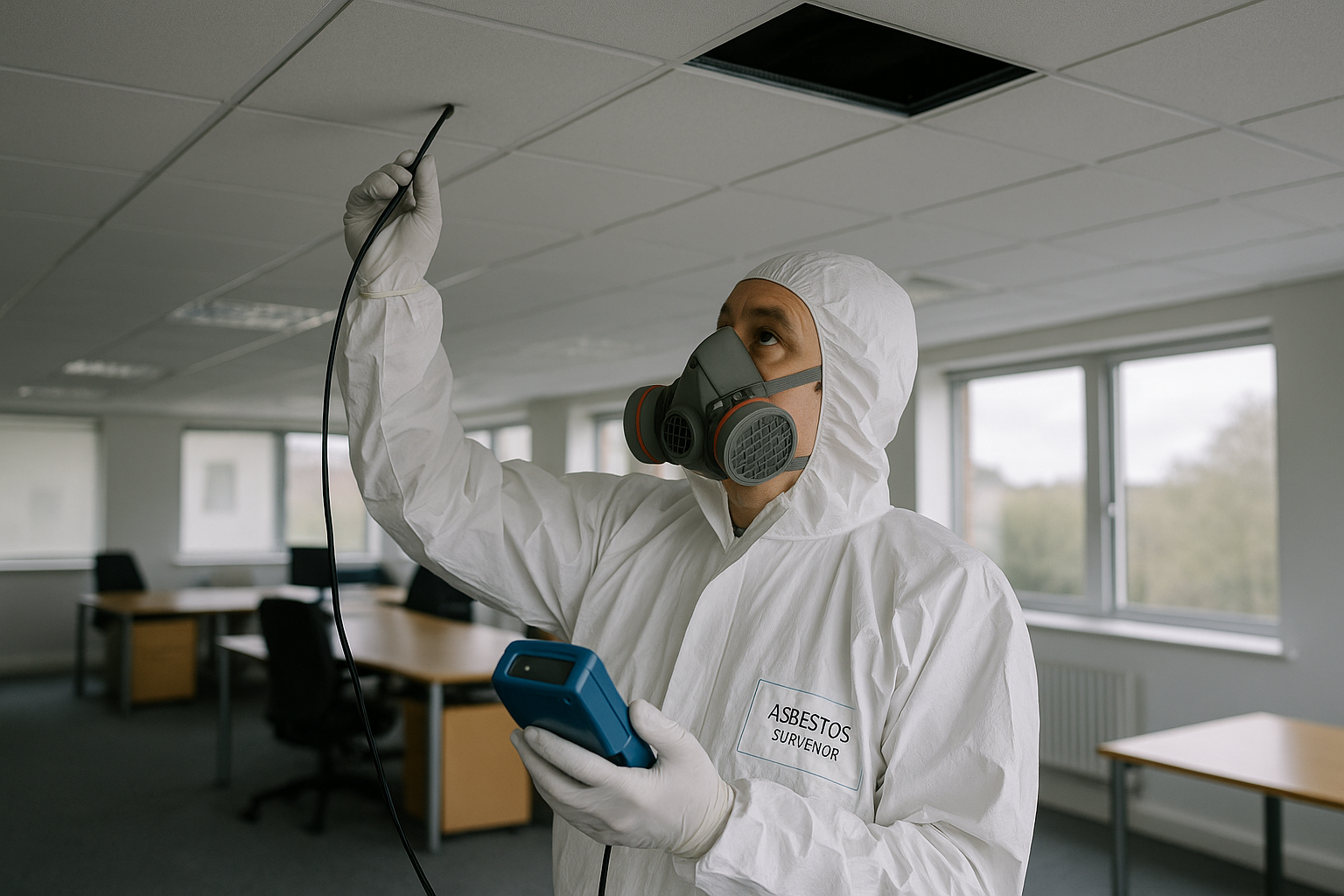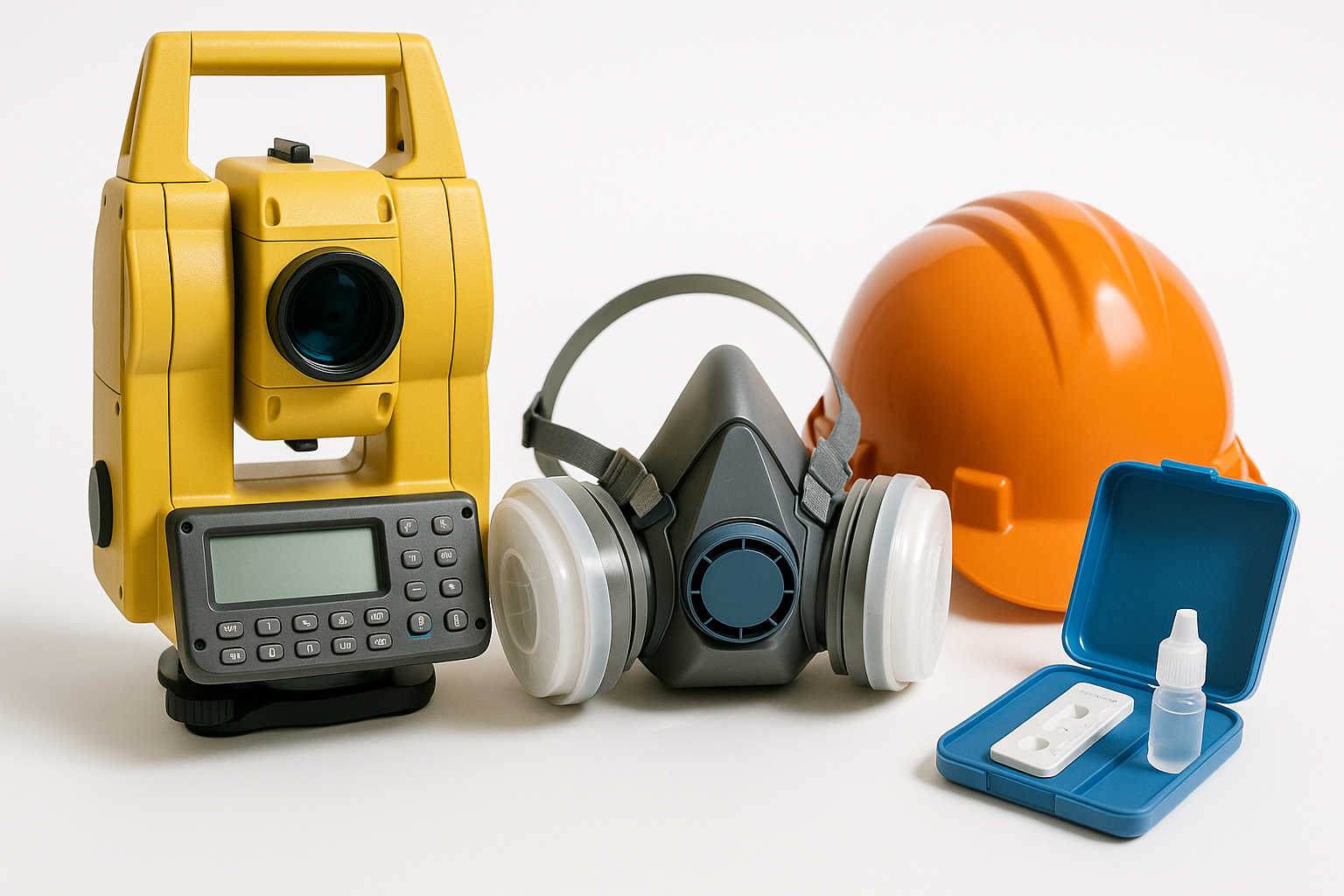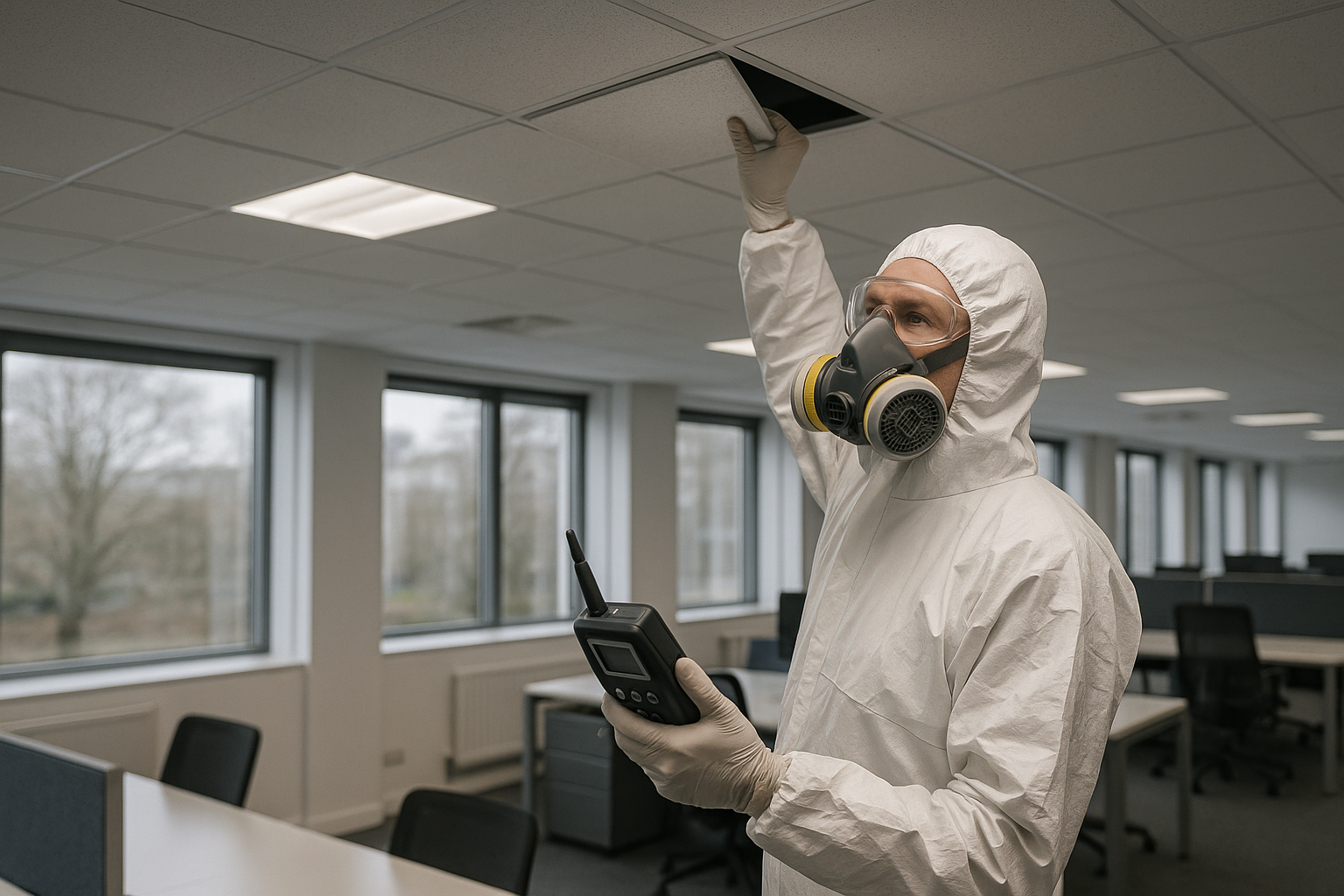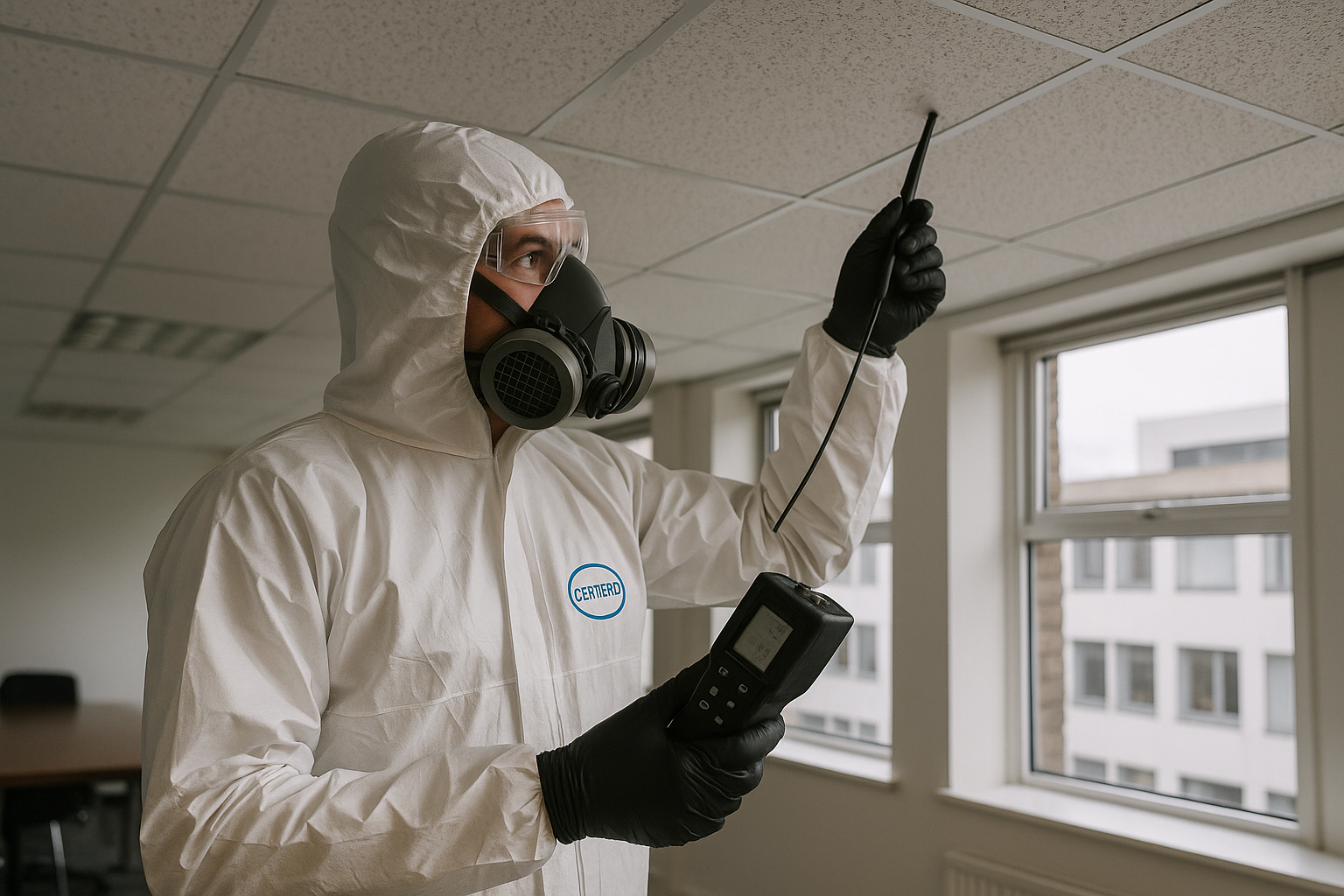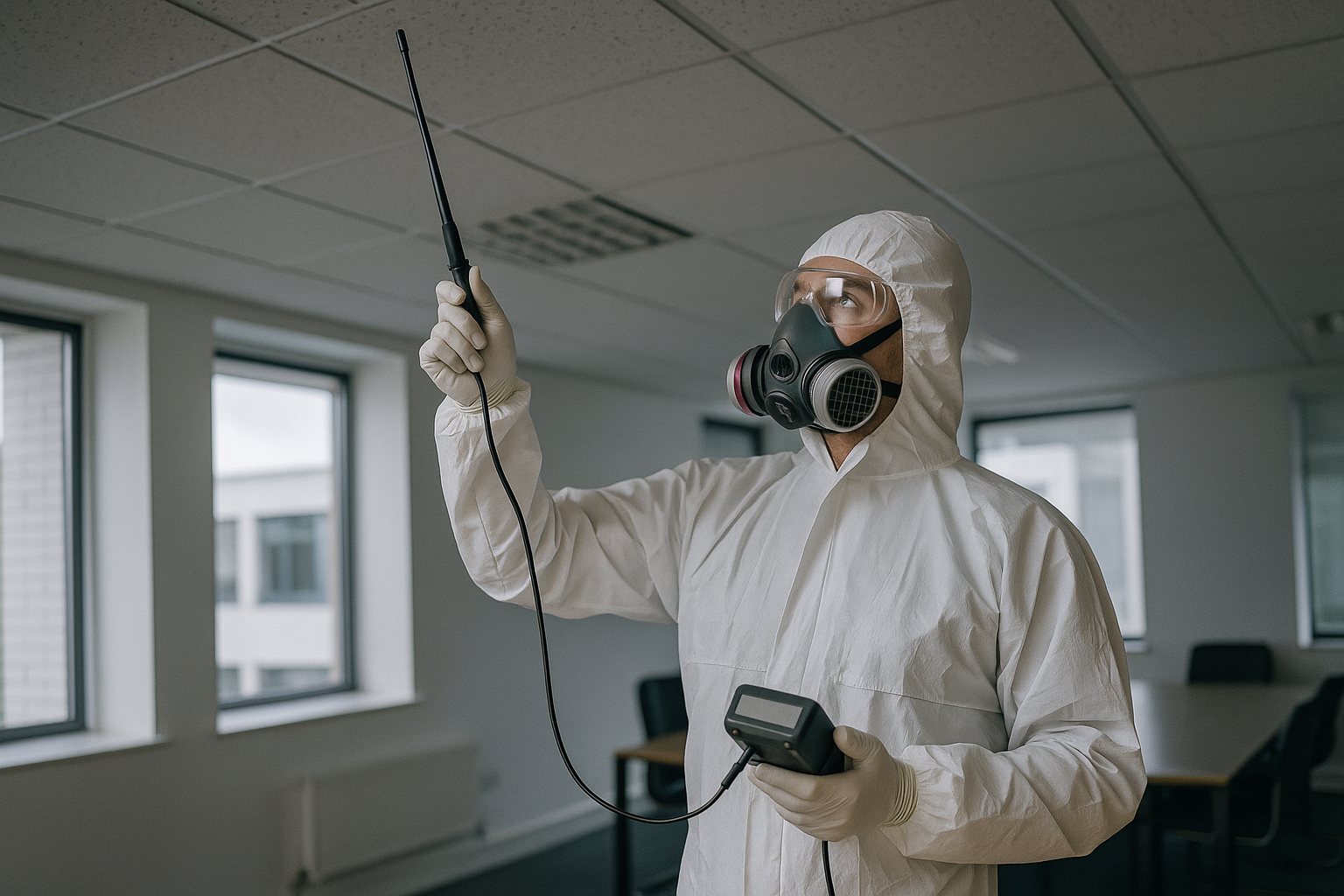
Author: ☀️ Supernova

  • Asbestos Testing for Tiles, Insulation, and More

    Asbestos Testing for Tiles, Insulation, and More

    How to Test for Asbestos Tile — and What to Do When You Find It

    Floor tiles, ceiling tiles, thermoplastic tiles, vinyl tiles — if your property was built or refurbished before 2000, there is a genuine possibility that some of those tiles contain asbestos. The fibres were woven into building materials for decades because they were cheap, durable, and exceptionally fire-resistant. Now they are a confirmed carcinogen, and the question most property owners and managers face is not whether asbestos might be present, but how to test for asbestos tile safely and accurately.

    This post gives you the straight answer: which tiles to suspect, how testing works, when to call a professional, and what to do if results come back positive.

    Which Tiles Are Most Likely to Contain Asbestos?

    Asbestos was not confined to one or two product types. It was added to a wide range of building materials throughout the mid-twentieth century, and tiles were among the most common applications.

    Floor Tiles

    Vinyl floor tiles and thermoplastic floor tiles manufactured between the 1950s and 1980s frequently contained chrysotile (white asbestos). The tile itself may contain asbestos, but so can the adhesive used to bond it to the subfloor — a detail that catches many people out during renovation work.

    If you are lifting old floor tiles or sanding down adhesive residue in a pre-2000 building, stop and test before you go any further. Disturbing asbestos-containing adhesive can release fibres just as readily as disturbing the tile itself.

    Ceiling Tiles

    Ceiling tiles are a higher-risk category. Many were manufactured from asbestos insulating board (AIB), which contains amosite (brown asbestos) — a more hazardous form than chrysotile. AIB is classed as a higher-risk material under HSE guidance, and its removal requires a licensed contractor.

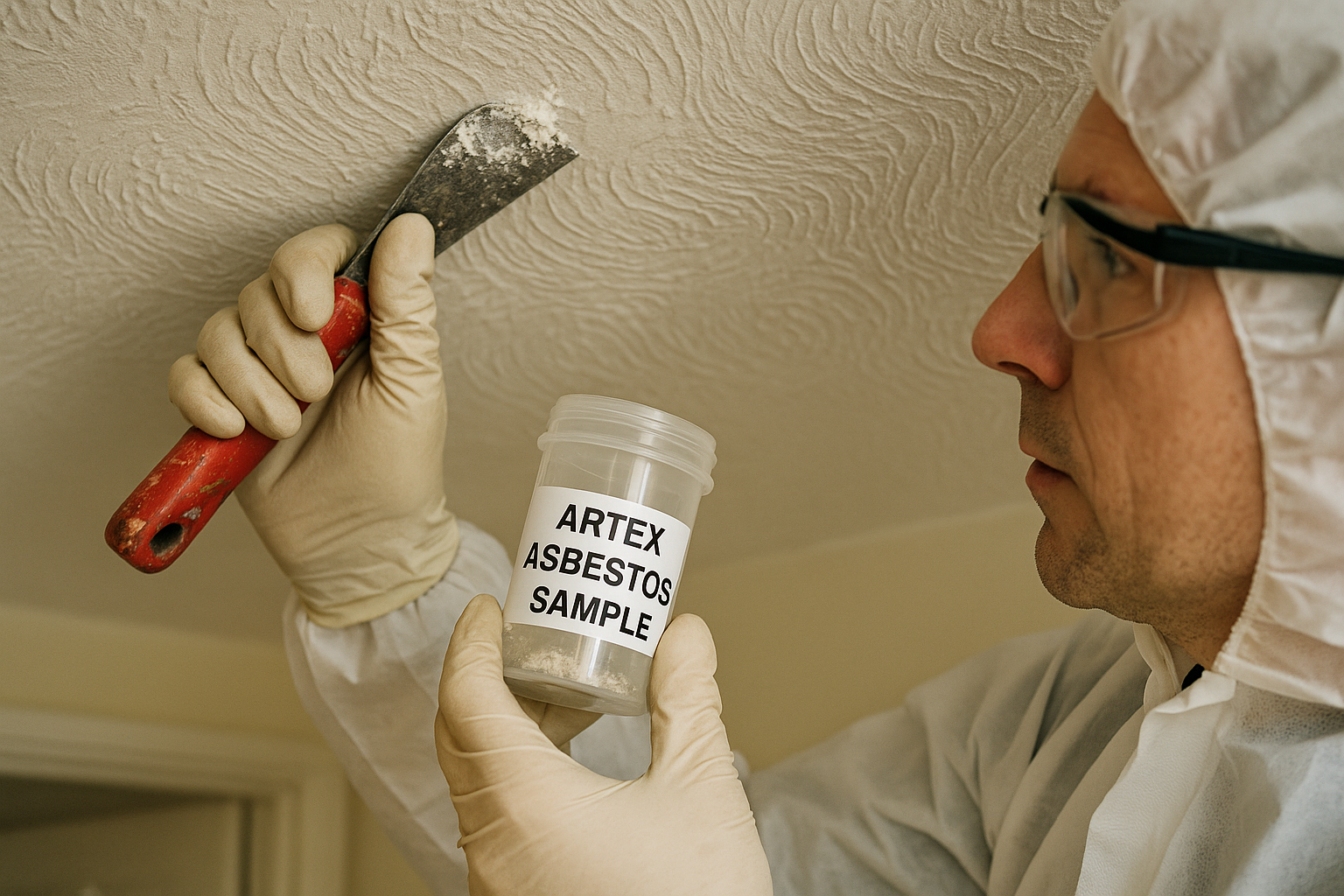
    Textured coatings such as Artex, often applied directly to ceilings, can also contain asbestos and should be tested before any sanding, scraping, or overcoating work begins.

    Other Tile-Adjacent Materials to Be Aware Of

    • Roof sheets and corrugated panels — asbestos cement was widely used in industrial, agricultural, and commercial roofing
    • Soffit boards and fascias — particularly on residential properties from the 1960s to 1980s
    • Insulation board used behind electrical panels and in partition walls
    • Pipe lagging and boiler insulation — not tiles, but often found in the same spaces and equally likely to contain asbestos

    The critical point here is simple: you cannot identify asbestos by looking at a tile. A perfectly ordinary-looking floor tile could contain chrysotile, amosite, or crocidolite fibres. The only reliable method is laboratory analysis.

    The Three Types of Asbestos Found in Tiles

    UK surveyors and laboratories focus on three forms of asbestos, all of which have been identified in tile products at one point or another.

    • Chrysotile (white asbestos) — the most widely used form, found in floor tiles, cement products, and roofing sheets. Still a confirmed carcinogen despite being considered slightly less hazardous than amphibole types.
    • Amosite (brown asbestos) — used extensively in ceiling tiles and insulation board. More hazardous than chrysotile, and its presence in a material typically triggers more stringent removal requirements.
    • Crocidolite (blue asbestos) — the most dangerous form. Its fine, needle-like fibres penetrate deep into lung tissue and are strongly associated with mesothelioma. Less common in tiles but not unheard of.

    All three are banned in the UK. All three pose serious health risks when fibres become airborne. The type identified in your sample affects the risk assessment, the management approach, and whether licensed removal is required.

    How to Test for Asbestos Tile: Your Two Main Options

    When it comes to testing, you have two routes: a DIY sampling kit or a professional survey. Which one you choose depends on the condition of the material, the purpose of the test, and your legal obligations.

    Option 1: DIY Asbestos Testing Kit

    An asbestos testing kit allows you to collect a small sample from the tile yourself and send it to an accredited laboratory for analysis. This is a practical and cost-effective option when you need to check one or two materials that are in good, undamaged condition.

    Supernova supplies testing kits directly from our website, complete with sampling instructions, PPE guidance, and pre-paid laboratory submission packaging. Before you collect a sample, however, there are non-negotiable safety steps you must follow.

    PPE: What You Must Wear

    Even collecting a small sample disturbs fibres. Do not attempt sampling without the following:

    • FFP3 respirator — the minimum standard for asbestos sampling. A standard dust mask is not adequate. The respirator must be properly fit-tested to ensure a facial seal.
    • Disposable Type 5/6 coveralls — to prevent fibres settling on your clothing
    • Disposable nitrile gloves — double-gloving is advisable
    • Overshoes or boot covers — to prevent contamination being tracked out of the area

    Step-by-Step: Collecting a Tile Sample

    1. Prepare the area. Close off the space to other occupants. Switch off any ventilation or air conditioning that could circulate fibres.
    2. Put on your PPE. All of it. Before you touch anything.
    3. Dampen the material. Lightly spray the tile surface with water before cutting or chipping. This significantly reduces airborne fibre release — it is one of the most important steps in the entire process.
    4. Take a small sample. A piece roughly the size of a 50p coin is sufficient. Work slowly and carefully. If the tile has an adhesive layer, include a small amount of that too, as the adhesive may contain asbestos independently of the tile itself.
    5. Seal the sample immediately. Place it in the sealed sample bag or container provided, label it clearly with the location and material type, and seal it straight away.
    6. Reseal the sampled area. Use a sealant, filler, or duct tape to cover the exposed edge. This prevents ongoing fibre release while you wait for results.
    7. Remove PPE carefully. Remove gloves first, then coveralls, turning them inside out as you go. Bag them and dispose of them as asbestos waste.
    8. Send the sample to the lab. Follow the instructions provided with your kit. Results from an accredited laboratory typically come back within two to five working days.

    When You Should Not Use a DIY Kit

    A DIY kit is suitable only when the tile is in good condition — intact, not crumbling, not visibly damaged. If the material is friable (crumbling or breaking apart), do not disturb it yourself. Sampling damaged asbestos-containing material without professional controls in place is dangerous and potentially unlawful.

    Similarly, if you need a legally defensible report for insurance purposes, property sale, or regulatory compliance, you will need a professional survey. A DIY sample result will not carry the same evidential weight as a qualified surveyor’s report.

    Professional Asbestos Surveys: Which One Do You Need?

    If you are managing a non-domestic property, planning any kind of building work, or need a formal asbestos register, a professional survey is the correct route. Supernova Asbestos Surveys carries out all types of survey across the UK, with fully qualified surveyors and UKAS-accredited laboratory analysis.

    Management Survey

    A management survey is the standard survey for occupied or in-use buildings. It identifies asbestos-containing materials — including tiles — that could be disturbed during normal occupancy or routine maintenance. This is what most duty holders need to meet their obligations under the Control of Asbestos Regulations.

    The result is an asbestos register and management plan: a documented record of what is present, where it is, what condition it is in, and how it should be managed going forward.

    Refurbishment Survey

    A refurbishment survey is required before any refurbishment work begins in a specific area. It is more intrusive than a management survey — surveyors will lift floors, access voids, and open up areas that will be disturbed during the planned works.

    If you are replacing floor tiles or ceiling tiles in a pre-2000 building, this survey must be completed before contractors move in. No exceptions.

    Demolition Survey

    A demolition survey is the most thorough type and is legally required before any demolition work. It involves full structural access and a complete inspection of all materials in the building. Every asbestos-containing material must be identified and removed prior to demolition — this is not optional under the Control of Asbestos Regulations.

    Re-Inspection Survey

    If you already have an asbestos register, it must be reviewed and updated at regular intervals. A re-inspection survey checks the condition of known asbestos-containing materials — including any tiles that were previously identified — to confirm that nothing has deteriorated and that your management plan remains appropriate.

    What Happens in the Laboratory?

    Whether you have collected a sample yourself using a kit or a surveyor has taken samples during a professional inspection, the analysis process is the same. Reputable UK laboratories operate under UKAS accreditation to ISO/IEC 17025 — this is the standard to look for when arranging sample analysis.

    The primary analytical method is polarised light microscopy (PLM), which allows analysts to identify asbestos fibres and distinguish between different types. For complex or low-concentration samples, transmission electron microscopy (TEM) may be used.

    Your laboratory report will confirm:

    • Whether asbestos fibres were detected
    • The type or types of asbestos present
    • The approximate concentration where relevant
    • The reporting limit — the lowest concentration the method can reliably detect

    Results typically come back within two to five working days. Express analysis is usually available if you need a faster turnaround.

    What to Do If Your Tile Tests Positive for Asbestos

    A positive result does not automatically mean you have an emergency. The appropriate response depends on the type of asbestos identified, the condition of the tile, and whether it is likely to be disturbed.

    Do Not Disturb It

    Asbestos-containing tiles that are in good condition and are not going to be disturbed pose a very low risk. In many cases, leaving them in place and managing them is the correct decision. What you must not do is start breaking, lifting, sanding, or removing tiles yourself without professional guidance.

    Assess the Risk Properly

    A professional surveyor or asbestos consultant can assess the risk based on the tile’s condition, location, and likelihood of disturbance. This assessment forms the basis of a management plan — a legal requirement for duty holders in non-domestic premises under the Control of Asbestos Regulations.

    HSG264, the HSE’s guidance document on asbestos surveys, sets out clearly how materials should be assessed and scored. A competent surveyor will use this framework to determine the appropriate management action for each material identified.

    Encapsulation or Removal?

    Depending on the condition and type of material, you have two main options:

    • Encapsulation — sealing the tile with a specialist coating or barrier to prevent fibre release. Suitable for tiles that are in reasonable condition and are not at immediate risk of disturbance. Requires ongoing monitoring and periodic re-inspection.
    • Removal — the permanent solution. Higher-risk materials, including AIB ceiling tiles, sprayed coatings, and loose-fill insulation, must be removed by a licensed contractor registered with the HSE. Licensed removal contractors must notify the relevant enforcing authority at least 14 days before licensable work begins.

    For asbestos removal, always use a contractor who can demonstrate their HSE licence and provide full documentation — including a waste transfer note confirming that the material has been disposed of correctly at a licensed facility.

    Keep Your Documentation

    Whether you encapsulate or remove, keep copies of everything: survey reports, test results, removal certificates, and waste transfer notes. These form part of your asbestos management file and may be requested by insurers, enforcing authorities, or future buyers of the property.

    Losing this paperwork creates real problems. Treat it with the same care as a title deed or planning permission.

    Understanding Your Legal Obligations Around Asbestos Tiles

    Many property managers are uncertain about exactly where their legal duties begin and end. The Control of Asbestos Regulations place a duty to manage asbestos on those who are responsible for non-domestic premises — this includes landlords, facilities managers, and building owners.

    The duty requires you to:

    1. Assess whether asbestos-containing materials are present in the building
    2. Presume materials contain asbestos unless there is strong evidence to the contrary
    3. Make and keep an up-to-date record of the location and condition of any ACMs
    4. Assess the risk of anyone being exposed to fibres from those materials
    5. Prepare a plan to manage that risk and put it into action
    6. Review and monitor the plan regularly

    For domestic properties, the legal obligations are different, but the health risks are identical. If you are a homeowner planning renovation work, you should still test before disturbing any suspect materials — particularly old floor or ceiling tiles.

    Our asbestos testing service is available to both commercial and residential clients across the UK, with clear advice on what the results mean and what steps to take next.

    Choosing the Right Testing Route: A Quick Summary

    Not sure which option is right for your situation? Use this as a quick reference:

    • Single tile in good condition, domestic property, no legal report needed — a DIY testing kit with accredited laboratory analysis is a reasonable starting point
    • Multiple materials, or any doubt about condition — book a professional survey rather than attempting DIY sampling
    • Non-domestic property, occupied building — a management survey is required under the Control of Asbestos Regulations
    • Pre-refurbishment work involving floor or ceiling tiles — a refurbishment survey must be completed before works begin
    • Building due for demolition — a demolition survey is a legal requirement, not a recommendation
    • Existing register in place — schedule a re-inspection survey to ensure the register remains current and accurate

    Our asbestos testing team can advise you on the most appropriate route if you are unsure — just call us and we will point you in the right direction without any obligation.

    Frequently Asked Questions

    Can I test for asbestos tiles myself at home?

    Yes, in certain circumstances. If the tile is in good condition — not crumbling, chipped, or damaged — you can use a DIY asbestos testing kit to collect a small sample and send it to an accredited laboratory. You must wear appropriate PPE, including an FFP3 respirator and disposable coveralls. If the tile is damaged or friable, do not attempt to sample it yourself. Call a professional surveyor instead.

    How long does asbestos tile testing take?

    Laboratory analysis of a tile sample typically takes two to five working days from receipt. Most accredited laboratories also offer express turnaround options if you need results faster. A professional survey, including laboratory analysis, usually takes a similar timeframe depending on the size of the property and the number of samples taken.

    Do all old floor tiles contain asbestos?

    No, but tiles manufactured or installed before 2000 — particularly those from the 1950s through to the 1980s — carry a meaningful risk of containing asbestos. The only way to know for certain is to have a sample tested by an accredited laboratory. Do not assume a tile is safe simply because it looks intact or undamaged.

    What should I do if my ceiling tiles test positive for asbestos?

    Do not disturb them. Asbestos-containing ceiling tiles in good condition can often be managed in place. However, if they are damaged, deteriorating, or scheduled to be removed during refurbishment, you will need a licensed asbestos removal contractor. AIB ceiling tiles are classified as a higher-risk material under HSE guidance, and their removal must be carried out by a contractor holding a current HSE licence.

    Is asbestos testing a legal requirement?

    For duty holders in non-domestic premises, the Control of Asbestos Regulations require a suitable and sufficient assessment of whether asbestos is present. In practice, this means surveying and, where necessary, testing suspect materials. For domestic homeowners, there is no legal obligation to test, but it is strongly advisable before any renovation or refurbishment work that could disturb older building materials.

    Talk to Supernova Asbestos Surveys

    Supernova Asbestos Surveys has completed over 50,000 surveys across the UK. Whether you need a single tile tested or a full site survey ahead of a major refurbishment, our team of qualified surveyors can help.

    We offer management surveys, refurbishment surveys, demolition surveys, re-inspection surveys, and individual sample analysis — all backed by UKAS-accredited laboratory partners and clear, jargon-free reporting.

    Call us on 020 4586 0680 or visit asbestos-surveys.org.uk to find out more or book a survey. If you are not sure which service you need, just call — we will give you a straight answer.


  • Understanding Asbestos Testing Cost

    Understanding Asbestos Testing Cost

    One wrong call on asbestos testing cost can do more than add an unexpected line to your budget. It can halt a fit-out, delay contractors, disrupt tenants and leave you exposed if the HSE asks how asbestos was identified and managed on your site.

    For commercial property, the cheapest option is rarely the least expensive overall. If the scope is wrong, if suspect materials are missed, or if the report does not match the planned works, the real cost surfaces later — in delays, re-visits and entirely avoidable risk.

    Whether you manage offices, schools, retail units, warehouses, healthcare premises or mixed-use buildings, asbestos testing cost needs to be understood in context. You need the right service, clear reporting and a defensible approach that aligns with the Control of Asbestos Regulations, HSE guidance and the survey standards set out in HSG264.

    What Affects Asbestos Testing Cost in Commercial Properties?

    The biggest factor in asbestos testing cost is not the postcode or even the square footage. It is the type of service you actually need and how complex the building is to inspect safely.

    A single sample sent to a laboratory costs far less than a full survey across an occupied site. But those two services answer entirely different questions, so comparing them directly does not help you control spend or manage risk.

    Commercial clients typically pay for one or more of the following:

    • Site attendance by a qualified surveyor
    • Inspection time across the relevant areas
    • Sampling of suspect materials
    • UKAS-accredited laboratory analysis
    • Written reporting and asbestos register information
    • Material assessments and recommendations
    • Urgent turnaround where works are pending
    • Re-visits, access equipment or out-of-hours attendance

    In practice, asbestos testing cost rises with complexity rather than size alone. A small building with service risers, ceiling voids, locked plant rooms and a history of multiple refurbishments can cost more to inspect than a larger open-plan unit with straightforward access.

    Key Pricing Factors to Check

    • Property type: offices, schools, depots and healthcare sites all present different access and risk considerations
    • Occupancy: live environments often require phased access and more careful planning
    • Number of suspect materials: more materials typically means more samples and more detailed reporting
    • Accessibility: roof voids, high-level areas and confined spaces take longer to inspect safely
    • Urgency: same-day or next-day analysis usually increases the overall asbestos testing cost
    • Location: travel, parking and logistics can affect the total, particularly in city centres — if you need an asbestos survey London clients should factor in site-specific access considerations

    If a quote looks unusually low, ask exactly what is included. Some headline prices exclude samples, laboratory analysis, reporting or sufficient inspection time to do the job properly.

    Asbestos Testing Cost vs Asbestos Survey Cost: What Is the Difference?

    This is where many commercial clients lose time and money. They ask for testing when they actually need a survey, or they commission a survey that is too limited for the work ahead.

    Asbestos testing usually means taking one or more samples from suspect materials and having them analysed by a laboratory. It tells you whether that specific material contains asbestos fibres.

    An asbestos survey goes further. It identifies where asbestos-containing materials are likely to be present across the building, records their location and condition, and provides the information needed to manage risk or plan works safely.

    That distinction matters because asbestos testing cost can look lower on a quote, but if you need a full survey for compliance or project planning, a single sample analysis will not address the wider issue.

    When a Single Test May Be Enough

    • One isolated suspect material has been found
    • Maintenance staff uncovered something unexpected during routine work
    • You need an initial answer before deciding on next steps
    • The material is low-risk, accessible and can be sampled safely

    When a Survey Is Usually the Better Option

    • You are managing non-domestic premises with a duty to manage
    • You need an asbestos register or management information
    • Contractors are due to start work on the building
    • There are multiple suspect materials across different areas
    • You need evidence that stands up to scrutiny from the HSE or contractors

    Which Survey Type Do You Need?

    Choosing the right survey scope is one of the most effective ways to control asbestos testing cost. The wrong survey can mean paying twice — first for the wrong service and then again for the correct one when the gap becomes apparent.

    Management Survey

    A management survey is designed for occupied premises in normal use. It helps dutyholders locate, as far as reasonably practicable, accessible asbestos-containing materials that could be disturbed during routine occupation, maintenance or minor works.

    This is typically the baseline requirement for offices, retail premises, schools and the common parts of commercial buildings. Because it is less intrusive than other survey types, asbestos testing cost is usually lower than for more invasive inspections.

    Refurbishment Survey

    If you are planning strip-out, fit-out, rewiring, HVAC upgrades or any intrusive maintenance, a refurbishment survey is usually required for the affected areas. This survey is intrusive by design — it needs to identify asbestos that may be hidden behind finishes, inside voids or within the building fabric.

    That extra access time, additional sampling and increased disruption all affect asbestos testing cost. Even so, it is far more cost-effective than discovering asbestos midway through a contractor programme.

    Demolition Survey

    Before a building — or part of one — is demolished, the correct service is a demolition survey. This is the most intrusive survey type because it must locate, as far as reasonably practicable, all asbestos-containing materials before demolition begins.

    Asbestos testing cost is often highest here. The inspection is broader, access is more invasive and the findings are critical to pre-demolition planning and contractor safety.

    Re-Inspection Survey

    Where asbestos has already been identified and is being managed in place, periodic review is essential. A re-inspection survey checks whether known materials have changed in condition, accessibility or risk level.

    This can be one of the most practical ways to keep records current without commissioning a full new survey. In many cases, asbestos testing cost is lower because the scope is built around existing information rather than starting from scratch.

    How Asbestos Sampling Works on Site

    Sampling sounds straightforward, but in commercial property it requires careful planning. The material type, condition, location and occupancy all affect how samples should be taken and what controls are needed.

    Good sampling is not simply about getting a laboratory result. It is about controlling disturbance, recording exactly where the sample came from and making sure the result is genuinely useful for decision-making.

    A typical professional sampling process looks like this:

    1. Identify suspect materials during the site inspection
    2. Assess condition, accessibility and likelihood of fibre release
    3. Take a representative sample using appropriate controls
    4. Seal, label and log the sample correctly
    5. Make good the sample point where appropriate
    6. Send the sample for UKAS-accredited sample analysis
    7. Issue results with clear, actionable recommendations

    For commercial sites, the paperwork matters as much as the sample itself. If a contractor asks what was tested, where it was located and whether adjacent materials remain unconfirmed, your records need to answer those questions clearly and completely.

    Is Asbestos Testing Safe to Carry Out?

    Sometimes yes, sometimes no. Safety depends entirely on what the material is, what condition it is in and whether the area can be adequately controlled during sampling.

    A cement sheet in good condition is a very different proposition from damaged insulation board, pipe lagging, sprayed coatings or loose debris in a confined plant room. HSE guidance is clear on this in practice: if you are unsure, treat the material as if it contains asbestos until proven otherwise.

    For friable, damaged or high-risk materials, do not ask maintenance staff to improvise. Bring in a competent surveyor who can assess the situation and take samples in a controlled, safe manner where sampling is appropriate.

    Practical Safety Points for Commercial Sites

    • Do not drill, cut, scrape or break suspect materials to establish what they are
    • Stop contractors immediately if unexpected materials are uncovered during works
    • Restrict access to the area until professional advice is obtained
    • Check existing asbestos records before any intrusive work begins
    • Arrange professional attendance where the material is damaged, hidden or high-risk

    What Asbestos Can Look Like in Commercial Buildings

    One reason asbestos testing cost is difficult to estimate from photographs alone is that asbestos-containing materials are not always obvious. Some are visible, but many are hidden behind boxing, above suspended ceilings, inside service risers or within plant areas.

    Visual checks are never sufficient to confirm whether a material contains asbestos. Many asbestos products look identical to modern non-asbestos alternatives, which is precisely why laboratory analysis is required.

    Common examples found in commercial premises include:

    • Asbestos insulating board panels and ceiling tiles
    • Pipe insulation and thermal lagging
    • Textured coatings on ceilings and walls
    • Vinyl floor tiles and bitumen-based adhesive
    • Cement roof sheets, soffits and flue pipes
    • Gaskets, rope seals and plant insulation materials
    • Fire doors, service riser panels and protective boxing

    In older buildings, the practical guidance is simple: treat suspect materials as potentially containing asbestos until professional confirmation says otherwise.

    How to Budget for Asbestos Testing Cost Without Under-Scoping

    There is no single national price for asbestos testing cost, and any honest provider will say so. Pricing depends on scope, access, occupancy and the level of information you need at the end of the process.

    What commercial clients can do is budget more accurately by understanding how quotes are typically structured. That makes it far easier to compare like with like and avoid purchasing a service that does not actually solve the problem.

    What a Quote May Include

    • A fixed attendance fee for the surveyor’s time on site
    • A per-sample laboratory charge for analysis
    • A survey fee based on building size and complexity
    • Reporting and asbestos register preparation
    • Additional charges for urgent turnaround
    • Specialist access costs where required

    The problem is not always the headline price. It is assuming two quotes cover the same scope when one includes ten samples, a full written report and recommendations, while the other charges separately for every sample and every revisit.

    Questions to Ask Before Approving a Quote

    • How many samples are included in the fee?
    • Is analysis carried out by a UKAS-accredited laboratory?
    • Does the quote include the final report and asbestos register information?
    • What turnaround time is included as standard?
    • Will the survey be carried out in line with HSG264?
    • Are travel, parking or specialist access equipment charged separately?
    • Is the scope suitable for management, refurbishment or demolition purposes?

    Those questions help you understand the real asbestos testing cost — not just the figure used to win the enquiry.

    DIY Kits, Posted Samples and Commercial Reality

    There are situations where a kit can serve a useful purpose. If a facilities manager has one isolated suspect material and needs a quick preliminary indication before arranging wider works, an asbestos testing kit may help as an initial step.

    Some clients also look for a straightforward testing kit where they need a simple route for collection and laboratory submission. That can work for low-risk, accessible materials where the sample can be obtained safely and lawfully by a competent person.

    But commercial dutyholders need to be realistic about the limitations. A kit does not replace a survey, an asbestos register or a management plan. It only answers the narrow question of whether the submitted sample contains asbestos — nothing more.

    When a Kit May Help

    • One isolated suspect material in a low-risk location
    • Material in good condition that can be sampled safely
    • Interim screening before wider professional attendance is arranged
    • Remote sites where a preliminary answer assists planning decisions

    When a Kit Is the Wrong Choice

    • Refurbishment or demolition work is planned
    • Multiple suspect materials are present across the building
    • You need a compliant asbestos register or management plan
    • The material is damaged, friable or in a high-risk location
    • Contractors are asking for a survey report before starting work

    For full site coverage and a defensible compliance record, professional asbestos testing carried out by a qualified surveyor remains the appropriate route for most commercial premises.

    Getting Asbestos Testing Cost Right First Time

    The most expensive outcome is not the one with the highest quote. It is the one where the scope was too narrow, the right questions were not asked and the problem had to be revisited — often under time pressure and at a premium rate.

    Getting asbestos testing cost right means matching the service to the actual need, understanding what is and is not included in any quote, and making sure the work is carried out by a competent provider using UKAS-accredited analysis.

    For occupied commercial buildings, that typically means a management survey as a baseline. For planned works, a refurbishment or demolition survey for the affected areas. For ongoing compliance, regular re-inspections to keep records current and defensible.

    None of those decisions need to be complicated — but they do need to be made with accurate information, not just the lowest number on a comparison.

    Frequently Asked Questions

    How much does asbestos testing cost for a commercial building?

    There is no fixed national price because asbestos testing cost depends on the type of service required, the size and complexity of the building, the number of samples needed and the turnaround time. A single sample sent for laboratory analysis costs significantly less than a full refurbishment survey across a multi-floor commercial premises. The most accurate way to understand the cost is to request a detailed, itemised quote that specifies what is included.

    Do I need a survey or just asbestos testing?

    It depends on what you are trying to achieve. If you have one isolated suspect material and need a quick confirmation, targeted testing may be sufficient. If you manage non-domestic premises, need an asbestos register, are planning works or need evidence for contractors, a full survey is almost always the more appropriate and compliant route. The Control of Asbestos Regulations place a duty on those responsible for non-domestic premises to manage asbestos, which typically requires survey-level information.

    Is UKAS-accredited laboratory analysis required?

    HSE guidance strongly recommends using UKAS-accredited laboratories for asbestos sample analysis. Accreditation provides assurance that the laboratory operates to a recognised standard and that results are reliable. For commercial compliance purposes, results from non-accredited laboratories may not be accepted by contractors, insurers or enforcement bodies. Always confirm accreditation status before commissioning analysis.

    Can I collect asbestos samples myself to reduce costs?

    In some circumstances, a competent person can collect samples from low-risk, accessible materials using an appropriate kit. However, for commercial properties, this approach has significant limitations. It does not produce a survey report, does not identify materials you were unaware of and does not provide the management information required under the Control of Asbestos Regulations. For anything beyond a simple preliminary check, professional attendance is the safer and more defensible approach.

    How often does asbestos need to be re-inspected in commercial buildings?

    Where asbestos-containing materials are present and being managed in place, the HSE recommends periodic re-inspection to check whether condition or risk has changed. The frequency depends on the type of material, its condition and the level of activity in the building. Annual re-inspections are common for many commercial premises, though higher-risk materials or busier environments may warrant more frequent review. A qualified surveyor can advise on an appropriate re-inspection schedule based on your specific circumstances.

    Speak to Supernova Asbestos Surveys

    Supernova Asbestos Surveys has completed over 50,000 surveys across the UK, working with commercial property managers, facilities teams, contractors and dutyholders who need accurate information and reliable reporting.

    Whether you need a management survey for an occupied building, a refurbishment survey ahead of planned works, or straightforward advice on asbestos testing cost for your specific situation, our qualified surveyors can help you get the scope right first time.

    Call us on 020 4586 0680 or visit asbestos-surveys.org.uk to request a quote or speak to a member of the team.

  • Comprehensive Guide to Asbestos Testing Services

    Comprehensive Guide to Asbestos Testing Services

    Asbestos Testing Services: What Every UK Property Owner Needs to Know

    Asbestos remains present in a significant proportion of UK buildings constructed before 2000. If you own, manage, or are planning to renovate a property from that era, professional asbestos testing services are not optional — they are a legal requirement and a basic duty of care. Getting this wrong carries serious consequences for health, finances, and legal standing.

    Why Asbestos Testing Services Matter

    The Health Risks Are Severe and Long-Lasting

    Asbestos fibres, once airborne, are invisible to the naked eye and nearly impossible to expel from the body once inhaled. Over time, they cause irreversible damage to lung tissue, leading to conditions including mesothelioma, asbestosis, and lung cancer — all of which are life-limiting, frequently fatal, and have no cure.

    What makes asbestos especially dangerous is its latency period. Symptoms can take 20 to 40 years to appear after initial exposure, by which time the damage is already done. Disturbing asbestos-containing materials (ACMs) during routine work — drilling into a ceiling, ripping out floor tiles, removing partition walls — can release dangerous concentrations of fibres in seconds.

    Testing before any works begin is the only way to know what you are dealing with. There is no safe level of guesswork when it comes to asbestos.

    Your Legal Obligations as a Duty Holder

    If you have any duty of care over a non-domestic property — as a landlord, employer, building manager, or property owner — the Control of Asbestos Regulations place a clear legal duty on you to manage asbestos risk. That duty requires you to:

    • Identify whether ACMs are present in your premises
    • Assess the condition and risk level of any ACMs found
    • Produce and maintain an asbestos register
    • Implement a management plan and keep it under review
    • Inform anyone who might disturb those materials

    Failure to comply is not simply a civil matter. The Health and Safety Executive (HSE) can issue improvement notices, prohibition notices, and prosecute duty holders. Fines and custodial sentences have both been imposed for serious breaches.

    For domestic properties, the legal position differs — homeowners are not bound by the same duty-to-manage rules — but anyone undertaking renovation or extension work should still arrange testing before starting, for their own safety and that of any tradespeople on site.

    Insurance and Property Value

    Undisclosed asbestos can create significant complications when selling, remortgaging, or insuring a property. Many standard policies exclude asbestos-related remediation costs unless material has been disturbed as a direct result of a covered event.

    Having a current asbestos survey on file demonstrates due diligence and makes conveyancing, insurance renewals, and lease negotiations considerably smoother. It is a relatively small upfront cost against potentially significant liabilities further down the line.

    What Asbestos Testing Services Are Available?

    Asbestos testing is not a single service. It encompasses several distinct activities depending on your circumstances, the type of property involved, and what you plan to do with it.

    Asbestos Management Survey

    A management survey is the standard survey for occupied premises. It is designed to locate ACMs that could be disturbed during normal occupation and routine maintenance. Surveyors access all accessible areas, take samples from suspected materials, and produce a report including an asbestos register and risk assessment.

    This is what most commercial landlords, property managers, and employers need to fulfil their legal duty to manage asbestos. If you are unsure which survey type you need, an asbestos management survey is usually the starting point for any occupied building.

    Refurbishment Survey

    Before any refurbishment work begins — even something as minor as a bathroom refit or the removal of a partition wall — a refurbishment survey is required in the affected areas. This is a more intrusive survey, involving minor destructive inspection to locate all ACMs that could be disturbed during the planned works.

    No contractor should be permitted to commence work in an area that has not had a refurbishment survey completed first. This protects workers, duty holders, and the integrity of the project.

    Demolition Survey

    The most comprehensive and intrusive survey type, a demolition survey is required before any structure is brought down or undergoes major structural alteration. It aims to locate all ACMs throughout the entire building so that a full asbestos removal programme can be planned prior to demolition.

    This is a regulatory requirement under the Control of Asbestos Regulations. Principal contractors must have a copy of the demolition survey report before notifiable demolition work begins.

    Re-Inspection Survey

    If your property already has an asbestos register, the ACMs within it need to be periodically re-inspected to confirm their condition has not deteriorated. A re-inspection survey updates your existing asbestos management plan and ensures you remain compliant on an ongoing basis.

    Annual re-inspections are standard practice, though high-risk or damaged materials may require more frequent monitoring. Keeping your register current is not just good practice — it is a legal obligation.

    Asbestos Sample Testing and Testing Kits

    If you have identified a specific material you are concerned about — an old floor tile, an Artex ceiling, pipe lagging — and want straightforward confirmation of whether it contains asbestos, sample testing is a cost-effective option. You can arrange professional asbestos testing directly, or use a home sampling kit if you need a quick answer on a single material.

    Supernova offers an asbestos testing kit directly from our website, allowing you to safely collect a sample yourself and send it to a UKAS-accredited laboratory for analysis. Full instructions and appropriate protective equipment are included. Results are typically returned within 24 to 48 hours.

    This testing kit is a practical solution for homeowners, small landlords, or anyone who needs a quick answer before deciding on next steps. It is not a substitute for a full survey where one is legally required, but it is a sensible first step when you have a specific concern.

    Asbestos Removal

    Where testing confirms the presence of ACMs that need to be removed — because they are damaged, or because refurbishment or demolition is planned — licensed asbestos removal by an HSE-licensed contractor is required for the most hazardous materials. Supernova provides removal services as part of a fully managed process, so you are not left coordinating between multiple contractors.

    Understanding the Asbestos Testing Process

    Knowing what to expect makes the process far less daunting. Here is how professional asbestos testing services work from start to finish.

    Step 1: Initial Assessment and Site Visit

    The process begins with a surveyor visiting the property to carry out a systematic inspection. For larger or more complex sites, a preliminary walkthrough may be arranged to review existing plans, identify access constraints, and scope the work accurately.

    Experienced surveyors do not simply tick boxes. They understand building construction, can identify high-risk materials by appearance and location, and know where to look even when materials have been painted over or concealed behind subsequent finishes.

    Step 2: Sample Collection

    When materials suspected of containing asbestos are identified, small samples are carefully taken for laboratory analysis. The collection process is tightly controlled: surveyors use appropriate PPE, wet-wipe the area to suppress fibre release, seal the sample immediately, and decontaminate or dispose of tools as asbestos waste.

    Where a material cannot be sampled safely — or where it is clearly in poor condition — surveyors will often presume it contains asbestos and record it as such. This cautious approach is consistent with HSE guidance and protects everyone involved.

    Step 3: Laboratory Analysis

    All samples are sent to a UKAS-accredited laboratory for analysis. UKAS accreditation is the recognised standard in the UK for testing competence, and it ensures results are reliable, defensible, and legally credible.

    The primary analytical technique is polarised light microscopy (PLM), which allows analysts to identify the type and approximate concentration of asbestos fibres present. Standard turnaround is 24 to 48 hours, with priority or same-day analysis available where urgency demands it.

    Step 4: Survey Report and Asbestos Register

    Once results are returned, you receive a detailed written report. A well-produced survey report includes:

    • A full asbestos register listing every ACM identified
    • Location, type, and extent of each material
    • Condition and risk assessment for each ACM
    • Photographs of sampled materials and their locations
    • Recommendations for management, encapsulation, or removal
    • A priority action plan where required

    This document becomes the foundation of your asbestos management plan. It must be made available to any contractor or maintenance worker before they begin any work on your premises.

    Common Materials Found to Contain Asbestos

    Asbestos was used in an extraordinarily wide range of building products. If your property was built or refurbished before 2000, any of the following could potentially contain asbestos:

    • Textured coatings (Artex and similar products) on ceilings and walls
    • Ceiling tiles and floor tiles, especially vinyl composite tiles
    • Floor tile adhesives and bitumen-based mastics
    • Pipe lagging and boiler insulation
    • Insulating board used in fire doors, partition walls, and ceiling panels
    • Roof sheets, guttering, and rainwater pipes (asbestos cement)
    • Sprayed coatings on structural steelwork
    • Soffit boards and external cladding panels
    • Rope seals and gaskets in boilers and heating systems
    • Toilet cisterns and water tanks

    The presence of asbestos is not always obvious. Many ACMs look identical to their non-asbestos equivalents. Only laboratory analysis can confirm whether a material contains asbestos fibres — which is precisely why professional asbestos testing services exist.

    How to Choose the Right Asbestos Testing Company

    Check for UKAS Accreditation

    UKAS (United Kingdom Accreditation Service) accreditation is the gold standard for asbestos surveying and laboratory analysis in the UK. It is not a nice-to-have — it is the minimum you should accept from any provider. A UKAS-accredited company operates under third-party oversight, regular audits, and defined quality assurance frameworks.

    Do not be afraid to ask a company for their UKAS accreditation certificate before engaging them. Any reputable provider will produce it without hesitation. Without accreditation, you have no reliable way to verify the quality of the work or the validity of the results.

    Look for Qualified, Experienced Surveyors

    The survey is only as good as the person conducting it. Asbestos surveyors should hold the relevant P402 qualification as a minimum. Ask about the experience of the specific surveyors who will attend your site — not just the company’s general credentials.

    Experience matters particularly in older or unusual building types: pre-war industrial buildings, listed properties, schools, hospitals, and public sector estates all present challenges that a less experienced surveyor might miss. HSG264 — the HSE’s guidance on asbestos surveys — sets out the competency requirements that surveyors should meet.

    Consider Service Range and National Coverage

    If you manage multiple properties or operate across different regions, you need a provider with consistent national coverage — not one that serves one area well but struggles to resource sites elsewhere. Supernova Asbestos Surveys provides nationwide coverage across England, Scotland, and Wales, with surveyors deployed directly rather than subcontracted.

    This matters because subcontracting introduces variability in quality, communication, and accountability. When you engage Supernova, you know exactly who is attending your site and what standards they are held to.

    Transparency on Pricing and Turnaround

    Reputable providers will give you a clear, itemised quote before any work begins. Be cautious of vague pricing structures, hidden laboratory fees, or companies that are evasive about turnaround times for reports.

    A good asbestos testing company will also advise you honestly on which service you actually need — not upsell you to a more expensive survey type if a simpler solution is appropriate.

    Who Needs Asbestos Testing Services?

    The short answer: anyone responsible for a building constructed before 2000. But in practice, the need for asbestos testing is particularly acute for:

    • Commercial landlords — legal duty to manage asbestos in all non-domestic premises
    • Employers — responsibility for the safety of employees and contractors on site
    • Property developers — required to survey before refurbishment or demolition
    • Housing associations and local authorities — managing large portfolios of older stock
    • Schools, hospitals, and public buildings — high footfall environments with particular obligations
    • Homeowners undertaking renovation — not legally required to manage, but strongly advised to test before any works
    • Buyers and conveyancers — due diligence before purchasing older properties

    Even if you have no immediate plans to carry out works, having a current asbestos survey on file is sound property management. It protects you, your tenants, your contractors, and anyone else who enters the building.

    Frequently Asked Questions

    How do I know if my building needs asbestos testing?

    If your building was constructed or refurbished before 2000, there is a realistic possibility that asbestos-containing materials are present somewhere within it. Age alone is sufficient reason to arrange a survey. If you are planning any building works — however minor — testing in the affected areas is essential before work begins. For non-domestic premises, the Control of Asbestos Regulations require duty holders to identify and manage asbestos regardless of whether any works are planned.

    What is the difference between a survey and a test?

    A survey involves a qualified surveyor inspecting the building, collecting samples, and producing a full written report including an asbestos register and risk assessment. A test refers specifically to the laboratory analysis of a sample — either collected by a surveyor or by yourself using a home sampling kit. Testing alone tells you whether a specific material contains asbestos; a survey gives you a complete picture of the building and your legal obligations.

    How long does an asbestos survey take?

    This depends on the size and complexity of the property. A small commercial unit might be completed in two to three hours. A large industrial building, school, or multi-storey property could take a full day or longer. Your surveyor will advise on the expected duration before attending. Laboratory results are typically returned within 24 to 48 hours of sample submission, after which your written report is produced.

    Can I collect my own asbestos sample?

    Yes, in some circumstances. Supernova’s asbestos testing kit allows you to safely collect a sample from a suspected material and send it to a UKAS-accredited laboratory for analysis. The kit includes full instructions and appropriate protective equipment. This is suitable for homeowners or small landlords with a concern about a specific material. However, it is not a substitute for a full survey where one is legally required — for example, before refurbishment or demolition works, or to fulfil your duty-to-manage obligations as a non-domestic duty holder.

    What happens if asbestos is found?

    Finding asbestos does not automatically mean it needs to be removed. Many ACMs in good condition and low-risk locations are best left in place and managed through a documented asbestos management plan. Your survey report will include recommendations for each material identified — whether that is monitoring, encapsulation, or removal. Where removal is required, it must be carried out by an HSE-licensed contractor for the most hazardous materials. Supernova can manage the entire process from survey through to removal and clearance.

    Get Professional Asbestos Testing Services from Supernova

    Supernova Asbestos Surveys has completed over 50,000 surveys nationwide. Our surveyors are fully qualified, our laboratory partners are UKAS-accredited, and our reports are produced to the standard required by the HSE and the Control of Asbestos Regulations.

    Whether you need a management survey for an occupied building, a refurbishment survey before planned works, sample testing for a specific material, or a full demolition survey, we have the expertise and national coverage to deliver it efficiently and accurately.

    Call us on 020 4586 0680 or visit asbestos-surveys.org.uk to request a quote or speak to a member of our team. We will advise you honestly on what you need — and get it done properly.

  • Asbestos Testing for Popcorn Ceilings: What You Need to Know

    Asbestos Testing for Popcorn Ceilings: What You Need to Know

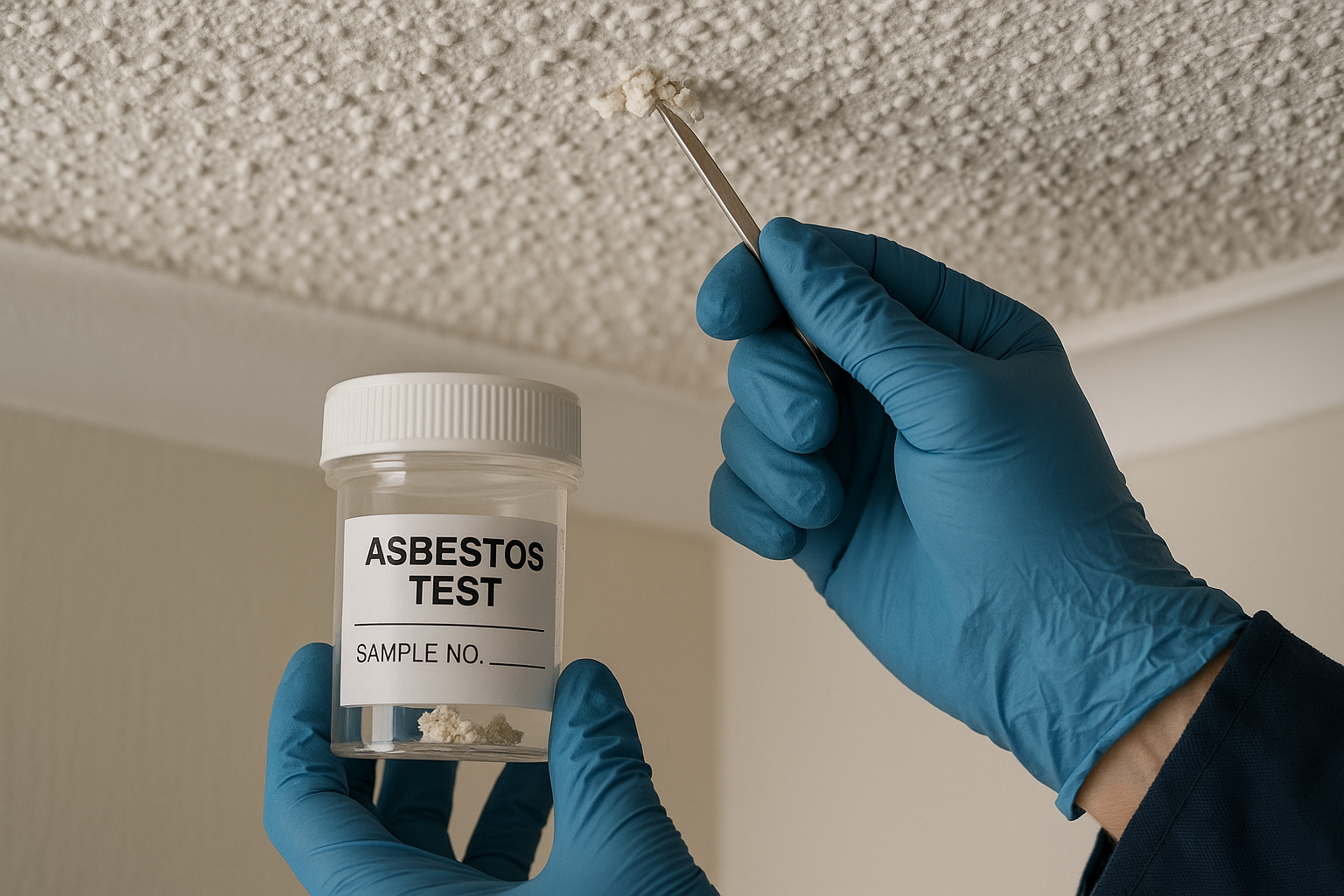
    That dated stippled finish might seem like a decorating problem, but a popcorn ceiling asbestos test can quickly turn it into a health, legal and cost issue if you get it wrong. Scraping, drilling or sanding a textured ceiling before it has been checked can release asbestos fibres, disrupt works and create avoidable risk for occupants and trades.

    Across older UK homes, offices, schools and mixed-use buildings, textured coatings were widely used on ceilings and sometimes walls. Some contain asbestos, some do not, and the finish alone will not tell you which is which. If you are planning maintenance, refurbishment or removal, testing first is the sensible step.

    Why a popcorn ceiling asbestos test matters

    Asbestos is most dangerous when fibres become airborne and are inhaled. That usually happens when asbestos-containing materials are damaged, drilled, sanded, cut or removed. A textured ceiling can sit undisturbed for years, but once work starts, the risk profile changes.

    A popcorn ceiling asbestos test gives you evidence rather than guesswork. Instead of relying on age, appearance or what a contractor thinks it might be, you get a laboratory result that helps you decide whether the ceiling should be left alone, managed in place, sealed or removed by a competent contractor.

    For non-domestic premises, the Control of Asbestos Regulations require dutyholders to manage asbestos risk. HSE guidance and HSG264 Asbestos: The Survey Guide set out expectations for identifying suspect materials, surveying, sampling and reporting. If you manage a property portfolio, school, office, shop or common parts of residential buildings, a proper assessment is not optional.

    How common is asbestos in popcorn ceilings?

    It is common enough that older textured ceilings should not be dismissed without checking. Textured coatings were used extensively in the UK and some products included chrysotile asbestos to add strength and improve application characteristics.

    Not every popcorn or stippled ceiling contains asbestos. That is the point. Two ceilings can look almost identical while only one contains asbestos, so visual inspection alone is unreliable.

    When suspicion should be higher

    You should treat a textured ceiling as suspect if:

    • the property is older and the ceiling appears original
    • there is no survey report or previous lab result
    • the ceiling has a stippled, swirled or heavily textured finish
    • repairs, rewiring, lighting changes or redecoration are planned
    • the surface is cracked, flaking, water-damaged or patched

    In practice, textured ceilings are often overlooked because they feel ordinary. The problem is that ordinary jobs can disturb them. Fitting a smoke detector, moving a light fitting, chasing cables or repairing a leak may all affect the coating.

    Why older records matter

    If you already have asbestos records for the building, review them before any work starts. A previous survey may already identify textured coatings, although older reports sometimes group them broadly and do not always reflect later repairs or hidden layers.

    If there is any doubt, arrange targeted asbestos testing rather than assuming the ceiling is safe.

    How dangerous is asbestos in ceilings?

    Textured coatings are generally considered lower risk than materials such as pipe insulation, sprayed coatings or asbestos insulating board. Lower risk does not mean no risk. The danger comes from disturbance and fibre release.

    popcorn ceiling asbestos test - Asbestos Testing for Popcorn Ceilings: W

    When a textured ceiling is intact and left alone, the immediate risk is usually low. When it is scraped, sanded, drilled or broken during works, fibres can be released into the air. Those fibres are microscopic, so you cannot see or smell them.

    Exposure to asbestos fibres is associated with serious diseases including mesothelioma, asbestos-related lung cancer and asbestosis. That is why a popcorn ceiling asbestos test should happen before any intrusive work begins.

    What affects the level of risk?

    • the type and amount of asbestos within the coating
    • the condition of the material
    • whether it has been sealed or overpainted
    • how the work is carried out
    • the scale and duration of disturbance
    • how many people may be exposed
    • whether suitable controls are in place

    A ceiling in good condition in a low-traffic room is one scenario. A damaged ceiling above a busy office being cut back for electrical works is another. The material may be similar, but the risk is not.

    Situations where extra caution is needed

    Arrange a popcorn ceiling asbestos test before any of the following:

    • installing spotlights, speakers, alarms or CCTV
    • moving or replacing light fittings
    • repairing leaks or water damage
    • skimming or flattening the ceiling
    • removing loose sections
    • major refurbishment
    • demolition

    If trades are due on site, do not rely on a visual opinion. Testing or surveying first is faster than stopping a project halfway through because suspect materials were disturbed.

    How to identify and test for asbestos

    You cannot confirm asbestos in a popcorn ceiling by sight. Colour, pattern, thickness and age may make a ceiling suspicious, but they do not prove anything. Only sample analysis can confirm whether asbestos is present.

    That is why a popcorn ceiling asbestos test is so useful. It replaces assumptions with a clear result from a UKAS-accredited laboratory process.

    Visual clues can only tell you a ceiling is suspect

    A surveyor or experienced contractor may recognise a textured coating that should be treated with caution. That is helpful for deciding whether to stop work, but it is not the same as confirmation.

    Paint layers, patch repairs, over-skimming and later decorative finishes often hide what is underneath. A ceiling that looks newer may still contain an older textured layer below.

    Professional inspection and sampling

    If you manage commercial premises, rental stock, schools, offices or common parts, professional attendance is usually the best route. A competent surveyor can inspect the ceiling in context, assess condition, identify other suspect materials and advise on the right level of survey.

    For day-to-day occupation and routine maintenance planning, a management survey helps identify asbestos-containing materials that could be disturbed during normal use.

    If planned works will disturb the ceiling or nearby structure, a refurbishment survey is normally required in the affected area. This is intrusive and designed to locate asbestos before work starts.

    If the building is due to be taken down, a demolition survey is required before demolition begins. It is fully intrusive and aims to identify all asbestos-containing materials that must be dealt with beforehand.

    Targeted testing for a single ceiling

    If the issue is one suspect textured ceiling rather than a wider project, targeted testing may be enough. Supernova can arrange professional attendance for a specific sample, especially where access is awkward, the coating is damaged or there are several suspect areas.

    For broader service information, see our asbestos testing page.

    DIY sampling in domestic settings

    In some homes, an owner may choose to submit a small sample for analysis before deciding what to do next. That can be practical if the ceiling is in reasonable condition and the aim is simply to confirm whether asbestos is present.

    If you take that route, use a proper asbestos testing kit rather than improvising with household bags and tools. The correct packaging and instructions help reduce unnecessary disturbance.

    If you already have a sample and only need laboratory confirmation, sample analysis may be the most direct option. Some householders prefer a straightforward testing kit for a one-room check, but if the ceiling is damaged, friable or above a frequently used area, professional sampling is the safer choice.

    Practical precautions during sampling

    Whether the sample is taken by a surveyor or, in a limited domestic setting, by the owner, the aim is to keep disturbance to an absolute minimum.

    • keep the sample small
    • lightly dampen the area first
    • do not use power tools
    • seal the sample immediately
    • clean the area with damp wipes
    • keep other people out of the room while sampling takes place

    Never scrape, sand or break away large sections just to see what lies underneath. That creates avoidable exposure and may spread contamination beyond the immediate area.

    What the test result means

    Once the popcorn ceiling asbestos test result comes back, the next step is not panic. It is deciding how the material should be managed based on condition, location and planned works.

    popcorn ceiling asbestos test - Asbestos Testing for Popcorn Ceilings: W

    If the result is negative

    A negative result means the sampled material did not contain asbestos. Keep the report with your property records and share it with contractors before work starts.

    Be careful not to overinterpret one result. A negative sample from one room does not automatically clear every textured ceiling in the building. Different rooms may have been coated at different times using different products.

    If the result is positive

    A positive result means the coating contains asbestos and should be managed accordingly. That does not automatically mean urgent removal is required.

    The right response depends on:

    • the condition of the ceiling
    • how likely it is to be disturbed
    • how the room is used
    • whether refurbishment is planned
    • whether damage, leaks or repeated maintenance are expected
    • whether other asbestos-containing materials may also be present nearby

    In many cases, an intact ceiling can remain in place under a management plan. In others, sealing, enclosing or removal is more appropriate.

    What to do if you find asbestos in your popcorn ceiling

    A positive popcorn ceiling asbestos test should lead to a calm, structured response. The goal is to stop disturbance, assess risk properly and choose the right control measure.

    1. Stop any planned work immediately. Do not let decorators, electricians or general builders keep going.
    2. Prevent further disturbance. Keep people away from the area where possible.
    3. Assess the ceiling condition. Check for cracks, water damage, delamination or previous drilling.
    4. Review planned works. A ceiling that can stay untouched may be managed differently from one due for removal.
    5. Record the finding. For non-domestic premises, update the asbestos register and share the information with anyone who may work on site.
    6. Take professional advice. The correct option may be management in place, encapsulation, encasement or removal.

    For domestic properties, keep the report with your maintenance records and show it to any contractor before future work starts. For commercial buildings and communal areas, make sure the finding feeds into wider asbestos management arrangements.

    When leaving it in place is the best option

    If the ceiling is sound and there is no reason to disturb it, leaving it alone is often the safest and most cost-effective approach. Many asbestos-containing materials are managed in place for years without incident.

    That only works if the material stays in good condition and everyone involved in maintenance knows it is there. A hidden risk is still a risk if contractors are not informed.

    Encapsulation

    Encapsulation means applying a suitable protective coating or sealant over the asbestos-containing material to reduce the chance of fibre release. For some textured ceilings, this can be an effective option when the coating is in fair condition and removal is not necessary.

    Encapsulation is not just a case of painting over the surface and hoping for the best. The product used, the condition of the ceiling and the likelihood of future disturbance all matter.

    When encapsulation may be suitable

    • the ceiling is largely intact
    • there is no major refurbishment planned
    • the room can be managed to avoid damage
    • a competent person has confirmed the condition is appropriate

    Encapsulation can help stabilise the surface and make accidental minor disturbance less likely to release fibres. It may also be useful where immediate removal would cause more disruption than benefit.

    Limits of encapsulation

    Encapsulation does not remove asbestos. The material remains in the building and still needs to be considered during future maintenance, refurbishments and surveys.

    If the ceiling is already badly damaged, water-affected or likely to be disturbed repeatedly, encapsulation may not be the right answer. In those cases, other control options are usually better.

    Encasement

    Encasement is different from encapsulation. Instead of applying a sealant directly to the asbestos-containing surface, encasement creates a physical barrier around it. In ceiling situations, that may involve installing a new lining or suspended ceiling beneath the textured coating so the original material is enclosed and protected from disturbance.

    Encasement can be practical where the existing ceiling is stable but unattractive, and where full removal would be unnecessarily disruptive. It can also reduce the chance of accidental contact during normal occupation.

    When encasement may make sense

    • the original ceiling is in reasonable condition
    • the asbestos-containing coating can remain undisturbed
    • access for future maintenance can be controlled
    • the new design allows the asbestos material to stay protected

    Encasement needs proper planning. If fixings, lighting or service penetrations disturb the original textured coating during installation, the benefit is lost. The work method has to be designed around the asbestos risk.

    What to remember about encasement

    Like encapsulation, encasement does not remove asbestos. The ceiling must still be recorded, labelled where appropriate and considered whenever future works are planned.

    For property managers, this often comes down to long-term practicality. If the ceiling is likely to need repeated access above it for services, removal may ultimately be simpler than enclosing it.

    Abatement: hire a professional to safely remove it

    If the ceiling is damaged, if refurbishment is planned or if ongoing maintenance will keep disturbing it, removal may be the better option. This is where professional asbestos abatement matters.

    Do not let general trades start scraping, sanding or soaking down a positive ceiling without proper assessment. Even where textured coating work is not always licensable, it still requires the correct controls, competent operatives, suitable equipment, waste handling and a safe method of work.

    Why professional removal is the safer route

    • the work area can be properly controlled
    • disturbance is minimised using the right methods
    • waste is packaged, transported and disposed of correctly
    • the surrounding area can be cleaned appropriately
    • records are created for compliance and future property files

    Removal is not only about taking the material down. It is about preventing spread, protecting workers and occupants, and making sure the building is safe for the next stage of works.

    Questions to ask before arranging removal

    1. Is the ceiling definitely asbestos-containing, based on analysis?
    2. Is the material damaged or likely to be disturbed?
    3. Will the planned works affect only the ceiling, or also walls, voids and services?
    4. Do you need a wider survey before removal starts?
    5. Who is responsible for the asbestos register and contractor communication?

    If you are planning broader works, testing one ceiling may not be enough. Hidden materials nearby can still delay the job if they are discovered after contractors have started.

    When you need a survey rather than a simple test

    A popcorn ceiling asbestos test is ideal when you need to confirm whether a specific ceiling contains asbestos. It is not always enough on its own.

    If the project involves wider intrusive works, the real question is often not just whether one ceiling is positive, but what else may be disturbed. Walls, service risers, floor finishes, boxing, soffits and hidden voids may also contain asbestos.

    Use the right option for the job

    • Testing when you need to identify a specific suspect material
    • Management survey for routine occupation and standard maintenance planning
    • Refurbishment survey before intrusive works
    • Demolition survey before demolition

    Getting the scope right at the start saves time and money later. It also prevents projects stopping halfway through because another asbestos-containing material is found after site mobilisation.

    Practical advice for homeowners, landlords and property managers

    For homeowners

    If you are planning to redecorate, fit downlights or remove a dated finish, do not start by scraping. Arrange a popcorn ceiling asbestos test first and keep the result with your house records.

    If the result is positive and the ceiling is in good condition, you may be able to leave it in place or discuss encapsulation or encasement with a competent professional. If you want it removed, use a specialist contractor rather than a general builder.

    For landlords

    Landlords should be especially careful in common parts and any areas where contractors may work. If maintenance is planned between tenancies, check suspect textured ceilings before the work order is issued.

    Clear records reduce disputes, delays and unsafe decisions. If one flat has a positive textured coating, do not assume neighbouring units are identical without evidence.

    For property managers

    Textured ceilings are easy to miss in offices, retail units, schools and residential blocks because they blend into the background. Add them to your asbestos review whenever there are lighting upgrades, leak repairs, HVAC works or fit-outs planned.

    If you operate in the capital, our asbestos survey London service can help with surveys and testing across a wide range of property types. For clients in the North West, our asbestos survey Manchester team can support local projects with the same practical approach.

    Top Posts

    If you are researching textured coatings, you are not alone. Property owners and managers often move on from a single popcorn ceiling asbestos test query to wider questions about surveys, removal planning and legal duties.

    Popular related topics usually include:

    • when a management survey is enough and when it is not
    • how refurbishment surveys affect project timelines
    • what happens after a positive asbestos sample
    • whether textured coatings must always be removed
    • how to prepare a property for asbestos sampling

    The common thread is simple: test before you disturb, survey before you refurbish, and keep clear records throughout.

    Frequently Asked Questions

    Can you tell if a popcorn ceiling contains asbestos just by looking at it?

    No. A textured finish can look suspicious, but appearance alone cannot confirm asbestos. A popcorn ceiling asbestos test using sample analysis is the only reliable way to know.

    Should I remove an asbestos popcorn ceiling straight away?

    Not always. If the ceiling is in good condition and will not be disturbed, it may be safer to leave it in place and manage it properly. Removal is usually considered when the material is damaged or planned works will disturb it.

    What is the difference between encapsulation and encasement?

    Encapsulation involves applying a protective sealant or coating directly to the asbestos-containing material. Encasement means enclosing it behind a physical barrier, such as a new ceiling lining, so it is protected from disturbance.

    Do I need a survey or just a test?

    If you only need to confirm whether one ceiling contains asbestos, targeted testing may be enough. If you are planning intrusive works, refurbishment or demolition, you will usually need the appropriate asbestos survey instead.

    What should I do if a contractor has already disturbed a textured ceiling?

    Stop work immediately, keep people out of the area and seek professional advice. The material may need to be assessed, sampled and managed before any further work continues.

    Need help with a popcorn ceiling asbestos test?

    If you need a popcorn ceiling asbestos test, a targeted sample, or a full survey before maintenance, refurbishment or demolition, Supernova Asbestos Surveys can help. We have completed more than 50,000 surveys nationwide and provide practical advice that keeps projects moving safely.

    Call 020 4586 0680 or visit asbestos-surveys.org.uk to arrange testing, discuss your property, or book the right survey for your project.

  • Home Asbestos Testing: A Must-Do Before Purchasing

    Home Asbestos Testing: A Must-Do Before Purchasing

    Asbestos Test Kit: What It Can and Cannot Tell You

    One wrong assumption about an old ceiling, garage roof or floor tile can turn a routine job into a health crisis, a contractor dispute or a costly delay. An asbestos test kit can be a genuinely useful tool in the right situation — but it is not a shortcut to a full asbestos assessment, and treating it as one is where things go wrong.

    If a property was built or altered before 2000, asbestos may still be present somewhere in the building fabric. The real question is not whether you can buy an asbestos test kit, but whether it is the right option for your property, your planned works and your legal responsibilities.

    What an Asbestos Test Kit Actually Does

    An asbestos test kit is designed to help you collect a small sample of a suspect material and send it to a laboratory for analysis. The laboratory confirms whether asbestos is present in that specific piece of material — and, in most cases, which type of asbestos fibre has been identified.

    That can be genuinely useful. It gives you a clear, written answer about one item instead of relying on guesswork, internet images or a contractor’s opinion.

    What an asbestos test kit can tell you

    • Whether the sampled material contains asbestos fibres
    • Which type of asbestos may be present in that sample
    • Whether work on that specific material should pause until you get further advice

    What an asbestos test kit cannot tell you

    • Whether other materials in the property contain asbestos
    • Whether hidden asbestos is present behind finishes, in voids or above ceilings
    • The overall condition and risk profile of asbestos-containing materials across the building
    • Whether your wider duty to manage asbestos has been met
    • Whether contractors can safely proceed with broader works

    That distinction matters enormously. Under the Control of Asbestos Regulations, dutyholders in non-domestic premises must take reasonable steps to identify asbestos, assess the risk and manage it properly. A single sample result can support one decision, but it rarely meets that wider duty on its own.

    When an Asbestos Test Kit Is the Right Choice

    There are situations where an asbestos test kit is a practical and proportionate option. If you have one accessible suspect material and need laboratory confirmation before deciding what to do next, a kit can be a sensible first step.

    Typical examples include a garage roof sheet, a section of textured coating, one vinyl floor tile, a soffit panel or a small piece of boxing around pipework. In these cases, the question is narrow: does this specific material contain asbestos?

    An asbestos test kit may be suitable when:

    • You are checking one or two accessible materials before minor maintenance
    • You want laboratory confirmation before arranging further professional advice
    • You understand the limits of sampling and can work carefully with appropriate protective equipment
    • You need a targeted result rather than a whole-building inspection

    If that is all you need, asbestos testing through a professional route can also be a straightforward way to get a written laboratory result without relying on assumptions.

    Where an Asbestos Test Kit Falls Short

    The biggest mistake people make with an asbestos test kit is assuming it does the same job as a survey. It does not. A survey carried out in line with HSG264 and relevant HSE guidance involves inspection, material identification, location recording and recommendations based on how the building is used. An asbestos test kit does none of that.

    It also does not deal with concealed materials. Asbestos can be hidden above ceilings, inside service risers, behind wall linings, beneath floor finishes, around pipework or within later alterations — none of which a test kit will find.

    You should not rely on an asbestos test kit alone if:

    • You are responsible for a workplace, communal area or commercial premises
    • You are planning refurbishment, strip-out or structural work
    • Contractors need reliable asbestos information before starting
    • There are several suspect materials across the property
    • You are unsure whether the material can be sampled safely

    For occupied buildings, a management survey is usually the right starting point. If major intrusive works are planned, a demolition survey is the correct route — it is specifically designed to locate asbestos that could be disturbed during destructive works.

    Types of Asbestos Test Kit Available

    Not every asbestos test kit offers the same level of support. Some only cover laboratory submission. Others include protective equipment, detailed instructions and options for multiple samples. Understanding what you are buying before you order matters.

    Sample submission only

    This is the most basic form of asbestos test kit. It is intended for people who already have suitable protective equipment and only need the bags, paperwork and laboratory analysis.

    A basic option typically includes:

    • Sample bags and a submission form or online registration
    • Return packaging
    • Sampling instructions
    • A written laboratory report

    If you already have the correct equipment and experience, this can be cost-effective. If not, it can encourage people to underestimate the risk of disturbing suspect material. If you only need the laboratory side of the process, sample analysis can be a sensible standalone choice.

    Full asbestos test kit with PPE and RPE

    For many homeowners, landlords and small property managers, a fuller kit is the safer option. These usually include personal protective equipment and respiratory protective equipment alongside the laboratory service.

    Suitable contents may include:

    • Disposable Type 5/6 coveralls
    • Disposable gloves
    • FFP3 respiratory protection or other suitable RPE
    • Protective eyewear
    • Overshoes or boot covers
    • Wipes and waste bags

    A basic dust mask is not adequate for asbestos sampling. If you are ordering for first-time use, choose an asbestos testing kit that includes appropriate PPE and RPE rather than trying to assemble everything separately.

    Kits for more than one sample

    One sample rarely tells you everything you need to know. Different materials should be sampled separately, and even similar-looking finishes may need individual testing if they differ in appearance, age or location.

    As a rule:

    • Take a separate sample for each distinct material
    • Do not mix materials in one bag
    • If materials look different, treat them as different until proven otherwise
    • If a material is damaged or friable, stop and call a professional

    If you need to check several suspect items, a testing kit with capacity for extra samples can save time and avoid repeat postage delays.

    Materials People Commonly Test with an Asbestos Test Kit

    Most people search for an asbestos test kit because they have found one of the usual suspect materials in an older property. Some are lower risk when intact. Others are much more likely to release fibres if disturbed.

    Common materials include:

    • Textured coatings on ceilings and walls
    • Vinyl floor tiles and bitumen adhesive
    • Asbestos cement garage roofs and outbuildings
    • Soffits, fascias and rainwater goods
    • Boxing around pipes or columns
    • Partition panels and service risers
    • Panels behind heaters or around flues
    • Old toilet cisterns and window boards

    Some materials should never be sampled casually. Asbestos insulating board, lagging and sprayed coatings are higher-risk materials because they can release fibres more readily when disturbed. If there is any doubt about the material, its condition or how accessible it is, step back from the asbestos test kit and get professional advice instead.

    How to Use an Asbestos Test Kit More Safely

    If you decide to use an asbestos test kit, the method matters as much as the laboratory result. Poor sampling can contaminate the surrounding area, expose people to fibres and still leave you with an unusable sample.

    Before you start

    • Do not sample badly damaged, crumbly or dusty material
    • Keep other people and pets out of the area
    • Turn off fans, HVAC systems and anything else that moves air around
    • Read the instructions fully before opening the kit
    • Prepare labels, bags and wipes before approaching the material
    • Make sure you have suitable PPE and RPE ready before you begin

    Basic sampling steps

    1. Put on all PPE and RPE before starting
    2. Lightly dampen the immediate area if the instructions advise this
    3. Take the smallest sample needed for analysis
    4. Place it straight into the sample bag and seal it
    5. Double-bag the sample if required by the kit instructions
    6. Label the material and location clearly
    7. Wipe down the immediate area and bag any waste
    8. Remove PPE carefully without shaking or flapping it
    9. Wash thoroughly and submit the sample promptly

    Never sand, drill, saw or break off a larger piece to get a better sample. More disturbance does not improve the result — it only increases the chance of fibre release into the surrounding area.

    If you want a structured route for sending material to the lab, this dedicated asbestos testing service is often easier to follow than improvised DIY sampling.

    What Buyers, Landlords and Dutyholders Need to Understand

    Buying an older property often creates pressure for quick answers. That is exactly when an asbestos test kit is most likely to be misunderstood or misused. A negative result on one ceiling coating or one floor tile does not mean the whole property is free from asbestos — it only means that one sample did not contain asbestos. The rest of the building fabric remains unknown.

    For homeowners

    If you are only concerned about one accessible material, a kit may be enough to help with a purchase decision or a small repair. Keep the scope narrow, avoid unnecessary disturbance and do not extrapolate a single result across the whole property.

    For landlords and managing agents

    If the building includes communal areas or non-domestic parts, your responsibilities are wider. A single sample result will not replace proper records, risk assessment or management information for contractors. Tenants and maintenance workers rely on accurate information before carrying out even routine tasks.

    For employers and dutyholders

    Under the Control of Asbestos Regulations, the duty is to identify and manage asbestos risk in non-domestic premises. That usually means using competent professionals, keeping accurate records and sharing information with anyone who may disturb the building fabric. An asbestos test kit result is not a substitute for that process.

    When to Stop Using an Asbestos Test Kit and Call a Surveyor

    There is a clear point where an asbestos test kit stops being the right tool. Recognising that point early can save money, reduce delays and prevent unnecessary exposure.

    Call a professional surveyor if:

    • You find more suspect materials than expected
    • The material is damaged, flaky, dusty or crumbling
    • You plan to remove walls, ceilings, floors or fixed fittings
    • The premises are non-domestic or include communal areas
    • A contractor has asked for an asbestos survey before work starts
    • You need an asbestos register or management plan
    • You cannot reach the material safely

    Supernova Asbestos Surveys operates across the UK, including asbestos survey London, asbestos survey Manchester and asbestos survey Birmingham, with surveyors available to assess properties of all types and sizes.

    Legal Points Every Dutyholder Should Know

    If you manage non-domestic premises, the issue is not simply whether asbestos is present. The real issue is whether asbestos risk is being identified, recorded and managed properly. Under the Control of Asbestos Regulations, dutyholders must take reasonable steps to determine whether asbestos-containing materials are present, assess the risk and manage it.

    In practice, that means using competent professionals, maintaining reliable records and ensuring contractors have the right information before work begins.

    A single asbestos test kit result does not replace:

    • An asbestos register
    • Material condition assessments
    • Location records and plans
    • Management recommendations
    • Clear information for contractors and maintenance teams

    HSE guidance under HSG264 sets out the standard expected of a competent survey. That standard cannot be met with a postal sampling kit alone, no matter how carefully it is used.

    If you are unsure whether your current approach meets the duty to manage, speaking to a qualified asbestos surveyor is always the right next step. It is far less costly than getting it wrong.

    Get the Right Advice from Supernova Asbestos Surveys

    Supernova Asbestos Surveys has completed over 50,000 surveys across the UK. Whether you need guidance on using an asbestos test kit, a full management or demolition survey, or professional laboratory analysis, our team can help you make the right decision for your property and your legal obligations.

    Call us on 020 4586 0680 or visit asbestos-surveys.org.uk to find out more about our services and to get a quote.

    Frequently Asked Questions

    Can I use an asbestos test kit to check my whole house?

    An asbestos test kit can only tell you whether a specific sampled material contains asbestos. It cannot assess every material in a property, identify hidden asbestos or give you an overall risk picture. If you need a full assessment, a professional management survey carried out in line with HSG264 is the appropriate route.

    Is it safe to take an asbestos sample myself?

    It can be, provided the material is accessible, intact and not friable, and you follow the kit instructions carefully using appropriate PPE and RPE including an FFP3 mask. You should never attempt to sample damaged, crumbling or dusty material. If there is any doubt about the material or its condition, contact a professional surveyor.

    How long does it take to get results from an asbestos test kit?

    Turnaround times vary depending on the laboratory and the service level you choose. Standard analysis typically takes a few working days once the sample is received. Some providers offer faster turnaround for an additional cost. Check what is included before you order.

    Does a negative asbestos test kit result mean my property is asbestos-free?

    No. A negative result only means that the specific sample you submitted did not contain asbestos fibres. Other materials in the property may still contain asbestos. A single kit result should never be used to declare a whole property clear without a proper survey being carried out.

    When do I legally need a professional asbestos survey rather than a test kit?

    If you are a dutyholder managing non-domestic premises, the Control of Asbestos Regulations requires you to identify and manage asbestos risk using competent professionals. A test kit result alone will not satisfy that duty. You will also need a professional survey if refurbishment or demolition works are planned, or if contractors require asbestos information before starting work.

  • Comprehensive Artex Asbestos Testing Guide: Ensure Safety in Your Home

    Comprehensive Artex Asbestos Testing Guide: Ensure Safety in Your Home

    That textured ceiling might have been ignored for years, but artex asbestos can turn into a real problem the moment someone drills into it, sands it back or starts refurbishment without checking first. For homeowners, landlords and property managers, the issue is rarely the ceiling simply existing overhead. The risk starts when the material is disturbed and fibres are released.

    Older textured decorative coatings were widely used across UK properties to hide uneven plaster and add pattern to ceilings and walls. Some of those coatings contained asbestos, usually chrysotile. If you are dealing with an older property and there is no clear record of what was used, the safest assumption is that the coating is suspect until it has been tested properly.

    What is artex asbestos?

    Artex was originally a brand name, but it became a common term for textured decorative coatings. Swirl, stipple, fan and broken leather finishes all fall into the sort of surface people usually mean when they talk about Artex.

    When people refer to artex asbestos, they mean a textured coating that contains asbestos fibres. Not every textured coating contains asbestos, and not every old ceiling will test positive. The problem is that you cannot tell by looking.

    Paint layers, age, pattern and colour do not confirm anything. A ceiling that looks fresh and modern may still contain asbestos beneath several coats of emulsion.

    Why asbestos was used in textured coatings

    Asbestos was added to some decorative coatings because it improved strength and helped bind the material together. At the time, asbestos was used in a huge range of building products for durability, insulation and fire resistance.

    That is why artex asbestos still appears in homes, schools, offices and communal areas today. The coating may have been applied decades ago and then simply painted over again and again.

    This matters because age alone does not make the material safe. If the coating contains asbestos, it needs to be managed in line with the Control of Asbestos Regulations, relevant HSE guidance and the survey standards set out in HSG264.

    How to tell if a ceiling might contain artex asbestos

    You cannot identify artex asbestos by sight alone, but you can judge whether asbestos is possible. That is often enough to know when to stop and arrange testing.

    artex asbestos - Comprehensive Artex Asbestos Testing Gui

    Suspicion is higher when:

    • the property was built or refurbished before 2000
    • the textured finish appears original
    • there are no asbestos records or test certificates
    • the surface has been patched around lights or fittings
    • the coating is damaged, flaking or affected by leaks
    • contractors are due to carry out work nearby

    If any of those apply, do not guess. Treat the material as suspect until sampling confirms otherwise.

    Visual clues only go so far

    A swirled or stippled ceiling in an older building should prompt caution, not certainty. Two ceilings can look almost identical, with one testing positive and the other negative.

    That is why records matter. If you manage non-domestic premises, communal areas or mixed-use buildings, you need a clear asbestos record rather than assumptions based on appearance.

    How artex asbestos is confirmed

    The only reliable way to confirm artex asbestos is to take a sample and have it analysed by a laboratory. Anything else is guesswork.

    Professional sampling

    Professional sampling is usually the best option where the coating is damaged, difficult to access or likely to be disturbed soon. It is also the sensible route if you need formal documentation for tenants, contractors or compliance records.

    A surveyor can take a controlled sample, minimise disturbance and make sure the result is properly recorded. If you need laboratory confirmation, arrange asbestos testing before any work starts.

    Self-sampling options

    If the coating is intact and you only need to test a small area, a postal sample can be suitable in some cases. A homeowner may prefer an asbestos testing kit when the risk is low and the instructions can be followed carefully.

    There is a difference between suitable self-sampling and unsafe DIY. If the material is crumbly, water-damaged or already breaking up, leave it alone and arrange professional attendance instead.

    For a simple postal option, a testing kit can be useful, but only where the surface is stable and accessible.

    When you need an asbestos survey rather than a single test

    Testing one ceiling tile or one patch of coating is not always enough. The right approach depends on what is happening in the building.

    artex asbestos - Comprehensive Artex Asbestos Testing Gui

    Management survey for normal occupation

    If the property is occupied and you need to identify asbestos-containing materials that could be disturbed during routine use or maintenance, a management survey is often the right starting point. This helps locate suspect materials and supports an asbestos register where required.

    For landlords, managing agents and duty holders, that is often the practical first step when there are textured coatings in communal areas, plant rooms, risers or other non-domestic parts of a building.

    Refurbishment or demolition work

    If major works are planned, the survey scope changes completely. Before strip-out, structural alteration or demolition, a demolition survey is required for the affected area so asbestos can be identified before it is disturbed.

    This is more intrusive than a management survey. It should be arranged before builders start opening ceilings, walls or service voids.

    Why artex asbestos becomes dangerous

    Artex asbestos in good condition is often lower risk than heavily friable asbestos materials such as lagging or sprayed coatings. That does not mean it is harmless. Once disturbed, it can release fibres.

    Common activities that create risk include:

    • drilling for spotlights, smoke alarms or cable routes
    • scraping back texture before plastering
    • sanding during redecoration
    • cutting into ceilings for electrical works
    • repairing leaks or cracks
    • removing ceilings during refurbishment

    This is where many people come unstuck. The coating may have sat undisturbed for years, then a routine maintenance job turns it into an exposure issue.

    Health risks linked to asbestos exposure

    Asbestos-related disease is caused by inhaling airborne fibres. The level of risk depends on the type of asbestos, the amount released and the duration and frequency of exposure.

    Textured coatings usually contain a lower percentage of asbestos than some other asbestos-containing materials, but avoidable exposure should never be dismissed. The practical aim is always the same: prevent fibres from being released.

    Asbestosis

    Asbestosis is a serious long-term lung disease caused by asbestos exposure over time. It scars the lungs and can make breathing progressively harder. It is generally linked to heavier or repeated exposure, but that does not change the need to control even small avoidable releases.

    Shortness of breath

    Shortness of breath is one symptom associated with asbestos-related illness, although it can have many causes. From a property management point of view, symptoms are not how you judge whether a ceiling is safe. Testing and proper assessment are.

    Chest pain

    Chest pain may be linked to asbestos-related conditions affecting the lungs or their lining. Again, the building safety lesson is simple: do not disturb suspect material without checking it first.

    Pleural thickening

    Pleural thickening is scarring and thickening of the lung lining that can be associated with past asbestos exposure. Some people have few symptoms at first, while others develop breathlessness. The right response in buildings is prevention, not guesswork.

    Is it safe to paint over artex asbestos?

    Sometimes, yes. Painting over confirmed artex asbestos can form part of a management approach if the coating is in good condition and you are not damaging the surface first.

    What you must not do is prepare the surface aggressively. That means no sanding, no scraping and no breaking the coating to get a smoother finish.

    Avoid these mistakes:

    • sanding the texture before painting
    • scraping off loose high spots
    • drilling through the coating without controls
    • using repair methods that damage the surface

    If the ceiling is cracked, flaking or affected by water damage, painting alone may not be enough. Get specialist advice before deciding what to do next.

    What to do if testing confirms artex asbestos

    A positive result does not automatically mean the ceiling has to come down. The right response depends on condition, location and whether the material is likely to be disturbed.

    Start with these steps:

    1. Stop any work that could disturb the coating.
    2. Record the exact location of the material.
    3. Assess its condition and whether it is likely to be damaged.
    4. Inform contractors, maintenance staff and anyone else working nearby.
    5. Choose management, encapsulation or removal based on risk.

    Leave it in place and manage it

    In many cases, the safest option is to leave asbestos-containing textured coating where it is and manage it properly. This is often appropriate when the material is intact, stable and unlikely to be disturbed.

    Good management includes:

    • keeping records of location and condition
    • checking periodically for damage
    • warning contractors before they start work
    • avoiding drilling, sanding or scraping
    • updating asbestos information where required

    Repair local damage

    If there is only minor isolated damage, a controlled repair may be possible. That is not a DIY filler-and-sandpaper job. Any repair still needs to prevent fibre release and should be planned properly.

    Encapsulation

    Encapsulation means sealing the material to reduce the chance of fibre release. Depending on the ceiling and the room, this may involve applying a suitable coating or overboarding the surface.

    Encapsulation can be practical where removal would create more disruption than benefit, but it still needs proper assessment first.

    Removal

    Removal may be the best option when the coating is badly damaged, refurbishment is planned or the ceiling will almost certainly be disturbed in future. The method depends on the material, the scale of work and the level of risk.

    Do not assume removal is a general DIY task. Even where the work is not licensable, it still has to be handled correctly with suitable controls, waste handling and cleaning procedures.

    Practical advice for homeowners, landlords and property managers

    The best way to deal with artex asbestos is to make sensible decisions before work starts. Most asbestos incidents happen because somebody assumed a ceiling was safe and carried on.

    Use this checklist:

    • Check whether the property has an asbestos survey or register.
    • Ask for test results before electricians, plumbers or decorators begin.
    • Do not let anyone drill or sand textured coatings without confirmation.
    • Keep copies of all survey reports and lab certificates.
    • Brief contractors clearly about known or suspected asbestos materials.
    • Review communal areas and service spaces, not just private rooms.

    If you are responsible for a portfolio, consistency matters. A clear process for testing and recording suspect textured coatings is far better than dealing with emergency stop-work situations later.

    Artex asbestos in different property types

    Artex asbestos can appear in more places than many people expect. It is not limited to old domestic ceilings.

    • Homes: bedrooms, hallways, lounges and stairwells often have textured ceilings.
    • Flats and HMOs: communal corridors and shared access areas may also contain textured coatings.
    • Schools and offices: older buildings may have decorative coatings in classrooms, corridors and ancillary spaces.
    • Commercial premises: back-of-house areas, toilets and storage rooms are often overlooked.

    If you manage multiple sites, each building should be assessed on its own records and condition. Never assume one negative result means every similar-looking ceiling elsewhere is also clear.

    Arranging local help

    If you need support quickly, local attendance can make planning easier. Supernova provides services nationwide, including asbestos survey London, asbestos survey Manchester and asbestos survey Birmingham.

    Wherever the property is located, the principle stays the same: identify suspect materials before maintenance, refurbishment or demolition begins.

    Need a clear answer on artex asbestos?

    If you suspect artex asbestos, do not leave it to guesswork and do not let contractors disturb the surface first. Whether you need sampling, a survey or advice on the right next step, Supernova Asbestos Surveys can help.

    To arrange testing or book a survey, call 020 4586 0680 or visit asbestos-surveys.org.uk. If you need more information about nationwide sampling and lab analysis, you can also view our asbestos testing service online.

    Frequently Asked Questions

    Can you tell if Artex contains asbestos just by looking at it?

    No. Pattern, age, paint finish and colour are not reliable indicators. The only dependable way to confirm artex asbestos is by sampling and laboratory analysis.

    Is artex asbestos dangerous if left alone?

    If the coating is in good condition and is not being disturbed, the risk is usually much lower than with damaged or friable asbestos materials. The danger increases when the surface is drilled, scraped, sanded or removed.

    Do I need to remove artex asbestos from my ceiling?

    Not always. If the material is sound and unlikely to be disturbed, it can often be left in place and managed. Removal is more likely to be appropriate where the coating is damaged or refurbishment works are planned.

    Can I paint over artex asbestos?

    In some cases, yes, if the coating is intact and you are not sanding or scraping it first. If the surface is damaged or flaking, get advice before painting because sealing alone may not be suitable.

    What survey do I need before building work starts?

    For normal occupation and routine management, a management survey is often suitable. If the work involves intrusive refurbishment or demolition in the affected area, a refurbishment or demolition survey is needed before work begins.

  • Asbestos Air Testing: What It Is and Why It Matters

    Asbestos Air Testing: What It Is and Why It Matters

    You cannot see asbestos fibres in the air, and that is exactly why asbestos air testing matters. When refurbishment starts, a ceiling tile breaks, or licensed removal is underway, decisions about safety should never rely on guesswork. Property managers, duty holders, landlords and contractors need evidence they can act on, and air monitoring provides it.

    Under the Control of Asbestos Regulations, asbestos risks must be identified, assessed and controlled. HSE guidance and HSG264 support that approach by setting expectations around competent inspection, assessment and asbestos management. Where there is a concern that fibres may be airborne, asbestos air testing helps show what is happening in real terms and whether an area, task or control measure is acceptable.

    At Supernova Asbestos Surveys, we use asbestos air testing as part of a wider risk management approach. If you need to confirm whether a material contains asbestos, our asbestos testing service deals with bulk sampling and laboratory analysis. Air testing answers a different question: what people may actually be breathing.

    What asbestos air testing actually measures

    Asbestos air testing involves drawing a measured volume of air through a specialist filter. Any fibres collected on that filter are then analysed to assess fibre concentration in the sampled air.

    That distinction matters. A material can contain asbestos without releasing significant fibres at that moment, while damaged or disturbed materials can create a much more immediate airborne risk.

    In practical terms, asbestos air testing is used to assess:

    • Potential exposure during asbestos-related work
    • The effectiveness of control measures
    • Conditions around enclosures and work areas
    • Whether accidental disturbance has created an airborne risk
    • Whether an area is suitable for reoccupation after licensed removal

    A sound sampling strategy is essential. Testing without a clear purpose can waste time and money, while targeted testing gives you defensible records and a clearer path to action.

    Why asbestos air testing matters for compliance and risk control

    The legal duty is not simply to know asbestos may be present. The duty is to manage the risk of exposure.

    That means identifying asbestos-containing materials, assessing their condition, preventing disturbance where possible and reducing exposure to the lowest level reasonably practicable where work must proceed. Asbestos air testing supports those duties with measurable data rather than assumptions.

    For property managers and duty holders, air monitoring can help you:

    • Check whether enclosures and control measures are working properly
    • Assess worker exposure during specific tasks
    • Support method statements and safe systems of work
    • Respond to incidents, complaints or suspected contamination
    • Provide evidence before handing areas back to occupants
    • Keep clearer records for audits and investigations

    If you manage older premises, especially non-domestic buildings where asbestos may still be present, air monitoring should be considered whenever work could disturb known or hidden asbestos-containing materials. That is particularly relevant during maintenance, strip-out, plant replacement and intrusive refurbishment.

    When asbestos air testing is usually needed

    Not every site needs air monitoring, but there are common situations where it is sensible or expected. The right decision depends on the material, its condition, the planned work and the likelihood of fibre release.

    asbestos air testing - Asbestos Air Testing: What It Is and Why

    Typical triggers for asbestos air testing include:

    • Before intrusive work where there are concerns about historic contamination
    • During licensed asbestos removal
    • After accidental damage to suspect materials
    • Following poor workmanship or debris discovery
    • Where staff or occupants need reassurance after an incident
    • When assessing worker exposure during repeated tasks
    • As part of four-stage clearance after licensed removal

    If there is uncertainty, get advice before work starts. Building air monitoring into a planned job is far easier than trying to explain later why exposure was never assessed properly.

    Types of asbestos air testing used on site

    Different monitoring methods answer different questions. Choosing the wrong one can produce results that are technically valid but practically unhelpful.

    Background air testing

    Background testing is carried out before asbestos-related work starts. It helps establish existing airborne fibre conditions where there are concerns about damaged materials, historic contamination or uncertainty about the building environment.

    This can be useful before refurbishment or removal, especially where later results need context. A baseline helps you understand whether site conditions changed once work began.

    Static air monitoring

    Static monitoring uses pumps placed at fixed positions. These may be near a work area, outside an enclosure or in nearby occupied spaces where reassurance is needed.

    It is useful for understanding conditions in a defined location, but it does not tell you what a worker is breathing during a task. For that, personal monitoring is usually more relevant.

    Personal air monitoring

    Personal monitoring measures air in the worker’s breathing zone while the task is being carried out. The pump is worn on the body, with the sampling head positioned close to the nose and mouth area.

    This is often the most meaningful form of asbestos air testing for employers because it reflects real working conditions. It shows whether methods, tools, suppression and respiratory controls are actually reducing exposure in practice.

    Leak testing

    Leak monitoring is used around enclosures during asbestos removal work. Its purpose is to identify whether fibres may be escaping from the controlled area.

    If results suggest a problem, the enclosure, work methods and decontamination arrangements should be reviewed immediately. Delay can allow contamination to spread beyond the work zone.

    Reassurance testing

    Reassurance testing is commonly requested after accidental disturbance, debris discovery or concern from building occupants. It can be useful, but only when the sampling plan reflects the actual incident.

    Testing the wrong area or testing before cleaning and isolation are complete can produce misleading comfort. The site history and likely source of disturbance should shape the approach.

    Clearance air testing

    After licensed asbestos removal, the area must pass the four-stage clearance process before it can be returned to normal use. Air testing forms part of that process and supports the certificate of reoccupation.

    This must be carried out independently and in line with HSE guidance. It should never be treated as a box-ticking exercise.

    What is asbestos personal air monitoring and testing?

    Asbestos personal air monitoring and testing is a specific form of asbestos air testing designed to measure the exposure of an individual worker during a task. Rather than sampling the room generally, it samples air from the worker’s breathing zone.

    asbestos air testing - Asbestos Air Testing: What It Is and Why

    That makes it especially valuable where you need to know whether a method of work is safe in reality, not just on paper. If a contractor is removing asbestos insulating board, cleaning debris, drilling near suspect materials or carrying out maintenance in a known asbestos environment, personal monitoring can provide meaningful exposure data.

    For employers and managers, personal monitoring helps answer practical questions such as:

    • Are workers being exposed during this task?
    • Is the method statement working under real site conditions?
    • Are wetting methods and shadow vacuuming effective?
    • Does respiratory protective equipment appear suitable for the activity?
    • Do exposure records need updating and retaining?

    Where work is repeated, personal monitoring can also improve future planning. If exposure is higher than expected, the task can be redesigned before the problem becomes routine.

    When asbestos personal air monitoring and testing is necessary

    There is no single trigger for personal monitoring, but there are many situations where it forms part of proper asbestos risk management. The key factors are the nature of the task, the type and condition of the asbestos-containing material, likely exposure and whether existing information is enough to assess that exposure reliably.

    Common examples include:

    • Licensed asbestos removal work
    • Notifiable non-licensed work where exposure data is needed
    • Work on friable, damaged or degraded materials
    • New or modified working methods
    • Repeated maintenance tasks involving known asbestos risks
    • Concerns about control failure or enclosure leakage
    • Unexpected incidents where workers may have been exposed

    If you are unsure whether monitoring is needed, seek independent advice before the task starts. That protects both the workforce and the organisation responsible for the work.

    Benefits of asbestos air testing for property managers and contractors

    Done properly, asbestos air testing is not just a compliance exercise. It gives you evidence you can use to make better decisions on site.

    It measures actual exposure risk

    Bulk sampling tells you whether a material contains asbestos. Air monitoring helps show whether fibres are airborne and whether people may be inhaling them.

    It checks whether controls are working

    Enclosures, wet removal methods, local controls, decontamination procedures and respiratory protection all need to perform properly together. Air testing helps verify that they do.

    It strengthens your records

    Measured results are far more useful than assumptions when dealing with audits, insurance queries, incident investigations or long-term exposure records.

    It improves future working methods

    Monitoring often highlights practical changes that reduce fibre release. A different sequence of work, better access, improved waste handling or stronger supervision can make a real difference.

    It protects occupants as well as workers

    Where buildings remain partly occupied, air monitoring can help assess whether work is affecting adjacent areas. That is especially useful in offices, schools, healthcare settings and mixed-use premises.

    How asbestos personal air monitoring and testing is carried out

    Personal monitoring needs to be methodical. Small mistakes in calibration, positioning or documentation can undermine the value of the sample.

    The process should always be handled by competent professionals using suitable procedures and properly maintained equipment.

    The right equipment

    Personal asbestos air testing typically uses:

    • A calibrated sampling pump with a stable flow rate
    • A filter cassette with the correct membrane filter
    • Flexible tubing and secure fittings
    • A calibration device or flow meter
    • A harness or belt arrangement that does not interfere with the work
    • Labels, field records and chain-of-custody documentation

    The pump must be safe and practical for the task. The sampling head needs to remain in the breathing zone throughout the monitored activity.

    Airflow measurement and calibration

    Before sampling starts, the airflow must be checked and set correctly. The final result depends on the volume of air drawn through the filter, so an incorrect or unstable flow rate can make the sample unreliable.

    Good practice includes recording:

    • The target flow rate
    • Pre-sampling calibration reading
    • Post-sampling calibration reading
    • Sampling duration
    • Total volume sampled

    These records are essential for interpreting the result properly and defending the quality of the monitoring if questions arise later.

    Preparation before sampling

    Preparation determines whether the sample will answer the right question. Before work begins, the analyst should understand the task, the material involved, the likely level of disturbance and the controls in place.

    The worker should also be briefed. If the pump or sampling head is moved casually during the task, the result may no longer reflect real exposure.

    The sampling process

    Once fitted and calibrated, the worker carries out the task as normally as possible. The point is to capture a realistic picture of exposure, not an artificial demonstration.

    During the sampling period, the analyst records relevant details such as:

    • The activity being carried out
    • Start and finish times
    • Changes in method or pace
    • Condition of the material
    • Use of wetting or shadow vacuuming
    • Any interruptions, equipment issues or unusual events

    This context matters. A fibre result without a clear task record can be difficult to interpret properly.

    Laboratory analysis and reporting

    After sampling, the filter is analysed and the result is reported as a fibre concentration. The report should explain what was sampled, under what conditions and what the result means in context.

    A useful report does more than list numbers. It should help the client decide whether controls were effective, whether further action is needed and whether future work methods should be adjusted.

    Common mistakes that make asbestos air testing less useful

    Air monitoring is only as good as the planning behind it. Several common errors can limit its value.

    • Testing without a clear objective – if you do not know what decision the result is meant to support, the exercise may achieve very little.
    • Using the wrong type of monitoring – static monitoring cannot replace personal monitoring where worker exposure is the real question.
    • Poor timing – reassurance testing before cleaning or isolation may simply confirm the obvious.
    • Sampling the wrong location – a result from an unaffected area may give false comfort.
    • Weak documentation – without proper notes on the task, controls and calibration, the result becomes harder to defend.
    • Relying on air testing alone – monitoring supports risk assessment, but it does not replace surveying, sampling, planning and competent site control.

    Where asbestos-containing materials are unknown or not properly recorded, the first step may be a survey rather than air monitoring. If you need location-specific support, Supernova can help with an asbestos survey London, an asbestos survey Manchester or an asbestos survey Birmingham.

    Asbestos air testing, bulk sampling and removal: knowing which service you need

    Clients often use similar terms for very different services, which can cause delays. The right service depends on the question you need answered.

    • Asbestos air testing asks whether fibres are airborne and whether exposure may be occurring.
    • Bulk sampling asks whether a material itself contains asbestos.
    • Surveying asks where asbestos-containing materials are, what condition they are in and how they should be managed.
    • Removal deals with the safe enclosure, stripping and disposal of asbestos-containing materials where that is the right control option.

    If you suspect a material contains asbestos, start with sampling rather than air monitoring. Supernova offers both project-based and standalone asbestos testing to identify suspect materials accurately.

    If asbestos-containing materials are damaged, likely to be disturbed or no longer suitable to manage in place, removal may be required. In those cases, professional asbestos removal should be planned alongside the right monitoring, clearance and documentation.

    Practical advice before you arrange asbestos air testing

    If you think air monitoring may be needed, a few simple steps will make the process more useful and more cost-effective.

    1. Define the concern clearly. Is the issue worker exposure, enclosure leakage, accidental damage or reoccupation?
    2. Gather existing asbestos information. Surveys, registers, plans and previous sampling results help shape the monitoring strategy.
    3. Record what has happened. If there has been an incident, note the location, time, material involved and who may have been affected.
    4. Avoid disturbing the area further. Unnecessary access can worsen contamination and complicate interpretation.
    5. Use competent specialists. Air testing must be planned, undertaken and interpreted by people who understand asbestos risk in real site conditions.

    The more accurate the briefing, the more useful the monitoring will be. Good information at the start usually leads to faster decisions and fewer repeat visits.

    Why independent judgement matters

    With asbestos, the pressure to keep a project moving can tempt people to look for the quickest answer rather than the right one. That is risky.

    Asbestos air testing should be based on site conditions, regulatory expectations and the decision that needs to be made. Independence matters, particularly where clearance, reoccupation or exposure concerns could affect legal duties, contractor performance or occupant confidence.

    A competent consultant will tell you when air testing is necessary, when it is not, and what other steps should come first. That honesty is often more valuable than the sample itself.

    Frequently Asked Questions

    What is asbestos air testing used for?

    Asbestos air testing is used to assess whether asbestos fibres are airborne and whether people may be exposed. It is commonly used during removal work, after accidental disturbance, around enclosures and as part of clearance before reoccupation.

    Does asbestos air testing tell me if a material contains asbestos?

    No. Air testing measures fibres in the air, not the asbestos content of a material. If you need to identify a suspect material, bulk sampling and laboratory analysis are required.

    When is personal asbestos air monitoring needed?

    Personal monitoring is often needed when you must assess what an individual worker is breathing during a task. It is especially useful for licensed work, higher-risk materials, repeated tasks and situations where the effectiveness of controls needs to be checked.

    Can reassurance air testing prove an area is definitely safe?

    It can provide useful evidence, but only when the testing strategy matches the actual incident and the area has been properly isolated and cleaned where necessary. Results should always be interpreted in context.

    Who should carry out asbestos air testing?

    It should be carried out by competent professionals with the right equipment, procedures and understanding of asbestos risk, HSE guidance and site conditions. Poorly planned monitoring can be misleading.

    If you need clear advice on asbestos air testing, surveying, sampling or project support, speak to Supernova Asbestos Surveys. We provide nationwide asbestos services for commercial, public sector and residential clients. Call 020 4586 0680 or visit asbestos-surveys.org.uk to arrange expert support.

  • Finding Reliable Asbestos Testing Services Near Me

    Finding Reliable Asbestos Testing Services Near Me

    Need an Asbestos Test Near Me? Here’s What You Actually Need to Know

    If you’ve typed “asbestos test near me” into a search engine, you already have a specific concern — a suspect material, an upcoming renovation, or a compliance question that needs answering fast. The problem is that search results range from genuinely qualified professionals to companies that look credible but aren’t. This post cuts straight to what matters: how to find a reliable service, what the process actually involves, and how to make sure the work you commission is legally sound and technically accurate.

    Why Asbestos Testing Is Never Optional

    Asbestos was banned in the UK in 1999, but any building constructed or refurbished before that date may still contain asbestos-containing materials (ACMs). That covers a vast proportion of the UK’s housing stock, schools, offices, hospitals, and industrial premises — far more buildings than most people realise.

    The danger isn’t simply having asbestos present. It’s disturbing it. When ACMs are drilled, cut, sanded, or demolished, microscopic fibres become airborne and can be inhaled. That exposure can cause mesothelioma, asbestosis, and lung cancer — diseases that are often diagnosed decades after the original exposure, and for which there is no cure.

    Professional asbestos testing identifies what’s present, where it is, and what condition it’s in. That information drives every decision that follows — whether to manage it in place, encapsulate it, or arrange removal. For non-domestic properties, it’s also a legal requirement under the Control of Asbestos Regulations.

    Where Asbestos Is Most Commonly Found

    Asbestos was used extensively in construction throughout much of the twentieth century, valued for its fire resistance, durability, and insulating properties. You cannot identify it by looking at a material — laboratory analysis is the only reliable confirmation.

    These are the locations surveyors check most carefully:

    • Insulation boards and lagging — around boilers, pipes, and heating systems
    • Textured coatings — Artex-style ceiling and wall finishes frequently contained chrysotile (white asbestos)
    • Floor tiles and adhesives — vinyl and thermoplastic tiles, particularly in kitchens and corridors
    • Roof sheets and guttering — asbestos cement was widely used for garages, outbuildings, and agricultural buildings
    • Ceiling tiles — especially in commercial and educational buildings
    • Soffit boards and eaves — common in domestic properties built before the 1980s
    • Fire doors and partitioning — particularly in public buildings and commercial premises
    • HVAC ducting and pipe insulation — asbestos was routinely used in heating and ventilation systems

    If a building predates 2000 and you’re planning any work that could disturb these materials, asbestos testing is the only responsible starting point.

    What Type of Asbestos Test Do You Actually Need?

    Before you book anything, it’s worth understanding what kind of service your situation calls for. The terminology matters — commissioning the wrong survey type can leave you exposed legally and practically.

    Management Survey

    This is the standard survey for occupied buildings. A management survey identifies the location, extent, and condition of any ACMs that could be disturbed during normal occupancy or routine maintenance. It’s a legal requirement for duty holders managing non-domestic premises under the Control of Asbestos Regulations and forms the basis of your asbestos register.

    Refurbishment Survey

    Required before any refurbishment work begins on a pre-2000 building. A refurbishment survey is more intrusive than a management survey — surveyors access areas that would normally remain undisturbed, including wall cavities, floor voids, and above ceilings. If contractors are moving in, this survey must happen first.

    Demolition Survey

    The most thorough survey type, required before any demolition work. A demolition survey covers the entire structure and is designed to locate all ACMs so they can be removed safely before demolition proceeds. Skipping this step is a serious legal and health risk.

    Re-Inspection Survey

    If an asbestos register already exists for your property, a re-inspection survey checks whether the condition of known ACMs has changed. These are recommended annually for most managed properties and are a key part of maintaining a robust asbestos management plan.

    Asbestos Sampling and Testing

    Where a specific material is suspected but a full survey isn’t required, individual samples can be taken and sent for laboratory analysis. Our asbestos testing service covers both site-collected samples and postal submissions. For homeowners who’ve identified a suspect material, our asbestos testing kit offers a quick and affordable way to get a confirmed result without needing a full survey.

    How to Find a Reliable Asbestos Test Near Me — What to Check

    Not all asbestos surveyors are equal. Before you appoint anyone, verify the following without exception.

    UKAS Accreditation

    This is non-negotiable. The Health and Safety Executive recognises the United Kingdom Accreditation Service (UKAS) as the sole approving body for asbestos testing laboratories in the UK. Any laboratory analysing your samples must hold UKAS accreditation — specifically to ISO 17025 for testing laboratories.

    You can verify this directly on the UKAS website. If a company cannot confirm UKAS-accredited analysis, don’t use them. Full stop.

    Surveyor Qualifications

    Surveyors should hold a relevant qualification — typically through the British Occupational Hygiene Society (BOHS) or the Asbestos Removal Contractors Association (ARCA). The P402 qualification (Building Surveys and Bulk Sampling for Asbestos) is the benchmark for asbestos surveyors.

    Ask directly — a competent company will provide this information upfront without hesitation. If they’re evasive, that tells you everything you need to know.

    Clear, Written Reports

    A proper asbestos survey produces a written report containing a full asbestos register, photographs, sample analysis results, material assessment scores, and clear recommendations. If a company is vague about what their report will include, that’s a red flag.

    The report is a legally important document — it needs to be thorough, accurate, and structured in line with HSG264 guidance.

    Transparent Pricing

    Get at least two or three quotes, and make sure each one specifies exactly what’s included — number of samples, laboratory analysis, turnaround time, and report format. Some companies quote a low headline price and charge per sample on top. Make sure you’re comparing like for like before making a decision.

    Nationwide Coverage with Local Knowledge

    A surveyor familiar with typical construction methods in your region can often work more efficiently and spot materials that less experienced surveyors might miss. At Supernova Asbestos Surveys, we provide nationwide coverage across the UK, with experienced surveyors operating locally in most regions — so when you search for an asbestos test near me, we’re genuinely nearby.

    What Happens During an Asbestos Survey or Test

    Understanding the process helps you prepare properly and ensures you know exactly what you’re paying for.

    Initial Assessment

    Before the site visit, a reputable company will ask for basic information about the property — age, size, construction type, and the purpose of the survey. This helps allocate the right resource and identify likely risk areas before the surveyor arrives.

    Site Inspection

    The surveyor conducts a systematic inspection of the property, assessing all materials that could potentially contain asbestos. For management surveys, this covers accessible areas. For refurbishment or demolition surveys, the inspection is more intrusive — surveyors access roof voids, floor voids, and wall cavities.

    Sample Collection

    Where a material is suspect, small samples are carefully collected using appropriate PPE and containment procedures. The area is sealed and cleaned after sampling. The process is done methodically to minimise any fibre release.

    Laboratory Analysis

    Samples go to a UKAS-accredited laboratory for analysis. The standard technique for bulk material analysis is polarised light microscopy (PLM), which identifies asbestos type and confirms presence. Results are typically returned within a few working days, with faster turnaround available where needed.

    Our sample analysis service provides prompt, accredited results with a full written analysis included.

    The Report

    You’ll receive a written report detailing every suspect material inspected, whether asbestos was confirmed, its type and condition, a risk-based priority assessment, and recommendations for management or removal. For non-domestic properties, this report forms your asbestos register — a document you are legally required to maintain and make available to anyone working on the premises.

    What Affects the Cost of an Asbestos Test?

    Costs vary considerably depending on several factors. Here’s a straightforward breakdown:

    • Property size and complexity — A small domestic property requires far less surveyor time than a large commercial building, school, or industrial site. Multi-storey buildings and sites with restricted access cost more.
    • Survey type — Refurbishment and demolition surveys are more intrusive and time-consuming than management surveys, and are priced accordingly.
    • Number of samples — More suspect materials mean more samples, and laboratory analysis is charged per sample. All-inclusive pricing is more common for straightforward residential surveys.
    • Turnaround time — Standard laboratory turnaround is typically three to five working days. Same-day or next-day analysis is available at a premium where you need results urgently.
    • Additional services — If asbestos is confirmed and removal is required, that cost is separate from the survey. Using a company that provides both survey and removal services can simplify the process and reduce overall project costs.

    Asbestos Testing for Homeowners

    Private homeowners don’t face the same legal duties as commercial duty holders, but asbestos poses exactly the same health risk regardless of who owns the building. If you’re planning renovations to a pre-2000 property — even something as routine as fitting a new kitchen or bathroom — it’s worth having suspect materials tested before your contractor starts work.

    Many contractors will refuse to work on materials that could contain asbestos without clearance, and rightly so. A confirmed test result protects both you and anyone working on your property.

    For homeowners who’ve identified a specific suspect material, our postal testing kit offers a quick and affordable route to a confirmed result. Samples are analysed by our UKAS-accredited laboratory and results are returned promptly with a full written analysis.

    For broader peace of mind, a domestic management survey will assess the whole property and give you a clear picture of what’s present and in what condition.

    What Happens If Asbestos Is Found?

    Finding asbestos doesn’t automatically mean immediate danger. Many ACMs in good condition are best managed in place rather than removed — disturbance during removal can create more risk than leaving a stable material alone. Your survey report will include a risk-based assessment to guide that decision.

    Where removal is required, the regulatory position depends on the material involved:

    • Licensed removal is required for high-risk materials such as sprayed coatings, lagging, and asbestos insulating board (AIB)
    • Notifiable non-licensed work (NNLW) covers lower-risk ACMs but still requires notification to the relevant enforcing authority and health surveillance for workers
    • Non-licensed work applies to the lowest-risk materials and has fewer regulatory requirements

    Our asbestos removal service covers licensed and non-licensed work across the UK. Any company offering to remove licensed asbestos without the appropriate HSE licence is operating illegally — always verify before appointing a contractor.

    Why Supernova Asbestos Surveys

    Supernova Asbestos Surveys has completed over 50,000 surveys across the UK. Our surveyors hold recognised qualifications, our laboratory analysis is UKAS-accredited, and our reports are produced to the standard required by HSG264 and the Control of Asbestos Regulations.

    We work with commercial property managers, housing associations, local authorities, schools, and private homeowners. Whatever the property type, our approach is the same: thorough, accurate, and clearly reported.

    We cover the entire UK, so wherever you are when you search for an asbestos test near me, there’s a good chance we already have surveyors working in your area.

    To book a survey or request a quote, call us on 020 4586 0680 or visit asbestos-surveys.org.uk.

    Frequently Asked Questions

    How do I know if I need an asbestos test or a full survey?

    If you have a specific suspect material and want a confirmed result quickly, a sample test is usually sufficient. If you’re planning refurbishment, managing a non-domestic property, or need a legally compliant asbestos register, a full survey is the right route. A management survey covers the whole property; a refurbishment or demolition survey is required before intrusive work begins.

    Can I take my own asbestos sample?

    Homeowners can use a postal testing kit to collect and submit a sample for laboratory analysis. However, sampling should be done carefully, following the instructions provided, with appropriate precautions to avoid disturbing the material unnecessarily. For commercial properties, samples should always be collected by a qualified surveyor.

    How long does an asbestos test take?

    The site visit for a domestic property typically takes between one and three hours depending on size. Laboratory analysis usually takes three to five working days, with expedited turnaround available if needed. You’ll receive a written report once analysis is complete.

    What qualifications should an asbestos surveyor hold?

    Look for surveyors holding the BOHS P402 qualification (Building Surveys and Bulk Sampling for Asbestos) as a minimum. Laboratory analysis should be carried out by a UKAS-accredited laboratory to ISO 17025. Both qualifications can be verified independently before you appoint anyone.

    Is asbestos testing a legal requirement for homeowners?

    Homeowners are not subject to the same legal duties as commercial duty holders under the Control of Asbestos Regulations. However, if you’re employing contractors to carry out work on a pre-2000 property, you have a responsibility to ensure their safety. Testing suspect materials before work begins is strongly recommended and increasingly expected by contractors.

  • DIY Asbestos Testing Kits: Pros, Cons, and Top Picks

    DIY Asbestos Testing Kits: Pros, Cons, and Top Picks

    One careless scrape on an old ceiling tile, soffit or service riser can turn a simple check into an exposure problem. An asbestos test kit can be useful in the right setting, but it is not a magic detector and it is never a substitute for a survey where the risk, the building type or legal duties demand more than a single sample.

    If you manage property, oversee maintenance or are planning works in a building built or refurbished before 2000, guessing is the expensive option. The real question is when an asbestos test kit is a sensible first step, how many samples you actually need, what extras are worth paying for, and when to stop and bring in a competent surveyor.

    What an asbestos test kit actually does

    An asbestos test kit is a sampling pack. It helps you collect a small piece of suspect material, package it correctly and send it to a laboratory for analysis.

    The laboratory does the testing. The kit only supports the sampling and submission process, which is why buyers should be cautious about any product description that makes it sound like an instant on-site answer.

    In practical terms, most kits involve three stages:

    1. Taking a small sample from a suspect material
    2. Sealing and labelling that sample correctly
    3. Sending it for laboratory analysis and receiving a result

    If you need a ready-to-order asbestos testing kit, check exactly what is included before you buy. Some packs cover analysis only, while others include protective equipment, return packaging or optional upgrades.

    Why asbestos testing matters before work starts

    Asbestos-containing materials are still found in many UK properties. Common examples include textured coatings, cement sheets, floor tiles, insulation board, pipe lagging, soffits, panels and service duct materials.

    The danger appears when fibres are released. Drilling, cutting, sanding, snapping or poor sampling can disturb the material and create airborne fibres that are not visible to the naked eye.

    For dutyholders in non-domestic premises, the Control of Asbestos Regulations place a duty to manage asbestos. That means identifying likely asbestos-containing materials, assessing their condition, keeping records and making sure anyone liable to disturb them has the right information.

    For occupied commercial premises, a DIY sample is rarely enough on its own. If you need to locate and assess asbestos during normal occupation, a management survey is usually the correct starting point, and survey work should align with HSG264 and current HSE guidance.

    If refurbishment, demolition or intrusive maintenance is planned, isolated sampling may leave too many gaps. In those situations, professional asbestos testing and the right survey strategy give you far more useful information than a few disconnected lab results.

    Who should use an asbestos test kit, and who should not

    An asbestos test kit can suit a limited number of situations. It is usually most appropriate where the material is accessible, in good condition, low risk to sample and the person taking the sample can follow controls properly.

    asbestos test kit - DIY Asbestos Testing Kits: Pros, Cons, a

    It is not suitable for every material, every building or every client. A cheap kit does not reduce the hazard of a poor sampling decision.

    When an asbestos test kit may be reasonable

    • A single suspect floor tile in good condition
    • A small area of textured coating with easy access
    • An intact cement sheet or garage panel
    • A minor domestic query where the area can be isolated during sampling
    • A situation where you understand and can use PPE and RPE correctly

    When to stop and call a professional

    • Pipe lagging, sprayed coatings or loose insulation
    • Damaged asbestos insulation board
    • Debris already present in the area
    • Multiple suspect materials across a building
    • Commercial premises with compliance duties
    • Refurbishment or demolition planning
    • Hard-to-reach areas such as risers, ceiling voids and plant rooms
    • Any case where you cannot control dust or isolate the area properly

    If there is any doubt, do not sample. Book professional asbestos testing instead.

    1. Asbestos Testing Kit – Sample Analysis Only

    This is the most stripped-back version of an asbestos test kit. It usually provides what you need to submit a sample to a lab, but not necessarily what you need to take that sample safely.

    A sample-analysis-only pack often includes:

    • Sample bags
    • Labels or submission paperwork
    • Basic instructions
    • Return packaging
    • Sometimes disposable gloves

    This option can look cost-effective, but it can also be misleading for first-time buyers. If you do not already have suitable PPE and RPE, a basic asbestos test kit may leave out the most important controls.

    It is usually best suited to:

    • Experienced users who already understand safe sampling
    • People who already have correct PPE and RPE
    • Clients who have had a sample taken professionally and only need laboratory confirmation

    If you already have a safely taken sample and just need the lab result, sample analysis may be the simplest route.

    Before choosing this format, ask one practical question: do you actually have everything needed to take the sample without increasing risk? If the answer is no, move to a fuller pack or book a professional service.

    2. Asbestos Testing Kit – PPE and RPE Included

    For most non-specialist users, this is the more sensible type of asbestos test kit. It combines the submission materials with basic protective equipment for controlled sampling.

    asbestos test kit - DIY Asbestos Testing Kits: Pros, Cons, a

    A better-equipped kit in this category may include:

    • FFP3 respirator
    • Disposable gloves
    • Disposable coveralls
    • Eye protection
    • Sample bags and labels
    • Submission forms
    • Return envelope or postal pack

    This does not make DIY sampling risk-free. It simply means the asbestos test kit is better aligned with the real task.

    When you compare any testing kit, check whether the respirator is clearly stated as FFP3 and whether the coveralls are disposable and suitable for contamination control. Vague wording is a warning sign.

    If the material is fragile, damaged or friable, even a better-equipped pack may still be the wrong choice. PPE reduces risk, but it does not remove it.

    3. Asbestos Testing Kit – Additional Tests

    Some suppliers offer an asbestos test kit with additional tests or optional upgrades. The wording sounds useful, but you need to read it carefully.

    In many cases, “additional tests” means one of the following:

    • Extra sample slots
    • Priority turnaround
    • Testing of more than one material
    • Related laboratory services

    It does not automatically mean a broader inspection, a site visit or a compliant asbestos survey. That distinction matters, especially for landlords, facilities teams and contractors who need reliable scope before works begin.

    Before ordering, check these points:

    • How many samples are included in the price?
    • Does the fee cover one material or several?
    • Is faster turnaround extra?
    • Will the report identify the asbestos type if detected?
    • Is postage included both ways?

    An asbestos test kit with additional tests can be useful if you have a few clearly separate materials to check and you can sample them safely. Once the number of suspect materials starts to grow, a survey is often more efficient and more useful.

    4. PPE and RPE Kit

    This is one of the most misunderstood parts of buying an asbestos test kit. Some people already have access to laboratory analysis and only need protective equipment. Others buy a low-cost kit and assume the included mask is enough.

    Both situations need care. A standalone PPE and RPE kit can help, but only if the equipment is suitable for asbestos-related sampling.

    What PPE and RPE mean

    PPE protects your skin, clothing and eyes. RPE protects your lungs, and for asbestos that is the critical part.

    If the respirator is not suitable, or it does not fit correctly, the rest of the pack will not compensate for that weakness.

    Popular Essentials

    When comparing products, these are the popular essentials worth looking for in an asbestos test kit or separate PPE and RPE pack:

    • FFP3 respirator as the minimum level for asbestos-related sampling tasks
    • Disposable Type 5/6 coveralls to reduce contamination of clothing
    • Disposable gloves suitable for the task
    • Eye protection where debris or flaking material may be an issue
    • Waste bags for used PPE after sampling

    A basic nuisance dust mask is not suitable. If the respirator is not correctly rated, or it does not seal properly to the face, it should not be relied on.

    Fit matters as much as rating

    An FFP3 mask only works properly if it fits the wearer. Facial hair, poor adjustment and the wrong mask shape can sharply reduce protection.

    If you cannot achieve a proper seal, using an asbestos test kit becomes much harder to justify. At that point, the safer option is usually to stop and arrange professional help.

    What to avoid

    • Basic paper dust masks
    • Reusing contaminated disposable respirators
    • Sampling in normal work clothes
    • Leaving used PPE unbagged
    • Assuming gloves alone make the task safe

    How many samples?

    “How many samples?” is one of the most common questions people ask before ordering an asbestos test kit. The honest answer is that it depends on the material, the extent of the area and what decision you need to make afterwards.

    One sample only tells you about one piece of one material from one location. It does not automatically prove that every similar-looking material elsewhere in the building is the same.

    General rule of thumb

    • One sample: one small, clearly defined suspect material
    • Two to three samples: where the same material appears over a wider area and consistency is uncertain
    • Multiple samples: where several different suspect materials are present

    Asbestos is not always evenly distributed. A negative result from one point does not always justify treating a whole room, floor or property as clear.

    Practical examples

    • Single vinyl floor tile in a cupboard: one representative sample may be enough
    • Large textured ceiling across several rooms: more than one sample may be needed
    • Garage roof, soffits and flue pipe: these are different materials and should be treated separately
    • Office building with ceiling tiles, riser boards and service insulation: do not rely on an asbestos test kit alone; commission a survey

    If the number of samples starts increasing, professional inspection often becomes better value. You get context, material assessment, location records and management advice, not just isolated lab results.

    How to use an asbestos test kit more safely

    If you decide a DIY sample is appropriate, the process needs to be controlled from start to finish. Sampling should be minimal, deliberate and planned.

    Before you start

    • Keep other people out of the area
    • Turn off fans or ventilation that may move fibres
    • Prepare bags, labels and tools in advance
    • Put on PPE and RPE before touching the material
    • Read the instructions fully before opening the pack

    During sampling

    • Dampen the surface lightly where appropriate to reduce dust release
    • Take the smallest sample needed for analysis
    • Avoid drilling, snapping or breaking more material than necessary
    • Place the sample straight into the inner bag and seal it
    • Wipe or bag tools as instructed
    • Seal the outer bag and label it clearly

    After sampling

    • Seal any exposed edge where appropriate
    • Remove PPE carefully to avoid spreading contamination
    • Bag used disposable items as directed
    • Wash hands thoroughly
    • Send the sample exactly as the supplier instructs

    Never vacuum suspect asbestos debris with a normal domestic vacuum. Never dry sweep dust. If the material starts crumbling or the sample does not go to plan, stop immediately and get professional advice.

    5. Water Absorption Test

    You may see a water absorption test mentioned alongside an asbestos test kit. This can confuse buyers because it is not the same thing as identifying whether asbestos is present.

    A water absorption test is generally used to help classify certain asbestos-containing materials by looking at how much water they absorb. That can be relevant in some technical and removal contexts, particularly when assessing product type and how a material may be treated under the rules applying to different forms of work.

    For most domestic buyers and many routine commercial enquiries, it is not the first service you need. If your main question is simply “does this material contain asbestos?”, standard laboratory analysis is the starting point.

    Where a water absorption test may be relevant

    • When a specialist contractor or consultant needs more technical classification detail
    • When a material needs further assessment beyond basic presence or absence
    • When project planning requires more precise information about the product

    Where it is not a substitute

    • It does not replace asbestos identification
    • It does not replace a survey
    • It does not make a DIY sample safer
    • It does not tell you whether a whole building is clear

    If a supplier offers a water absorption test as an add-on, ask why you need it and what decision it will help you make. If the answer is vague, you probably do not need that extra cost.

    Item added to your cart: what to check before you pay

    That small “item added to your cart” message can make an asbestos test kit feel like any other online purchase. It is not. Before checkout, pause and confirm what you are actually buying.

    The most common mistake is assuming every pack includes the same level of service. They do not.

    Check the product description for these details

    • How many samples are included
    • Whether analysis is included or charged separately
    • Whether PPE and RPE are included
    • Whether return postage is included
    • Expected turnaround times
    • Whether the report confirms asbestos type as well as presence

    If any of that information is missing, ask before ordering. A low headline price can quickly become poor value if you need to add postage, extra samples, protective equipment and faster processing.

    Additional information buyers should look for

    The additional information section on a product page is often where the useful details hide. Many people skip it, then discover too late that the service is narrower than expected.

    Before buying an asbestos test kit, look for these points in the additional information:

    • Limits on the number of samples
    • Any excluded materials or high-risk products
    • Instructions for packaging and posting
    • Whether damaged or friable materials should not be sampled by the customer
    • Whether support is available if you are unsure what to do

    A clear product page should tell you exactly what happens after the lab receives your sample. If it does not, treat that as a warning sign rather than a minor omission.

    Reviews: what they can tell you, and what they cannot

    Reviews can be useful when you are comparing an asbestos test kit, but they need to be read properly. A five-star score does not automatically mean the product is suitable for your material or your level of experience.

    Look for reviews that mention practical details such as:

    • Clear instructions
    • Fast turnaround
    • Good customer support
    • Accurate packaging contents
    • Easy submission process

    Be more cautious with reviews that only say “arrived quickly” or “great service” without saying whether the kit contents matched the description. Delivery speed matters, but clarity and suitability matter more.

    Also remember that reviews cannot confirm whether a DIY sample was the right decision in the first place. That judgement still depends on the material, the condition and the setting.

    Help and Information

    Good suppliers do more than sell an asbestos test kit. They provide help and information that allows buyers to decide whether they should sample at all.

    Useful help and information should explain:

    • What the kit is for
    • What the kit does not do
    • Which materials should not be sampled by untrained people
    • How to package samples safely
    • When a survey is more appropriate than a kit

    If the website only pushes a sale and gives no meaningful safety guidance, that is not a strength. It is a gap.

    When help and information should lead you away from DIY

    Sometimes the best advice is not to buy. If you are dealing with insulation board, lagging, sprayed coatings, debris, damaged materials or a commercial compliance issue, a proper survey or site visit is usually the right route.

    For example, if you manage premises in the capital and need building-wide clarity rather than one-off samples, an asbestos survey London service is a more reliable starting point than a DIY pack.

    If your site is in the North West and multiple materials are involved, arranging an asbestos survey Manchester service will usually save time and reduce uncertainty.

    For Midlands properties with maintenance or refurbishment planning, a professional asbestos survey Birmingham service provides the context a single lab result cannot.

    Popular Essentials when comparing kits and services

    Whether you are buying an asbestos test kit or weighing up professional support, a few essentials separate a useful option from a false economy.

    • Clear description: you should know exactly what is included
    • Suitable PPE and RPE: especially if the kit is aimed at non-specialists
    • Transparent sample limits: no hidden assumptions about quantity
    • Straightforward instructions: written for real users, not laboratory staff
    • Reliable analysis process: with clear reporting and expected turnaround
    • Honest scope: no suggestion that a kit replaces a survey where it does not

    If a product or service fails on any of those basics, keep looking.

    The USA’s Best Rated on Trustpilot: why this should not drive a UK asbestos decision

    You may come across marketing lines such as “The USA’s Best Rated on Trustpilot” when researching asbestos sampling products online. That kind of claim might be useful for general e-commerce confidence, but it should not be the reason you choose an asbestos test kit in the UK.

    UK asbestos decisions need to reflect UK materials, UK building types and UK legal duties. The relevant framework here is the Control of Asbestos Regulations, supported by HSG264 for survey standards and current HSE guidance for safe practice.

    When comparing providers, focus on practical UK questions instead:

    • Does the service explain when a survey is needed?
    • Does it distinguish between low-risk sampling and high-risk materials?
    • Does it give clear instructions for packaging and submission?
    • Does it support property managers, landlords and contractors with realistic advice?

    A strong review profile is useful. It is just not a substitute for UK competence and clear scope.

    When a survey is better than an asbestos test kit

    An asbestos test kit gives you a result for one sample. A survey gives you context, location records, material assessment and practical recommendations.

    That difference matters if you are responsible for a workplace, communal area, school, retail unit, industrial site or refurbishment project.

    A survey is usually the better option when:

    • You have more than one suspect material
    • You need a register or management plan input
    • Contractors will be working on site
    • The building is occupied and ongoing management is required
    • Access is difficult or intrusive inspection is needed
    • You need evidence that aligns with recognised survey practice

    For many dutyholders, the real cost is not the kit itself. It is the delay, confusion or unsafe assumption that follows from using the wrong approach at the start.

    Practical buying advice for property managers and landlords

    If you are buying an asbestos test kit for a managed property, keep the decision simple. Start with the building use, the likely material type and the reason you need the answer.

    1. Define the purpose. Are you checking one material, or trying to manage a whole property?
    2. Assess the material condition. If it is damaged, friable or in a high-risk location, do not sample it yourself.
    3. Count the suspect materials. If there are several, move straight to a survey discussion.
    4. Check legal duties. In non-domestic settings, duty to manage obligations often make isolated DIY sampling inadequate.
    5. Buy only what matches the task. Do not pay for add-ons you do not need, and do not underbuy on PPE.

    That approach avoids the two biggest mistakes: overconfidence in a simple kit, and underestimating how much information is needed for safe property management.

    Frequently Asked Questions

    Can an asbestos test kit tell me if my whole property is asbestos-free?

    No. An asbestos test kit only tells you whether the specific sample submitted contains asbestos. It does not confirm that other materials in the property are free from asbestos.

    Is an asbestos test kit suitable for commercial buildings?

    Sometimes for a very limited, low-risk query, but often not as a standalone solution. Commercial premises usually require a broader approach because dutyholders must manage asbestos in line with the Control of Asbestos Regulations, HSG264 and HSE guidance.

    How many samples should I take with an asbestos test kit?

    It depends on how many different suspect materials are present and how consistent they are across the area. One sample may be enough for one small, clearly defined material, but multiple materials usually need multiple samples or a survey.

    Does PPE and RPE included mean DIY sampling is safe?

    No. PPE and RPE reduce risk, but they do not remove it. High-risk, damaged or friable materials should not be sampled by untrained people, even if an asbestos test kit includes protective equipment.

    Should I choose a kit with additional tests or book a survey?

    If you only need one or two low-risk samples analysed, a kit may be reasonable. If several materials are involved, or you need building-wide clarity, a professional survey is usually more useful and often better value overall.

    If you are unsure whether an asbestos test kit is the right option, speak to Supernova Asbestos Surveys before you buy. We provide expert asbestos surveys, testing and sampling support across the UK. Call 020 4586 0680 or visit asbestos-surveys.org.uk to arrange the right service for your property.

  • Asbestos Testing in the UK: Methods, Costs & What to Expect

    Asbestos Testing in the UK: Methods, Costs & What to Expect

    What Asbestos Monitoring Actually Means — And Why It Cannot Be an Afterthought

    A survey tells you what is in a building. Asbestos monitoring tells you whether it is still safe, whether the risk has shifted, and whether your records still reflect the building your staff and contractors are working in today.

    For duty holders, facilities managers, landlords and property teams, this is not optional. Under the Control of Asbestos Regulations, those responsible for non-domestic premises must manage asbestos actively — and that means keeping information current, not just collecting it once.

    If asbestos is present and left in place, someone needs to keep checking it. If works are planned, someone needs to confirm the existing information is still adequate. If damage occurs, someone needs to assess the risk quickly and decide whether air testing, remedial action or asbestos removal is required. That is the practical job of asbestos monitoring.

    The Two Main Types of Asbestos Monitoring

    Asbestos monitoring generally falls into two distinct areas: monitoring the condition of known or presumed asbestos-containing materials, and monitoring the air where there is a risk of fibre release. They are connected, but they serve different purposes and are used in different circumstances.

    Condition Monitoring

    Condition monitoring is the day-to-day backbone of asbestos management. It focuses on whether materials remain stable, sealed and unlikely to be disturbed during normal occupation, routine maintenance or foreseeable use.

    If asbestos-containing materials are in good condition and are not at risk of disturbance, they can often remain in place — but only if they are inspected regularly and the findings are properly recorded.

    When carrying out condition-based asbestos monitoring, a competent person will typically look for:

    • Cracks, chips, abrasion or broken edges
    • Water damage, staining or damp that may accelerate deterioration
    • Damaged encapsulation, missing seals or exposed surfaces
    • Signs of drilling, cutting, impact or accidental disturbance
    • Changes in access, occupancy or building use that increase risk
    • Poor or missing labelling and barriers that no longer provide adequate control

    Context matters here. A board in a locked electrical riser is not managed in the same way as a board in a busy service corridor. The material may be identical, but the exposure risk is not.

    Air Monitoring

    Air monitoring involves drawing a measured volume of air through a filter using calibrated equipment. The filter is then analysed by a competent laboratory or analyst using recognised methods.

    This part of asbestos monitoring is not needed in every building where asbestos is present — it is used where there is a specific reason to check whether fibres are airborne under the conditions being assessed.

    Typical situations where air monitoring is used include:

    • After suspected or confirmed disturbance of asbestos-containing materials
    • During certain licensed asbestos works
    • As part of the four-stage clearance process after licensed removal work
    • Where reassurance is needed in higher-risk areas
    • When occupants or contractors raise concerns about possible fibre release

    Air monitoring answers a narrow but important question: are asbestos fibres present in the air at the time of testing? It does not replace a survey, and it does not tell you where asbestos is located within the building.

    Why Asbestos Monitoring Is a Legal Requirement, Not a Best Practice

    The Control of Asbestos Regulations place a duty to manage asbestos on those responsible for non-domestic premises. That duty includes identifying asbestos-containing materials, assessing the risk, keeping an up-to-date record, preparing a management plan, and reviewing that plan regularly.

    That final point is where asbestos monitoring becomes central to compliance. An asbestos register created years ago and never checked again does not satisfy the duty to manage. If materials deteriorate, become accessible, or are affected by works, your records and controls must change with the risk.

    HSE guidance and HSG264 both support the same principle: asbestos information must be suitable, sufficient and kept up to date.

    As a practical test, you should be able to answer these questions without hesitation:

    • Where are the known or presumed asbestos-containing materials?
    • What condition are they in right now?
    • Who could disturb them?
    • What controls are currently in place?
    • When were they last checked?
    • What action is due next?

    If those answers are vague or out of date, your asbestos monitoring system needs tightening.

    When Asbestos Monitoring Is Needed

    Not every property needs the same inspection frequency. The right schedule depends on the type of material, its condition, its location, and the likelihood that someone will disturb it.

    A sensible approach follows risk rather than routine — annual review is common, but some materials need more frequent checks and some situations require immediate action.

    Known Asbestos Left in Place

    If asbestos has been identified and is being managed rather than removed, it should be subject to regular review and re-inspection. The condition of the material, its location and the activities taking place nearby all determine how often that check should happen.

    After Accidental Damage

    If someone drills, cuts, breaks or impacts a suspect material, the area should be assessed quickly. Depending on the circumstances, air monitoring and asbestos testing may also be needed before the area is reoccupied.

    Before, During or After Asbestos Works

    Certain asbestos works require specialist testing and independent clearance procedures before an area can be handed back. This applies to licensed removal work and forms a formal part of the handover process.

    In Higher-Risk Areas

    Plant rooms, service risers, industrial spaces, ceiling voids and maintenance routes often need closer attention because disturbance is more likely. If contractors regularly access an area, the monitoring frequency should reflect that.

    Where Building Use Changes

    A low-risk area can become a higher-risk one if occupancy increases, access changes or refurbishment exposes previously hidden materials. The monitoring plan must reflect what is happening in the building now, not what was true when the first survey was carried out.

    Re-Inspection Surveys: The Backbone of Ongoing Asbestos Monitoring

    For most duty holders, the core of asbestos monitoring is a re-inspection survey. This revisits known or presumed asbestos-containing materials, reassesses their condition, and checks whether the asbestos register and management plan are still accurate.

    It is not a paperwork exercise — it is the point where minor deterioration can be caught before it becomes a costly incident, a contractor exposure issue or a compliance failure.

    During a re-inspection, a competent surveyor will typically review:

    • The location and accessibility of each recorded item
    • Its present condition and any signs of deterioration
    • Whether seals, labels or encapsulation remain effective
    • Whether nearby activities have increased the chance of disturbance
    • Whether previous recommendations have been acted on

    If a material has worsened, the next step may be tighter controls, repair, encapsulation, further testing or removal. If the building has changed significantly, a different survey type may be required rather than another routine re-check.

    Choosing the Right Survey to Support Asbestos Monitoring

    Strong asbestos monitoring depends on reliable underlying information. If the original survey was incomplete, unsuitable for the building use, or no longer reflects the property, your monitoring decisions will be weaker from the start.

    Different surveys serve different purposes, and using the wrong one leaves gaps that monitoring alone cannot fill.

    Management Surveys

    A management survey is usually the starting point for occupied premises. It identifies asbestos-containing materials that could be disturbed during normal occupation, routine maintenance and foreseeable day-to-day activities.

    Without a suitable management survey, asbestos monitoring becomes guesswork — you cannot monitor materials properly if they have not been identified, recorded and risk assessed in the first place.

    Refurbishment Surveys

    If you are planning works that will disturb the fabric of the building, you will usually need a refurbishment survey in the affected area before work starts. This is more intrusive than a management survey and is intended to locate asbestos that may be hidden behind finishes, inside voids or beneath fixed elements.

    Asbestos monitoring is not only about watching known materials — it is also about making sure new risks are not introduced when planned works begin.

    Demolition Surveys

    Where a structure is due to be demolished, a demolition survey is required before demolition proceeds. This is the most intrusive survey type and aims to locate asbestos throughout the entire building so it can be dealt with safely beforehand.

    Demolition without suitable asbestos identification is a serious control failure, and monitoring cannot compensate for the absence of the correct survey.

    How Asbestos Air Monitoring Works in Practice

    Airborne fibre measurement is a specialist part of asbestos monitoring. It is used to assess whether asbestos fibres are present in the air and whether the control measures in place are working as intended.

    The process typically involves a pump drawing a measured volume of air through a membrane filter, which is then analysed by a competent laboratory or analyst. The result helps determine whether an area is suitable for occupation, whether further cleaning is needed, or whether additional controls are required.

    Air monitoring should always be planned and interpreted by competent professionals. A clear result at one moment does not mean a material is safe indefinitely, and a poor result needs to be understood in context before decisions are made.

    Clearance After Licensed Removal

    After licensed asbestos work, an area cannot simply be handed back because the visible debris has been cleared. Formal clearance procedures are required, including independent air testing where applicable.

    This stage of asbestos monitoring is critical because it provides verifiable evidence that the area has been cleaned properly and is safe for reoccupation. Skipping or shortcutting this process is not just a compliance failure — it is a direct risk to the people who will use that space.

    Risk Factors That Should Shape Your Asbestos Monitoring Plan

    Not all asbestos-containing materials present the same level of risk. A sensible asbestos monitoring plan prioritises the materials most likely to release fibres if they deteriorate or are disturbed.

    When deciding inspection intervals and control measures, the following factors all carry weight:

    • Material type: Some asbestos products are more friable and more likely to release fibres if damaged.
    • Condition: Deteriorated materials need closer attention than stable, well-protected ones.
    • Surface treatment: Encapsulated materials may present a lower immediate risk than bare or damaged surfaces.
    • Location: Busy corridors, service areas and plant rooms carry a higher disturbance risk.
    • Accessibility: If contractors can reach it easily, they can disturb it easily.
    • Occupancy and use: Changes in footfall, maintenance activity or room function can alter the risk quickly.

    A practical approach is to rank materials by priority. Higher-risk items may need more frequent checks, while low-risk materials in stable, protected areas may justify longer intervals. What matters is that the decision is reasoned, recorded and reviewed — and that the monitoring plan changes when the building use changes.

    Testing, Sampling and Laboratory Analysis

    Sampling and laboratory analysis support asbestos monitoring by confirming whether a material contains asbestos and, where relevant, what type is present. If a suspect material has not been formally identified, it should be treated as if it contains asbestos until proven otherwise — or sampled and tested to get a definitive answer.

    For properties where the asbestos status of certain materials is still unknown, asbestos testing provides the factual basis needed to make sound monitoring and management decisions. Acting on assumptions is not a substitute for confirmed identification.

    Bulk sampling — taking a small physical sample of the suspect material — is the standard approach. The sample is sent to an accredited laboratory for analysis, and the result confirms whether asbestos is present and identifies the fibre type. This information feeds directly into the asbestos register and shapes the monitoring plan going forward.

    Asbestos Monitoring Across Different Locations and Property Types

    The principles of asbestos monitoring apply across the country, but the practical challenges can vary considerably depending on the age, type and use of a building. Older commercial and industrial properties, schools, hospitals and public sector buildings all carry their own histories and their own risks.

    If you manage property in a major urban centre, working with a surveying team that understands local building stock and has regional experience makes a practical difference. Our teams carry out asbestos survey London work across a wide range of commercial, industrial and residential properties, as well as asbestos survey Manchester and asbestos survey Birmingham services for clients across the Midlands and the North.

    Wherever your property is located, the obligation to monitor asbestos properly is the same. The practical approach to meeting it should be tailored to the building, not applied as a one-size-fits-all process.

    Common Mistakes That Undermine Asbestos Monitoring

    Even duty holders who take asbestos seriously can find their monitoring programme falling short. These are the gaps that appear most often:

    1. Treating the asbestos register as a fixed document. It is a living record and needs to be updated when conditions change, works are carried out, or new materials are identified.
    2. Applying a blanket inspection interval to all materials. Risk-based scheduling means higher-risk materials are checked more frequently, not that everything is reviewed on the same annual cycle regardless of condition.
    3. Failing to inform contractors. Before any work begins, contractors must be made aware of the asbestos register and the location of relevant materials. This is a legal obligation, not a courtesy.
    4. Confusing a survey with ongoing monitoring. A survey — even a recent one — is a point-in-time assessment. Asbestos monitoring is what happens between surveys to ensure the picture remains accurate.
    5. Skipping re-inspections after incidents. If a material is damaged or disturbed, a re-inspection is not optional. The risk has changed, and the record must reflect that.
    6. Not acting on recommendations. Re-inspection reports and survey reports often include recommended actions. If those actions are not completed and recorded, the monitoring programme is incomplete.

    Building an Asbestos Monitoring Programme That Actually Works

    Effective asbestos monitoring is not a single task — it is a system. It connects the original survey data, the asbestos register, the management plan, the re-inspection schedule, contractor communication and any remedial actions into a coherent process that can be demonstrated to the HSE if required.

    Getting that system right starts with having the correct information. If your existing survey is outdated, incomplete or unsuitable for the current use of the building, the monitoring built on top of it will be unreliable. Address the foundation first.

    From there, a practical monitoring programme typically includes:

    • A current, accurate asbestos register with condition ratings for each item
    • A documented management plan with clear responsibilities and review dates
    • A risk-based re-inspection schedule with records of each visit
    • A process for reporting and responding to damage, disturbance or changes in building use
    • A contractor briefing procedure that ensures relevant information is shared before work begins
    • A record of completed actions and outstanding recommendations

    If any of those elements are missing or out of date, the monitoring programme has a gap. The goal is not perfection on paper — it is a system that genuinely protects people and can be evidenced when it matters.

    Frequently Asked Questions

    What is asbestos monitoring and who is responsible for it?

    Asbestos monitoring is the ongoing process of checking the condition of known or presumed asbestos-containing materials and, where relevant, measuring airborne fibre levels. Under the Control of Asbestos Regulations, the duty to manage asbestos — which includes monitoring — falls on the person or organisation responsible for maintaining non-domestic premises. This is typically the building owner, employer or managing agent, depending on the terms of any lease or management agreement.

    How often should asbestos monitoring take place?

    There is no single fixed interval that applies to every building or every material. The frequency of asbestos monitoring should be based on risk — taking into account the type of material, its condition, its location and the likelihood of disturbance. Annual re-inspection is a common starting point, but higher-risk materials or areas with frequent contractor access may need more regular checks. The schedule should be documented and reviewed whenever the building use changes.

    Is air monitoring the same as an asbestos survey?

    No. An asbestos survey identifies where asbestos-containing materials are located within a building. Air monitoring measures whether asbestos fibres are present in the air at a specific point in time. Both are forms of asbestos monitoring, but they answer different questions and are used in different circumstances. Air monitoring is typically carried out after disturbance, during licensed works, or as part of the clearance process following removal.

    Do I need asbestos monitoring if no asbestos has been found in my building?

    If a suitable survey has been carried out and no asbestos-containing materials were identified, a formal monitoring programme for those materials is not required. However, if any materials were recorded as presumed to contain asbestos rather than confirmed as asbestos-free, those should continue to be treated as if asbestos is present until they are formally tested. If the building pre-dates the year 2000, it is worth confirming that the original survey was thorough and appropriate for the building’s current use.

    What happens if asbestos monitoring reveals deterioration?

    If a re-inspection or condition check identifies that an asbestos-containing material has deteriorated, the response should be proportionate to the risk. Options include increased inspection frequency, repair, encapsulation, further air testing or removal. The findings and the action taken should be recorded and the asbestos register updated. If the deterioration is significant or the material has been disturbed, specialist advice should be sought promptly rather than waiting for the next scheduled review.

    Talk to Supernova Asbestos Surveys

    Supernova Asbestos Surveys has completed over 50,000 surveys across the UK. Our team works with duty holders, property managers, facilities teams and contractors to deliver accurate, reliable asbestos monitoring support — from initial surveys and re-inspections through to sampling, testing and clearance.

    Whether you need to establish a monitoring programme from scratch, update an existing register, or respond to a specific incident, we can help. Call us on 020 4586 0680 or visit asbestos-surveys.org.uk to find out more.

  • Non-Intrusive vs. Intrusive Asbestos Surveys: Understanding the Difference

    Non-Intrusive vs. Intrusive Asbestos Surveys: Understanding the Difference

    Choose the wrong asbestos survey types and the problem rarely stays hidden for long. It usually appears when a contractor opens a ceiling void, lifts flooring or starts stripping out a wall, and suddenly everyone is dealing with delays, extra cost and a serious safety issue.

    For anyone responsible for a building built before 2000, understanding asbestos survey types is not an admin task to push down the list. It sits at the centre of legal compliance, safe maintenance, contractor control and sensible project planning.

    Why asbestos survey types matter

    Asbestos was used in a wide range of materials across UK buildings. It can still be found in insulation board, pipe lagging, cement sheets, floor tiles, textured coatings, ceiling panels, gaskets and other products.

    If asbestos-containing materials remain in good condition and are not disturbed, the immediate risk may be lower. The issue starts when work damages those materials and releases fibres, which is why the right survey must match the work being carried out.

    Under the Control of Asbestos Regulations, duty holders in non-domestic premises must manage asbestos risk. HSE guidance and HSG264 set out the purpose and approach for the main survey categories, and those survey categories are not interchangeable.

    A survey should help you:

    • Locate asbestos-containing materials as far as reasonably practicable
    • Assess their condition
    • Record what has been found or presumed
    • Plan control measures
    • Give contractors the right information before work starts

    In simple terms, different asbestos survey types apply at different stages of a building’s life. A survey for day-to-day occupation is not the same as a survey for a strip-out project or demolition programme.

    What are the main asbestos survey types?

    In practice, the main asbestos survey types you will come across are:

    • Management survey
    • Refurbishment survey
    • Demolition survey
    • Reinspection survey

    HSG264 recognises two core survey categories: the management survey and the refurbishment/demolition survey. In real-world property management, reinspection surveys are also a standard part of ongoing asbestos control because identified or presumed materials need reviewing over time.

    If you brief the wrong survey, you may end up with a report that is technically valid but useless for the work ahead. That is where many avoidable project delays begin.

    Management survey: the usual choice for occupied buildings

    A management survey is the standard option when a building is occupied and the aim is to manage asbestos during normal use. Among all asbestos survey types, this is the one most commonly required for offices, schools, warehouses, retail units, communal areas and public buildings.

    asbestos survey types - Non-Intrusive vs. Intrusive Asbestos Sur

    The purpose is to locate, as far as reasonably practicable, asbestos-containing materials that could be disturbed during everyday occupation, routine maintenance or minor installation work. If you need a management survey, the findings should support your asbestos register and day-to-day management plan.

    Is a management survey non-intrusive?

    Usually, yes. A management survey is generally non-intrusive or only lightly intrusive. The surveyor inspects accessible areas, identifies suspect materials and takes samples where safe and appropriate.

    It is not designed to open up every hidden void or dismantle major parts of the building. The focus is on asbestos that could be encountered during normal occupation and foreseeable maintenance.

    What a management survey usually includes

    • Inspection of accessible rooms, corridors and service areas
    • Sampling of suspected asbestos-containing materials
    • Laboratory analysis of samples
    • Photographs and location references
    • Material assessments of identified or presumed ACMs
    • An asbestos register or schedule of findings
    • Recommendations for management actions
    • Clear notes on areas not accessed

    When to arrange an asbestos management survey

    An asbestos management survey is commonly needed when:

    • You are responsible for a non-domestic property built before 2000
    • You are taking over a commercial building and need reliable asbestos information
    • Your existing register is missing, outdated or unclear
    • You need to manage asbestos during occupation and routine maintenance
    • You are reviewing compliance across a property portfolio

    What it does not cover

    This is where confusion around asbestos survey types often causes trouble. A management survey does not normally access concealed areas that require destructive inspection.

    It should not be relied on before major refurbishment, strip-out, rewiring through hidden voids, structural alterations or demolition. If planned works will disturb the building fabric, a more intrusive survey is usually required.

    Refurbishment survey: the intrusive survey for planned works

    A refurbishment survey is needed before intrusive refurbishment or upgrade works. This survey is targeted to the specific area affected by the project and is designed to find asbestos in locations a management survey would not usually access.

    If you are planning a fit-out, alteration or strip-out, a refurbishment survey should be scoped around the exact works area unless the whole building is affected.

    Why this survey is intrusive

    Unlike a management survey, this is an intrusive inspection. It may involve lifting floor finishes, opening ceiling voids, breaking through partitions, accessing risers and inspecting behind fixed surfaces.

    That level of access matters because hidden asbestos is often the material most likely to be disturbed once contractors begin work.

    When an asbestos refurbishment survey is required

    An asbestos refurbishment survey is usually needed before:

    • Office refurbishments and fit-outs
    • Shop, restaurant and hospitality refits
    • Replacement of ceilings, partitions or wall linings
    • Mechanical and electrical upgrades affecting hidden areas
    • Rewiring, replumbing or HVAC works
    • Kitchen and bathroom refurbishments in older properties
    • Internal remodelling, extensions and conversions
    • Upgrade works in schools, healthcare sites and industrial premises

    Does the area need to be vacant?

    Usually, yes. Because the survey is intrusive, it often causes damage to finishes and may leave openings in walls, floors or ceilings. The area being surveyed should normally be vacated and isolated before work starts.

    That is not over-cautious. It is practical planning. If the scope is vague or access is restricted, the survey may miss critical locations and the project can stall later when asbestos is discovered mid-job.

    Practical advice before booking

    1. Define exactly where the planned works will take place.
    2. Provide drawings, specifications or contractor scopes if you have them.
    3. Confirm whether the area will be vacant during the survey.
    4. Flag any permits, security arrangements or access restrictions early.
    5. Allow time for sampling, analysis and reporting before contractors arrive.

    The clearer the brief, the better the outcome. That applies to all asbestos survey types, but it is especially important for refurbishment work.

    Demolition survey: full access before structural removal

    Where a building, or part of one, is to be demolished, a demolition survey is required. Of all the common asbestos survey types, this is one of the most intrusive because the aim is to identify all asbestos-containing materials as far as reasonably practicable before demolition starts.

    asbestos survey types - Non-Intrusive vs. Intrusive Asbestos Sur

    If demolition is planned, arrange a demolition survey for the exact structure involved. Do not assume an older management report will be enough.

    When a demolition survey is needed

    • Full demolition of a standalone building
    • Partial demolition of a wing, extension or internal structure
    • Major strip-out where the building is being taken back to shell
    • Redevelopment projects involving structural removal

    How it differs from refurbishment

    Refurbishment and demolition surveys are often grouped together under HSG264, but the objective still matters. A refurbishment survey focuses on the area affected by planned works, while a demolition survey is intended to support complete structural removal.

    That difference affects the scope, the level of access and the assumptions the surveyor can make. If the brief says refurbishment but the real plan is demolition, the survey may not go far enough.

    What to expect on site

    Demolition surveys often involve extensive access into hidden construction elements. Depending on the building, this may include shafts, risers, cladding zones, plant rooms, service ducts and structural voids.

    The building or relevant area should normally be unoccupied. If access is limited, the report should state that clearly so those limitations can be resolved before demolition begins.

    Reinspection survey: keeping your asbestos register current

    Not all asbestos survey types are about finding new materials. Once asbestos has been identified or presumed, it needs to be monitored so your records stay accurate and your management plan remains workable.

    That is where a reinspection survey comes in. It revisits known or suspected asbestos-containing materials and checks whether their condition has changed.

    Why reinspections matter

    Materials can deteriorate because of age, water ingress, vibration, accidental damage, poor repairs or maintenance activity. If the condition changes, your risk assessment and control measures may need updating.

    A register that is never reviewed quickly becomes unreliable. That creates problems for maintenance teams, contractors and anyone trying to show compliance.

    When to arrange a reinspection survey

    • As part of routine asbestos management
    • After leaks, impact damage or tenant alterations
    • When previous recommendations need review
    • Before issuing updated information to contractors
    • When the use of the area has changed

    This is a focused survey rather than a substitute for refurbishment or demolition work. It supports ongoing management, not intrusive construction activity.

    Non-intrusive vs intrusive asbestos survey types

    Many clients start with a simple question: do I need a non-intrusive survey or an intrusive one? In practice, that usually maps directly onto the recognised asbestos survey types.

    Non-intrusive surveys

    A management survey is generally non-intrusive or minimally intrusive. It suits occupied buildings and routine management because it focuses on accessible areas without significant damage to the fabric.

    That makes it useful for compliance during normal occupation, but limited for planning works that open up hidden spaces.

    Intrusive surveys

    Refurbishment and demolition surveys are intrusive. They are designed to locate asbestos in places that only become visible when the building is opened up.

    If contractors will disturb voids, finishes, service routes or structural elements, an intrusive survey is normally the correct choice. Anything less leaves uncertainty in the part of the building where risk is often highest.

    How to choose the right asbestos survey type

    If you are unsure which of the asbestos survey types you need, start with the planned activity rather than the building itself. The key question is straightforward: will the work disturb the fabric of the building?

    Use this quick decision process:

    • No planned works, but you need to manage the building safely: management survey
    • Known asbestos already recorded and you need to check condition: reinspection survey
    • Planned refurbishment, fit-out or intrusive maintenance: refurbishment survey
    • Planned demolition or structural removal: demolition survey

    If the answer is still unclear, speak to your surveyor before booking. A short scoping call can save a lot of wasted time and prevent the wrong report being commissioned.

    Common mistakes when ordering asbestos survey types

    The biggest errors are usually avoidable. They happen when the survey brief does not match the actual work on site.

    1. Using a management survey for refurbishment works

    This is one of the most common problems. A management survey may be perfectly suitable for occupation, but it will not normally provide the destructive inspection needed before intrusive works.

    2. Surveying the wrong area

    If only part of a building is being refurbished, the scope must match that area exactly. If the contractor later expands into adjacent rooms, risers or ceiling voids not covered by the survey, the report may no longer be sufficient.

    3. Booking too late

    Leaving asbestos surveys until just before contractors start is asking for delays. Sampling, laboratory analysis, reporting and any follow-up action all take time.

    4. Ignoring access limitations

    If locked rooms, tenant spaces, live plant areas or security restrictions prevent access, those limitations need resolving. Unchecked limitations can leave major gaps in the findings.

    5. Failing to update records

    An asbestos register should be a live document. If materials are removed, encapsulated, damaged or reinspected, records should be updated promptly.

    What information to give your surveyor

    The quality of the survey often depends on the quality of the brief. Good surveyors will ask the right questions, but you can speed things up by preparing the basics in advance.

    Provide:

    • The property address and building type
    • The age of the premises, if known
    • The planned works or reason for the survey
    • Drawings, floor plans or contractor scopes
    • Any existing asbestos reports or registers
    • Access details, permits and contact names
    • Whether the area is occupied or can be vacated

    This is especially useful where multi-site portfolios are involved. If you manage buildings in the capital, an asbestos survey London service can help coordinate local access and reporting. The same applies if you need an asbestos survey Manchester or an asbestos survey Birmingham for regional properties.

    What happens after the survey?

    Ordering the right survey is only part of the job. Once the report arrives, someone needs to review it properly and act on the findings.

    After receiving the report, you should:

    1. Check whether asbestos has been identified, presumed or ruled out
    2. Review any material assessments and recommended actions
    3. Update the asbestos register if required
    4. Share relevant information with contractors and maintenance teams
    5. Arrange remedial action, encapsulation, monitoring or removal where necessary
    6. Rebook a suitable survey if the planned works change

    If asbestos is identified in an area due for refurbishment or demolition, do not let contractors proceed on assumptions. Review the findings, confirm the scope and arrange the next step before work starts.

    Practical advice for property managers and duty holders

    If you manage property, the simplest way to avoid problems with asbestos survey types is to tie the survey decision directly to the building activity. Match the survey to what people will actually do on site, not what the file says the building is used for.

    A few practical habits make a big difference:

    • Keep your asbestos register easy to access
    • Review it before maintenance or project works are approved
    • Make survey scope part of contractor pre-start planning
    • Do not rely on old reports without checking limitations and relevance
    • Arrange reinspections where identified materials remain in place
    • Escalate early if the project scope changes

    That approach is safer, faster and usually cheaper than dealing with unexpected asbestos once work has already begun.

    Frequently Asked Questions

    What are the main asbestos survey types?

    The main asbestos survey types used in practice are management surveys, refurbishment surveys, demolition surveys and reinspection surveys. The right one depends on whether the building is occupied, being maintained, refurbished or demolished.

    Is a management survey enough before refurbishment?

    No. A management survey is intended for normal occupation and routine maintenance. If refurbishment works will disturb the building fabric, a refurbishment survey is usually required for the affected area.

    When is an intrusive asbestos survey needed?

    An intrusive asbestos survey is needed before works that open up hidden parts of the building, such as strip-outs, rewiring, major upgrades, structural alterations or demolition. In most cases, that means a refurbishment or demolition survey.

    How often should asbestos be reinspected?

    There is no single fixed interval that suits every building. Reinspection should follow your asbestos management plan and reflect the condition, location and risk of the materials present. If there has been damage, water ingress or a change in use, review sooner.

    Can a survey cover only part of a building?

    Yes. Refurbishment and demolition surveys are often scoped to the specific area affected by the planned works. The key is making sure the scope matches exactly where contractors will be working.

    Need help choosing the right survey?

    If you are still unsure which of the asbestos survey types applies to your building or project, Supernova Asbestos Surveys can help you scope it properly before work starts. We carry out management, refurbishment, demolition and reinspection surveys nationwide, with clear reporting that supports compliance and practical decision-making.

    Call 020 4586 0680 or visit asbestos-surveys.org.uk to book a survey or speak to our team about the right service for your property.

  • Frequently Asked Questions About Asbestos Surveys

    Frequently Asked Questions About Asbestos Surveys

    Asbestos Management Surveys: Your Questions Answered

    Asbestos remains the single biggest cause of work-related deaths in the UK. If you manage, own, or have maintenance responsibilities for a building constructed before 2000, asbestos management surveys are not optional — they are the legal and practical foundation of everything else you do to keep people safe.

    We get asked the same questions week in, week out. So here are clear, practical answers — no jargon, no waffle.

    What Is Asbestos and Why Does It Still Matter?

    Asbestos is a group of naturally occurring fibrous minerals used extensively in UK construction throughout most of the 20th century. Its heat resistance, durability, and insulating properties made it a first-choice material for builders and manufacturers for decades.

    The danger lies in the fibres. When asbestos-containing materials (ACMs) are disturbed, microscopic fibres become airborne. Once inhaled, they lodge permanently in lung tissue and can cause:

    • Mesothelioma — a rare, aggressive cancer affecting the lining of the lungs or abdomen, almost always fatal
    • Asbestos-related lung cancer — risk increases significantly with smoking
    • Asbestosis — progressive and irreversible scarring of lung tissue
    • Pleural thickening — thickening of the lung lining that restricts breathing

    These diseases typically have a latency period of 20 to 40 years. Someone exposed in the 1980s may only now be receiving a diagnosis. That time lag makes asbestos uniquely dangerous — by the time symptoms appear, the damage is already done.

    Asbestos was banned from use in UK construction in 1999. Any building constructed or refurbished before 2000 may contain ACMs, and those materials must be properly managed.

    Where Is Asbestos Commonly Found in Buildings?

    Asbestos was used in hundreds of different building products. You cannot identify it by sight alone — laboratory analysis is the only way to confirm its presence, which is precisely why surveys matter.

    Common locations include:

    • Ceiling tiles and textured coatings, including Artex
    • Floor tiles and their adhesives
    • Pipe lagging and boiler insulation
    • Roof sheets, guttering, and soffits — often asbestos cement
    • Insulating boards around fire doors and heating systems
    • Sprayed coatings on steel beams and structural elements
    • Roofing felt beneath tiles
    • Partition walls in offices and industrial buildings

    The sheer variety of products means that even experienced tradespeople can be caught out. A material that looks entirely unremarkable could be harbouring asbestos fibres that pose a serious health risk the moment they are disturbed.

    Who Legally Needs an Asbestos Management Survey?

    Duty Holders of Non-Domestic Premises

    If you own, manage, or have maintenance responsibilities for a non-domestic building built before 2000, the Control of Asbestos Regulations places a legal duty on you to manage asbestos. This is known as the duty to manage under Regulation 4.

    This applies to offices, shops, warehouses, schools, hospitals, factories, leisure facilities, and the communal areas of residential blocks — stairwells, plant rooms, roof spaces, and similar shared spaces. Meeting that duty starts with knowing what is in the building, and that requires a management survey.

    Contractors and Tradespeople

    Any contractor carrying out work on a pre-2000 building must check whether an asbestos survey has been carried out and review the findings before starting. If no survey exists and the work could disturb the fabric of the building, one must be commissioned first.

    Disturbing asbestos unknowingly is one of the leading causes of occupational asbestos exposure today. Electricians, plumbers, carpenters, and general builders are among those most frequently affected.

    Homeowners

    Private homeowners have no legal obligation to survey their property for their own domestic use. However, a survey is strongly advisable if:

    • You are planning renovation, extension, or structural work on a pre-2000 home
    • You are buying or selling a property and want to understand the risk
    • You are letting out a property and contractors will be working there
    • You have discovered a material you suspect could be asbestos

    Instructing tradespeople to work on a property where ACMs have not been identified puts both them and you at risk. If a tradesperson is exposed to asbestos on your property, the legal consequences can be serious.

    What Types of Asbestos Survey Are There?

    Under UK guidance — specifically the HSE’s HSG264 — there are two main types of asbestos survey. The right one depends entirely on your situation.

    Management Survey

    An asbestos management survey is the standard survey for occupied buildings in normal use. The purpose is to locate ACMs that could be disturbed during everyday activities — routine maintenance, minor repairs, or moving equipment — and to assess their condition.

    The surveyor works systematically through all accessible areas of the building, taking samples from suspected materials where necessary. Some materials may be presumed to contain asbestos without sampling, particularly where disturbance risk is low, and these presumptions are clearly documented in the report.

    The outputs from asbestos management surveys are:

    • An asbestos register — a record of the location, type, condition, and risk assessment of every ACM or presumed ACM identified
    • An asbestos management plan — a document outlining how ACMs will be monitored and managed going forward

    These documents are not a one-time exercise. The management plan must be reviewed regularly, and the register updated whenever conditions change or work is carried out. A management survey is intentionally non-destructive — it will not involve breaking into voids, lifting floors, or disturbing the building structure.

    Refurbishment and Demolition Survey

    When structural or intrusive work is planned — a full demolition, major refurbishment, or work that will penetrate the fabric of a building — a demolition survey is required before work begins.

    This survey is far more intrusive than a management survey. Surveyors access concealed areas including ceiling voids, floor voids, wall cavities, and service ducts. Because of this, a refurbishment and demolition survey must only be carried out in areas that are vacant — occupied spaces cannot be surveyed this way without creating a risk to people within them.

    The goal is to identify every ACM in the areas where work will take place, so that a licensed asbestos removal contractor can safely remove them before the main works begin. No refurbishment or demolition contractor should start work on a pre-2000 building without one.

    Re-Inspection Survey

    If you already have an asbestos register in place, the Control of Asbestos Regulations requires that the condition of known ACMs is periodically reviewed. A re-inspection survey does exactly this — an assessor revisits the ACMs logged in your register and updates their condition rating.

    The frequency of re-inspections depends on the condition and risk level of the materials identified, but annually is a common standard for higher-risk items. Supernova offers re-inspection surveys as part of an ongoing asbestos management service.

    What Does an Asbestos Management Survey Actually Involve?

    Before the Survey

    A professional surveyor will request relevant information about your building ahead of the visit — construction drawings if available, details of previous surveys, information about the building’s use, and access requirements. For asbestos management surveys of occupied buildings, the process is agreed in advance to keep disruption to staff and operations to a minimum.

    During the Survey

    The surveyor works systematically through the building, assessing all accessible areas. Where materials are suspected to contain asbestos, small samples are taken using specialist equipment. The surveyor wears appropriate personal protective equipment and reseals any areas disturbed during sampling.

    Each sample is securely labelled and packaged, and the exact location is recorded — typically with photographs and a floor plan reference.

    Sample Analysis

    Samples are sent to a UKAS-accredited laboratory for sample analysis. Technicians examine them under polarised light microscopy to identify the presence and type of asbestos fibres. UKAS accreditation is essential — it is the benchmark for analytical quality in the UK.

    Always confirm your surveying company uses an accredited laboratory before appointing them. An unaccredited analysis is not legally defensible and may not hold up to regulatory scrutiny.

    The Survey Report

    The final report is a detailed document that includes:

    • A schedule of all materials inspected, sampled, or presumed to contain asbestos
    • The location and extent of each ACM
    • The type of asbestos identified where sampled
    • A condition assessment for each material
    • A risk priority rating
    • Photographs and floor plan annotations
    • Recommendations for management, monitoring, or removal

    This report forms the basis of your asbestos register and feeds directly into your asbestos management plan.

    What Qualifications Should an Asbestos Surveyor Have?

    Asbestos surveys must be carried out by a competent surveyor. The recognised professional qualification in the UK is the RSPH Level 3 Award in Asbestos Surveying, and many surveyors also hold BOHS P402 certification.

    The surveying organisation itself should ideally be UKAS-accredited to ISO 17020 as an inspection body. This demonstrates that the company operates to a verified quality standard and that its survey methodology meets the requirements of HSG264.

    Always ask about qualifications and accreditation before appointing a surveyor. An unqualified or unaccredited survey may not be legally defensible and could leave you exposed both in terms of safety and compliance.

    What Happens After an Asbestos Management Survey?

    The survey report tells you what is there. What you do next depends on what was found. Not all ACMs need to be removed — in many cases, asbestos in good condition that is not at risk of disturbance is best left in place and managed. Removing asbestos unnecessarily can actually increase the risk of fibre release.

    Your options following a survey typically include:

    1. Monitor and manage — for ACMs in good condition with low disturbance risk, regular re-inspection is often sufficient
    2. Encapsulation or sealing — some materials can be treated with specialist coatings to reduce fibre release risk
    3. Removal — required where materials are in poor condition, present a high disturbance risk, or where refurbishment or demolition work is planned

    Where asbestos removal is necessary, certain types of work must be carried out by a contractor licensed by the HSE. This includes most work involving sprayed coatings, asbestos insulation, and asbestos insulating board. Always verify a contractor’s licence status on the HSE’s licensed contractor register before appointing them.

    How Much Does an Asbestos Management Survey Cost?

    Survey costs vary depending on the size and complexity of the building, the type of survey required, and the number of samples taken for analysis. A management survey for a small commercial unit will typically cost less than one for a multi-storey office building. Refurbishment and demolition surveys tend to cost more due to their intrusive nature and the higher number of samples required.

    What we would caution against is choosing purely on price. The cost of an inadequate survey — a missed material, an unaccredited laboratory, or an incomplete report — can far exceed any initial saving. Your survey is the foundation of your entire asbestos management approach, and cutting corners here has consequences that extend well beyond the invoice.

    Can I Test for Asbestos Without Commissioning a Full Survey?

    If you have found a material you are concerned about and want a quick answer before commissioning a full survey, asbestos testing options are available to you.

    At Supernova, we offer a postal asbestos testing kit through our website. You collect a small sample yourself, send it to our UKAS-accredited laboratory, and receive a written analysis confirming whether asbestos is present and, if so, which type.

    This is a useful first step for homeowners or landlords who want to assess a specific material quickly. However, it is not a substitute for a full management survey — it will not give you the systematic inspection, condition assessment, risk rating, or management plan that the Control of Asbestos Regulations requires.

    For duty holders, a professional asbestos testing and survey programme remains the only route to genuine legal compliance.

    How Often Should Asbestos Management Surveys and Inspections Be Repeated?

    A management survey does not have an automatic expiry date, but it is not a permanent document either. Your asbestos register must be kept up to date and reviewed whenever:

    • Work is carried out that could affect ACMs
    • The condition of a known material changes
    • New areas of the building are accessed or refurbished
    • You commission new works that involve the building fabric

    Beyond the register, the condition of ACMs must be periodically re-inspected. Annual re-inspections are standard for higher-risk materials, though lower-risk items in stable condition may be reviewed less frequently. Your asbestos management plan should set out a clear schedule.

    If your existing survey is several years old, has not been updated following building works, or was carried out by an unaccredited surveyor, commissioning a fresh asbestos management survey is the prudent course of action. An outdated register is worse than a current one — it creates a false sense of security.

    Common Mistakes Property Managers Make With Asbestos

    After completing tens of thousands of surveys across the UK, we see the same errors repeated. Knowing what to avoid is just as useful as knowing what to do.

    • Assuming a pre-2000 building has already been surveyed. Previous owners or occupiers may not have commissioned a survey, or any survey that exists may be incomplete or out of date. Always verify.
    • Letting contractors start work without checking the register. Even if a survey exists, contractors must be briefed on its findings before they begin. The register should be accessible and shared as a matter of course.
    • Treating the survey as a one-off task. Asbestos management is an ongoing obligation. A survey completed five years ago and never revisited does not satisfy the duty to manage.
    • Assuming all asbestos must be removed. Removal is not always the right answer. Disturbing stable, well-managed ACMs can create more risk than leaving them in place. Your surveyor’s recommendations should guide your decisions.
    • Using an unaccredited surveyor to save money. A survey carried out by an unqualified individual or unaccredited company may not be legally defensible. It could also miss materials that a trained surveyor would have identified.
    • Not updating the register after works. If maintenance or refurbishment work has been carried out near ACMs, the register must be reviewed and updated. An inaccurate register is a liability, not a safeguard.

    What Makes a Good Asbestos Management Survey Report?

    Not all survey reports are created equal. A thorough, well-structured report should leave you in no doubt about what is in your building, where it is, what condition it is in, and what you need to do about it.

    Look for these elements in any report you receive:

    • Clear identification of every material inspected, sampled, or presumed
    • Precise location descriptions supported by floor plan annotations and photographs
    • Confirmation of the asbestos type for every sampled material, with laboratory certificates attached
    • A condition rating and a material risk assessment score for each ACM
    • A priority risk rating that tells you which materials require most urgent attention
    • Specific, actionable recommendations — not vague statements about monitoring
    • Details of any areas that could not be accessed, with an explanation

    If a report you have received does not contain these elements, or if the surveying company cannot confirm UKAS accreditation, it is worth seeking a second opinion before relying on that document for compliance purposes.

    Ready to Book an Asbestos Management Survey?

    Supernova Asbestos Surveys has completed over 50,000 surveys nationwide. Our surveyors hold recognised professional qualifications, our laboratory analyses are carried out by a UKAS-accredited facility, and our reports are built to meet the requirements of HSG264 and the Control of Asbestos Regulations.

    Whether you need a management survey for an occupied commercial building, a demolition survey ahead of major works, or a re-inspection to keep your existing register current, we can help. We also offer a postal testing kit for homeowners who want a fast answer on a specific material.

    Call us on 020 4586 0680 or visit asbestos-surveys.org.uk to get a quote or speak to one of our team. We cover the whole of the UK and can typically arrange surveys at short notice.

    Frequently Asked Questions

    What is the difference between a management survey and a refurbishment survey?

    An asbestos management survey is designed for occupied buildings in normal use. It identifies ACMs that could be disturbed during routine maintenance or minor works, and it is non-destructive. A refurbishment and demolition survey is required before any intrusive structural work takes place. It is far more thorough, accesses concealed areas such as voids and cavities, and must be carried out in vacant areas only. The two surveys serve different purposes and one cannot substitute for the other.

    Do I need an asbestos management survey for a residential property?

    Private homeowners are not legally obliged to commission an asbestos survey for their own domestic use. However, if you are planning renovation or building work on a pre-2000 property, intend to let the property out, or are concerned about a specific material, a survey or at minimum an asbestos test is strongly advisable. Landlords whose properties will be accessed by contractors have a duty of care to ensure those workers are not exposed to asbestos.

    How long does an asbestos management survey take?

    The time required depends on the size and complexity of the building. A small commercial unit may take a few hours, while a large multi-storey building could require a full day or more. Your surveyor will give you an estimated duration when they confirm the booking. The survey report, including laboratory results, is typically returned within a few working days of the site visit.

    What happens if asbestos is found during a survey?

    Finding asbestos does not automatically mean it needs to be removed. The surveyor will assess the condition and risk level of each material. ACMs in good condition with a low risk of disturbance are often best left in place and managed through regular monitoring. Where materials are damaged, deteriorating, or at high risk of disturbance, the surveyor will recommend encapsulation or removal. Any removal work involving licensable materials must be carried out by an HSE-licensed contractor.

    Is an asbestos management survey a legal requirement?

    Yes, for duty holders of non-domestic premises built before 2000. The Control of Asbestos Regulations places a duty to manage asbestos on anyone who owns, manages, or has maintenance responsibilities for such a building. Fulfilling that duty requires knowing what ACMs are present, which means commissioning asbestos management surveys and maintaining an up-to-date asbestos register and management plan. Failure to comply can result in enforcement action by the HSE, including improvement notices, prohibition notices, and prosecution.

  • Asbestos Surveys for Home Buyers: Protecting Your Investment

    Asbestos Surveys for Home Buyers: Protecting Your Investment

    Buying a Pre-2000 Home? An Asbestos Survey Could Be the Most Important Step You Take

    An asbestos survey for homebuyers isn’t a luxury — it’s one of the most practical pieces of due diligence you can carry out before exchanging contracts on a pre-2000 property. Asbestos was woven into UK construction for decades, appearing in everything from textured ceiling coatings to floor tiles, pipe lagging to insulation boards. When materials are intact and undisturbed, the risk is manageable. When you start renovating without knowing what’s there, the consequences can be severe.

    Buying a home is the largest financial commitment most people make. Getting an asbestos survey done before you commit protects your health, your budget, and your negotiating position. Here’s what every homebuyer needs to know.

    Why Asbestos Still Matters in UK Homes

    The UK banned asbestos use in construction in 1999, but that ban came after several decades of widespread use. Any property built or significantly refurbished before that date could contain asbestos-containing materials (ACMs). The list of products that historically contained asbestos is long — and many of them are found in ordinary domestic settings.

    Common locations in pre-2000 UK homes include:

    • Textured ceiling and wall coatings such as Artex
    • Asbestos cement roof sheets, tiles, soffits, fascias, and guttering
    • Floor tiles — vinyl and thermoplastic — and the adhesive beneath them
    • Pipe lagging and boiler insulation
    • Insulation board in walls, ceilings, partition panels, and door linings
    • Cold water storage tanks
    • Garage roofs and outbuildings

    The presence of any of these materials doesn’t automatically mean you’re in danger. ACMs in good condition, left undisturbed, are generally low risk. The danger arises when fibres become airborne — through deterioration, damage, or disturbance during renovation work.

    The Health Case for an Asbestos Survey for Homebuyers

    Asbestos-related diseases — mesothelioma, asbestosis, and asbestos-related lung cancer — are caused by inhaling microscopic fibres that lodge permanently in lung tissue. There is no safe level of exposure. Symptoms can take decades to develop, meaning exposure during a home renovation could have consequences that don’t become apparent until much later.

    Many buyers plan to renovate shortly after moving in. Knocking through walls, fitting a new bathroom, replacing flooring, converting a loft — all of these activities can disturb ACMs if they’re present. Without an asbestos survey beforehand, you’re working blind, and so are any tradespeople you bring in.

    Qualified contractors should always ask for asbestos survey information before starting work on a pre-2000 property. If they’re not asking, treat that as a warning sign.

    The Financial Case: Protecting Your Investment

    Discovering asbestos after completion — particularly mid-renovation — is an expensive and stressful experience. Remediation costs vary depending on the type and extent of ACMs found, but they can run into thousands of pounds. Work may need to stop entirely until the issue is resolved safely, affecting your timeline and your budget.

    An asbestos survey completed before exchange gives you real options:

    • Negotiate a price reduction to cover the cost of remediation
    • Request the seller arranges removal or encapsulation before completion
    • Factor remediation costs into your renovation budget from the outset
    • Walk away if the extent of asbestos makes the property unworkable for your plans

    None of those options exist once you’ve completed. Knowledge before exchange is negotiating power — and an asbestos survey for homebuyers gives you that knowledge at exactly the right moment.

    Legal Responsibilities Once You Own the Property

    The Control of Asbestos Regulations places clear legal obligations on duty holders to manage known asbestos risks. While the primary duties apply to non-domestic premises, landlords renting out residential properties and those managing blocks of flats have explicit legal responsibilities.

    Even for owner-occupiers, the practical implications are significant. If you instruct builders to carry out work and they disturb asbestos you were aware of but failed to disclose, the legal and financial consequences can be serious. A documented survey and management plan is straightforward protection against that scenario.

    Once you own a property, responsibility for managing asbestos within it transfers to you. Starting that ownership with a clear picture of what’s present — and what condition it’s in — is simply good practice.

    Which Type of Asbestos Survey Do You Need?

    The right survey depends on what you’re planning to do with the property. For most homebuyers, one of three types will be relevant.

    Management Survey

    A management survey is the standard option for properties that will be occupied and used normally, with no major structural work planned. The surveyor inspects all reasonably accessible areas, identifies ACMs or materials presumed to contain asbestos, and assesses their condition.

    The output is an asbestos register — a full record of where ACMs are located, what condition they’re in, and what action (if any) is recommended. For most homebuyers, this is the right starting point. It gives you a clear picture of what you’re buying and what needs to be managed going forward.

    Refurbishment Survey

    If you’re planning significant renovation work — a loft conversion, full kitchen refit, bathroom replacement, or anything that involves breaking into the fabric of the building — you’ll need a refurbishment survey in the areas where work is planned. This is a more intrusive process, with the surveyor accessing areas behind walls, above ceilings, and beneath floors to locate all ACMs that could be disturbed.

    This survey must be completed before any refurbishment work begins — not after, not during.

    Demolition Survey

    If you’re purchasing a property with the intention of demolishing it — partially or entirely — a demolition survey is required. This is the most thorough and intrusive type, designed to locate every ACM throughout the entire structure before work commences. The building must be vacated for the process.

    Demolition surveys are less common for residential buyers, but if your plans involve tearing down and rebuilding, this is the survey you need.

    What Does an Asbestos Survey Actually Involve?

    A qualified surveyor will carry out a systematic visual inspection of the property, working through each area methodically. Where materials are suspected to contain asbestos, small samples are taken for laboratory sample analysis — this is the only reliable way to confirm the presence of asbestos.

    Each identified or presumed ACM is assessed using a risk scoring system that considers:

    • The type of asbestos — white (chrysotile), brown (amosite), or blue (crocidolite), with brown and blue being the most hazardous
    • The condition of the material
    • Its location and the likelihood of it being disturbed
    • Surface treatment and the extent of any damage

    The final report includes an asbestos register, photographs, sample analysis results, condition scores, and clear recommendations. This is a working document — something you’ll refer back to before any future renovation work, and something you’ll pass on to tenants or future buyers.

    How to Choose the Right Asbestos Surveyor

    Check UKAS Accreditation

    The most important thing to verify is whether the surveying company holds UKAS (United Kingdom Accreditation Service) accreditation. UKAS accreditation demonstrates that the company meets the required competence standards and operates in line with HSE guidance and HSG264. An unaccredited survey report may carry little weight if a legal or insurance matter arises.

    Individual surveyors should also hold the P402 qualification — the recognised asbestos surveying qualification in the UK. Ask for confirmation of this before you book.

    Questions to Ask Before Booking

    1. Are you UKAS accredited for asbestos surveying?
    2. Do your surveyors hold the P402 qualification?
    3. Which UKAS-accredited laboratory do you use for sample analysis?
    4. What does the report include — and will I receive a full asbestos register?
    5. Have you surveyed similar residential properties?
    6. What is your turnaround time for reports?

    A reputable surveyor will answer all of these confidently and without hesitation. Vagueness or reluctance on any of these points is a reason to look elsewhere.

    What Does an Asbestos Survey Cost?

    Survey costs vary depending on the size and age of the property and the type of survey required. For a standard residential management survey, you’re typically looking at a few hundred pounds. Larger properties, older buildings with more complex construction, or properties requiring a refurbishment survey will cost more.

    Always request a written quote that clearly includes sample analysis, laboratory testing, and the final report. Some companies advertise low base prices and then charge per sample taken — make sure you understand exactly what’s included before agreeing to anything.

    Supernova Asbestos Surveys provides transparent, all-inclusive quotes for residential asbestos surveys across the UK. Get a quote online or call us on 020 4586 0680.

    What Happens After the Survey?

    Understanding the Report

    Your asbestos survey report will detail every ACM found — or presumed to be present — along with a risk score and recommended action for each. Take time to read it properly rather than skipping to the summary.

    Recommended actions are typically categorised as:

    • No action required — material is in good condition and poses low risk; should be monitored
    • Monitor — material is present but currently low risk; include in a management plan and inspect periodically
    • Repair or encapsulate — material is damaged but can be made safe without full removal
    • Remove — material is in poor condition or poses significant risk and must be removed by a licensed contractor

    If anything in the report is unclear, ask the surveying company to walk you through it. A good surveyor will be happy to explain their findings in plain language.

    Management vs. Removal

    Removing asbestos isn’t always the right answer. ACMs in good condition that are unlikely to be disturbed are often best left in place, managed and monitored under a formal plan. Removal itself carries risk — disturbing ACMs releases fibres — which is why it must always be carried out by licensed contractors when dealing with higher-risk materials.

    Where asbestos removal is recommended, it must be carried out in compliance with the Control of Asbestos Regulations by a licensed contractor. Where management is appropriate, your asbestos management plan should document the location, condition, and inspection schedule for all remaining ACMs.

    When to Commission an Asbestos Survey for Homebuyers

    The ideal time to commission an asbestos survey for homebuyers is after your offer has been accepted but before exchange of contracts. This gives you time to review the findings, seek specialist advice if needed, and use the results in any price negotiations — without the pressure of an imminent completion date.

    Don’t leave it until after exchange. At that point, you’re committed, and any costs associated with remediation fall entirely on you.

    What If the Property Was Built After 1999?

    If the property was built after the UK’s full ban on asbestos use came into effect, the risk of ACMs being incorporated during original construction is negligible. However, if the property was significantly refurbished before 2000, or if older materials were reused during later work, there could still be ACMs present.

    For most post-2000 new builds with no refurbishment history, a full asbestos survey is unlikely to be necessary. If you’re uncertain, a conversation with a qualified surveyor will help you assess whether a survey is warranted based on the specific history of the property.

    Asbestos Surveys Available Across the UK

    Supernova Asbestos Surveys operates nationwide, with specialist teams covering all major cities and regions. Whether you’re purchasing a property in the capital or further afield, our UKAS-accredited surveyors are available to carry out residential asbestos surveys quickly and thoroughly.

    If you’re buying a property in the capital, our asbestos survey London service covers all London boroughs. Purchasing in the north-west? Our asbestos survey Manchester team covers Greater Manchester and the surrounding area. For buyers in the Midlands, our asbestos survey Birmingham service covers Birmingham and the wider West Midlands region.

    With over 50,000 surveys completed across the UK, Supernova has the experience and accreditation to give you the clear, reliable information you need before you commit to a purchase.

    Frequently Asked Questions

    Do I legally have to get an asbestos survey before buying a home?

    There is no legal requirement for a homebuyer to commission an asbestos survey before purchasing a residential property. However, if you plan to carry out renovation work on a pre-2000 property, the Control of Asbestos Regulations requires that asbestos risks are identified before work begins. Getting a survey before exchange means you have that information ready, and it gives you negotiating leverage before you’re legally committed to the purchase.

    Will a standard homebuyer’s survey identify asbestos?

    No. A standard homebuyer’s survey or structural survey carried out by a chartered surveyor is not an asbestos survey. These reports may note the presence of materials that could contain asbestos — such as textured coatings — but they will not sample or test those materials, and they will not produce an asbestos register. Only a dedicated asbestos survey carried out by a UKAS-accredited surveyor provides that level of detail.

    How long does a residential asbestos survey take?

    For a typical three or four-bedroom house, a management survey usually takes between two and four hours on site. Larger properties, or those requiring a refurbishment survey with more intrusive inspection, will take longer. Laboratory analysis of samples typically adds a few working days before the final report is issued. Most residential surveys are completed and reported within a week of the site visit.

    Can I get an asbestos survey done before making an offer?

    In theory, yes — but in practice, access to the property before an offer is accepted is rarely granted by sellers. Most homebuyers commission the survey after their offer has been accepted and during the conveyancing period, before exchange of contracts. This is the most practical window, giving you enough time to act on the findings without being locked into the purchase.

    What happens if asbestos is found — does that mean I shouldn’t buy the property?

    Not necessarily. The presence of asbestos-containing materials doesn’t make a property unliveable or unsaleable. Many pre-2000 homes contain ACMs that are in good condition and pose minimal risk when left undisturbed. What matters is knowing what’s there, what condition it’s in, and what it will cost to manage or remove. Armed with that information, you can make an informed decision — and negotiate accordingly if remediation costs are significant.

    Talk to Supernova Asbestos Surveys Before You Exchange

    Supernova Asbestos Surveys is the UK’s leading asbestos surveying company, with over 50,000 surveys completed for homebuyers, landlords, and property professionals across the country. Our UKAS-accredited surveyors provide clear, detailed reports that give you the information you need before you commit.

    Don’t exchange contracts without knowing what you’re buying. Call us on 020 4586 0680, visit asbestos-surveys.org.uk, or get a quote online today.

  • The Role of R&D Asbestos Surveys in Construction and Demolition

    The Role of R&D Asbestos Surveys in Construction and Demolition

    Hidden asbestos is one of the fastest ways to derail a project. Open a ceiling void, strip out a riser or start breaking through partitions without the right r&d survey, and you can turn a planned programme into an expensive stop-start problem.

    For any refurbishment or demolition work in a building where asbestos may be present, an r&d survey is the survey type designed to find the materials that ordinary inspections miss. If the property was built before 2000, asbestos should be presumed unless suitable inspection and analysis show otherwise. Under the Control of Asbestos Regulations, supported by HSG264 and wider HSE guidance, intrusive work must be planned with the correct asbestos information in place before work begins.

    What is an r&d survey?

    An r&d survey is a refurbishment and demolition asbestos survey. Its purpose is to locate and, so far as reasonably practicable, identify asbestos-containing materials in the areas where refurbishment or demolition will take place.

    This is not a light-touch inspection. An r&d survey is intrusive and often destructive because asbestos linked to building work is frequently concealed behind finishes, inside ducts, above ceilings, within risers and built into the fabric of the structure.

    A properly scoped r&d survey gives property managers, contractors, principal designers and duty holders the information they need before intrusive work starts. It should make clear:

    • where suspected or confirmed asbestos is located
    • which materials are affected
    • how far the material appears to extend
    • what access was achieved during the inspection
    • what limitations remain
    • what action is needed before refurbishment or demolition proceeds

    If your project involves opening walls, replacing services, removing ceilings, lifting floor finishes, stripping out plant or demolishing part or all of a structure, an r&d survey is usually required.

    Why an r&d survey matters before refurbishment or demolition

    The biggest risk on strip-out and demolition jobs is not always the asbestos you can see. It is the asbestos nobody looked for in the first place.

    A suitable r&d survey helps you avoid accidental disturbance, protects workers and occupants, and allows asbestos risks to be managed before the main contractor starts opening up the building. It also helps with sequencing, pricing and tendering because contractors are not guessing what might be hidden behind the finishes.

    Practical benefits of an r&d survey include:

    • reducing the chance of unexpected asbestos discoveries mid-project
    • allowing removal work to be planned in the right order
    • helping contractors price works more accurately
    • supporting safer methods of work
    • preventing avoidable delays and site shutdowns
    • showing where further access or isolation arrangements are needed

    Leaving the survey until contractors are already on site creates pressure and usually leads to poor decisions. The right sequence is simple: define the works, scope the survey properly, review the report, then arrange any remedial action before intrusive works begin.

    r&d survey vs management survey

    A common mistake is assuming an existing asbestos register or routine survey is enough for refurbishment works. In many cases, it is not.

    r&d survey - The Role of R&D Asbestos Surveys in

    A management survey is intended for the normal occupation and day-to-day use of a building. It is usually non-intrusive or only lightly intrusive, and its purpose is to help duty holders manage asbestos-containing materials that could be disturbed during routine occupancy or minor maintenance.

    An r&d survey serves a different purpose entirely. It is designed for work that will disturb the building fabric, so it must inspect hidden areas likely to be affected by the proposed refurbishment or demolition.

    Key differences

    • Purpose: a management survey supports ongoing occupation, while an r&d survey supports intrusive works.
    • Intrusiveness: management surveys are mainly non-destructive, while an r&d survey involves opening up the structure.
    • Access: an r&d survey targets concealed spaces that may be disturbed by the works.
    • Occupation: the survey area for an r&d survey should normally be vacant during inspection.

    If contractors plan to cut, drill, strip, demolish, rewire, replumb or alter the fabric of the building, a management survey will rarely be enough on its own.

    When an r&d survey is needed

    The trigger for an r&d survey is the type of work being carried out, not the size of the project. Even relatively small refurbishment jobs can disturb hidden asbestos if they involve access into the structure.

    You will usually need an r&d survey before:

    • full building demolition
    • partial demolition
    • office refurbishment
    • shop fitting and retail refits
    • structural alterations
    • ceiling replacement
    • partition removal
    • rewiring and replumbing
    • HVAC upgrades
    • plant room strip-outs
    • kitchen and bathroom refurbishment in older buildings
    • opening service risers, shafts and floor voids

    If the works only affect one part of a building, the r&d survey can often be limited to that area. The scope still needs to match the real works. If the project expands later, the survey scope should be reviewed and extended before new areas are disturbed.

    Where a building is being demolished, a dedicated demolition survey may be required as part of the same planning process, particularly where the whole structure is due to come down and full access can be arranged.

    Who typically needs an r&d survey?

    The need for an r&d survey cuts across almost every property sector. If the building may contain asbestos and the works are intrusive, the principle is the same.

    r&d survey - The Role of R&D Asbestos Surveys in

    Projects commonly requiring an r&d survey include:

    • commercial offices
    • schools, colleges and universities
    • retail units and shopping centres
    • industrial sites and warehouses
    • healthcare premises
    • hotels, bars and leisure venues
    • local authority estates
    • residential blocks and mixed-use buildings
    • plant rooms, service compounds and back-of-house areas

    Different sectors bring different access issues, but the legal duty does not disappear because the site is busy, occupied or time-sensitive. If the works may disturb asbestos, the correct survey must come first.

    What happens during an r&d survey?

    A proper r&d survey follows a structured process. The exact approach depends on the building, the work scope and the level of access available, but the main stages are consistent.

    1. Scoping the works

    The survey starts with a clear understanding of what is being refurbished or demolished. This matters because the inspection should cover the areas and elements likely to be disturbed, not just the spaces that are easy to inspect.

    Give the surveyor as much detail as possible. Floor plans, specifications, strip-out notes, photos and contractor information all help the r&d survey reflect the actual works.

    2. Reviewing existing information

    Previous asbestos reports, registers, plans and records of earlier remediation can provide useful background. They do not replace a new r&d survey, but they can help identify known risks, earlier alterations and likely asbestos locations.

    Useful documents include:

    • earlier asbestos reports
    • existing asbestos registers
    • building plans and elevations
    • refurbishment history
    • records of previous asbestos removal

    3. Intrusive inspection

    This is where an r&d survey differs most from routine survey work. Surveyors may lift floor coverings, open boxing, remove access panels, inspect behind fixed finishes, enter risers, access ceiling voids and investigate service ducts.

    Common suspect materials include:

    • asbestos insulating board in partitions, soffits and risers
    • pipe lagging and thermal insulation
    • sprayed coatings
    • ceiling tiles and backing materials
    • textured coatings
    • vinyl floor tiles and bitumen adhesive
    • cement sheets, flues and gutters
    • gaskets, rope seals and plant insulation
    • bath panels, cisterns and service cupboard linings

    4. Sampling and analysis

    Where suspect materials are found, representative samples are taken safely and sent for analysis by a UKAS-accredited laboratory. If access is not possible, the material may need to be presumed to contain asbestos unless later inspection proves otherwise.

    The report should clearly state what was sampled, what was presumed and where access limitations remained.

    5. Reporting and recommendations

    The final r&d survey report should be practical rather than vague. It needs to explain what was inspected, what was found, what could not be accessed and what must happen before work proceeds.

    A useful report will usually include:

    • an executive summary
    • survey scope and limitations
    • material locations with photographs
    • sample results
    • plans or marked-up drawings where available
    • recommendations for removal, making safe or further access

    How to arrange an r&d survey properly

    A good r&d survey starts with a good instruction. If the brief is vague, the report will often be vague too.

    Use this process to get the survey right first time:

    1. Define the project scope. Be precise about what is being removed, altered or demolished.
    2. Identify affected areas. Think about walls, ceilings, floors, service routes, plant, risers and hidden voids.
    3. Share documents early. Provide plans, specifications, photos and access details before the visit.
    4. Arrange vacant access. Areas for an r&d survey should usually be unoccupied and safe to inspect.
    5. Confirm isolations if needed. Electrical systems, plant and restricted spaces may require special arrangements.
    6. Review the report before works start. Make sure the inspected areas match the intended scope of works.
    7. Act on recommendations. Arrange removal, encapsulation, further access or reinspection before the main project begins.

    The most common client-side mistake is treating the survey as a box-ticking exercise. A rushed instruction with poor access often leads to limitations, presumptions and return visits, which means more cost and more delay.

    How to check an r&d survey report is fit for purpose

    Even a well-carried-out r&d survey should be reviewed carefully before contractors rely on it. The key question is simple: does the report cover every area and building element that will be disturbed?

    Check the following points:

    • the address and building description are correct
    • the scope of works matches the planned project
    • all relevant rooms, voids, risers and service areas are included
    • limitations are clearly stated
    • sample results are easy to follow
    • presumed asbestos materials are identified
    • recommendations are specific and practical
    • plans and photos help contractors locate materials on site

    If anything is unclear, ask before work starts. It is far better to clarify a limitation at planning stage than discover a missing area halfway through a strip-out.

    Warning signs that the report may need review

    • the works description is too general
    • large parts of the area were inaccessible
    • service risers or ceiling voids were excluded
    • the report relies heavily on presumption because no access was arranged
    • the project scope has changed since the survey was completed

    If the planned works change, the r&d survey may also need to change. Survey information must reflect the actual work being done, not the original assumption.

    Common mistakes that lead to delays and extra cost

    Most asbestos-related project delays are avoidable. They usually happen because the survey was instructed too late, scoped too loosely or relied on after the works changed.

    Watch out for these common mistakes:

    • using a management survey for refurbishment work
    • booking the r&d survey after contractors have mobilised
    • failing to provide drawings or specifications
    • not making areas vacant before the visit
    • ignoring service ducts, risers, ceiling voids and plant spaces
    • assuming previous removal means the whole area is clear
    • starting work before recommendations have been acted on
    • not updating the survey when the scope of works changes

    Practical advice for property managers: involve the asbestos surveyor early, alongside design and pre-construction planning. That gives you time to resolve access issues, review findings and programme any remedial work properly.

    Does location matter when booking an r&d survey?

    The legal need for an r&d survey is the same across the UK, but local access and project pressures can vary. City-centre sites, occupied premises and multi-tenant buildings often need tighter planning and clearer communication.

    If your project is in the capital, arranging an asbestos survey London service early can help with access coordination, tenant liaison and programme planning. The same applies to regional schemes where local knowledge and fast mobilisation matter, such as an asbestos survey Manchester instruction for commercial refurbishments or an asbestos survey Birmingham booking for industrial and mixed-use properties.

    Wherever the building is located, the principle remains the same: the r&d survey must be correctly scoped, intrusive enough for the planned works and reviewed before any disturbance begins.

    Practical steps before contractors start work

    Once the r&d survey is complete, there is still work to do before the site is ready. The report is not the end of the process. It is the basis for the next decisions.

    Before contractors begin, make sure you have:

    1. reviewed the report against the latest drawings and scope
    2. identified all asbestos materials that need removal or control
    3. arranged any licensed or non-licensed asbestos work as required
    4. shared relevant findings with designers, contractors and duty holders
    5. resolved any access limitations or excluded areas
    6. updated the programme to reflect asbestos-related works
    7. kept records with the project health and safety information

    If asbestos is identified in areas due to be disturbed, do not leave decisions until the day the strip-out starts. Plan the remedial work in advance and make sure the people on site know exactly what has been found and what has already been dealt with.

    Why professional support makes the r&d survey process easier

    A well-delivered r&d survey is not just about finding asbestos. It is about giving you usable information that fits the project, the programme and the building.

    That means clear scoping, competent inspection, reliable sampling, practical reporting and straightforward advice on what happens next. For property managers, estates teams and contractors, that level of support makes the difference between a survey that helps the job move forward and one that creates more questions than answers.

    If you are planning refurbishment, strip-out or demolition, Supernova Asbestos Surveys can help you arrange the right r&d survey quickly and correctly. We provide asbestos surveying services nationwide, with clear reporting and practical advice for project teams. Call 020 4586 0680 or visit asbestos-surveys.org.uk to book a survey or discuss your project.

    Frequently Asked Questions

    Is an r&d survey required before every refurbishment project?

    Not every minor job will need an r&d survey, but any work that disturbs the building fabric may require one. If the project involves opening up walls, ceilings, floors, risers, ducts or service routes in a building that could contain asbestos, an r&d survey is usually the correct survey type.

    Can a management survey be used instead of an r&d survey?

    No, not for refurbishment or demolition work. A management survey is designed for normal occupation and routine maintenance. An r&d survey is intrusive and is specifically intended to identify asbestos in the areas affected by planned refurbishment or demolition.

    Does the area need to be vacant for an r&d survey?

    Usually, yes. Because an r&d survey is intrusive and may involve destructive inspection, the area being surveyed should normally be unoccupied and safe to access. This helps the surveyor inspect concealed spaces properly and reduces disruption to others.

    What happens if parts of the building cannot be accessed during the survey?

    If access is restricted, the report should clearly identify those limitations. In some cases, materials in inaccessible areas may need to be presumed to contain asbestos until further inspection is possible. If those areas will be disturbed later, additional survey work may be needed before the project proceeds.

    How long is an r&d survey valid for?

    An r&d survey does not have a simple expiry date, but it is only reliable for the scope and areas it actually covered at the time of inspection. If the building changes, access improves, or the project scope expands, the survey may need to be reviewed or updated.

  • Asbestos Management Surveys: Ensuring Compliance and Safety

    Asbestos Management Surveys: Ensuring Compliance and Safety

    What an Asbestos Management Survey Actually Does — and Why Getting It Right Matters

    Miss asbestos in a live building and the consequences rarely stay contained. A proper asbestos management survey gives duty holders a clear picture of where asbestos-containing materials may be present, what condition they are in, and what action is needed to keep people safe and remain legally compliant.

    If you manage non-domestic premises, communal areas in residential buildings, or older commercial property, this is not paperwork for a shelf. It is the foundation of your asbestos register, your management plan, your contractor controls, and your day-to-day obligations under the Control of Asbestos Regulations and HSE guidance, including HSG264.

    What Is an Asbestos Management Survey?

    An asbestos management survey is the standard survey type used for buildings that are occupied and in normal use. Its purpose is to locate, as far as reasonably practicable, any asbestos-containing materials that could be damaged or disturbed during everyday occupation, routine maintenance, or minor works.

    It is not designed for major strip-out or intrusive construction work. It is a targeted inspection of accessible areas, with sampling where needed, so the duty holder can assess risk and manage asbestos safely in place where appropriate.

    The Four Questions a Management Survey Should Answer

    A well-conducted survey should give you clear answers to:

    1. Is asbestos likely to be present in this building?
    2. Exactly where is it located?
    3. What condition is it currently in?
    4. How likely is it to be disturbed during normal use or maintenance?

    That information feeds directly into your asbestos register and management plan. Without it, contractors may drill, cut, lift, or disturb materials without any awareness of what they are dealing with.

    When Do You Need an Asbestos Management Survey?

    You usually need a management survey when you are responsible for a non-domestic building constructed before 2000, or for communal areas in residential premises such as corridors, risers, plant rooms, stairwells, and service cupboards.

    asbestos management survey - Asbestos Management Surveys: Ensuring Co

    If there is no reliable asbestos information already in place, arranging a survey should be near the top of your list. You may also need a fresh survey if the existing report is outdated, incomplete, poorly scoped, or does not reflect changes to the building.

    Typical Situations Where a Management Survey Is Needed

    • Buying or taking over management of an older property
    • Reviewing compliance across a property portfolio
    • Preparing an asbestos register for contractors and maintenance teams
    • Checking communal areas in blocks of flats or mixed-use buildings
    • Replacing a poor-quality or outdated survey report
    • Responding to a gap identified during a compliance audit

    A survey that misses extensions, roof voids, service ducts, or locked rooms can leave dangerous gaps in your asbestos records. Those gaps have real consequences when contractors start work without complete information.

    What Happens During an Asbestos Management Survey on Site?

    A management survey is primarily visual, but it is far more than a walk-through with a clipboard. The surveyor inspects accessible areas, identifies suspected asbestos-containing materials, assesses their condition, and takes samples where laboratory confirmation is needed.

    The surveyor should also record inaccessible areas clearly. If a space cannot be inspected, it must not be ignored — it should be noted explicitly so the duty holder can manage that uncertainty until access is achieved.

    Materials Commonly Identified During a Management Asbestos Survey

    • Asbestos insulating board in partitions, ceiling tiles, fire breaks, and service risers
    • Pipe lagging and thermal insulation in plant rooms and basements
    • Textured coatings such as Artex on ceilings and walls
    • Vinyl floor tiles and bitumen adhesives
    • Asbestos cement sheets, soffits, gutters, and flues
    • Sprayed coatings, insulation debris, gaskets, and rope seals

    Each material identified should be described clearly, photographed, located on a plan, and assessed for condition and risk. Vague entries like “ceiling area” are not good enough when contractors need to work safely.

    Arranging the Survey Properly

    The quality of the result depends on the instructions, access, and competence behind it. HSE guidance is clear that surveys must be suitable, sufficient, and carried out by competent professionals.

    asbestos management survey - Asbestos Management Surveys: Ensuring Co
    • Define the scope clearly. Specify which buildings, floors, plant areas, outbuildings, roof spaces, and communal areas are included.
    • Provide proper access. Unlock rooms, arrange permits, and make sure service areas, ceiling voids, and risers can be inspected where reasonably accessible.
    • Choose a competent provider. Look for demonstrable experience, clear reporting, and work carried out in line with HSG264.
    • Share the results. The report must feed into your asbestos register and be available to anyone liable to disturb materials.

    Do not commission a management survey when you are actually planning intrusive works. That mismatch is one of the most common causes of asbestos being disturbed unexpectedly on site.

    Sampling and Laboratory Analysis

    Sampling and analysis is a key part of a reliable asbestos management survey. Visual inspection alone is not always sufficient, particularly where asbestos-containing products look similar to non-asbestos alternatives.

    Samples should be taken carefully to minimise fibre release and sent for analysis by a UKAS-accredited laboratory. The result confirms whether asbestos is present and, where relevant, identifies the fibre type — which affects how the material should be managed.

    Why Sampling Matters

    • It reduces guesswork in the report and the register
    • It helps prioritise risk accurately across the building
    • It supports clear decisions on management, encapsulation, or removal
    • It gives contractors better information before work begins

    There are situations where a material is presumed to contain asbestos rather than sampled — usually because sampling would cause unnecessary damage or disturbance. If that approach is taken, the report must make it explicit, and the material must be managed as though asbestos is confirmed.

    The Risk of Asbestos in Artex and Textured Coatings

    Textured coatings applied to ceilings and walls in older properties may contain asbestos, usually in relatively small quantities, and they are still found regularly during a management survey. Artex and similar coatings are not always high risk if they are in good condition and left undisturbed.

    The problem starts when ceilings are drilled for light fittings, scraped during redecoration, sanded, or damaged during repair works. That is when fibres can be released — often without anyone realising the material was hazardous.

    Practical Advice for Textured Coatings

    • Do not assume a textured ceiling is asbestos-free because it looks intact
    • Do not scrape, sand, or drill it before survey confirmation or testing
    • Inform electricians, decorators, and maintenance teams before any ceiling work starts
    • Use the survey findings to decide whether the coating can be managed in place or requires specialist treatment

    For many duty holders, textured coatings are exactly the kind of material an asbestos management survey is designed to identify before routine works turn into an exposure incident.

    Checking the Accuracy of the Survey Report

    A report is only useful if it is accurate, clear, and practical. Checking the report carefully should be part of your handover process, especially if you are responsible for contractor control across multiple sites.

    Start by reading it as an end user would. Can a maintenance contractor easily understand where asbestos is, what it is, and what restrictions apply?

    What to Check in the Report

    • Correct building address, floor references, and room numbers
    • Clear descriptions of each asbestos-containing material or presumed material
    • Photographs and plans that match the actual site layout
    • Material assessments and condition notes that are specific and usable
    • A clear list of inaccessible areas and any survey limitations
    • Recommendations that are proportionate and actionable

    If something looks wrong or incomplete, query it immediately. A missing plant room, incorrect room label, or vague location reference can make the asbestos register far less useful when it matters most.

    After the report is issued, keep it live. A periodic re-inspection survey confirms whether known materials remain in good condition and whether your register still accurately reflects the building as it stands.

    When You Need a Refurbishment or Demolition Survey Instead

    An asbestos management survey is not suitable for intrusive construction work. If you are upgrading toilets, replacing kitchens, opening walls, removing ceilings, rewiring, or altering services, a refurbishment survey is usually required in the affected area before work begins. It is intrusive by design and aims to identify asbestos before disturbance occurs.

    If the whole building — or a significant part of it — is coming down, a demolition survey is required. This is more extensive and must identify all reasonably accessible asbestos-containing materials before demolition starts.

    Choosing the Right Survey Type

    • Management survey: Occupied building, normal use, routine maintenance
    • Refurbishment survey: Intrusive works in a defined area before work begins
    • Demolition survey: Full or partial demolition of a structure

    Using the wrong survey type for the situation is not a technicality — it is a compliance failure that can put workers at risk. If asbestos is identified and removal is required before works proceed, asbestos removal by a licensed contractor must be arranged where the regulations require it.

    Industries and Property Types That Commonly Require a Management Survey

    Asbestos risk is not limited to heavy industry. Any older premises can contain asbestos-containing materials, and the duty to manage applies across a wide range of sectors and building types.

    • Offices and commercial buildings
    • Schools, colleges, and training centres
    • Healthcare settings, GP surgeries, and dental practices
    • Retail units, shopping parades, and warehouses
    • Factories, workshops, and industrial estates
    • Hotels, pubs, and leisure venues
    • Blocks of flats and housing association communal areas
    • Places of worship and community buildings

    Different sectors bring different patterns of risk. A school may have repeated maintenance activity during holiday periods. A warehouse may experience frequent impact damage to panels and cladding. A block of flats may need clear asbestos information for communal refurbishments and visiting service contractors.

    The asbestos management survey needs to reflect the specific building and how it is used — a generic approach rarely produces a report that is genuinely useful in practice.

    Practical Steps After Your Asbestos Management Survey

    Commissioning the survey is step one. Acting on it is where the legal duty actually sits. The Control of Asbestos Regulations require duty holders to manage asbestos — not simply to commission a report and file it away.

    1. Review the report for accuracy, completeness, and any limitations noted
    2. Create or update the asbestos register using the survey findings
    3. Prepare an asbestos management plan with clear responsibilities and review dates
    4. Share information with maintenance staff, contractors, and anyone likely to disturb materials
    5. Label or otherwise identify higher-risk areas where appropriate and practical
    6. Arrange remedial action, encapsulation, monitoring, or removal where the report recommends it
    7. Schedule future review and re-inspection activity based on the condition and risk of known materials

    The register should be a live document, not a one-off exercise. As the building changes and materials age, the information needs to keep pace. Failing to maintain an up-to-date register is itself a breach of your duty to manage under the Control of Asbestos Regulations.

    Regional Asbestos Management Survey Services

    Supernova Asbestos Surveys operates across the UK, with surveyors experienced in commercial, residential, industrial, and public sector properties. Whether you need an asbestos survey London, an asbestos survey Manchester, or an asbestos survey Birmingham, our surveyors are familiar with the building stock, the sectors, and the compliance expectations in each area.

    We have completed over 50,000 surveys nationwide and our reporting is designed to be genuinely usable — not just compliant on paper. Every survey is scoped correctly, carried out by competent professionals, and delivered in a format that supports real asbestos management rather than box-ticking.

    If you are not sure which survey type you need, or if you want an honest assessment of whether an existing report is fit for purpose, speak to our team directly. We will give you a straight answer.
    Call us on 020 4586 0680 or visit asbestos-surveys.org.uk to request a quote or discuss your requirements.

    Frequently Asked Questions

    What is the difference between an asbestos management survey and a refurbishment survey?

    A management survey is designed for buildings in normal occupation and everyday use. It identifies asbestos-containing materials that could be disturbed during routine maintenance or minor works. A refurbishment survey is intrusive and required before any significant construction, alteration, or fit-out work takes place in a specific area. The two survey types serve different purposes and should not be used interchangeably.

    Who is legally required to have an asbestos management survey?

    Under the Control of Asbestos Regulations, the duty to manage asbestos applies to those who are responsible for non-domestic premises — including owners, landlords, facilities managers, and managing agents. This also extends to communal areas in residential buildings such as blocks of flats. If you have a duty to manage, you need to know whether asbestos is present, and an asbestos management survey is typically the starting point for fulfilling that obligation.

    How long does an asbestos management survey take?

    The duration depends on the size, complexity, and accessibility of the building. A small commercial unit may take a few hours. A large multi-floor office building, school, or industrial site may take a full day or more. Your surveyor should give you a realistic time estimate based on the scope before the survey begins. Laboratory results for samples typically take a few working days, after which the full report can be issued.

    Can I rely on an old asbestos survey report?

    Not always. Older reports may be incomplete, use outdated formats, or fail to cover areas that have since been altered or extended. HSE guidance requires that asbestos information is kept up to date and that the asbestos register reflects the current condition of the building. If your existing report is more than a few years old, has known gaps, or predates significant building works, it is worth having it reviewed or replaced with a current asbestos management survey.

    What happens if asbestos is found during a management survey?

    Finding asbestos does not automatically mean it needs to be removed. Many asbestos-containing materials can be safely managed in place, provided they are in good condition and not likely to be disturbed. The survey report will assess each material and recommend an appropriate course of action — whether that is monitoring, encapsulation, labelling, or referral for removal. Where removal is required, it must be carried out by a licensed contractor in accordance with the Control of Asbestos Regulations.

  • Asbestos Surveys in the UK: Types, Costs & Legal Requirements

    Asbestos Surveys in the UK: Types, Costs & Legal Requirements

    Work stops quickly when suspect materials turn up on site. If you are dealing with asbestos removal UK questions, the wrong first move can create delay, cost and unnecessary risk. The right one is to identify the material properly, assess the condition, and decide whether it should be managed, repaired, encapsulated or removed by a competent contractor.

    That is why asbestos issues should never be handled on guesswork. Old insulating board, cement sheets, pipe lagging, floor tiles and textured coatings can all look harmless until they are disturbed. Once fibres are released, the situation becomes far more difficult to control.

    At Supernova Asbestos Surveys, we help homeowners, landlords, contractors and property managers make practical decisions fast. Sometimes the answer is full removal. Sometimes it is sampling, a targeted survey or safe management in place. The point is to get clear information before anybody drills, strips out or demolishes.

    Why asbestos removal UK work is tightly controlled

    Asbestos-containing materials can release hazardous fibres when they are cut, sanded, drilled, broken or disturbed during maintenance. That is why asbestos removal UK work is governed by the Control of Asbestos Regulations, supported by HSE guidance and survey standards in HSG264.

    For anyone responsible for premises, the practical rule is simple: identify asbestos before work begins. If maintenance, refurbishment or demolition is planned, you need reliable information first. That applies to homes, commercial buildings, industrial sites and public sector estates alike.

    The law also separates different types of asbestos work. Some tasks are licensable, some are notifiable non-licensed work, and some are non-licensed. The category depends on the material, its condition, the likely fibre release and the method of work. That is one reason a proper survey or sampling exercise matters before pricing removal.

    What dutyholders and property managers should do

    • Check whether an asbestos register or previous survey already exists
    • Stop intrusive work if suspect materials are found
    • Restrict access to damaged areas
    • Arrange identification through surveying or testing
    • Use competent specialists for any removal or waste handling
    • Keep records of surveys, remedial work and disposal paperwork

    If you are managing non-domestic premises, the duty to manage asbestos is ongoing. It is not enough to commission one report and forget about it. Materials left in place must be monitored and reviewed.

    How the asbestos removal UK process should start

    The first step is rarely removal itself. In most cases, the process starts with identification. If you suspect asbestos, do not touch it, move it or break off a piece yourself. Isolate the area if needed and gather any existing records.

    From there, the route is usually straightforward when handled properly:

    1. Identify the material through a survey or testing
    2. Assess the condition, accessibility and likelihood of disturbance
    3. Decide whether management, remediation or removal is appropriate
    4. Plan the work using suitable controls
    5. Arrange lawful transport and disposal if waste is involved
    6. Keep all documents for compliance and future reference

    If you are unsure where to begin, clear photos can help if they can be taken safely. It is also useful to explain whether the property is occupied and whether refurbishment or demolition is planned. That information usually points to the right service immediately.

    When sampling is enough

    Sometimes a full survey is not necessary at the first stage. If you have one suspect material and no wider intrusive work planned, laboratory confirmation may be the best starting point. Supernova offers sample analysis for situations where a single item needs to be identified before the next step is decided.

    Sampling should still be carried out safely. If the material is damaged, friable or difficult to access, a surveyor visit is usually the better option.

    Which survey do you need before asbestos removal UK work?

    Choosing the right survey saves time and avoids paying for the wrong service. It also reduces the chance of disturbing asbestos without adequate controls. Different surveys serve different purposes.

    asbestos removal uk - Asbestos Surveys in the UK: Types, Costs

    Management survey

    A management survey is used in occupied premises where asbestos needs to be located and assessed during normal use. It helps dutyholders manage asbestos-containing materials that may remain in place.

    This survey is suitable when the building is in use and no major intrusive works are planned. It is not designed to support strip-out or demolition.

    Refurbishment survey

    A refurbishment survey is required before intrusive works, upgrades or strip-out in a specific area. It is more invasive because it needs to find asbestos in the parts of the building likely to be disturbed during the project.

    If walls are being opened, ceilings removed, services upgraded or kitchens and bathrooms stripped back, this is usually the correct survey.

    Demolition survey

    A demolition survey is needed before a building or structure is demolished. It is fully intrusive and aims to identify asbestos-containing materials throughout the area due for demolition.

    No demolition should begin without this level of information. Hidden asbestos can otherwise be broken up and spread across site very quickly.

    Re-inspection survey

    If asbestos has already been identified and is being managed in place, a re-inspection survey helps confirm whether the material remains in a stable condition. This is an important part of ongoing asbestos management.

    Re-inspection is especially useful for landlords, facilities managers and dutyholders responsible for older buildings with known asbestos registers.

    When removal is necessary and when it is not

    One of the biggest misconceptions around asbestos removal UK work is that every asbestos-containing material must be stripped out immediately. That is not the case. Some materials can remain safely in place if they are in good condition, properly recorded and unlikely to be disturbed.

    Removal is usually the right option when materials are damaged, deteriorating, exposed during works, or located where future disturbance is likely. Friable materials and higher-risk products often need stricter controls than asbestos cement.

    Removal may be needed when:

    • The material is broken, flaking or otherwise damaged
    • Maintenance or installation work will disturb it
    • Refurbishment or demolition is planned
    • The material is difficult to protect in place
    • Previous repairs or encapsulation are no longer effective
    • Waste has already been generated and needs lawful disposal

    Management in place may be suitable when:

    • The asbestos-containing material is in good condition
    • It is sealed, stable and unlikely to be disturbed
    • The location can be clearly recorded and monitored
    • Occupiers and contractors can be informed through the asbestos register
    • Regular condition reviews are in place

    That decision should always be based on evidence, not assumption. A competent surveyor or asbestos specialist should assess the material, the environment and the planned use of the area.

    What a proper asbestos removal UK quote should include

    A reliable quote is based on facts. Before pricing asbestos removal UK work, a contractor needs to know what the material is, how much is present, how accessible it is and whether the job falls into a licensable category.

    asbestos removal uk - Asbestos Surveys in the UK: Types, Costs

    If a quote arrives with very little detail, treat that as a warning sign. Safe asbestos work involves trained operatives, suitable equipment, site controls, waste handling and documentation. Those elements should be visible in the proposal.

    Look for these points in the quote

    • Description of the material or waste to be removed
    • Scope of the work and the proposed method
    • Access arrangements and any site restrictions
    • Packaging, transport and disposal details
    • Whether air monitoring or clearance procedures are required
    • What paperwork will be issued after completion
    • Any assumptions that could affect price or programme

    Ask direct questions if anything is vague. You want to know who is attending site, what controls will be used, and whether the contractor is dealing with removal only or also handling surveying, testing and waste disposal.

    If you already know removal is required, Supernova can support you with a dedicated asbestos removal service for residential, commercial and industrial projects.

    Common materials involved in asbestos removal UK projects

    Asbestos was used in a wide range of products, so the material on site can vary significantly. Some items are relatively low risk when intact, while others can release fibres more easily if damaged.

    Common materials that often lead to asbestos removal UK enquiries include:

    • Asbestos cement roof sheets and wall cladding
    • Guttering, downpipes, soffits and fascias containing asbestos cement
    • Asbestos insulating board in partitions, risers and ceiling voids
    • Pipe lagging and insulation residues
    • Textured coatings where asbestos is present
    • Vinyl floor tiles and bitumen adhesive
    • Boiler and plant room insulation materials
    • Loose asbestos debris left after previous works
    • Contaminated PPE and cleaning materials associated with asbestos work

    Do not rely on appearance alone. Many non-asbestos products look similar, and some higher-risk materials can be mistaken for ordinary building debris. Testing or surveying is the safe route.

    Asbestos waste collection and disposal

    Not every client needs asbestos removed from a building structure. In many cases, the material has already been taken down and now needs lawful collection and disposal. That waste still has to be handled correctly.

    You cannot put asbestos into a general skip or mix it with standard construction waste. Hazardous waste must be packaged, labelled, transported and disposed of through the correct route. If the waste is broken, loose or poorly contained, get advice before anyone tries to move it.

    Signs you need professional asbestos waste collection

    • Old cement sheets stacked in a yard, garage or outbuilding
    • Bagged waste left after repair or strip-out works
    • Damaged insulating board or lagging debris on site
    • Fly-tipped suspect asbestos on managed land
    • Loose fragments discovered during maintenance or clearance

    A typical collection process

    1. Initial enquiry: explain what you have, where it is and whether it has been tested
    2. Assessment: confirm whether the waste can be collected safely as presented
    3. Quote and booking: agree scope, access and programme
    4. Collection: trained personnel attend site and load the waste using suitable procedures
    5. Documentation: the required consignment paperwork is completed
    6. Disposal: the waste is taken to an authorised facility

    Keep every document issued after the job. Property managers, landlords and dutyholders should retain these records as part of their compliance file.

    Equipment, competence and accreditations

    Safe asbestos removal UK work depends on competent people using suitable equipment that is maintained properly. The exact controls vary by job, but they may include respiratory protective equipment, Type H vacuums, negative pressure units, decontamination equipment, air monitoring equipment and secure waste containment systems.

    Equipment should be serviced and tested in line with manufacturer instructions and relevant HSE expectations. Where respiratory protective equipment is used, face-fit testing is essential.

    Questions worth asking before appointing a contractor

    • Is the contractor competent for the specific material and task involved?
    • Is licensing in place where licensable work is required?
    • Are operatives trained for the work they will actually carry out?
    • Can the contractor explain the proposed method clearly?
    • Will you receive survey reports, waste paperwork and any relevant clearance documentation?
    • Are site controls proportionate to the risk?

    Accreditations can be useful, but they need to match the service being provided. Surveying, testing, removal and waste collection are related tasks, but they are not identical. Always ask who will attend site and what role they are performing.

    Practical advice for homeowners, landlords and property managers

    A few sensible actions can prevent unnecessary exposure and wasted cost. Whether you manage one flat or a large estate, the same principles apply.

    • Do not drill, scrape, sand or break suspect materials
    • Restrict access if the material is damaged or in a busy area
    • Check for existing surveys, registers or maintenance records
    • Arrange the correct survey before requesting removal prices
    • Do not ask general trades to remove suspect materials casually
    • Keep all survey, removal and disposal paperwork together

    If you manage properties across multiple locations, local support helps speed things up. Supernova provides regional services including asbestos survey London, asbestos survey Manchester and asbestos survey Birmingham.

    How asbestos removal UK decisions differ by project type

    The material may be similar from one site to another, but the decision-making process changes depending on the building and the planned works. A domestic garage roof is not assessed in the same way as a city-centre office refurbishment or an industrial plant room strip-out.

    Homes and rental properties

    Homeowners and landlords often encounter asbestos in garages, outbuildings, textured coatings, floor tiles and service cupboards. The key issue is usually whether the material is damaged or likely to be disturbed during improvement works.

    If the material is stable and left alone, management may be appropriate. If a kitchen refit, loft conversion or heating upgrade is planned, survey information should come first.

    Commercial premises

    Offices, shops, warehouses and mixed-use buildings often have an existing duty to manage asbestos. Property managers should make sure registers are current, contractors are given the right information and known materials are re-inspected where needed.

    Before any intrusive works, a refurbishment survey should be commissioned for the affected area. Relying on a standard management survey is a common mistake.

    Industrial and public sector sites

    Older industrial buildings, schools, healthcare settings and public buildings can contain more complex asbestos materials in plant rooms, service ducts and building fabric. Access restrictions, occupancy patterns and contractor control become especially important.

    These projects often need careful phasing so that surveying, removal and reinstatement are coordinated without disrupting operations more than necessary.

    Frequently Asked Questions

    Do all asbestos materials need to be removed?

    No. Some asbestos-containing materials can be managed safely in place if they are in good condition, properly recorded and unlikely to be disturbed. Removal is usually needed when materials are damaged, deteriorating or affected by planned works.

    Can I put asbestos waste in a skip?

    No. Asbestos waste must go through the correct hazardous waste route. It needs suitable packaging, labelling, transport and disposal at an authorised facility.

    What is the difference between a survey and asbestos removal?

    A survey identifies whether asbestos is present, where it is and what condition it is in. Removal is the controlled process of taking asbestos-containing materials out of the property. In most cases, the survey or testing comes first.

    How do I know which survey I need?

    If the building is occupied and you need to manage asbestos during normal use, a management survey is usually appropriate. If intrusive works are planned, you will normally need a refurbishment survey. If the building is being demolished, a demolition survey is required.

    What should I do if I find suspect asbestos during building work?

    Stop work immediately, keep people away from the area and avoid disturbing the material further. Then arrange competent surveying or testing so the next step can be decided safely.
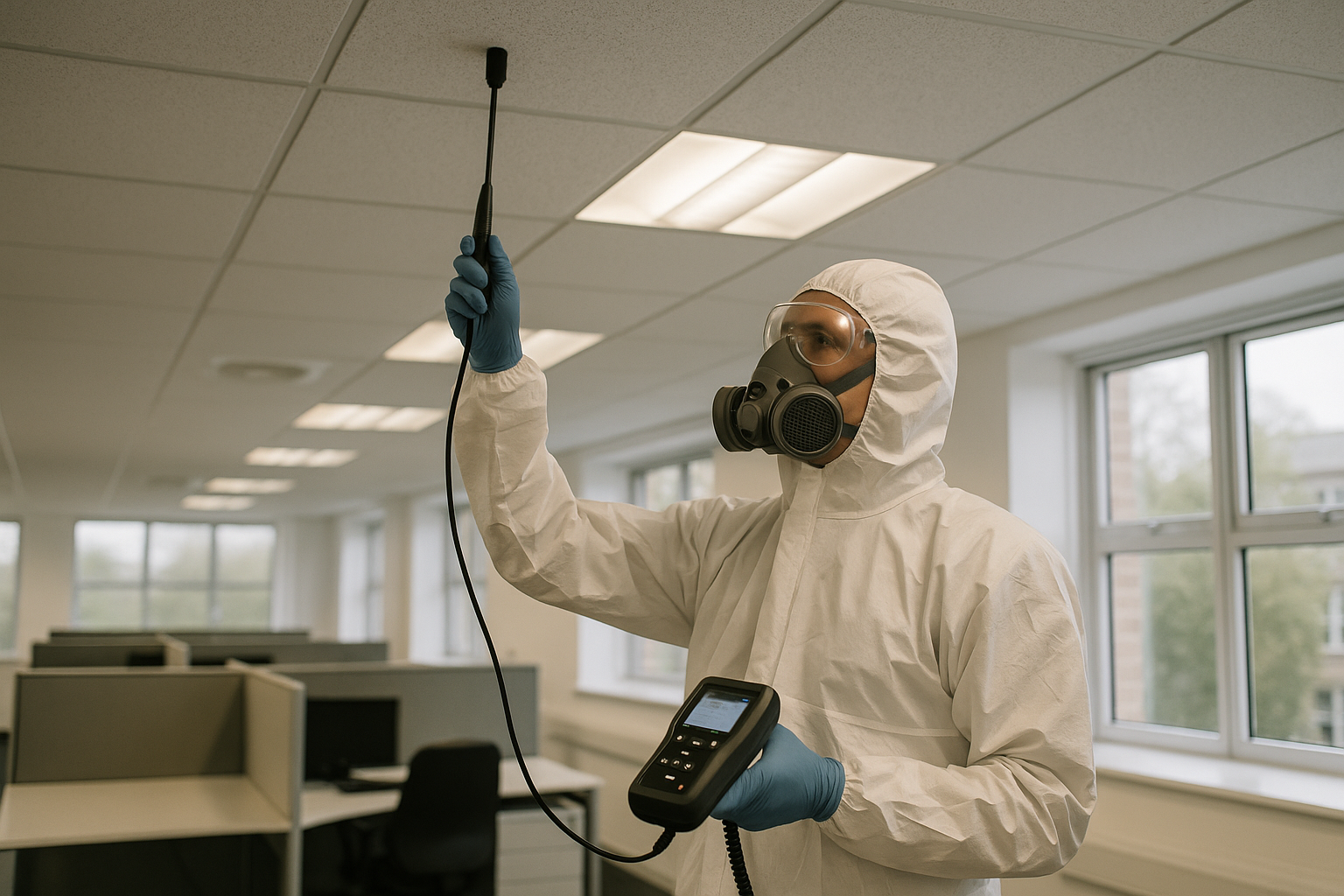
    Need clear advice on asbestos removal UK?

    If you need fast, practical guidance on surveying, sampling, management or asbestos removal UK services, speak to Supernova Asbestos Surveys. We provide nationwide support for homeowners, landlords, contractors and property managers, with clear reporting and a compliant approach from identification through to disposal.

    Call 020 4586 0680 or visit asbestos-surveys.org.uk to book the right service for your property.

  • Asbestos Surveys In London

    Asbestos Surveys In London

    Why Asbestos Surveys London Still Matter

    A hidden asbestos panel can turn a routine maintenance job into a full site shutdown. Across the capital, asbestos surveys London remain one of the most practical ways to protect building occupants, brief contractors properly and stay on the right side of your legal duties.

    London’s building stock is unusually mixed. Victorian conversions, post-war estates, schools, hospitals, offices, retail units and industrial premises can all contain asbestos-containing materials — particularly where buildings were constructed or altered before 2000. If you manage, own, lease, maintain or refurbish property, guessing is not a strategy.

    Asbestos was used widely because it was strong, heat resistant and effective as an insulator. Those same qualities mean it is still present in many buildings today, often in places people do not expect. Common examples include insulation board, pipe lagging, textured coatings, floor tiles, ceiling tiles, cement sheets, soffits, toilet cisterns, panels, ducts and service risers.

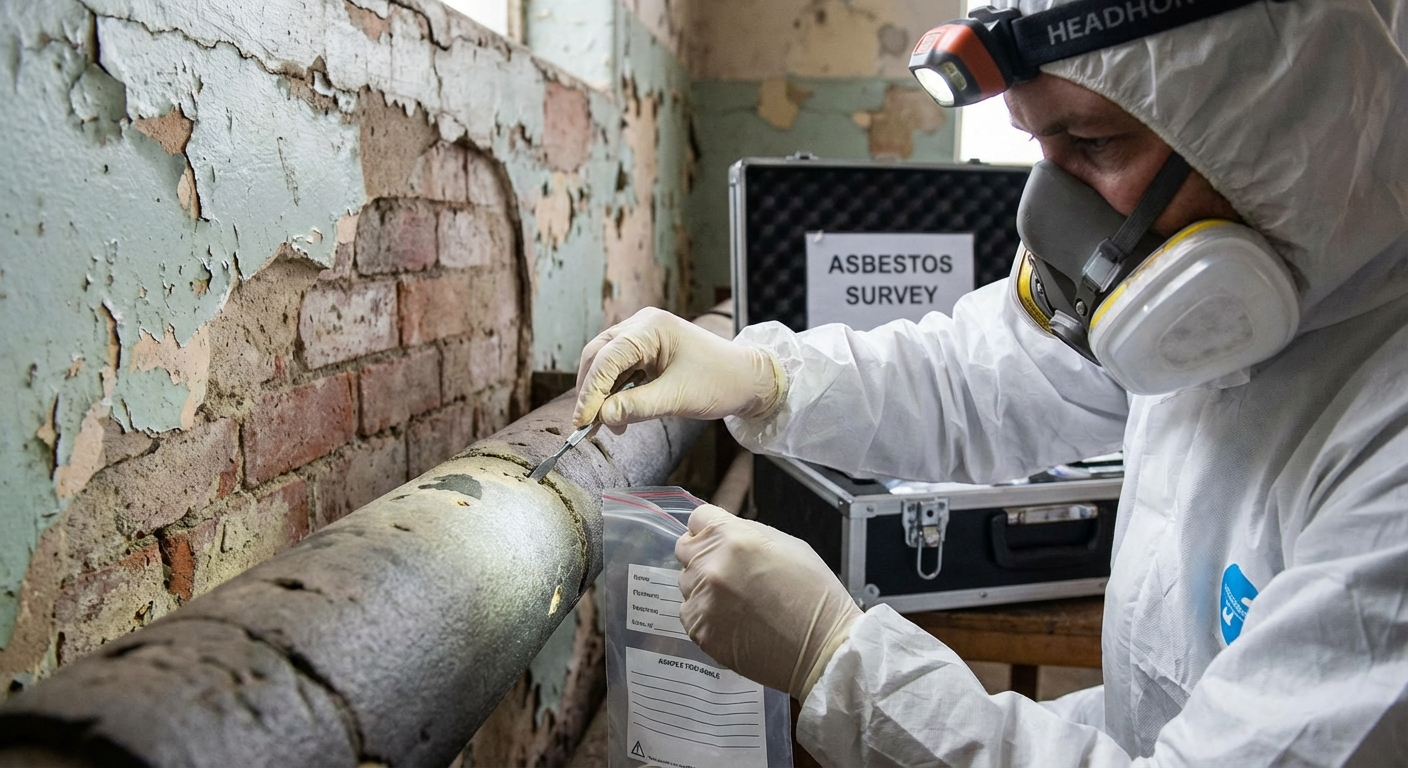
    Some materials are obvious. Others are hidden behind finishes, inside plant areas or buried within voids. The risk is not simply that asbestos exists — the real danger comes when materials are damaged, drilled, cut, removed or allowed to deteriorate. Once fibres are released and inhaled, they can cause serious long-term health conditions including mesothelioma and asbestosis.

    A suitable survey gives you clear information about whether asbestos is present, where it is located, what condition it is in, how likely it is to be disturbed and what action should happen next. Without that information, it is difficult to maintain an accurate asbestos register, write a sensible management plan or brief contractors safely. In practical terms, that can mean delays, extra cost and avoidable exposure.

    What the Law Expects from Duty Holders

    Under the Control of Asbestos Regulations, those responsible for non-domestic premises have a legal duty to manage asbestos. That duty applies to landlords, employers, facilities managers, managing agents and anyone responsible for maintenance or repair.

    HSE guidance and HSG264 set out what a suitable asbestos survey should achieve. The aim is straightforward: identify asbestos-containing materials so the right people have the right information before anyone disturbs them.

    If you are the duty holder, you should be able to demonstrate that you have taken reasonable steps to:

    • Find out whether asbestos is present in the premises
    • Record its location and condition accurately
    • Assess the risk of disturbance from routine activities or planned works
    • Keep an up-to-date asbestos register
    • Prepare and regularly review an asbestos management plan
    • Share the information with staff, contractors and anyone likely to disturb the material

    That legal duty is especially relevant in London, where buildings are altered frequently and contractors may be on site for small works, fit-outs, M&E upgrades or reactive repairs. If your records are outdated, incomplete or based on assumptions, you are exposed.

    A useful rule is simple: if people are likely to work on the fabric of the building, they need reliable asbestos information before they start. That is where choosing the right survey type becomes critical.

    Choosing the Right Type of Asbestos Survey

    Not every survey serves the same purpose. One of the most common mistakes we see is clients booking a survey that does not match the work they are planning. The correct survey depends on whether the building is occupied, whether intrusive work is planned and whether asbestos has already been identified.

    Management Survey

    A management survey is the standard survey for buildings in normal occupation. It is designed to locate asbestos-containing materials that could be damaged or disturbed during everyday use, routine maintenance or minor works.

    This is often the right starting point for offices, schools, communal areas, shops, warehouses and healthcare settings. It supports the duty to manage by providing the information needed for an asbestos register and management plan.

    A management survey is usually suitable when:

    • The building is occupied and in normal use
    • No major refurbishment is planned
    • You need to establish or update your asbestos records
    • Contractors may carry out routine maintenance works

    Refurbishment Survey

    If you are planning works that will disturb the building fabric, you will usually need a refurbishment survey. This type of survey is intrusive and aims to identify asbestos in the specific area affected by the planned works.

    That may involve opening up walls, ceilings, floors, boxing, risers and service voids. It is commonly required before office strip-outs, flat upgrades, retail reconfigurations, kitchen and bathroom refurbishments, plant replacements and major M&E works.

    Clients searching for an asbestos refurbishment survey are usually trying to avoid one of the biggest project risks in older buildings: hidden asbestos discovered after contractors have already started work. The practical advice is to arrange the survey early, while there is still time to plan around the findings.

    Demolition Survey

    A demolition survey is required before a building, or part of a building, is demolished. It is fully intrusive and intended to locate all asbestos-containing materials, as far as reasonably practicable, before demolition begins.

    This survey is particularly important on redevelopment sites in London, where access can be tight, neighbouring premises may be occupied and project timelines are often compressed. If demolition is planned, a management survey is not a sufficient substitute.

    Re-Inspection Survey

    Where asbestos has already been identified and left in place, regular checks are needed to confirm the material remains in a safe condition. A re-inspection survey helps keep your asbestos register current and your management plan active.

    Some clients refer to this as a reinspection survey — whatever term you use, the purpose is the same. Review known or presumed asbestos-containing materials, check for damage or deterioration and update the records so they still reflect the building as it stands today.

    This is especially useful for:

    • Multi-site property portfolios
    • Schools and further education colleges
    • Social housing communal areas
    • Commercial estates with long-term retained asbestos materials

    What Happens During Asbestos Surveys London

    Clients often ask how disruptive a survey will be. The answer depends on the survey type, but the process should always be clear, controlled and proportionate to the building and the planned works.

    Before the Site Visit

    Good preparation makes surveys more efficient. If you can provide plans, previous reports, access details and a clear description of the intended works, the surveyor can scope the job properly. Before attendance, it helps to:

    • Confirm the building address and access arrangements
    • Identify which areas are included or excluded from scope
    • Share any previous asbestos records or survey reports
    • Arrange permits, escorts or keys if needed
    • Notify tenants, reception teams or site managers where appropriate

    On Site

    The surveyor will inspect the relevant areas systematically, identify suspect materials and take samples where necessary. Sample points are controlled, recorded and made good where appropriate — but intrusive surveys will involve more opening up than a management survey.

    Any inaccessible areas should be noted clearly in the report. That matters because inaccessible does not mean asbestos-free. If access was not possible, assumptions may still need to be managed until the area can be inspected properly.

    Sample Analysis and Reporting

    Where materials are sampled, they should be analysed by an appropriate laboratory process. If you only need a specific material checked rather than a full survey, our sample analysis service can be a practical option.

    The final report should do more than list sample results — it should help you make decisions. A useful report will include material locations, photographs, sample outcomes, condition details, risk information and recommendations for management or further action.

    After receiving the report, you should be able to answer three immediate questions:

    1. Where is the asbestos or presumed asbestos?
    2. Can it remain in place safely?
    3. What must happen before maintenance, refurbishment or demolition proceeds?

    Practical Advice for Property Managers and Duty Holders

    Most clients do not need a lecture on asbestos theory. They need a process that works in the real world, especially when contractors, tenants and deadlines are all involved at the same time.

    Keep Your Asbestos Records Live

    An asbestos register should reflect the building as it exists now, not as it looked several years ago. If areas have been refurbished, partitions moved, plant replaced or materials removed, the records need updating. Set a clear internal process for storing survey reports where teams can find them, updating the register after works and triggering reinspection where asbestos remains in place.

    Brief Contractors Before Work Starts

    Do not assume contractors will ask for asbestos information. Make it part of your permit, pre-start or work order process. If they are going to drill, cut, remove, access voids or disturb finishes, they should see the relevant asbestos information first.

    This is one of the simplest ways to prevent accidental disturbance — and it also demonstrates that your management arrangements are active rather than purely administrative.

    Match the Survey to the Planned Work

    A management survey is not a substitute for a refurbishment or demolition survey. If the works will disturb the building fabric, arrange the intrusive survey before tender, before strip-out and certainly before contractors begin opening up. That advice applies to small jobs as well as major projects — a single riser alteration or washroom refit can still uncover hidden asbestos.

    Act Quickly When Suspect Materials Are Found

    If a contractor uncovers a suspicious board, lagging or debris, stop work in that area immediately. Prevent further disturbance, restrict access and arrange professional assessment. Do not ask untrained staff to break off a piece for checking — that creates unnecessary risk and can complicate the situation considerably.

    When Asbestos Is Found: What to Do Next

    Finding asbestos does not automatically mean panic or immediate removal. In many cases, asbestos-containing materials can remain in place if they are in good condition and unlikely to be disturbed. The right response depends on the type of material, its condition, its location and the activities planned nearby.

    A damaged insulating board panel in a service riser is a very different issue from an intact asbestos cement sheet on an outbuilding. Typical next steps include:

    • Manage in place if the material is sound and unlikely to be disturbed during normal use
    • Encapsulate if extra protection is needed without removing the material entirely
    • Repair where minor damage can be controlled safely by a licensed or trained operative
    • Remove if the material is damaged, higher risk or will be directly affected by planned works

    Whatever route is chosen, record the decision clearly and update your asbestos documents. If contractors are due on site, make sure they receive the relevant information before work starts. Where asbestos removal is necessary, it should be planned properly and carried out through the correct licensed route.

    Asbestos Surveys London for Different Property Types

    One reason asbestos surveys London require genuine experience is that no two properties in the capital are quite the same. Access, occupancy, building age and the history of previous alterations all affect the approach.

    Offices and Commercial Buildings

    In offices, asbestos is often found in ceiling voids, risers, plant rooms, floor coverings, partition panels and fire protection materials. The challenge is usually balancing survey access with the needs of an occupied building — good communication with facilities teams and tenants makes a significant difference.

    Schools, Colleges and Public Buildings

    Educational buildings present particular challenges because many were built or extended during the peak period of asbestos use. Surveys in occupied schools require careful scheduling, clear communication with site managers and strict control of sample points to avoid disruption to staff and pupils.

    Residential and Social Housing

    In residential blocks, asbestos is commonly found in communal areas, plant rooms, stairwells, roof spaces and service risers. Flat interiors may also contain textured coatings, floor tiles or insulation board. Gaining access to individual dwellings requires coordination with residents and managing agents.

    Industrial and Warehouse Properties

    Older industrial buildings often contain asbestos cement roofing and cladding, pipe lagging in plant areas, insulation board around structural steelwork and sprayed coatings. These materials can be in variable condition depending on how the building has been used and maintained over time.

    Mixed-Use and Retail Premises

    Retail units and mixed-use buildings in London are frequently altered. That history of change means asbestos may have been disturbed, partially removed or left in place behind new finishes. A thorough survey should account for the building’s alteration history as well as its current condition.

    London-Specific Considerations

    Carrying out asbestos survey London work across the capital involves practical challenges that do not always apply elsewhere. Access to central London sites can be restricted by parking controls, loading bay limitations and security requirements. High-rise buildings, basements and complex plant rooms all require additional planning.

    London’s property market also moves quickly. Lease events, change-of-use applications, permitted development conversions and redevelopment projects all create time pressure. Having up-to-date asbestos records means you are not scrambling to commission surveys at the last minute when a project is already in motion.

    If you manage property outside London as well, the same principles apply. Our asbestos survey Manchester service covers the same range of survey types for clients with portfolios that extend beyond the capital.

    Frequently Asked Questions

    Do I need an asbestos survey if my building was built after 2000?

    If your building was constructed entirely after November 1999, the risk of asbestos-containing materials is significantly lower because the import and use of all asbestos types was banned in the UK from that point. However, if the building incorporates older materials, was refurbished using salvaged components or if you are unsure of its full construction history, a survey is still a sensible precaution. For buildings with any pre-2000 elements, a survey is strongly advisable.

    What is the difference between a management survey and a refurbishment survey?

    A management survey is suitable for occupied buildings in normal use and focuses on materials that could be disturbed during everyday activities or routine maintenance. A refurbishment survey is intrusive and is required when works will disturb the building fabric — for example, during a strip-out, fit-out or structural alteration. Using a management survey when a refurbishment survey is needed puts contractors and occupants at risk and does not satisfy your legal obligations under the Control of Asbestos Regulations.

    How long does an asbestos survey take?

    Survey duration depends on the size and complexity of the building, the type of survey required and the level of access available. A management survey of a small commercial unit may take a few hours. A fully intrusive demolition survey of a large industrial building could take several days. Your surveyor should be able to give you a realistic estimate once the scope has been agreed.

    Can asbestos-containing materials be left in place?

    Yes — in many cases, asbestos-containing materials that are in good condition and are unlikely to be disturbed can be safely managed in place rather than removed. The duty to manage under the Control of Asbestos Regulations does not require removal in all circumstances. What it does require is that you know where the materials are, assess the risk, keep records and ensure anyone working near them has the relevant information. Removal becomes necessary when materials are damaged, deteriorating or will be directly affected by planned works.

    How often should I have a re-inspection survey carried out?

    HSG264 recommends that asbestos-containing materials left in place are regularly monitored to check their condition. The frequency of re-inspection will depend on the type of material, its condition and the level of activity in the area. In practice, annual re-inspections are common for many commercial and public buildings, but higher-risk materials or busier environments may warrant more frequent checks. Your asbestos management plan should specify the re-inspection intervals that apply to your building.

    Get Your Asbestos Survey Arranged Today

    Supernova Asbestos Surveys has completed over 50,000 surveys across the UK. Our qualified surveyors work across London and the wider country, covering all survey types — from routine management surveys to fully intrusive demolition surveys and everything in between.

    Whether you need a survey for a single commercial unit, a residential block, a school or a large mixed-use development, we can scope the right approach and turn reports around efficiently so your projects and compliance obligations stay on track.

    Call us on 020 4586 0680 or visit asbestos-surveys.org.uk to request a quote or discuss your requirements with our team.

  • Asbestos Surveys for Renovation and Demolition Projects

    Asbestos Surveys for Renovation and Demolition Projects

    Demolition work has a habit of exposing problems that have sat quietly behind walls and above ceilings for decades. An asbestos demolition survey is the step that stops those hidden materials turning into emergency stoppages, contractor disputes and costly breaches of the Control of Asbestos Regulations.

    For property managers, developers and contractors, this is not paperwork for the file. A properly planned asbestos demolition survey is a fully intrusive inspection designed to identify asbestos-containing materials before the structure is broken out, stripped down or demolished.

    What is an asbestos demolition survey?

    An asbestos demolition survey is carried out before a building, or part of a building, is demolished. Its purpose is to locate, so far as reasonably practicable, all asbestos-containing materials that could be disturbed by the planned works.

    Under HSE guidance and HSG264, demolition surveys sit within the refurbishment and demolition survey category. In practice, this is the most intrusive survey type because surveyors need to inspect the building fabric, not just visible surfaces.

    That often means opening up:

    • walls and partitions
    • ceiling voids
    • floor build-ups
    • service risers and ducts
    • plant rooms
    • roof spaces
    • boxing, panels and hidden linings

    If the building is staying in normal use, a management survey is usually the right starting point. If the works involve major alterations rather than full demolition, a refurbishment survey may be more suitable.

    Refurbishment or demolition surveys: knowing which one you need

    This is one of the most common points of confusion on construction projects. People often use the terms interchangeably, but the correct survey depends on what the works will physically disturb.

    When a refurbishment survey is appropriate

    A refurbishment survey is used where a building is being upgraded, altered or stripped out, but not fully demolished. It focuses on the specific area affected by the works.

    Typical examples include:

    • office fit-outs
    • toilet refurbishments
    • kitchen replacements
    • plant upgrades
    • structural alterations to one section of a building
    • strip-out works before remodelling

    If that is your situation, an asbestos refurbishment survey is often the correct route.

    When a demolition survey is appropriate

    A demolition survey is needed where the structure itself is coming down, whether that is the whole building or a defined section. The inspection must be intrusive enough to identify hidden asbestos before demolition starts.

    Typical examples include:

    • full building demolition
    • demolition of a warehouse, office, school or factory
    • removal of a wing or extension
    • site clearance ahead of redevelopment
    • demolition after fire, flood or serious structural damage

    If the structure is being removed, a dedicated demolition survey is the safer and more defensible option.

    When is a demolition survey carried out?

    A demolition survey should be arranged during project planning, not a few days before machines arrive on site. Leaving it late is one of the fastest ways to create delays.

    asbestos demolition survey - Asbestos Surveys for Renovation and Demo

    The right time is before tendering demolition work is finalised, before strip-out starts and before contractors commit to a programme built on assumptions. If asbestos is found, the team then has time to plan removal, sequencing and site controls properly.

    As a rule, arrange the survey when:

    1. the demolition scope is defined
    2. the relevant area can be vacated
    3. safe access can be provided
    4. existing records have been gathered
    5. there is still time to act on the findings

    If your project is phased, each phase should be reviewed carefully. A partial demolition can still require a full intrusive survey of the affected section.

    4. Arrange an asbestos survey properly

    HSE guidance is clear on the principle: if work is likely to disturb asbestos, the right survey needs to be arranged before that work starts. For demolition, that means an intrusive refurbishment and demolition survey, not a light-touch inspection.

    To arrange an asbestos survey properly, follow these practical steps:

    1. Define the works clearly. State whether the whole building or only part of it is being demolished.
    2. Choose the correct survey type. Do not rely on a management survey for demolition planning.
    3. Provide drawings and existing records. Old reports, plans and removal records help surveyors target hidden areas.
    4. Make the area vacant where possible. Demolition surveys are intrusive and can involve destructive inspection.
    5. Resolve access issues early. Locked rooms, roof voids, risers and plant spaces should not be left as last-minute exclusions.
    6. Share the findings with contractors. The survey only adds value if the demolition and removal teams actually use it.

    If you are unsure which survey you need, ask a simple question: what parts of the building fabric will the works disturb? That usually points to the answer very quickly.

    What happens during asbestos refurbishment and demolition surveys?

    During asbestos refurbishment and demolition surveys, the surveyor goes beyond visible surfaces and inspects the structure in a way that matches the planned works. The aim is to locate suspect asbestos-containing materials in the areas that will be disturbed, including concealed spaces.

    asbestos demolition survey - Asbestos Surveys for Renovation and Demo

    For an asbestos demolition survey, that usually means the inspection is fully intrusive. Surveyors may lift floor finishes, open service ducts, inspect voids, remove access panels and break into selected building elements where needed.

    Typical activities on site

    • reviewing the agreed survey scope and site hazards
    • inspecting all accessible rooms and structural areas
    • opening up hidden or enclosed spaces
    • taking samples of suspect materials
    • photographing locations and findings
    • recording any access restrictions or exclusions
    • sending samples for laboratory analysis

    Some minor damage to finishes is normal during this type of survey. That is the point of the exercise: to find asbestos before contractors disturb it unexpectedly during demolition.

    Common asbestos materials identified

    Surveyors regularly find asbestos in places the site team did not expect. Common materials include:

    • asbestos insulating board in partitions, soffits and ceiling tiles
    • pipe lagging and thermal insulation
    • sprayed coatings and fire protection
    • cement sheets, flues, gutters and roof products
    • floor tiles and bitumen adhesives
    • textured coatings
    • gaskets, seals and rope products
    • boards behind heaters, fuse boards and plant
    • mastics, packing materials and older service insulation

    Why a management survey is not enough for demolition

    This is where projects often go wrong. A management survey is designed for normal occupation, routine maintenance and day-to-day asbestos management. It is not intended to uncover every hidden asbestos material inside the building fabric.

    Demolition changes everything. Once walls, ceilings, floors and service spaces are disturbed, concealed asbestos can be exposed immediately. Relying on a management survey in that situation can leave contractors working without the information they need.

    The difference is straightforward:

    • Management survey: for normal occupation and routine maintenance, with limited intrusion
    • Refurbishment survey: intrusive inspection of the specific area affected by planned works
    • Demolition survey: intrusive inspection of the structure or section due to be demolished

    If demolition is planned, a management survey should not be treated as a substitute for an asbestos demolition survey.

    How to prepare for an asbestos demolition survey

    A good survey starts well before the surveyor arrives on site. Clear scope, proper access and accurate background information make a major difference to the quality of the inspection and the usefulness of the report.

    Define the demolition scope

    Be precise about what is being demolished. Is it the whole building, a rear extension, a plant room, a single wing or a roof structure?

    On phased projects, each stage should have clear boundaries. Vague instructions create gaps, and gaps create risk.

    Gather existing records

    Previous asbestos reports, registers, plans, refurbishment history and removal records should be reviewed in advance. They do not replace the survey, but they help the surveyor understand likely risk areas and identify what may already have been removed.

    Arrange safe access

    Access issues are one of the main reasons reports end up with exclusions. Deal with these before the survey date:

    • locked rooms
    • roof access limitations
    • unstable floors
    • live electrical services
    • confined spaces
    • plant hazards
    • security restrictions

    If an area cannot be inspected, it may need to be presumed to contain asbestos until proven otherwise. That can complicate both removal and demolition planning.

    Vacate the area

    An asbestos demolition survey is intrusive and often destructive. The building, or at least the relevant area, should generally be vacant so the surveyor can inspect properly and safely.

    Checking the accuracy of the survey report

    The value of any asbestos demolition survey depends heavily on the report that follows. A vague report can cause just as much trouble as no report at all.

    When checking the accuracy of the survey report, review it against the scope of works rather than reading it in isolation. The key question is simple: does this report give the demolition team enough clear information to act safely?

    What a strong report should include

    • confirmation of the survey type
    • a clear description of the surveyed area
    • sample results from laboratory analysis
    • photographs and location references
    • details of identified or presumed asbestos-containing materials
    • notes on extent, accessibility and condition
    • a list of exclusions or inaccessible areas
    • recommendations relevant to demolition planning

    Questions to ask before signing it off

    • Does the report match the agreed demolition scope?
    • Are all floors, voids, plant spaces and ancillary areas covered?
    • Are exclusions clearly listed and explained?
    • Can contractors identify the materials and locations easily?
    • Does it separate confirmed asbestos from presumed materials?
    • Are sample references and plans easy to follow?

    If anything is unclear, ask for clarification straight away. Sorting out uncertainty at report stage is far cheaper than arguing over it once strip-out or demolition has started.

    What happens if the survey finds asbestos?

    Finding asbestos does not automatically stop the project. It means the next step is to plan the right response before demolition begins.

    The survey findings help your team decide what must be removed, what control measures are required and how the works should be sequenced. Depending on the material and the work involved, asbestos work may fall into licensed, notifiable non-licensed or non-licensed categories under the Control of Asbestos Regulations.

    You should never assume all asbestos can be dealt with in the same way. The findings need to be reviewed by competent specialists so the correct removal method is used.

    Where removal is required, using a specialist provider for asbestos removal helps keep the process aligned from survey findings through to site preparation.

    If suspect asbestos is uncovered after work has already started, stop work in the affected area immediately, secure the area and obtain competent advice. That is exactly the kind of disruption a properly scoped asbestos demolition survey is designed to prevent.

    Sourcing analysts and surveyors: what good support looks like

    Sourcing analysts and surveyors should never be treated as a last-minute procurement exercise. The quality of the advice, the scope of the inspection and the clarity of the reporting all affect programme, cost and compliance.

    When choosing a provider, look for practical capability rather than vague promises. You want a team that understands intrusive surveys, live project pressures and the need for clear communication with contractors.

    A suitable surveying organisation should be able to:

    • explain whether you need a refurbishment or demolition survey
    • review drawings and existing records before attending site
    • identify likely access issues in advance
    • produce reports that demolition contractors can use easily
    • support follow-on sampling, analyst input and removal planning where needed
    • cover single sites and multi-site property portfolios

    Good coordination matters. If surveyors, analysts, project managers and removal contractors are all working from different assumptions, delays are almost inevitable.

    Legal guidance on demolition and asbestos

    The legal position is straightforward even if projects are not. Under the Control of Asbestos Regulations, those managing premises and commissioning works must make sure asbestos risks are identified and managed properly.

    For demolition, that means arranging the correct survey before work that could disturb asbestos takes place. HSG264 sets out the purpose and approach of asbestos surveys, while HSE guidance makes clear that refurbishment and demolition work requires intrusive inspection.

    Practical compliance means:

    • commissioning the correct survey early
    • using a competent surveying organisation
    • making sure the survey scope matches the planned works
    • sharing the report with relevant contractors
    • resolving exclusions before demolition begins
    • allowing time for removal where required

    If you are managing a demolition project, the safest approach is to assume hidden materials may be present until a proper survey proves otherwise.

    Common mistakes that delay demolition projects

    Most asbestos-related delays are avoidable. They usually come from weak planning rather than the presence of asbestos itself.

    Watch out for these common mistakes:

    • commissioning a management survey when demolition is planned
    • booking the survey too late in the programme
    • failing to define the demolition area clearly
    • not providing access to all relevant spaces
    • ignoring exclusions in the report
    • assuming old asbestos records are enough
    • starting strip-out before the findings have been reviewed

    If you want the project to move smoothly, the practical advice is simple: scope early, survey early and resolve access issues before the survey date.

    Regional support for demolition and refurbishment projects

    If you manage property across more than one location, consistency matters. Using the same surveying approach across sites makes reports easier to compare and helps project teams work from the same standard.

    Regional Office:

    Regional support is particularly useful for portfolio managers, developers and contractors working across multiple cities. It helps when one provider can coordinate scope, attendance and reporting without you having to brief different companies in different ways.

    South Wales:

    Projects in South Wales often involve a mix of industrial, commercial and public-sector buildings where historic asbestos use is common. The same rule applies there as anywhere else: if demolition or major intrusive work is planned, get the right survey in place before the programme is fixed.

    Supernova supports clients across the UK, including major urban and regional locations. If you need local coverage, we can arrange an asbestos survey London service, an asbestos survey Manchester appointment, or an asbestos survey Birmingham visit for projects in the Midlands.

    At Supernova, we’re fully equipped to carry out refurbishment and demolition surveys

    You may have seen competitors say, “At Core Surveys, We’re Fully Accredited to Carry Out R&D Surveys”. The wording varies across the industry, but the point behind it matters: demolition and refurbishment surveys should only be handled by competent specialists with the right technical understanding and practical site experience.

    At Supernova Asbestos Surveys, we carry out refurbishment and demolition surveys nationwide for property managers, developers, landlords, contractors and public-sector clients. We focus on clear scoping, intrusive inspection where required and reporting that is actually useful on site.

    That means practical support with:

    • survey type selection
    • pre-survey planning
    • vacant and restricted-access properties
    • portfolio work across multiple locations
    • clear reports for removal and demolition teams
    • follow-on advice where asbestos is identified

    Contact us for advice

    If you are planning demolition, strip-out or major refurbishment, getting the survey right early will save time and reduce avoidable risk. A quick conversation at planning stage is often enough to confirm whether you need a refurbishment survey or an asbestos demolition survey.

    Supernova Asbestos Surveys provides nationwide support for refurbishment and demolition projects, with practical advice, fast booking options and clear reporting. Call 020 4586 0680 or visit asbestos-surveys.org.uk to arrange a survey or discuss your project.

    Frequently Asked Questions

    Is an asbestos demolition survey always required before demolition?

    If demolition will disturb the structure, an asbestos demolition survey is usually required so asbestos-containing materials can be identified before work begins. A competent surveyor can confirm the correct scope for your project.

    Can I use an old management survey for demolition works?

    No. A management survey is intended for normal occupation and routine maintenance. Demolition requires a refurbishment and demolition survey with intrusive inspection of the relevant structure.

    Does the building need to be empty for a demolition survey?

    In most cases, yes. A demolition survey is intrusive and may involve destructive access into walls, floors, ceilings and voids, so the building or affected area should usually be vacant.

    What if parts of the building cannot be accessed during the survey?

    Any exclusions should be clearly recorded in the report. Inaccessible areas may need further inspection later or may have to be treated as presumed asbestos-containing materials until proven otherwise.

    What happens after asbestos is found in a demolition survey?

    The findings are used to plan the correct next steps before demolition starts. That may include licensed, notifiable non-licensed or non-licensed asbestos work, depending on the material and the task involved.

  • Types of Asbestos Surveys: UK Guide

    Types of Asbestos Surveys: UK Guide

    Choose the wrong survey and asbestos can stay hidden until a contractor drills into it, opens a ceiling void or starts a strip-out. Understanding asbestos survey types is how property managers, landlords and dutyholders avoid that mistake, stay compliant and keep projects moving without expensive surprises.

    If a building was constructed before 2000, asbestos-containing materials may still be present in ceilings, floor coverings, risers, plant rooms, textured coatings, roof sheets, ducts and wall linings. The right survey tells you what is there, where it is, what condition it is in and what needs to happen next.

    At Supernova Asbestos Surveys, we have completed more than 50,000 surveys across the UK. That experience matters because a school in daily use, a retail unit due for fit-out and an industrial site heading for demolition all need a different approach.

    Why asbestos survey types matter

    Different asbestos survey types exist because buildings are used in different ways and work activities create different levels of disturbance. A survey for day-to-day occupation is not suitable for intrusive refurbishment, and a refurbishment survey is not enough for demolition.

    Under the Control of Asbestos Regulations, those responsible for non-domestic premises and the common parts of domestic buildings must identify and manage asbestos risk. HSE guidance and HSG264 make it clear that the survey type must match the purpose.

    In practical terms, the survey you need depends on:

    • Whether the building is occupied and in normal use
    • Whether routine maintenance or repair work is planned
    • Whether refurbishment will disturb the building fabric
    • Whether part or all of the property will be demolished
    • Whether an existing asbestos register needs updating

    Get that decision right at the start and everything else becomes easier. Contractors know what they are dealing with, the asbestos register is reliable and you can plan work without avoidable disruption.

    What are the main asbestos survey types?

    There are four main asbestos survey types that property professionals need to understand. Each one has a distinct purpose, and none should be used as a shortcut for another.

    1. Management surveys
    2. Refurbishment surveys
    3. Demolition surveys
    4. Re-inspection surveys

    The names sound straightforward, but confusion still causes problems on live sites. The safest approach is to match the survey to the work you are actually planning, not the survey you happen to already have on file.

    Management surveys for occupied buildings

    A management survey is the standard survey for an occupied building in normal use. Its purpose is to locate, so far as reasonably practicable, the presence and extent of asbestos-containing materials that could be damaged or disturbed during normal occupation, routine maintenance or foreseeable installation work.

    For most dutyholders, this is the starting point of effective asbestos management. If you need a formal management survey, the report should give you enough information to create or update your asbestos register and management plan.

    What a management survey is designed to achieve

    A good management survey helps you answer four practical questions:

    • Is asbestos present or likely to be present?
    • Where is it located, or where should it be presumed?
    • What condition is it in?
    • What action is needed to prevent disturbance?

    That information supports day-to-day compliance. It also helps maintenance teams and contractors avoid disturbing materials that can remain safely in place if properly managed.

    What is included in an asbestos management survey

    A properly executed asbestos management survey should inspect all reasonably accessible areas relevant to occupation and routine maintenance. Sampling is carried out where appropriate, and suspect materials are assessed and clearly recorded.

    Depending on the building, this may include:

    • Offices, classrooms and working areas
    • Corridors, stairwells and reception spaces
    • Plant rooms, boiler rooms and service cupboards
    • Toilets, kitchens and welfare areas
    • Basements, loft access points and roof voids where accessible
    • Meter cupboards, risers and service ducts
    • Garages, outbuildings, soffits and roof sheets
    • Communal areas in residential blocks

    Where access is restricted, the report should say so clearly. If an area cannot be inspected safely, materials may need to be presumed to contain asbestos until proper access is arranged.

    When a management survey is the right choice

    This survey is usually appropriate when:

    • You are responsible for a non-domestic property built before 2000
    • You manage the common parts of a residential building
    • You have taken over a site with no reliable asbestos register
    • Your existing survey is unclear, incomplete or outdated
    • You are carrying out due diligence before a lease or purchase

    A management survey is not designed for intrusive construction work. If walls, ceilings, floors, ducts or fixed elements will be opened up, you need one of the more intrusive asbestos survey types instead.

    Refurbishment surveys before intrusive work

    A refurbishment survey is required before work that will disturb the building fabric. That includes projects such as rewiring, replacing kitchens, altering partitions, upgrading heating systems, installing air conditioning, removing ceilings or opening service risers.

    If you are planning alterations, a dedicated refurbishment survey is the correct starting point rather than relying on an older management report. This is one of the most commonly misunderstood asbestos survey types because many projects described as minor still involve intrusive work.

    Why refurbishment surveys are intrusive

    A refurbishment survey is intrusive by design. Surveyors need to inspect the exact areas affected by the planned works, including hidden voids and concealed materials behind walls, ceilings, boxing and floor finishes.

    The aim is simple: identify asbestos before contractors disturb it. That protects workers, prevents contamination and reduces the risk of delays once the project has started.

    When you need an asbestos refurbishment survey

    An asbestos refurbishment survey is usually needed before:

    • Strip-outs and fit-outs
    • Kitchen and bathroom replacements
    • Electrical rewires
    • Heating and ventilation upgrades
    • Partition removal or new openings
    • Suspended ceiling changes
    • Major repairs affecting walls, floors or ceilings
    • Shop, office or school refurbishments

    The survey area should normally be vacant during inspection. Access may involve lifting floors, opening up enclosures and breaking into the building fabric, which is not suitable in occupied spaces without proper controls.

    Practical advice before commissioning a refurbishment survey

    Be precise about the work scope. If the contractor is refurbishing only one floor, one riser or one flat stack, the survey must match that exact area.

    Provide drawings if available and confirm whether the work affects adjacent spaces. Vague instructions lead to vague survey coverage, and that is where risk starts to creep in.

    Demolition surveys before buildings come down

    A demolition survey is required before a building, or part of one, is demolished. Among the main asbestos survey types, this is usually the most intrusive because the objective is to identify all asbestos-containing materials, so far as reasonably practicable, within the area to be demolished.

    Where demolition is planned, commission a dedicated demolition survey. This applies whether you are taking down an entire structure or only a defined section of a larger site.

    What makes a demolition survey different

    Demolition surveys go further than management or refurbishment surveys because the whole structure is being removed. Hidden voids, sealed service runs, plant enclosures and inaccessible construction details may all need destructive inspection.

    The area should be unoccupied and isolated where necessary. Locked rooms, restricted plant spaces and difficult access points should be resolved before demolition starts, not after suspect materials are found during soft strip.

    When demolition surveys are needed

    You are likely to need this survey before:

    • Full building demolition
    • Partial demolition of a wing or extension
    • Major structural removal
    • Redevelopment projects involving complete strip-back of a structure
    • Demolition of outbuildings, warehouses, garages or industrial units

    Do not assume a refurbishment survey can cover demolition. If the structure is coming down, the survey scope must reflect that.

    Re-inspection surveys keep the register current

    Re-inspection surveys are often overlooked, yet they are a core part of effective asbestos management. If asbestos-containing materials remain in place, their condition can change because of wear, leaks, vibration, accidental damage or changes in building use.

    A re-inspection survey updates the condition of known or presumed asbestos-containing materials that are already recorded. It is not a substitute for the other asbestos survey types, but it is essential for keeping your records live.

    What a re-inspection survey should do

    A re-inspection should confirm whether materials are still present, whether their condition has changed and whether the likelihood of disturbance has increased. It should also record discrepancies between the existing asbestos register and the current site condition.

    That can lead to practical decisions such as:

    • Continue to manage in place
    • Repair minor damage
    • Encapsulate exposed surfaces
    • Restrict access to vulnerable areas
    • Arrange removal where risk is no longer manageable

    When re-inspection is useful

    This type of survey is particularly useful:

    • As part of your routine asbestos management plan
    • After leaks, impact damage or unplanned disturbance
    • Before renewing maintenance contracts
    • After tenant changes or changes in building use
    • Where previous reports recommended periodic monitoring

    Do not rely on an old register indefinitely. If the building has seen regular maintenance, tenant churn or alterations, the information can quickly become unreliable.

    How to choose the right asbestos survey type

    If you are unsure which of the asbestos survey types applies, start by asking one question: what work is actually going to happen in this building? The answer usually points you in the right direction.

    Use this simple rule of thumb:

    • Normal occupation and routine maintenance: management survey
    • Intrusive alterations or fit-out: refurbishment survey
    • Building or structural demolition: demolition survey
    • Updating known asbestos records: re-inspection survey

    Where clients go wrong is assuming one survey can do everything. A management survey may be perfectly suitable for ongoing occupation, but it will not provide the intrusive inspection needed before major works.

    Questions to ask before you book

    1. Is the building occupied or vacant?
    2. Will the work disturb walls, ceilings, floors, risers or fixed plant?
    3. Is the project limited to one area or across the whole site?
    4. Do you already have an asbestos register, and is it reliable?
    5. Are there access restrictions that need resolving first?

    Answer those questions clearly and share the details with your surveyor. The more accurate the brief, the more useful the survey report will be.

    Common mistakes property managers should avoid

    Most asbestos problems on projects are not caused by the material itself. They are caused by poor planning, vague scopes and relying on the wrong information.

    These are the mistakes we see most often:

    • Using a management survey before refurbishment works
    • Assuming a survey for one area covers the whole building
    • Failing to share the asbestos register with contractors
    • Ignoring inaccessible areas listed in the report
    • Not updating records after removal or remedial work
    • Letting old survey data remain in circulation after site changes
    • Starting strip-out before intrusive surveying is complete

    The fix is usually straightforward. Match the survey to the task, review exclusions carefully and make asbestos information part of your project planning rather than an afterthought.

    What a good asbestos survey report should include

    Not all reports are equally useful. A survey should do more than list suspect materials. It should give you practical information you can act on.

    A strong report will usually include:

    • Clear description of the survey type and scope
    • Areas inspected and areas not accessed
    • Location references and photographs
    • Sample results from UKAS-accredited laboratory analysis where applicable
    • Material assessments
    • Recommendations for management, encapsulation, monitoring or removal
    • Priority actions where relevant to the survey purpose

    Read the exclusions section carefully. If a void, riser, roof area or locked room was not accessed, you may need further action before work starts.

    What happens after asbestos is identified?

    Finding asbestos does not automatically mean everything has to be removed. One of the biggest misunderstandings around asbestos survey types is the idea that every positive result leads straight to expensive remedial work.

    In many cases, asbestos-containing materials in good condition can remain in place and be managed safely. The right response depends on material type, condition, location and likelihood of disturbance.

    Typical next steps after a survey

    • Create or update the asbestos register
    • Review the management plan
    • Label or otherwise identify higher-risk areas where appropriate
    • Brief maintenance teams and contractors
    • Schedule re-inspections for materials left in place
    • Arrange remedial works or removal where needed

    If removal is recommended, use competent specialists and make sure the removal scope matches the survey findings. Where required, professional asbestos removal should be completed before other trades begin disturbing the area.

    Asbestos survey types for different property scenarios

    The same building can need different surveys at different stages of its life. That is why understanding asbestos survey types matters so much for estate management and project planning.

    Office building in normal use

    If the building is occupied and no intrusive works are planned, a management survey is usually the right choice. That gives you the baseline information needed for compliance and contractor control.

    Retail or office fit-out

    If partitions, ceilings, finishes or services will be altered, a refurbishment survey is likely to be required in the affected area. A general management survey will not be enough.

    School or hospital estate

    Large estates often need a combination of survey types. Management surveys support ongoing occupation, re-inspections keep records current and refurbishment surveys are commissioned for project-specific works.

    Industrial unit due for redevelopment

    If the structure is being taken down, a demolition survey is required. If only part is being altered while the rest remains in use, you may need both management and refurbishment surveys for different areas.

    Residential block communal areas

    The duty to manage applies to the common parts of domestic buildings. That often means a management survey for corridors, service cupboards, stairwells, plant rooms and other shared spaces.

    Local survey support across the UK

    Survey quality matters, but so does practical delivery. You need a team that can attend site promptly, understand the building type and produce reports your contractors can actually use.

    Supernova provides local support across major UK locations, including asbestos survey London, asbestos survey Manchester and asbestos survey Birmingham. Whether you manage one property or a national portfolio, the key is getting the right survey type booked at the right stage.

    Frequently Asked Questions

    What is the difference between a management survey and a refurbishment survey?

    A management survey is for occupied buildings in normal use and focuses on materials that could be disturbed during routine occupation or maintenance. A refurbishment survey is intrusive and is required before works that will disturb the building fabric.

    Can I use an old management survey before refurbishment works?

    Usually not. A management survey is not designed to identify all asbestos in the areas affected by intrusive works. Before refurbishment, you normally need a dedicated refurbishment survey covering the exact work area.

    Is a demolition survey needed for partial demolition?

    Yes, if part of a building is being demolished, the area affected still requires a demolition survey. The survey scope should match the section being taken down.

    How often should asbestos be re-inspected?

    There is no single fixed interval that suits every property. Re-inspection frequency should reflect the condition of the materials, the likelihood of disturbance and the requirements of your asbestos management plan.

    What should I do if asbestos is found in good condition?

    Do not disturb it. Update your asbestos register, assess the risk, put management controls in place and arrange periodic re-inspection. Removal is not always necessary if the material is stable and unlikely to be damaged.

    Need help choosing the right survey?

    If you are not sure which of the asbestos survey types fits your building or project, Supernova Asbestos Surveys can help. We carry out management, refurbishment, demolition and re-inspection surveys nationwide, with clear reporting and practical advice you can act on.

    Call 020 4586 0680 or visit asbestos-surveys.org.uk to book a survey or discuss your site requirements with our team.

  • Asbestos Surveys for Commercial and Industrial Properties

    Asbestos Surveys for Commercial and Industrial Properties

    One missed ceiling void can stop a project in its tracks. A commercial asbestos survey gives you reliable information before maintenance teams, fit-out contractors or demolition crews disturb materials that may contain asbestos, helping you avoid delays, unsafe work and expensive surprises.

    If you manage non-domestic premises, asbestos is not an admin exercise. Under the Control of Asbestos Regulations, duty holders must identify asbestos-containing materials so far as reasonably practicable, assess their condition and manage the risk in line with HSE guidance and HSG264.

    Speak to our expert team

    If you are unsure which survey you need, get advice before works start. A short conversation can prevent the wrong survey being commissioned, which is one of the most common reasons projects stall.

    Supernova Asbestos Surveys supports landlords, managing agents, facilities managers, contractors and estate teams across the UK. We can help you scope the right commercial asbestos survey, arrange access, review existing asbestos information and explain what the report means in practical terms.

    What is asbestos and what risk does it present?

    Asbestos is a group of naturally occurring minerals that were widely used in UK buildings because they were heat resistant, durable and good for insulation and fire protection. It was used in many commercial and industrial properties, particularly those built or refurbished before 2000.

    The risk comes when asbestos-containing materials are damaged or disturbed. If fibres are released and breathed in, they can cause serious disease, which is why identifying and managing asbestos properly matters so much in occupied buildings and during building work.

    Common asbestos-containing materials in commercial premises include:

    • Asbestos insulating board
    • Pipe lagging
    • Sprayed coatings
    • Cement sheets and roof panels
    • Textured coatings
    • Vinyl floor tiles and adhesives
    • Insulation around plant and boilers
    • Fire protection materials
    • Debris in ceiling voids, ducts and service risers

    Risk depends on several factors:

    • The type of asbestos product
    • Its condition
    • Its location
    • How likely it is to be disturbed
    • Who may be exposed, including contractors and maintenance staff

    That is why a commercial asbestos survey is not simply about finding asbestos. It is about understanding where the risk sits in the building and what action is sensible.

    When is a commercial asbestos survey needed?

    A commercial asbestos survey is usually needed when you take on responsibility for a building, when asbestos information is missing or unreliable, or before work that could disturb the fabric of the premises.

    commercial asbestos survey - Asbestos Surveys for Commercial and Indu

    In practical terms, you should be asking for current asbestos information when:

    • You have taken over a commercial property
    • The building was constructed or refurbished before 2000 and no reliable survey exists
    • The asbestos register is missing, unclear or out of date
    • Routine maintenance or installation work is planned
    • Contractors need asbestos information before starting work
    • Refurbishment, strip-out or demolition is due to begin
    • Known asbestos is being managed in place and needs reviewing

    If there is no dependable information, the safest assumption is that asbestos may be present until a suitable survey proves otherwise. Leaving the question unanswered until contractors arrive on site is where avoidable problems start.

    Who usually arranges a commercial asbestos survey?

    The duty to manage asbestos generally sits with whoever has responsibility for repair and maintenance of non-domestic premises. Depending on the lease and occupation, that may include:

    • Commercial landlords
    • Managing agents
    • Facilities managers
    • Freeholders
    • Tenants with repairing obligations
    • Employers occupying their own premises
    • School, academy and university estates teams
    • Healthcare estate managers
    • Industrial site operators
    • Retail, leisure and hospitality groups
    • Public sector organisations

    If you authorise maintenance, appoint contractors or control access to the building, you need to know whether the asbestos information is current and fit for purpose.

    What does an asbestos survey involve?

    A proper commercial asbestos survey is a structured inspection by a competent surveyor. It is not a quick walk-round, and it should not leave contractors guessing what is safe to disturb.

    The process usually includes:

    1. Scoping the survey – the survey type, purpose, access arrangements and affected areas are confirmed.
    2. Inspecting the site – accessible areas are checked systematically.
    3. Sampling suspect materials – where appropriate, samples are taken using controlled techniques.
    4. Laboratory analysis – samples are analysed by a UKAS-accredited laboratory.
    5. Recording findings – materials are logged by location, extent, product type and condition.
    6. Issuing the report – you receive findings, sample results, register information and recommendations.

    Some materials may be recorded as presumed asbestos if sampling is not possible or would cause unnecessary damage. A good report makes clear what has been sampled, what has been presumed and which areas were not inspected.

    What should be in the survey report?

    A useful report should be clear enough for property managers, consultants and contractors to act on without confusion. It will usually include:

    • Survey scope and methodology
    • Areas inspected
    • Exclusions and limitations
    • Material descriptions and locations
    • Photographs
    • Sample locations and laboratory results
    • Asbestos register information
    • Material assessments
    • Recommendations for management or further action

    Before relying on the report, check that all relevant areas are covered. Pay particular attention to plant rooms, risers, service ducts, roof voids, basements, external stores and outbuildings.

    Types of commercial asbestos survey

    The right commercial asbestos survey depends on what is happening in the building. Day-to-day occupation needs a different approach from intrusive works or demolition.

    commercial asbestos survey - Asbestos Surveys for Commercial and Indu

    Management survey

    A management survey is the standard survey for an occupied building in normal use. Its purpose is to locate, so far as reasonably practicable, suspected asbestos-containing materials that could be damaged or disturbed during normal occupation, routine maintenance or foreseeable installation work.

    This survey is usually non-intrusive or only mildly intrusive. It is often suitable when you have recently taken over a property, when no asbestos register exists, or when contractors need information before routine maintenance.

    Refurbishment surveys

    If intrusive works are planned, a management survey is not enough. A refurbishment survey is designed for areas where the building fabric will be disturbed.

    This type of commercial asbestos survey is intrusive by design. It aims to identify asbestos in the areas affected by the planned works, including materials hidden behind walls, above ceilings, below floors and within service routes.

    You will usually need one before:

    • Office refits
    • Toilet or kitchen refurbishments
    • Mechanical and electrical upgrades
    • Partition changes
    • Heating system replacement
    • Rewiring projects
    • Roof works
    • Strip-out before fit-out

    Demolition surveys

    Where a structure is being taken down, a demolition survey is required. This is a fully intrusive survey intended to locate asbestos-containing materials throughout the building, so they can be dealt with before demolition starts.

    The relevant area is normally vacant for this level of inspection. If demolition is planned, a management-focused commercial asbestos survey will not provide enough information.

    Re-inspection surveys

    When asbestos is being managed in place, information must stay current. A re-inspection survey checks known or presumed asbestos-containing materials again to confirm whether their condition has changed.

    This helps you keep your register accurate and decide whether materials can remain in place, need repair, require encapsulation or should be removed.

    How to choose the right survey for your building

    The key question is not just whether you need a commercial asbestos survey, but what that survey needs to achieve. The answer depends on the building use, planned works, affected areas and whether the premises are occupied.

    A simple rule of thumb is:

    • Normal occupation and routine maintenance – management survey
    • Intrusive refurbishment or strip-out – refurbishment survey
    • Full or partial demolition – demolition survey
    • Known asbestos still on site – re-inspection survey

    Some sites need more than one survey type. A live office building may need a management survey for occupied floors and a refurbishment survey for one vacant suite being altered. A factory may need a phased approach because access permits, shutdown windows and operational risks affect what can be inspected safely.

    Before booking, have answers to these questions:

    • What work is planned?
    • Which exact areas are affected?
    • Is the building occupied?
    • Do you already have asbestos reports or a register?
    • Are there inaccessible spaces such as risers, roof voids or plant rooms?

    Getting the scope right at the start saves repeat visits and reduces the chance of gaps in the final report.

    Sourcing analysts and surveyors

    Choosing the right people matters as much as choosing the right survey type. A commercial asbestos survey should be carried out by competent professionals who understand the building, the planned works and the level of intrusion required.

    When sourcing analysts and surveyors, ask practical questions:

    • Do they specialise in asbestos surveying for commercial property?
    • Can they work to HSG264 requirements?
    • Can they explain the survey scope clearly before attending?
    • Will samples be analysed by a UKAS-accredited laboratory?
    • Can they deal with live sites, permits and restricted access?
    • Will the final report be clear enough for contractors to use?

    If removal or remedial works are needed afterwards, there may also be a need for analytical support, air monitoring or clearance procedures depending on the nature of the work. Good coordination between surveyors, analysts and contractors keeps projects moving and reduces confusion on site.

    What happens if asbestos is found?

    Finding asbestos during a commercial asbestos survey does not automatically mean everything must be stripped out. In many cases, asbestos-containing materials can remain safely in place if they are in good condition, sealed, recorded properly and unlikely to be disturbed.

    The next step depends on the material, its condition and the planned use of the area. Typical options include:

    • Manage in place – where the material is sound and unlikely to be disturbed
    • Encapsulate or repair – where minor damage can be controlled
    • Restrict access – where immediate disturbance risk needs reducing
    • Remove – where the material is damaged, deteriorating or affected by planned works

    If removal is required, it should be planned properly under the appropriate controls. Supernova can also help arrange asbestos removal where survey findings show materials need to be taken out.

    Our clients

    Supernova carries out commercial asbestos survey work for a wide range of organisations. That includes single-site businesses, multi-site property portfolios and complex estates with mixed building types.

    We regularly assist:

    • Landlords and freeholders
    • Managing agents
    • Facilities management companies
    • Retail and hospitality operators
    • Industrial and logistics businesses
    • Schools, colleges and universities
    • Healthcare providers
    • Local authorities and public bodies
    • Contractors and project managers
    • Housing providers managing common parts and mixed-use sites

    Different sectors create different asbestos management challenges. Offices often involve churn and frequent fit-outs, while industrial sites may have plant rooms, service ducts and shutdown constraints. Education and healthcare settings usually need careful planning around occupation and access.

    Areas we carry out commercial asbestos surveys

    Supernova provides commercial asbestos survey services nationwide. We support clients in major cities, regional centres and multi-site portfolios that need consistent reporting across different locations.

    If you need local support, you can arrange an asbestos survey London, an asbestos survey Manchester or an asbestos survey Birmingham.

    When booking across multiple sites, it helps to standardise the brief. Provide addresses, building use, planned works, access restrictions and any previous asbestos information for each property so the survey scope can be set correctly from the outset.

    Address and site information: what to have ready

    A smooth booking starts with accurate property details. If you can provide the full address and a few practical points about the site, the survey can be planned more efficiently and with fewer assumptions.

    Have this information ready:

    • Full property address
    • Building type and approximate age
    • Number of floors and approximate size
    • Contact details for site access
    • Any previous asbestos reports or registers
    • Plans, drawings or site layouts if available
    • Details of planned works
    • Access restrictions, permits or security procedures

    Also mention awkward areas early. Locked rooms, roof voids, basements, risers, plant rooms, external stores and outbuildings can all affect the scope of a commercial asbestos survey.

    Disclaimer

    Survey findings are based on the scope agreed, the areas accessed and the level of intrusion permitted at the time of inspection. No commercial asbestos survey can report on areas that were inaccessible, concealed beyond the survey scope or excluded by client instruction.

    If the building use changes, further intrusive works are planned, or previously inaccessible areas need to be disturbed, an additional survey may be required. Survey reports should be read in full, including limitations, exclusions and recommendations, before maintenance, refurbishment or demolition work begins.

    Frequently Asked Questions

    Do I need a commercial asbestos survey for an occupied building?

    If the building is non-domestic and asbestos information is missing, unreliable or out of date, a commercial asbestos survey is often needed. For an occupied building in normal use, this is usually a management survey.

    Is a management survey enough before refurbishment works?

    No. A management survey is not designed for intrusive works. If refurbishment will disturb the building fabric, you normally need a refurbishment survey for the affected areas.

    What if parts of the building cannot be accessed?

    Inaccessible areas will usually be recorded as not inspected, and in some cases materials may need to be presumed to contain asbestos until proven otherwise. That can affect later works, so it is best to resolve access issues early.

    Does finding asbestos always mean removal is required?

    No. If asbestos-containing materials are in good condition and unlikely to be disturbed, they can often be managed in place. Removal is usually considered where materials are damaged, deteriorating or affected by planned works.

    How do I arrange the right survey quickly?

    Start with the building address, planned works, occupancy details and any existing asbestos records. Then speak to a competent surveyor who can match the survey type to the actual risk and scope of work.

    Need clear advice and a fast quotation? Speak to Supernova Asbestos Surveys about your commercial asbestos survey requirements. Call 020 4586 0680 or visit asbestos-surveys.org.uk to book a survey anywhere in the UK.