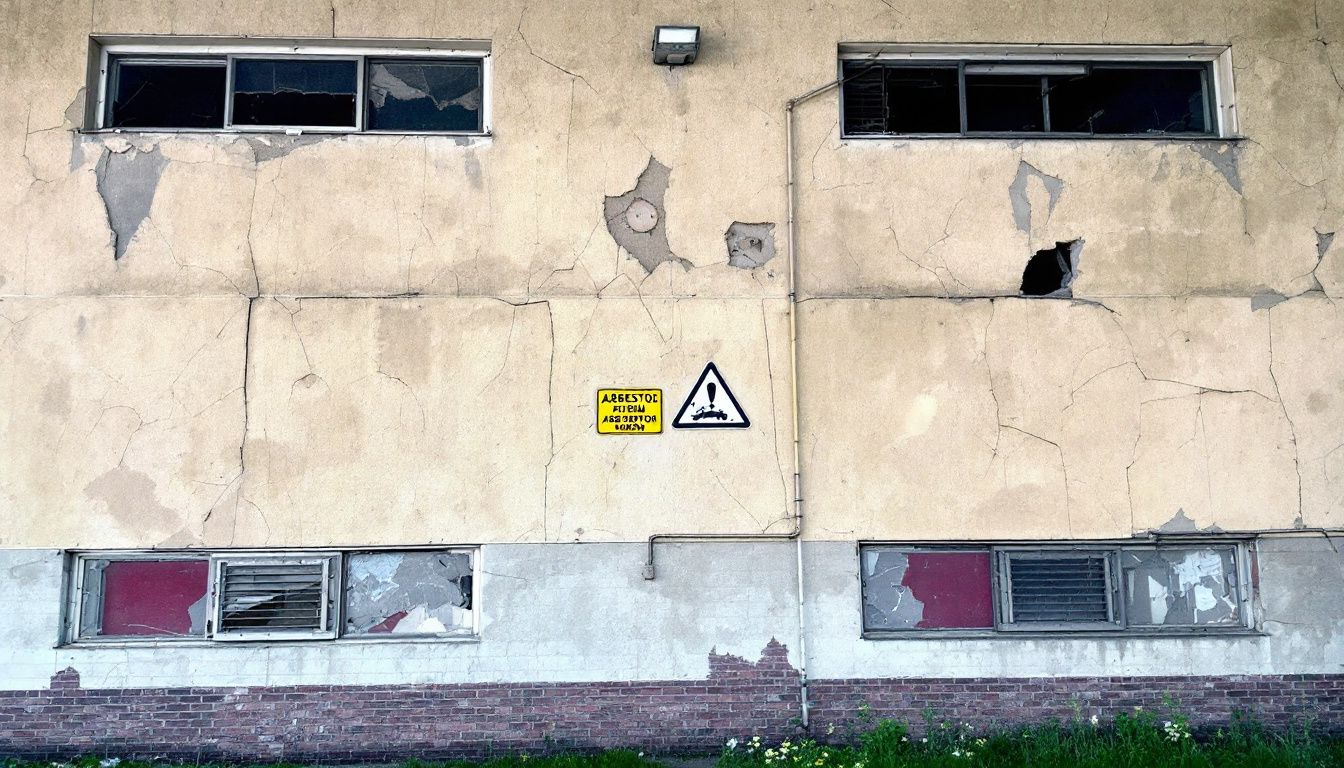
When Companies Fail to Protect People from Asbestos, the Consequences Last Decades
Asbestos kills more people in the UK each year than road traffic accidents. That is not a historical footnote — it is a present-day crisis, and corporate responsibility for holding companies accountable for asbestos exposure in the UK sits at the heart of addressing it.
For decades, employers, building owners, and duty holders have had clear legal obligations to protect workers and occupants. Yet failures persist, diseases develop, and families are left devastated by illnesses that can take up to 60 years to manifest.
This post sets out what the law demands, where companies fall short, what victims and duty holders need to know, and how proper asbestos management protects everyone involved.
The Scale of the Problem: Why Corporate Accountability Matters
Asbestos was banned in the UK in 1999, but it remains present in millions of buildings constructed before that date. Schools, hospitals, offices, warehouses, and residential properties all potentially contain asbestos-containing materials (ACMs).
The fibres themselves are invisible to the naked eye — and once inhaled, they cannot be expelled from the body. The resulting diseases — mesothelioma, asbestosis, and asbestos-related lung cancer — are among the most aggressive and difficult to treat.
Mesothelioma is invariably fatal. Asbestosis causes progressive, irreversible scarring of the lungs. These are not theoretical risks; they are the documented outcomes of corporate failures stretching back generations.
What makes accountability so challenging is the latency period. A worker exposed to asbestos fibres in the 1980s may only receive a diagnosis today. By that point, tracing liability, gathering evidence, and pursuing legal redress becomes enormously complex.
This is precisely why proactive compliance — not reactive damage control — is the only responsible approach for any organisation managing property or employing workers.
The Legal Framework: What UK Law Requires of Duty Holders
Corporate responsibility for holding companies accountable for asbestos exposure in the UK is not a matter of best practice — it is a matter of law. Several pieces of legislation work together to create a robust framework of obligations.
The Control of Asbestos Regulations
The Control of Asbestos Regulations represent the primary legislation governing asbestos management in Great Britain. They set out licensing requirements for high-risk work, notification duties, and — critically — the duty to manage asbestos in non-domestic premises.
Regulation 4 places a legal obligation on the duty holder (typically the owner or manager of a building) to identify ACMs, assess their condition and risk, and maintain an up-to-date asbestos register.
The regulations also set a workplace exposure limit of 0.1 fibres per cubic centimetre, averaged over a four-hour period. Employers must ensure this limit is never exceeded and must supply appropriate personal protective equipment (PPE) and respiratory protective equipment (RPE) where necessary.
The Health and Safety at Work Act
The Health and Safety at Work Act places a broad duty on employers to ensure, so far as is reasonably practicable, the health, safety, and welfare of their employees. This includes protection from hazardous substances such as asbestos fibres.
Failure to comply can result in criminal prosecution, unlimited fines, and imprisonment for individuals. These are not rarely-used powers — the HSE pursues enforcement action regularly across the UK.
RIDDOR Reporting Obligations
Under the Reporting of Injuries, Diseases and Dangerous Occurrences Regulations (RIDDOR), employers and duty holders are required to report certain asbestos-related incidents to the Health and Safety Executive (HSE). Where asbestos fibres are released in harmful quantities — for example, during unplanned disturbance of ACMs — this constitutes a reportable dangerous occurrence.
Failure to report is itself a legal offence, and it compounds the liability exposure for any organisation already in breach of its management duties.
HSG264: The HSE’s Survey Guidance
HSG264 is the HSE’s definitive guidance on asbestos surveys. It sets out how management surveys and refurbishment or demolition surveys should be conducted, and any survey carried out on behalf of a duty holder should comply with its standards.
At Supernova Asbestos Surveys, every inspection we carry out follows HSG264 to the letter, ensuring that the resulting documentation is legally defensible and fit for purpose.
Types of Asbestos Survey: Matching the Right Survey to the Situation
One of the most common failures in corporate asbestos management is commissioning the wrong type of survey — or failing to commission one at all. The type of survey required depends on the circumstances of the building and what is planned for it.
Management Survey
A management survey is the standard survey required for any non-domestic premises to satisfy the duty to manage under the Control of Asbestos Regulations. It identifies the location, extent, and condition of ACMs that could be disturbed during normal occupation and maintenance.
Every duty holder managing a commercial or public building should have a current management survey in place. Operating without one is not a grey area — it is a breach of the law.
Refurbishment Survey
Before any refurbishment, demolition, or intrusive maintenance work begins, a refurbishment survey is legally required. This is a far more intrusive inspection, designed to locate all ACMs in areas that will be disturbed.
Carrying out refurbishment work without this survey is not only illegal — it puts workers and neighbouring occupants at serious risk of exposure. No contractor or principal designer should proceed without confirmed survey documentation in hand.
Demolition Survey
Where a building is to be demolished entirely, a demolition survey is required. This is the most thorough type of asbestos inspection, covering all accessible and inaccessible areas of the structure.
Demolition without a prior survey is a serious breach of the Control of Asbestos Regulations and can expose a duty holder to significant criminal and civil liability — as well as endangering demolition crews and anyone in the vicinity.
Re-inspection Survey
Where ACMs are identified and left in situ — which is often the safest option provided they are in good condition and not at risk of disturbance — they must be monitored regularly. A re-inspection survey checks the condition of known ACMs and updates the asbestos register accordingly.
The HSE recommends that asbestos registers are reviewed at least annually. A re-inspection survey provides the documented evidence that this obligation has been met — and that evidence matters enormously if your management approach is ever scrutinised.
Where Corporate Accountability Breaks Down
Understanding where and why companies fail is essential to preventing future harm. The patterns of non-compliance are well documented by the HSE and reinforced by enforcement action across the UK.
Inadequate or Absent Asbestos Registers
Some duty holders manage buildings for years without commissioning a management survey. Without an asbestos register, maintenance workers, contractors, and even emergency services personnel may disturb ACMs without any awareness of the risk.
This is one of the most common and most dangerous failures in corporate asbestos management — and it is entirely preventable.
Failure to Share Information with Contractors
Even where an asbestos register exists, duty holders sometimes fail to share it with contractors before work begins. The Control of Asbestos Regulations require that anyone liable to disturb ACMs is informed of their location and condition.
Withholding this information — whether through negligence or cost-cutting — exposes contractors to potentially fatal risk and exposes the duty holder to serious legal liability. There is no defensible justification for this failure.
Inadequate Training and Supervision
Workers who may encounter asbestos must receive appropriate awareness training. This is not optional. Employers who deploy staff in buildings containing ACMs without providing that training are in breach of their legal obligations.
The consequences can be fatal, and the financial penalties for non-compliance are substantial. Courts have shown little sympathy for organisations that treat training as an optional overhead.
Enforcement in Practice
The HSE carries out inspections and investigates reports of asbestos mismanagement. Companies found to be in breach face improvement notices, prohibition notices, and prosecution. Fines imposed by courts can be unlimited in serious cases, and individual directors and managers can be prosecuted personally.
Corporate responsibility for holding companies accountable for asbestos exposure in the UK is not merely theoretical — the HSE actively and regularly pursues enforcement action against non-compliant organisations of all sizes.
The Long Latency Problem and Its Legal Implications
The 15 to 60-year latency period between asbestos exposure and disease diagnosis creates profound challenges for victims seeking justice. By the time a diagnosis is made, the company responsible for the exposure may have been restructured, dissolved, or absorbed into a larger group.
Evidence of exposure may be incomplete. Former colleagues who could corroborate a claim may themselves be ill or deceased. Payroll records, site logs, and safety documentation from decades past may no longer exist.
This is why advocacy organisations and specialist solicitors play such an important role in asbestos-related litigation in the UK. Victims and their families should be aware that legal routes to compensation do exist, and that the long latency period is well understood by the courts.
Duty holders, meanwhile, should recognise that their obligations do not expire — the consequences of today’s failures may not become apparent for decades. The asbestos management decisions made right now will determine liability exposure well into the future.
For building owners uncertain about their current position, an asbestos testing kit can provide a useful first step in identifying suspect materials. However, a full professional survey remains the legally required standard for duty holders managing non-domestic premises.
Where there is genuine uncertainty about whether specific materials contain asbestos, professional asbestos testing provides laboratory-confirmed results that are legally defensible and far more reliable than visual inspection alone.
Asbestos Management Across the UK: Regional Considerations
Asbestos is a nationwide issue, not a regional one. Industrial heritage means that some areas carry a heavier legacy burden — former manufacturing towns, port cities, and areas with significant post-war construction all tend to have higher concentrations of ACMs in their building stock.
However, no region is exempt, and corporate obligations apply equally across England, Scotland, and Wales. The Control of Asbestos Regulations make no distinction based on geography.
Supernova Asbestos Surveys operates across the entire UK. Whether you require an asbestos survey in London or anywhere else in the country, our BOHS P402-qualified surveyors are available, typically with same-week appointments.
Fire Risk and Asbestos: An Overlooked Intersection
Building managers focused on asbestos compliance sometimes overlook the related obligation to carry out a fire risk assessment. The two are more closely connected than they might appear.
A fire in a building containing ACMs can release asbestos fibres into the atmosphere, creating a secondary hazard for firefighters and neighbouring occupants. A thorough fire risk assessment will identify whether ACMs are present in locations that increase fire-related risk, and this information should inform the building’s overall safety management plan.
Treating fire safety and asbestos management as separate silos is a mistake that good corporate governance should actively avoid. Both obligations exist under the same overarching duty of care to employees and building occupants.
What Good Corporate Asbestos Management Looks Like
Genuine corporate responsibility goes beyond ticking boxes. Here is what best practice looks like for any organisation managing buildings that may contain asbestos:
- Commission a professional management survey for all non-domestic premises built before 2000, and ensure the resulting asbestos register is kept up to date.
- Share the asbestos register with all contractors before any maintenance or refurbishment work begins — this is a legal requirement, not a courtesy.
- Commission a refurbishment or demolition survey before any intrusive works, regardless of scale. Even minor alterations can disturb concealed ACMs.
- Arrange annual re-inspections of known ACMs to monitor their condition and update the register.
- Provide asbestos awareness training to all employees who work in, or manage, buildings that may contain ACMs.
- Establish clear reporting procedures so that any accidental disturbance of ACMs is dealt with promptly, documented properly, and reported to the HSE where RIDDOR obligations apply.
- Appoint a named duty holder with clear responsibility for asbestos management — and ensure that person has the knowledge and resources to fulfil the role.
- Review your asbestos management plan regularly — not just when something changes, but as a scheduled governance activity.
None of this is onerous when approached systematically. What is onerous — legally, financially, and morally — is the alternative.
The Role of Professional Surveyors in Supporting Corporate Compliance
Duty holders are not expected to be asbestos experts. What they are expected to do is appoint competent professionals to carry out the work that the law requires. This is where the choice of surveying company matters enormously.
A survey carried out by unqualified or under-resourced surveyors may miss ACMs, misclassify materials, or produce documentation that would not withstand legal scrutiny. When a duty holder’s compliance is challenged — whether by the HSE, a contractor, or a claimant — the quality of the underlying survey documentation is critical.
At Supernova Asbestos Surveys, all our surveyors hold BOHS P402 qualifications as a minimum. Every survey is conducted in accordance with HSG264, and every report is produced to a standard that is legally defensible. We have completed over 50,000 surveys across the UK, and our processes are built around the needs of duty holders who take their obligations seriously.
If you need asbestos testing alongside a survey — for example, to confirm the composition of a specific material before works proceed — we can arrange laboratory analysis as part of the same instruction.
Frequently Asked Questions
Who is legally responsible for managing asbestos in a commercial building?
The legal duty holder is typically the owner of the building, or the person or organisation with responsibility for its maintenance and repair — for example, a facilities manager or a commercial tenant with a full repairing lease. The Control of Asbestos Regulations place a specific duty on this person to identify ACMs, assess their condition, and maintain an asbestos register. Where responsibility is shared, it should be clearly documented in contractual arrangements.
What happens if a company fails to comply with asbestos regulations?
The HSE has wide enforcement powers. Non-compliant organisations can receive improvement notices requiring corrective action within a set timeframe, prohibition notices stopping work immediately, and — in serious cases — criminal prosecution. Courts can impose unlimited fines, and individual directors or managers can face personal prosecution and imprisonment. Civil claims from affected workers or contractors are also a significant financial and reputational risk.
Can a company be held liable for asbestos exposure that happened decades ago?
Yes. The long latency period of asbestos-related diseases is well understood by UK courts, and the fact that a disease takes decades to manifest does not extinguish liability. Specialist solicitors and advocacy organisations have extensive experience in tracing historic liability, including in cases where companies have been restructured or dissolved. Employers’ liability insurers may also be pursued directly in some circumstances.
Is an asbestos register a legal requirement for all buildings?
The formal duty to manage asbestos — and therefore to maintain an asbestos register — applies to non-domestic premises. However, the duty can also apply to common areas of residential buildings such as blocks of flats. If you manage any building built before 2000 and are uncertain whether the duty applies to you, taking professional advice is strongly recommended. Operating without a register when one is legally required leaves you exposed to enforcement action and personal liability.
How often should an asbestos register be updated?
The HSE recommends that asbestos registers are reviewed at least annually. Where ACMs are known to be present and left in situ, a formal re-inspection survey should be carried out to assess their condition and record any changes. The register should also be updated immediately following any works that may have affected ACMs, or if new materials are discovered. Keeping the register current is not just good practice — it is an ongoing legal obligation.
Need a survey, re-inspection, or asbestos testing anywhere in the UK? Supernova Asbestos Surveys has completed over 50,000 surveys nationwide, with BOHS P402-qualified surveyors available at short notice. Call us on 020 4586 0680 or visit asbestos-surveys.org.uk to book or request a quote. We work with facilities managers, property owners, contractors, and legal teams — and we understand what duty holders need from their survey documentation.