
An asbestos register is only useful when it reflects the real condition of the building in front of you. If it is out of date, missing key areas or buried in a folder nobody checks, it stops being a control measure and starts becoming a liability for landlords, managing agents, facilities teams and dutyholders.
Across offices, schools, hospitals, shops, warehouses, factories and the common parts of residential blocks, the duty to manage asbestos is ongoing under the Control of Asbestos Regulations. HSE guidance and HSG264 are clear on the practical point: identify asbestos-containing materials, record them properly, assess the risk, communicate the findings and keep the information under review.
That is where an asbestos register sits. It is not a one-off report. It is a live record that supports safe maintenance, contractor control, refurbishment planning and day-to-day compliance.
5. Make a register and assess the risk
For most dutyholders, this is the stage where asbestos information becomes genuinely useful. A survey tells you what was found on the day. An asbestos register turns that information into a working record, and the risk assessment tells you what action is needed in practice.
If you manage non-domestic premises, or the common parts of a residential building, your process should be straightforward and repeatable:
- Identify known or presumed asbestos-containing materials.
- Record each item in the asbestos register.
- Assess the material risk and the likelihood of disturbance.
- Decide whether to monitor, repair, encapsulate or remove.
- Share the information with anyone who may disturb the material.
- Review and update the register after inspections, works or changes in use.
That sounds simple, but many failures happen because one of those steps is skipped. A survey is commissioned, the PDF is filed away, contractors arrive on site and nobody checks the asbestos register before work starts.
A practical rule works well here: no asbestos register check, no intrusive work. Make it part of your permit-to-work system, contractor induction and maintenance approval process.
What an asbestos register actually is
An asbestos register is the record of known or presumed asbestos-containing materials in a property. It should tell anyone who may disturb the building fabric what the material is, where it is, what condition it is in and whether it presents a risk during normal occupation, maintenance or planned works.
In most occupied premises, the register begins with a management survey. That survey identifies accessible asbestos-containing materials that could be disturbed during routine use and maintenance, and its findings usually form the backbone of the asbestos register.
The register is not the same as the management plan. The asbestos register records the materials and their condition. The management plan sets out how the risk will be controlled, who is responsible, how information will be shared and when the materials will be checked again.
What to include in your register
A useful asbestos register should be clear enough that a contractor, maintenance engineer or project manager can understand the risk before starting work. If the record is vague, incomplete or difficult to access, it is not doing its job.
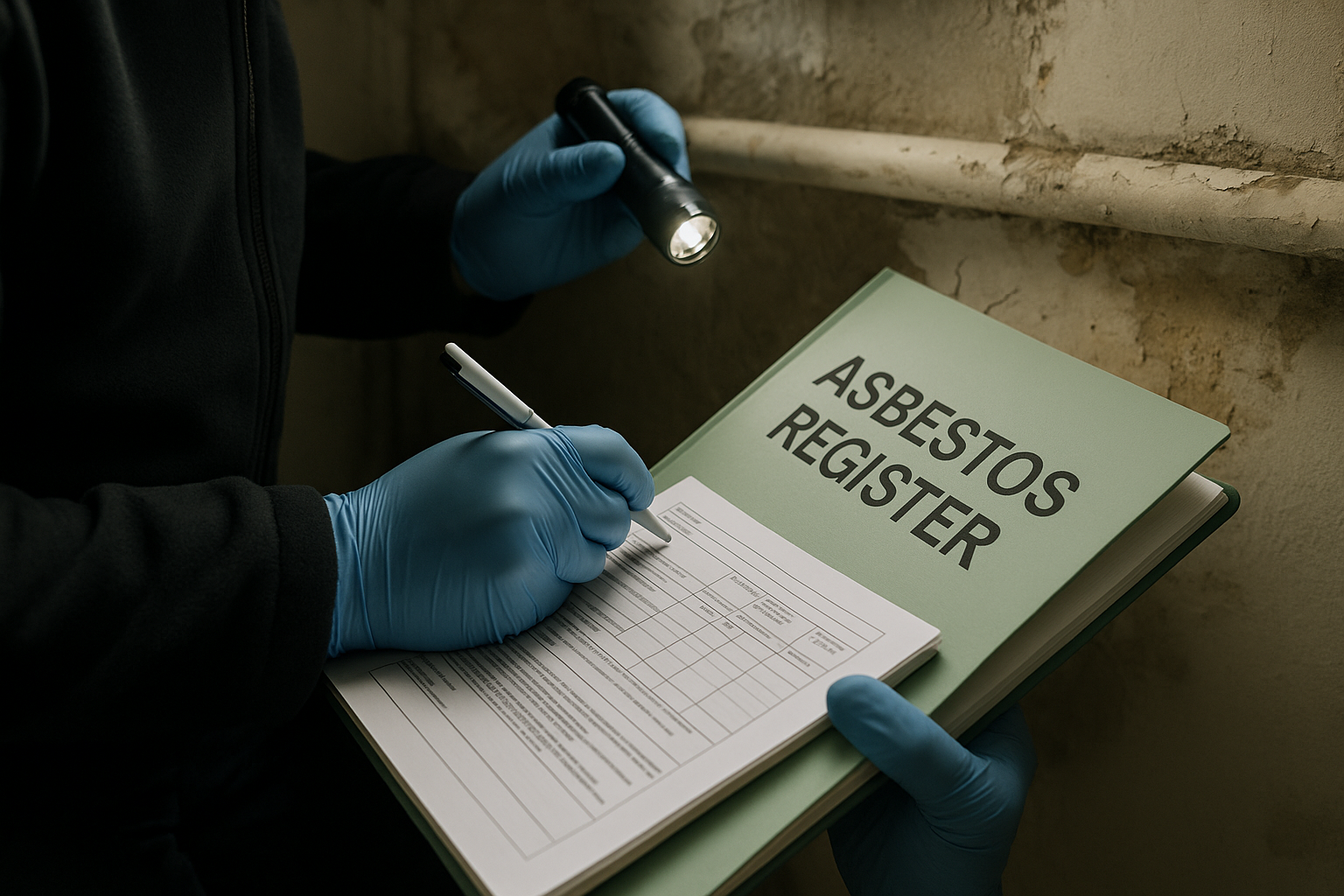
Most registers should include:
- Property address and the areas covered
- Survey date and survey type
- Location of each known or presumed asbestos-containing material
- Product type, such as asbestos insulating board, pipe lagging, textured coating, floor tile or cement sheet
- Whether the material was sampled or presumed
- Laboratory result where sampling confirmed asbestos type
- Extent or approximate quantity of material
- Condition at the time of inspection
- Surface treatment, accessibility and vulnerability to damage
- Material assessment details
- Priority or risk assessment notes relevant to how the building is used
- Recommended action, such as monitor, repair, encapsulate or remove
- Dates of re-inspection and any changes since the previous visit
- Areas not accessed and any presumptions made
Photographs, room references and marked-up plans make a big difference, especially on larger or more complex sites. They reduce confusion and help contractors locate materials quickly rather than relying on guesswork.
How to deal with inaccessible areas
Ceiling voids, service risers, roof spaces, locked rooms, ducts and confined areas should never be quietly left out. If they were not accessed, your asbestos register should say so clearly.
Where materials cannot be inspected and asbestos cannot be ruled out, they may need to be presumed to contain asbestos until checked properly. That presumption should be recorded plainly so nobody mistakes a gap in access for a clean bill of health.
Producing a risk assessment
An asbestos register tells you what is there. A risk assessment tells you what that means in the real world. Both are needed if asbestos information is going to be useful on a live site.
A proper asbestos risk assessment considers more than the product itself. It also looks at how likely the material is to be disturbed, who may come into contact with it and what activities take place in the area.
Material assessment and priority assessment
Material assessment looks at the asbestos-containing material itself. That includes the product type, condition, surface treatment, friability and how easily fibres could be released if the material is damaged.
Priority assessment looks at the building context. It considers occupancy, maintenance activity, accessibility, likelihood of disturbance and who may enter the area.
That is why the same product can present very different practical risks in different settings. Asbestos insulating board in poor condition inside a busy service riser is a different risk from asbestos cement sheeting in good condition on a low-traffic outbuilding.
What should be considered in the risk assessment?
- Condition of the asbestos-containing material
- Friability and fibre release potential
- Whether the material is sealed, enclosed or exposed
- Accessibility and vulnerability to accidental damage
- How often the area is used
- Who uses the area, including staff, cleaners, caretakers and contractors
- Whether routine maintenance could disturb the material
- Whether refurbishment is planned
- How effective current controls, labelling and permit systems are
The outcome should always be practical. If the material is in good condition and unlikely to be disturbed, monitoring may be enough. If it is damaged, exposed or located in a high-traffic or high-maintenance area, repair, enclosure or asbestos removal may be the safer option.
Who is responsible for keeping an asbestos register updated?
The person or organisation responsible for maintenance or repair of non-domestic premises is usually the dutyholder. Depending on the lease, contract or management arrangement, that could be the owner, landlord, managing agent, employer, facilities manager or tenant.
Typical dutyholders include:
- Commercial landlords
- Property management companies
- Facilities managers
- Local authorities
- Schools, academies and universities
- Healthcare estates teams
- Industrial site operators
- Tenants with repairing obligations
Where responsibility is shared, it needs to be defined properly. One of the most common reasons an asbestos register becomes unreliable is that everyone assumes someone else is updating it.
Check the lease, maintenance agreement and contractor arrangements carefully. You should know:
- Who commissions surveys
- Who receives and reviews reports
- Who updates the asbestos register
- Who briefs contractors before work starts
- Who signs off changes after removal, repair or re-inspection
When an asbestos register should be reviewed and updated
An asbestos register should change when the building changes. If the condition, accessibility or likelihood of disturbance has altered, the record needs to reflect that.
You should review and update the register when:
- A scheduled re-inspection survey has been completed
- An asbestos-containing material has been damaged
- Repair, encapsulation or enclosure work has been carried out
- Asbestos has been removed
- Previously inaccessible areas have been inspected
- The use of the building changes
- Refurbishment or demolition surveys identify further materials
- Additional sampling changes an earlier presumption
There is no single review interval that suits every property. The frequency should be based on risk and set out in the asbestos management plan. Annual review is common, but higher-risk materials or heavily used areas may need more frequent checks.
The key point is not the calendar alone. It is whether the asbestos register still reflects the actual condition on site.
Survey types that support an asbestos register
The right survey depends on what is happening in the building. A reliable asbestos register is usually maintained through a combination of surveys, sampling and remedial work rather than one isolated inspection.
Management survey
This is the standard survey for occupied buildings where the aim is to locate, as far as reasonably practicable, asbestos-containing materials that could be disturbed during normal occupation and routine maintenance. It provides the core information for the asbestos register.
Refurbishment survey
Where intrusive work is planned, a management survey is not enough. A refurbishment survey is needed in the area of the proposed works so hidden asbestos can be identified before the project starts.
Demolition survey
Before full structural demolition or major strip-out, a demolition survey is required. This is a more intrusive survey designed to locate asbestos throughout the areas due to be demolished.
Testing suspect materials
Sometimes the asbestos register contains presumptions because a material could not be sampled at the time of survey. In other cases, a suspect material may be found later during maintenance or minor works.
Where confirmation is needed, professional asbestos testing is the right next step. Sampling and laboratory analysis can confirm whether the material contains asbestos and help you update the register accurately.
If you need a fast route for localised sampling support, we also provide a dedicated asbestos testing service for properties that need clear answers before work continues.
Industries where an asbestos register matters most
An asbestos register matters in any non-domestic premises built or refurbished during the period when asbestos-containing materials were commonly used. In practice, some sectors carry more day-to-day exposure risk because of occupancy levels, maintenance activity or the complexity of the estate.
Education
Schools, colleges and universities often have mixed-age buildings, regular contractor attendance and high levels of daily occupancy. Registers need to be accessible, current and clearly linked to estates and maintenance procedures.
Healthcare
Hospitals, clinics and care settings can include plant rooms, service voids, risers and older back-of-house areas where asbestos-containing materials remain in place. Maintenance work must be tightly controlled, and the asbestos register should be easy to consult at short notice.
Commercial offices
Office buildings often see frequent fit-outs, cabling works, partition changes and reactive maintenance. If the asbestos register is not checked before small works begin, accidental disturbance becomes far more likely.
Retail and hospitality
Shops, restaurants, hotels and leisure sites often operate with minimal downtime. That makes planning vital. A current asbestos register helps you brief contractors quickly and avoid delays when reactive works arise.
Industrial and logistics sites
Factories, depots and warehouses may contain asbestos cement roofs and wall panels, insulating board, gaskets, lagging and older plant insulation. Wear and tear, vibration and repeated maintenance can change the risk profile over time.
Residential blocks
While individual domestic dwellings are treated differently, the common parts of residential blocks can still fall within the duty to manage. Plant rooms, corridors, service cupboards, risers and bin stores should be considered carefully.
Templates to help you build and maintain a better asbestos register
Templates can help, provided they are used properly. A template should support clear recording and review, not replace competent surveying, risk assessment or management decisions.
A practical asbestos register template should include fields for:
- Unique item reference number
- Building, floor, room and exact location
- Material description
- Sampled or presumed status
- Asbestos type if confirmed
- Condition assessment
- Risk or priority notes
- Recommended action
- Person responsible
- Date inspected
- Next review date
- Status after repair or removal
For larger portfolios, digital registers are often easier to control than static spreadsheets. They allow quicker updates, easier contractor access and clearer version control.
Whatever format you use, keep these points in mind:
- Use consistent room references and naming conventions
- Record inaccessible areas clearly
- Link plans and photographs where possible
- Archive old versions rather than overwriting without trace
- Make sure the latest version is the one contractors see
Related content that supports your asbestos register
An asbestos register does not sit in isolation. It works best when it is connected to the wider asbestos management process and the right survey support at the right time.
If you are reviewing your current arrangements, these services are usually the most relevant:
- A asbestos survey London service for properties across the capital
- An asbestos survey Manchester option for North West sites and portfolios
- An asbestos survey Birmingham service for West Midlands properties
These are especially useful where you manage multiple premises and need local surveying support that feeds back into one consistent asbestos register process.
Search HSE.GOV.UK and use the right guidance
When dutyholders are unsure what good practice looks like, they often search HSE.GOV.UK first. That is sensible, because HSE guidance sets the benchmark for how asbestos should be identified, recorded and managed in the UK.
The key references to understand are:
- Control of Asbestos Regulations for the legal duty to manage
- HSG264 for asbestos survey standards and methodology
- HSE guidance on asbestos management, risk assessment and contractor information
The practical takeaway is consistent across all of them: know where asbestos is, assess the risk, prevent disturbance and keep records current. A well-maintained asbestos register is central to that duty.
Support and communication: making the register usable on site
Even a technically accurate asbestos register can fail if nobody can access it when they need it. Support and communication matter just as much as the survey data itself.
Make sure the following people know how to access and use the register:
- Facilities and estates teams
- On-site maintenance staff
- External contractors
- Project managers
- Cleaning and caretaking teams where relevant
- Health and safety leads
Good support usually means:
- A single controlled version of the register
- Clear responsibility for updates
- Simple escalation if suspect materials are found
- Training for staff who authorise works
- A rule that intrusive works cannot start without checking asbestos information
If you manage a large estate, nominate one person or team to own the process. Shared responsibility often turns into no responsibility.
Common mistakes that make an asbestos register unreliable
Most failures are not caused by a total lack of paperwork. They happen because the paperwork no longer matches the building.
Watch for these common problems:
- The asbestos register is based on an old survey and has not been reviewed
- Contractors are not shown the register before starting work
- Refurbishment begins without the correct intrusive survey
- Removed materials are still listed as present
- Damaged materials are still recorded as being in good condition
- Inaccessible areas are not flagged clearly
- The management plan and asbestos register do not match
- There is no clear record of who is responsible for updates
If any of those sound familiar, fix the process before the next round of maintenance or project work starts. The cost of correcting paperwork is usually minor compared with the disruption caused by an accidental disturbance.
Footer links, record access and document control
On many property portals and contractor systems, asbestos information is hidden away behind generic footer links or buried inside a wider health and safety folder. That creates delay and increases the chance that someone starts work without checking the right information.
Your asbestos register should be easy to find. Good document control means:
- Clear file names and version dates
- Visible links in contractor portals or building compliance folders
- A simple route to plans, photographs and survey reports
- Old versions archived separately
- A named person responsible for issuing updates
If your teams have to hunt through footer links and old email chains to find the latest register, the system needs tightening up.
Support us, change lives: why good asbestos management matters
That phrase is often used in fundraising, but the principle applies here too. Good asbestos management protects people. It reduces the chance of avoidable exposure for maintenance workers, contractors, staff, visitors and residents.
A current asbestos register is not just about satisfying an audit trail. It helps people go home safe after routine jobs that might otherwise disturb hidden asbestos-containing materials.
For property managers and dutyholders, that means taking a practical approach:
- Commission the right survey for the work involved
- Keep the register live and accessible
- Carry out risk assessments that reflect how the building is actually used
- Review the information after changes, damage or remedial works
- Make asbestos checks part of everyday maintenance control
Need help with your asbestos register?
If your asbestos register is outdated, incomplete or based on surveys that no longer reflect the building, Supernova Asbestos Surveys can help. We carry out surveys, sampling and follow-up inspections nationwide, with clear reporting that supports practical asbestos management.
Whether you need a baseline survey, an intrusive survey before works, re-inspection support or advice on updating your asbestos register after removal or damage, our team can guide you through the next step. Call 020 4586 0680 or visit asbestos-surveys.org.uk to book a survey or discuss your site.
Frequently Asked Questions
Who should have access to the asbestos register?
Anyone who may disturb the building fabric should be able to access the asbestos register. That usually includes facilities teams, maintenance staff, project managers and contractors working on site.
Is an asbestos register the same as an asbestos management plan?
No. The asbestos register records known or presumed asbestos-containing materials and their condition. The management plan explains how those risks will be controlled, who is responsible and how reviews will be carried out.
How often should an asbestos register be updated?
It should be updated whenever conditions change, such as after re-inspection, damage, removal, repair, additional sampling or a change in building use. Review frequency should be based on risk rather than a fixed period alone.
Do I need a new survey before refurbishment works?
Yes, if the planned works are intrusive. A management survey is not designed to identify all hidden asbestos in work areas, so a refurbishment survey is usually required before refurbishment starts.
What happens if a suspect material is found that is not on the asbestos register?
Work should stop in the affected area until the material has been assessed. Professional sampling and analysis can confirm whether it contains asbestos, after which the asbestos register and risk assessment should be updated.