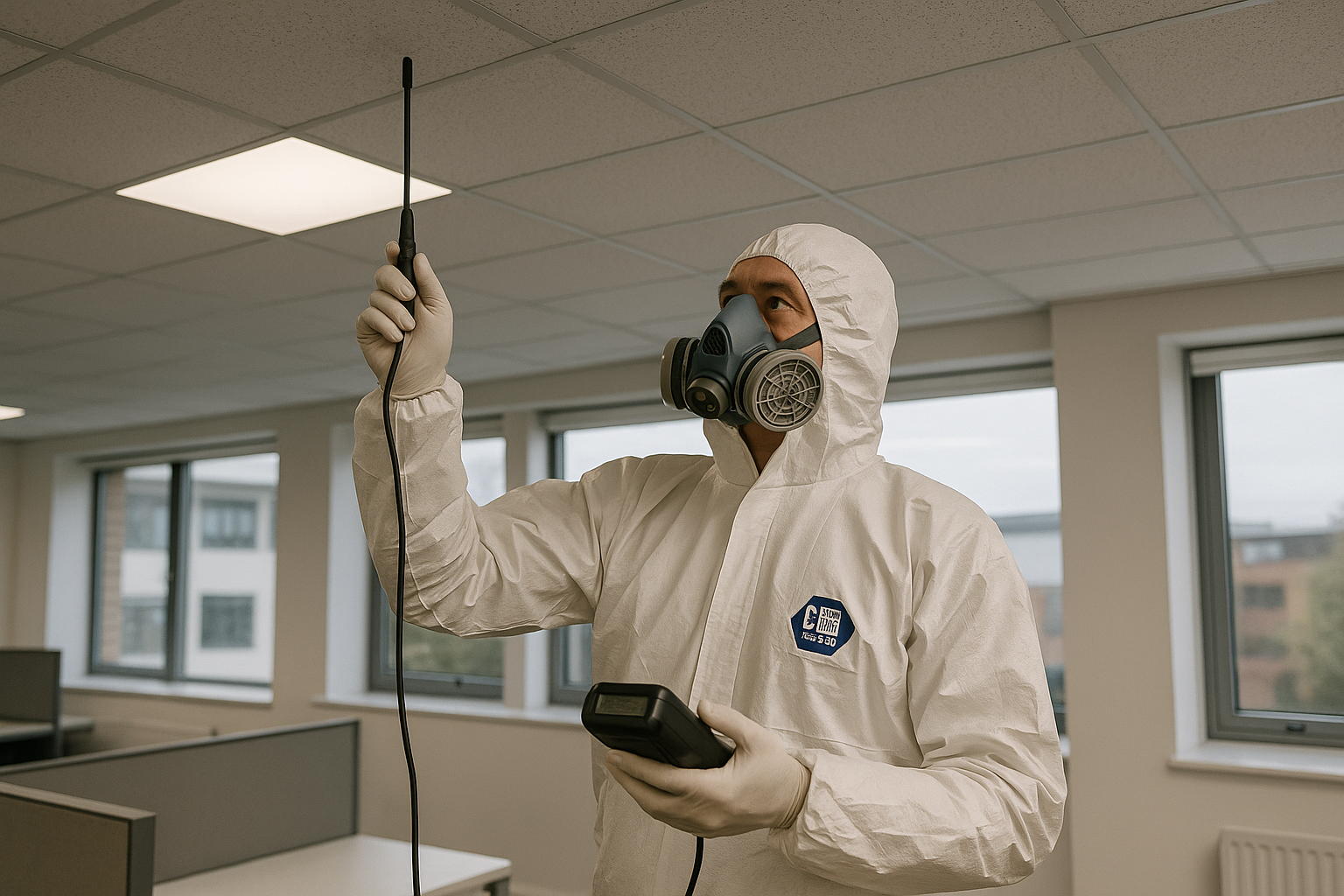
Asbestos is not a problem locked away in the past. Across the UK, it still sits in older offices, schools, shops, warehouses, communal areas and plant rooms, often hidden behind finishes or above ceilings, waiting to be disturbed by routine maintenance or building work.
That is why asbestos remains a live health, safety and legal issue for property managers, landlords, dutyholders and facilities teams. The hard lesson from decades of asbestos-related lung disease is simple: if you do not know what is in the building, you cannot manage the risk properly.
Why asbestos became so common in UK buildings
Asbestos was widely used because it was seen as practical, durable and resistant to heat. It appeared in a huge range of construction products, particularly in buildings erected or refurbished when asbestos-containing materials were commonly specified.
Even where a property looks modern, asbestos may still be present behind later upgrades. Refits often covered original materials rather than removing them, which is why asbestos still turns up during inspections, maintenance and project works.
Common materials that may contain asbestos include:
- Pipe and boiler insulation
- Sprayed coatings
- Asbestos insulating board
- Cement sheets and roofing panels
- Floor tiles and bitumen adhesive
- Textured coatings
- Soffits, gutters and downpipes
- Fire doors, partition panels and service risers
- Ceiling tiles and insulation around plant
A visual guess is never enough. Many asbestos products look similar to safer alternatives, so proper surveying and sampling are essential before anyone starts disturbing the fabric of a building.
Why older buildings need careful asbestos management
If you manage an older property, asbestos should always be considered before repair, installation or refurbishment work begins. Hidden materials are one of the main reasons small jobs become serious incidents.
Older buildings often have incomplete records, mixed phases of refurbishment and undocumented alterations. That makes asbestos harder to track unless you have a reliable survey, an accurate register and a management plan that is actually used on site.
Where asbestos is often found
Asbestos can appear in obvious and non-obvious places. High-risk locations are usually the areas contractors access when carrying out routine works.
- Plant rooms
- Boiler houses
- Basements
- Roof voids
- Ceiling voids
- Service ducts and risers
- Store rooms and outbuildings
- Communal corridors and stairwells
- Wall linings, columns and boxing-in
For property managers, the practical point is clear: if work is planned in any of these areas, check the asbestos information first. If the records are missing, unclear or out of date, stop and get professional advice.
How asbestos affects the lungs
The main danger from asbestos comes from inhaling airborne fibres. When asbestos-containing materials are damaged, drilled, cut, sanded, broken or otherwise disturbed, microscopic fibres can be released into the air.
These fibres are small enough to travel deep into the lungs. Unlike ordinary dust, asbestos fibres do not break down easily in the body, which is why exposure can lead to serious long-term harm.
What happens after fibres are inhaled
Once inhaled, asbestos fibres can lodge in lung tissue or in the lining around the lungs. The body may react with inflammation and scarring, but it cannot reliably clear all of the fibres.
This is one reason asbestos-related disease can take many years to appear. The exposure may have happened decades earlier, yet the damage develops slowly over time.
Scarring and reduced lung function
Repeated or significant asbestos exposure can cause fibrosis, which is scarring in the lungs. As that scarring increases, breathing may become more difficult and lung function may decline.
The severity depends on several factors, including:
- The amount of asbestos inhaled
- The type of asbestos-containing material disturbed
- How often exposure occurred
- How long the exposure lasted
- Whether proper controls were in place
From a building management perspective, the message is straightforward. The safest approach is always to prevent exposure rather than assume a task is too small to matter.
Asbestos-related lung diseases you should know about
Not every exposure to asbestos leads to illness, but the health risks are well established. The diseases linked to asbestos are exactly why the legal duties around surveying, management and communication are so strict.
Asbestosis
Asbestosis is a chronic lung disease caused by inhaling asbestos fibres. It leads to scarring of the lung tissue, which can cause breathlessness, a persistent cough and reduced capacity for physical activity.
It is generally associated with heavier or prolonged exposure. Historically, this was seen in occupations where asbestos was handled regularly without adequate controls.
Mesothelioma
Mesothelioma is a cancer affecting the lining of the lungs, and less commonly the lining of the abdomen. It is strongly associated with asbestos exposure and can develop long after the original contact with fibres.
For dutyholders, this matters because even relatively limited disturbance of asbestos may create risk. There is no sensible shortcut when asbestos is suspected.
Asbestos-related lung cancer
Asbestos can also cause lung cancer. The risk is higher where exposure has been significant, and smoking can further increase the overall risk of lung disease.
That does not change the practical duty in buildings. Your role is to stop fibres being released in the first place by identifying asbestos and controlling work properly.
Pleural plaques and diffuse pleural thickening
Asbestos exposure may also be associated with pleural plaques and diffuse pleural thickening. These conditions differ from mesothelioma and asbestosis, but they still demonstrate that asbestos can cause lasting damage to the respiratory system.
Damaged asbestos materials should never be treated as a minor snagging issue. If the material is suspect, stop work and assess it properly.
Where asbestos exposure happens in buildings
Many people still associate asbestos with heavy industry, but modern exposure often happens during ordinary building work. Electricians, plumbers, joiners, decorators, surveyors, maintenance staff and general contractors can all encounter asbestos during routine tasks.
That exposure may happen when opening up a ceiling, drilling through wall panels, replacing pipework, lifting floor finishes or removing old fittings. In many cases, the workers involved are not expecting asbestos to be present.
Occupational exposure today
Historically, large-scale industrial use caused major exposure. Today, one of the most common risks comes from maintenance, refurbishment and intrusive inspection in existing premises.
If contractors cut into materials without checking the asbestos register or survey first, fibres can be released quickly and without any obvious visual warning. Dust from asbestos does not announce itself.
Environmental and secondary exposure
Asbestos exposure is not limited to the person doing the work. Occupants may be affected if damaged materials are left in accessible areas, and fibres can spread through debris, dust and contaminated clothing.
That is why asbestos management is not just paperwork. It needs practical site controls, clear communication and disciplined decision-making before work starts.
What UK law expects from dutyholders on asbestos
Under the Control of Asbestos Regulations, those responsible for non-domestic premises have a duty to manage asbestos. In practical terms, that means finding out whether asbestos is present, assessing the risk and making sure the risk is controlled.
If asbestos is known or presumed to be present, the information must be recorded, kept up to date and shared with anyone liable to disturb it. That usually includes contractors, maintenance teams, consultants and visiting trades.
The duty to manage asbestos
The duty to manage asbestos usually involves:
- Identifying asbestos-containing materials, or presuming their presence where necessary
- Assessing condition and likelihood of disturbance
- Maintaining an asbestos register
- Preparing an asbestos management plan
- Reviewing and updating records
- Sharing asbestos information before work begins
- Monitoring known materials over time
HSE guidance is clear in principle: if you are responsible for the building, you are responsible for managing the asbestos risk within it.
Why HSG264 matters
HSG264 sets out the recognised approach to asbestos surveying. It explains the purpose of different survey types, how surveys should be carried out and how findings should be reported.
For property managers, this matters because a survey should give you usable information, not just a document to file away. The survey needs to support safe occupation, maintenance planning and project delivery.
Choosing the right asbestos survey
One of the most common asbestos mistakes is relying on the wrong type of survey. If the survey does not match the planned activity, you can be left with dangerous gaps in information.
The two main survey types serve different purposes, and choosing correctly can prevent delays, accidental disturbance and enforcement problems.
Management survey
A management survey is used to locate, as far as reasonably practicable, the presence and extent of asbestos-containing materials that could be disturbed during normal occupation, routine maintenance or foreseeable installation work.
This type of asbestos survey helps you manage day-to-day risk in an occupied building. It is generally the right starting point where no major intrusive work is planned.
Refurbishment and demolition survey
Where works will disturb the fabric of the building, a more intrusive survey is required. Before strip-out, structural alteration or demolition, you should arrange a demolition survey so asbestos can be identified in the areas affected by the proposed works.
This survey is designed for higher-risk situations. It is essential before removing walls, replacing services, lifting floors, opening up risers, upgrading plant or demolishing all or part of a site.
Location-specific support
If your site is in the capital, booking an asbestos survey London service before refurbishment can help avoid project delays and protect contractors from accidental exposure.
For properties in the North West, arranging an asbestos survey Manchester is a sensible step before intrusive works begin, especially in older commercial, industrial or mixed-use premises.
In the Midlands, a professional asbestos survey Birmingham can support legal compliance and keep maintenance or redevelopment projects moving safely.
What to do if you suspect asbestos
If you think a material may contain asbestos, do not disturb it. Drilling, scraping, sanding, snapping or removing suspect materials without assessment can turn a manageable issue into a contamination incident.
Quick, structured action matters. Small maintenance jobs are a common cause of accidental asbestos disturbance because people assume the work is too minor to need checks.
Immediate steps to take
- Stop work straight away.
- Keep people out of the affected area if dust or debris may have been released.
- Check whether an asbestos survey or register already exists.
- Review the location, condition and likely extent of the suspect material.
- Inform the responsible manager, dutyholder or facilities lead.
- Arrange professional inspection, sampling or surveying.
- Do not restart work until the asbestos risk is understood and controlled.
If debris is present, avoid sweeping or vacuuming it unless the correct specialist controls are in place. Improvised cleaning can spread asbestos fibres further.
When sampling is appropriate
Sampling is used to confirm whether a suspect material contains asbestos. It should be carried out by a competent professional using suitable methods and submitted to an appropriate laboratory for analysis.
Do not ask a contractor to break off a piece of material just to check. That is exactly the sort of informal decision that creates avoidable asbestos exposure.
When asbestos should be managed and when it should be removed
Not all asbestos has to be removed immediately. In many cases, asbestos in good condition can be managed safely in situ if it is stable, protected, recorded and unlikely to be disturbed.
What matters is the risk, not panic. The correct response depends on the type of material, its condition, its location and the work planned around it.
Management in situ may be suitable when:
- The asbestos-containing material is in good condition
- It is sealed or otherwise protected
- It is unlikely to be disturbed during normal use
- The register and management plan are current
- Anyone who may work nearby is properly informed
Removal may be needed when:
- The asbestos is damaged or deteriorating
- It is likely to be disturbed by planned works
- It is in a vulnerable or accessible location
- Encapsulation is no longer suitable
- The building is being refurbished or demolished
The decision should always be based on competent assessment. Some asbestos work is licensed, some is not, and the legal route depends on the material and task involved.
Practical asbestos management for property managers
Good asbestos management is built on routine, not reaction. The aim is to know where asbestos is, understand its condition and make sure nobody disturbs it without the right information.
If you are responsible for a property portfolio, consistency matters. The strongest asbestos systems are simple enough for site teams and contractors to follow every time.
Actions that make a real difference
- Keep the asbestos register current and easy to access
- Review the asbestos management plan regularly
- Reinspect known asbestos-containing materials at suitable intervals
- Share asbestos information before permits, tenders or contractor instructions are issued
- Train in-house teams to recognise suspect materials and stop work
- Check survey coverage before refurbishment is scoped or priced
- Update records after removal, encapsulation or remedial works
- Make asbestos checks part of contractor induction and permit systems
Common mistakes to avoid
Most asbestos failures come from weak processes, not a lack of concern. The building team may care about safety, but if the information is poor or not shared, people still get exposed.
Common mistakes include:
- Relying on an outdated asbestos survey
- Failing to tell contractors about known asbestos
- Assuming textured coatings or boards are harmless without evidence
- Using a management survey to support intrusive refurbishment work
- Keeping the register in a file nobody checks before work starts
- Forgetting to update records after changes to the building
If any of those sound familiar, the fix is practical: review your asbestos information before the next job starts, not after something has gone wrong.
Why learning from the past still matters
The rise in asbestos-related lung disease did not happen because the risk was theoretical. It happened because asbestos was used widely, disturbed regularly and not managed with the level of control now required.
That history still matters in the buildings you manage today. Every time a ceiling tile is lifted, a service duct is opened or an old panel is drilled, the same basic question applies: do we know whether asbestos is present?
The best lesson to take forward is a practical one. Do not guess, do not assume and do not let small works bypass the asbestos process.
When the survey is right, the register is current and contractors are properly briefed, asbestos becomes a manageable risk rather than a hidden threat. That protects occupants, workers, programmes and your organisation.
Need help with asbestos surveys?
If you need clear, reliable advice on asbestos in a commercial, industrial or residential property, Supernova Asbestos Surveys can help. We carry out asbestos surveys nationwide, including management surveys and refurbishment or demolition surveys, with reporting designed to support real-world compliance and safe project planning.
Call 020 4586 0680 or visit asbestos-surveys.org.uk to arrange a survey or speak to our team about the right asbestos approach for your building.
Frequently Asked Questions
What is asbestos and why is it dangerous?
Asbestos is a group of naturally occurring fibrous minerals once widely used in building materials for insulation, fire resistance and durability. It becomes dangerous when disturbed because fibres can be released into the air and inhaled, which may lead to serious lung disease over time.
Do all older buildings contain asbestos?
Not all older buildings contain asbestos, but many do. The only reliable way to know is through a suitable asbestos survey and, where needed, sampling and laboratory analysis.
Can asbestos be left in place?
Yes, asbestos can sometimes be left in place if it is in good condition, protected and unlikely to be disturbed. It must still be recorded, monitored and managed properly under the duty to manage asbestos.
When do I need an asbestos survey?
You usually need an asbestos survey when managing a non-domestic building, planning maintenance or before refurbishment or demolition work. The correct survey type depends on whether the building is in normal use or about to undergo intrusive works.
What should I do if a contractor accidentally disturbs asbestos?
Stop work immediately, keep people away from the area, prevent further spread of dust or debris and seek competent professional advice. Do not restart work until the asbestos risk has been assessed and the area has been dealt with appropriately.