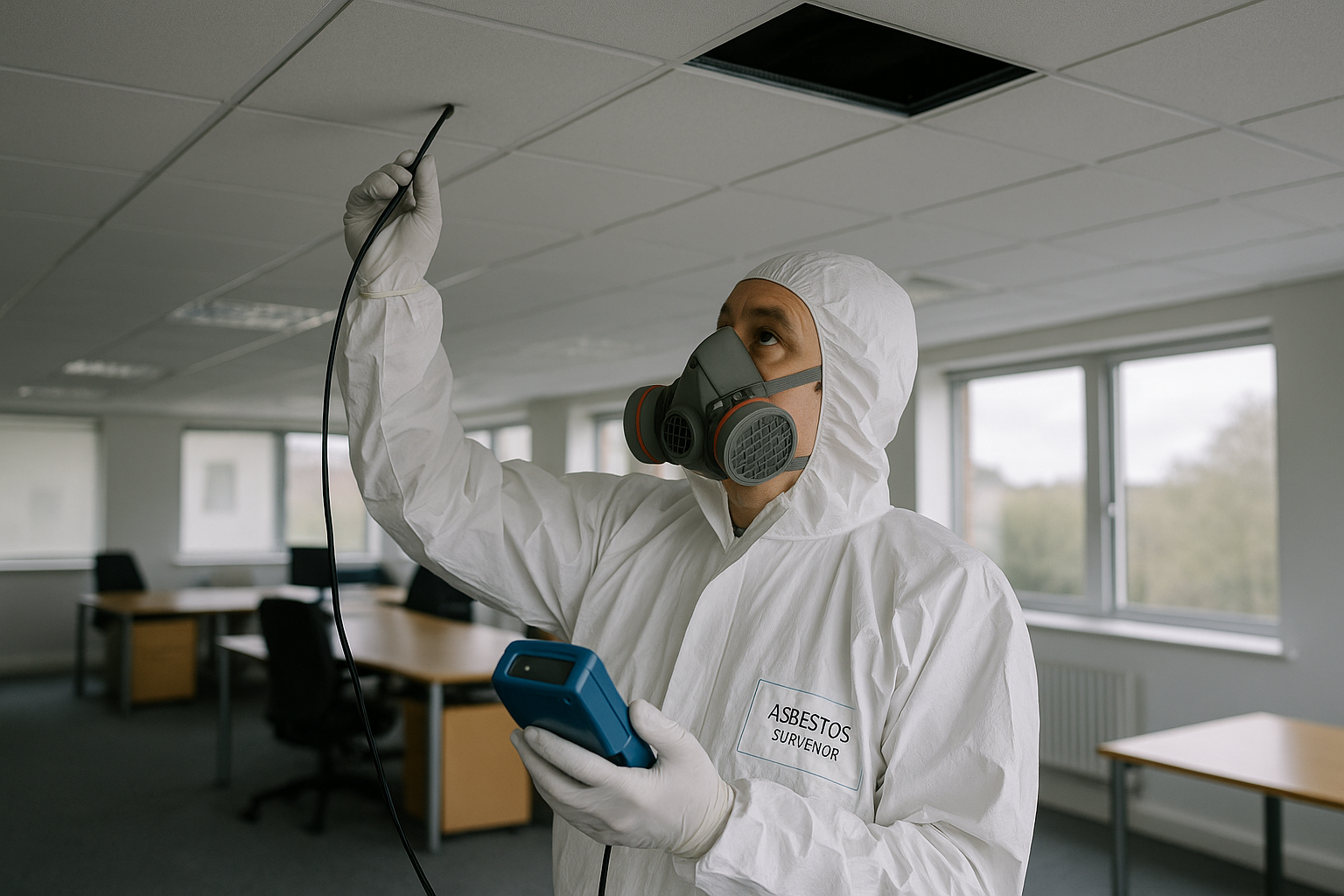
Hidden asbestos is one of the fastest ways to derail a project. Open a ceiling void, strip out a riser or start breaking through partitions without the right r&d survey, and you can turn a planned programme into an expensive stop-start problem.
For any refurbishment or demolition work in a building where asbestos may be present, an r&d survey is the survey type designed to find the materials that ordinary inspections miss. If the property was built before 2000, asbestos should be presumed unless suitable inspection and analysis show otherwise. Under the Control of Asbestos Regulations, supported by HSG264 and wider HSE guidance, intrusive work must be planned with the correct asbestos information in place before work begins.
What is an r&d survey?
An r&d survey is a refurbishment and demolition asbestos survey. Its purpose is to locate and, so far as reasonably practicable, identify asbestos-containing materials in the areas where refurbishment or demolition will take place.
This is not a light-touch inspection. An r&d survey is intrusive and often destructive because asbestos linked to building work is frequently concealed behind finishes, inside ducts, above ceilings, within risers and built into the fabric of the structure.
A properly scoped r&d survey gives property managers, contractors, principal designers and duty holders the information they need before intrusive work starts. It should make clear:
- where suspected or confirmed asbestos is located
- which materials are affected
- how far the material appears to extend
- what access was achieved during the inspection
- what limitations remain
- what action is needed before refurbishment or demolition proceeds
If your project involves opening walls, replacing services, removing ceilings, lifting floor finishes, stripping out plant or demolishing part or all of a structure, an r&d survey is usually required.
Why an r&d survey matters before refurbishment or demolition
The biggest risk on strip-out and demolition jobs is not always the asbestos you can see. It is the asbestos nobody looked for in the first place.
A suitable r&d survey helps you avoid accidental disturbance, protects workers and occupants, and allows asbestos risks to be managed before the main contractor starts opening up the building. It also helps with sequencing, pricing and tendering because contractors are not guessing what might be hidden behind the finishes.
Practical benefits of an r&d survey include:
- reducing the chance of unexpected asbestos discoveries mid-project
- allowing removal work to be planned in the right order
- helping contractors price works more accurately
- supporting safer methods of work
- preventing avoidable delays and site shutdowns
- showing where further access or isolation arrangements are needed
Leaving the survey until contractors are already on site creates pressure and usually leads to poor decisions. The right sequence is simple: define the works, scope the survey properly, review the report, then arrange any remedial action before intrusive works begin.
r&d survey vs management survey
A common mistake is assuming an existing asbestos register or routine survey is enough for refurbishment works. In many cases, it is not.
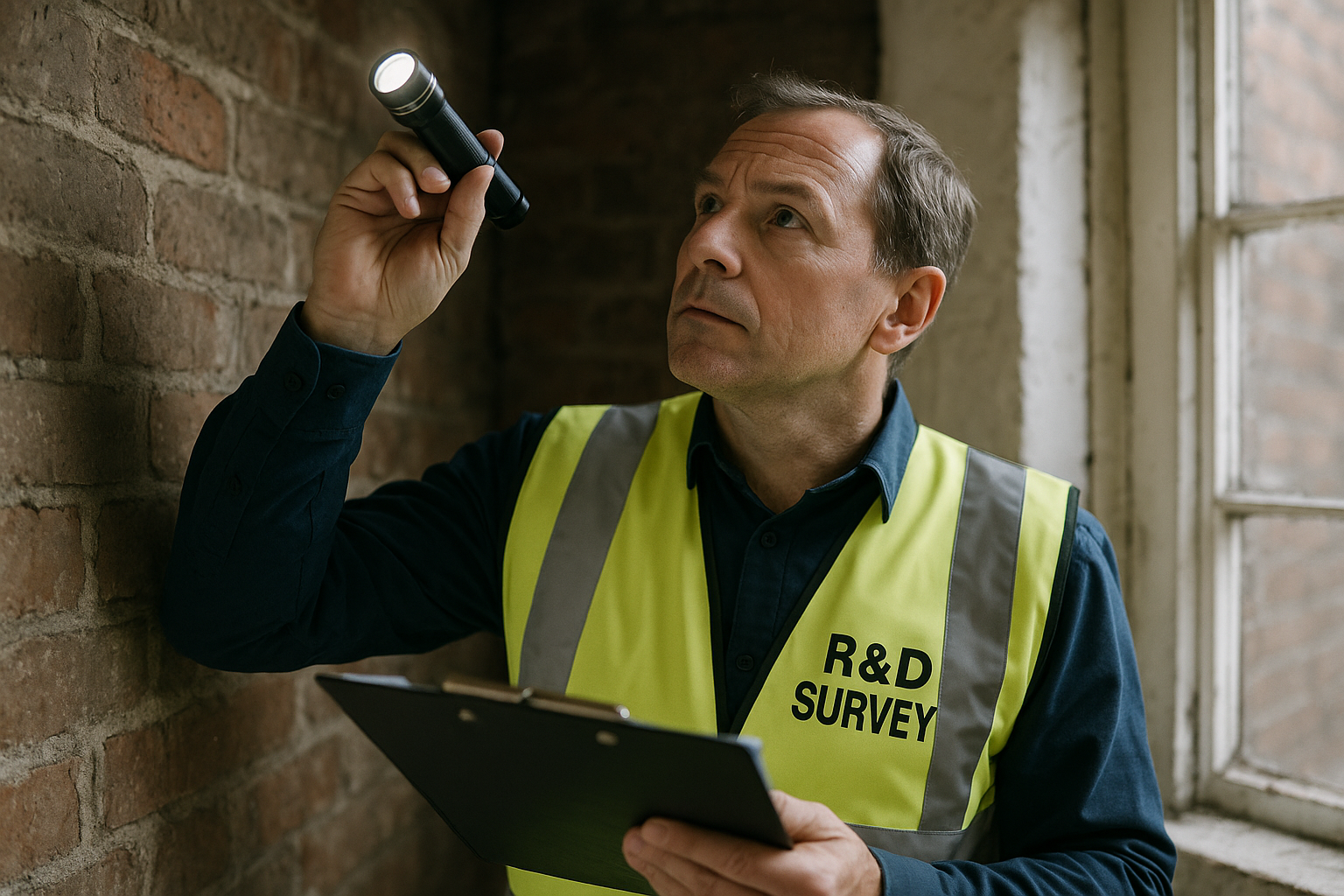
A management survey is intended for the normal occupation and day-to-day use of a building. It is usually non-intrusive or only lightly intrusive, and its purpose is to help duty holders manage asbestos-containing materials that could be disturbed during routine occupancy or minor maintenance.
An r&d survey serves a different purpose entirely. It is designed for work that will disturb the building fabric, so it must inspect hidden areas likely to be affected by the proposed refurbishment or demolition.
Key differences
- Purpose: a management survey supports ongoing occupation, while an r&d survey supports intrusive works.
- Intrusiveness: management surveys are mainly non-destructive, while an r&d survey involves opening up the structure.
- Access: an r&d survey targets concealed spaces that may be disturbed by the works.
- Occupation: the survey area for an r&d survey should normally be vacant during inspection.
If contractors plan to cut, drill, strip, demolish, rewire, replumb or alter the fabric of the building, a management survey will rarely be enough on its own.
When an r&d survey is needed
The trigger for an r&d survey is the type of work being carried out, not the size of the project. Even relatively small refurbishment jobs can disturb hidden asbestos if they involve access into the structure.
You will usually need an r&d survey before:
- full building demolition
- partial demolition
- office refurbishment
- shop fitting and retail refits
- structural alterations
- ceiling replacement
- partition removal
- rewiring and replumbing
- HVAC upgrades
- plant room strip-outs
- kitchen and bathroom refurbishment in older buildings
- opening service risers, shafts and floor voids
If the works only affect one part of a building, the r&d survey can often be limited to that area. The scope still needs to match the real works. If the project expands later, the survey scope should be reviewed and extended before new areas are disturbed.
Where a building is being demolished, a dedicated demolition survey may be required as part of the same planning process, particularly where the whole structure is due to come down and full access can be arranged.
Who typically needs an r&d survey?
The need for an r&d survey cuts across almost every property sector. If the building may contain asbestos and the works are intrusive, the principle is the same.
Projects commonly requiring an r&d survey include:
- commercial offices
- schools, colleges and universities
- retail units and shopping centres
- industrial sites and warehouses
- healthcare premises
- hotels, bars and leisure venues
- local authority estates
- residential blocks and mixed-use buildings
- plant rooms, service compounds and back-of-house areas
Different sectors bring different access issues, but the legal duty does not disappear because the site is busy, occupied or time-sensitive. If the works may disturb asbestos, the correct survey must come first.
What happens during an r&d survey?
A proper r&d survey follows a structured process. The exact approach depends on the building, the work scope and the level of access available, but the main stages are consistent.
1. Scoping the works
The survey starts with a clear understanding of what is being refurbished or demolished. This matters because the inspection should cover the areas and elements likely to be disturbed, not just the spaces that are easy to inspect.
Give the surveyor as much detail as possible. Floor plans, specifications, strip-out notes, photos and contractor information all help the r&d survey reflect the actual works.
2. Reviewing existing information
Previous asbestos reports, registers, plans and records of earlier remediation can provide useful background. They do not replace a new r&d survey, but they can help identify known risks, earlier alterations and likely asbestos locations.
Useful documents include:
- earlier asbestos reports
- existing asbestos registers
- building plans and elevations
- refurbishment history
- records of previous asbestos removal
3. Intrusive inspection
This is where an r&d survey differs most from routine survey work. Surveyors may lift floor coverings, open boxing, remove access panels, inspect behind fixed finishes, enter risers, access ceiling voids and investigate service ducts.
Common suspect materials include:
- asbestos insulating board in partitions, soffits and risers
- pipe lagging and thermal insulation
- sprayed coatings
- ceiling tiles and backing materials
- textured coatings
- vinyl floor tiles and bitumen adhesive
- cement sheets, flues and gutters
- gaskets, rope seals and plant insulation
- bath panels, cisterns and service cupboard linings
4. Sampling and analysis
Where suspect materials are found, representative samples are taken safely and sent for analysis by a UKAS-accredited laboratory. If access is not possible, the material may need to be presumed to contain asbestos unless later inspection proves otherwise.
The report should clearly state what was sampled, what was presumed and where access limitations remained.
5. Reporting and recommendations
The final r&d survey report should be practical rather than vague. It needs to explain what was inspected, what was found, what could not be accessed and what must happen before work proceeds.
A useful report will usually include:
- an executive summary
- survey scope and limitations
- material locations with photographs
- sample results
- plans or marked-up drawings where available
- recommendations for removal, making safe or further access
How to arrange an r&d survey properly
A good r&d survey starts with a good instruction. If the brief is vague, the report will often be vague too.
Use this process to get the survey right first time:
- Define the project scope. Be precise about what is being removed, altered or demolished.
- Identify affected areas. Think about walls, ceilings, floors, service routes, plant, risers and hidden voids.
- Share documents early. Provide plans, specifications, photos and access details before the visit.
- Arrange vacant access. Areas for an r&d survey should usually be unoccupied and safe to inspect.
- Confirm isolations if needed. Electrical systems, plant and restricted spaces may require special arrangements.
- Review the report before works start. Make sure the inspected areas match the intended scope of works.
- Act on recommendations. Arrange removal, encapsulation, further access or reinspection before the main project begins.
The most common client-side mistake is treating the survey as a box-ticking exercise. A rushed instruction with poor access often leads to limitations, presumptions and return visits, which means more cost and more delay.
How to check an r&d survey report is fit for purpose
Even a well-carried-out r&d survey should be reviewed carefully before contractors rely on it. The key question is simple: does the report cover every area and building element that will be disturbed?
Check the following points:
- the address and building description are correct
- the scope of works matches the planned project
- all relevant rooms, voids, risers and service areas are included
- limitations are clearly stated
- sample results are easy to follow
- presumed asbestos materials are identified
- recommendations are specific and practical
- plans and photos help contractors locate materials on site
If anything is unclear, ask before work starts. It is far better to clarify a limitation at planning stage than discover a missing area halfway through a strip-out.
Warning signs that the report may need review
- the works description is too general
- large parts of the area were inaccessible
- service risers or ceiling voids were excluded
- the report relies heavily on presumption because no access was arranged
- the project scope has changed since the survey was completed
If the planned works change, the r&d survey may also need to change. Survey information must reflect the actual work being done, not the original assumption.
Common mistakes that lead to delays and extra cost
Most asbestos-related project delays are avoidable. They usually happen because the survey was instructed too late, scoped too loosely or relied on after the works changed.
Watch out for these common mistakes:
- using a management survey for refurbishment work
- booking the r&d survey after contractors have mobilised
- failing to provide drawings or specifications
- not making areas vacant before the visit
- ignoring service ducts, risers, ceiling voids and plant spaces
- assuming previous removal means the whole area is clear
- starting work before recommendations have been acted on
- not updating the survey when the scope of works changes
Practical advice for property managers: involve the asbestos surveyor early, alongside design and pre-construction planning. That gives you time to resolve access issues, review findings and programme any remedial work properly.
Does location matter when booking an r&d survey?
The legal need for an r&d survey is the same across the UK, but local access and project pressures can vary. City-centre sites, occupied premises and multi-tenant buildings often need tighter planning and clearer communication.
If your project is in the capital, arranging an asbestos survey London service early can help with access coordination, tenant liaison and programme planning. The same applies to regional schemes where local knowledge and fast mobilisation matter, such as an asbestos survey Manchester instruction for commercial refurbishments or an asbestos survey Birmingham booking for industrial and mixed-use properties.
Wherever the building is located, the principle remains the same: the r&d survey must be correctly scoped, intrusive enough for the planned works and reviewed before any disturbance begins.
Practical steps before contractors start work
Once the r&d survey is complete, there is still work to do before the site is ready. The report is not the end of the process. It is the basis for the next decisions.
Before contractors begin, make sure you have:
- reviewed the report against the latest drawings and scope
- identified all asbestos materials that need removal or control
- arranged any licensed or non-licensed asbestos work as required
- shared relevant findings with designers, contractors and duty holders
- resolved any access limitations or excluded areas
- updated the programme to reflect asbestos-related works
- kept records with the project health and safety information
If asbestos is identified in areas due to be disturbed, do not leave decisions until the day the strip-out starts. Plan the remedial work in advance and make sure the people on site know exactly what has been found and what has already been dealt with.
Why professional support makes the r&d survey process easier
A well-delivered r&d survey is not just about finding asbestos. It is about giving you usable information that fits the project, the programme and the building.
That means clear scoping, competent inspection, reliable sampling, practical reporting and straightforward advice on what happens next. For property managers, estates teams and contractors, that level of support makes the difference between a survey that helps the job move forward and one that creates more questions than answers.
If you are planning refurbishment, strip-out or demolition, Supernova Asbestos Surveys can help you arrange the right r&d survey quickly and correctly. We provide asbestos surveying services nationwide, with clear reporting and practical advice for project teams. Call 020 4586 0680 or visit asbestos-surveys.org.uk to book a survey or discuss your project.
Frequently Asked Questions
Is an r&d survey required before every refurbishment project?
Not every minor job will need an r&d survey, but any work that disturbs the building fabric may require one. If the project involves opening up walls, ceilings, floors, risers, ducts or service routes in a building that could contain asbestos, an r&d survey is usually the correct survey type.
Can a management survey be used instead of an r&d survey?
No, not for refurbishment or demolition work. A management survey is designed for normal occupation and routine maintenance. An r&d survey is intrusive and is specifically intended to identify asbestos in the areas affected by planned refurbishment or demolition.
Does the area need to be vacant for an r&d survey?
Usually, yes. Because an r&d survey is intrusive and may involve destructive inspection, the area being surveyed should normally be unoccupied and safe to access. This helps the surveyor inspect concealed spaces properly and reduces disruption to others.
What happens if parts of the building cannot be accessed during the survey?
If access is restricted, the report should clearly identify those limitations. In some cases, materials in inaccessible areas may need to be presumed to contain asbestos until further inspection is possible. If those areas will be disturbed later, additional survey work may be needed before the project proceeds.
How long is an r&d survey valid for?
An r&d survey does not have a simple expiry date, but it is only reliable for the scope and areas it actually covered at the time of inspection. If the building changes, access improves, or the project scope expands, the survey may need to be reviewed or updated.