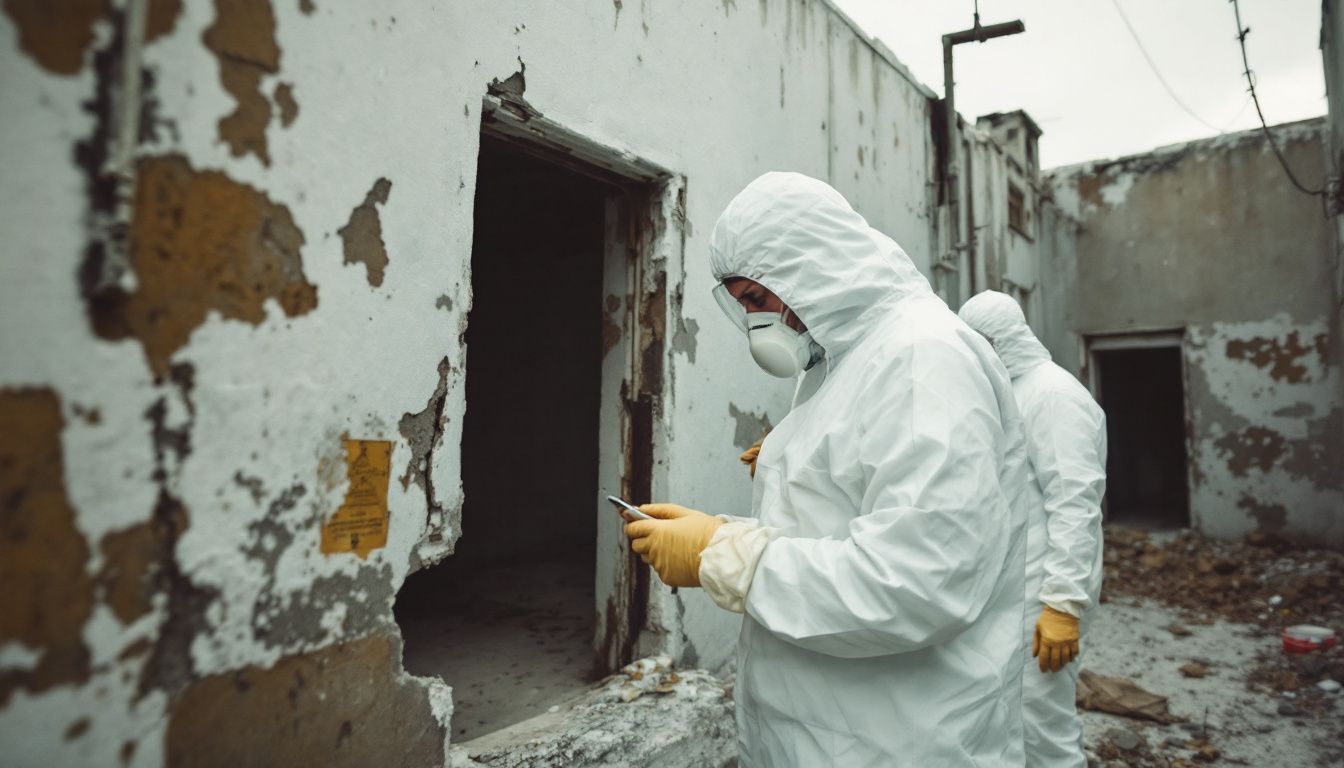
Demolishing a Building Without This Survey Is Illegal — Here’s What You Need to Know
Demolishing a building without first commissioning an asbestos demolition survey is not just dangerous — it is a criminal offence. Any structure built before 2000 could contain asbestos-containing materials (ACMs), and disturbing them without proper identification puts workers, the public, and the environment at serious risk.
Whether you are a developer, property owner, or demolition contractor, understanding what a demolition survey involves — and how it shapes every decision that follows — is essential before a single brick comes down.
What Is an Asbestos Demolition Survey?
An asbestos demolition survey is a fully intrusive inspection of a building carried out before any demolition work begins. Unlike a routine management survey, which assesses accessible areas to help manage asbestos in situ, a demolition survey is designed to locate every single ACM in the entire structure — regardless of how hidden or inaccessible it might be.
Surveyors will break into walls, lift floors, open up ceiling voids, and access all concealed spaces to ensure nothing is missed. The building is effectively treated as if it will be fully stripped, because it will be.
Every material that could contain asbestos must be identified, sampled, and tested before demolition proceeds. The results directly inform how the demolition is planned and executed. Without this data, contractors are working blind — and that is a risk no responsible party should accept.
Why the Law Requires an Asbestos Demolition Survey
The Control of Asbestos Regulations places a clear legal duty on those responsible for non-domestic premises — and on those commissioning demolition work — to ensure ACMs are identified before any structural work begins. HSE guidance, particularly HSG264, sets out the standards that surveys must meet to be legally compliant.
Failing to commission a survey before demolition is a criminal offence. Penalties include unlimited fines and, in serious cases, custodial sentences. The HSE actively investigates breaches and has the power to issue prohibition notices that halt projects immediately.
There is also a notification requirement to factor into your programme. Before any licensed asbestos removal work begins — which will almost certainly be necessary following a demolition survey — the HSE must receive at least 14 days’ advance notice. That notice cannot be served until the survey is complete and the scope of removal work is known.
Commissioning a proper demolition survey early in your project timeline is not just about compliance — it protects your programme, your budget, and most importantly, the people on site.
How an Asbestos Demolition Survey Differs From Other Survey Types
There are three main types of asbestos survey, and understanding the differences matters when planning demolition or major structural work.
Management Surveys
A management survey is used to locate and assess ACMs in a building that will remain in use. It covers accessible areas and is designed to help dutyholders manage asbestos safely over time — not to find every hidden material within the structure. It is not sufficient for demolition purposes.
Refurbishment Surveys
A refurbishment survey is required before any work that disturbs the building fabric — extensions, loft conversions, kitchen and bathroom refits, and similar projects. It is intrusive in the areas affected by the planned work, but not necessarily across the entire building. If you are carrying out a partial refurbishment rather than full demolition, this is the survey type you need.
Demolition Surveys
A demolition survey is the most thorough of the three. It must cover the entire structure, including every room, void, and concealed space that will be affected by the demolition — in most cases, that means the whole building.
Samples are taken from all suspected ACMs and sent to a UKAS-accredited laboratory for analysis. Nothing can be assumed to be asbestos-free without testing.
If your project involves both partial refurbishment and eventual demolition, you may need elements of both survey types. A qualified surveyor can advise on the right approach for your specific project.
What Does an Asbestos Demolition Survey Actually Involve?
The process is methodical and thorough. Here is what you can expect from a properly conducted survey.
Pre-Survey Preparation
Before the physical inspection begins, surveyors will review any available building records, previous asbestos registers, planning documents, and construction drawings. This desktop research helps identify where ACMs are most likely to be found and ensures the inspection is as targeted as possible.
The property owner or dutyholder should provide access to all areas of the building — including locked rooms, plant rooms, roof spaces, and basement areas. Any restrictions on access must be declared in the final report.
Physical Inspection and Sampling
The surveyor will conduct a fully intrusive inspection of the entire building. This involves:
- Breaking into walls, floors, and ceilings to access concealed materials
- Lifting floor coverings and inspecting subfloor materials
- Accessing roof voids, service ducts, and pipe runs
- Inspecting plant rooms, boiler houses, and electrical intake areas
- Checking insulation on pipes, boilers, and structural steelwork
- Examining textured coatings, floor tiles, ceiling tiles, and partition boards
Where suspected ACMs are found, bulk samples are taken using controlled methods to minimise fibre release. Each sample is carefully labelled, recorded, and sent to a UKAS-accredited laboratory for analysis. Surveyors wear appropriate personal protective equipment throughout and follow strict procedures to prevent contamination.
Laboratory Analysis
Samples are analysed by polarised light microscopy (PLM) to identify the type and concentration of asbestos fibres present. The laboratory will confirm whether asbestos is present and, if so, which type — chrysotile (white), amosite (brown), or crocidolite (blue), among others.
This information is critical for planning safe removal. Different fibre types carry different risk profiles, and licensed removal contractors need this data before they can begin work.
Survey Report and Asbestos Register
Once laboratory results are received, the surveyor produces a detailed report. A compliant demolition survey report will include:
- The location of every ACM identified, with photographs and floor plan markings
- The type, condition, and extent of each ACM
- Laboratory analysis results for all samples taken
- A risk assessment for each material identified
- Recommendations for removal prior to demolition
- An asbestos register that can be passed to the demolition contractor
This report becomes the cornerstone of your demolition strategy. Without it, no responsible contractor should be willing to proceed — and no licensed asbestos removal company can lawfully begin their work.
How Survey Results Shape the Demolition Strategy
The survey report does not just satisfy a legal requirement — it actively drives the planning and sequencing of the entire demolition project.
Prioritising Asbestos Removal Before Demolition
All ACMs identified in the survey must be removed by a licensed contractor before demolition work begins. The survey report tells the removal team exactly where each material is located, what type of asbestos it contains, and what condition it is in.
Some materials — particularly those in poor condition or in high-risk locations — will be prioritised for removal first. Others may be removed in sequence as the building is progressively stripped. The survey report provides the information needed to make these decisions correctly and safely.
Informing the Demolition Method
The presence, location, and condition of ACMs can influence how the building is demolished. In some cases, certain demolition methods may need to be modified or excluded entirely to prevent fibre release. The survey gives the demolition contractor the intelligence they need to select appropriate techniques and equipment.
Air Monitoring and Clearance
During and after asbestos removal, air monitoring is carried out to ensure fibre concentrations remain within safe limits. The survey report helps define the scope of this monitoring. Once removal is complete, a four-stage clearance procedure is typically followed before the area is released for demolition work to proceed.
Protecting Surrounding Areas
The survey identifies whether ACMs are located in areas adjacent to occupied buildings, public spaces, or sensitive environments. This information is used to plan appropriate exclusion zones, dust suppression measures, and communication with neighbouring properties or businesses.
Who Can Carry Out an Asbestos Demolition Survey?
Not just anyone can conduct a legally compliant demolition survey. Surveyors must hold recognised qualifications — the BOHS P402 certificate is the industry standard — and must be competent to conduct fully intrusive surveys in accordance with HSG264.
The surveying organisation should ideally hold UKAS accreditation for asbestos surveying, which provides independent assurance that their processes meet the required standard. Always ask to see evidence of qualifications and accreditation before appointing a surveyor.
Laboratory analysis must also be carried out by a UKAS-accredited laboratory. Samples sent to non-accredited labs will not produce results that are legally defensible or accepted by the HSE.
Common Challenges in Demolition Surveys
Demolition surveys are not always straightforward. Buildings that have been modified over the years, poorly maintained, or partially stripped before the survey was commissioned can present real challenges.
Access restrictions are one of the most common issues. If parts of the building cannot be accessed — due to structural instability, security concerns, or other factors — these limitations must be clearly documented in the report. Any inaccessible area must be treated as potentially containing ACMs until proven otherwise.
Older buildings may also contain materials that are difficult to identify visually. Asbestos was used in a wide range of products — textured coatings, floor tiles, roof sheets, pipe insulation, gaskets, ceiling tiles, and more — and some of these are not immediately obvious. An experienced surveyor will know where to look and what to look for.
Structural instability in buildings awaiting demolition can also create safety challenges for surveyors. A thorough risk assessment should be carried out before the survey begins to confirm the building is safe to enter and inspect.
How Much Does an Asbestos Demolition Survey Cost?
Survey costs vary depending on the size and complexity of the building, the level of access available, and the number of samples that need to be taken. A small commercial unit will cost significantly less to survey than a large industrial complex or multi-storey building.
What is consistent is that the cost of a survey is always a fraction of the cost of getting it wrong. Unplanned discovery of ACMs mid-demolition can halt a project for weeks, trigger HSE enforcement action, and result in costly emergency removal work. The survey is not an overhead — it is an investment in a project that runs on time and on budget.
To get an accurate quote, contact a qualified surveying company with details of the property type, size, age, and any known history of previous asbestos work. A reputable surveyor will be able to provide a clear, itemised quotation before any work begins.
Asbestos Demolition Surveys Across the UK
Demolition projects happen across the country, and the requirement for a compliant survey applies regardless of location. If you need an asbestos survey London teams can rely on, or you are overseeing a development in the North West and need an asbestos survey Manchester based surveyors can deliver, or you are coordinating work in the Midlands and require an asbestos survey Birmingham professionals can provide — the legal standards are identical and the obligations are the same.
Supernova Asbestos Surveys operates nationwide, with experienced teams covering all regions of England, Scotland, and Wales. With over 50,000 surveys completed, we understand the pressures that come with demolition project timelines and the need for accurate, actionable results.
Key Steps Before You Demolish: A Quick Reference
- Commission a demolition survey — appoint a UKAS-accredited surveying company with qualified, experienced surveyors
- Receive and review the survey report — ensure it includes a full asbestos register, risk assessments, and removal recommendations
- Appoint a licensed removal contractor — only licensed contractors can remove most ACMs found during demolition surveys
- Notify the HSE — at least 14 days before licensed removal work begins
- Complete asbestos removal — in line with the survey report, with air monitoring throughout
- Obtain clearance certificates — following the four-stage clearance procedure
- Proceed with demolition — with confidence that the site has been properly cleared
Frequently Asked Questions
Is an asbestos demolition survey a legal requirement?
Yes. Under the Control of Asbestos Regulations and associated HSE guidance (HSG264), a demolition survey is a legal requirement before any demolition work begins on a building that may contain asbestos. Failure to commission one before demolition is a criminal offence, carrying the risk of unlimited fines and, in serious cases, custodial sentences.
Can I use a management survey instead of a demolition survey?
No. A management survey is designed to help dutyholders manage asbestos safely in a building that remains in use. It does not cover concealed or inaccessible areas and is not sufficient for demolition purposes. A fully intrusive demolition survey is required before any demolition work proceeds.
How long does an asbestos demolition survey take?
The duration depends on the size and complexity of the building. A small commercial property may be surveyed in a single day, while a large industrial or multi-storey building could take several days. Laboratory analysis of samples typically adds five to ten working days before the final report is issued. Factor this into your project programme from the outset.
What happens if asbestos is found during a demolition survey?
Finding asbestos during a demolition survey is not a problem — it is the purpose of the survey. Once ACMs are identified and confirmed by laboratory analysis, a licensed asbestos removal contractor is appointed to remove them before demolition proceeds. The survey report provides all the information the removal team needs to plan and execute the work safely and efficiently.
Do I need a demolition survey for a residential property?
The legal duty under the Control of Asbestos Regulations applies specifically to non-domestic premises. However, any residential building built before 2000 could contain ACMs, and demolishing without identifying them first puts workers and the public at risk. Many local authorities and demolition contractors will require evidence of an asbestos survey before work begins on residential demolition projects, regardless of the strict legal position. It is strongly advisable to commission one.
Get Your Asbestos Demolition Survey Booked Today
Supernova Asbestos Surveys has completed over 50,000 surveys across the UK. Our qualified, UKAS-accredited surveyors deliver fully compliant demolition surveys that give you the data you need to plan your project safely and legally — with fast turnaround times that keep your programme on track.
Call us on 020 4586 0680 or visit asbestos-surveys.org.uk to request a quote or speak to a member of our team.