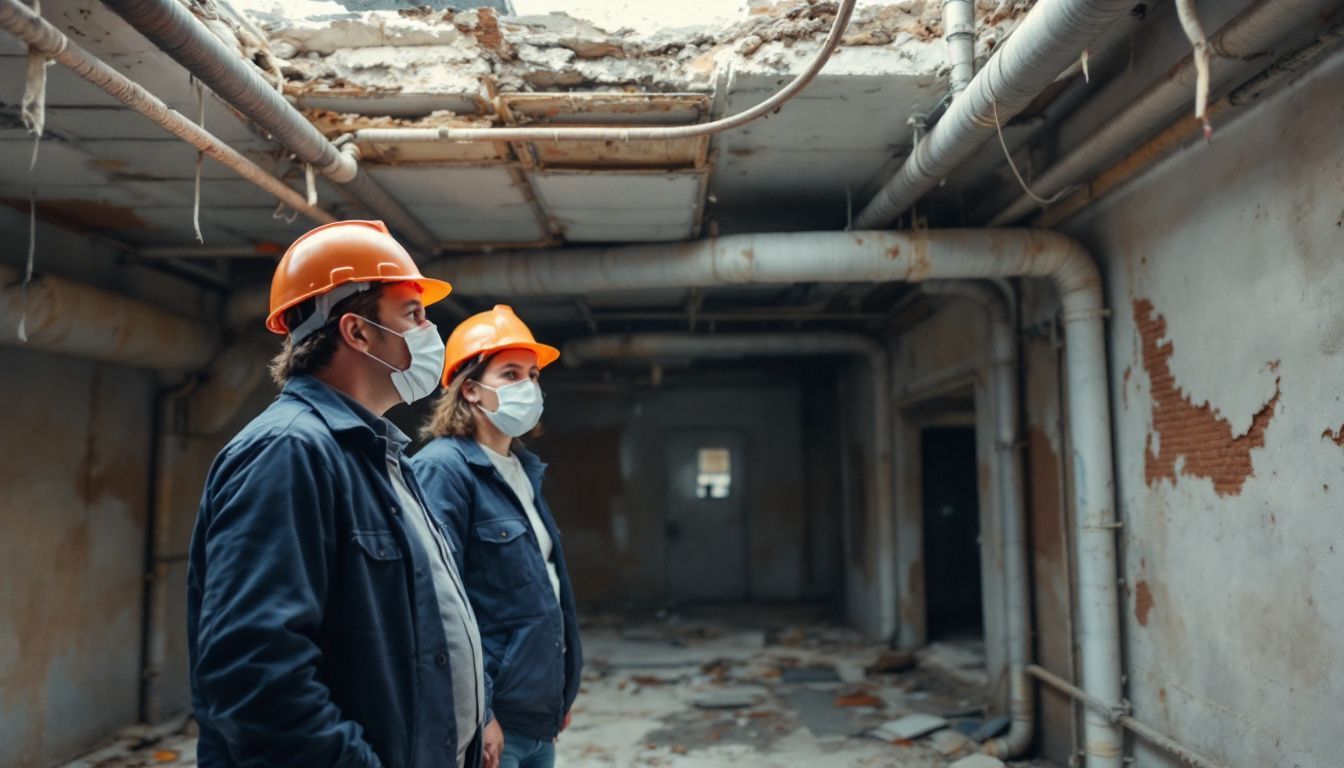
Asbestos in Buildings UK: What Every Property Owner and Manager Needs to Know
Asbestos kills more people in the UK each year than road traffic accidents. It sits quietly inside millions of older buildings — in ceiling tiles, pipe lagging, floor coverings, and textured coatings — causing no harm whatsoever until it is disturbed. That is precisely what makes asbestos in buildings UK-wide such a persistent and serious problem.
The danger is invisible, the consequences are irreversible, and the legal duties on property owners are absolute. Whether you manage a commercial premises, own a block of flats, or are about to start a refurbishment project, understanding asbestos is not optional.
Why Asbestos in Buildings UK Remains a Major Concern
Asbestos was used extensively in UK construction from the 1950s through to the late 1990s. It was cheap, fire-resistant, and incredibly versatile — which is why it ended up in everything from roof sheeting to textured decorative coatings like Artex.
The UK banned the use of all forms of asbestos in 1999, but that ban did nothing to remove the material already embedded in the building stock. The HSE acknowledges that asbestos-containing materials (ACMs) remain present in a significant proportion of non-domestic buildings constructed before 2000.
Schools, hospitals, offices, factories, warehouses, and housing association blocks are all affected. Even some domestic properties built before 2000 can contain ACMs, particularly in garages, outbuildings, and utility areas.
The fibres released when ACMs are disturbed are microscopic and can remain airborne for hours. Once inhaled, they become permanently lodged in lung tissue — and the diseases they cause typically take 20 to 50 years to develop, which is why asbestos-related deaths are still rising despite the ban on use.
Which Materials in Buildings Are Likely to Contain Asbestos?
One of the most common misconceptions is that asbestos is easy to spot. It is not. ACMs look like ordinary building materials because, in most cases, they are ordinary building materials — just with asbestos fibres mixed in during manufacture.
The following materials commonly contained asbestos in buildings constructed before 2000:
- Sprayed coatings — used on structural steelwork and concrete for fire protection
- Pipe and boiler lagging — insulation wrapped around heating systems and pipework
- Insulating board (AIB) — used for fire doors, ceiling tiles, partition walls, and service duct linings
- Textured coatings — Artex and similar decorative finishes on ceilings and walls
- Asbestos cement products — roof sheets, guttering, downpipes, and cladding panels
- Floor tiles and vinyl flooring — particularly thermoplastic tiles from the 1960s and 1970s
- Rope seals and gaskets — used in boilers, furnaces, and industrial equipment
- Bitumen products — roofing felt and damp-proof courses
The only reliable way to confirm whether a material contains asbestos is laboratory analysis. Visual inspection alone is never sufficient, and assuming a material is safe without testing it is not an acceptable approach under UK law.
The Health Risks: Why Asbestos Exposure Cannot Be Undone
The health consequences of asbestos exposure are severe, progressive, and incurable. Understanding them is essential context for why the legal framework around asbestos in buildings UK-wide is so stringent.
Mesothelioma
Mesothelioma is a cancer of the lining of the lungs, abdomen, or heart. It is almost exclusively caused by asbestos exposure and is invariably fatal. There is no cure, and median survival after diagnosis is typically measured in months rather than years.
Asbestosis
Asbestosis is a chronic scarring of the lung tissue caused by prolonged asbestos fibre inhalation. It causes progressive breathlessness and significantly reduces quality of life. Like mesothelioma, it is irreversible.
Asbestos-Related Lung Cancer
Long-term asbestos exposure substantially increases the risk of lung cancer, particularly in combination with smoking. The risk is multiplicative — a smoker who has also been exposed to asbestos faces a dramatically elevated risk compared to either factor alone.
Pleural Plaques and Pleural Thickening
These are non-cancerous changes to the lining of the lungs caused by asbestos exposure. While not immediately life-threatening, they indicate past exposure and can cause discomfort and reduced lung function over time.
The latency period for all asbestos-related diseases is long — often 20 to 50 years. Workers exposed in the 1970s and 1980s are still being diagnosed today, and anyone exposed now may not develop symptoms until the 2040s or beyond.
Who Is at Risk? High-Risk Occupations and Bystander Exposure
Asbestos exposure is an occupational hazard for a wide range of trades and professions. The HSE consistently identifies certain groups as being at elevated risk due to the nature of their work in older buildings.
High-risk occupations include:
- Construction and demolition workers
- Electricians working in older commercial and industrial premises
- Plumbers and heating engineers
- Joiners and carpenters
- Plasterers and decorators
- Roofers working with asbestos cement products
- Maintenance workers in schools, hospitals, and public buildings
- Gas and utility engineers entering older properties
The risk is not limited to those who work directly with ACMs. Bystander exposure — where workers in the vicinity of asbestos disturbance are affected — is a recognised and serious hazard. A decorator sanding an Artex ceiling in an unventilated room can generate fibre levels that far exceed safe limits without ever knowing the material contained asbestos.
Legal Duties: What UK Law Requires
The legal framework governing asbestos in buildings UK-wide is primarily set out in the Control of Asbestos Regulations. These regulations place clear, enforceable duties on dutyholders — typically the owners or managers of non-domestic premises.
The Duty to Manage
Regulation 4 of the Control of Asbestos Regulations places a duty to manage asbestos on anyone responsible for maintaining or repairing non-domestic premises. This duty also extends to the common parts of domestic premises — stairwells, corridors, and communal areas in blocks of flats.
The duty to manage requires dutyholders to:
- Take reasonable steps to determine whether ACMs are present in the premises
- Assess the condition of any ACMs found and the risk they present
- Prepare and implement a written asbestos management plan
- Monitor the condition of ACMs on a regular basis
- Provide information about ACM locations to anyone who may disturb them
- Review and update the management plan as circumstances change
Failure to comply with the duty to manage is a criminal offence. Enforcement action by the HSE can result in substantial fines and, in serious cases, imprisonment. There is no defence of ignorance — if you are responsible for a building, you are required to know what it contains.
Licensed and Non-Licensed Asbestos Work
Not all asbestos work requires a licensed contractor, but the highest-risk activities do. The Control of Asbestos Regulations divide asbestos work into three categories: licensed work, notifiable non-licensed work (NNLW), and non-licensed work.
Licensed work — which includes removing pipe lagging, sprayed coatings, and asbestos insulating board — must be carried out by a contractor holding a licence from the HSE. Using an unlicensed contractor for licensable work is a serious criminal offence.
Non-licensed and NNLW activities, such as working with asbestos cement in good condition, still require proper risk assessment, appropriate training, and suitable protective measures. The distinction between categories is not always obvious, and when in doubt, the safer course is always to treat the work as licensable.
HSG264: The Survey Standard
The HSE’s guidance document HSG264 sets out the standards for asbestos surveying in the UK. It defines the two main survey types and specifies how they should be conducted. Any survey that does not follow HSG264 is not compliant, regardless of who carries it out.
Asbestos Surveys: Your First Line of Defence
If you do not know what asbestos-containing materials are present in your building, you cannot manage them. An asbestos survey is the essential first step for any dutyholder, and it is the foundation of a legally compliant asbestos management plan.
Management Surveys
A management survey is the standard survey required for buildings in normal occupation and use. It identifies ACMs that could be damaged or disturbed during everyday activities and assesses the risk they present.
The output is an asbestos register — a document recording the location, type, condition, and risk rating of every ACM found — along with a management plan setting out how those materials should be controlled.
Refurbishment and Demolition Surveys
Before any refurbishment or demolition work begins, a more intrusive survey is required. A demolition survey involves destructive inspection techniques to locate all ACMs in the areas to be disturbed. It must be completed before contractors start work — not after the fact.
Re-Inspection Surveys
Where ACMs are being managed in situ — left in place because they are in good condition and low risk — they must be monitored regularly. A re-inspection survey checks the condition of known ACMs against the original register and updates the risk assessment accordingly. Annual re-inspections are standard practice for most commercial premises.
What Happens If Asbestos Needs to Be Removed?
Not all asbestos needs to be removed. In many cases, ACMs in good condition and low-risk locations are better left in place and managed. Disturbance during unnecessary removal can create more risk than leaving the material undisturbed.
However, when removal is necessary — because the material is damaged, deteriorating, or in an area that will be disturbed during works — it must be done properly. Professional asbestos removal by a licensed contractor involves strict containment procedures, specialist equipment, air monitoring, and correct disposal of waste materials at a licensed facility.
Attempting to remove high-risk asbestos materials without a licence is illegal and extremely dangerous. This is not a corner that can be cut.
Testing: What to Do If You Suspect Asbestos
If you suspect a material in your property may contain asbestos but you are not ready to commission a full survey, a testing kit allows you to collect a sample and have it analysed at a UKAS-accredited laboratory. This is a useful first step for homeowners and small business premises.
Samples should always be collected carefully, following the instructions provided, to minimise fibre release. If you are in any doubt about how to collect a sample safely, commission a professional survey instead.
A testing kit does not replace a full management survey for non-domestic properties with a duty to manage.
Asbestos and Fire Risk: An Overlooked Connection
Asbestos management and fire safety are often treated as separate compliance concerns, but they are closely linked in older buildings. Many ACMs were used specifically for their fire-resistant properties — fire doors lined with asbestos insulating board, for example, or fireproofing sprayed onto structural steelwork.
If your building requires a fire risk assessment, the assessor needs to know the location of ACMs, particularly those that form part of the passive fire protection system. Removing or damaging these materials without understanding their role in fire safety can compromise the building’s fire resistance — and disturbing them without proper controls creates an asbestos hazard simultaneously.
Coordinating your asbestos management plan with your fire risk assessment is good practice and, in complex buildings, essential.
Asbestos Management Best Practices for Dutyholders
Managing asbestos in buildings UK-wide comes down to a consistent, documented, and proactive approach. The following principles apply whether you manage a single office suite or a portfolio of commercial properties.
- Commission a survey before assuming anything. If your building was constructed before 2000 and you do not have a current asbestos register, commission a management survey now. Do not wait for a trigger event.
- Keep your register up to date. An asbestos register is a living document. It must be updated whenever works are carried out, materials are removed, or re-inspection surveys identify changes in condition.
- Brief contractors before they start work. Every contractor working in your building must be told about the location and condition of ACMs before they begin. This is a legal requirement, not a courtesy.
- Do not disturb ACMs unnecessarily. If a material is in good condition and not at risk of being damaged, leaving it in place and monitoring it is usually the right decision.
- Use licensed contractors for licensable work. Check that any contractor you engage for asbestos work holds a current HSE licence. You can verify this on the HSE’s licensed asbestos contractor register.
- Schedule annual re-inspections. The condition of ACMs can change. Regular re-inspection is the only way to catch deterioration before it becomes a hazard.
- Document everything. Records of surveys, re-inspections, contractor briefings, and remedial works are your evidence of compliance. Keep them accessible and organised.
Where Supernova Surveys Across the UK
Asbestos in buildings is a nationwide issue, and Supernova Asbestos Surveys operates across the length and breadth of the UK. Whether you need an asbestos survey in London, an asbestos survey in Manchester, or an asbestos survey in Birmingham, our UKAS-accredited surveyors are available to help.
With over 50,000 surveys completed nationwide, we have the experience and the accreditation to deliver surveys that are compliant, thorough, and clearly reported. Every survey follows HSG264 guidance, and every report is produced in a format that supports your duty to manage.
Frequently Asked Questions
Is asbestos still present in UK buildings?
Yes. The use of asbestos was banned in the UK in 1999, but the ban did not require the removal of materials already installed. ACMs remain present in a significant proportion of non-domestic buildings constructed before 2000, as well as in many domestic properties — particularly in garages, outbuildings, and utility spaces.
Do I need an asbestos survey if my building was built before 2000?
If you are responsible for a non-domestic building constructed before 2000, you have a legal duty under the Control of Asbestos Regulations to manage asbestos. This begins with determining whether ACMs are present, which in practice means commissioning a management survey. You cannot fulfil your legal duty without knowing what your building contains.
What is the difference between a management survey and a demolition survey?
A management survey is designed for buildings in normal occupation. It identifies accessible ACMs and assesses the risk they present during everyday use. A demolition survey is required before any refurbishment or demolition work and involves more intrusive, destructive inspection to locate all ACMs in the affected areas — including those hidden behind walls, above ceilings, and beneath floors.
Can I remove asbestos myself?
It depends on the type of material and the nature of the work. Some minor non-licensed activities — such as removing a small number of asbestos cement sheets in good condition — may be carried out by a competent person following a proper risk assessment. However, the removal of higher-risk materials such as pipe lagging, sprayed coatings, or asbestos insulating board must be carried out by an HSE-licensed contractor. If you are unsure which category applies, treat the work as licensable.
How often should ACMs be re-inspected?
For most commercial premises, annual re-inspection is standard practice and is consistent with HSE guidance. However, the appropriate frequency depends on the condition and location of the ACMs, the level of activity in the building, and any changes to how the premises are used. A qualified surveyor can advise on the right re-inspection schedule for your specific building.
Get Expert Help With Asbestos in Your Building
Supernova Asbestos Surveys has completed over 50,000 surveys across the UK. Our UKAS-accredited team delivers management surveys, demolition surveys, re-inspections, and asbestos removal support — all in line with HSG264 and the Control of Asbestos Regulations.
If you manage a building constructed before 2000 and you are not certain what asbestos-containing materials it contains, the time to act is now — not when a contractor disturbs something they should not have.
Call us on 020 4586 0680 or visit asbestos-surveys.org.uk to book a survey or speak to one of our team.