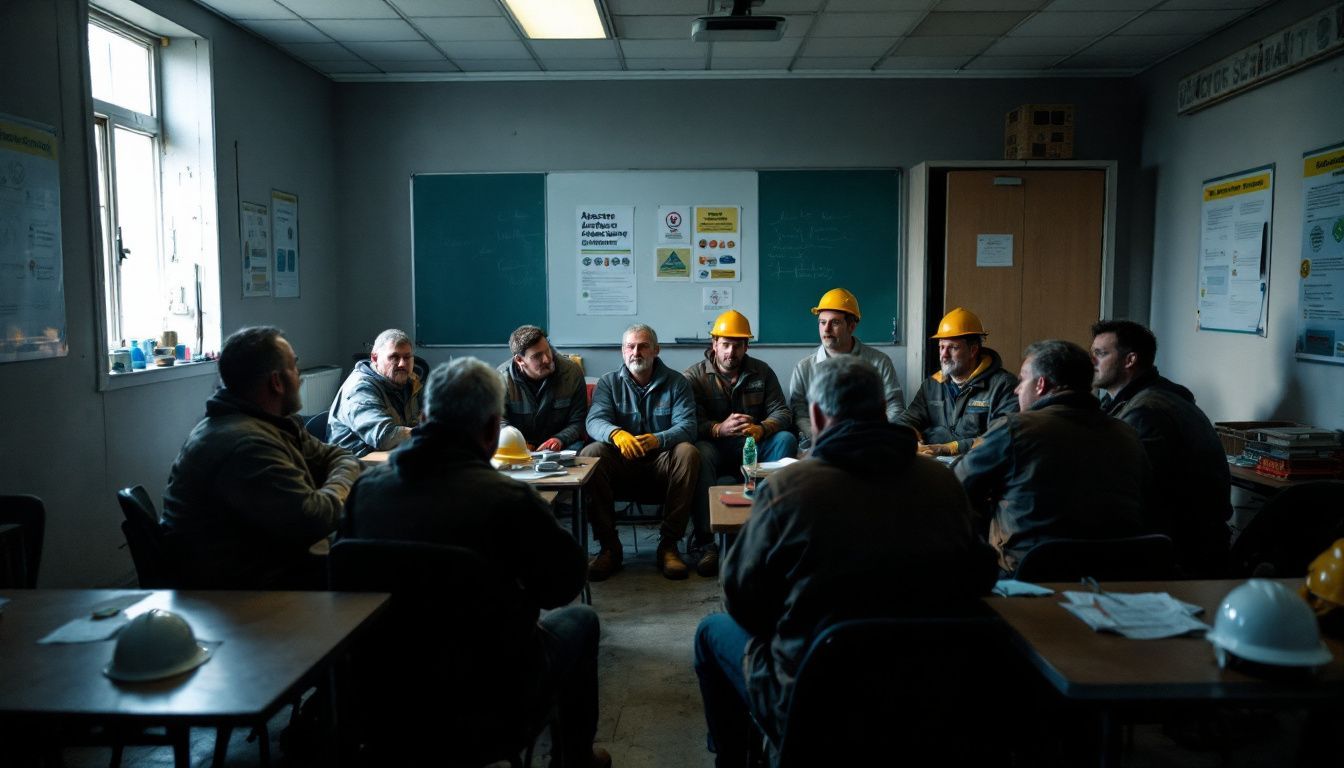
Who Requires Asbestos Training? The UK Rules Every Employer and Worker Must Know
Asbestos kills more people in the UK each year than any other single work-related cause. The fibres are invisible, odourless, and give no immediate warning when they enter the lungs — yet the buildings most of us work in every day may still contain them. Understanding who requires asbestos training is not a box-ticking exercise. It is a legal obligation that directly determines whether workers go home healthy or carry a fatal diagnosis for the rest of their lives.
This affects far more people than most employers realise. It is not limited to demolition crews or specialist contractors. Electricians, plumbers, joiners, facilities managers, and even surveyors visiting live sites all fall within the scope of the law — and the consequences of getting it wrong are severe.
The Scale of the Asbestos Problem in UK Buildings
Asbestos was used extensively in UK construction from the 1950s until it was banned in 1999. That is nearly five decades of widespread use across homes, schools, hospitals, offices, factories, and public buildings. A significant proportion of the UK’s non-domestic building stock still contains asbestos in some form today.
For anyone regularly working on pre-2000 buildings, encountering asbestos-containing materials (ACMs) is not a remote possibility — it is close to an inevitability. Electricians chasing cables through old walls, plumbers working around lagged pipework, roofers lifting corrugated sheets, joiners cutting through partition boards — all of these trades routinely disturb asbestos, often without knowing it.
That is precisely why the question of who requires asbestos training is so important. The hazard is widespread, largely hidden, and entirely preventable with the right knowledge and approach.
What the Law Says About Asbestos Training
The Control of Asbestos Regulations set out clear legal duties for both employers and workers. Any worker who is liable to disturb asbestos during their work — even incidentally — must receive asbestos awareness training. This is not optional guidance. It is a legal requirement.
The HSE’s guidance, including HSG264, is unambiguous on this point: if a worker’s activities could reasonably disturb ACMs, they must be trained before carrying out that work. Employers have a duty to ensure their workforce is trained, and workers have a corresponding duty to follow the safe systems of work that training establishes.
Failure to comply can result in improvement notices, prohibition notices, unlimited fines, and criminal prosecution. The HSE actively enforces asbestos compliance in the construction sector, and enforcement action is far from rare.
Who Requires Asbestos Training? The Full List
The straightforward answer is: most people who work on or inside buildings constructed before 2000. The Control of Asbestos Regulations specifically highlight trades and roles most at risk. If you fall into any of the following categories, asbestos awareness training applies to you.
Trades Most Commonly at Risk
- Electricians and electrical contractors
- Plumbers and heating engineers
- Carpenters and joiners
- Plasterers
- Roofers
- HVAC engineers
- General builders and labourers
- Demolition workers
- Fire and security system installers
- Gas engineers
- Painters and decorators
Non-Trade Roles That Also Require Training
It is not only hands-on trades that need training. The following roles carry significant exposure risk and are equally covered by the regulations:
- Facilities managers and building maintenance staff
- Site managers and contracts managers
- Architects and surveyors visiting live sites
- Housing association and local authority maintenance teams
- School and hospital estates teams
- Property managers overseeing older building stock
If your work involves cutting, drilling, sanding, breaking, or otherwise disturbing building materials in structures built before 2000, asbestos awareness training applies to you — regardless of your job title.
The Health Risks That Make Training Non-Negotiable
Understanding why asbestos is so dangerous is central to understanding why training matters so much. These are not mild occupational irritants. Asbestos-related diseases are progressive, largely untreatable, and fatal.
Mesothelioma
Mesothelioma is a cancer of the lining of the lungs — and sometimes the abdomen or heart — caused almost exclusively by asbestos exposure. It is always fatal, typically within 12 to 18 months of diagnosis. There is no cure.
Symptoms, including chest pain, breathlessness, and persistent cough, do not usually appear until decades after the exposure that caused them. Many people receiving diagnoses today were exposed on construction sites in the 1970s, 1980s, or 1990s — often with no awareness of the risk at the time.
Asbestos-Related Lung Cancer
Asbestos is a recognised cause of lung cancer independently of smoking, though the two combined dramatically increase risk. Like mesothelioma, asbestos-related lung cancer typically has a latency period of 15 to 40 years. By the time symptoms develop, the cancer is frequently advanced and difficult to treat.
Asbestosis
Asbestosis is a chronic, progressive scarring of lung tissue caused by inhaling asbestos fibres over time. It is not cancer, but it significantly reduces lung function, causes persistent breathlessness, and has no curative treatment. It also increases the risk of developing mesothelioma or lung cancer.
Pleural Disease
Pleural plaques and pleural thickening affect the tissue surrounding the lungs. They are markers of asbestos exposure and can cause chronic breathlessness and discomfort, significantly reducing quality of life over time.
All of these conditions are entirely preventable through awareness, correct identification, and safe working practices. That is exactly what good asbestos training delivers.
What Asbestos Awareness Training Actually Covers
Effective asbestos awareness training is not a slideshow about how bad asbestos is. It equips workers with practical, on-site knowledge they can apply from their very next job.
Identifying Asbestos-Containing Materials
Workers learn to recognise where ACMs are commonly found in buildings and what forms they take. Asbestos was used in a huge range of construction products, including:
- Ceiling tiles and floor tiles
- Pipe and boiler lagging
- Sprayed coatings on structural steelwork
- Roof sheets and soffit boards
- Textured wall and ceiling coatings, including Artex
- Insulating board used in partition walls, fire doors, and ceiling panels
- Cement products, including gutters, flues, and rainwater pipes
- Gaskets and rope seals around boilers and furnaces
You cannot reliably identify asbestos by sight alone — the only certain way to confirm whether a material contains asbestos is through laboratory analysis. Training gives workers the knowledge to treat suspect materials with appropriate caution and to know when to stop work and seek guidance.
Understanding the Different Types of Asbestos
Not all asbestos is the same. The three types most commonly found in UK buildings are:
- Chrysotile (white asbestos) — the most widely used, found in cement products, roofing, and floor tiles
- Amosite (brown asbestos) — commonly found in insulating board and ceiling tiles; considered particularly hazardous
- Crocidolite (blue asbestos) — the most dangerous form, found in some insulation products and sprayed coatings; less common but very high-risk
All three types are dangerous. Training ensures workers do not make the mistake of assuming only one type needs careful handling.
Licensed Versus Non-Licensed Work
Not all work involving asbestos requires a licensed contractor — but understanding where that line sits is crucial. Some lower-risk, short-duration work with certain non-friable ACMs can be carried out by trained workers without a licence. Other work — particularly involving friable asbestos, sprayed coatings, or insulation — must only be done by HSE-licensed contractors.
Getting this wrong is not just dangerous. It is a criminal offence. Asbestos awareness training helps workers and supervisors understand which category a given task falls into.
Safe Working Practices and Emergency Procedures
Training covers the practical steps workers must take to minimise risk, including:
- Stopping work immediately if asbestos is suspected or discovered unexpectedly
- Not disturbing or attempting to clean up suspected ACMs
- Reporting finds to a supervisor and following the site’s asbestos management plan
- Using appropriate PPE, including FFP3 respirators
- Decontamination procedures — how to remove and dispose of PPE and contaminated clothing safely
- Understanding the site’s emergency procedures if accidental disturbance occurs
The Duty to Manage: What Employers and Dutyholders Must Understand
For those working in commercial, industrial, or public buildings, there is an additional layer to understand. The Control of Asbestos Regulations places a specific duty to manage on those responsible for the maintenance and repair of non-domestic premises.
In practice, this means that before any construction, refurbishment, or maintenance work begins, the dutyholder — usually the building owner or facilities manager — should have an up-to-date asbestos management survey in place. This survey records the location, condition, and type of any ACMs in the building, forming the foundation of an asbestos management plan.
As a construction worker or site manager, you are entitled to ask to see this information before work begins. If no survey exists, that is a serious red flag — and further investigation is needed before any work proceeds.
Choosing the Right Asbestos Survey Before Work Starts
Understanding the different types of asbestos surveys is directly relevant to anyone managing or working on construction projects. Getting the right survey commissioned before work starts is not a formality — it is a legal requirement and a genuine safety measure.
Management Surveys
A management survey is suitable for occupied buildings where normal day-to-day activities and maintenance are taking place. It identifies ACMs that could be disturbed during routine work and forms the basis of an asbestos management plan. If you are responsible for an occupied commercial or public building, this is likely the survey you need.
Refurbishment and Demolition Surveys
Before any refurbishment, renovation, or demolition work begins, a more intrusive survey is required. A demolition survey involves accessing all areas that will be disturbed by the planned work — including above ceilings, inside voids, and behind panels. It is destructive by nature, because the surveyor needs to inspect areas that standard management surveys do not access.
If you are about to start a refurbishment project and no survey has been commissioned, work should not begin until one has been completed. This protects both the workers on site and the building’s dutyholder from serious legal and health consequences.
Refresher Training: Keeping Knowledge Current
Asbestos awareness training is not a one-time event. HSE guidance recommends that workers refresh their training regularly — typically every year — to ensure their knowledge stays current and relevant. This is particularly important as regulations, best practices, and site-specific circumstances evolve.
Refresher training does not need to be expensive or time-consuming. What matters is that it is delivered properly, covers the key areas, and is recorded. Employers should maintain training records and make them available for inspection.
If you cannot demonstrate that a worker has been trained, the HSE will treat them as untrained — regardless of their experience on site. That is a significant liability for any employer.
What Happens When Workers Are Not Trained
Workers who inadvertently disturb asbestos without training are at far greater risk of exposure — not because the asbestos is more dangerous, but because they lack the knowledge to recognise the hazard, stop work, or take appropriate precautions. A single uncontrolled disturbance of friable asbestos can release millions of fibres into the air in a matter of seconds.
For employers, the consequences extend beyond the immediate health risk. HSE inspectors can issue prohibition notices that halt work on site immediately, causing significant financial disruption. Improvement notices require documented corrective action within a specified timeframe. In serious cases, prosecutions can result in unlimited fines and custodial sentences for company directors and senior managers.
The reputational damage of an asbestos enforcement action can be equally damaging — particularly for contractors working in the public sector or on regulated sites where compliance records are scrutinised carefully.
Asbestos Training Across the UK: What Regional Workers Need to Know
The legal requirements for asbestos training apply equally across England, Scotland, Wales, and Northern Ireland. Whether you are managing a refurbishment project in the capital or overseeing maintenance work in the Midlands or the North, the obligations under the Control of Asbestos Regulations are the same.
If you are based in or around the capital and need a survey before work begins, our asbestos survey London service covers the full Greater London area. For projects in the North West, our asbestos survey Manchester team operates across Greater Manchester and the surrounding region. In the Midlands, our asbestos survey Birmingham service covers Birmingham and the wider West Midlands area.
Wherever your project is located, having a qualified surveyor assess the building before work begins is the most reliable way to protect your workforce and meet your legal obligations.
Practical Steps for Employers Right Now
If you are an employer or dutyholder reviewing your asbestos compliance position, here is where to start:
- Audit your workforce. Identify every worker whose role could involve disturbing building materials in pre-2000 structures. This list is likely longer than you expect.
- Check training records. Confirm that every relevant worker has completed asbestos awareness training within the last 12 months. If records are missing or out of date, arrange refresher training immediately.
- Review your building surveys. If you manage or occupy a pre-2000 building and do not have a current asbestos management survey, commission one before any maintenance or refurbishment work begins.
- Establish a clear reporting procedure. Every worker should know exactly what to do if they suspect they have encountered asbestos — who to tell, how to secure the area, and what not to do.
- Keep records. Training certificates, survey reports, and risk assessments should all be documented and accessible. In the event of an HSE inspection, these records are your first line of defence.
Frequently Asked Questions
Who requires asbestos training under UK law?
Any worker whose activities could reasonably disturb asbestos-containing materials is legally required to receive asbestos awareness training under the Control of Asbestos Regulations. This includes a wide range of trades — electricians, plumbers, joiners, roofers, and general builders — as well as non-trade roles such as facilities managers, site managers, and property maintenance staff working in buildings constructed before 2000.
How often does asbestos awareness training need to be renewed?
HSE guidance recommends that asbestos awareness training is refreshed regularly, with annual renewal considered best practice. Employers must be able to demonstrate that their workers’ training is current. If training records cannot be produced, the HSE will treat a worker as untrained regardless of their practical experience.
Is asbestos training required for office workers in older buildings?
Standard office workers who do not carry out any maintenance, installation, or construction activities are generally not required to have formal asbestos awareness training. However, facilities managers, estates staff, and anyone who may disturb building fabric — even occasionally — should be trained. If in doubt, the safer and legally sounder position is to ensure training is in place.
What is the difference between asbestos awareness training and a licensed asbestos qualification?
Asbestos awareness training is designed to help workers recognise and avoid ACMs — it does not authorise them to work with asbestos. Licensed work, such as removing friable insulation or sprayed coatings, requires workers to hold an HSE licence and specific additional training. Awareness training is the baseline requirement; licensed qualifications are required for higher-risk activities.
Do I need an asbestos survey before refurbishment work begins?
Yes. Before any refurbishment, renovation, or demolition work begins on a pre-2000 building, a refurbishment and demolition survey is legally required under the Control of Asbestos Regulations. This is a more intrusive survey than a standard management survey and must be completed before work starts. Proceeding without one puts workers at serious risk and exposes the dutyholder to significant legal liability.
Get the Right Asbestos Survey Before Work Begins
Supernova Asbestos Surveys has completed over 50,000 surveys across the UK. Our UKAS-accredited surveyors operate nationwide, providing management surveys, refurbishment and demolition surveys, and asbestos sampling for properties of every type and size.
If you are about to start work on a pre-2000 building and need a survey completed quickly and accurately, call us on 020 4586 0680 or visit asbestos-surveys.org.uk to book your survey today. Do not let an absent survey become the reason work stops — or worse, the reason a worker is harmed.