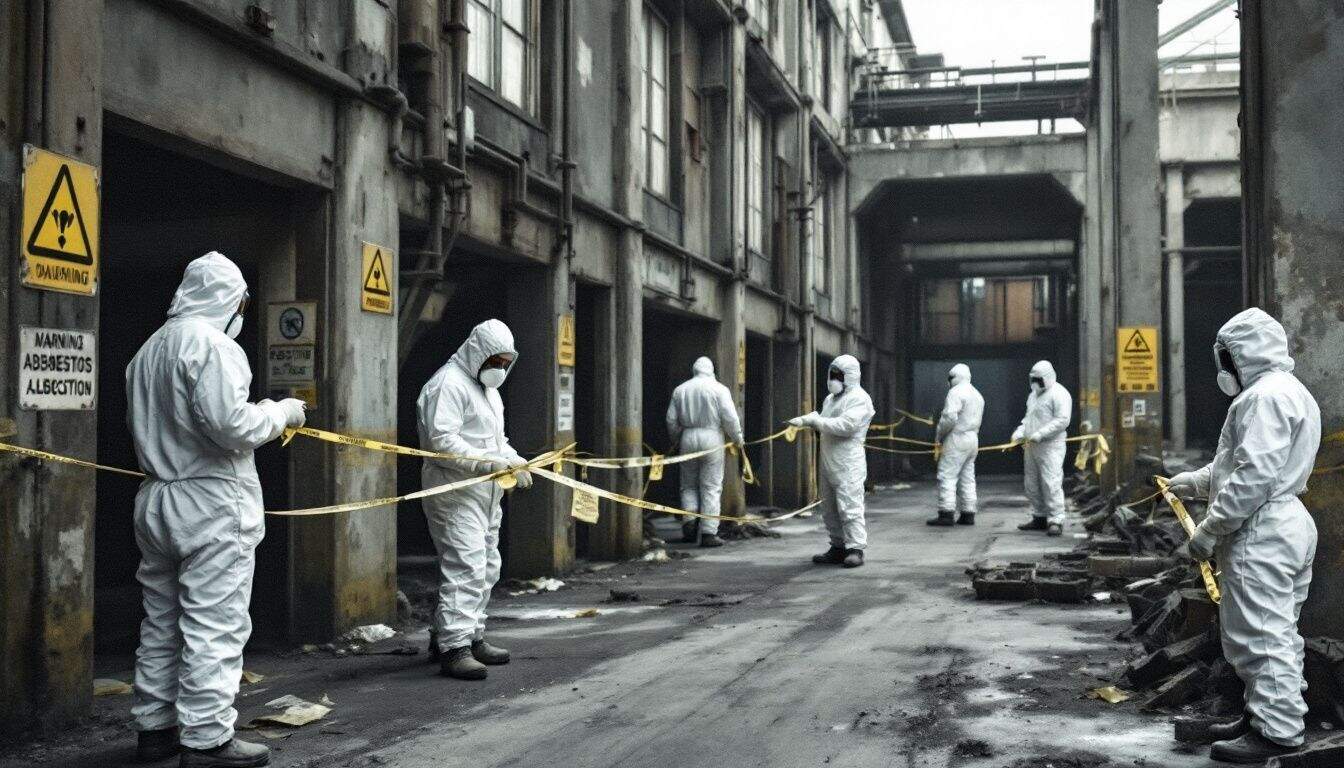
Which Category of Work Is the Most Dangerous According to the Control of Asbestos Regulations?
Asbestos kills more people in the UK each year than any other single work-related cause. Despite a total ban on its use since 1999, millions of buildings still contain asbestos-containing materials (ACMs) — and the people most at risk are those who disturb them without understanding the rules that govern such work.
Understanding which category of work is the most dangerous according to the Control of Asbestos Regulations is not merely a regulatory exercise. It is the difference between life and a slow, painful death from mesothelioma or asbestos-related lung cancer. Get the category wrong — or ignore it entirely — and the consequences extend far beyond a fine.
The Control of Asbestos Regulations divide asbestos work into distinct categories based on the level of risk involved. Each carries different legal obligations, and the framework exists for a very specific reason: some asbestos work is genuinely lethal if not handled under strictly controlled conditions.
How the Control of Asbestos Regulations Categorise Asbestos Work
The Control of Asbestos Regulations establish a tiered framework for all asbestos-related work. The tier a job falls into determines what controls, notifications, and licences are required before anyone touches an ACM.
There are three broad categories:
- Licensed work — the highest-risk category, requiring a licence issued by the Health and Safety Executive (HSE)
- Notifiable Non-Licensed Work (NNLW) — lower risk than licensed work but still requiring formal HSE notification
- Non-Licensed Work — the lowest-risk category, with no notification or licence required, though safe working practices still apply
These categories are not arbitrary. They reflect the type of asbestos material being disturbed, the scale of the work, and the likely level of fibre release into the air. The more fibres released, the greater the risk — and the stricter the controls required.
Licensed Work: The Most Dangerous Category Under the Control of Asbestos Regulations
Licensed work is unequivocally the most dangerous category of asbestos work under the Control of Asbestos Regulations. It covers tasks most likely to generate high concentrations of airborne asbestos fibres — the kind that lodge permanently in lung tissue and cause irreversible, fatal disease.
Licensed work typically includes:
- Removal of sprayed asbestos coatings (sometimes called limpet asbestos)
- Stripping asbestos insulation from pipes, boilers, and structural steelwork
- Removing asbestos insulating board (AIB) in large quantities
- Any work with asbestos that is in poor condition and highly friable
- Major refurbishment or demolition work where significant ACMs are present
These materials — particularly sprayed coatings and thermal insulation — contain high concentrations of asbestos fibres that become airborne very easily when disturbed. The fibres are microscopic and invisible to the naked eye, meaning workers have no way of knowing they are inhaling them without proper monitoring and protective equipment in place.
Why Licensed Work Carries the Greatest Risk
The danger in licensed work comes from the combination of fibre type, material condition, and the nature of the task itself. Friable materials — those that crumble easily — release fibres far more readily than bonded materials such as asbestos cement.
Amphibole asbestos types, including blue asbestos (crocidolite) and brown asbestos (amosite), are particularly hazardous. These fibres are longer, thinner, and more durable in lung tissue than white asbestos (chrysotile), making them more strongly associated with mesothelioma. They are commonly found in thermal insulation and sprayed coatings — precisely the materials that require licensed removal.
The HSE sets a control limit for asbestos fibres of 0.1 fibres per cubic centimetre (f/cm³) measured over a four-hour period, and a short-term limit of 0.6 f/cm³ over ten minutes. During licensed removal work, fibre concentrations can far exceed these limits without the correct enclosures, negative pressure units, and respiratory protective equipment (RPE) in place.
What Licensed Asbestos Work Actually Involves
Carrying out licensed asbestos work is not a matter of putting on a dust mask and getting on with it. The regulatory requirements are extensive — and for very good reason.
The HSE Licence
Only companies holding a current HSE licence may carry out licensed asbestos removal. Licences are granted for periods of up to three years and are subject to renewal. The HSE can revoke or suspend a licence at any time if standards are not maintained.
To obtain a licence, companies must demonstrate:
- Competent, trained personnel with relevant qualifications
- Robust health and safety management systems
- Experience in carrying out licensed asbestos work safely
- Adequate equipment, including full enclosures and air monitoring capability
- Valid public liability insurance
Prior Notification to the HSE
Before any licensed work begins, the employer must notify the HSE at least 14 days in advance. The notification must include details of the location, the type of asbestos involved, the planned start date, and the duration of the work.
This requirement exists specifically because licensed work is the most dangerous category under the Control of Asbestos Regulations. The HSE needs to be aware of it so it can inspect and intervene if necessary.
Health Surveillance and Medical Records
Workers engaged in licensed asbestos work must undergo regular health surveillance by an appointed doctor. Their medical records must be retained for 40 years — a direct reflection of the long latency period of asbestos-related diseases, which can take between 15 and 60 years to manifest after exposure.
Controlled Work Areas
Licensed work must be carried out within a controlled area — typically a sealed enclosure fitted with a negative pressure unit (NPU) to prevent fibres escaping into the wider building. Workers must enter and exit through airlocks, and contaminated clothing must be removed in a decontamination unit before leaving the work area.
Air monitoring is conducted throughout the work and during clearance to ensure fibre levels are within acceptable limits before the enclosure is dismantled. Proper asbestos removal by a licensed contractor is the only legally compliant way to deal with high-risk ACMs.
Notifiable Non-Licensed Work: The Middle Tier
Notifiable Non-Licensed Work (NNLW) sits between licensed work and non-licensed work in terms of risk. It covers tasks that are hazardous enough to require formal notification to the HSE, but do not require a full licence.
NNLW typically includes:
- Removal of small quantities of asbestos insulating board (AIB)
- Minor encapsulation or sealing of AIB
- Removal of textured coatings such as Artex that contain asbestos
- Short-duration work on AIB that is in reasonable condition
Employers carrying out NNLW must notify the relevant enforcing authority before work starts. They must also ensure workers receive appropriate training, undergo health surveillance, and that exposure records are maintained.
NNLW is not without risk. AIB can release significant quantities of fibres if cut, drilled, or broken — which is why it occupies its own category rather than being treated as routine maintenance work.
Non-Licensed Work: The Lowest Risk Category
Non-licensed work involves ACMs that are unlikely to release significant quantities of fibres under normal working conditions. This includes materials such as asbestos cement sheets, asbestos floor tiles, and bitumen products containing asbestos.
Examples of non-licensed work include:
- Removing intact asbestos cement roof sheets with minimal breakage
- Encapsulating asbestos cement products
- Drilling asbestos cement with appropriate controls
- Cleaning up small amounts of asbestos cement debris
No HSE notification or licence is required for non-licensed work. However, employers must still carry out a risk assessment, ensure workers are trained in asbestos awareness, and provide appropriate RPE. The absence of a licence does not mean the absence of risk — it simply means the risk is lower and can be managed without the full apparatus of licensed controls.
The Duty to Manage: Before Any Work Begins
Before any category of asbestos work can be properly planned, the presence and condition of ACMs in a building must be established. This is where the duty to manage asbestos under the Control of Asbestos Regulations becomes critical.
Duty holders — typically the owner or manager of a non-domestic building — are legally required to identify ACMs, assess their condition, and put a management plan in place. This almost always requires a professional asbestos survey.
A management survey is used for occupied buildings to locate ACMs that could be disturbed during normal occupation or routine maintenance. It is the starting point for any effective asbestos management programme.
A refurbishment survey is required before any significant works take place. It is far more intrusive than a management survey and is designed to locate all ACMs that could be disturbed during the planned work — including those concealed within the building fabric.
Where a building is being demolished, a demolition survey must be completed before any demolition work begins. This is a comprehensive inspection of the entire structure to ensure all ACMs are identified and properly managed before the building is brought down.
Without an accurate survey, contractors cannot know which category of work they are dealing with. Proceeding without this information is not only dangerous — it is a criminal offence.
What Happens When Categories Are Ignored
Misclassifying asbestos work — or simply ignoring the categorisation system entirely — is one of the most common causes of illegal asbestos exposure in the UK. It happens most often in construction and refurbishment, where contractors encounter ACMs unexpectedly and make a judgement call to proceed without stopping to assess the risk properly.
The consequences can be severe:
- For workers: Uncontrolled exposure to asbestos fibres, with no health surveillance or records to track future disease development
- For employers: Prosecution by the HSE, unlimited fines, and potential imprisonment
- For building occupants: Contamination of the wider building if fibres escape a poorly controlled work area
- For the public: Environmental contamination if asbestos waste is not properly sealed, labelled, and disposed of at a licensed site
The HSE actively investigates reports of illegal asbestos work and has the power to issue prohibition notices, improvement notices, and to prosecute both companies and individuals. Fines in serious cases have reached hundreds of thousands of pounds. Cutting corners is never worth the legal, financial, or human cost.
HSG264 and the Role of the HSE
The HSE’s guidance document HSG264 — Asbestos: The Survey Guide — provides detailed technical guidance on how surveys should be conducted and how ACMs should be assessed. It is the authoritative reference for surveyors, duty holders, and contractors trying to understand the condition and risk posed by materials they have identified.
HSG264 supports the categorisation system by helping surveyors accurately assess the type of material present, its condition, and the likelihood of fibre release during disturbance. This assessment directly informs the category of work that will be required to manage or remove it.
The HSE also publishes detailed guidance on licensed work, NNLW, and non-licensed work — all freely available on its website. Employers have no excuse for not knowing the rules.
Asbestos Work Categories Across Different Property Types
The category of asbestos work required depends heavily on the type of building and its age. Properties built before 2000 are the primary concern, as asbestos was widely used in construction materials throughout the mid-to-late twentieth century.
Commercial and Industrial Properties
Older offices, factories, warehouses, and public buildings frequently contain sprayed asbestos coatings on structural steelwork, AIB ceiling tiles, and lagged pipework — all materials that fall into the licensed work category when removal is required. Refurbishment of these buildings almost always triggers the need for a refurbishment and demolition survey before works begin.
If you require an asbestos survey in Birmingham for a commercial or industrial property, Supernova Asbestos Surveys provides fully accredited surveys to help duty holders understand exactly what they are dealing with before any works commence.
Residential Properties
Houses and flats built or refurbished before 2000 can contain a wide range of ACMs — from Artex ceilings and AIB panels to asbestos cement roof sheets and floor tiles. The category of work required depends on the specific material and its condition.
Textured coatings like Artex that contain asbestos typically fall into NNLW when removal is planned. AIB panels in poor condition may require licensed removal. Understanding the distinction matters enormously before any refurbishment project begins.
Schools, Hospitals, and Public Buildings
Many public sector buildings constructed during the post-war decades contain significant quantities of ACMs, including sprayed coatings and AIB — the very materials most likely to require licensed removal. Duty holders in the public sector carry the same legal obligations as private building owners, and the consequences of non-compliance are equally serious.
For those managing properties across the north-west, an asbestos survey in Manchester from Supernova Asbestos Surveys will provide the detailed information needed to plan work safely and compliantly.
Choosing the Right Contractor for the Right Category of Work
One of the most practical things a duty holder or project manager can do is verify that the contractor they appoint is actually permitted to carry out the category of work involved. For licensed work, this means checking that the contractor holds a current HSE licence — which can be verified directly on the HSE website.
Appointing an unlicensed contractor to carry out licensed work does not transfer liability away from the duty holder. Both the contractor and the client can face enforcement action if illegal work is carried out on a property.
For those in the capital, an asbestos survey in London from Supernova Asbestos Surveys will establish the presence and condition of ACMs across your property, giving you the information you need to appoint the right contractor for the right category of work.
A Practical Summary: Matching the Work to the Category
To bring this together clearly, here is a practical overview of how the three categories align with common asbestos tasks:
- Licensed work — sprayed coatings, pipe lagging, AIB in poor condition, large-scale AIB removal, any highly friable material. Requires HSE licence, 14-day prior notification, controlled enclosure, air monitoring, and health surveillance.
- NNLW — small quantities of AIB in reasonable condition, textured coatings containing asbestos, minor AIB encapsulation. Requires notification to the enforcing authority, appropriate training, health surveillance, and exposure records.
- Non-licensed work — asbestos cement products in reasonable condition, floor tiles, bitumen products. No licence or notification required, but risk assessment, awareness training, and RPE remain mandatory.
The starting point for any of these categories is always the same: know what is in the building before anyone picks up a tool. A professional asbestos survey is not an optional extra — it is a legal requirement in most circumstances and the foundation of safe asbestos management.
Frequently Asked Questions
Which category of work is the most dangerous according to the Control of Asbestos Regulations?
Licensed work is the most dangerous category under the Control of Asbestos Regulations. It covers tasks involving highly friable materials such as sprayed asbestos coatings, pipe lagging, and asbestos insulating board in poor condition — all of which can release very high concentrations of airborne fibres if not handled under strictly controlled conditions.
What is the difference between licensed work and NNLW?
Licensed work involves the highest-risk ACMs and requires an HSE-issued licence, 14-day prior notification, a controlled enclosure, air monitoring, and ongoing health surveillance. Notifiable Non-Licensed Work (NNLW) covers lower-risk tasks — such as removing small quantities of AIB or textured coatings — that still require notification to the enforcing authority and health surveillance, but do not require a full HSE licence.
Do I need an asbestos survey before refurbishment work?
Yes. A refurbishment survey is a legal requirement before any significant refurbishment work begins in a building that may contain ACMs. Without it, contractors cannot determine which category of asbestos work applies to the materials they may disturb — and proceeding without this information is both dangerous and a criminal offence.
Can any contractor carry out licensed asbestos removal?
No. Only contractors holding a current licence issued by the HSE may carry out licensed asbestos removal. Licences must be verified before work begins. Appointing an unlicensed contractor for licensed work exposes both the contractor and the duty holder to HSE enforcement action, including prosecution and unlimited fines.
How long must health records be kept for workers doing licensed asbestos work?
Medical and health surveillance records for workers engaged in licensed asbestos work must be retained for 40 years. This reflects the long latency period of asbestos-related diseases, which can take between 15 and 60 years to develop after the original exposure occurred.
Speak to Supernova Asbestos Surveys
Supernova Asbestos Surveys has completed over 50,000 surveys across the UK, helping duty holders, property managers, and contractors understand exactly what they are dealing with before any work begins. Whether you need a management survey for an occupied building, a refurbishment survey ahead of planned works, or specialist advice on which category of work applies to your property, our accredited team is ready to help.
Call us on 020 4586 0680 or visit asbestos-surveys.org.uk to book a survey or speak to one of our surveyors today.