Asbestos Clothing in the Middle Ages: The Remarkable History of a Mineral That Shaped Civilisations
Long before asbestos became synonymous with industrial disaster and legal liability, it was treated as something close to miraculous. The story of asbestos clothing in the Middle Ages sits at the heart of a history stretching back hundreds of thousands of years — one that traces how a naturally occurring mineral moved from royal banqueting halls to factory floors, and eventually into the strict regulatory framework that governs UK buildings today.
Understanding that journey is not just academically interesting. It provides genuine context for why so many British buildings still contain asbestos-containing materials, and why the legal duties placed on property owners exist in the first place.
The Earliest Evidence: Asbestos Before Written Records
Archaeological evidence suggests that asbestos mineral fibres were present in human environments as far back as 750,000 years ago. Whether early humans had any awareness of its fire-resistant properties at that stage is unknown, but the material was undeniably part of their world.
By around 4000 BC, deliberate use had begun. Fire-resistant fibres were being woven into lamp and candle wicks — a logical first application for a material that simply refused to burn. This set the template for everything that followed: asbestos as a tool for managing and containing fire.
Ancient Egypt and the Pharaohs
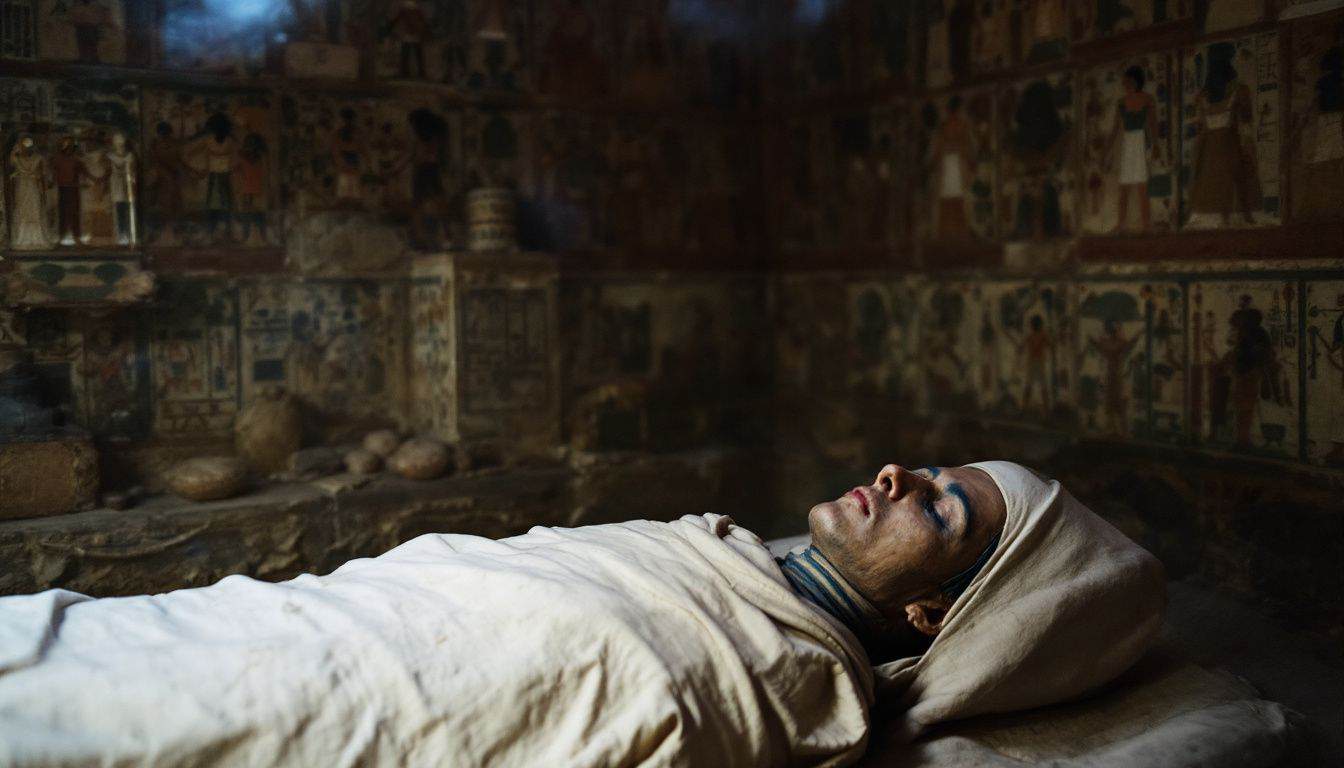
Between 2000 and 3000 BC, ancient Egyptians were incorporating asbestos cloth into the embalming process. Pharaohs were reportedly wrapped in asbestos linen to protect their mummified remains from deterioration. For a culture defined by its obsession with preserving the body for the afterlife, a material that resisted both decay and flame must have seemed extraordinary — almost divine in its properties.
Finnish craftsmen were independently reaching similar conclusions during this period, adding asbestos fibres to clay pots around 2500 BC to improve their resistance to heat and cracking. Across different continents and cultures, the same remarkable properties were being recognised and put to work.
Classical Antiquity: Greeks, Romans, and the Birth of the Name
The ancient Greeks gave asbestos its name, derived from a word meaning indestructible or unquenchable. The historian Herodotus recorded the use of asbestos shrouds for cremation in 456 BC — a practical application that prevented the ashes of the deceased from mixing with the embers of the funeral pyre.
Roman writers offered competing explanations for the material’s fire resistance. Some believed it was the fur of a fire-dwelling salamander. Others thought it was a plant that grew in volcanic regions. The actual explanation — that it was a naturally occurring silicate mineral with a fibrous crystalline structure — would not be properly understood for many centuries.
Roman emperors reportedly used asbestos napkins that could be cleaned simply by throwing them into a fire, emerging spotless from the flames. Whether these accounts are entirely accurate or somewhat embellished by the passage of time is debatable, but they reflect a consistent and widespread fascination with the material’s properties.
Asbestos Clothing in the Middle Ages: Myth, Reality, and King Charlemagne
The medieval period produced some of the most vivid — and most mythologised — accounts of asbestos use. Asbestos clothing in the Middle Ages occupied a peculiar space between practical utility and outright legend, with writers and scholars struggling to explain a material that defied ordinary understanding.
The most famous medieval account involves King Charlemagne, who reportedly used an asbestos tablecloth at royal banquets around 755 AD. The story goes that he would throw the cloth into the fire at the end of a meal to clean it, leaving his guests astonished when it emerged undamaged from the flames. Whether this was a genuine demonstration of the material’s properties, a piece of deliberate theatre designed to impress foreign dignitaries, or some combination of both, it speaks to the remarkable status that asbestos had acquired by this period.
The Salamander Legend
Medieval Europeans inherited the classical belief that asbestos was connected to the mythical salamander — a creature said to live within fire without being harmed. Asbestos cloth was sometimes described as salamander wool or salamander skin, and the material was attributed with almost supernatural protective qualities.
Marco Polo, writing in the 13th century after his travels through Central Asia, explicitly sought to debunk this myth. He described visiting mines in what is now China where asbestos was extracted directly from rock, and his account reflects a clear frustration with the persistence of the salamander legend. His writing represents one of the earliest attempts to describe asbestos in straightforwardly geological terms rather than mythological ones.
Practical Uses of Asbestos Cloth in Medieval Times
Beyond the legends, asbestos clothing and cloth in the Middle Ages served genuine practical purposes. Recorded uses during this period include:
- Cremation shrouds, continuing the practice documented by Herodotus centuries earlier
- Tablecloths and napkins for high-status households, as with Charlemagne’s famous cloth
- Wicks for lamps and candles, maintaining the application that dated back to 4000 BC
- Protective garments for those working near furnaces or open flames
- Pouches and containers for carrying or storing hot materials
Access to asbestos cloth in the Middle Ages was largely restricted to the wealthy and powerful. The material was rare, difficult to work with, and expensive to produce. This scarcity reinforced its association with luxury, mystery, and high status.
Medieval Mining and Trade Routes
Asbestos was mined in several locations known to medieval traders, including parts of what are now Italy, Greece, and Cyprus. The fibres were spun and woven using techniques broadly similar to those used for wool or linen, though the process was considerably more difficult and the resulting cloth was coarser in texture.
Trade routes connected these mining regions to the courts and monasteries of northern Europe, which explains how Charlemagne and other powerful figures came to possess asbestos items at all. The material travelled alongside spices, silks, and other luxury goods from the Mediterranean world and beyond.
From the Renaissance to the Industrial Revolution
Interest in asbestos continued through the Renaissance, with natural philosophers attempting to understand the material’s properties through observation and experiment rather than mythology. By the 17th and 18th centuries, asbestos was being studied scientifically, and its fibrous mineral nature was becoming better understood.
The Industrial Revolution transformed asbestos from a rare curiosity into a commercial commodity on a vast scale. Its combination of fire resistance, thermal insulation, and tensile strength made it ideally suited to the demands of rapidly industrialising economies.
Chrysotile asbestos was discovered in Thetford Township, Quebec in 1876, opening up large-scale mining operations. Australian mining followed in New South Wales in the 1880s. Henry Ward Johns founded one of the first businesses built around asbestos products in 1858, a firm that later merged to become Johns Manville in 1901.
Asbestos brake linings appeared in 1896, and global production climbed rapidly. The material that had wrapped Egyptian pharaohs and cleaned Charlemagne’s tablecloth was now being installed in factories, ships, schools, and homes across the industrialised world.
The Recognition of Health Risks
The health consequences of asbestos exposure were not entirely invisible even in the early industrial period. An Austrian doctor linked pulmonary problems with asbestos dust as early as 1897. Dr Montague Murray reported the first formally documented asbestos-related death in 1906.
Despite these early warnings, industrial use continued and expanded through much of the 20th century. The economic benefits were considered to outweigh the risks, and the long latency period between exposure and disease — often 20 to 40 years — made the connection difficult to establish and easy to dismiss.
By the latter half of the 20th century, the evidence was overwhelming. Mesothelioma, asbestosis, and asbestos-related lung cancer were killing workers and, in some cases, family members who had been exposed to fibres brought home on work clothing. Litigation, regulation, and eventually outright bans followed across the industrialised world.
Global Bans and the UK Regulatory Framework
The European Union enforced a comprehensive asbestos ban, and the UK’s own legislative response came through the Control of Asbestos Regulations, which set out the legal framework governing asbestos management, work with asbestos, and the duties placed on owners and managers of non-domestic premises.
HSG264, the HSE’s definitive survey guidance, establishes the standards that professional asbestos surveyors must follow. These regulations exist precisely because the legacy of 20th-century asbestos use is still present in millions of UK buildings — and will remain so for decades to come.
The journey from asbestos clothing in the Middle Ages to the strict regulatory environment of today is not a straight line, but the thread connecting them is consistent: a material whose remarkable properties made it genuinely useful, and whose dangers were understood far too late.
Why This History Matters for Property Owners Today
The history of asbestos is not simply an academic curiosity. It explains directly why so many buildings constructed before the year 2000 contain asbestos-containing materials, and why managing those materials correctly is both a legal obligation and a moral one.
If you own or manage a non-domestic property, the duty to manage asbestos under the Control of Asbestos Regulations requires you to identify asbestos-containing materials, assess the risk they pose, and put a management plan in place. A professional management survey is the standard starting point for meeting this duty, and it should be your first call if you do not already have an asbestos register in place.
If you are planning renovation or demolition work, a refurbishment survey is legally required before work begins. This ensures that contractors are not unknowingly disturbing asbestos-containing materials and putting themselves — and others — at serious risk.
Once an asbestos register is in place, it must be kept current. A periodic re-inspection survey ensures that the condition of known asbestos-containing materials is monitored over time, and that any deterioration is identified and addressed before it becomes a hazard.
For properties where fire safety is also a concern, a fire risk assessment can be carried out alongside asbestos surveying to provide a complete picture of your building safety obligations in a single, coordinated process.
If you want to test a specific material before committing to a full survey, a testing kit allows samples to be collected and sent to an accredited laboratory for analysis — a practical first step when you have a specific concern about a material.
Supernova Asbestos Surveys operates across the UK, with specialist teams providing an asbestos survey in London, an asbestos survey in Manchester, and an asbestos survey in Birmingham — as well as hundreds of locations across England, Scotland, and Wales.
With over 50,000 surveys completed nationwide, our teams understand both the regulatory requirements and the practical realities of managing asbestos in occupied buildings. To discuss your requirements, call us on 020 4586 0680 or visit asbestos-surveys.org.uk.
Frequently Asked Questions
What was asbestos clothing used for in the Middle Ages?
Asbestos clothing and cloth in the Middle Ages served several purposes, including cremation shrouds, tablecloths and napkins for wealthy households, protective garments for those working near furnaces, and wicks for lamps and candles. Access to asbestos cloth was largely restricted to the wealthy due to its rarity and the difficulty of producing it.
Who was King Charlemagne and what is his connection to asbestos?
King Charlemagne was a Frankish ruler who reportedly used an asbestos tablecloth at royal banquets around 755 AD. According to historical accounts, he would throw the cloth into a fire at the end of meals to clean it, astonishing his guests when it emerged undamaged. The story illustrates the high status that asbestos had acquired among the medieval elite.
Why did medieval people believe asbestos came from a salamander?
Medieval Europeans inherited a classical belief that asbestos was connected to the mythical salamander — a creature said to live within fire unharmed. Because the true geological explanation for asbestos’s fire resistance was not understood, writers described the cloth as salamander wool or salamander skin. Marco Polo was among the first to challenge this myth directly, describing asbestos mines he had visited in Central Asia in the 13th century.
When were the health risks of asbestos first recognised?
Early warnings emerged in the late 19th and early 20th centuries. An Austrian doctor linked pulmonary problems with asbestos dust in 1897, and Dr Montague Murray reported the first formally documented asbestos-related death in 1906. Despite these warnings, industrial use continued for much of the 20th century before regulation and eventual bans followed as the evidence of harm became overwhelming.
What are my legal obligations as a UK property owner regarding asbestos?
Under the Control of Asbestos Regulations, owners and managers of non-domestic premises have a duty to manage asbestos. This means identifying asbestos-containing materials, assessing the risk they pose, and maintaining a management plan. A management survey is typically the starting point, followed by a refurbishment survey before any renovation or demolition work, and regular re-inspection surveys to monitor the condition of known materials over time.