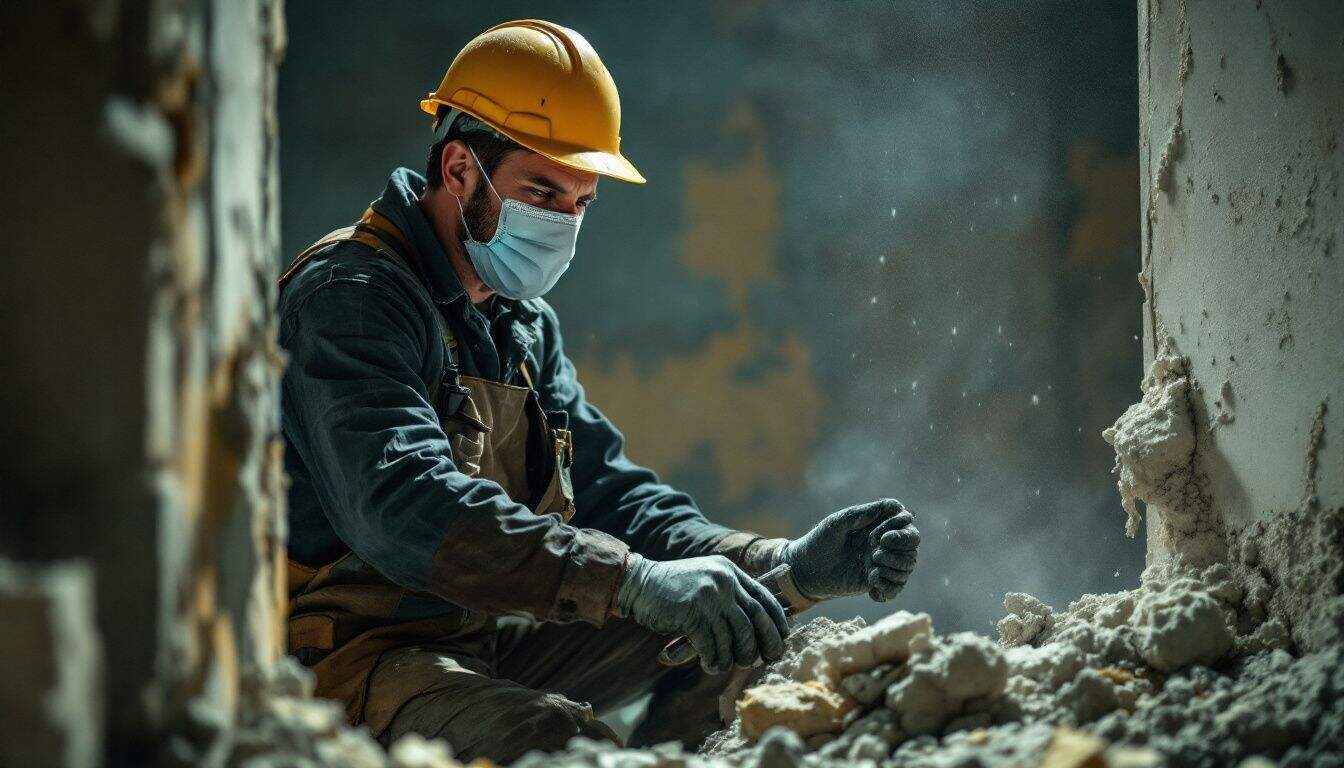
Facilitation Works Before Asbestos Removal: What You Need to Know
Before a single piece of asbestos-containing material (ACM) is touched, there is a layer of preparatory work that must happen first. Facilitation works before asbestos removal are the enabling tasks that make the actual removal safe, legal, and practical — and skipping or rushing them is one of the most common mistakes made on renovation and demolition projects across the UK.
Whether you are managing a school refurbishment, a commercial fit-out, or a full demolition, understanding what facilitation works involve could be the difference between a compliant project and a costly enforcement action from the HSE.
What Are Facilitation Works in the Context of Asbestos?
Facilitation works are the preparatory and enabling activities carried out before licensed asbestos removal begins. They create the conditions needed for removal to take place safely and in line with the Control of Asbestos Regulations and HSE guidance document HSG264.
These works typically include:
- Conducting the appropriate asbestos survey to locate and characterise all ACMs
- Developing a written asbestos management plan
- Isolating affected areas and establishing controlled access zones
- Setting up enclosures, airlocks, and negative pressure units where required
- Disconnecting or isolating services such as electrics, gas, and water within the work area
- Notifying the relevant enforcing authority where required
- Briefing all workers — including those not directly involved in removal — on the hazards present
None of this is optional. Each element plays a direct role in protecting workers, building occupants, and the wider environment from asbestos fibre release.
The Legal Framework You Must Follow
The Control of Asbestos Regulations place clear duties on employers, building owners, and contractors. Before any refurbishment or demolition work begins on a building that may contain asbestos, a suitable survey must be carried out — this is a legal requirement, not a recommendation.
The Construction (Design and Management) Regulations add another layer of responsibility. The principal designer must consider asbestos risks during the pre-construction phase, and the principal contractor must ensure that facilitation works are properly planned and executed before removal activities start on site.
Failure to carry out adequate facilitation works can result in:
- Prohibition notices from the HSE
- Improvement notices and substantial fines
- Criminal prosecution in serious cases
- Civil liability if workers or third parties are exposed
The HSE takes unplanned disturbance of asbestos extremely seriously. Projects that proceed without proper facilitation works in place are a primary target for enforcement action.
Choosing the Right Survey: The Foundation of All Facilitation Works
You cannot plan facilitation works before asbestos removal without knowing exactly what you are dealing with. The type of survey you need depends entirely on the nature of the project.
Asbestos Management Survey
An asbestos management survey is designed for buildings that are in normal occupation and use. It locates ACMs that could be disturbed during routine maintenance and minor works, forming the baseline record that informs your overall asbestos management strategy.
A management survey will identify the location, type, and condition of ACMs, assign a risk score to each, and feed into a written asbestos register. This register must be kept up to date and made available to anyone carrying out work on the premises. However, it is not sufficient on its own for major refurbishment or demolition projects.
Refurbishment and Demolition Survey
For any project involving significant structural work, a demolition survey is required. This is a far more intrusive process — surveyors will access voids, lift floor coverings, open up ceiling spaces, and take samples from materials that would not be disturbed under normal conditions.
The purpose is to ensure that every ACM within the scope of the works is identified before any activity begins. The findings directly inform the facilitation works plan, the removal specification, and the waste disposal arrangements.
Key outputs from a refurbishment and demolition survey include:
- A full schedule of all ACMs within the project scope
- Sample analysis results confirming asbestos type and fibre content
- Condition assessments for each material
- Recommendations for removal priority and method
- Information to support the tendering of licensed removal works
Planning Facilitation Works: A Step-by-Step Approach
Once the survey is complete and the ACMs are fully characterised, the facilitation works plan can be developed. This is not something to improvise on the day — a structured approach is essential.
Step 1 — Develop the Asbestos Management Plan
The asbestos management plan sets out how ACMs will be managed, controlled, and removed throughout the project. It should document every ACM identified, the chosen management option (removal, encapsulation, or leave in place with monitoring), the responsible parties, and the timeline.
This plan must be a live document. If additional ACMs are discovered during works — which is not uncommon in older buildings — the plan must be updated and work must stop until the new materials are assessed.
Step 2 — Notify the Enforcing Authority
Where licensable asbestos work is planned, the contractor must notify the relevant enforcing authority at least 14 days before work begins. This is a legal requirement under the Control of Asbestos Regulations.
The notification must include details of the work location, the type of asbestos involved, the planned start date, and the duration of the works. Missing this step is not a minor oversight — it is a regulatory breach.
Step 3 — Isolate the Work Area
Physical isolation of the affected area is one of the most critical facilitation works. This typically involves:
- Sealing off doorways, ventilation openings, and any gaps with polythene sheeting and tape
- Establishing a three-stage decontamination unit (dirty end, shower, clean end) for workers entering and leaving the enclosure
- Installing negative pressure equipment to ensure air flows into the enclosure rather than out, preventing fibre migration
- Displaying appropriate warning signage at all access points
Step 4 — Disconnect Services
Before removal begins, any services running through or adjacent to the work area must be isolated. Live electrical circuits, gas supplies, and water pipes create both safety hazards and practical obstacles during removal.
Service disconnection must be planned in advance and coordinated with the relevant service providers and the principal contractor. Last-minute arrangements here cause delays and increase risk.
Step 5 — Brief All Site Personnel
Everyone working on or near the site needs to understand where asbestos has been found, what the exclusion zones are, and what to do if they suspect they have disturbed an ACM. This briefing must be documented.
Workers directly involved in facilitation and removal must hold the appropriate level of asbestos awareness training for the work they are carrying out. Verbal briefings are not sufficient on their own — written records are essential.
PPE and Respiratory Protection During Facilitation Works
Facilitation works themselves can disturb asbestos fibres, particularly when setting up enclosures in areas where ACMs are present. The correct PPE must be worn from the outset — not just during the removal phase.
For most facilitation activities in areas containing ACMs, workers will require:
- A disposable Type 5, category 3 coverall — commonly referred to as a Tyvek suit
- A suitable respiratory protective device — typically a half-face FFP3 respirator or a powered air-purifying respirator (PAPR) for higher-risk environments
- Disposable gloves and boot covers
- Goggles where there is a risk of eye contamination
Respirators must be fit-tested before use. An untested respirator provides no reliable protection, regardless of its rated filtration level. Fit testing must be repeated if the worker’s face shape changes significantly, or if a different model of respirator is introduced.
Air Monitoring: A Non-Negotiable Part of the Process
Air monitoring is an essential component of facilitation works before asbestos removal. Background air samples should be taken before work begins to establish a baseline, and ongoing monitoring during enclosure setup and throughout the removal process provides real-time assurance that fibre levels remain within acceptable limits.
All air monitoring must be carried out by a UKAS-accredited laboratory using phase contrast microscopy or, where greater sensitivity is needed, transmission electron microscopy. Results must be recorded and retained as part of the project health and safety file.
If monitoring results indicate elevated fibre levels outside the enclosure, work must stop immediately and the situation investigated before it can resume. There is no grey area here.
Facilitation Works for Different Building Types
Schools and Public Buildings
Schools present particular challenges because of the need to protect children and staff who may be in other parts of the building during works. Facilitation works in schools must include robust communication with the school management team, clearly defined exclusion zones that cannot be accessed by pupils, and out-of-hours scheduling wherever possible.
Local authorities responsible for school buildings must ensure their asbestos management plans are current and that any contractor engaged to carry out facilitation or removal works is fully briefed on the specific constraints of working in an occupied educational setting.
Residential Properties
In domestic properties, the scale of facilitation works is often smaller, but the principles are identical. Occupants must be relocated before any licensable asbestos work begins, and isolation of the work area from the rest of the property is essential.
If additional ACMs are discovered once works are under way, all activity must cease, the area must be re-secured, and the asbestos management plan must be revised before work continues. Waste must be managed and disposed of in accordance with hazardous waste regulations throughout.
Commercial and Industrial Properties
Large commercial and industrial buildings often contain multiple ACM types across extensive floor areas. Facilitation works in these settings require detailed phasing plans to ensure that occupied areas of the building are never compromised.
Coordination between the asbestos contractor, the principal contractor, and the building occupier is essential throughout. Poor communication at this stage is one of the leading causes of programme overruns and enforcement action on commercial projects.
Safe Disposal of Asbestos Waste
Facilitation works include making arrangements for the safe disposal of asbestos waste before asbestos removal begins. Asbestos waste is classified as hazardous waste under UK environmental regulations and must be handled accordingly.
Key requirements include:
- Double-bagging all asbestos waste in clearly labelled, UN-approved sacks
- Completing a consignment note for every load of hazardous waste leaving the site
- Using only licensed waste carriers to transport asbestos waste
- Disposing of waste only at a permitted facility authorised to accept hazardous asbestos waste
- Retaining copies of all waste transfer documentation for a minimum of three years
These arrangements must be confirmed in advance. Turning up at a waste facility without the correct paperwork, or using an unlicensed carrier, is a criminal offence — not a paperwork inconvenience.
After Removal: Clearance and Reinstatement
Facilitation works do not end when the asbestos is removed. A four-stage clearance procedure must be completed before the enclosure is taken down and the area reinstated for use.
- Visual inspection — a thorough check of the enclosure to confirm no visible ACM debris remains
- Preliminary air test — air sampling within the enclosure to check fibre levels before the final clean
- Final clean — a detailed clean of all surfaces within the enclosure using HEPA-filtered vacuum equipment and damp wiping
- Four-stage clearance air test — a final air test carried out by an independent UKAS-accredited analyst to confirm the area is safe for reoccupation
The clearance certificate issued after a successful four-stage clearance is a critical document. It must be retained as part of the project health and safety file and made available to future building owners and occupiers.
Only once this certificate has been issued can the enclosure be dismantled and the area returned to normal use. Reinstating an area before clearance is complete is a serious breach of the Control of Asbestos Regulations.
Common Mistakes That Cause Projects to Fail
Even experienced project managers make avoidable errors when it comes to facilitation works. The most common include:
- Relying on an outdated management survey for a project that requires a full refurbishment and demolition survey — the two are not interchangeable
- Failing to update the asbestos register when new ACMs are discovered during works
- Inadequate service isolation — live services within the work area create hazards that can halt the project entirely
- Skipping or delaying the enforcing authority notification — the 14-day notice period is fixed and cannot be compressed after the fact
- Appointing an unlicensed contractor for work that legally requires a licensed operative
- Poor documentation — verbal agreements and informal briefings are not sufficient; everything must be in writing
Getting these elements right from the outset is far less costly than dealing with an enforcement notice, a project shutdown, or — worst of all — an exposure incident involving workers or building occupants.
Regional Considerations: Getting the Right Survey Team in Place
The quality of your facilitation works is only as good as the survey data underpinning them. Using an accredited, experienced survey team with genuine knowledge of your building type and region makes a significant difference to the accuracy of the information you receive.
If you are based in the capital and need an asbestos survey London teams can rely on, Supernova Asbestos Surveys provides fully accredited refurbishment, demolition, and management surveys across all London boroughs. For projects in the north-west, our asbestos survey Manchester service covers the full Greater Manchester area and beyond. In the Midlands, our asbestos survey Birmingham team operates across the city and surrounding areas, providing the same standard of accredited survey work.
Wherever your project is located, the survey must be carried out by a UKAS-accredited body. Accreditation is not a badge — it is the baseline standard required by HSG264 and the Control of Asbestos Regulations.
Frequently Asked Questions
What is the difference between facilitation works and asbestos removal?
Facilitation works are the preparatory activities that must take place before any asbestos is physically removed. They include surveying, isolating the work area, disconnecting services, notifying the enforcing authority, and setting up enclosures and decontamination units. Asbestos removal is the licensed activity that follows once all facilitation works are in place. You cannot safely or legally carry out removal without completing the facilitation stage first.
Do I need a refurbishment and demolition survey even for small projects?
If the work involves disturbing the fabric of a building — even on a relatively small scale — and the building was constructed or refurbished before the year 2000, a refurbishment and demolition survey is required for the areas affected. A management survey alone is not sufficient where materials will be disturbed. The scope of the survey should match the scope of the works.
Who is responsible for ensuring facilitation works are carried out correctly?
Responsibility sits with multiple parties. The building owner or dutyholder has an overarching duty to manage asbestos under the Control of Asbestos Regulations. The principal contractor under CDM Regulations is responsible for ensuring facilitation works are planned and executed correctly on site. The licensed asbestos removal contractor is responsible for the safety of the removal operation itself. All three must work together — gaps in communication between these parties are a leading cause of non-compliance.
What happens if additional asbestos is found during works?
All work in the affected area must stop immediately. The area must be re-secured, and the discovery must be reported to the principal contractor and the dutyholder. A surveyor must assess the newly identified material, and the asbestos management plan must be updated before any work resumes. Continuing to work in an area where unsurveyed ACMs have been discovered is a serious breach of the Control of Asbestos Regulations and creates significant liability for everyone involved.
How long does the facilitation works process typically take?
The timeline depends on the scale and complexity of the project. For a straightforward domestic removal, facilitation works might be completed in a day or two. For large commercial or industrial projects, the facilitation phase — including survey, planning, service isolation, and enclosure setup — can take several weeks. The 14-day enforcing authority notification period alone means that facilitation works must begin well in advance of the planned removal start date. Rushed facilitation is a false economy; the time invested at this stage prevents far greater delays later.
Work With a Survey Team You Can Trust
Supernova Asbestos Surveys has completed over 50,000 surveys nationwide. Our UKAS-accredited team provides management surveys, refurbishment and demolition surveys, and the full range of support services needed to underpin compliant facilitation works — from initial survey through to clearance certification.
If you are planning a renovation, refurbishment, or demolition project and need expert guidance on facilitation works before asbestos removal, contact our team today. Call us on 020 4586 0680 or visit asbestos-surveys.org.uk to book your survey or request a quote.