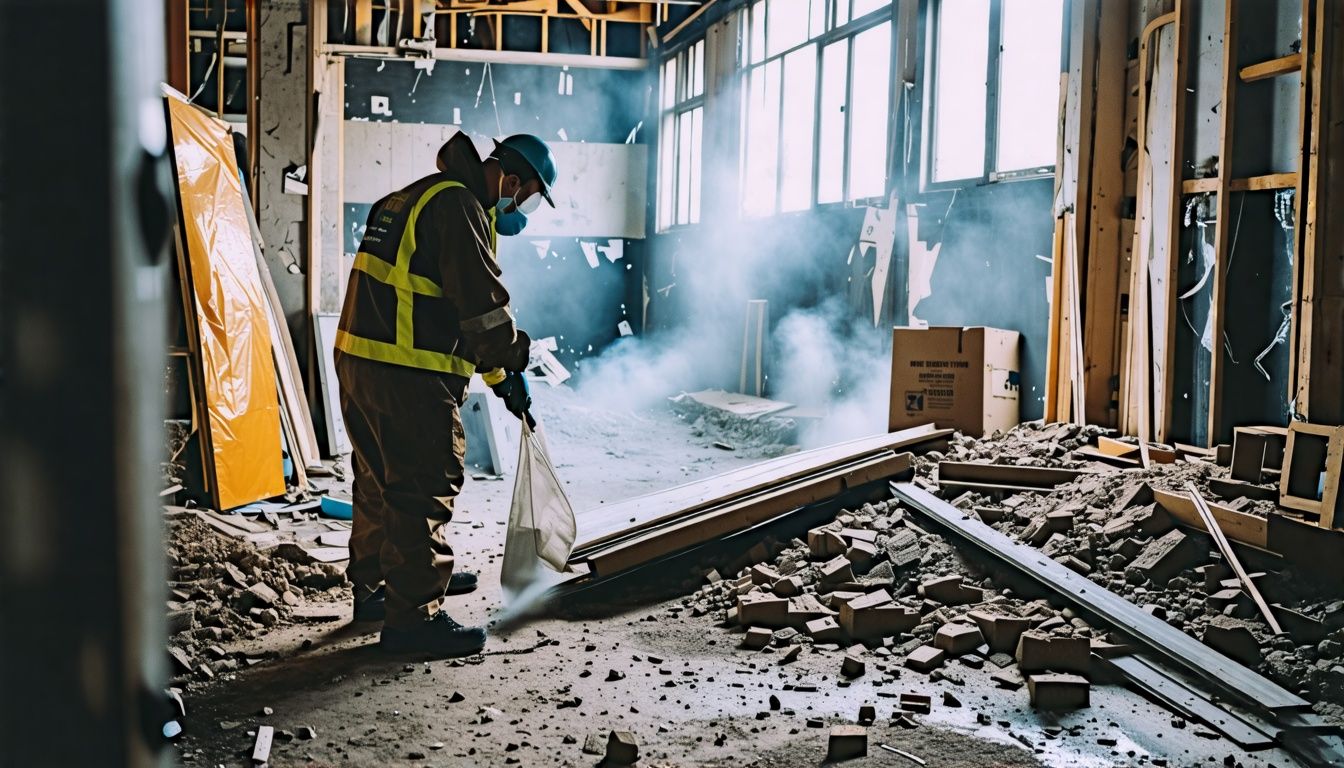
Working With Asbestos: Precautions Every Worker and Property Manager Must Know
Asbestos still kills around 5,000 people in the UK every year — more than any other single work-related cause of death. Despite being banned from new construction since 1999, it remains present in millions of buildings across the country. Working with asbestos without the right precautions is both dangerous and illegal, and the consequences of getting it wrong can be fatal.
Whether you’re a contractor, facilities manager, tradesperson, or property owner, here is what you need to know before a single tool is picked up.
Identifying Asbestos Before Any Work Begins
The most important precaution you can take is knowing whether asbestos is present before work starts. The majority of exposures happen because asbestos is disturbed unknowingly — and that is entirely preventable with the right preparation.
Which Buildings Are at Risk?
Any building constructed or refurbished before 2000 may contain asbestos-containing materials (ACMs). That includes residential properties, commercial premises, industrial sites, schools, hospitals, and public buildings of all kinds.
Age alone doesn’t tell the full story. Asbestos was used in hundreds of different products right up to the late 1990s, and it can appear in places that aren’t immediately obvious. Common locations include:
- Ceiling tiles and textured coatings such as Artex
- Lagging on pipes and boilers
- Insulating board in partition walls, ceiling panels, and fire doors
- Roof sheets and soffit boards
- Floor tiles and associated adhesives
- Spray-applied coatings on structural steelwork
- Electrical equipment and fuse boxes
Get a Professional Survey Before You Start
Visual identification is not reliable. Asbestos cannot be confirmed by appearance alone — laboratory analysis of a sample is the only definitive method. Before any refurbishment or demolition work, a professional asbestos survey is a legal requirement.
There are two main types. A management survey is used for routine occupation and maintenance, identifying ACMs that could be disturbed during normal activities. A demolition survey is a more intrusive inspection required before any structural work or demolition begins, covering all areas that will be affected.
If you’re unsure which type of survey your project requires, call Supernova Asbestos Surveys on 020 4586 0680 before proceeding. Getting this wrong at the outset creates legal and health risks that are far harder to manage later.
Understanding Fibre Type and Condition
Not all asbestos carries the same immediate level of risk. The three fibre types found in UK buildings — chrysotile (white), amosite (brown), and crocidolite (blue) — each have different properties, but all three are hazardous and none should be disturbed without proper controls in place.
Condition matters just as much as type. Asbestos in good condition and left undisturbed presents a lower immediate risk than damaged, deteriorating, or friable material. A professional surveyor will assess both, producing a risk rating that informs your management plan and determines what action is required.
Legal Requirements for Working With Asbestos in the UK
The Control of Asbestos Regulations set out the legal framework for managing asbestos in the UK. They apply to employers, the self-employed, and anyone who manages non-domestic premises. Ignorance of these requirements is not a defence — penalties for non-compliance can include prosecution, unlimited fines, and custodial sentences in serious cases.
The Duty to Manage
Dutyholders — typically building owners, employers, or those responsible for maintenance — must actively manage asbestos in non-domestic premises. This means maintaining an up-to-date asbestos register, a written management plan, and a system for ensuring anyone who could disturb ACMs is informed before they start work.
Licensed, Notifiable Non-Licensed, and Non-Licensed Work
The regulations draw a clear distinction between different categories of asbestos work, each with specific requirements.
Licensed work covers the highest-risk activities — typically work on sprayed coatings, lagging, or asbestos insulating board (AIB). Only contractors holding a licence issued by the Health and Safety Executive (HSE) can carry out this work. Requirements include:
- HSE notification before work begins
- A full written risk assessment and method statement
- Continuous air monitoring throughout the job
- Regular health surveillance for all workers involved
- Strict decontamination procedures
- Comprehensive record-keeping
Notifiable non-licensed work (NNLW) covers activities that are less hazardous but still require the employer to notify the relevant enforcing authority, keep records, and arrange health surveillance for workers.
Non-licensed work covers the lowest-risk activities, such as minor work on textured coatings or encapsulation. A risk assessment is still required, appropriate PPE must be worn, and workers must be adequately trained.
If you are not certain which category your work falls into, stop and seek advice before proceeding. The HSE’s guidance under HSG264 is clear: when in doubt, treat it as licensed work.
Personal Protective Equipment: What’s Required
PPE is the last line of defence, not the first. Engineering controls — such as wet methods, enclosure, and extraction — should be in place to minimise fibre release before you rely on PPE. That said, appropriate protective equipment is non-negotiable for any work involving or near asbestos.
Respiratory Protection
A correctly fitted FFP3 disposable mask or a half-face respirator with P3 filters is the minimum standard for most asbestos work. For higher-risk activities, a full-face respirator or powered air-purifying respirator (PAPR) may be required.
Fit matters as much as the filter rating. A mask that doesn’t seal properly offers little real protection. Face-fit testing is mandatory for all workers required to wear tight-fitting respirators — this must be carried out by a competent person and is not optional.
Protective Clothing
- Type 5 disposable coveralls rated for fine particles including asbestos fibres, with elasticated cuffs and ankles
- Disposable boot covers or rubber boots that can be properly decontaminated
- Disposable gloves, changed before leaving the work area
Personal clothing must not be worn into the work area. All disposable PPE must be double-bagged as asbestos waste after use — it cannot be washed and reused under any circumstances.
Safe Working Methods to Prevent Fibre Release
Every decision made during work involving asbestos should be evaluated against one principle: preventing fibres from becoming airborne. Once fibres are in the air, the risk of inhalation rises dramatically and the situation becomes much harder to control.
Wet Methods
Damping down ACMs before and during work is one of the most effective ways to suppress fibre release. Use a low-pressure water spray with a suitable wetting agent, and keep the material damp throughout — do not allow it to dry out mid-task.
Hand Tools Over Power Tools
Power tools generate significantly more dust. Where any work is required on or near ACMs, hand tools should always be the default. If power tools must be used, they must be fitted with appropriate H-type vacuum attachments at the point of dust generation — not as an afterthought.
Containment and Enclosure
For higher-risk work, the area must be fully enclosed using heavy-duty sheeting and airlocks. Negative pressure units (NPUs) keep airborne fibres inside the enclosure and filter the exhausted air before it reaches the wider environment. This prevents cross-contamination to adjacent areas and protects other workers on site.
Cleaning During and After Work
- Use an H-type (HEPA-filtered) industrial vacuum — never a standard vacuum cleaner or compressed air
- Wipe surfaces with damp rags, not dry cloths
- Clear waste regularly into sealed, labelled asbestos waste bags — do not allow it to accumulate
- Carry out a thorough visual inspection and air clearance test before declaring the area safe to reoccupy
What to Do If Asbestos Is Accidentally Disturbed
Even with careful planning, unexpected disturbances happen. A swift and correct response can significantly limit the harm caused.
Immediate Actions
- Stop work immediately. Further disturbance will increase fibre release — do not continue.
- Evacuate the area. Remove all personnel and restrict access. Prevent others from walking through and tracking fibres elsewhere.
- Do not attempt to clean it yourself unless you are trained and properly equipped to do so.
- Contain the area where safe — close doors and seal ventilation where possible.
- Notify your supervisor or dutyholder immediately.
Reporting and Follow-Up
The incident must be documented — location, time, who was present, and what occurred. If workers may have been exposed, this must be recorded and reported through the correct channels. Depending on severity, notification to the HSE may be required.
The area must not be reoccupied until it has been assessed and cleared by a competent person. Air testing following an uncontrolled disturbance is essential before anyone returns to work in that space.
Employer and Employee Responsibilities
What Employers Must Provide
If you employ people who may encounter asbestos as part of their work, the law places clear obligations on you:
- Ensure an up-to-date asbestos survey is in place for any premises where work is being carried out
- Share information from the asbestos register with contractors before work begins
- Provide suitable asbestos awareness training for workers who may disturb ACMs in their normal duties
- Ensure any licensed asbestos work is only carried out by an HSE-licensed contractor
- Provide adequate PPE and ensure it is used correctly
- Arrange health surveillance for workers carrying out notifiable non-licensed or licensed work
Employee Responsibilities
Workers are not passive in this process. Under health and safety law, employees must:
- Follow the training they have received and comply with safe working procedures
- Use PPE correctly and report any defects or shortfalls in provision
- Never disturb suspected ACMs without confirming it is safe to proceed
- Report any incidents or accidental disturbances immediately
Asbestos Awareness Training
Category A asbestos awareness training is a legal requirement for any tradesperson whose work could inadvertently disturb asbestos. This includes plumbers, electricians, joiners, plasterers, painters, and general maintenance operatives.
Awareness training does not qualify workers to work on asbestos — it equips them to recognise it and avoid disturbing it. Workers who carry out non-licensed asbestos work need additional, more specific training. Licensed work requires formal training aligned with HSE guidance under HSG264 and associated documentation.
Training must be refreshed regularly. A one-off course from years ago does not satisfy the ongoing legal obligation to ensure workers remain competent and up to date.
Decontamination Procedures
Leaving the work area without proper decontamination risks spreading asbestos fibres beyond the controlled zone. This is how secondary exposure occurs — and it is entirely preventable.
Worker Decontamination
For licensed work, a three-stage decontamination unit is required, comprising a dirty end, a shower, and a clean end. Workers move through in sequence, removing contaminated PPE before showering thoroughly and dressing in clean clothing on the other side.
For lower-risk work, decontamination should still follow a logical sequence: vacuum down coveralls with an H-type vacuum, remove and bag all PPE, then wash hands and face thoroughly before leaving the area. Cutting corners here puts other people at risk.
Tool and Equipment Decontamination
All tools used in the work area must be decontaminated before removal. H-type vacuuming followed by damp wiping is the standard approach. Any equipment that cannot be adequately decontaminated must be double-bagged and disposed of as asbestos waste — it cannot simply be left in a van or taken to a general skip.
Asbestos Waste Disposal
Asbestos waste is classified as hazardous waste under UK law and must be handled accordingly. The requirements are specific and non-negotiable.
- All asbestos waste must be double-bagged in heavy-duty, clearly labelled polythene bags or wrapped in heavy-duty polythene sheeting
- Bags must be sealed immediately and not reopened
- Waste must be transported by a registered waste carrier with the appropriate hazardous waste licence
- Disposal must be at a licensed facility authorised to accept asbestos — not a general skip or household waste site
- Waste transfer documentation must be retained for the required period
Illegal fly-tipping of asbestos waste carries serious penalties, including prosecution and significant fines. There are no shortcuts here.
Where Supernova Asbestos Surveys Operates
Supernova Asbestos Surveys carries out professional asbestos surveys across the UK, with experienced surveyors covering all major cities and regions. If you need an asbestos survey in London, an asbestos survey in Manchester, or an asbestos survey in Birmingham, our teams are available to survey commercial, industrial, and residential properties of all types.
With over 50,000 surveys completed nationwide, we have the experience and accreditation to deliver accurate, reliable results — fast. Contact us before work begins, not after a problem has already occurred.
Frequently Asked Questions
Do I need a survey before every job involving potential asbestos?
Yes. Before any refurbishment or demolition work on a building constructed or refurbished before 2000, a professional asbestos survey is a legal requirement. For routine maintenance in premises where an asbestos register already exists, you should consult that register and confirm the status of any materials in the work area before starting. If there is any doubt, commission a survey first.
Can I remove asbestos myself if it’s only a small amount?
It depends on the type of material and the work involved. Some very low-risk non-licensed work may be carried out without an HSE licence, but it still requires a risk assessment, appropriate PPE, and trained workers. Higher-risk materials such as asbestos insulating board, lagging, and sprayed coatings must only be handled by an HSE-licensed contractor. If you are unsure, treat it as licensed work until a competent person advises otherwise.
What training do tradespeople need before working with asbestos?
Any tradesperson whose work could inadvertently disturb asbestos requires Category A asbestos awareness training as a minimum. This covers recognition, common locations, health risks, and what to do if asbestos is suspected or found. Workers who carry out non-licensed asbestos work need additional task-specific training beyond awareness level. Licensed work requires formal training aligned with HSG264 guidance. All training must be refreshed at regular intervals.
What happens if asbestos is found unexpectedly during work?
Stop work immediately, evacuate the area, and restrict access. Do not attempt to clean up the material unless you are trained and equipped to do so. Notify your supervisor or dutyholder, document the incident, and arrange for a competent person to assess the situation. The area must not be reoccupied until it has been assessed and cleared, including air testing where required.
How do I know if a contractor is licensed to work with asbestos?
You can check whether a contractor holds a current HSE asbestos licence by searching the HSE’s publicly available licensed asbestos contractor register on the HSE website. Always verify a contractor’s licence before allowing any licensed asbestos work to proceed. An unlicensed contractor carrying out licensed work exposes both the contractor and the dutyholder to serious legal liability.
Get Expert Help From Supernova Asbestos Surveys
Working with asbestos safely starts with knowing exactly what you’re dealing with. Supernova Asbestos Surveys provides fully accredited management surveys, demolition surveys, and asbestos testing services for commercial, industrial, and residential properties across the UK.
Call us on 020 4586 0680 or visit asbestos-surveys.org.uk to book a survey or speak to one of our experienced team members. Don’t start work and hope for the best — get the facts before anyone sets foot on site.