What Replaced Asbestos — And What to Do When You Find the Real Thing
Asbestos was genuinely remarkable. Cheap, fire-resistant, thermally stable, chemically inert, and available in abundance — it seemed like the perfect construction material. For most of the 20th century, UK builders used it in everything from roof sheeting and pipe lagging to floor tiles and textured coatings. Then the evidence became impossible to ignore.
Asbestos fibres, once inhaled, cause mesothelioma, asbestosis, and lung cancer — diseases that still kill thousands of people in the UK every year, decades after exposure. The UK banned asbestos entirely, and the construction industry had to find asbestos alternatives that could match its performance without the lethal consequences.
Modern materials have largely succeeded — but asbestos itself has not gone anywhere. It remains inside millions of buildings constructed before 2000, and managing that legacy is just as important as understanding what replaced it.
Why Asbestos Was So Difficult to Replace
To appreciate why finding asbestos alternatives was genuinely challenging, you need to understand what made asbestos so useful in the first place. It offered an almost unique combination of properties in a single, inexpensive material:
- Exceptional resistance to heat and fire
- High tensile strength
- Chemical and biological stability
- Electrical insulation
- Sound absorption
- Compatibility with cement, textiles, and other materials
No single material has replicated all of those properties simultaneously. Instead, the construction industry now uses a range of specialist materials, each suited to specific applications.
That is actually a more rational approach — using the right material for the right job, rather than defaulting to one substance for everything. What follows is a breakdown of the most widely used modern replacements and where they fit.
The Best Modern Asbestos Alternatives Used in UK Construction
Mineral Wool — Rockwool and Glass Wool
Mineral wool is probably the most widely used asbestos alternative in the UK today. Stone wool (commonly known as Rockwool) and glass wool (fibreglass) are found in loft insulation, cavity wall insulation, pipe lagging, and fire-rated partition systems throughout commercial and residential buildings.
Stone wool in particular offers impressive fire resistance, capable of withstanding extremely high temperatures. This makes it a credible substitute for asbestos in fire protection applications, and it is used extensively in commercial buildings, industrial facilities, and high-rise residential developments.
- Widely available and cost-effective
- Strong fire resistance credentials
- Suitable for both thermal and acoustic applications
- Works in new build and retrofit contexts
Mineral wool fibres can irritate the skin and respiratory system during installation, so appropriate PPE should always be worn. However, unlike asbestos fibres, they do not cause the same irreversible long-term disease — that distinction matters enormously.
Calcium Silicate Boards
Calcium silicate boards are one of the most direct functional replacements for asbestos insulating board (AIB) — one of the most dangerous asbestos-containing materials found in UK buildings. AIB was used extensively in fire doors, ceiling tiles, partition walls, and service duct linings throughout the 1960s, 70s, and 80s.
Modern calcium silicate boards offer comparable fire resistance and structural properties. They are now standard specification in fire-rated wall and ceiling systems across commercial and industrial buildings, and they carry none of the health risk associated with AIB.
Cellulose Fibre Insulation
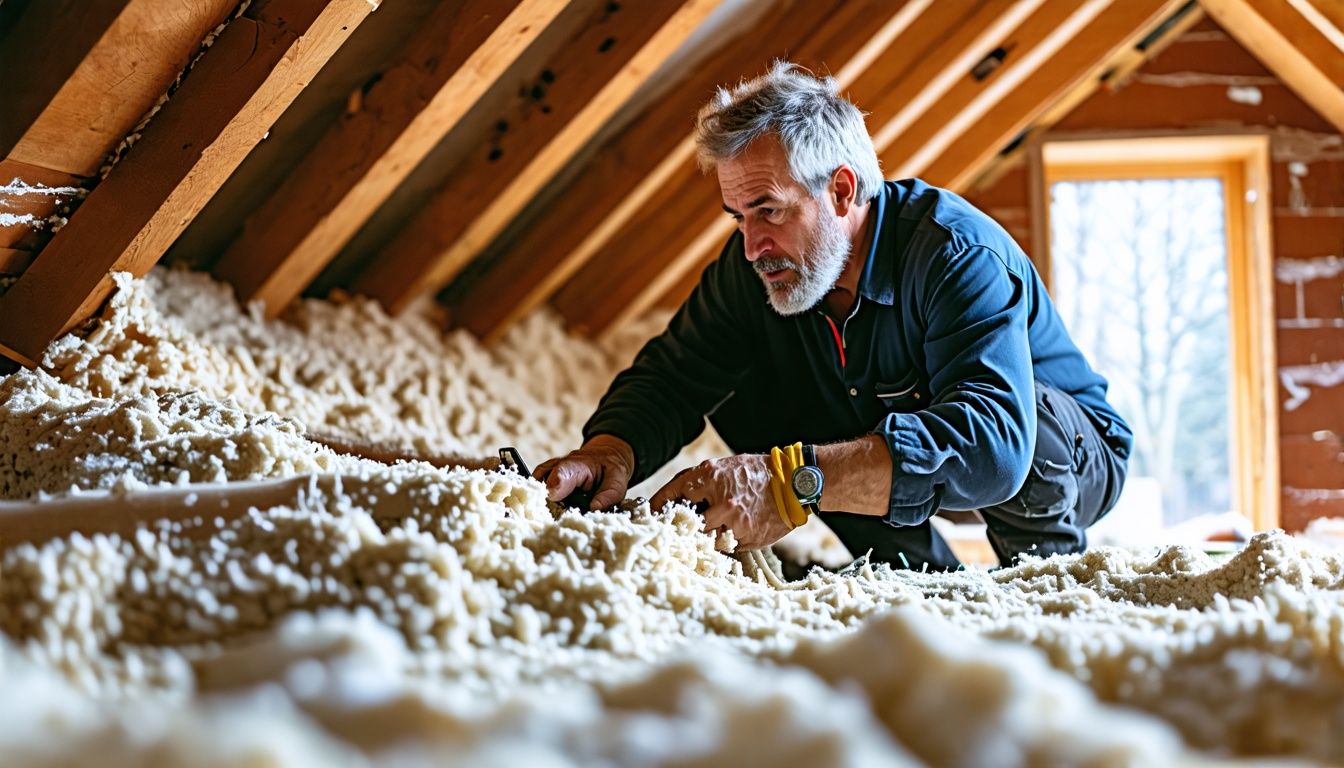
Cellulose fibre insulation is made predominantly from recycled paper and cardboard, treated with borate compounds that provide fire-retardant and pest-resistant properties without introducing toxicity. It performs particularly well as loose-fill insulation, blown into wall cavities and loft spaces where it conforms to irregular shapes that rigid board products would miss.
This makes it an excellent choice for retrofitting older properties — the very buildings most likely to contain asbestos elsewhere in their fabric. Key advantages include:
- Good thermal and acoustic performance
- Low embodied carbon compared to mineral wool or foam
- Effective for retrofitting Victorian and Edwardian properties
- Non-toxic and safe to handle during installation
If you are planning an upgrade programme on a pre-2000 building, always commission an asbestos survey before any refurbishment work begins. Cellulose insulation is an excellent choice for the upgrade itself — but only once you know what you are dealing with in the existing fabric.
Polyurethane and Polyisocyanurate Foam Boards
Rigid polyurethane (PUR) and polyisocyanurate (PIR) foam boards have become dominant insulants in new UK construction. They offer outstanding thermal performance at relatively thin depths, which matters in projects where space is constrained — roof build-ups, floor constructions, and cavity walls.
They do not match asbestos’s fire performance directly, which is why fire stopping and intumescent products are always specified alongside them in compliant construction details. Used correctly within a properly designed system, they are safe, effective, and widely accepted by building control.
Amorphous Silica Fabrics
For high-temperature industrial applications — the kind where asbestos pipe lagging and rope seals were once the default — amorphous silica fabrics are now the professional standard. These woven fabrics are engineered from non-crystalline silica, giving them exceptional resistance to extreme heat without emitting toxic fumes or breaking down into hazardous fibres.
They are used in power generation, petrochemical plants, foundries, and other industrial environments where temperatures can reach or exceed 1,000°C. In construction they appear in expansion joints, high-temperature gaskets, and protective curtains.
Unlike asbestos, amorphous silica does not have a fibrous crystalline structure that splinters into inhalable particles — that fundamental difference in chemistry is what makes it safe.
Modern Fibre Cement Products
Asbestos cement — sometimes called AC sheet — was once ubiquitous on UK farm buildings, garages, and industrial roofing. Its modern replacements use cellulose, PVA, or other synthetic fibres embedded in a Portland cement matrix. They look almost identical to the original asbestos cement sheet but carry none of the health risk.
Various fibre-reinforced composites using natural fibres such as hemp, flax, and jute are also increasingly used in sustainable construction as replacements for asbestos cement products — a development that combines safety with environmental benefit.
Thermoset Plastic Composites
Thermoset plastics — materials that harden permanently when heat-cured and cannot be re-melted — provide another asbestos substitute in specific construction and manufacturing applications. Their resistance to heat, chemicals, and electrical conductivity made them a natural candidate for replacing asbestos in electrical boards, chemical-resistant linings, and industrial components.
They are not the most visible material in mainstream construction, but in specialist applications they fill an important niche. Crucially, they do not release hazardous fibres under normal use conditions.
The Situation in Existing UK Buildings
The availability of safe asbestos alternatives is reassuring for new construction. But for most property managers, landlords, and building owners, the more pressing issue is not what to use going forward — it is what is already in the building they are responsible for right now.
Any building constructed or refurbished before the year 2000 may contain asbestos. Not just the obvious suspects — old boiler rooms and industrial sites — but ordinary offices, schools, hospitals, residential flats, and domestic houses. Asbestos was used in over 3,000 different construction products, and it is often hidden inside materials that look completely unremarkable.
Asbestos in good condition and left undisturbed does not necessarily pose an immediate risk. The danger arises when it is disturbed — during renovation, maintenance, or accidental damage — releasing microscopic fibres into the air. That is why identifying it before any work begins is so critical.
Your Legal Obligations Under the Control of Asbestos Regulations
The Control of Asbestos Regulations place a legal duty on those who manage non-domestic premises to identify, manage, and control asbestos. This is known as the Duty to Manage, and it applies to anyone with responsibility for the maintenance and repair of non-domestic buildings.
If you own or manage a commercial or public building, you are legally required to:
- Find out whether asbestos is present and where it is located
- Assess the condition of any asbestos-containing materials and the risk they pose
- Produce and maintain a written asbestos management plan
- Share that information with anyone who might disturb the material
- Monitor the condition of asbestos-containing materials over time
Failing to comply is not just a regulatory risk — it directly exposes workers, tenants, and visitors to serious harm. The Health and Safety Executive (HSE) takes enforcement seriously, and prosecutions do occur.
HSG264 sets out the HSE’s detailed guidance on asbestos surveying and should be the reference point for anyone commissioning or managing survey work. For domestic properties, the legal framework differs slightly, but the health risk is identical. Homeowners planning renovations on pre-2000 properties are strongly advised to commission a survey before work begins.
What to Do If You Discover Asbestos During Renovation Work
Discovering asbestos mid-project is more common than many people expect. The response in those first few minutes matters enormously.
Stop Work Immediately
The moment you suspect you have encountered an asbestos-containing material, halt all work in the area. Continuing to drill, cut, sand, or otherwise disturb the material will release fibres into the air — and that is precisely where exposure, and the long-term health consequences, begins.
Restrict Access and Do Not Touch the Material
Keep everyone away from the affected zone. Asbestos fibres are microscopic and invisible to the naked eye — you do not need visible dust to have a hazard. Leave the material exactly as it is, and resist the urge to clean up any debris. Standard vacuum cleaners and brushing will spread fibres rather than contain them.
Commission a Professional Survey
Contact a UKAS-accredited asbestos surveying company. Depending on the situation, you will need either a management survey to identify and assess what is present in an occupied building, or a demolition survey if intrusive refurbishment or demolition work is planned.
A qualified surveyor will take samples, have them analysed by an accredited laboratory, and give you a clear picture of what you are dealing with. If you already have a survey in place but it is out of date, a re-inspection survey will assess whether the condition of known asbestos-containing materials has changed and whether the risk rating needs updating.
Arrange Licensed Removal If Required
Not all asbestos removal requires a licensed contractor, but high-risk materials — including most forms of asbestos insulating board, sprayed coatings, and lagging — must only be removed by an HSE-licensed contractor. Your surveyor will advise on which category applies.
Professional asbestos removal carried out by licensed specialists ensures the work is done safely and in full compliance with the regulations.
Dispose of Waste Correctly and Obtain a Clearance Certificate
Asbestos waste is classified as hazardous waste under UK law. It must be double-bagged in UN-approved packaging, clearly labelled, and taken to a licensed hazardous waste facility. A reputable removal contractor will handle this as part of their service.
After removal, an independent four-stage clearance procedure — including air testing — must be completed before the area is signed off as safe to reoccupy. Do not accept a verbal assurance that the area is clear. Insist on the paperwork.
Where Supernova Asbestos Surveys Operates
Supernova Asbestos Surveys provides UKAS-accredited asbestos surveys and management services across the UK. Whether you need an asbestos survey in London, an asbestos survey in Manchester, or an asbestos survey in Birmingham, our surveyors are on the ground and available to respond quickly.
With over 50,000 surveys completed nationwide, we have the experience to handle everything from a single domestic property to a complex multi-site commercial estate. We work with property managers, local authorities, housing associations, contractors, and private homeowners — and we provide clear, actionable reports that tell you exactly what you are dealing with and what to do next.
Frequently Asked Questions
What are the safest asbestos alternatives for insulation?
The most widely used safe alternatives for insulation are mineral wool (stone wool and glass wool), cellulose fibre insulation, and rigid PIR or PUR foam boards. Each suits different applications — mineral wool is particularly strong on fire resistance, cellulose works well for retrofitting older properties, and foam boards offer excellent thermal performance in space-constrained situations. A building professional can advise on the right specification for your project.
Do I need an asbestos survey before using modern replacement materials in a renovation?
Yes — if the building was constructed or refurbished before 2000, you should always commission an asbestos survey before any refurbishment work begins. The survey identifies what asbestos-containing materials are present and where, so that any disturbance during the works can be managed safely. Installing modern asbestos alternatives in a building without first establishing what is already in the fabric is a serious risk.
Is asbestos cement on an old garage roof dangerous?
Asbestos cement in good condition and left undisturbed presents a relatively low risk compared to more friable asbestos materials. However, it should never be drilled, cut, sanded, or pressure-washed, as these actions release fibres into the air. If the sheet is deteriorating, cracked, or you plan to carry out work in the area, have it assessed by a qualified surveyor before proceeding. Modern fibre cement sheet is a direct replacement if removal is required.
What is the difference between a management survey and a demolition survey?
A management survey is designed for buildings in normal occupation. It identifies asbestos-containing materials that could be disturbed during routine maintenance and provides the information needed to produce an asbestos management plan. A demolition survey (also called a refurbishment and demolition survey) is required before major refurbishment or demolition work. It is more intrusive, accessing areas that a management survey would not disturb, and it must locate all asbestos before any structural work begins.
Can I remove asbestos myself?
Some minor, low-risk asbestos work can legally be carried out by non-licensed contractors, but the rules are specific and the risk of getting it wrong is serious. High-risk materials — including asbestos insulating board, sprayed coatings, and most forms of lagging — must only be removed by an HSE-licensed contractor. If you are unsure which category applies to your situation, commission a survey first. A qualified surveyor will advise on the correct removal route for the specific materials identified.
Talk to Supernova Asbestos Surveys
If you manage, own, or are working on a pre-2000 building, do not leave asbestos to chance. The modern asbestos alternatives used in new construction are safe and effective — but the asbestos already in existing buildings requires professional identification, assessment, and management.
Supernova Asbestos Surveys provides fast, accurate, UKAS-accredited surveys across the UK. Call us on 020 4586 0680 or visit asbestos-surveys.org.uk to book a survey or speak to one of our specialists.