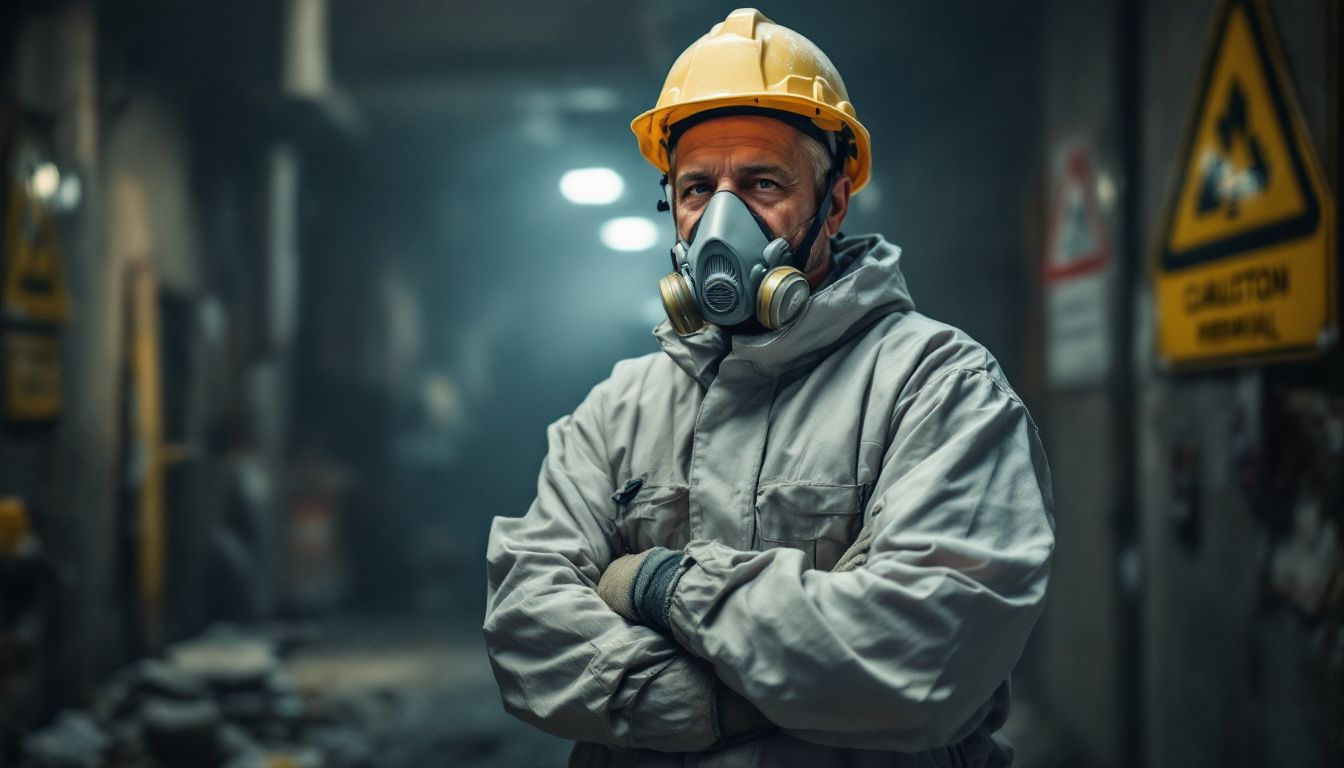
Asbestos PPE: The Last Line of Defence That Cannot Afford to Fail
When asbestos-containing materials are disturbed, microscopic fibres become airborne within seconds. They are invisible, they are silent, and they cause mesothelioma, asbestosis, and lung cancer — often 20 to 40 years after the original exposure. Asbestos PPE is the final barrier between a worker and a life-altering diagnosis, and it is not a formality.
The particular danger of asbestos is that there is no immediate warning. No burning sensation, no coughing fit, no signal that fibres have been inhaled. That invisibility is precisely why every component of an asbestos PPE system must be selected carefully, fitted correctly, and used rigorously — every single time, without exception.
Why Asbestos Demands Specialist PPE
Asbestos is not one material. It is a group of naturally occurring silicate minerals — crocidolite (blue), amosite (brown), and chrysotile (white) being the most common — each with different fibre types and varying levels of toxicity. All are regulated under the Control of Asbestos Regulations, and none can be safely managed with standard dust masks or general-purpose respiratory equipment.
The Health and Safety Executive sets a Workplace Exposure Limit (WEL) for asbestos fibres. Even brief exceedances contribute to a worker’s cumulative lifetime dose, and because mesothelioma can take decades to develop, the consequences of poor PPE practice today may not become visible for a generation. That delayed timeline makes complacency particularly dangerous.
Standard surgical masks, FFP1 and FFP2 respirators, and general dust protection offer no meaningful protection against asbestos fibres. Only certified, correctly fitted respiratory protective equipment meets the legal and practical standard — and even that is just one part of a complete system.
The Complete Asbestos PPE System: Every Item Explained
Asbestos PPE functions as a system. A gap anywhere — an ungloved hand, an ill-fitting respirator, footwear that traps fibres — can undermine every other element of protection. Here is what a complete, compliant system looks like in practice.
Disposable Coveralls
Coveralls must be certified to Type 5, Category 3 standard under EN ISO 13982-1. This classification covers protection against dry particulates, including asbestos fibres. Hooded coveralls are essential — the hood must seal properly around the face and over the respirator head straps, never underneath them.
Disposable coveralls are single-use only. Taking them home for washing creates a serious secondary exposure risk for household members. After use, they must be removed using a controlled doffing procedure, double-bagged in heavy-duty polythene bags of at least 200 microns, and disposed of as asbestos waste through a licensed contractor.
Respiratory Protective Equipment (RPE)
Respiratory protection is arguably the most critical component of any asbestos PPE system. The two types most commonly used in asbestos work are:
- FFP3 Filtering Facepiece Respirators: Half-mask disposable respirators with an Assigned Protection Factor (APF) of x20. Suitable for lower-risk, short-duration, non-licensable asbestos tasks. FFP3 is the absolute minimum standard — FFP1 and FFP2 are not acceptable under any circumstances.
- Full-Face Respirators with P3 Filters: Cover the entire face including the eyes, with an APF of x40. Required for higher-risk work, including licensed asbestos removal. Powered air-purifying respirators (PAPRs) with P3 filters are used where even higher protection factors are needed.
Every respirator must be fit-tested before first use and annually thereafter. Fit testing confirms that a specific make and model creates an adequate seal against the wearer’s face. A respirator that fits one person perfectly may leak on another — there is no universal fit, and assuming otherwise is a serious mistake.
Before each shift, workers must also perform a fit check — a quick positive or negative pressure test — to confirm the seal has not been compromised by damage, facial hair growth, or incorrect donning. This takes seconds and is not optional.
Protective Gloves
Gloves prevent direct skin contact with asbestos-containing materials and reduce the risk of transferring fibres from hands to face. Nitrile or latex disposable gloves are standard, as they can be removed and disposed of safely after each use.
Reusable gloves are not appropriate for asbestos work. They cannot be reliably decontaminated and carry a real risk of spreading fibres between tasks and locations.
Safety Goggles
Where full-face respirators are not in use, safety goggles must be worn to protect the eyes from airborne fibres and particulates. They must seal against the face — vented goggles are not suitable, as the vents allow particulates to enter. When a full-face respirator is worn, separate goggles are not required.
Protective Footwear
Standard lace-up boots can trap asbestos fibres in fabric and eyelets, carrying contamination out of the work area. Rubber wellington boots or smooth-soled overshoes are preferred — they can be decontaminated or disposed of cleanly without risk of fibre transfer.
Footwear must be removed or decontaminated before leaving the work area. Tracking fibres into clean areas on the soles of boots is a common and entirely preventable mistake.
Donning and Doffing: The Procedures That Matter as Much as the Equipment
The most expensive, highest-specification asbestos PPE will fail to protect a worker if it is put on or taken off incorrectly. Doffing — removing contaminated PPE — is where most secondary exposure actually occurs, and the procedure must be followed precisely every time.
Putting On (Donning) Asbestos PPE
- Put on the respirator first and perform a fit check before anything else.
- Step into the coverall and pull it up over the body, with the hood positioned ready to go over the respirator.
- Pull the hood up and over the respirator head straps — not underneath them.
- Seal the coverall zip with the adhesive flap if present.
- Put on gloves and tape the cuffs to the coverall sleeves.
- Put on footwear or overshoes last.
Removing (Doffing) Asbestos PPE
This is the highest-risk moment of any asbestos task. The outside of all PPE is contaminated, and touching your face or clothing with contaminated gloves can cause direct exposure. Follow this sequence without shortcuts:
- Decontaminate the outside of the coverall using a damp wipe or a vacuum fitted with a HEPA filter — never dry brush or shake it.
- Remove overshoes first, rolling them inward to contain fibres.
- Remove gloves using a peel-and-roll technique, avoiding contact with the outer surface.
- Unzip the coverall and roll it downward and inward, turning it inside out as it comes off.
- Place immediately into a waste bag — do not set it down on any surface.
- Remove the respirator last, handling only the straps. Do not touch the facepiece.
- Wash hands and face thoroughly before leaving the decontamination area.
Post-shift decontamination facilities — including clean rooms, shower facilities where required, and clearly designated dirty and clean zones — are a legal requirement for licensed asbestos work. These are not optional extras.
Asbestos PPE and the Law: What UK Regulations Require
The Control of Asbestos Regulations set out clear legal requirements for PPE in asbestos work. Employers must provide suitable RPE and protective clothing at no cost to the worker. They must also ensure equipment is properly maintained, that workers are trained in its use, and that contaminated PPE is disposed of correctly as hazardous waste.
HSG264 — the HSE’s definitive guidance on asbestos surveying — makes clear that before any work begins on a building, the presence or absence of asbestos must be established. No amount of PPE compensates for failing to identify asbestos-containing materials before disturbing them.
A management survey is the starting point for most occupied buildings. It establishes what asbestos is present, where it is located, and what condition it is in — giving building managers the information they need to manage the risk properly and ensure that any workers entering the building are appropriately protected.
Where refurbishment or demolition work is planned, a refurbishment survey is legally required before work commences. This more intrusive survey identifies asbestos in areas that will be disturbed, giving contractors the information they need to specify the correct PPE and plan safe working methods from the outset.
For buildings where asbestos has already been identified and is being managed in place, a re-inspection survey should be carried out periodically to check the condition of known materials and update the risk assessment — including any changes to the PPE requirements for workers in the building.
Licensed vs Non-Licensed Asbestos Work: PPE Requirements Differ
Not all asbestos work requires a licence, but the distinction matters significantly when specifying PPE. The Control of Asbestos Regulations divide asbestos work into three categories:
- Licensable work: High-risk activities involving materials such as sprayed coatings, lagging, or insulation board in poor condition. Requires a licence from the HSE, notification to the relevant enforcing authority, and the highest levels of RPE — typically full-face respirators with P3 filters or PAPRs. Where asbestos removal is required, this category almost always applies.
- Notifiable non-licensed work (NNLW): Lower-risk work that does not require a licence but must be notified to the enforcing authority. Workers must have health surveillance and appropriate training. FFP3 respirators are typically the minimum RPE requirement.
- Non-licensed work: Short-duration, low-risk tasks. PPE requirements still apply — workers cannot handle asbestos-containing materials without appropriate respiratory protection and coveralls, regardless of how brief the task.
The category of work dictates not just the PPE specification but also the training, health surveillance, and waste disposal requirements. Getting this wrong is not just a compliance failure — it is a direct health risk to workers.
Storing, Maintaining, and Disposing of Asbestos PPE
Reusable PPE — such as full-face respirators — must be stored in sealed, clean containers when not in use, clearly labelled to prevent contamination of clean equipment. Filters must be checked and replaced according to the manufacturer’s guidance and whenever there is any doubt about their integrity.
Disposable PPE — coveralls, gloves, overshoes — must be treated as asbestos waste after use without exception. This means:
- Double-bagging in heavy-duty polythene bags (minimum 200 microns)
- Clearly labelling bags as asbestos waste
- Storing in a designated, secure waste area
- Disposing of through a licensed hazardous waste contractor
Contaminated PPE must never be placed in general waste bins, taken off site in personal vehicles, or washed at home. These actions risk spreading asbestos contamination and may constitute a criminal offence under environmental legislation.
Training: PPE Only Works When People Know How to Use It
Providing the correct asbestos PPE is a legal obligation. Ensuring workers know how to use it properly is equally required by law — and equally important in practice. Equipment sitting unused in a bag, or worn incorrectly, protects nobody.
Training must cover:
- The health risks associated with asbestos exposure
- Correct donning and doffing procedures
- How to perform a fit check before each shift
- Correct disposal of contaminated PPE
- What to do if PPE is damaged or compromised during a task
Training must be role-appropriate, regularly refreshed, and documented. Supervisors carry responsibility too — they must confirm that workers are using PPE correctly before and during tasks, not simply assume that a briefing was sufficient. Where licensed work is being carried out, training requirements under the Control of Asbestos Regulations are more prescriptive still.
When PPE Alone Is Not Enough: The Role of Surveying
PPE is a control measure — it reduces exposure, but it does not eliminate the source of risk. The hierarchy of controls under UK health and safety law places elimination and substitution above personal protective equipment. In practice, this means identifying asbestos-containing materials before any work begins, not after.
Across the UK, Supernova Asbestos Surveys provides professional asbestos surveying to give building owners, managers, and contractors the information they need before workers are ever put at risk. Whether you need an asbestos survey in London, an asbestos survey in Manchester, or an asbestos survey in Birmingham, our accredited surveyors are ready to help.
Knowing what asbestos is present, where it is, and what condition it is in allows contractors to specify the correct PPE, plan safe working methods, and ensure that no worker is exposed unnecessarily. A survey is not a bureaucratic exercise — it is the foundation on which all other asbestos controls, including PPE, are built.
Frequently Asked Questions
What is the minimum RPE standard for asbestos work?
FFP3 is the minimum acceptable standard for respiratory protection in asbestos work. FFP1 and FFP2 respirators do not provide adequate protection against asbestos fibres and must not be used. For higher-risk or licensable work, full-face respirators with P3 filters or powered air-purifying respirators (PAPRs) are required.
Does asbestos PPE need to be fit-tested?
Yes. Every respirator must be fit-tested before first use and at least annually thereafter. Fit testing confirms that the specific make and model of respirator creates an adequate seal against the individual wearer’s face. A fit check must also be performed before each shift. Fit testing and fit checking are separate procedures — both are required.
Can I wash and reuse disposable asbestos coveralls?
No. Disposable coveralls used during asbestos work are single-use only and must be treated as asbestos waste after removal. Washing them at home risks contaminating your household and exposing family members to asbestos fibres. After doffing, coveralls must be double-bagged in heavy-duty polythene bags and disposed of through a licensed hazardous waste contractor.
Do I need asbestos PPE for non-licensed asbestos work?
Yes. PPE requirements apply to all three categories of asbestos work under the Control of Asbestos Regulations — licensable, notifiable non-licensed, and non-licensed. Even short-duration, low-risk tasks require appropriate respiratory protection and coveralls. The specific PPE specification varies by risk level, but there is no category of asbestos work where PPE is not required.
How do I know if a building contains asbestos before work starts?
A professional asbestos survey is the only reliable way to establish whether asbestos-containing materials are present before work begins. HSG264 guidance from the HSE makes this a clear requirement. A management survey is suitable for most occupied buildings, while a refurbishment survey is legally required before any refurbishment or demolition work commences. Contact Supernova Asbestos Surveys on 020 4586 0680 or visit asbestos-surveys.org.uk to arrange a survey.
Get Expert Asbestos Support from Supernova
Supernova Asbestos Surveys has completed over 50,000 surveys across the UK. Our accredited team provides management surveys, refurbishment surveys, re-inspection surveys, and asbestos removal support — giving you the information and guidance you need to keep workers safe and stay legally compliant.
Call us on 020 4586 0680 or visit asbestos-surveys.org.uk to speak with our team or book a survey.