
Britain did not tighten asbestos law on a whim. The history of asbestos regulations is a long, uncomfortable story of industrial enthusiasm, mounting medical evidence and a legal system forced to catch up after asbestos had already been built into factories, offices, schools, hospitals and homes across the UK.
For property managers, landlords and dutyholders, that history still matters. It explains why today’s asbestos rules are strict, why surveys must be carried out properly, and why the Control of Asbestos Regulations, HSG264 and HSE guidance place such weight on identifying asbestos before maintenance, refurbishment or demolition starts.
Why the history of asbestos regulations still matters today
Asbestos is often treated as an old problem, but it is still a live compliance issue in thousands of buildings. If your premises were built or refurbished before asbestos use was fully prohibited, there is a realistic chance asbestos-containing materials remain somewhere in the fabric of the property.
Understanding the history of asbestos regulations helps you see why the law is built around prevention. The central lesson has stayed the same: asbestos is most dangerous when disturbed, so the right approach is to identify it, assess its condition and manage or remove risk before fibres are released.
That is why modern compliance is not just about reacting to damage. It is about planning ahead, keeping accurate records and using the correct type of survey for the work you intend to carry out.
- Routine occupation and normal maintenance usually call for a management survey.
- Intrusive building work requires a refurbishment survey before work begins.
- Local knowledge also matters, whether you need an asbestos survey London service, an asbestos survey Manchester appointment or an asbestos survey Birmingham team for regional portfolios.
Before regulation: why asbestos became so widely used
To understand the history of asbestos regulations, you first need to understand why asbestos spread so quickly. It was valued because it resisted heat, helped with insulation, added strength to products and could be used in everything from pipe lagging to cement sheets.
The word itself comes from a term commonly translated as “inextinguishable” or “unquenchable”. That reputation made asbestos commercially attractive long before anyone created a meaningful legal framework around exposure.
Early uses of asbestos
Long before modern construction boomed, asbestos fibres were recognised for their unusual properties. Historical references describe asbestos being used in textiles, lamp wicks and heat-resistant materials.
Those early uses were limited compared with later industrial demand, but they shaped one dangerous assumption: asbestos was seen as a clever material, not a serious health hazard.
Why industry embraced it
As industrial production expanded, asbestos solved several practical problems at once. It was cheap, adaptable and effective in harsh environments.
- It resisted heat and flame.
- It improved insulation performance.
- It strengthened cement and composite materials.
- It offered chemical resistance in some settings.
- It suited factories, shipbuilding and mass construction.
That combination made asbestos highly attractive during periods of industrial growth and post-war rebuilding. By the time the dangers were properly reflected in law, the material had already been installed across the built environment on a huge scale.
The rise of asbestos in British buildings and workplaces
The history of asbestos regulations is inseparable from the rise of asbestos in workplaces and buildings. Once mining, processing and manufacturing expanded, asbestos stopped being a niche mineral and became a standard ingredient in construction and engineering products.
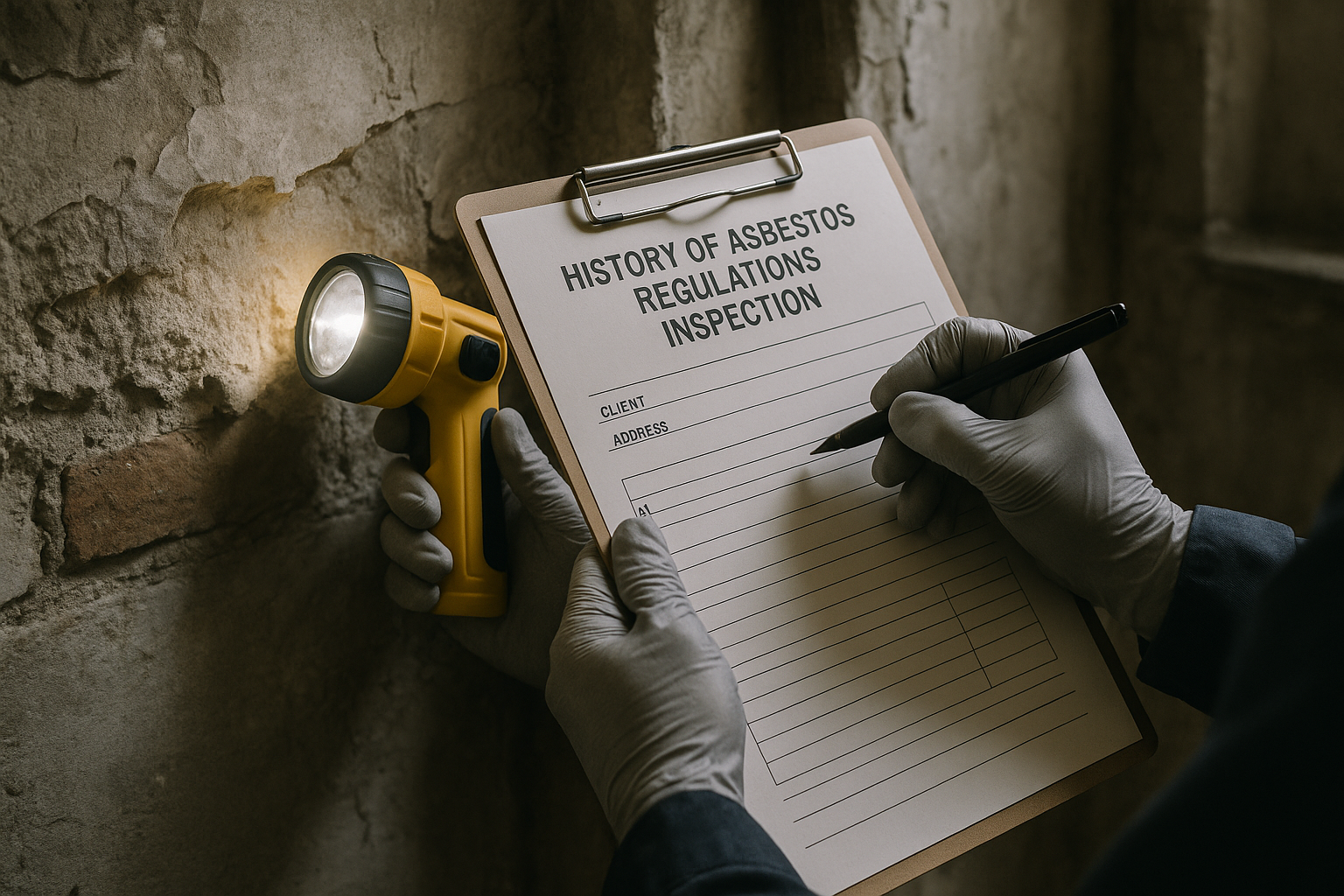
This is why asbestos remains such a practical issue for dutyholders today. The legal story is not just about factories where asbestos was handled directly. It is also about offices, schools, warehouses, communal areas, retail units and public buildings where asbestos-containing materials may still be present.
Common asbestos-containing materials in the UK
Many products installed in older buildings can still contain asbestos. Some are relatively low risk when in good condition, while others can release fibres far more easily if damaged.
- Pipe and boiler insulation
- Sprayed coatings
- Asbestos insulating board
- Asbestos cement sheets, gutters and flues
- Floor tiles and bitumen adhesives
- Textured coatings
- Roofing products
- Gaskets, seals and rope products
From a management point of view, the key issue is not whether asbestos was once legally used. It is whether it is present now, what condition it is in and whether planned work could disturb it.
Early medical warnings and the slow recognition of harm
One of the starkest themes in the history of asbestos regulations is how long the response took. Medical concerns did not appear suddenly. They built up over time as doctors, inspectors and researchers saw patterns of illness among workers exposed to asbestos dust.
Early concern focused on respiratory damage in industrial settings where dust levels were high. Over time, evidence linked asbestos exposure with asbestosis, mesothelioma, lung cancer and other serious disease.
Why the danger was underestimated for so long
The legal response lagged behind the evidence for several reasons. None of them make the delay acceptable, but they help explain why regulation developed so slowly.
- Asbestos-related disease often has a long latency period.
- Industrial use was commercially profitable.
- Exposure controls were inconsistent and often poor.
- Medical understanding developed gradually.
- Workers frequently had limited protection or influence.
For modern dutyholders, the practical lesson is clear. You cannot judge asbestos risk by waiting for obvious signs of harm. The law requires a preventive approach because the consequences of getting it wrong can be severe and long-lasting.
The Merewether and Price Report and a major turning point
No serious account of the history of asbestos regulations can ignore the Merewether and Price Report. It marked a major shift because it set out structured medical evidence linking asbestos dust exposure with serious occupational disease.

The report examined conditions in asbestos manufacturing and processing and made it harder to dismiss the issue as anecdotal concern. It showed that asbestos dust was a real workplace hazard and that exposure levels mattered.
Why the report mattered
The report helped move asbestos from suspicion to documented occupational risk. That gave regulators and government a stronger basis for intervention.
Its influence can be seen in the push towards dust suppression, ventilation, medical supervision and more formal control measures. It did not end dangerous exposure, but it changed the conversation.
Why it still matters to property managers
You may not manage an asbestos factory, but the principle behind the report still underpins modern compliance. If asbestos fibres can be released, people can be harmed. That is why those in control of premises must identify asbestos risk and prevent exposure so far as reasonably practicable.
From factory controls to wider workplace duties
Early asbestos laws were much narrower than the framework we rely on today. They tended to focus on specific industrial processes rather than the full lifecycle of asbestos in buildings.
That matters when looking at the history of asbestos regulations. Older rules often addressed dust in manufacturing rather than maintenance work, refurbishment projects or the day-to-day management of premises containing asbestos materials.
What early controls focused on
- Dust extraction and ventilation
- Medical examinations for exposed workers
- Specific factory processes
- Basic workplace hygiene measures
Those steps had value, but they did not tackle the wider problem. Asbestos was still being supplied, installed and disturbed in many other settings.
The wider legal shift in health and safety
The Health and Safety at Work etc. Act marked a broader change in British workplace law. It placed general duties on employers and those in control of premises, creating a stronger foundation for hazard management across many sectors.
For asbestos, that shift was crucial. It helped move responsibility away from a narrow factory model and towards a wider expectation that foreseeable risks had to be assessed, managed and communicated properly.
That legacy is still visible today. If you control premises, you need reliable asbestos information, competent advice and a clear plan before work starts.
The move towards product restrictions and bans
Another major stage in the history of asbestos regulations was the move away from merely controlling exposure and towards restricting asbestos products themselves. This reflected a more precautionary approach.
Once the health consequences became harder to deny, the law began to target the supply and use of the most hazardous asbestos materials. This was a significant change in legal thinking. Some risks were no longer seen as acceptable even with workplace controls in place.
Why product restrictions mattered
Restricting products sent a clear signal that asbestos was not just a dust issue for certain industries. It was a material problem embedded in supply chains, specifications and construction practice.
That shift also explains why so many buildings still require attention now. Materials fitted lawfully at the time do not disappear when the law changes. They remain in place until identified, assessed and managed correctly.
The practical effect on today’s buildings
For dutyholders, this is where history becomes operational. A building may contain asbestos that was entirely legal when installed but now falls within a strict management and control regime.
That is why assumptions are risky. If records are missing, if refurbishment history is unclear or if suspect materials are present, arrange a survey before work proceeds.
How the Control of Asbestos Regulations shaped current duties
The modern legal framework did not appear in one step. Over time, asbestos law became more consolidated, more practical and more clearly focused on prevention. The Control of Asbestos Regulations now sit at the centre of that framework.
When people ask why the history of asbestos regulations matters, this is the answer: today’s duties are the result of decades of evidence, enforcement experience and legal refinement.
What the current framework is trying to achieve
The regulations are designed to prevent exposure to asbestos fibres. In practical terms, that means identifying asbestos-containing materials, assessing risk, controlling work and making sure the right information reaches the right people at the right time.
For non-domestic premises, the duty to manage is one of the most important concepts. If you are responsible for maintenance or repair, you need to know whether asbestos is present and how it will be managed.
Key compliance expectations for dutyholders
- Find out whether asbestos is present, and if so, where it is.
- Assess the risk posed by those materials.
- Keep records up to date.
- Share asbestos information with anyone liable to disturb it.
- Review the management plan regularly.
- Arrange the correct survey before intrusive work.
HSG264 remains especially important because it sets out how asbestos surveys should be planned, carried out and reported. If a survey is poorly scoped or badly executed, the resulting information may not be reliable enough to support safe decisions.
HSG264, HSE guidance and why survey quality matters
The history of asbestos regulations is not just about Acts and Regulations. It is also about how those legal duties are applied in practice. That is where HSG264 and wider HSE guidance become essential.
HSG264 explains what a survey is for, what type of survey is appropriate and how findings should be recorded. It also makes clear that the survey must match the intended purpose. A survey carried out for routine occupation is not a substitute for one designed to support refurbishment or demolition.
What good asbestos information looks like
- Clear identification of suspect materials
- Accessible plans or locations
- Material assessments where appropriate
- Practical recommendations
- Sampling carried out safely and competently
- Reporting that supports real-world decision-making
For property managers, the actionable point is simple: do not treat asbestos surveys as box-ticking exercises. The value of a survey lies in whether it helps you prevent accidental disturbance and plan work safely.
Lessons property managers can take from the history of asbestos regulations
The history of asbestos regulations offers some very practical lessons for anyone responsible for premises. Most of them come down to planning, information and not making assumptions.
1. Do not rely on age alone
Older buildings are more likely to contain asbestos, but refurbishment history matters too. A newer-looking area may still conceal older asbestos-containing materials above ceilings, behind panels or within service risers.
2. Keep your asbestos register live
An asbestos register should be reviewed and updated when conditions change, materials are removed, new information becomes available or further surveys are carried out. A register that sits untouched for years is a weak control measure.
3. Match the survey to the work
This is one of the most common failings. If contractors are only carrying out minor routine tasks, a management survey may be enough. If walls, ceilings, floors, plant or fixed structures will be disturbed, you need a refurbishment survey scoped to the actual works.
4. Tell contractors what they need to know
Even the best survey is useless if the information stays in a folder. Anyone liable to disturb asbestos-containing materials must receive relevant information before work starts.
5. Act on damage quickly
If suspect materials are deteriorating, have been struck, drilled or exposed during works, stop and get competent advice. Delays increase the chance of further disturbance and poor decision-making.
Common mistakes that still cause asbestos compliance problems
Despite the long history of asbestos regulations, the same mistakes still appear across commercial and public property management.
- Assuming a previous owner dealt with asbestos properly
- Starting refurbishment without the correct survey
- Failing to update asbestos records after works
- Not sharing survey findings with contractors
- Confusing low-risk material with no-risk material
- Using outdated plans or incomplete registers
Most asbestos incidents are not caused by mystery. They are caused by missing information, poor communication or work starting before the right checks have been completed.
What to do if you manage an older building
If you are responsible for an older property, the safest approach is structured and straightforward. You do not need to panic, but you do need reliable information.
- Review what asbestos information you already hold.
- Check whether the existing survey is suitable for the building and current use.
- Inspect whether any known materials have changed condition.
- Confirm whether planned works are routine, intrusive or major.
- Arrange the correct survey before contractors begin.
- Make sure findings are reflected in your asbestos register and management plan.
This is where experienced surveying support matters. The aim is not just to identify asbestos, but to give you information you can actually use to manage risk, brief contractors and stay compliant.
Frequently Asked Questions
Why is the history of asbestos regulations relevant to property managers today?
Because current duties were shaped by decades of evidence showing what happens when asbestos is ignored or disturbed. Understanding that history helps property managers see why surveys, records, planning and communication are central to compliance.
What is the main UK law dealing with asbestos now?
The Control of Asbestos Regulations form the core legal framework for managing asbestos risk in the UK. They work alongside HSE guidance and HSG264, which sets out expectations for asbestos surveying.
What is the difference between a management survey and a refurbishment survey?
A management survey is used to locate, as far as reasonably practicable, asbestos-containing materials that could be disturbed during normal occupation and routine maintenance. A refurbishment survey is required before intrusive work so hidden asbestos can be identified in the areas affected by the planned project.
If asbestos was legal when installed, does it still need to be managed?
Yes. The fact that a material was lawful when fitted does not remove current duties. If asbestos remains in a building, it must be identified and managed in line with the Control of Asbestos Regulations and relevant HSE guidance.
When should I arrange an asbestos survey?
You should arrange a survey if you are responsible for a building and do not have reliable asbestos information, if the existing information is outdated, or before any refurbishment or intrusive works begin. The right survey depends on the building and the planned activity.
If you need clear, practical advice on asbestos compliance, Supernova Asbestos Surveys can help. We carry out surveys nationwide for landlords, managing agents, schools, commercial premises and public sector buildings. Call 020 4586 0680 or visit asbestos-surveys.org.uk to book a survey or discuss the right service for your property.