
Ignore asbestos law UK at your peril. If you manage, own or maintain a building built before 2000, asbestos is not a historic problem tucked away in the fabric of the premises. It is a live compliance issue that affects routine maintenance, contractor safety, refurbishment planning and, in the worst cases, life-changing disease caused by fibre exposure.
For most duty holders, the legal question is not complicated: do you know where asbestos is, what condition it is in, and what controls are in place to stop anyone disturbing it? If the answer is uncertain, you have work to do.
Asbestos law UK: the legal framework that matters
The foundation of asbestos law UK is the Control of Asbestos Regulations. These regulations sit alongside HSE guidance and recognised surveying practice set out in HSG264. Together, they explain how asbestos should be identified, assessed, recorded and managed so that exposure is prevented.
The law is built around a simple principle: if asbestos may be present, the risk must be understood before work starts. That applies whether you are managing a school, a shop, an office block, a warehouse, a surgery or the common parts of a residential building.
In practical terms, the legal duties usually include:
- Taking reasonable steps to find out whether asbestos-containing materials are present
- Presuming materials contain asbestos where there is uncertainty
- Assessing the risk from those materials
- Keeping an up-to-date asbestos register
- Preparing and following an asbestos management plan
- Sharing information with anyone liable to disturb asbestos
- Using competent surveyors, analysts and contractors
The law does not require asbestos to be removed in every case. If a material is in good condition and unlikely to be damaged, careful management may be the correct approach. What the law does require is control, evidence and communication.
Why asbestos law UK is still so strict
Asbestos remains a major issue because it was used widely across UK buildings for decades. It can still be found in insulation board, pipe lagging, sprayed coatings, textured coatings, ceiling tiles, floor tiles, bitumen products, cement sheets, soffits, panels and service risers.
The risk is not usually asbestos that is sealed, undamaged and properly managed. The danger comes when materials are drilled, cut, broken, sanded or otherwise disturbed, releasing fibres into the air.
Those fibres can cause serious disease, often many years after exposure. The conditions most commonly associated with asbestos include:
- Mesothelioma
- Lung cancer
- Asbestosis
- Pleural thickening
That is why asbestos law UK focuses so heavily on prevention. Waiting until work has started is too late. By that stage, a simple maintenance task can become a contamination incident, a site shutdown and a serious health risk.
Who asbestos law UK applies to
Many people assume asbestos duties only apply to large commercial landlords. They do not. Asbestos law UK applies to anyone with responsibility for maintenance or repair in non-domestic premises.
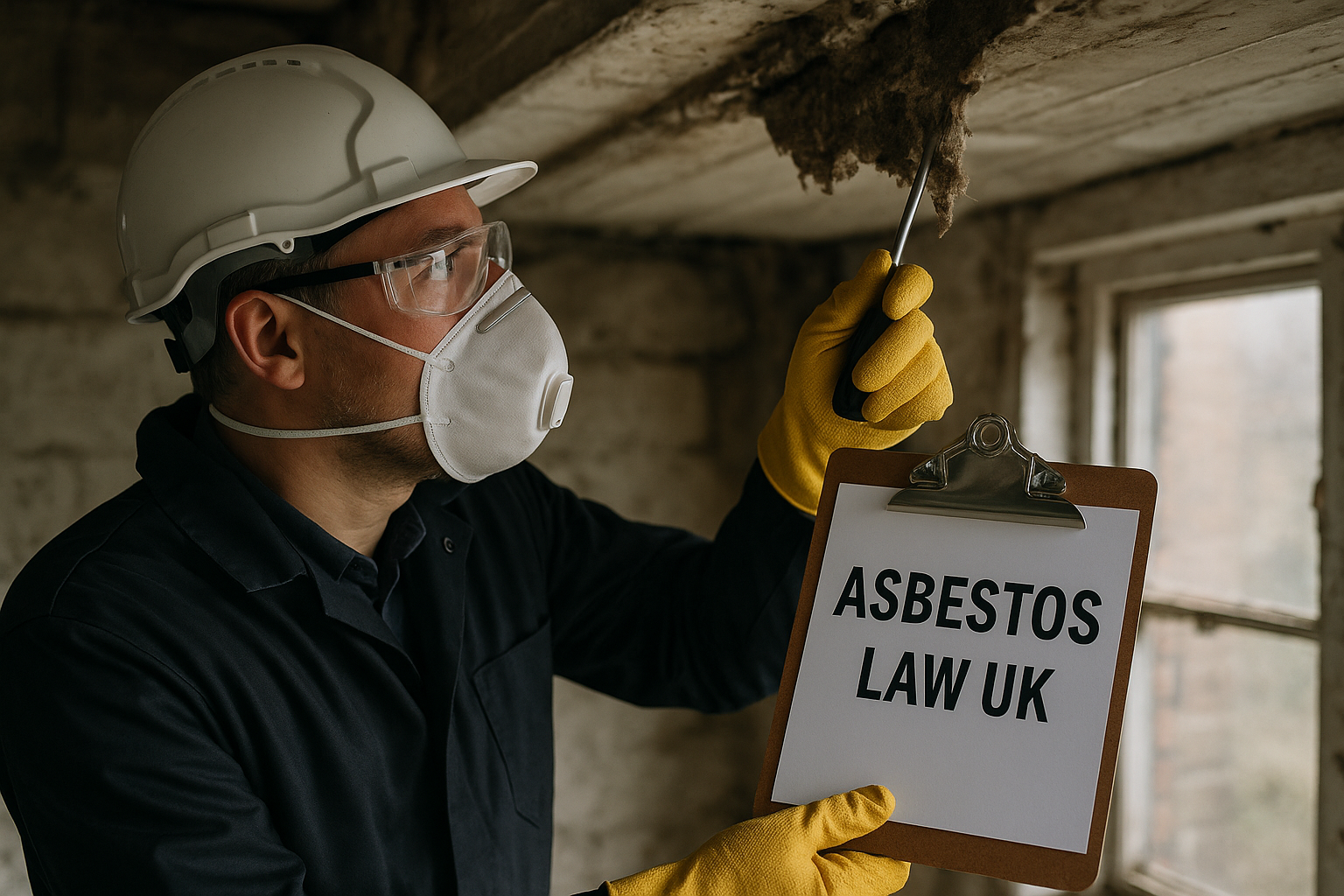
This can include:
- Commercial property owners
- Landlords
- Facilities managers
- Managing agents
- Tenants with repairing obligations
- Schools, academies and colleges
- Healthcare providers and NHS premises
- Local authorities
- Housing associations
- Charities, churches and community organisations
It also affects the common parts of domestic buildings, such as corridors, plant rooms, stairwells, lift motor rooms and shared service areas. If you control repair or maintenance in those spaces, you may hold the duty to manage.
Contractors are part of the picture as well. Electricians, plumbers, decorators, telecoms engineers, fire alarm installers and general maintenance teams can all disturb hidden asbestos if they are not given the right information before starting work.
Industries that commonly face asbestos risk
Some sectors encounter asbestos more often simply because of the age and layout of their buildings. These include:
- Construction
- Property and facilities management
- Education
- Healthcare
- Manufacturing
- Retail and hospitality
- Transport and logistics
- Public sector estates
If your organisation occupies older premises, asbestos should be treated as a routine compliance issue. It is not something to revisit only when a contractor raises a concern.
The duty to manage under asbestos law UK
The duty to manage is one of the most important parts of asbestos law UK. If you are the duty holder, you must take reasonable steps to determine whether asbestos is present, assess the risk and keep that risk under control.
That usually means having the right survey, a reliable asbestos register and a management plan that is used in real life rather than filed away and forgotten.
Your practical duties generally include:
- Identify asbestos-containing materials, or presume they are present if there is doubt
- Record their location, extent and condition
- Assess the likelihood of disturbance
- Set out how the risk will be managed
- Review the information regularly
- Provide relevant asbestos information to anyone who may disturb the material
A common failure is assuming that a survey alone is enough. It is not. A survey gives you information. Compliance comes from using that information properly.
What good asbestos management looks like
On a well-run site, asbestos information is easy to access and forms part of everyday maintenance control. Contractors are briefed before work starts. Permits reference asbestos where relevant. Known materials are monitored. Planned works trigger the right survey before anyone opens up the building fabric.
If your team cannot quickly answer where the asbestos register is, when it was last reviewed and how contractors see it, your arrangements need attention.
Surveys and testing needed to comply with asbestos law UK
You cannot manage what you have not identified. For many buildings, the first step towards compliance with asbestos law UK is a suitable survey carried out by a competent organisation.

Management surveys
For occupied premises, a management survey is usually the baseline requirement. Its purpose is to locate, as far as reasonably practicable, asbestos-containing materials that could be damaged or disturbed during normal occupation, routine maintenance or minor works.
If your records are outdated, missing or unclear, arranging an asbestos management survey is often the most sensible place to start. It gives you the information needed for an asbestos register and management plan.
Refurbishment surveys
Planned works change everything. Before intrusive refurbishment, upgrade or alteration work begins, a refurbishment survey is required for the affected area.
These surveys are intrusive because they are designed to find asbestos that may be hidden within walls, ceilings, risers, floor voids and service routes. They must be completed before contractors start stripping out or opening up the structure.
Demolition surveys
If a building, or part of it, is due to be demolished, a demolition survey is required. This survey is fully intrusive and aims to identify asbestos throughout the area to be demolished so it can be dealt with safely before demolition proceeds.
Starting demolition without the right asbestos information is a fast route to enforcement action, delay and contamination.
Re-inspection surveys
Where asbestos-containing materials are known and remain in place, they need regular review. A re-inspection survey helps confirm whether those materials are still in the same condition and whether your management plan remains accurate.
The suitable interval depends on the material, its condition, occupancy levels and the likelihood of disturbance. High-traffic or vulnerable areas often need closer attention.
Asbestos testing and sample analysis
Sometimes you do not need a full survey. If there is a specific suspect material and the question is simply whether it contains asbestos, targeted asbestos testing may be the right option.
For individual materials, professional sample analysis can confirm whether asbestos is present. This can be useful when a single board, tile, coating or panel needs identification before minor decisions are made.
Where sampling is suitable and can be carried out safely, an asbestos testing kit can help you submit a sample correctly. A testing kit may be convenient for straightforward cases, but do not take samples yourself if the material is damaged, friable, difficult to access or likely to release fibres. In those situations, bring in a professional surveyor.
Removal, licensing and contractor controls
Not all asbestos work is treated the same under asbestos law UK. Depending on the material, its condition and the task involved, work may be licensed, notifiable non-licensed or non-licensed.
Higher-risk materials such as pipe lagging, sprayed coatings and some insulation board work often require a licensed contractor. Lower-risk materials may still require notification, specific control measures, training and appropriate waste handling.
If asbestos needs to be removed, use a competent specialist for asbestos removal. Do not rely on assumptions from a general builder or maintenance contractor.
Checks to make before removal starts
- Confirm whether the work requires a licence
- Review the risk assessment and method statement
- Check training and competence records
- Confirm how the area will be controlled and cleaned
- Make sure waste handling and disposal are properly arranged
- Establish whether air monitoring or clearance procedures are needed
If the work category is misjudged, the consequences can escalate quickly. A task that looked minor on paper can become a serious compliance failure if the wrong controls are used.
Training, records and day-to-day asbestos compliance
A large part of complying with asbestos law UK is operational discipline. The legal duties are clear, but many failures happen because information is not shared, records are out of date or contractors are allowed to start work without proper checks.
Training
Anyone liable to disturb asbestos during their work should have appropriate training. For many trades, that means asbestos awareness training. For those carrying out asbestos work, more specific task-based training is required.
Training should match the person’s role. A caretaker, electrician and licensed removal operative do not need the same level of instruction.
Records you should keep
Your asbestos records should be current, organised and easy to retrieve. At a minimum, keep:
- Survey reports
- Re-inspection records
- Asbestos registers
- Management plans
- Risk assessments
- Contractor briefing records
- Training records
- Removal paperwork and waste documentation where relevant
If a contractor signs in and starts drilling before seeing the asbestos register, your system has already failed. The paperwork only matters if it controls behaviour on site.
Practical site controls that make a difference
Good asbestos management is usually built on simple habits carried out consistently. Useful controls include:
- Briefing contractors before they begin work
- Linking asbestos checks to permit-to-work systems
- Reviewing asbestos information before maintenance packages are tendered
- Updating records after removal, repair or newly identified materials
- Marking or otherwise clearly identifying asbestos where appropriate
- Restricting access to higher-risk areas
These are not complicated steps, but they are often the difference between a controlled site and an avoidable incident.
What happens when asbestos law UK is ignored
Non-compliance is not just an administrative problem. Ignoring asbestos law UK can lead to enforcement notices, stopped works, expensive remediation, civil claims and long-term reputational damage.
More importantly, it can expose workers, occupants and contractors to fibres that may cause fatal disease years later. That human cost is the reason the law is enforced so seriously.
Potential consequences include:
- Improvement notices
- Prohibition notices stopping work immediately
- Prosecution and fines
- Project delays and cost overruns
- Emergency clean-up costs
- Civil claims linked to exposure and illness
- Loss of confidence from tenants, clients or staff
For property managers, the best protection is practical rather than theoretical. Get the right survey. Keep the register live. Share information before work starts. Review known materials. Use competent specialists when testing, surveying or removal is needed.
A practical asbestos compliance checklist for duty holders
Property managers rarely need legal theory on its own. They need a system that works on occupied sites with maintenance teams, contractors, tenants and changing projects. This checklist keeps your position stronger and your building safer.
- Check whether the building was built or altered before 2000
- Confirm who holds the duty to manage
- Make sure you have the correct survey for the building and any planned works
- Review the asbestos register for accuracy and accessibility
- Keep the management plan current and site-specific
- Brief contractors before access is granted
- Arrange re-inspections for known asbestos-containing materials
- Use testing where specific materials need identification
- Bring in competent removal specialists where work requires it
- Update records after any changes to the building or asbestos status
If your documents are old, vague or difficult to use, treat that as a warning sign. Poor information can create almost as much risk as no information at all.
Common mistakes property managers make
Even organisations that take compliance seriously can slip into bad habits. The same mistakes appear again and again across commercial and public sector estates.
- Assuming a historic survey is still valid without checking changes to the building
- Using a management survey to support refurbishment work
- Failing to review known asbestos-containing materials regularly
- Keeping records that contractors cannot access easily
- Letting minor works proceed without checking asbestos information first
- Assuming all asbestos must be removed immediately
- Assuming no risk exists because the building “has never had a problem before”
The fix is usually straightforward: tighten your process, define responsibilities and make asbestos checks part of routine maintenance control.
When to seek professional help
You should seek professional help whenever the asbestos position is unclear, works are planned, suspect materials are damaged, or your records are incomplete. Waiting for certainty often creates delay. A competent surveyor can usually tell you quickly what level of action is needed.
Professional support is especially valuable when:
- You have inherited a building with poor records
- You are planning refurbishment or strip-out works
- You need to verify suspect materials before maintenance
- You are unsure whether known asbestos is still in good condition
- You need removal and are not sure what category the work falls into
Early advice is almost always cheaper and safer than dealing with an incident once fibres have been released or a project has been halted.
Frequently Asked Questions
What is the main asbestos law in the UK?
The main legal framework is the Control of Asbestos Regulations. These regulations set out duties to identify asbestos, assess risk, manage materials in place, prevent exposure and provide information to anyone who may disturb asbestos during their work.
Do all buildings need an asbestos survey?
Not every building automatically needs the same type of survey, but many non-domestic premises built or altered before 2000 will require asbestos information to meet the duty to manage. The right survey depends on how the building is used and whether maintenance, refurbishment or demolition is planned.
Does asbestos always have to be removed?
No. If asbestos-containing materials are in good condition and unlikely to be disturbed, they can often be managed safely in place. Removal is usually required when materials are damaged, likely to be disturbed, or affected by planned works.
Who is responsible for managing asbestos in a commercial building?
The duty holder is usually the person or organisation with responsibility for maintenance or repair. That may be the owner, landlord, managing agent, facilities manager or tenant, depending on the lease and how responsibilities are allocated.
What survey is needed before refurbishment works?
Before intrusive refurbishment, you need a refurbishment survey for the affected area. A standard management survey is not enough for works that involve opening up the building fabric.
Need expert help with asbestos compliance?
If you are unsure whether your current arrangements meet asbestos law UK, Supernova Asbestos Surveys can help. We carry out management, refurbishment, demolition, re-inspection and testing services nationwide, with clear reporting designed for real-world property management.
Call 020 4586 0680 or visit asbestos-surveys.org.uk to arrange a survey, discuss testing, or get practical advice on the next step for your building.