Why Asbestos Surveys for Healthcare Settings Are a Legal and Moral Necessity
Healthcare buildings present one of the most complex asbestos management challenges in the UK. Hospitals, GP surgeries, care homes, and clinical facilities built before 2000 are highly likely to contain asbestos-containing materials (ACMs) — and the stakes for getting it wrong are extraordinarily high.
Asbestos surveys for healthcare environments aren’t just a regulatory box to tick. They are the foundation of patient safety, staff protection, and legal compliance.
The NHS estate alone includes thousands of buildings constructed during the peak era of asbestos use. Maintenance engineers, porters, nurses, and contractors move through these spaces daily — often unaware of what lies behind ceiling tiles, within pipe lagging, or beneath floor coverings.
The Unique Asbestos Risks Facing Healthcare Buildings
Healthcare facilities aren’t like offices or warehouses. They operate around the clock, with continuous footfall from patients who may already be immunocompromised or seriously ill. Any disturbance of ACMs in a clinical environment carries consequences far beyond those in a typical commercial building.
Common asbestos-containing materials found in older healthcare buildings include:
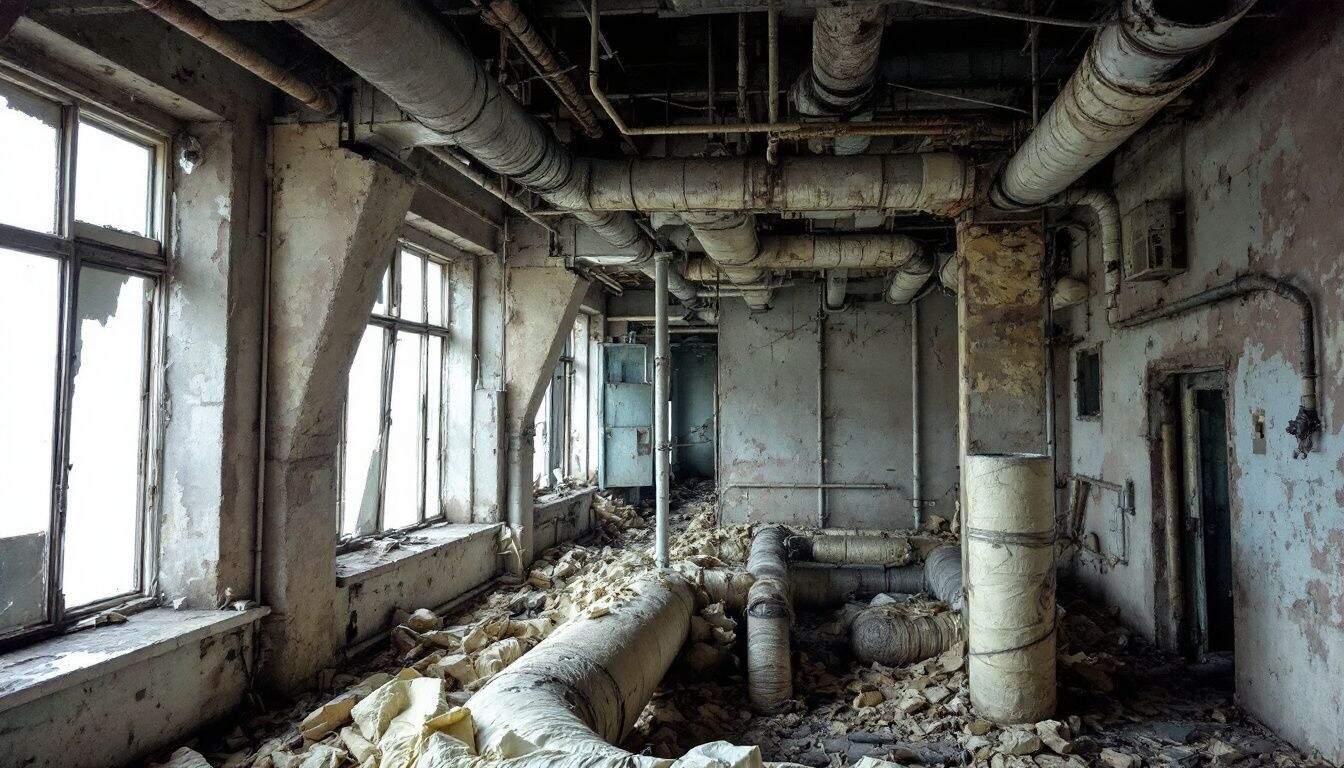
- Pipe and boiler lagging in plant rooms and service corridors
- Ceiling tiles and suspended ceiling systems
- Artex coatings and textured wall finishes
- Floor tiles and adhesives in wards and corridors
- Insulating board used in partition walls and fire doors
- Roofing materials and external cladding panels
- Sprayed coatings on structural steelwork
Maintenance and refurbishment work — which is constant in a busy hospital — creates the highest risk of ACM disturbance. A plumber cutting through a partition or an electrician drilling above a ceiling tile can unknowingly release fibres directly into a ward environment.
What the Law Requires for Healthcare Premises
The Control of Asbestos Regulations places a clear duty to manage asbestos on anyone who owns, occupies, or manages non-domestic premises. Healthcare buildings fall squarely within this duty.
NHS trusts, private hospital operators, care home providers, and GP practice landlords all carry legal responsibility. The duty holder must:
- Assess whether ACMs are present in the building
- Presume materials contain asbestos unless there is strong evidence to the contrary
- Produce and maintain a written asbestos register
- Develop and implement an asbestos management plan
- Ensure anyone who may disturb ACMs is given access to the register and relevant information
- Review and update the management plan regularly
The HSE’s guidance document HSG264 sets out the standards for asbestos surveying in detail. Healthcare organisations should treat this guidance as the minimum standard, not the ceiling.
Given the vulnerability of patients and the density of staff movement, best practice often goes considerably further. Failure to comply isn’t just a financial risk — enforcement action, prohibition notices, and prosecution are all real possibilities for healthcare organisations that fail to manage asbestos properly.
Types of Asbestos Surveys Used in Healthcare Settings
Not all asbestos surveys are the same, and healthcare settings frequently require more than one type depending on the circumstances. Understanding which survey applies to your situation is essential before any work begins.
Management Surveys
A management survey is the standard survey required to manage ACMs during the normal occupation of a building. It identifies, as far as reasonably practicable, the location and condition of ACMs that could be disturbed during routine maintenance or day-to-day use.
For a hospital or care home, this means surveying accessible areas — wards, corridors, plant rooms, roof spaces, and service areas. The surveyor assesses the condition of any ACMs found and assigns a risk score to inform the management plan.
This survey type is typically carried out without significant disruption to building occupants, making it well suited to operational healthcare environments.
Refurbishment Surveys
When a healthcare building is being refurbished, extended, or partially altered, a refurbishment survey is legally required before work begins. This is a more intrusive survey, designed to locate all ACMs in the areas to be worked on — including those hidden within the building fabric.
Healthcare refurbishments are common: ward upgrades, new imaging suites, lift replacements, and infrastructure overhauls all trigger the need for this survey type. Contractors must not begin any notifiable work until the survey has been completed and the results reviewed.
Demolition Surveys
Where a building or a significant portion of it is being taken out of use, a demolition survey is required. This is the most thorough and intrusive survey type, designed to locate every ACM throughout the entire structure before demolition work commences.
Skipping any of these steps exposes patients, staff, and contractors to serious harm — and exposes the organisation to significant legal liability.
How an Asbestos Survey Is Carried Out in a Healthcare Environment
Conducting asbestos surveys for healthcare premises requires careful planning. Disruption to clinical services must be minimised, infection control protocols must be respected, and access to sensitive areas must be coordinated with the facilities management team well in advance.
Pre-Survey Planning
Before a surveyor sets foot on site, a detailed scope of work should be agreed. This includes identifying which areas will be surveyed, what access arrangements are needed, and whether any areas will need to be temporarily vacated. In a working hospital, this planning stage is critical.
Surveyors should review any existing asbestos register or previous survey reports before arriving on site. This prevents duplication of effort and ensures any previously identified ACMs are properly accounted for within the new survey.
On-Site Inspection and Sampling
Qualified surveyors carry out a systematic visual inspection of all accessible areas. Where materials are suspected to contain asbestos, small samples are collected carefully and securely packaged for laboratory analysis.
Surveyors wear appropriate personal protective equipment throughout, and sampling areas are cleaned and made safe immediately after sampling takes place. Laboratories analyse samples using polarised light microscopy or electron microscopy to identify asbestos fibre types — typically chrysotile (white asbestos), amosite (brown asbestos), or crocidolite (blue asbestos).
Risk Assessment and Reporting
Once sampling results are returned, the surveyor produces a detailed report. This includes the location of all ACMs, their condition, an assessment of the risk they pose, and recommendations for management or removal.
In a healthcare setting, this report forms the basis of the asbestos management plan and must be kept accessible to all relevant staff and contractors. The risk assessment considers factors including the material’s condition, its accessibility, the likelihood of disturbance, and the number of people who could be affected.
In a busy ward environment, even a low-risk material may require closer monitoring simply because of the volume of people passing through the area.
Managing Asbestos Safely in an Operational Healthcare Facility
Identifying asbestos is only the first step. The ongoing management of ACMs in a live healthcare environment requires sustained attention, clear processes, and a genuine commitment from facilities leadership.
Maintaining the Asbestos Register
The asbestos register must be kept up to date at all times. Every maintenance job, refurbishment project, or building alteration that could affect ACMs should trigger a review of the relevant register entries, with new survey findings added promptly.
Facilities managers should ensure the register is genuinely accessible — not locked in a filing cabinet, but readily available to contractors before they begin any work. A permit-to-work system that requires contractors to consult the register before starting is good practice in any healthcare setting.
Staff Training and Awareness
Anyone who could disturb ACMs in the course of their work must receive appropriate asbestos awareness training. In a healthcare context, this includes maintenance engineers, porters, facilities staff, and any contractors working on the building fabric.
Training should cover what asbestos is, where it may be found, the health risks associated with exposure, and what to do if ACMs are discovered or accidentally disturbed. Refresher training should be provided regularly to ensure knowledge remains current across the workforce.
When Asbestos Removal Is Required
Not all asbestos needs to be removed immediately. ACMs in good condition that are unlikely to be disturbed can often be safely managed in place. However, when materials are damaged, deteriorating, or located in areas scheduled for refurbishment, asbestos removal by a licensed contractor becomes necessary.
In a healthcare environment, removal work must be carefully planned to avoid disruption to clinical services and to ensure that no fibres are released into occupied areas. Air monitoring before, during, and after removal work provides assurance that the environment remains safe throughout the process.
Responding to Accidental Disturbance
Despite the best management plans, accidental disturbance of ACMs can occur. Healthcare organisations must have clear emergency procedures in place — stopping work immediately, evacuating the area, preventing further access until the area has been properly assessed, and arranging specialist decontamination if required.
Any incident involving suspected asbestos disturbance should be documented and, where relevant, reported under RIDDOR. Transparency and prompt action protect both the people involved and the organisation itself.
Asbestos Surveys for Healthcare: Choosing the Right Provider
Not every asbestos surveying company has the experience or accreditation to work effectively in a healthcare environment. When selecting a surveying provider, healthcare organisations should look for:
- UKAS accreditation for asbestos surveying and bulk sampling
- Surveyors holding the P402 qualification (Building Surveys and Bulk Sampling for Asbestos)
- Demonstrated experience working in healthcare or similarly complex, occupied environments
- Clear processes for minimising disruption to building occupants and clinical services
- Detailed, accurate survey reports that meet HSG264 standards
- Ability to provide ongoing support for asbestos management planning and register maintenance
Healthcare organisations across the UK can access specialist asbestos surveying services wherever their facilities are located. If you manage a healthcare facility in the capital, an asbestos survey London from an experienced provider ensures your building is assessed to the highest standard.
For facilities in the north-west, an asbestos survey Manchester delivers the same level of expertise with local knowledge of the regional estate. And for healthcare sites across the West Midlands, an asbestos survey Birmingham gives facilities managers confidence that their duty of care is being properly discharged.
The Consequences of Inadequate Asbestos Management in Healthcare
The human cost of asbestos-related disease is severe. Mesothelioma, asbestosis, and asbestos-related lung cancer are all fatal conditions with no cure. Healthcare workers who are repeatedly exposed to even low levels of asbestos fibre over their careers face a genuinely elevated risk — and patients in vulnerable health face even greater danger from unexpected exposure.
Beyond the human cost, the reputational and financial consequences for a healthcare organisation that fails to manage asbestos properly are substantial. Regulatory investigations, civil claims, and the loss of public trust can follow a serious asbestos incident — consequences that are entirely preventable with the right survey programme in place.
Healthcare organisations have a duty of care that extends to every person who walks through their doors. Robust asbestos surveys for healthcare settings are not an optional extra. They are a fundamental part of fulfilling that duty.
Frequently Asked Questions
Are healthcare buildings legally required to have an asbestos survey?
Yes. Under the Control of Asbestos Regulations, duty holders responsible for non-domestic premises — including hospitals, care homes, and GP surgeries — must assess whether ACMs are present and manage any identified risks. An asbestos survey is the standard method for fulfilling this duty. Buildings constructed before 2000 should be treated as potentially containing asbestos until a survey confirms otherwise.
How often should asbestos surveys be repeated in a healthcare building?
There is no fixed legal interval for re-surveying, but the asbestos register and management plan must be reviewed regularly and updated whenever building work, refurbishment, or changes in building use occur. In practice, many healthcare organisations commission updated surveys every three to five years, or whenever significant works are planned. Any area not previously surveyed should be assessed before work begins.
Can asbestos surveys be carried out in a hospital that is still in operation?
Yes, and this is the norm. Experienced surveyors working in healthcare environments plan their work carefully to avoid disrupting clinical services. Access to sensitive areas such as operating theatres or intensive care units is coordinated with the facilities team in advance, and sampling is carried out with minimal disruption. Infection control protocols are followed throughout.
What happens if asbestos is found in a healthcare building?
Finding asbestos does not automatically mean it needs to be removed. ACMs in good condition that are unlikely to be disturbed can be safely managed in place, with their location and condition recorded in the asbestos register. Damaged or deteriorating materials, or those in areas due for refurbishment, will require a risk-based decision on whether management, encapsulation, or removal is the appropriate course of action.
Who is responsible for asbestos management in an NHS building?
Responsibility falls on the duty holder — typically the NHS trust or the organisation that manages and controls the building. This responsibility cannot be delegated away, although specialist contractors and surveyors can be engaged to carry out the practical work. Facilities managers, estates directors, and senior leadership all have a role in ensuring compliance with the Control of Asbestos Regulations and HSE guidance.
Speak to Supernova Asbestos Surveys
Supernova Asbestos Surveys has completed over 50,000 surveys across the UK, with extensive experience working in healthcare and other complex occupied environments. Our UKAS-accredited surveyors understand the unique demands of clinical settings and deliver detailed, HSG264-compliant reports that give facilities managers the information they need to protect patients, staff, and their organisation.
To discuss your healthcare facility’s asbestos surveying requirements, call us on 020 4586 0680 or visit asbestos-surveys.org.uk to request a quote.