Asbestos Management Surveys: Your Questions Answered
Asbestos remains the single biggest cause of work-related deaths in the UK. If you manage, own, or have maintenance responsibilities for a building constructed before 2000, asbestos management surveys are not optional — they are the legal and practical foundation of everything else you do to keep people safe.
We get asked the same questions week in, week out. So here are clear, practical answers — no jargon, no waffle.
What Is Asbestos and Why Does It Still Matter?
Asbestos is a group of naturally occurring fibrous minerals used extensively in UK construction throughout most of the 20th century. Its heat resistance, durability, and insulating properties made it a first-choice material for builders and manufacturers for decades.
The danger lies in the fibres. When asbestos-containing materials (ACMs) are disturbed, microscopic fibres become airborne. Once inhaled, they lodge permanently in lung tissue and can cause:
- Mesothelioma — a rare, aggressive cancer affecting the lining of the lungs or abdomen, almost always fatal
- Asbestos-related lung cancer — risk increases significantly with smoking
- Asbestosis — progressive and irreversible scarring of lung tissue
- Pleural thickening — thickening of the lung lining that restricts breathing
These diseases typically have a latency period of 20 to 40 years. Someone exposed in the 1980s may only now be receiving a diagnosis. That time lag makes asbestos uniquely dangerous — by the time symptoms appear, the damage is already done.
Asbestos was banned from use in UK construction in 1999. Any building constructed or refurbished before 2000 may contain ACMs, and those materials must be properly managed.
Where Is Asbestos Commonly Found in Buildings?
Asbestos was used in hundreds of different building products. You cannot identify it by sight alone — laboratory analysis is the only way to confirm its presence, which is precisely why surveys matter.
Common locations include:
- Ceiling tiles and textured coatings, including Artex
- Floor tiles and their adhesives
- Pipe lagging and boiler insulation
- Roof sheets, guttering, and soffits — often asbestos cement
- Insulating boards around fire doors and heating systems
- Sprayed coatings on steel beams and structural elements
- Roofing felt beneath tiles
- Partition walls in offices and industrial buildings
The sheer variety of products means that even experienced tradespeople can be caught out. A material that looks entirely unremarkable could be harbouring asbestos fibres that pose a serious health risk the moment they are disturbed.
Who Legally Needs an Asbestos Management Survey?
Duty Holders of Non-Domestic Premises
If you own, manage, or have maintenance responsibilities for a non-domestic building built before 2000, the Control of Asbestos Regulations places a legal duty on you to manage asbestos. This is known as the duty to manage under Regulation 4.
This applies to offices, shops, warehouses, schools, hospitals, factories, leisure facilities, and the communal areas of residential blocks — stairwells, plant rooms, roof spaces, and similar shared spaces. Meeting that duty starts with knowing what is in the building, and that requires a management survey.
Contractors and Tradespeople
Any contractor carrying out work on a pre-2000 building must check whether an asbestos survey has been carried out and review the findings before starting. If no survey exists and the work could disturb the fabric of the building, one must be commissioned first.
Disturbing asbestos unknowingly is one of the leading causes of occupational asbestos exposure today. Electricians, plumbers, carpenters, and general builders are among those most frequently affected.
Homeowners
Private homeowners have no legal obligation to survey their property for their own domestic use. However, a survey is strongly advisable if:
- You are planning renovation, extension, or structural work on a pre-2000 home
- You are buying or selling a property and want to understand the risk
- You are letting out a property and contractors will be working there
- You have discovered a material you suspect could be asbestos
Instructing tradespeople to work on a property where ACMs have not been identified puts both them and you at risk. If a tradesperson is exposed to asbestos on your property, the legal consequences can be serious.
What Types of Asbestos Survey Are There?
Under UK guidance — specifically the HSE’s HSG264 — there are two main types of asbestos survey. The right one depends entirely on your situation.
Management Survey
An asbestos management survey is the standard survey for occupied buildings in normal use. The purpose is to locate ACMs that could be disturbed during everyday activities — routine maintenance, minor repairs, or moving equipment — and to assess their condition.
The surveyor works systematically through all accessible areas of the building, taking samples from suspected materials where necessary. Some materials may be presumed to contain asbestos without sampling, particularly where disturbance risk is low, and these presumptions are clearly documented in the report.
The outputs from asbestos management surveys are:
- An asbestos register — a record of the location, type, condition, and risk assessment of every ACM or presumed ACM identified
- An asbestos management plan — a document outlining how ACMs will be monitored and managed going forward
These documents are not a one-time exercise. The management plan must be reviewed regularly, and the register updated whenever conditions change or work is carried out. A management survey is intentionally non-destructive — it will not involve breaking into voids, lifting floors, or disturbing the building structure.
Refurbishment and Demolition Survey
When structural or intrusive work is planned — a full demolition, major refurbishment, or work that will penetrate the fabric of a building — a demolition survey is required before work begins.
This survey is far more intrusive than a management survey. Surveyors access concealed areas including ceiling voids, floor voids, wall cavities, and service ducts. Because of this, a refurbishment and demolition survey must only be carried out in areas that are vacant — occupied spaces cannot be surveyed this way without creating a risk to people within them.
The goal is to identify every ACM in the areas where work will take place, so that a licensed asbestos removal contractor can safely remove them before the main works begin. No refurbishment or demolition contractor should start work on a pre-2000 building without one.
Re-Inspection Survey
If you already have an asbestos register in place, the Control of Asbestos Regulations requires that the condition of known ACMs is periodically reviewed. A re-inspection survey does exactly this — an assessor revisits the ACMs logged in your register and updates their condition rating.
The frequency of re-inspections depends on the condition and risk level of the materials identified, but annually is a common standard for higher-risk items. Supernova offers re-inspection surveys as part of an ongoing asbestos management service.
What Does an Asbestos Management Survey Actually Involve?
Before the Survey
A professional surveyor will request relevant information about your building ahead of the visit — construction drawings if available, details of previous surveys, information about the building’s use, and access requirements. For asbestos management surveys of occupied buildings, the process is agreed in advance to keep disruption to staff and operations to a minimum.
During the Survey
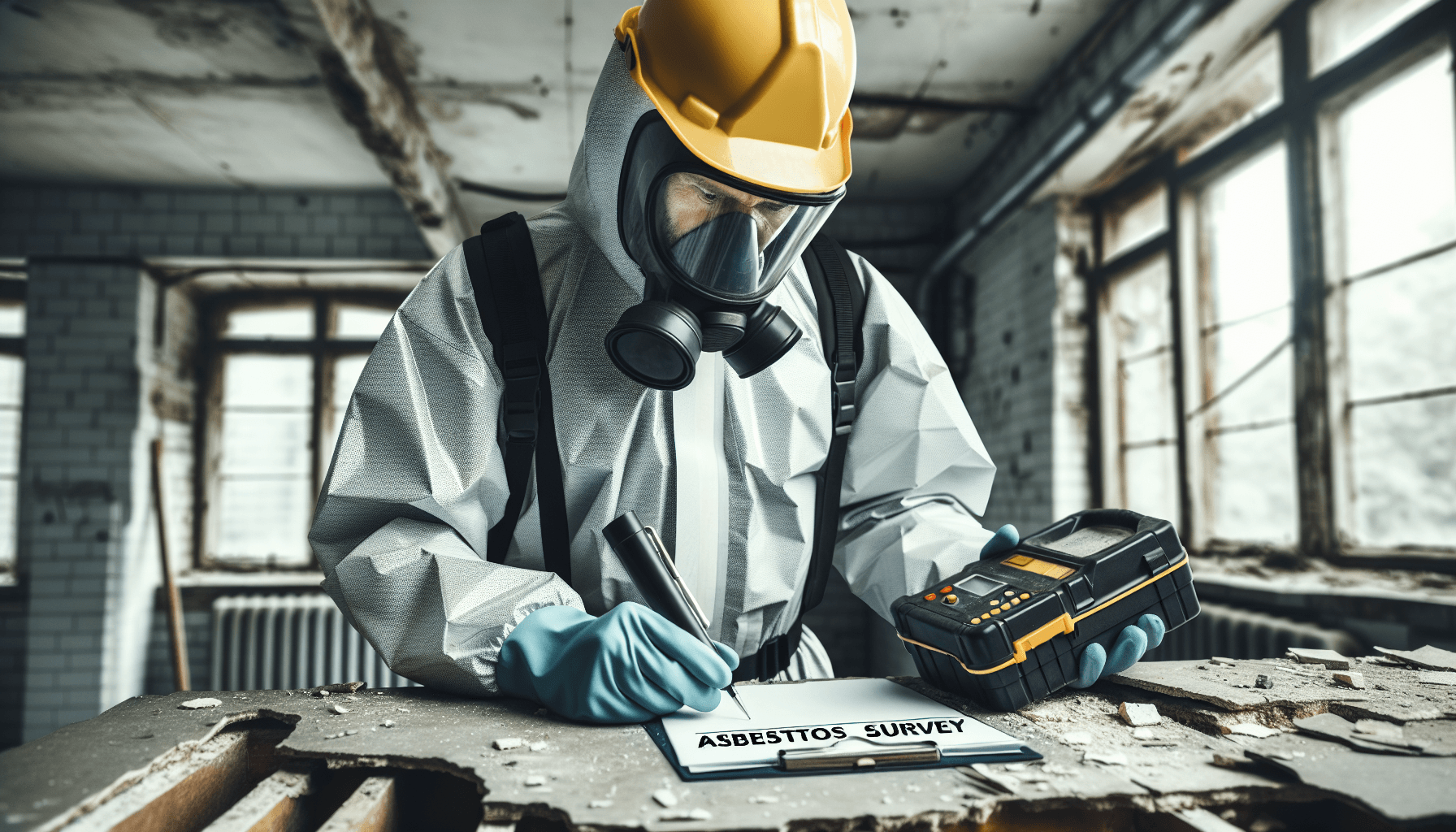
The surveyor works systematically through the building, assessing all accessible areas. Where materials are suspected to contain asbestos, small samples are taken using specialist equipment. The surveyor wears appropriate personal protective equipment and reseals any areas disturbed during sampling.
Each sample is securely labelled and packaged, and the exact location is recorded — typically with photographs and a floor plan reference.
Sample Analysis
Samples are sent to a UKAS-accredited laboratory for sample analysis. Technicians examine them under polarised light microscopy to identify the presence and type of asbestos fibres. UKAS accreditation is essential — it is the benchmark for analytical quality in the UK.
Always confirm your surveying company uses an accredited laboratory before appointing them. An unaccredited analysis is not legally defensible and may not hold up to regulatory scrutiny.
The Survey Report
The final report is a detailed document that includes:
- A schedule of all materials inspected, sampled, or presumed to contain asbestos
- The location and extent of each ACM
- The type of asbestos identified where sampled
- A condition assessment for each material
- A risk priority rating
- Photographs and floor plan annotations
- Recommendations for management, monitoring, or removal
This report forms the basis of your asbestos register and feeds directly into your asbestos management plan.
What Qualifications Should an Asbestos Surveyor Have?
Asbestos surveys must be carried out by a competent surveyor. The recognised professional qualification in the UK is the RSPH Level 3 Award in Asbestos Surveying, and many surveyors also hold BOHS P402 certification.
The surveying organisation itself should ideally be UKAS-accredited to ISO 17020 as an inspection body. This demonstrates that the company operates to a verified quality standard and that its survey methodology meets the requirements of HSG264.
Always ask about qualifications and accreditation before appointing a surveyor. An unqualified or unaccredited survey may not be legally defensible and could leave you exposed both in terms of safety and compliance.
What Happens After an Asbestos Management Survey?
The survey report tells you what is there. What you do next depends on what was found. Not all ACMs need to be removed — in many cases, asbestos in good condition that is not at risk of disturbance is best left in place and managed. Removing asbestos unnecessarily can actually increase the risk of fibre release.
Your options following a survey typically include:
- Monitor and manage — for ACMs in good condition with low disturbance risk, regular re-inspection is often sufficient
- Encapsulation or sealing — some materials can be treated with specialist coatings to reduce fibre release risk
- Removal — required where materials are in poor condition, present a high disturbance risk, or where refurbishment or demolition work is planned
Where asbestos removal is necessary, certain types of work must be carried out by a contractor licensed by the HSE. This includes most work involving sprayed coatings, asbestos insulation, and asbestos insulating board. Always verify a contractor’s licence status on the HSE’s licensed contractor register before appointing them.
How Much Does an Asbestos Management Survey Cost?
Survey costs vary depending on the size and complexity of the building, the type of survey required, and the number of samples taken for analysis. A management survey for a small commercial unit will typically cost less than one for a multi-storey office building. Refurbishment and demolition surveys tend to cost more due to their intrusive nature and the higher number of samples required.
What we would caution against is choosing purely on price. The cost of an inadequate survey — a missed material, an unaccredited laboratory, or an incomplete report — can far exceed any initial saving. Your survey is the foundation of your entire asbestos management approach, and cutting corners here has consequences that extend well beyond the invoice.
Can I Test for Asbestos Without Commissioning a Full Survey?
If you have found a material you are concerned about and want a quick answer before commissioning a full survey, asbestos testing options are available to you.
At Supernova, we offer a postal asbestos testing kit through our website. You collect a small sample yourself, send it to our UKAS-accredited laboratory, and receive a written analysis confirming whether asbestos is present and, if so, which type.
This is a useful first step for homeowners or landlords who want to assess a specific material quickly. However, it is not a substitute for a full management survey — it will not give you the systematic inspection, condition assessment, risk rating, or management plan that the Control of Asbestos Regulations requires.
For duty holders, a professional asbestos testing and survey programme remains the only route to genuine legal compliance.
How Often Should Asbestos Management Surveys and Inspections Be Repeated?
A management survey does not have an automatic expiry date, but it is not a permanent document either. Your asbestos register must be kept up to date and reviewed whenever:
- Work is carried out that could affect ACMs
- The condition of a known material changes
- New areas of the building are accessed or refurbished
- You commission new works that involve the building fabric
Beyond the register, the condition of ACMs must be periodically re-inspected. Annual re-inspections are standard for higher-risk materials, though lower-risk items in stable condition may be reviewed less frequently. Your asbestos management plan should set out a clear schedule.
If your existing survey is several years old, has not been updated following building works, or was carried out by an unaccredited surveyor, commissioning a fresh asbestos management survey is the prudent course of action. An outdated register is worse than a current one — it creates a false sense of security.
Common Mistakes Property Managers Make With Asbestos
After completing tens of thousands of surveys across the UK, we see the same errors repeated. Knowing what to avoid is just as useful as knowing what to do.
- Assuming a pre-2000 building has already been surveyed. Previous owners or occupiers may not have commissioned a survey, or any survey that exists may be incomplete or out of date. Always verify.
- Letting contractors start work without checking the register. Even if a survey exists, contractors must be briefed on its findings before they begin. The register should be accessible and shared as a matter of course.
- Treating the survey as a one-off task. Asbestos management is an ongoing obligation. A survey completed five years ago and never revisited does not satisfy the duty to manage.
- Assuming all asbestos must be removed. Removal is not always the right answer. Disturbing stable, well-managed ACMs can create more risk than leaving them in place. Your surveyor’s recommendations should guide your decisions.
- Using an unaccredited surveyor to save money. A survey carried out by an unqualified individual or unaccredited company may not be legally defensible. It could also miss materials that a trained surveyor would have identified.
- Not updating the register after works. If maintenance or refurbishment work has been carried out near ACMs, the register must be reviewed and updated. An inaccurate register is a liability, not a safeguard.
What Makes a Good Asbestos Management Survey Report?
Not all survey reports are created equal. A thorough, well-structured report should leave you in no doubt about what is in your building, where it is, what condition it is in, and what you need to do about it.
Look for these elements in any report you receive:
- Clear identification of every material inspected, sampled, or presumed
- Precise location descriptions supported by floor plan annotations and photographs
- Confirmation of the asbestos type for every sampled material, with laboratory certificates attached
- A condition rating and a material risk assessment score for each ACM
- A priority risk rating that tells you which materials require most urgent attention
- Specific, actionable recommendations — not vague statements about monitoring
- Details of any areas that could not be accessed, with an explanation
If a report you have received does not contain these elements, or if the surveying company cannot confirm UKAS accreditation, it is worth seeking a second opinion before relying on that document for compliance purposes.
Ready to Book an Asbestos Management Survey?
Supernova Asbestos Surveys has completed over 50,000 surveys nationwide. Our surveyors hold recognised professional qualifications, our laboratory analyses are carried out by a UKAS-accredited facility, and our reports are built to meet the requirements of HSG264 and the Control of Asbestos Regulations.
Whether you need a management survey for an occupied commercial building, a demolition survey ahead of major works, or a re-inspection to keep your existing register current, we can help. We also offer a postal testing kit for homeowners who want a fast answer on a specific material.
Call us on 020 4586 0680 or visit asbestos-surveys.org.uk to get a quote or speak to one of our team. We cover the whole of the UK and can typically arrange surveys at short notice.
Frequently Asked Questions
What is the difference between a management survey and a refurbishment survey?
An asbestos management survey is designed for occupied buildings in normal use. It identifies ACMs that could be disturbed during routine maintenance or minor works, and it is non-destructive. A refurbishment and demolition survey is required before any intrusive structural work takes place. It is far more thorough, accesses concealed areas such as voids and cavities, and must be carried out in vacant areas only. The two surveys serve different purposes and one cannot substitute for the other.
Do I need an asbestos management survey for a residential property?
Private homeowners are not legally obliged to commission an asbestos survey for their own domestic use. However, if you are planning renovation or building work on a pre-2000 property, intend to let the property out, or are concerned about a specific material, a survey or at minimum an asbestos test is strongly advisable. Landlords whose properties will be accessed by contractors have a duty of care to ensure those workers are not exposed to asbestos.
How long does an asbestos management survey take?
The time required depends on the size and complexity of the building. A small commercial unit may take a few hours, while a large multi-storey building could require a full day or more. Your surveyor will give you an estimated duration when they confirm the booking. The survey report, including laboratory results, is typically returned within a few working days of the site visit.
What happens if asbestos is found during a survey?
Finding asbestos does not automatically mean it needs to be removed. The surveyor will assess the condition and risk level of each material. ACMs in good condition with a low risk of disturbance are often best left in place and managed through regular monitoring. Where materials are damaged, deteriorating, or at high risk of disturbance, the surveyor will recommend encapsulation or removal. Any removal work involving licensable materials must be carried out by an HSE-licensed contractor.
Is an asbestos management survey a legal requirement?
Yes, for duty holders of non-domestic premises built before 2000. The Control of Asbestos Regulations places a duty to manage asbestos on anyone who owns, manages, or has maintenance responsibilities for such a building. Fulfilling that duty requires knowing what ACMs are present, which means commissioning asbestos management surveys and maintaining an up-to-date asbestos register and management plan. Failure to comply can result in enforcement action by the HSE, including improvement notices, prohibition notices, and prosecution.