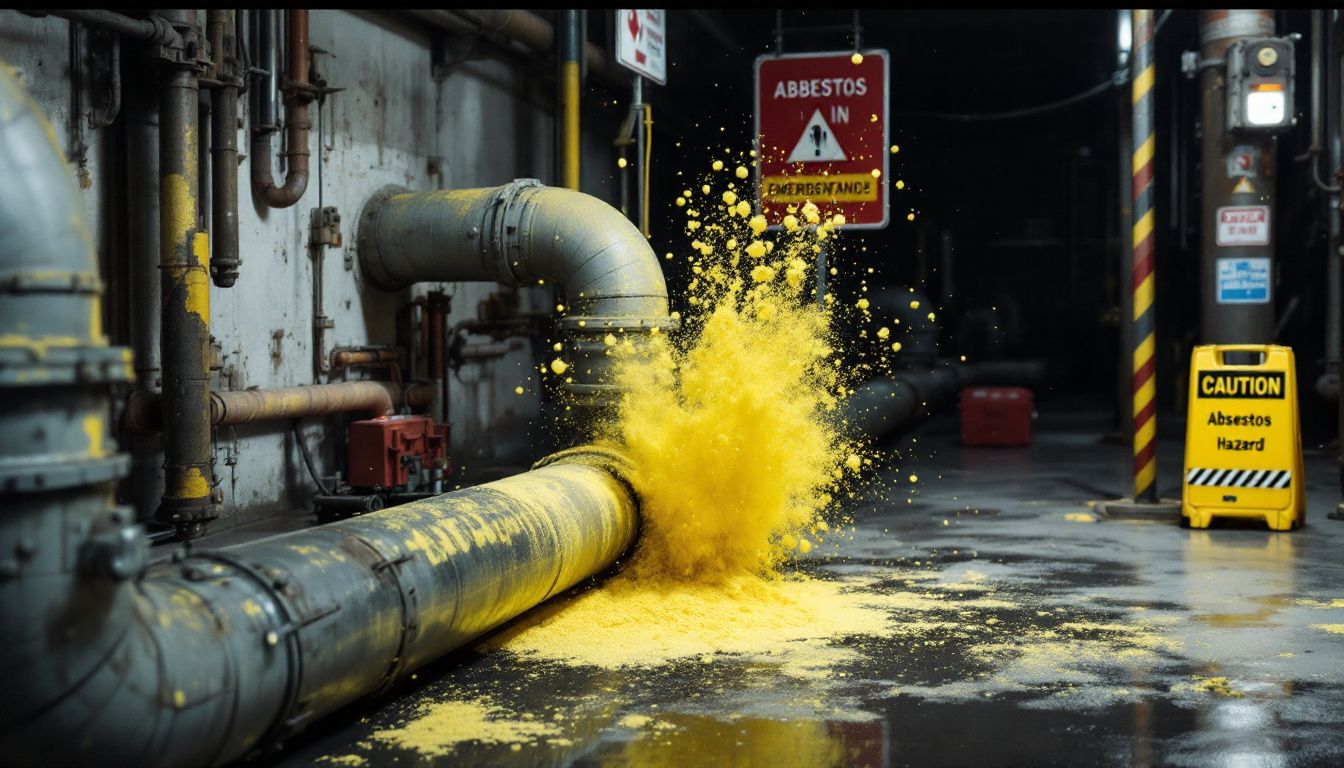
When Asbestos Goes Wrong: What Effective Incident Management Actually Looks Like
Asbestos emergencies do not announce themselves. One moment a contractor is cutting through a ceiling tile, the next you have a potential exposure event, a panicked workforce, and a legal obligation to act — fast. Effective asbestos incident management is what separates a controlled, well-documented response from a chaotic situation that puts lives at risk and lands duty holders in front of the HSE.
This post walks through building your command structure, taking immediate action, containing the hazard, managing decontamination, and making sure your records hold up to regulatory scrutiny.
Why Asbestos Incident Management Is a Legal Obligation, Not a Choice
Asbestos-related disease remains the single largest cause of work-related deaths in the UK. The fibres are invisible to the naked eye, and the diseases they cause — mesothelioma, asbestosis, lung cancer — can take decades to develop. That lag means the consequences of poor incident management may not become apparent for years, long after the responsible party assumed the problem had gone away.
The Control of Asbestos Regulations places clear duties on employers and those in control of premises. When an incident occurs — whether a disturbance during routine maintenance, an accidental breach of known asbestos-containing materials (ACMs), or an emergency such as a fire or structural collapse — the duty holder must respond in a structured, documented way.
Getting this right is not optional. The HSE has the power to issue improvement notices, prohibition notices, and prosecute those who fail to comply. The financial and reputational consequences of a poorly managed incident can be severe — but they are nothing compared to the human cost of preventable exposure.
Building Your Asbestos Incident Command Structure
A clear command structure is the foundation of any effective asbestos incident management plan. Without defined roles, response efforts become disorganised and people get hurt. Your command team does not need to be large, but every role must be filled by someone with the appropriate knowledge and authority.
The Core Command Team
- Incident Commander: Makes decisions under pressure, coordinates all response activity, and maintains overall accountability. In smaller organisations, this is often the owner or facilities manager.
- Safety Manager: Monitors compliance with protective measures, ensures PPE is worn correctly, and enforces the exclusion zone.
- Health Officer: Tracks potential exposure for all personnel, arranges medical surveillance where required, and liaises with occupational health providers.
- Competent Asbestos Person: The technical expert. This individual must have formal asbestos training and ideally holds a relevant qualification. They advise on material identification, fibre release risk, and appropriate containment methods.
In larger organisations, these roles may be held by dedicated health and safety professionals. In smaller businesses, one person may cover multiple roles — but they must have the training to do so competently. Improvising in the middle of an incident is not an option.
Communication Protocols
During an asbestos incident, communication must be fast, clear, and documented. Verbal instructions alone are not sufficient — everything should be backed up in writing, whether that is a log entry, an email, or a formal notification form.
Establish primary and backup communication channels before an incident ever occurs. Radios, mobile phones, and site-wide PA systems all have a role depending on the scale of your premises.
Critically, your asbestos register and any existing asbestos management survey data should be immediately accessible to the incident commander and to any emergency services attending the site. If you do not yet have an up-to-date survey in place, this is the single most important step you can take before an incident occurs. Without it, your command team is working blind.
Coordinating with External Emergency Services
Fire crews, paramedics, and police attending an asbestos incident need specific information quickly: where the ACMs are located, which areas are contaminated, what the access and egress routes are, and what level of PPE they require.
Prepare a one-page asbestos site summary that can be handed to emergency services on arrival. This should reference your asbestos register, mark exclusion zones on a site plan, and identify the on-site competent person. Update this document every time your asbestos register is revised — an out-of-date summary is almost as dangerous as having none at all.
Immediate Actions When an Asbestos Incident Occurs
The first fifteen minutes of an asbestos incident are critical. The steps below apply whether the disturbance is minor — a contractor accidentally drilling into a textured coating — or major, such as structural damage exposing pipe lagging.
Stop Work and Clear the Area
The moment a potential asbestos disturbance is identified, all work in the area must stop immediately. Do not wait for confirmation — treat the material as asbestos-containing until proven otherwise.
Clear the affected area of all personnel, not just those directly involved in the work. Asbestos fibres travel in air currents and can affect people in adjacent rooms or corridors. Err on the side of caution and clear a wider area than you think necessary.
Establish an Exclusion Zone
Once the area is cleared, secure it. Use physical barriers — boards, plastic sheeting, or crowd control barriers — and post clear signage: DANGER — ASBESTOS HAZARD — DO NOT ENTER. The exclusion zone should extend beyond the immediately visible disturbance to account for fibre migration.
Close windows and doors to limit air movement. Switch off any HVAC systems serving the affected area to prevent fibres being drawn into ductwork and distributed elsewhere in the building. This step is frequently overlooked and can turn a localised incident into a building-wide contamination event.
Identify and Assess the Affected Material
A trained and competent person must assess the disturbed material. This involves a visual inspection to determine the type of material, the extent of damage, and the likely fibre release risk. Friable materials — those that can be crumbled by hand — represent a significantly higher risk than bonded ACMs such as asbestos cement.
If the material has not been previously sampled and confirmed, bulk samples must be taken by a trained operative and submitted to a UKAS-accredited laboratory for analysis. Do not assume — confirmation is essential before any remediation work begins.
Notify the Right People
Notification is a legal obligation, not a courtesy. Depending on the nature and scale of the incident, you may need to notify:
- Your building or facilities manager
- The HSE (if the incident meets the threshold for RIDDOR reporting)
- Occupants of the building or adjacent premises
- Your licensed asbestos contractor (for any remediation work involving licensable materials)
- Your insurer
Keep a written log of every notification, including who was contacted, when, and what was communicated. This record will be scrutinised if the incident is investigated.
Asbestos Containment and Safe Handling During an Incident
Once the immediate area is secured and assessments are underway, the focus shifts to containment — preventing further fibre release and protecting anyone who must work in or near the affected zone.
Personal Protective Equipment
No one should enter the exclusion zone without appropriate PPE. At minimum, this means:
- A correctly fitted FFP3 disposable respirator or a half-face respirator with a P3 filter
- Disposable coveralls (Type 5 Category 3)
- Disposable gloves and overshoes
PPE must be donned before entering the zone and removed carefully in a designated decontamination area immediately adjacent to the exclusion zone. Contaminated PPE must be double-bagged in clearly labelled asbestos waste sacks and disposed of correctly — it cannot go into general waste.
Wet Methods and Suppression
Where disturbance has already occurred, wet suppression techniques help to reduce airborne fibre levels. Lightly dampen disturbed materials with water — ideally mixed with a surfactant — to bind loose fibres and prevent them becoming airborne again. Avoid high-pressure spraying, which can break materials apart and release more fibres.
Emergency Encapsulation
For damaged ACMs that cannot be immediately removed, emergency encapsulation provides a temporary barrier. Specialist bitumen-based or PVA-based sealants can be applied to exposed surfaces to lock fibres in place. This is a short-term measure only — it does not replace proper remediation by a licensed contractor.
Negative air pressure units (NAUs) equipped with HEPA filtration should be deployed in the affected area during any containment work. These machines maintain a negative pressure differential, ensuring that any fibres released during work are drawn through the filter rather than escaping into adjacent spaces.
Air Monitoring
Air monitoring must be conducted throughout any incident response involving potential fibre release. Personal air sampling on those working in the exclusion zone, combined with static air monitoring at the zone boundary, provides the data needed to assess exposure levels and confirm when the area is safe to re-enter.
All air monitoring must be carried out by a competent analyst. Results should be documented and retained as part of your incident record. These figures may become critical evidence in any subsequent investigation or civil claim.
Decontamination Procedures
Decontamination is not simply a matter of wiping surfaces down. It is a structured process that must be followed correctly every time someone exits the exclusion zone.
Personnel Decontamination
A three-stage decontamination unit — dirty end, shower, clean end — is the standard for licensed asbestos work. For lower-risk incidents, a simpler process may be acceptable, but the principle remains the same: contamination stays in the dirty zone.
- Remove outer coveralls in the dirty area, rolling them inward to trap contamination
- Place contaminated PPE immediately into double-bagged asbestos waste sacks
- Wipe down respirator with a damp cloth before removal
- Wash hands and face thoroughly before leaving the decontamination area
- Change into clean clothing before re-entering unaffected areas of the building
Area Decontamination
Once containment work is complete, the affected area must be thoroughly decontaminated before it can be returned to use. This involves:
- Damp wiping all surfaces from high to low, ensuring fibres are collected rather than redistributed
- Using HEPA-filtered vacuum equipment — standard vacuum cleaners must never be used as they will distribute fibres
- Disposing of all cleaning materials as asbestos waste
- Conducting a thorough visual inspection and clearance air test before the area is reopened
The clearance air test must be carried out by an independent UKAS-accredited analyst — not by the contractor who carried out the remediation work. This independence is a critical safeguard, and any contractor who suggests otherwise should be treated with caution.
Regulatory Compliance and Documentation
Thorough documentation is not bureaucracy for its own sake. It is your evidence that you fulfilled your duty of care, and it is your protection if a claim or prosecution follows years down the line.
What Your Incident Record Must Include
- Date, time, and location of the incident
- Description of how the disturbance occurred
- Details of materials involved (confirmed or suspected)
- Names of all personnel potentially exposed
- PPE worn and air monitoring results
- All notifications made and to whom
- Remediation work carried out, by whom, and when
- Clearance air test results
- Any changes made to the asbestos register following the incident
HSG264 — the HSE’s guidance on asbestos surveying — sets out expectations for how asbestos data should be recorded and maintained. Your incident records should align with the standards set out in that document, and they should be retained for the lifetime of the building where possible.
Updating Your Asbestos Register After an Incident
Every asbestos incident changes the condition of ACMs in your building. Once remediation is complete and the area has been cleared, your asbestos register must be updated to reflect what happened, what was removed or encapsulated, and the current condition of any remaining materials.
If the incident revealed previously unknown ACMs, those materials must be added to the register. If it exposed gaps in your existing management survey, a further survey of the affected area may be required before normal occupation resumes.
Failing to update your register is not just poor practice — it creates a false picture of risk that could lead to the next incident being even worse.
Learning from the Incident: Post-Incident Review
Once the immediate emergency is resolved, a structured post-incident review is essential. This is not about apportioning blame — it is about understanding what went wrong, why, and how to prevent it happening again.
What a Post-Incident Review Should Cover
- How and why the disturbance occurred — was it a failure of planning, communication, or training?
- Whether the command structure functioned as intended
- Whether PPE and containment measures were adequate
- Whether notification timelines were met
- Whether the asbestos register and management plan were up to date at the time of the incident
- What changes are needed to prevent recurrence
The findings of the review should be documented and acted upon. Update your asbestos management plan, revise your emergency procedures, and brief all relevant staff on the changes. A review that produces no action is a wasted opportunity.
Refreshing Staff Training
Many asbestos incidents occur because workers did not recognise what they were dealing with, or because they knew but did not follow the correct procedure. Both failures are addressable through training.
All workers who may encounter ACMs during their normal duties should receive asbestos awareness training. Those with a specific role in incident response need more detailed instruction covering emergency procedures, PPE use, and decontamination. Refresher training should be scheduled regularly — not left until after the next incident.
Prevention: The Best Form of Asbestos Incident Management
The most effective asbestos incident management is the kind you never have to use. That means having a current, accurate asbestos register, a written management plan, and a workforce that knows what to do before work begins — not after something goes wrong.
If your building was constructed before the year 2000 and you do not have an up-to-date asbestos survey, you are operating without the information you need to protect your workers and comply with the law. The risk of an unplanned disturbance is real, and the consequences of being unprepared are serious.
Supernova Asbestos Surveys provides management surveys across the UK, giving duty holders the accurate, actionable data they need to manage asbestos safely and respond effectively when incidents occur. Whether you need an asbestos survey London, an asbestos survey Manchester, or an asbestos survey Birmingham, our surveyors are ready to help you build a clear picture of risk across your premises.
With over 50,000 surveys completed nationwide, we understand the pressures facing duty holders and the importance of getting asbestos management right — before an incident forces your hand.
Frequently Asked Questions
What should I do first if I suspect an asbestos disturbance has occurred?
Stop all work in the area immediately and clear all personnel — not just those directly involved. Treat the material as asbestos-containing until confirmed otherwise. Secure the area with physical barriers and signage, switch off any HVAC systems serving the space, and contact your competent asbestos person to assess the situation. Do not re-enter the area without appropriate PPE.
Do I need to report an asbestos incident to the HSE?
It depends on the nature and severity of the incident. Under RIDDOR, certain incidents involving dangerous occurrences — including the unintentional release of a biological agent, radiation, or a substance hazardous to health — may require reporting. Where there is any doubt, seek advice from a competent asbestos consultant or contact the HSE directly. Failure to report when required is a criminal offence.
Can my own staff carry out decontamination after an asbestos incident?
For minor, non-licensable disturbances, trained staff may be able to carry out limited decontamination work — provided they have appropriate PPE, training, and a documented method statement. For any incident involving licensable asbestos materials, a licensed contractor must be engaged. The clearance air test must always be carried out by an independent UKAS-accredited analyst, regardless of who carried out the remediation.
How long should I keep asbestos incident records?
The HSE recommends that records relating to asbestos exposure are kept for a minimum of 40 years. This reflects the long latency period of asbestos-related diseases. Incident records, air monitoring results, decontamination logs, and clearance certificates should all be retained as part of your asbestos management file for the lifetime of the building where practicable.
What is the difference between an asbestos management survey and an emergency response?
A management survey is a planned, proactive process carried out to locate and assess the condition of ACMs in a building before work begins or as part of ongoing duty-holder compliance. Emergency response is the reactive process that follows an unplanned disturbance. The two are closely linked — a current management survey provides the information your incident command team needs to respond effectively. Without one, your response is slower, less accurate, and more dangerous.
Get Expert Help Today
If you need professional advice on asbestos in your property, our team of qualified surveyors is ready to help. With over 50,000 surveys completed across the UK, Supernova Asbestos Surveys delivers clear, actionable reports you can rely on.
Call us on 020 4586 0680 or visit asbestos-surveys.org.uk for a free, no-obligation quote.