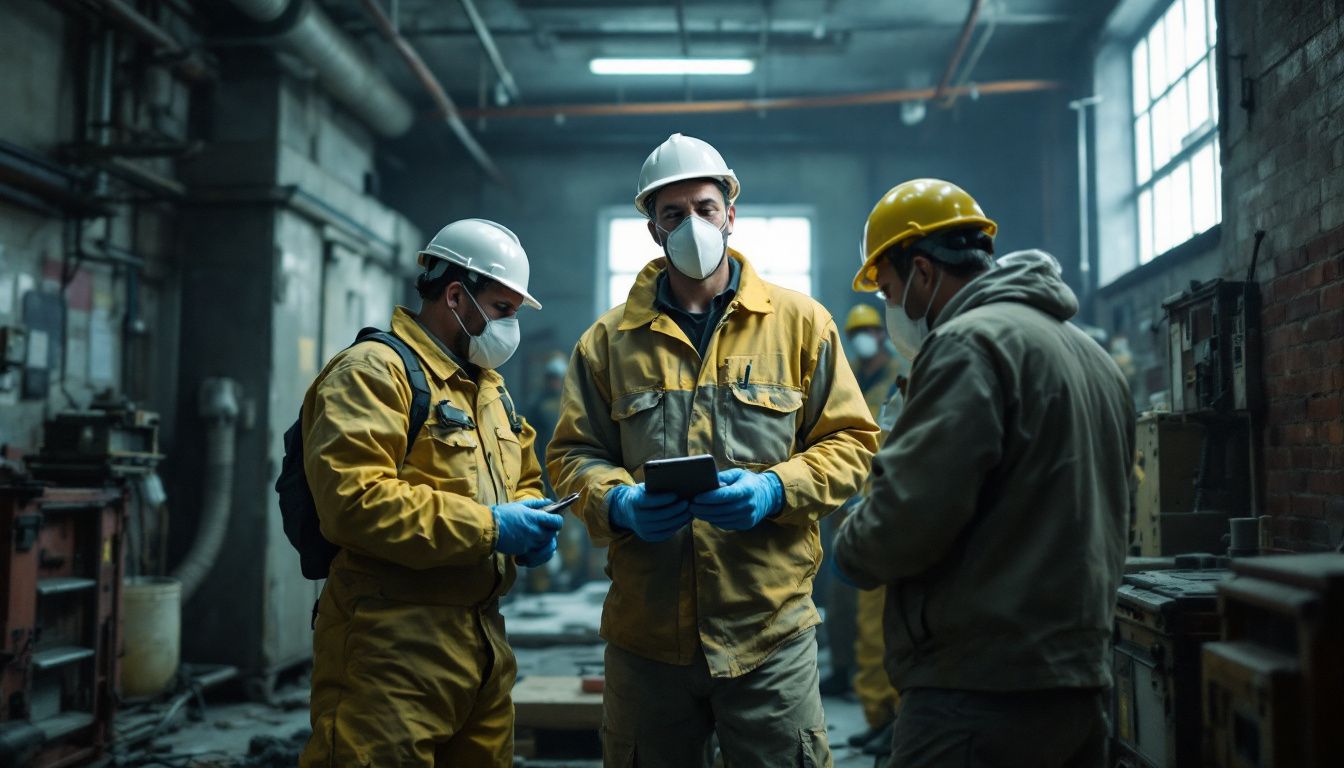
When Asbestos Gets Disturbed Unexpectedly: Emergency Asbestos Testing Explained
A contractor drills through what turns out to be an insulated ceiling panel. A tenant reports crumbling artex above their bed. Storm damage exposes pipe lagging in a building that went up in the 1970s. In each of these situations, emergency asbestos testing isn’t a precaution — it’s a legal obligation and a matter of genuine urgency.
The next few minutes after a suspected asbestos disturbance genuinely matter. What you do — and what you don’t do — in that window can determine whether people are protected or exposed, and whether you’re legally compliant or facing serious enforcement action.
This post walks you through exactly what to do, in the right order, with no corners cut.
Why Emergency Asbestos Testing Is Not the Same as a Routine Survey
A planned management survey is methodical, scheduled in advance, and designed to identify asbestos-containing materials (ACMs) before any disturbance takes place. Emergency asbestos testing is reactive — something has already gone wrong, and fibres may already be airborne.
That distinction changes everything. The speed required is different. The expertise required is different. And the stakes are considerably higher.
Asbestos fibres are invisible to the naked eye. They have no smell. They cause no immediate symptoms. Diseases including mesothelioma, asbestosis, and lung cancer develop years or even decades after exposure — which is precisely why you cannot rely on a visual check or gut feeling when a disturbance has occurred. Only proper asbestos testing by a qualified professional gives you a legally defensible answer.
Step One: Stop All Work and Isolate the Area Immediately
If you suspect asbestos has been disturbed, stop all work in that area right now. This is not a recommendation — it is a requirement under the Control of Asbestos Regulations. Ask everyone to leave calmly. Unnecessary movement stirs settled fibres back into the air, so slow and deliberate is the right approach.
Leave tools, equipment, and materials exactly where they are. Nobody should re-enter until emergency asbestos testing has been completed and a qualified professional has confirmed it is safe to do so.
Sealing the Area
Once the space is clear of people, seal it off as effectively as possible:
- Close all doors and windows to prevent fibres spreading via airflow
- Switch off any HVAC, ventilation, or air conditioning systems — these can carry fibres throughout a building rapidly
- Place physical barriers such as tape, cones, and signage at all entry points
- Post clear warning notices stating the area is out of bounds pending professional assessment
Do not attempt to clean the area with a domestic vacuum or brush — standard vacuum cleaners cannot capture asbestos fibres and will simply redistribute them. Only specialist H-class vacuums used by trained professionals are appropriate.
Step Two: Notify the Right People Without Delay
The notification chain will vary depending on your setting, but the principle is the same — the right people need to know immediately.
Who to Contact
- Your health and safety manager or building manager — they need to be informed and may have an existing asbestos management plan that covers this scenario
- The principal contractor (if on a construction or refurbishment site) — they carry legal duties under the Control of Asbestos Regulations
- A licensed asbestos surveying company — to arrange emergency asbestos testing as quickly as possible
- Occupational health — if workers may have been exposed, exposure must be documented and those individuals assessed
If workers have been exposed to a significant release of asbestos fibres, this may trigger reporting obligations under RIDDOR (Reporting of Injuries, Diseases and Dangerous Occurrences Regulations). Your health and safety adviser can confirm whether this applies in your specific circumstances.
Step Three: Manage Potential Contamination on People and Clothing
Anyone present when asbestos was disturbed may have fibres on their clothing, skin, or hair. This needs to be managed carefully to prevent contamination spreading beyond the immediate area.
Decontamination Procedure
- Ask anyone potentially contaminated to remain in a designated area, away from others
- Wipe down work clothing with a damp cloth — never dry brush, as this releases fibres back into the air
- Place contaminated clothing into two sealed heavy-duty plastic bags, one inside the other
- Label the bags clearly as asbestos-contaminated waste
- Arrange disposal through a licensed waste carrier — contaminated clothing must never be taken home or laundered domestically
- Those affected should shower as soon as practicable
This process should be supervised by someone with asbestos awareness training. If nobody on site has that training, keep people calm and still in a clean area until professional help arrives.
What Emergency Asbestos Testing Actually Involves
Emergency asbestos testing typically involves two elements: bulk material sampling and, where relevant, air monitoring. Understanding both helps you communicate clearly with your surveying team and know what to expect.
Bulk Material Sampling
A qualified surveyor takes physical samples from the suspect material — whether that’s a ceiling tile, pipe lagging, floor tile adhesive, or textured coating such as artex. These samples are sent to a UKAS-accredited laboratory for analysis using polarised light microscopy (PLM).
Results from a UKAS-accredited laboratory confirm whether asbestos is present and, if so, which type. This is the only legally defensible method of confirming or ruling out asbestos — visual identification alone does not meet the requirements of HSG264 guidance.
If professional attendance isn’t immediately possible and the material is not actively friable or releasing fibres, a testing kit can allow a sample to be safely collected and sent for professional sample analysis. This is only appropriate where proper sampling precautions can be taken — it is not a substitute for professional attendance where active disturbance has occurred.
Air Monitoring
Where there is reason to believe fibres have been released into the air — for example, following drilling, cutting, or mechanical damage — air monitoring will be required. This involves taking air samples from the affected area and having them analysed to determine fibre concentrations.
Air monitoring must be carried out by a specialist analyst and is essential before re-occupying any space following a significant disturbance event. It cannot be skipped simply because the area looks clean. Asbestos fibres are not visible to the naked eye — the area looking clear tells you nothing about air quality.
Your Legal Obligations During an Asbestos Emergency
The Control of Asbestos Regulations place clear duties on employers, building owners, and those in control of non-domestic premises. In an emergency, these obligations don’t pause — if anything, they become more pressing.
The Duty to Manage
Non-domestic building owners and those responsible for the maintenance of premises have a legal duty to manage asbestos. This includes maintaining an up-to-date asbestos register, having a management plan in place, and ensuring that anyone who may disturb ACMs is made aware of their presence and condition.
If an emergency has arisen because an asbestos register didn’t exist, was out of date, or wasn’t shared with contractors, that represents a serious compliance failure. Following the incident, a thorough re-inspection survey will be needed to reassess the condition of all remaining ACMs and update the management plan accordingly.
Licensed and Notifiable Non-Licensed Work
Depending on the type of asbestos involved and the nature of the disturbance, any subsequent remediation work may require notification to the HSE or may only be carried out by a licensed asbestos removal contractor. Your surveying team can advise on this once testing results are confirmed.
Never assume that because a disturbance was accidental, the remediation can be handled informally. The type of asbestos fibre identified — chrysotile, amosite, or crocidolite — and the condition of the material will determine exactly what is required.
Record Keeping
All asbestos incidents must be formally recorded. This includes details of what happened, who was potentially exposed, what actions were taken, and the results of any testing carried out. These records must be retained and made available to the HSE if requested.
Accurate documentation also protects you legally if questions arise later about the incident. Do not rely on memory or informal notes — create a proper written record at the time.
After the Emergency: Returning to Normal Operations Safely
Once emergency asbestos testing results have been received and any necessary remediation has been completed, there are clear steps to follow before the area can be returned to use. Skipping any of them creates both a health risk and a compliance failure.
Clearance Certification
Following any asbestos removal or encapsulation work, a four-stage clearance procedure is required. This includes a thorough visual inspection, air testing, and the issuing of a clearance certificate by an independent analyst. The area must not be re-occupied until this certificate has been issued — no exceptions.
Updating Your Asbestos Management Plan
Any emergency event should trigger a full review of your asbestos management plan. The incident may have revealed gaps in your existing register, or the remediation work may have changed the status of ACMs elsewhere in the building. Your plan must accurately reflect the current situation.
It’s also worth considering whether a fire risk assessment needs to be reviewed following any structural disturbance — particularly if fire compartmentation or fire-resistant materials have been affected during the incident.
Communicating With Occupants and Workers
Once the all-clear has been given, communicate clearly with everyone who uses the building. Explain what happened, what testing was carried out, what the results showed, and what actions were taken. Transparency builds trust and demonstrates that you take your legal and moral responsibilities seriously.
People have a right to know when a potential exposure event has occurred in their workplace or home. Don’t leave them to find out through rumour.
Common Scenarios That Trigger Emergency Asbestos Testing
Understanding what typically triggers an emergency response can help building managers and contractors recognise a situation early — before it escalates further.
- Accidental drilling or cutting through ceiling panels, partition walls, or floor tiles in pre-2000 buildings
- Storm or flood damage to older buildings, particularly where roof materials, pipe lagging, or insulation boards are affected
- Discovery of visibly deteriorated ACMs during routine maintenance — crumbling pipe insulation or damaged ceiling tiles
- Tenant reports of damaged or disturbed textured coatings such as artex in residential properties
- Demolition or refurbishment work where an asbestos survey was not carried out prior to works commencing
- Fire or water damage to areas where ACMs are known or suspected to be present
Any building constructed or refurbished before the year 2000 should be treated as potentially containing asbestos until proven otherwise. This applies to commercial premises, schools, hospitals, residential blocks, and industrial buildings alike.
Emergency Asbestos Testing Across the UK: Where Supernova Operates
Supernova Asbestos Surveys provides emergency asbestos testing and rapid-response surveying across the United Kingdom. Our BOHS P402-qualified surveyors are available to respond quickly, without compromising on the quality or compliance of our work.
If you need an urgent asbestos survey in London or an emergency inspection in the North West including an asbestos survey in Manchester, our team can attend at short notice. We cover England, Scotland, and Wales, with same-week attendance available in most locations.
For urgent enquiries, call us on 020 4586 0680 or visit asbestos-surveys.org.uk to find out more about our asbestos testing services. When time matters, we move fast.
Frequently Asked Questions
What counts as an asbestos emergency?
An asbestos emergency is any situation where asbestos-containing materials have been unexpectedly disturbed or damaged, potentially releasing fibres into the air. Common triggers include accidental drilling or cutting through ACMs, storm or flood damage to older buildings, and the discovery of severely deteriorated asbestos materials during routine maintenance. If there is any doubt about whether fibres have been released, treat the situation as an emergency and arrange professional emergency asbestos testing immediately.
Can I collect asbestos samples myself for emergency testing?
In limited circumstances — where the material is not actively friable and fibres are not being released — a DIY sampling kit can be used to collect a bulk material sample for laboratory analysis. However, if the material is damaged, crumbling, or has clearly been disturbed, sampling must only be carried out by a trained professional wearing appropriate PPE. Attempting to sample actively disturbed asbestos without proper training and equipment puts you at serious risk of exposure.
How quickly can emergency asbestos testing results be obtained?
At Supernova Asbestos Surveys, bulk sample analysis at our UKAS-accredited laboratory typically returns results within 24 to 48 hours of the sample being received. In genuine emergency situations, expedited turnaround may be available. Contact us directly on 020 4586 0680 to discuss your specific requirements and timeline.
Do I have to report an asbestos emergency to the HSE?
Certain asbestos exposure events must be reported to the HSE under RIDDOR. If an employee has been exposed to asbestos as a result of a workplace incident, this will likely trigger a reporting obligation. Any subsequent remediation work involving notifiable non-licensed work or licensed asbestos removal must also be notified to the HSE in advance. Your surveying team and health and safety adviser can confirm the specific requirements for your situation.
What happens if I ignore a suspected asbestos disturbance?
Ignoring a suspected asbestos disturbance is both a health risk and a criminal offence under the Control of Asbestos Regulations. The HSE has powers to issue improvement notices, prohibition notices, and prosecute duty holders who fail to manage asbestos correctly. Beyond the legal consequences, the long-term health risks to anyone exposed are severe and irreversible. Emergency asbestos testing is always the right course of action — delay serves nobody.