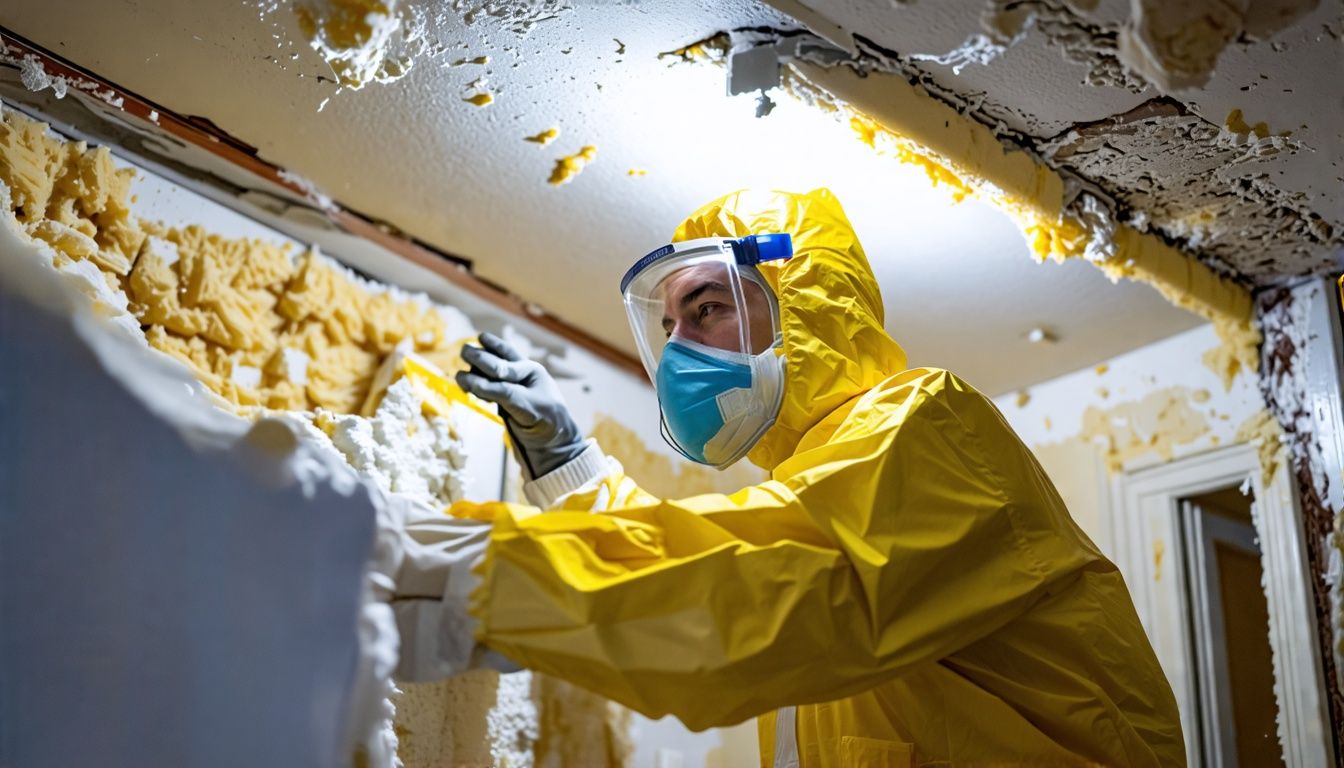
The Real Cost of Improper Asbestos Removal — And Why It Matters to You
Cutting corners with asbestos doesn’t just put workers at risk. Improper asbestos removal can destroy lives, devastate communities, bankrupt businesses, and cause environmental damage that persists for generations. It remains a serious and persistent problem across the UK, driven by a lack of awareness, cost-cutting pressures, or simply not knowing the rules.
If you own, manage, or are responsible for a property built before 2000, understanding what’s at stake is not optional. Here’s what can go wrong — and what you should be doing instead.
Health Risks: The Human Cost of Getting It Wrong
Asbestos fibres are invisible to the naked eye. When materials containing asbestos are disturbed — during demolition, refurbishment, or even routine maintenance — those fibres become airborne. Once inhaled, they lodge permanently in lung tissue, and there is no safe level of exposure.
Diseases Caused by Asbestos Exposure
The diseases linked to asbestos inhalation are serious, progressive, and often fatal. They include:
- Mesothelioma — an aggressive cancer affecting the lining of the lungs, chest, or abdomen. It is almost exclusively caused by asbestos exposure and carries a very poor prognosis.
- Asbestos-related lung cancer — particularly common in those who also smoked, but asbestos exposure alone significantly raises the risk.
- Asbestosis — progressive scarring of lung tissue that causes increasingly severe breathlessness and reduces quality of life over time.
- Pleural thickening — thickening of the membrane surrounding the lungs, which restricts breathing and can cause chronic pain.
- Cancers of the larynx and ovaries — also recognised as linked to asbestos exposure by health authorities.
What makes improper asbestos removal particularly dangerous is the latency period. These conditions typically take between 20 and 50 years to develop after initial exposure. Someone exposed during a poorly managed refurbishment today may not receive a diagnosis for decades.
Workers Are Most at Risk
Tradespeople — particularly plumbers, electricians, joiners, and builders working in older properties — face elevated exposure risk. Without correct PPE, proper containment, and professional oversight, disturbing asbestos-containing materials (ACMs) during routine work can be catastrophic.
Employers have a legal duty to protect workers from asbestos exposure under the Control of Asbestos Regulations. Providing inadequate respiratory protective equipment (RPE), failing to commission a survey before work begins, or not arranging proper training are all serious breaches of that duty.
The Public Is Not Safe Either
Asbestos fibres don’t stay neatly inside a work zone. Airborne contamination can spread to neighbouring properties, communal areas, playgrounds, and public spaces. Inadequately sealed work areas and improperly bagged waste both contribute to this risk — meaning people with no direct involvement in the work can still be exposed.
This is one of the most overlooked dangers of improper asbestos removal, and one of the hardest to quantify after the fact.
Environmental Damage From Improper Asbestos Disposal
Asbestos waste is classified as hazardous waste under UK law. It must be double-bagged in heavy-duty polythene, clearly labelled, and transported to a licensed facility that accepts asbestos. Fly-tipping ACMs, mixing asbestos waste with general skip waste, or disposing of it in standard landfill are all illegal — and genuinely harmful to the environment.
Soil and Water Contamination
Asbestos fibres are chemically stable and do not biodegrade. Once they enter soil or waterways, they persist almost indefinitely. Contaminated soil can release fibres into the air whenever it’s disturbed, and waterways carrying asbestos can transport contamination across wide areas, affecting drinking water sources and aquatic ecosystems.
Remediating land contaminated by illegally dumped asbestos is expensive, technically complex, and often takes years. The liability typically falls on the landowner — even if they weren’t responsible for the original dumping.
Impact on Wildlife and Ecosystems
Areas near illegal asbestos disposal sites often show reduced biodiversity. Animals can ingest contaminated water or soil, causing internal damage. The knock-on effects through food chains are difficult to predict and harder to reverse.
Legal Consequences: What Non-Compliance Actually Means
The legal framework around asbestos in the UK is strict, and enforcement has teeth. The Health and Safety Executive (HSE) has powers to issue improvement and prohibition notices, impose substantial fines, and pursue criminal prosecution. Improper asbestos removal can trigger all three.
Fines and Prosecution
Under the Health and Safety at Work etc. Act and the Control of Asbestos Regulations, there is no upper limit on fines for serious breaches heard in the Crown Court. Prosecutions can be brought against both companies and individuals — including directors and managers who were aware of non-compliance and failed to act.
For businesses, a successful HSE prosecution doesn’t just mean a fine. It typically becomes public record, appears on the HSE’s enforcement database, and can directly affect your ability to tender for contracts, maintain insurance, and retain clients.
Civil Liability for Health Damages
If workers or members of the public develop an asbestos-related disease as a result of exposure linked to your property or your work, you can face civil claims for damages. These claims can run into hundreds of thousands — or millions — of pounds, and they can emerge decades after the original exposure occurred.
The statute of limitations for personal injury claims involving disease runs from the date of diagnosis, not the date of exposure. That means claims can arrive long after the original incident, with no warning.
Insurance Implications
Insurers take asbestos compliance seriously. If a claim is made following an asbestos incident and it emerges that proper procedures weren’t followed, insurers may refuse to pay out — leaving you personally exposed to the full cost.
A history of asbestos-related incidents or enforcement action can make obtaining affordable public liability or employers’ liability insurance significantly harder, if not impossible. This is a consequence that many duty holders don’t consider until it’s too late.
Waste Carrier and Contractor Regulations
Anyone transporting asbestos waste must be a registered waste carrier. Contractors undertaking licensed asbestos removal work must hold an HSE licence. Using an unlicensed contractor — even inadvertently — exposes the duty holder to enforcement action.
It’s not enough to claim you didn’t know; the duty to check lies with you. If you’re arranging asbestos removal work, verifying your contractor’s credentials before they set foot on site is a basic and non-negotiable step.
Regulatory Duties for Duty Holders
Under the Control of Asbestos Regulations, anyone who has responsibility for maintaining or repairing non-domestic premises — including landlords, managing agents, and facilities managers — is a “duty holder.” This comes with specific legal obligations that cannot be delegated away.
What Duty Holders Must Do
- Presume asbestos is present in any building built or refurbished before 2000, unless a survey proves otherwise.
- Commission a management survey to locate and assess ACMs in the fabric of the building.
- Maintain an asbestos register documenting the location, condition, and risk rating of all identified ACMs.
- Produce a written asbestos management plan and keep it up to date.
- Share information about ACMs with anyone who may disturb them — contractors, maintenance staff, and emergency services.
- Monitor the condition of ACMs through periodic re-inspection survey visits to ensure nothing has deteriorated.
Failure to maintain an asbestos register is one of the most common compliance failures found during HSE inspections — and one of the most easily avoided. It’s a document that protects you as much as it protects anyone else.
What Proper Asbestos Removal Actually Looks Like
The right approach to asbestos removal depends on the type and condition of the material, and what work is being planned. Cutting corners at any stage of the process creates risk — for workers, for occupants, and for the duty holder.
Survey Before You Start
No refurbishment or demolition work should begin in a pre-2000 building without a refurbishment survey or demolition survey first. This is a more intrusive process than a standard management survey — it involves accessing areas that will be disturbed by the planned works.
Without it, contractors are working blind. The risk of accidental exposure is very high, and the legal exposure for the duty holder is significant. This is not a step that can be skipped to save time or money.
Licensed vs Non-Licensed Work
Some asbestos work requires an HSE-licensed contractor — this includes work on sprayed coatings, lagging, insulation board, and any material in poor condition. Other lower-risk work is non-licensed but still notifiable or subject to specific controls under HSE guidance.
Never assume that because a material seems intact it can be handled informally. If you’re uncertain, commission asbestos testing to confirm what you’re dealing with before any work begins.
Containment, PPE, and Decontamination
Correct asbestos removal carried out by a licensed contractor involves a structured process that protects everyone on site and in the surrounding area:
- Establishing a properly sealed containment area with negative air pressure where required.
- Using the correct class of respiratory protective equipment — typically P3-rated respirators for licensed work.
- Wearing disposable Type 5 coveralls and other appropriate PPE.
- Decontamination procedures for all workers before leaving the work area.
- Air monitoring during and after the work to confirm clearance.
- A clearance certificate issued by an independent UKAS-accredited analyst before the enclosure is released.
Each of these steps exists for a reason. Omitting any one of them is not a minor administrative failure — it’s a potential pathway to serious harm.
Waste Disposal Done Correctly
All asbestos waste must be double-bagged in UN-approved heavy-duty polythene bags, clearly labelled with the appropriate hazardous waste label, and transported by a licensed waste carrier to a facility permitted to accept asbestos. Consignment notes must be completed and retained.
This isn’t bureaucracy for its own sake — it creates a traceable chain of custody that protects everyone involved and demonstrates compliance if questions are ever raised. Improper asbestos removal doesn’t end when the material leaves the building; how that waste is handled matters just as much.
What Happens When Buildings Are Renovated Without Surveys
One of the most common scenarios encountered in the industry is a property owner or contractor starting refurbishment work on a pre-2000 building without commissioning a survey first. Sometimes this is genuine ignorance. Sometimes it’s an attempt to save time or money. Either way, the consequences can be severe.
Drilling into an artex ceiling, cutting through an airing cupboard panel, or removing floor tiles — all routine activities — can release significant quantities of asbestos fibres if the materials contain asbestos. Workers are exposed. The building becomes contaminated. The clean-up cost dwarfs whatever was saved by skipping the survey.
In the worst cases, buildings have had to be evacuated and professionally decontaminated at enormous cost — with the bill falling squarely on the building owner.
How to Confirm Whether Materials Contain Asbestos
If you’re unsure whether materials in your property contain asbestos, there are two practical routes. The first is to use a testing kit to take a sample yourself and have it analysed by an accredited laboratory. This is suitable for straightforward situations where you need a quick answer on a specific material.
The second — and more thorough — option is to arrange professional asbestos testing carried out by a qualified surveyor. This is particularly important where multiple materials are suspect, or where the results will inform a significant programme of works.
Either way, testing before disturbance is always the right call. The cost of a test is negligible compared to the cost of an exposure incident, a decontamination exercise, or an HSE enforcement action.
Improper Asbestos Removal: The Risks Are Not Theoretical
It’s easy to think of asbestos compliance as a box-ticking exercise — another regulatory burden on top of everything else involved in managing a property. It isn’t. The risks associated with improper asbestos removal are well-documented, legally enforceable, and in many cases irreversible.
People have died — and continue to die — as a result of asbestos exposure that occurred decades ago. The diseases are real, the legal consequences are real, and the financial exposure is real. The only thing that isn’t inevitable is the harm itself, provided the right steps are taken.
Whether you’re managing a commercial premises in the city or a residential block in the north of England, the obligations are the same. If you need an asbestos survey in London or an asbestos survey in Manchester, Supernova Asbestos Surveys operates nationwide and can help you meet your legal duties quickly and professionally.
Frequently Asked Questions
What makes asbestos removal “improper”?
Improper asbestos removal typically involves disturbing asbestos-containing materials without a prior survey, using unlicensed contractors, failing to establish adequate containment, using incorrect or no PPE, and disposing of asbestos waste without following hazardous waste regulations. Any one of these failures can result in harmful fibre release, legal consequences, or both.
Who is legally responsible if asbestos is disturbed without a survey?
Responsibility lies with the duty holder — the person or organisation responsible for maintaining the premises. This includes landlords, managing agents, and facilities managers. If a contractor disturbs asbestos during work that should have been preceded by a survey, the duty holder who commissioned that work without arranging a survey can be held liable alongside the contractor.
Can I remove asbestos myself?
Some very limited, non-licensed asbestos work can be carried out by a competent person, but this is tightly defined under HSE guidance. Most asbestos removal — particularly involving materials in poor condition, sprayed coatings, lagging, or insulation board — must be carried out by an HSE-licensed contractor. Attempting to remove these materials yourself is illegal and extremely dangerous.
What should I do if asbestos has already been disturbed?
Stop work immediately and evacuate the affected area. Do not re-enter until the area has been assessed by a qualified asbestos professional. You will likely need a licensed contractor to carry out decontamination and air testing before the area can be reoccupied. Report the incident to the HSE if workers were exposed — this is a legal requirement in many circumstances.
How often does an asbestos register need to be updated?
An asbestos register should be reviewed and updated whenever there is a change to the condition of known ACMs, following any work that may have affected asbestos-containing materials, and after each periodic re-inspection. HSG264 recommends that re-inspections are carried out at least annually, though higher-risk materials or deteriorating conditions may require more frequent checks.
Get Expert Help Today
If you need professional advice on asbestos in your property, our team of qualified surveyors is ready to help. With over 50,000 surveys completed across the UK, Supernova Asbestos Surveys delivers clear, actionable reports you can rely on.
Call us on 020 4586 0680 or visit asbestos-surveys.org.uk for a free, no-obligation quote.