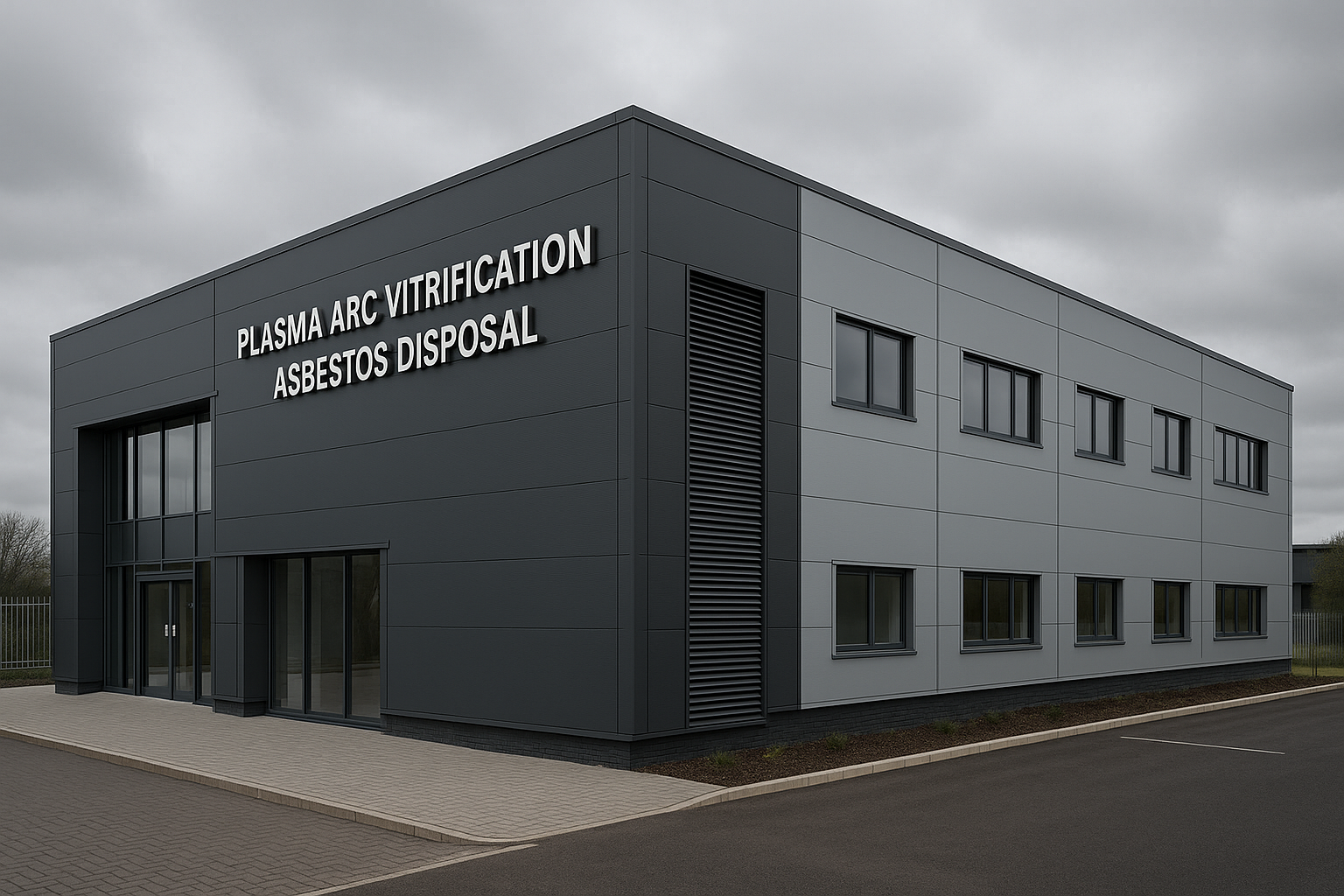
Plasma Arc Vitrification Asbestos Disposal: Is It the Future of Asbestos Waste Treatment in the UK?
Most asbestos waste in the UK still ends up buried in licensed hazardous landfill. That route is lawful, widely used, and for many projects it remains the only realistic option available today. But plasma arc vitrification asbestos disposal takes a fundamentally different approach — using extreme heat to destroy the fibrous mineral structure entirely, rather than simply containing it underground.
For property managers, dutyholders and anyone planning refurbishment or demolition work, that raises a straightforward question. Is this a realistic alternative, or is it still a specialist technology with limited practical application across the UK?
The honest answer is both. Plasma arc treatment is scientifically credible, technically proven in controlled settings, and highly effective at destroying asbestos when correctly operated. But disposal choices in practice are shaped by regulation, licensing, cost, logistics, and the need for a compliant route that works on a real project, today.
Before any disposal route is considered, the starting point is always proper identification. If you manage a building portfolio in the capital, arranging an asbestos survey London service establishes what materials are present, what condition they are in, and what action is genuinely required.
What Is Plasma Arc Vitrification Asbestos Disposal?
Plasma arc vitrification asbestos disposal is a high-temperature thermal treatment process that converts asbestos-containing waste into a glass-like, non-fibrous material. Rather than isolating asbestos in the ground, the process is designed to destroy the mineral structure that makes asbestos dangerous in the first place.
Vitrification means turning a material into a glassy solid. In the context of asbestos treatment, that matters because the hazard comes from microscopic fibres with a durable crystalline structure. Destroy that structure completely, and the material no longer behaves like asbestos.
How the Plasma Arc Works
A plasma arc is generated by passing electricity through a gas — commonly air, argon or nitrogen — producing an ionised stream at temperatures far beyond those achieved in ordinary waste incineration. Inside a specialist furnace, asbestos-containing materials are exposed to that heat.
The waste melts, the fibrous mineral structure is destroyed, and the cooled output solidifies into a dense vitrified slag. This is not encapsulation — it is transformation at the molecular level.
Why This Differs From Landfill
Licensed landfill contains asbestos safely when handled correctly, but it does not alter the asbestos itself. The fibres remain hazardous — buried and controlled, but present. Plasma arc vitrification asbestos disposal is designed to eliminate the fibre hazard at source.
That distinction is why it attracts serious interest from researchers, regulators and waste specialists exploring long-term alternatives to burial.
Why Asbestos Is Hazardous and Why Disposal Matters
Asbestos is not dangerous because of its age or its appearance. It is dangerous because damaged asbestos-containing materials can release tiny airborne fibres that lodge deep in the lungs, where they remain for decades. These fibres are durable, biologically persistent and associated with serious diseases including mesothelioma and asbestosis.
That is why the Control of Asbestos Regulations place strict legal duties on those managing non-domestic premises, and why all asbestos work must follow HSE guidance. The three types most commonly encountered in UK buildings are:
- Chrysotile — white asbestos, historically the most widely used
- Amosite — brown asbestos, frequently found in insulation board
- Crocidolite — blue asbestos, considered the most hazardous form
Each has a different mineral structure, but all can present a serious risk if fibres become airborne. Disposal decisions should never be based on assumptions. Identification, sampling where appropriate, and a survey carried out to HSG264 standards must come first.
How Plasma Arc Vitrification Asbestos Disposal Works in Practice
The science is straightforward in principle: apply sufficient heat and asbestos stops being asbestos. The engineering is where things become considerably more demanding. A functioning plasma arc vitrification system requires controlled waste handling, sealed processing, emissions management and rigorous verification of the treated output.
1. Waste Acceptance and Preparation
Asbestos waste arrives packaged and labelled in line with hazardous waste requirements. It must be transported by a licensed carrier and accompanied by the correct documentation. Operators also need to understand the composition of the waste stream, since asbestos cement, insulation board, lagging residues and mixed demolition debris behave differently under thermal treatment.
2. Controlled Feeding Into the Furnace
Material is introduced through a sealed loading system designed to prevent fibre release during handling. This is critical — the treatment method only works safely if asbestos remains contained from arrival through to final output.
Well-designed facilities minimise handling points and keep operator exposure under tight control, in line with the duty under the Control of Asbestos Regulations to prevent exposure so far as is reasonably practicable.
3. Extreme Heat and Mineral Transformation
Once inside the chamber, plasma torches generate temperatures high enough to melt the waste completely. The asbestos minerals lose their fibrous crystalline form and are transformed into an amorphous or glass-ceramic phase.
This is the core of plasma arc vitrification asbestos disposal — not encapsulation by heat, but the destruction of the structure that gives asbestos its hazardous properties.
4. Off-Gas Treatment
Any thermal process generates gases and particulates that must be managed carefully. The challenge extends beyond the asbestos itself to the binders, coatings, organics and contaminants present in the waste. A treatment plant therefore requires robust gas cleaning, filtration and environmental controls.
Without those systems, the process would not meet the standards expected under environmental permitting and HSE guidance.
5. Cooling and Testing the Vitrified Output
The molten material cools into a hard, glass-like slag. That output must then be tested to confirm it is non-fibrous and behaves as an inert material rather than hazardous asbestos waste. Verification is not optional — a disposal route is only credible if the end product can be demonstrated, through proper analysis, to have genuinely lost its hazardous asbestos characteristics.
What Temperatures Are Required to Destroy Asbestos?
Asbestos begins to change when heated, but partial change is not sufficient. For a treatment process to be trusted, it must destroy the fibrous structure consistently — not merely damage it.
Research has confirmed that asbestos minerals lose their defining structure at high temperatures, with complete transformation requiring temperatures well above those reached in conventional heating systems. Plasma arc systems operate far beyond that threshold. In practical terms:
- Lower heat may alter asbestos without guaranteeing full destruction
- Very high heat can melt the waste and eliminate the fibrous form entirely
- Consistency of operation is as important as peak temperature
- Post-treatment testing is essential to confirm the result
This is one reason plasma arc vitrification asbestos disposal is taken seriously by technical specialists. When the system is correctly engineered and operated, the temperatures achieved are sufficient to support complete mineral transformation.
Which Asbestos-Containing Materials Can Be Treated?
In theory, a wide range of asbestos-containing materials can be subjected to vitrification. In practice, the composition of the waste affects how manageable the process is and how commercially viable it becomes. Typical asbestos-containing materials found in UK buildings include:
- Asbestos insulation board
- Pipe lagging and thermal insulation
- Sprayed coatings
- Textured coatings containing asbestos
- Asbestos cement products
- Floor tiles and bitumen-based products
- Gaskets, ropes and seals
Many of these contain a high proportion of non-asbestos material. That influences furnace performance, residue characteristics and off-gas treatment demands.
For building owners, the relevant question is not whether a material could theoretically be vitrified, but whether a licensed facility is available, permitted to accept that waste stream, and able to process it compliantly. If you are managing sites across the North West, a properly scoped asbestos survey Manchester inspection helps separate materials requiring licensed removal from those that can be safely managed in situ until planned works take place.
Plasma Arc Vitrification vs Licensed Landfill: A Realistic Comparison
Most clients comparing disposal options want a clear answer: which route is better? The honest response depends on whether you mean better scientifically, environmentally, commercially or practically. Each frame gives a different result.
Where Landfill Still Makes Sense
Licensed hazardous landfill remains the standard disposal route in the UK for good reason. It is established, well understood and available. When asbestos is removed correctly, packaged properly and taken to an authorised site, landfill provides a lawful and controlled means of disposal. For many routine removal projects, it is the most practical option currently available.
Where Plasma Arc Treatment Has an Advantage
Plasma arc vitrification asbestos disposal offers something landfill fundamentally cannot: destruction of the hazard rather than indefinite containment. That removes the long-term issue of leaving hazardous fibres buried for future generations to manage. Potential advantages include:
- Complete destruction of the fibrous asbestos mineral structure
- Reduced long-term liability associated with buried hazardous waste
- A vitrified end product that may have reuse potential, subject to regulatory confirmation
- Alignment with broader waste minimisation and resource recovery objectives
The Practical Drawbacks
The drawbacks are significant and should not be understated. Plasma systems are expensive to build, energy-intensive to operate and technically demanding to permit. There is also the issue of scale.
A technology can be scientifically sound and still not be widely available enough to change day-to-day disposal practice across the UK. Until more permitted facilities exist, landfill will remain the default for the vast majority of projects.
What the Science Actually Shows
The scientific case for plasma arc vitrification asbestos disposal is stronger than many people assume. This is not a speculative concept based on marketing claims. Thermal destruction of asbestos has been examined through mineralogical analysis, electron microscopy and material characterisation.
Techniques such as X-ray diffraction have been used to assess whether treated material retains any asbestos fibre structure. When the process is properly controlled at sufficient temperature, studies have demonstrated transformation of asbestos minerals into non-fibrous phases. The key word is controlled.
Science and commercial rollout are not the same thing, and a process can work in pilot projects or specialist research facilities while still facing real barriers to routine use.
What Operators Need to Demonstrate
For the process to be trusted in practice, operators need robust evidence across several areas:
- Asbestos fibres have been fully destroyed in the treated output
- The output material is stable and non-hazardous
- Air emissions are controlled within permit conditions
- The process remains consistent across different waste stream compositions
- The facility can operate safely and compliantly over time
Those are appropriately high standards. Asbestos disposal is not an area where assumption or approximation is acceptable.
The Regulatory and Licensing Framework
Any facility operating plasma arc vitrification asbestos disposal in the UK must hold the correct environmental permits and demonstrate compliance with waste management legislation alongside the Control of Asbestos Regulations. This is not a process that can be operated informally or without regulatory oversight.
The Environment Agency oversees environmental permitting in England. Equivalent bodies operate in Scotland, Wales and Northern Ireland. Permits will specify what waste streams can be accepted, what emissions standards must be met, and what monitoring is required.
For dutyholders, this matters because your legal obligation does not end when asbestos leaves your site. You must use a licensed carrier and ensure the waste goes to an appropriately permitted facility. Using an unpermitted route — however well-intentioned — does not discharge your legal duty.
Waste transfer documentation must be retained. If you are responsible for a building in the Midlands, beginning with an asbestos survey Birmingham ensures the full material picture is established before any removal or disposal planning begins.
What This Means for Dutyholders and Property Managers Today
If you are responsible for a non-domestic building, your immediate obligations are set out clearly in the Control of Asbestos Regulations and HSE guidance. Those obligations centre on identifying what is present, managing it safely, and ensuring any removal work is carried out by licensed contractors using compliant disposal routes.
Plasma arc vitrification asbestos disposal is unlikely to be the disposal route your contractor offers on a standard removal project today. That does not mean it is irrelevant to you — it means the technology is at a stage where awareness matters more than immediate procurement decisions.
What you can do right now:
- Ensure your asbestos management plan is current and reflects the actual condition of materials
- Confirm that any removal contractor uses a licensed carrier and permitted disposal facility
- Retain all waste transfer documentation as required
- Ask your surveyor and contractor about emerging disposal options if long-term liability is a concern
- Review your survey records if your building was constructed before the year 2000
The disposal question only becomes relevant once the survey and management picture is clear. Getting that foundation right is the first and most important step.
The Vitrified Output: Can It Be Reused?
One of the more interesting aspects of plasma arc vitrification asbestos disposal is the nature of the end product. A dense, glass-like slag that has demonstrably lost its asbestos characteristics is a fundamentally different material from hazardous waste destined for landfill.
In principle, vitrified material could have applications as aggregate or construction fill, subject to regulatory acceptance and end-of-waste determinations. Whether that potential is realised depends on regulatory frameworks keeping pace with the technology, and on operators being able to demonstrate consistent, verified output quality.
This is an area where regulatory development and commercial deployment need to move together. The science may support reuse in appropriate applications, but the legal and commercial pathway must be established before any such claims can be acted upon.
Looking Ahead: Is Plasma Arc the Future?
Plasma arc vitrification asbestos disposal represents a genuinely different approach to a problem that landfill only defers rather than solves. The case for treating asbestos as a material to be destroyed rather than buried is logical, and the underlying science supports it.
Whether it becomes a mainstream disposal route in the UK depends on several factors coming together: investment in permitted facilities, regulatory clarity on treated outputs, competitive cost structures, and the development of a reliable supply chain that contractors and dutyholders can actually access.
None of those barriers are insurmountable. But they are real, and they mean that for most projects in the near term, licensed landfill remains the compliant, practical route. Staying informed about how the landscape is developing is worthwhile — particularly for organisations managing large estates or planning major demolition and refurbishment programmes where disposal volumes are significant.
The technology deserves to be taken seriously. So does the gap between scientific credibility and practical availability. Both things can be true at the same time.
Frequently Asked Questions
What is plasma arc vitrification asbestos disposal?
Plasma arc vitrification asbestos disposal is a high-temperature thermal treatment process that exposes asbestos-containing waste to extreme heat generated by a plasma arc. The heat destroys the fibrous crystalline structure of asbestos minerals, converting the waste into a dense, glass-like slag that no longer has the hazardous properties of asbestos. It is fundamentally different from landfill disposal, which contains asbestos without altering it.
Is plasma arc vitrification available for routine asbestos disposal in the UK?
Not widely. The technology is scientifically credible and has been demonstrated in controlled and pilot settings, but the number of permitted facilities capable of accepting asbestos waste for plasma arc treatment in the UK is currently very limited. For most removal projects, licensed hazardous landfill remains the standard disposal route. That position may change as investment and regulatory frameworks develop.
Does plasma arc treatment fully destroy asbestos fibres?
When correctly operated at sufficient temperatures, plasma arc vitrification is designed to destroy the fibrous mineral structure of asbestos entirely. Research using techniques such as X-ray diffraction has shown transformation of asbestos minerals into non-fibrous phases at high temperatures. However, consistent operation and post-treatment verification of the output are essential — the process must be demonstrated to work reliably, not just in theory.
What are my legal obligations for asbestos disposal as a dutyholder?
Under the Control of Asbestos Regulations and HSE guidance, you must ensure asbestos is removed by a licensed contractor where required, transported by a licensed carrier, and disposed of at an appropriately permitted facility. You must retain waste transfer documentation. Your legal duty does not end when asbestos leaves your building — the entire chain of removal, transport and disposal must be compliant.
What should I do before considering any asbestos disposal route?
The starting point is always a properly conducted asbestos survey carried out to HSG264 standards. You cannot make informed decisions about removal or disposal without knowing what materials are present, where they are, and what condition they are in. Supernova Asbestos Surveys carries out management and refurbishment and demolition surveys across the UK, providing the information dutyholders need to plan compliantly and safely.
Speak to Supernova Asbestos Surveys
Supernova Asbestos Surveys has completed over 50,000 surveys across the UK, helping property managers, dutyholders and building owners understand exactly what asbestos is present in their buildings and what action is required. Whether you are planning refurbishment, managing an estate, or preparing for demolition, we provide surveys carried out to HSG264 standards by qualified professionals.
For expert advice and to arrange a survey, call us on 020 4586 0680 or visit asbestos-surveys.org.uk. Getting the survey right is the foundation for every compliant decision that follows.