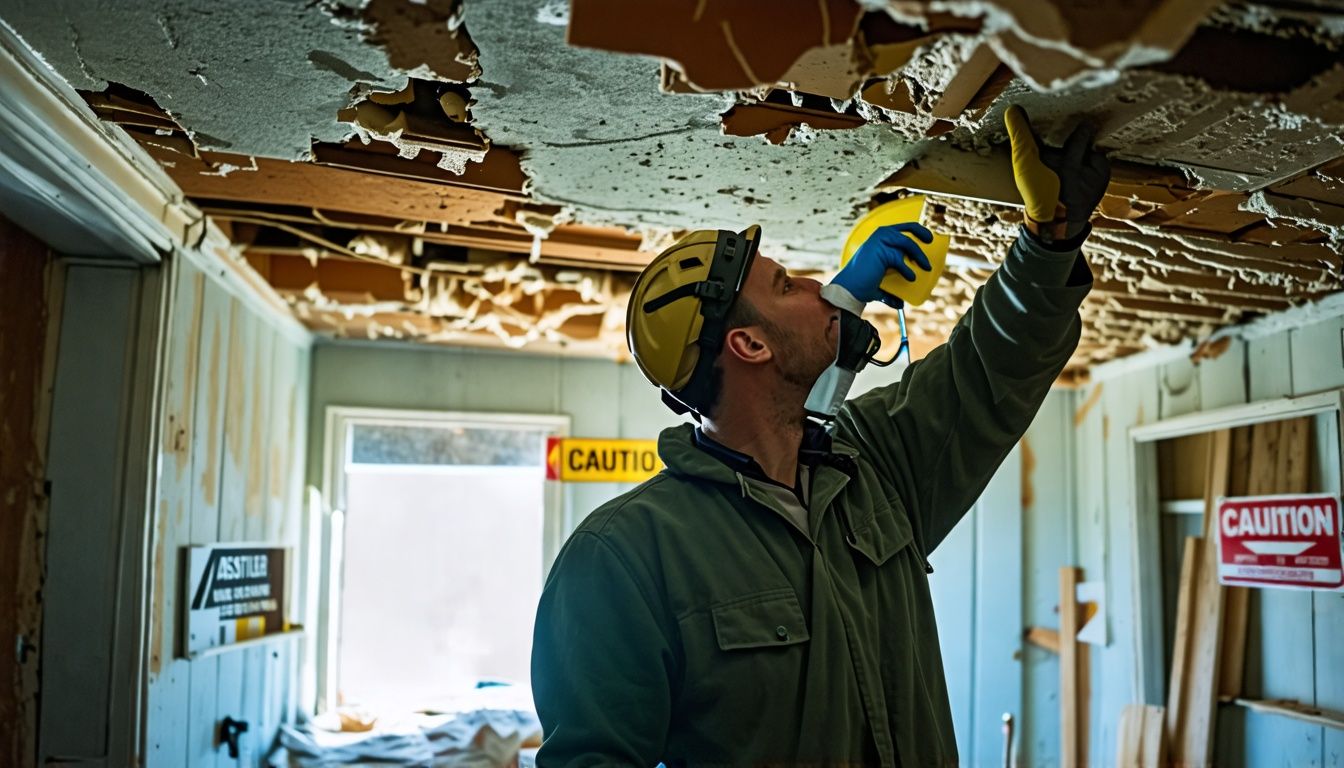
Can Asbestos Be Safely Removed by Homeowners, or Is Professional Help Necessary?
You’ve found something suspicious — a textured ceiling, crumbling pipe lagging, old floor tiles that look like they’ve been there since the 1970s. The instinct to deal with it yourself is completely understandable. But when asking whether asbestos can be safely removed by homeowners or whether professional help is necessary, the honest answer is almost always the same: you need a professional.
In most cases, DIY asbestos removal is not only dangerous — it’s illegal. And the consequences of getting this wrong don’t show up immediately. Asbestos-related diseases can take decades to develop, by which point your options are extremely limited.
Does Your Home Actually Contain Asbestos?
If your property was built or refurbished before 2000, there’s a realistic chance asbestos-containing materials (ACMs) are present somewhere. Asbestos wasn’t fully banned in the UK until 1999, and for decades it was used extensively in residential construction because of its fire resistance, durability, and low cost.
Here’s the problem: you cannot identify asbestos by looking at it. The fibres are microscopic, and many ACMs are visually identical to their non-asbestos equivalents. The only reliable way to confirm whether a material contains asbestos is through laboratory testing.
Where Is Asbestos Commonly Found in UK Homes?
Asbestos turns up in more places than most homeowners expect. Common locations include:
- Artex and textured coatings — particularly on ceilings applied before the 1990s
- Ceiling tiles and floor tiles — especially vinyl floor tiles in kitchens, bathrooms, and hallways
- Roof sheets and garage roofs — corrugated asbestos cement was extremely common in outbuildings
- Soffit boards and fascias — particularly in properties built between the 1950s and 1980s
- Pipe lagging and boiler insulation — in older heating systems and around hot water pipes
- Partition walls and ceiling boards — asbestos insulation board (AIB) was widely used
- Window putty and sealants — older glazing compounds sometimes contained asbestos
- Fireplace surrounds and flue linings — due to asbestos’s heat-resistant properties
- Sprayed coatings on structural steel — more common in commercial properties but found in some older residential conversions
If your home was built before 2000 and you’re planning any work that will disturb building materials, treat those materials as potentially containing asbestos until proven otherwise. That’s not overcaution — that’s the correct approach.
The Health Risks Are Real and Serious
Asbestos-related diseases kill more people in the UK each year than any other single work-related cause of death. That includes mesothelioma, asbestosis, and asbestos-related lung cancer — all caused by inhaling microscopic fibres that become lodged in lung tissue.
What makes asbestos particularly dangerous is the latency period. You won’t feel anything when you’re exposed. There’s no immediate cough, no warning sign. The damage accumulates silently over years and decades.
The Three Main Asbestos-Related Diseases
- Mesothelioma — an aggressive and almost always fatal cancer of the lining of the lungs or abdomen, almost exclusively caused by asbestos exposure
- Asbestosis — progressive scarring of the lung tissue, causing chronic breathlessness and a significantly reduced quality of life
- Asbestos-related lung cancer — a substantially increased risk, particularly in those who also smoke
There is no safe level of asbestos exposure. This isn’t scaremongering — it’s the scientific and regulatory consensus, and it’s the reason UK law treats asbestos handling as seriously as it does.
What UK Law Says About DIY Asbestos Removal
The Control of Asbestos Regulations set out clear rules about who can remove asbestos, under what conditions, and what training and licensing is required. These regulations apply to all work with asbestos — including in domestic properties.
Assuming that because it’s your own home you can do whatever you like is a dangerous misconception.
Licensed vs Non-Licensed Asbestos Work
Not all asbestos work requires a licence, but the distinction matters enormously:
- Licensed asbestos removal — required for the highest-risk materials, including asbestos insulation board (AIB), sprayed coatings, and pipe lagging. Only contractors holding a licence issued by the Health and Safety Executive (HSE) can carry out this work legally. As a homeowner, you cannot do this yourself.
- Notifiable non-licensed work (NNLW) — some lower-risk work doesn’t require a full licence but must still be notified to the relevant enforcing authority, and workers must have received appropriate training.
- Non-licensed work — the lowest-risk category, covering materials like asbestos cement in good condition. A licence isn’t required, but strict controls still apply.
The practical reality for homeowners is this: unless you have the training, equipment, and knowledge to correctly categorise the material you’re dealing with — and the vast majority of homeowners don’t — you should not be attempting removal yourself.
What About Small DIY Jobs?
There’s a common misconception that homeowners can freely remove small amounts of asbestos from their own properties. While domestic premises fall outside some areas of health and safety legislation that apply to workplaces, this does not mean anything goes.
The health risks to you, your family, and your neighbours are identical regardless of legal technicalities. Improper removal can contaminate your home, your clothing, and your vehicle. It can also affect your ability to sell or remortgage your property if asbestos contamination is later discovered.
Beyond the health consequences, improper disposal of asbestos waste is a criminal offence under environmental legislation. Fly-tipping asbestos or putting it in household waste is illegal and can result in significant fines.
When a Licensed Professional Is Not Optional
There are situations where using a licensed asbestos contractor is a legal requirement, not simply a recommendation. These include:
- Removal of any asbestos insulation board (AIB)
- Removal of pipe lagging or boiler insulation containing asbestos
- Any sprayed asbestos coatings
- Any work in commercial, industrial, or public buildings
- Asbestos asbestos removal as part of a refurbishment or demolition project
- Any situation where the material is friable — crumbling, damaged, or deteriorating — regardless of type
If you’re in any doubt about what type of material you’re dealing with, treat it as requiring licensed removal. The cost of bringing in a professional is nothing compared to the cost — financial, legal, and human — of getting it wrong.
The Right Way to Handle Suspected Asbestos in Your Home
If you find or suspect asbestos-containing materials in your property, your approach should be methodical and cautious. Here’s what to do — and what to avoid.
What You Should Do
- Leave it alone. Undisturbed asbestos in good condition poses minimal risk. The danger comes when fibres are released into the air.
- Get it tested. Arrange for a sample to be taken and analysed by an accredited laboratory before making any decisions. Our asbestos testing service provides fast, accurate results from UKAS-accredited analysts.
- Book a professional survey. A management survey will identify all ACMs in your property, assess their condition, and give you a clear picture of the risk — without you having to disturb anything.
- Commission a refurbishment survey before any building work. If you’re planning renovations, a refurbishment survey is essential before works begin. It locates ACMs in areas that will be disturbed and helps ensure the work is carried out safely and legally.
- Use a licensed contractor for removal. If removal is necessary, engage a contractor with a current HSE licence and ask to see their documentation.
What You Should Not Do
- Drill, sand, scrape, cut, or otherwise disturb any material you suspect might contain asbestos
- Use a standard vacuum cleaner on suspected asbestos dust — it will spread fibres rather than contain them
- Attempt to remove asbestos ceiling tiles, Artex, or insulation board yourself
- Dispose of asbestos in household bins, skips, or by fly-tipping
- Assume a material is safe simply because it looks intact or undamaged
What Professional Asbestos Removal Actually Involves
When you engage a licensed asbestos contractor, you’re not simply paying someone to pull material off a wall. You’re paying for a controlled, documented process that protects everyone — the operatives, the occupants, and the wider environment.
A professional removal will typically involve:
- A detailed risk assessment and method statement before any work begins
- Notification to the HSE where required under the regulations
- Full enclosure and containment of the work area using negative pressure air units and polyethylene sheeting
- Operatives wearing appropriate respiratory protective equipment (RPE) and disposable protective clothing
- Wet methods to suppress fibre release during removal
- Continuous air monitoring throughout the process
- Double-bagging and correct labelling of all asbestos waste
- Disposal at a licensed hazardous waste facility
- A clearance certificate and independent air test upon completion
This level of control is simply not achievable for a homeowner working alone. The equipment alone — HEPA-filtered vacuum units, negative pressure enclosures, appropriate RPE — is specialist kit that requires proper training to use correctly and safely.
Not All Asbestos Needs to Be Removed
This is a point that often surprises homeowners: in many cases, leaving ACMs in place and managing them is the safer and more cost-effective approach. Where materials are in good condition and are unlikely to be disturbed, removal may actually create more risk than it prevents.
A professional management survey will tell you what you have, where it is, and what condition it’s in. From there, a qualified surveyor can advise whether management in situ, encapsulation, or full removal is the appropriate course of action for each material.
For landlords and property managers, there is a specific legal duty to manage asbestos in non-domestic premises. This includes maintaining an up-to-date asbestos register, conducting regular re-inspection survey visits, and ensuring that anyone working on the building has access to that information before they start work.
What If You’re Planning a Demolition?
If your property is being demolished — in whole or in part — the requirements are even more stringent. A demolition survey must be carried out before any demolition work begins. This is an intrusive survey that aims to locate all ACMs throughout the entire structure, including areas that would normally be inaccessible.
Failing to commission a demolition survey before proceeding with demolition work is a serious regulatory breach. It also puts demolition workers at significant risk of exposure — which carries both legal and moral consequences for the property owner.
Testing Options for Homeowners
If you want to understand what you’re dealing with before committing to a full survey, testing is a sensible starting point. Our asbestos testing kit allows you to take a sample safely and send it to an accredited laboratory for analysis.
It’s worth being clear about what a testing kit can and can’t do. It can confirm whether a specific material contains asbestos. It cannot tell you the extent of ACMs throughout your property, assess the condition of materials, or provide the kind of documented risk assessment that’s required for legal compliance or property transactions.
For a complete picture — particularly if you’re buying, selling, or planning significant works — a full professional survey is the right tool. If you’re based in the capital and need fast, expert support, our asbestos survey London service covers the full range of survey types across all London boroughs.
Choosing the Right Survey for Your Situation
Not every situation calls for the same type of survey. Understanding which one applies to your circumstances saves time and ensures you’re meeting your legal obligations.
- Management survey — suitable for occupied properties where no major works are planned. Identifies and assesses ACMs without significant intrusion into the building fabric.
- Refurbishment survey — required before any renovation or refurbishment work that will disturb the building fabric. More intrusive by design.
- Demolition survey — required before full or partial demolition. The most thorough and intrusive survey type, designed to locate every ACM in the structure.
- Re-inspection survey — used to monitor the condition of known ACMs over time, updating the asbestos register and flagging any deterioration.
If you’re unsure which survey type applies to your situation, speak to a qualified surveyor. The right advice at the outset will save you significant time, money, and stress further down the line.
Frequently Asked Questions
Can I legally remove asbestos from my own home in the UK?
The legal position depends on the type of material involved. Some low-risk, non-licensed asbestos work — such as carefully removing a small amount of asbestos cement in good condition — is not explicitly prohibited for homeowners. However, licensed materials such as asbestos insulation board, pipe lagging, and sprayed coatings can only be removed legally by a contractor holding a current HSE licence. Because most homeowners cannot reliably identify which category a material falls into, professional assessment before any action is always the correct first step.
How do I know if a material in my home contains asbestos?
You cannot tell by looking at it. The only reliable way to confirm the presence of asbestos is through laboratory analysis of a sample taken from the material. Supernova offers both a professional asbestos testing service and a postal testing kit for homeowners who want a quick answer on a specific material. For a full assessment of the entire property, a management survey is the appropriate route.
Is it safe to leave asbestos in place rather than removing it?
In many cases, yes. Asbestos-containing materials that are in good condition and are unlikely to be disturbed pose very little risk. The danger arises when fibres are released into the air — typically through cutting, drilling, sanding, or other physical disturbance. A qualified surveyor can assess the condition of any ACMs in your property and advise on whether management in situ, encapsulation, or removal is the most appropriate course of action.
What happens if I dispose of asbestos incorrectly?
Improper disposal of asbestos waste is a criminal offence under UK environmental legislation. This includes placing asbestos in household bins, disposing of it in a standard skip, or fly-tipping. Offenders can face substantial fines and, in serious cases, prosecution. Asbestos waste must be double-bagged in clearly labelled, sealed bags and taken to a licensed hazardous waste facility. A professional asbestos contractor will handle all of this as part of their removal service.
Do I need an asbestos survey before renovating my home?
If your home was built or refurbished before 2000 and you’re planning work that will disturb the building fabric — including plastering, rewiring, plumbing, or structural alterations — a refurbishment survey is strongly recommended and, in many contexts, legally required. This survey identifies ACMs in the areas to be disturbed before work begins, allowing contractors to plan the work safely and ensuring you’re not inadvertently exposing workers or occupants to asbestos fibres.
Speak to Supernova Asbestos Surveys
With over 50,000 surveys completed across the UK, Supernova Asbestos Surveys has the expertise to help you understand exactly what you’re dealing with — and what to do about it. Whether you need a management survey, a refurbishment survey ahead of building works, or fast laboratory testing on a suspect material, our UKAS-accredited team is ready to help.
Call us on 020 4586 0680 or visit asbestos-surveys.org.uk to book your survey or request a quote. Don’t take chances with asbestos — get the right advice from the people who do this every day.