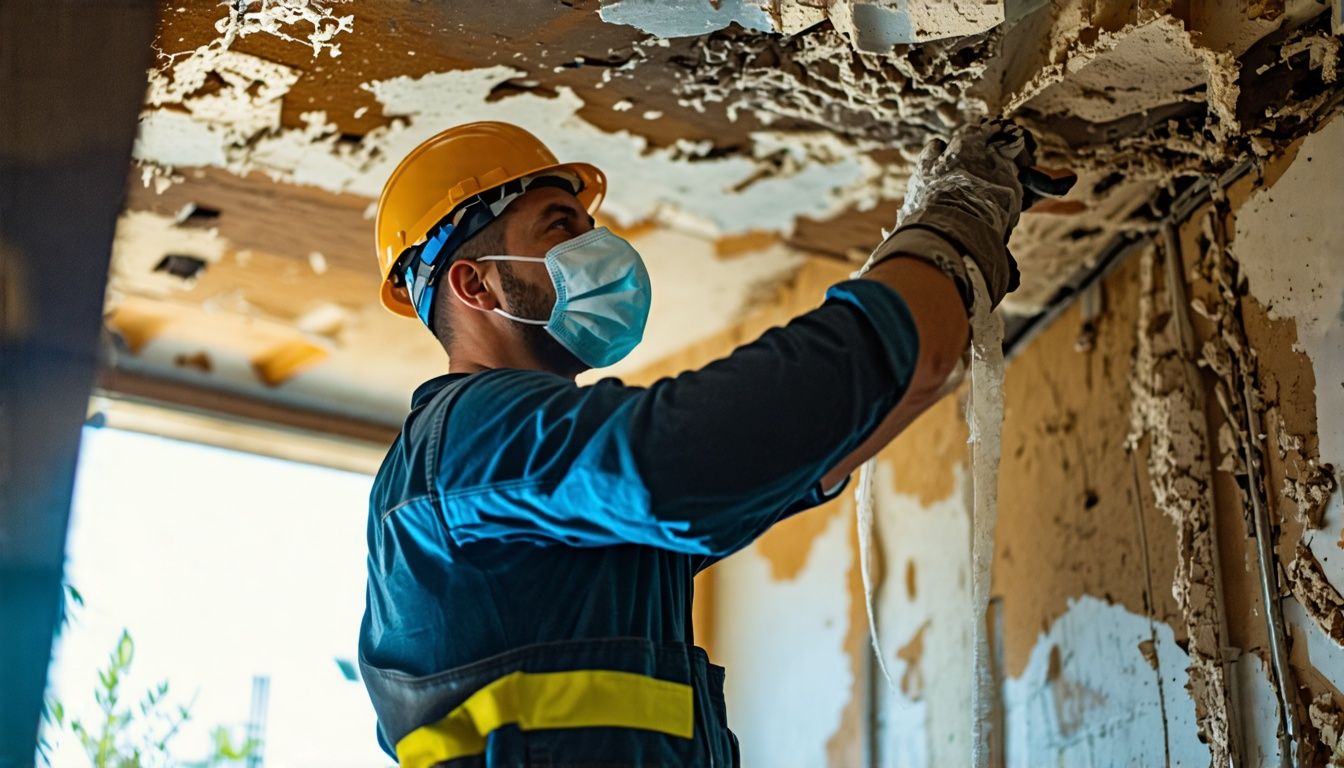
Asbestos Flash Guard Removal: What You Need to Know Before Work Begins
Flash guards are one of those asbestos-containing materials that catch property owners and contractors completely off guard. They look unremarkable — small, functional components tucked around chimneys, roof junctions, and weatherproofing details — yet in buildings constructed before 2000, they frequently contain asbestos cement. Get the asbestos flash guard removal wrong and you are looking at a serious health risk, a regulatory breach, and potentially significant liability.
This post covers what flash guards are, why they pose a risk, the legal framework that governs their removal, and the precautions that must be in place before, during, and after the work.
What Are Asbestos Flash Guards and Where Are They Found?
Flash guards — sometimes called flashings or flashing strips — are protective strips or covers used to seal joints and transitions in a building’s exterior. They are typically found at the junction between a roof and a chimney stack, around skylights, along parapet walls, and at any point where two different building elements meet and need weatherproofing.
In older UK buildings, these were commonly manufactured from asbestos cement — a composite material combining Portland cement with chrysotile (white asbestos) fibres, and in some cases amosite or crocidolite. The asbestos content gave the material durability, resistance to heat, and weatherproofing qualities that made it ideal for external use.
Because flash guards are external components, they are exposed to decades of weathering. Freeze-thaw cycles, UV degradation, and physical impact all cause the cement matrix to deteriorate over time, making previously bound asbestos fibres progressively more accessible. By the time a property owner notices a flash guard needs replacing, it may already be in a fragile, friable condition — which significantly raises the risk during removal.
Other Asbestos Cement Components Often Found Alongside Flash Guards
Flash guards rarely appear in isolation. In buildings where asbestos cement flashings are present, it is common to find other asbestos cement products in the same area:
- Corrugated or flat asbestos cement roofing sheets
- Asbestos cement ridge tiles and capping
- Gutters, downpipes, and rainwater goods in asbestos cement
- Asbestos cement soffits and fascias
- Asbestos cement flue pipes and chimney stack linings
If you are planning roofing work or chimney repairs on an older building, assume multiple asbestos-containing materials (ACMs) may be present until a survey confirms otherwise. Never treat a flash guard in isolation — the surrounding materials matter just as much.
Why You Cannot Simply Remove Asbestos Flash Guards Without a Survey
One of the most common mistakes made during roofing and maintenance work on older buildings is treating asbestos cement flash guards as a straightforward material swap — out with the old, in with the new. That approach is both legally non-compliant and genuinely dangerous.
Before any asbestos flash guard removal takes place, a professional asbestos survey must be completed. The type of survey required depends on the scope of the planned work.
Management Survey
A management survey is the baseline survey required for any building in normal use. It identifies ACMs that could be disturbed during routine occupation, maintenance, or minor works, and assesses their condition. If you manage a building and have not yet had a management survey carried out, this is your legal starting point — everything else follows from it.
Refurbishment Survey
Where flash guard removal is part of planned maintenance, roofing work, or any intrusive activity, a refurbishment survey is required. This is a more invasive survey that specifically examines the areas that will be disturbed during the planned work. It must be completed before work starts — not once operatives are already on the roof.
Demolition Survey
If the building is being taken down entirely, a demolition survey is required. This covers the entire structure and all its components, including external elements such as flash guards, roofing, and guttering. All ACMs must be identified and removed before demolition proceeds.
Visual inspection alone cannot confirm whether a flash guard contains asbestos. Laboratory analysis of bulk samples taken by a qualified surveyor is the only reliable method. Do not let any contractor skip this step on the basis of cost or time pressure.
The Legal Framework Governing Asbestos Flash Guard Removal
Asbestos work in the UK is governed by the Control of Asbestos Regulations, which set out clear duties for those who own, manage, or work on buildings containing ACMs. These regulations apply to non-domestic premises, and their requirements are not optional. HSE guidance — including HSG264 — provides the practical framework surveyors and duty holders must follow.
The Duty to Manage
If you are a building owner, landlord, managing agent, or employer with control over non-domestic premises, you have a legal duty to manage asbestos. That duty requires you to:
- Take reasonable steps to identify whether ACMs are present
- Assess the condition of any ACMs found
- Presume materials contain asbestos unless there is strong evidence they do not
- Produce and maintain an asbestos management plan
- Share information about ACM locations with contractors and maintenance workers before they start any work
- Review and update the plan regularly
Flash guards that are in poor condition or are likely to be disturbed during maintenance work must be included in your management plan. Failing to document them — and failing to inform contractors — is a breach of your legal duties.
Licensing Requirements
Asbestos cement, including the type typically found in flash guards, is generally classified as a non-licensed material. However, this does not mean it can be removed without controls. Non-licensed asbestos work still requires:
- A written risk assessment and method statement prepared before work begins
- Appropriate personal protective equipment (PPE) and respiratory protective equipment (RPE) for all workers
- Proper waste handling and disposal procedures
- Adequate supervision and worker training
Some non-licensed asbestos work also falls under the notifiable non-licensed work (NNLW) category, which requires notification to the HSE and medical surveillance for workers. Whether this applies depends on the frequency and duration of the work involved. If you are uncertain, treat the work as notifiable — it is the safer default.
Higher-risk asbestos materials such as sprayed coatings, pipe lagging, and insulating board require a fully HSE-licensed contractor. Where asbestos flash guard removal involves disturbing adjacent materials of this type, licensed contractors must be engaged.
Precautions Required During Asbestos Flash Guard Removal
Whether the work is being carried out by a specialist asbestos contractor or by a roofing contractor with appropriate training and controls, the precautions during asbestos flash guard removal are non-negotiable.
Before Work Starts
- Confirm the survey results and ensure the method statement specifically addresses the flash guard removal
- Check that all workers involved have received relevant asbestos awareness training
- Establish clear site boundaries and erect warning signage
- Notify building occupants and any other contractors working in the vicinity
- Ensure all required PPE and RPE is available, in good condition, and properly fitted — RPE must be fit-tested for each individual worker
During Removal
The priority during removal is minimising fibre release. Asbestos cement is a bonded material, which means fibres are less likely to become airborne than with softer, friable asbestos products — but deteriorated or broken asbestos cement can still release significant fibre levels if handled carelessly.
- Wet the flash guard thoroughly before and during removal using a fine water mist with a wetting agent — this suppresses fibre release
- Remove flash guards in whole sections wherever possible — do not break, snap, or cut them unless absolutely necessary
- Avoid using power tools; hand tools are strongly preferred
- Do not dry sweep, use a standard vacuum, or use compressed air to clean up debris
- Double-bag all removed material immediately in heavy-duty, clearly labelled asbestos waste bags
- Seal bags securely before moving them from the work area
Personal Protective Equipment
For non-licensed asbestos cement removal, the minimum PPE requirements are:
- RPE: A minimum FFP3 disposable mask, properly fit-tested. For more extensive work, a half or full-face respirator with P3 filters is appropriate.
- Coveralls: Disposable, hooded Type 5/6 coveralls worn over work clothing
- Gloves: Disposable nitrile gloves, taped at the cuffs to the coverall
- Boot covers or dedicated site footwear: Disposable overshoes taped at the ankle, or washable laceless footwear
All contaminated PPE must be treated as asbestos waste after use. It does not go in the general site skip — this is a common and costly mistake.
Decontamination After Work
Workers must decontaminate before leaving the work area. At minimum this involves:
- HEPA-vacuuming coveralls before removal
- Bagging and sealing coveralls as asbestos waste
- Washing hands and face thoroughly
- Changing into clean clothing before leaving site
No eating, drinking, or smoking is permitted in or near the work area during asbestos flash guard removal. These rules exist for good reason — asbestos fibres are invisible to the naked eye and can be ingested as easily as inhaled.
Waste Disposal After Asbestos Flash Guard Removal
Asbestos waste is classified as hazardous waste under UK legislation. All removed flash guard material must be:
- Double-bagged in heavy-duty, clearly labelled asbestos waste bags
- Transported to a licensed hazardous waste disposal facility
- Accompanied by a correctly completed hazardous waste consignment note
Consignment notes must be retained — do not discard them. They form part of your compliance documentation and may be requested by the HSE or local authority. Retain them for a minimum of three years, though keeping them indefinitely is good practice.
Putting asbestos waste in a general skip is illegal. It exposes you to prosecution and puts others at risk. Ensure your contractor provides copies of all waste transfer documentation before you sign off the job as complete.
Air Monitoring and Clearance Testing
For non-licensed asbestos work such as asbestos cement flash guard removal, a formal clearance air test is not a statutory requirement in the same way it is for licensed work. However, it is strongly advisable — particularly where the work has been extensive, where the material was in poor condition, or where the area will be reoccupied quickly.
A clearance air test carried out by a UKAS-accredited independent body provides objective confirmation that fibre levels are below the clearance indicator. It is the only reliable way to confirm the area is safe to reoccupy. Skipping it to save time or money is a false economy.
For any licensed asbestos work carried out in the same vicinity — for example, if insulating board or pipe lagging is disturbed during roofing works — a full four-stage clearance procedure including a clearance air test is mandatory before the enclosure is dismantled.
Keeping Your Asbestos Management Plan Up to Date
Once asbestos flash guard removal has been completed, your asbestos management plan must be updated to reflect the change. This is not an administrative afterthought — it is a legal requirement under the Control of Asbestos Regulations.
Your updated plan should record:
- The location and extent of the flash guards that were removed
- The date of removal and the contractor who carried out the work
- Waste transfer documentation reference
- Any remaining ACMs in the same area that are being managed in situ
- The next scheduled inspection date for any remaining ACMs
Failing to keep your management plan current means the next contractor to work on that building may not have accurate information about what remains. That information gap is where accidents happen.
Additional Precautions for Older Buildings
Older buildings present particular challenges when it comes to asbestos flash guard removal. The older the building, the more likely it is that multiple generations of repair and maintenance have been carried out — and that ACMs have been disturbed, damaged, or partially removed without proper documentation.
Before any roofing or chimney work begins on a pre-2000 building, consider the following:
- Review all existing asbestos records. If the building has a management plan, check it carefully. If it does not, commission a survey before any work proceeds.
- Do not assume previous removal work was done correctly. Poorly removed asbestos can leave residual contamination in cavities, on roof timbers, and in guttering. A thorough survey will identify this.
- Account for the age and condition of the material. Flash guards in buildings from the 1960s and 1970s may be significantly more degraded than those from the 1990s. Condition assessment must inform the removal method.
- Consider the wider roofing context. If the roof structure itself contains asbestos cement sheeting, the removal of flash guards cannot be planned in isolation — the full scope of ACMs must be addressed together.
- Engage a surveyor with experience in older building stock. HSG264 provides the technical framework, but experience in identifying asbestos in complex, multi-layered older structures is equally important.
If your property is located in a major urban area, Supernova provides specialist surveys across the country. Whether you need an asbestos survey in London, an asbestos survey in Manchester, or an asbestos survey in Birmingham, our qualified surveyors are available nationwide.
Choosing the Right Contractor for Asbestos Flash Guard Removal
Not every roofing contractor is qualified to carry out asbestos flash guard removal safely and legally. Before engaging anyone for this work, verify the following:
- Do they hold relevant asbestos training certificates for non-licensed work?
- Can they produce a written risk assessment and method statement specific to your job?
- Do they carry appropriate insurance, including asbestos-specific liability cover?
- Can they demonstrate experience with asbestos cement removal on similar buildings?
- Will they provide all waste transfer documentation upon completion?
If the work involves any licensed asbestos materials — even if the primary target is the flash guard — the contractor must hold a current HSE licence. Ask to see it. A reputable contractor will have no hesitation in providing this.
Do not accept verbal assurances. Get everything in writing before work begins, and ensure the method statement is specific to your building and the materials involved — not a generic template.
Frequently Asked Questions
Do all flash guards on older buildings contain asbestos?
Not necessarily, but in buildings constructed or refurbished before 2000, asbestos cement flashings were widely used and must be assumed to contain asbestos until laboratory analysis of bulk samples confirms otherwise. Visual inspection alone cannot rule out asbestos content. A qualified surveyor must take samples and have them analysed before any removal work proceeds.
Can a roofer remove asbestos flash guards, or does it have to be a licensed asbestos contractor?
Asbestos cement is generally classified as a non-licensed material, which means a licensed asbestos contractor is not always legally required for its removal. However, the roofer must have received appropriate asbestos awareness and non-licensed asbestos work training, must work to a written risk assessment and method statement, and must follow all the control measures required under the Control of Asbestos Regulations. If any adjacent materials — such as pipe lagging or insulating board — are present, a licensed contractor must be involved.
What survey do I need before asbestos flash guard removal?
For planned maintenance or roofing work, a refurbishment survey is required before work begins. This is an intrusive survey of the areas to be disturbed. If the building is being demolished, a demolition survey covering the entire structure is needed. A standard management survey is not sufficient for planned intrusive work — it is the baseline for managing ACMs in an occupied building, not a pre-works survey.
How should asbestos flash guard waste be disposed of?
Asbestos waste is classified as hazardous waste under UK legislation. All removed flash guard material must be double-bagged in clearly labelled asbestos waste bags and transported to a licensed hazardous waste disposal facility. The work must be accompanied by a correctly completed hazardous waste consignment note, which must be retained for a minimum of three years. Placing asbestos waste in a general skip is illegal and may result in prosecution.
Do I need an air test after asbestos flash guard removal?
A formal clearance air test is not a statutory requirement for non-licensed asbestos cement work, but it is strongly recommended — particularly where the material was in poor condition, the work was extensive, or the area will be reoccupied promptly. A UKAS-accredited independent analyst should carry out the test. For any licensed asbestos work carried out in the same area, a full four-stage clearance procedure including an air test is mandatory.
Get Expert Help With Asbestos Flash Guard Removal
Supernova Asbestos Surveys has completed over 50,000 surveys across the UK. Our qualified surveyors work to HSG264 and the Control of Asbestos Regulations, providing accurate, actionable reports that give you and your contractors the information needed to proceed safely and legally.
Whether you need a management survey, refurbishment survey, or demolition survey ahead of flash guard removal, we can mobilise quickly and provide results you can act on. Call us on 020 4586 0680 or visit asbestos-surveys.org.uk to book your survey today.