That textured ceiling might have been ignored for years, but artex asbestos can turn into a real problem the moment someone drills into it, sands it back or starts refurbishment without checking first. For homeowners, landlords and property managers, the issue is rarely the ceiling simply existing overhead. The risk starts when the material is disturbed and fibres are released.
Older textured decorative coatings were widely used across UK properties to hide uneven plaster and add pattern to ceilings and walls. Some of those coatings contained asbestos, usually chrysotile. If you are dealing with an older property and there is no clear record of what was used, the safest assumption is that the coating is suspect until it has been tested properly.
What is artex asbestos?
Artex was originally a brand name, but it became a common term for textured decorative coatings. Swirl, stipple, fan and broken leather finishes all fall into the sort of surface people usually mean when they talk about Artex.
When people refer to artex asbestos, they mean a textured coating that contains asbestos fibres. Not every textured coating contains asbestos, and not every old ceiling will test positive. The problem is that you cannot tell by looking.
Paint layers, age, pattern and colour do not confirm anything. A ceiling that looks fresh and modern may still contain asbestos beneath several coats of emulsion.
Why asbestos was used in textured coatings
Asbestos was added to some decorative coatings because it improved strength and helped bind the material together. At the time, asbestos was used in a huge range of building products for durability, insulation and fire resistance.
That is why artex asbestos still appears in homes, schools, offices and communal areas today. The coating may have been applied decades ago and then simply painted over again and again.
This matters because age alone does not make the material safe. If the coating contains asbestos, it needs to be managed in line with the Control of Asbestos Regulations, relevant HSE guidance and the survey standards set out in HSG264.
How to tell if a ceiling might contain artex asbestos
You cannot identify artex asbestos by sight alone, but you can judge whether asbestos is possible. That is often enough to know when to stop and arrange testing.

Suspicion is higher when:
- the property was built or refurbished before 2000
- the textured finish appears original
- there are no asbestos records or test certificates
- the surface has been patched around lights or fittings
- the coating is damaged, flaking or affected by leaks
- contractors are due to carry out work nearby
If any of those apply, do not guess. Treat the material as suspect until sampling confirms otherwise.
Visual clues only go so far
A swirled or stippled ceiling in an older building should prompt caution, not certainty. Two ceilings can look almost identical, with one testing positive and the other negative.
That is why records matter. If you manage non-domestic premises, communal areas or mixed-use buildings, you need a clear asbestos record rather than assumptions based on appearance.
How artex asbestos is confirmed
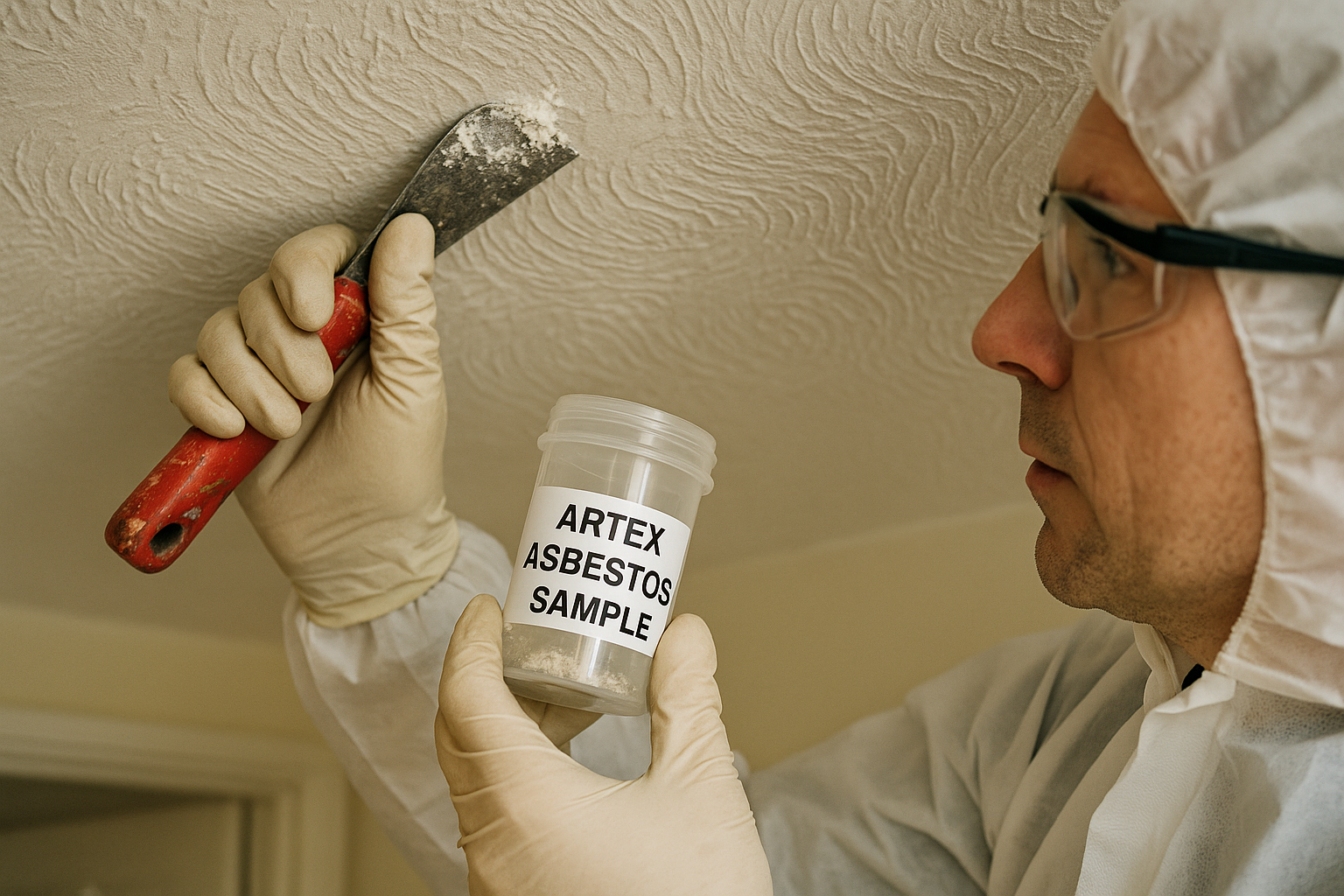
The only reliable way to confirm artex asbestos is to take a sample and have it analysed by a laboratory. Anything else is guesswork.
Professional sampling
Professional sampling is usually the best option where the coating is damaged, difficult to access or likely to be disturbed soon. It is also the sensible route if you need formal documentation for tenants, contractors or compliance records.
A surveyor can take a controlled sample, minimise disturbance and make sure the result is properly recorded. If you need laboratory confirmation, arrange asbestos testing before any work starts.
Self-sampling options
If the coating is intact and you only need to test a small area, a postal sample can be suitable in some cases. A homeowner may prefer an asbestos testing kit when the risk is low and the instructions can be followed carefully.
There is a difference between suitable self-sampling and unsafe DIY. If the material is crumbly, water-damaged or already breaking up, leave it alone and arrange professional attendance instead.
For a simple postal option, a testing kit can be useful, but only where the surface is stable and accessible.
When you need an asbestos survey rather than a single test
Testing one ceiling tile or one patch of coating is not always enough. The right approach depends on what is happening in the building.
Management survey for normal occupation
If the property is occupied and you need to identify asbestos-containing materials that could be disturbed during routine use or maintenance, a management survey is often the right starting point. This helps locate suspect materials and supports an asbestos register where required.
For landlords, managing agents and duty holders, that is often the practical first step when there are textured coatings in communal areas, plant rooms, risers or other non-domestic parts of a building.
Refurbishment or demolition work
If major works are planned, the survey scope changes completely. Before strip-out, structural alteration or demolition, a demolition survey is required for the affected area so asbestos can be identified before it is disturbed.
This is more intrusive than a management survey. It should be arranged before builders start opening ceilings, walls or service voids.
Why artex asbestos becomes dangerous
Artex asbestos in good condition is often lower risk than heavily friable asbestos materials such as lagging or sprayed coatings. That does not mean it is harmless. Once disturbed, it can release fibres.
Common activities that create risk include:
- drilling for spotlights, smoke alarms or cable routes
- scraping back texture before plastering
- sanding during redecoration
- cutting into ceilings for electrical works
- repairing leaks or cracks
- removing ceilings during refurbishment
This is where many people come unstuck. The coating may have sat undisturbed for years, then a routine maintenance job turns it into an exposure issue.
Health risks linked to asbestos exposure
Asbestos-related disease is caused by inhaling airborne fibres. The level of risk depends on the type of asbestos, the amount released and the duration and frequency of exposure.
Textured coatings usually contain a lower percentage of asbestos than some other asbestos-containing materials, but avoidable exposure should never be dismissed. The practical aim is always the same: prevent fibres from being released.
Asbestosis
Asbestosis is a serious long-term lung disease caused by asbestos exposure over time. It scars the lungs and can make breathing progressively harder. It is generally linked to heavier or repeated exposure, but that does not change the need to control even small avoidable releases.
Shortness of breath
Shortness of breath is one symptom associated with asbestos-related illness, although it can have many causes. From a property management point of view, symptoms are not how you judge whether a ceiling is safe. Testing and proper assessment are.
Chest pain
Chest pain may be linked to asbestos-related conditions affecting the lungs or their lining. Again, the building safety lesson is simple: do not disturb suspect material without checking it first.
Pleural thickening
Pleural thickening is scarring and thickening of the lung lining that can be associated with past asbestos exposure. Some people have few symptoms at first, while others develop breathlessness. The right response in buildings is prevention, not guesswork.
Is it safe to paint over artex asbestos?
Sometimes, yes. Painting over confirmed artex asbestos can form part of a management approach if the coating is in good condition and you are not damaging the surface first.
What you must not do is prepare the surface aggressively. That means no sanding, no scraping and no breaking the coating to get a smoother finish.
Avoid these mistakes:
- sanding the texture before painting
- scraping off loose high spots
- drilling through the coating without controls
- using repair methods that damage the surface
If the ceiling is cracked, flaking or affected by water damage, painting alone may not be enough. Get specialist advice before deciding what to do next.
What to do if testing confirms artex asbestos
A positive result does not automatically mean the ceiling has to come down. The right response depends on condition, location and whether the material is likely to be disturbed.
Start with these steps:
- Stop any work that could disturb the coating.
- Record the exact location of the material.
- Assess its condition and whether it is likely to be damaged.
- Inform contractors, maintenance staff and anyone else working nearby.
- Choose management, encapsulation or removal based on risk.
Leave it in place and manage it
In many cases, the safest option is to leave asbestos-containing textured coating where it is and manage it properly. This is often appropriate when the material is intact, stable and unlikely to be disturbed.
Good management includes:
- keeping records of location and condition
- checking periodically for damage
- warning contractors before they start work
- avoiding drilling, sanding or scraping
- updating asbestos information where required
Repair local damage
If there is only minor isolated damage, a controlled repair may be possible. That is not a DIY filler-and-sandpaper job. Any repair still needs to prevent fibre release and should be planned properly.
Encapsulation
Encapsulation means sealing the material to reduce the chance of fibre release. Depending on the ceiling and the room, this may involve applying a suitable coating or overboarding the surface.
Encapsulation can be practical where removal would create more disruption than benefit, but it still needs proper assessment first.
Removal
Removal may be the best option when the coating is badly damaged, refurbishment is planned or the ceiling will almost certainly be disturbed in future. The method depends on the material, the scale of work and the level of risk.
Do not assume removal is a general DIY task. Even where the work is not licensable, it still has to be handled correctly with suitable controls, waste handling and cleaning procedures.
Practical advice for homeowners, landlords and property managers
The best way to deal with artex asbestos is to make sensible decisions before work starts. Most asbestos incidents happen because somebody assumed a ceiling was safe and carried on.
Use this checklist:
- Check whether the property has an asbestos survey or register.
- Ask for test results before electricians, plumbers or decorators begin.
- Do not let anyone drill or sand textured coatings without confirmation.
- Keep copies of all survey reports and lab certificates.
- Brief contractors clearly about known or suspected asbestos materials.
- Review communal areas and service spaces, not just private rooms.
If you are responsible for a portfolio, consistency matters. A clear process for testing and recording suspect textured coatings is far better than dealing with emergency stop-work situations later.
Artex asbestos in different property types
Artex asbestos can appear in more places than many people expect. It is not limited to old domestic ceilings.
- Homes: bedrooms, hallways, lounges and stairwells often have textured ceilings.
- Flats and HMOs: communal corridors and shared access areas may also contain textured coatings.
- Schools and offices: older buildings may have decorative coatings in classrooms, corridors and ancillary spaces.
- Commercial premises: back-of-house areas, toilets and storage rooms are often overlooked.
If you manage multiple sites, each building should be assessed on its own records and condition. Never assume one negative result means every similar-looking ceiling elsewhere is also clear.
Arranging local help
If you need support quickly, local attendance can make planning easier. Supernova provides services nationwide, including asbestos survey London, asbestos survey Manchester and asbestos survey Birmingham.
Wherever the property is located, the principle stays the same: identify suspect materials before maintenance, refurbishment or demolition begins.
Need a clear answer on artex asbestos?
If you suspect artex asbestos, do not leave it to guesswork and do not let contractors disturb the surface first. Whether you need sampling, a survey or advice on the right next step, Supernova Asbestos Surveys can help.
To arrange testing or book a survey, call 020 4586 0680 or visit asbestos-surveys.org.uk. If you need more information about nationwide sampling and lab analysis, you can also view our asbestos testing service online.
Frequently Asked Questions
Can you tell if Artex contains asbestos just by looking at it?
No. Pattern, age, paint finish and colour are not reliable indicators. The only dependable way to confirm artex asbestos is by sampling and laboratory analysis.
Is artex asbestos dangerous if left alone?
If the coating is in good condition and is not being disturbed, the risk is usually much lower than with damaged or friable asbestos materials. The danger increases when the surface is drilled, scraped, sanded or removed.
Do I need to remove artex asbestos from my ceiling?
Not always. If the material is sound and unlikely to be disturbed, it can often be left in place and managed. Removal is more likely to be appropriate where the coating is damaged or refurbishment works are planned.
Can I paint over artex asbestos?
In some cases, yes, if the coating is intact and you are not sanding or scraping it first. If the surface is damaged or flaking, get advice before painting because sealing alone may not be suitable.
What survey do I need before building work starts?
For normal occupation and routine management, a management survey is often suitable. If the work involves intrusive refurbishment or demolition in the affected area, a refurbishment or demolition survey is needed before work begins.