Cut into the wrong ceiling tile, disturb an old floor tile adhesive, or start a strip-out without checking first, and a routine job can turn into a serious asbestos problem very quickly. Asbestos testing is the only reliable way to confirm whether a material contains asbestos and to decide what needs to happen next.
For property managers, landlords, dutyholders, contractors and homeowners, visual guesswork is not enough. Materials that look harmless can contain asbestos, while products that look suspicious sometimes do not. The answer comes from controlled sampling, competent inspection and laboratory analysis.
Across the UK, asbestos still appears in offices, schools, shops, warehouses, communal areas and older homes. If those materials are damaged or disturbed during maintenance, refurbishment or demolition, fibres can be released. That is why asbestos testing sits at the centre of safe planning, legal compliance and practical risk management.
Why asbestos testing matters in UK properties
Asbestos was used widely because it was durable, heat resistant and cost-effective. Many buildings constructed or refurbished before the final ban still contain asbestos-containing materials in places that are easy to overlook.
The risk is not simply that asbestos exists. The real risk arises when it is drilled, broken, sanded, cut, stripped out or otherwise disturbed. Once fibres become airborne, exposure control becomes the priority.
Under the Control of Asbestos Regulations, those responsible for non-domestic premises have a duty to manage asbestos. That means identifying suspect materials properly, assessing the risk, keeping records up to date and making sure anyone who may disturb asbestos has the right information before work starts.
Surveying and sampling should also follow relevant HSE guidance and the principles set out in HSG264. In practice, that means using a competent surveyor, taking representative samples and producing a report that is clear enough for contractors, managing agents and dutyholders to act on.
If you need an occupied-building inspection to locate and assess accessible asbestos-containing materials, a management survey is usually the right starting point. If intrusive works are planned, a more targeted survey is normally needed.
When asbestos testing becomes necessary
There are times when asbestos testing is a sensible precaution, and times when it is essential. If work is planned, materials are damaged, or legal duties apply, delaying the decision usually creates more cost and more risk.
You should arrange asbestos testing or survey advice before work begins if any of the following apply:
- You are planning maintenance that may disturb suspect materials
- You are preparing for structural alterations or strip-out works
- You are refurbishing part of a building
- You are demolishing all or part of a property
- The building was constructed or refurbished when asbestos use was common
- Materials have been damaged by leaks, impact or general wear
- Contractors need evidence before starting work
- You are the dutyholder for non-domestic premises
Where refurbishment is planned, a refurbishment survey is normally required because a standard occupied-building survey will not go far enough. Before demolition, the correct route is a demolition survey.
If asbestos has already been identified and remains in place, condition checks are part of proper management. A re-inspection survey helps confirm whether known materials remain stable or whether the risk profile has changed.
Where asbestos is commonly found
Many people think first of garage roofs or pipe lagging, but asbestos was used in a much wider range of products. It can appear in high-risk friable materials and in harder products such as cement sheets and floor tiles.
Common locations include:
- Textured coatings on walls and ceilings
- Floor tiles and bitumen adhesives
- Asbestos insulating board in partitions, risers, soffits and service cupboards
- Pipe insulation, boiler insulation and gaskets
- Cement roof sheets, gutters, downpipes and wall panels
- Ceiling tiles and duct panels
- Sprayed coatings on structural steel or concrete
- Vinyl sheet flooring and backing materials
- Fire doors, fuse boxes and electrical backboards
- Roofing felts, mastics, seals and some insulation products
Appearance alone is never enough. Two materials can look identical, with one containing asbestos and the other not. That is why asbestos testing remains the basis for safe decisions.
How asbestos testing is typically performed
Professional asbestos testing follows a controlled process. The detail varies depending on the building, the material and the purpose of the inspection, but the basic stages are consistent.
1. Initial assessment
A competent surveyor identifies suspect materials, considers their condition and accessibility, and decides whether sampling is appropriate. This first stage also establishes whether the task should sit within a wider survey rather than a stand-alone visit.
If you already know which material needs checking, Supernova provides dedicated asbestos testing for material identification. That can be useful when a specific product needs confirmation before minor works or as part of a wider management plan.
2. Controlled sampling
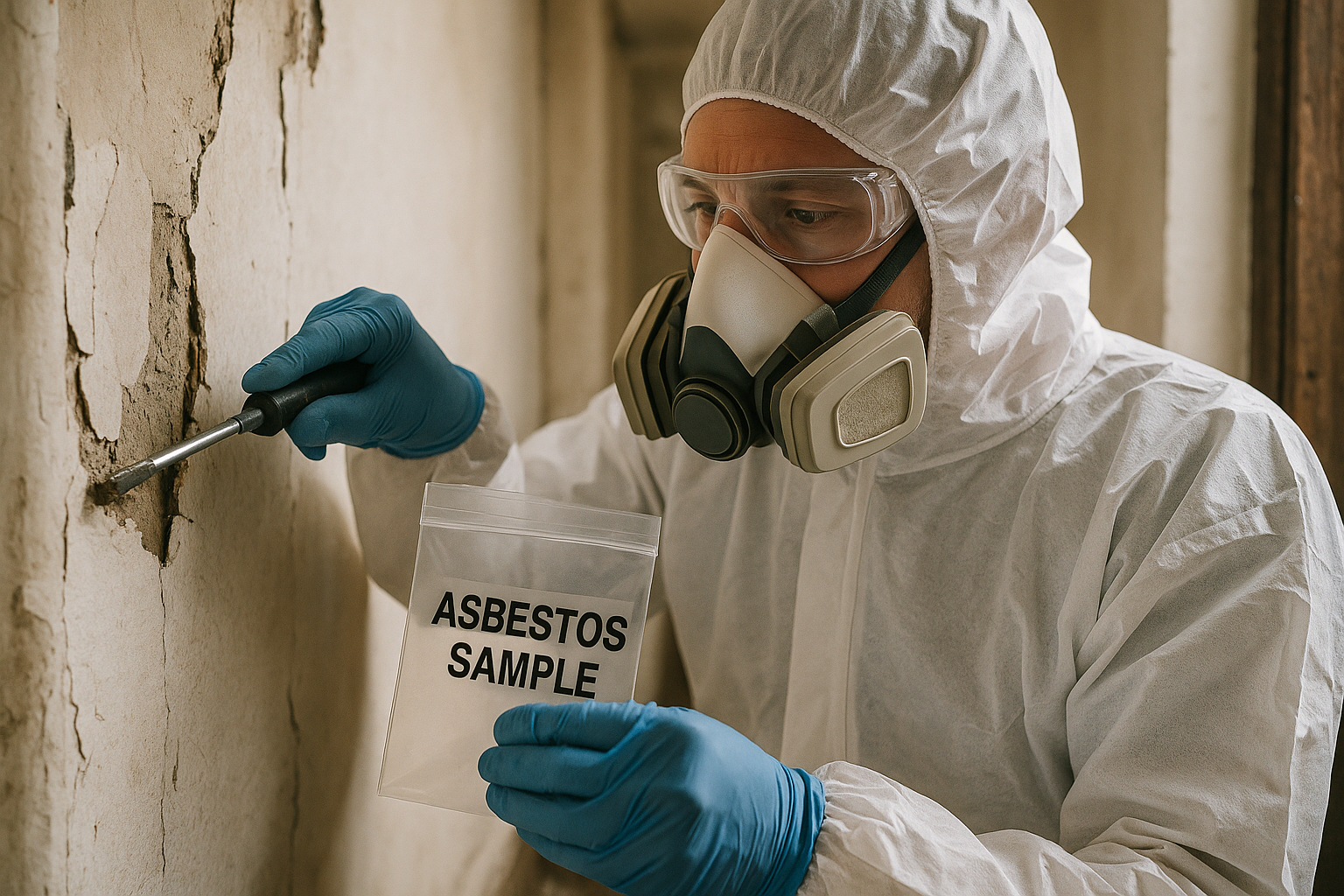
Small samples are taken using methods designed to minimise fibre release. The area is prepared, suitable controls are used, the material may be dampened where appropriate, and the sample point is sealed afterwards.
Each sample is placed into a sealed, labelled container and logged carefully. Good chain-of-custody procedures matter because the result needs to be traceable, clear and defensible.
3. Laboratory analysis
Samples are sent to a UKAS-accredited laboratory for analysis in line with HSE guidance. The laboratory determines whether asbestos is present and, where possible, identifies the asbestos type.
Results may refer to chrysotile, amosite or crocidolite depending on the material analysed. What matters most for the client is that the finding is accurate, clearly reported and linked to sensible next steps.
4. Reporting and recommendations
A useful report does more than say yes or no. It should explain what was sampled, where it came from, what the laboratory found and what practical action should follow.
That action might include:
- Leave the material in place and manage it
- Record it in the asbestos register
- Label or protect the area
- Encapsulate or repair the material
- Restrict access until action is taken
- Arrange licensed or non-licensed removal, depending on the material and task
- Carry out further surveying if the sampling was limited
How many samples are needed for asbestos testing?
One of the most common questions around asbestos testing is simple: how many samples? The honest answer is that it depends on the material, the extent of the area and whether the product is genuinely homogeneous.
If a material is uniform in appearance, age and installation across a defined area, fewer samples may be needed. If it changes between rooms, shows signs of patch repair, includes different layers or appears to have been installed at different times, more samples may be necessary.
Surveyors use HSE guidance, experience and professional judgement to decide sample numbers. The aim is not to take the fewest samples possible. The aim is to take enough to support a reliable conclusion.
What affects sample numbers?
- Material type: cement, insulating board, textured coating and floor tile products are assessed differently
- Extent of material: a single access panel is very different from a whole block of similar ceiling tiles
- Homogeneity: uniform materials may need fewer samples than mixed or inconsistent products
- Condition: damaged or layered materials may need more careful assessment
- Access: occupancy, hidden voids and work restrictions can affect the sampling approach
- Purpose of the work: refurbishment and demolition projects usually need more intrusive inspection and broader sampling
Practical advice on sample strategy
If someone tells you one sample will cover an entire property, ask them to explain the reasoning. A credible surveyor should be able to justify the sampling plan clearly and relate it to the building layout, material type and intended work.
When comparing quotes, do not compare price alone. Check the proposed scope, expected sample numbers, turnaround times and whether the final report will be detailed enough for contractors, managing agents and dutyholders to rely on.
Asbestos testing kit options and when they are suitable
Searches for an asbestos testing kit are common because many people want a quick route from suspect material to laboratory result. There is a place for that, but only in the right circumstances.
A properly packaged asbestos testing kit can be useful where a single accessible material needs checking and there is no wider need for a full survey. That is more likely in a limited domestic setting than in a commercial property, school, office block or communal area.
For dutyholders and property managers, a professional visit is usually the safer option. You need traceable sampling, defensible records and advice that fits your legal duties.
Item added to your cart: what to check before you buy
When you see the familiar message item added to your cart, pause before checkout. The cheapest option is not always the most useful one, particularly if the listing headline hides extra charges or limited support.
Before buying any testing kit, check:
- How many samples are included in the price
- Whether return postage is included
- Whether PPE and RPE are supplied
- Whether laboratory analysis is included
- Whether the laboratory is UKAS-accredited
- How results are issued
- Whether additional sample fees apply
- Whether support is available if the result is positive
If the wording is vague, ask before ordering. A low initial price can become expensive once postage, extra samples and protective equipment are added.
2. Asbestos Testing Kit – PPE and RPE Included
People searching for 2. Asbestos Testing Kit – PPE and RPE Included usually want a straightforward package that covers the essentials. That can be helpful, but only if the contents are suitable and the instructions are clear.
PPE means personal protective equipment. RPE means respiratory protective equipment. Both matter, but neither replaces competence, planning or correct sampling technique.
A kit marketed with PPE and RPE included should make clear exactly what is supplied. Typical contents may include:
- Disposable fibre-protective coveralls
- Disposable gloves
- Overshoes or suitable disposable footwear protection
- Appropriate RPE for the intended task
- Sealable sample bags and labels
- Wipes or cleaning materials for controlled clean-up
- Waste bags for contaminated disposable items
- Instructions for safe handling and packaging
RPE has to be suitable for the task and worn correctly. A poor face seal can reduce protection significantly. For regular sampling work, fit testing and training are essential.
The practical advice is simple. If the material is friable, damaged, overhead, difficult to access or likely to release fibres, stop and call a competent surveyor instead of relying on a DIY approach.
3. Asbestos Testing Kit – Additional Tests
You may also come across listings labelled 3. Asbestos Testing Kit – Additional Tests. This usually refers to the option to add more sample analysis beyond the base package.
That can be useful if, once you inspect the area more closely, you realise there is more than one suspect material. For example, a ceiling tile, the adhesive above it and a nearby panel may all need separate consideration.
Additional tests are often sensible when:
- You have several different materials in one room
- The same material looks different in different areas
- You suspect multiple layers, such as floor tile and adhesive
- You want broader certainty before instructing contractors
- The initial result does not answer the wider project question
Do not assume that one result applies to every similar-looking product in the building. If the materials are not clearly homogeneous, extra samples may be the right choice.
Popular essentials to look for in asbestos testing services
Many buyers compare asbestos testing services and kits by headline price, but that is rarely the best comparison. A better question is what is actually included and whether the output will be useful once the result arrives.
Popular essentials in a testing service or kit should include more than a lab result alone. They should support safe sampling, clear reporting and sensible next steps.
Look for these essentials:
- Clear instructions for controlled sampling
- Sample bags and labels
- PPE and, where appropriate, RPE
- Return packaging or courier details
- UKAS-accredited laboratory analysis
- Written results that identify the sampled material
- Advice on what to do if asbestos is confirmed
- Transparent pricing for extra samples
If you are responsible for a workplace or communal building, the essentials should also include proper site records and recommendations that fit your asbestos register and management arrangements.
Description, additional information and reviews: how to judge a testing provider
Online product pages and service listings often use headings such as Description, Additional information and Reviews. Those sections can be useful, but only if you know what to look for.
Description
A proper description should tell you exactly what you are paying for. It should explain whether the price covers one sample or several, whether return delivery is included, and how the results will be reported.
A useful description should answer these points:
- How many samples are included
- Whether extra samples can be added
- Whether PPE and RPE are supplied
- How samples should be packaged
- Whether analysis is by a UKAS-accredited laboratory
- How long results usually take
- Whether support is available after the result
If any of that is missing, clarify it before ordering. A short, vague description is often a sign that the service may not be as complete as it first appears.
Additional information
The additional information section should deal with practical details that affect the buying decision. This is where you often find the small print.
Check for details such as:
- Sample size guidance
- Packaging requirements
- Turnaround options
- Excluded materials or limitations
- Charges for extra samples
- Whether advice is limited to identification only
For property managers, this matters because identification is only one part of the decision. You may also need risk assessment, a management plan, contractor information and follow-up surveying.
Reviews
Reviews can be helpful, but read them carefully. Look for comments about clear communication, reliable turnaround times, understandable reporting and practical post-result advice.
Be wary of reviews that only praise speed while saying nothing about report quality or support. Fast results are useful, but only if they are accurate and actionable.
You may see bold marketing claims such as the USA’s best rated on Trustpilot. For UK property decisions, that phrase is not especially helpful. What matters here is whether the provider understands UK buildings, UK dutyholder requirements and UK asbestos guidance.
Help and information for property managers and dutyholders
Good asbestos testing is not just about confirming whether asbestos is present. You also need clear help and information on what the result means for the building, the planned work and the people on site.
If a positive result comes back, the next step depends on the material, its condition and whether it will be disturbed. In some cases, the right answer is to leave it in place and manage it. In others, repair, encapsulation, restricted access or removal may be necessary.
What to do after a positive asbestos result
- Stop any work that could disturb the material further.
- Limit access to the affected area if there is a risk of disturbance.
- Review the report carefully to confirm the material and location.
- Update the asbestos register if you are managing non-domestic premises.
- Take advice on whether the material should be managed, repaired, encapsulated or removed.
- Inform contractors before any related work starts.
If the result is negative, do not automatically assume the whole building is clear. A negative result only applies to the material sampled. Other suspect materials may still need inspection.
When a testing kit is not enough
A testing kit is not a substitute for a full survey where one is required. If you are planning intrusive works, managing a commercial property portfolio or dealing with communal areas, a surveyor-led approach is usually the correct route.
For broader project planning, Supernova also provides location-based support including an asbestos survey London service and an asbestos survey Manchester service for clients who need local coverage backed by national experience.
Useful resources for making the right asbestos decision
When clients search for useful resources, they are usually trying to answer one of three questions: do I need a sample, do I need a survey, or do I need removal advice? Getting that distinction right saves time and avoids unnecessary risk.
Use this simple checklist:
- One suspect material, limited domestic setting: a carefully chosen testing kit may be suitable if the material is accessible and in sound condition
- Occupied commercial or communal building: a management survey is usually more appropriate than isolated sampling
- Planned refurbishment: intrusive inspection and targeted sampling are needed before work starts
- Planned demolition: a demolition survey is required before the structure is brought down
- Known asbestos in place: periodic re-inspection helps confirm whether the condition has changed
If you are unsure which route applies, start by asking what work is planned, who could disturb the material and whether you have a duty to manage asbestos in the premises. That usually points you towards the right service quickly.
For clients comparing options online, Supernova also offers further information on asbestos testing for those who want to understand the service before booking.
Practical mistakes to avoid with asbestos testing
Most asbestos problems are made worse by delay, assumptions or poor communication. A few simple checks can prevent expensive mistakes.
- Do not assume a material is asbestos-free because it looks modern
- Do not rely on old paperwork without checking whether it matches the exact material and location
- Do not let contractors disturb suspect materials before results are confirmed
- Do not treat one negative sample as proof for every similar-looking product in the building
- Do not choose a provider on price alone if the scope is unclear
- Do not use a DIY sample route for damaged, friable or hard-to-reach materials
The best practical approach is to match the service to the risk. Simple identification can be enough in some domestic cases. For anything wider, more intrusive or more accountable, professional asbestos testing and surveying is usually the right decision.
Why professional asbestos testing often saves time
Some clients initially look for the cheapest route, then discover they still need a survey, more samples or clearer reporting before contractors can proceed. That delay can cost more than booking the right service from the start.
Professional asbestos testing gives you:
- A competent assessment of what actually needs sampling
- Safer sample collection
- Traceable records
- Laboratory-backed identification
- Recommendations that fit the building and planned work
- Reports that are easier for contractors and dutyholders to rely on
That matters most where time, liability and site safety all need to be managed together.
Frequently Asked Questions
Can asbestos testing tell me if a whole property is asbestos-free?
No. Asbestos testing only confirms the result for the material that was sampled. If you need to assess a wider area or whole building, a survey is usually the correct approach.
Is an asbestos testing kit suitable for commercial premises?
Usually not as a first choice. In commercial and communal settings, professional inspection and sampling are generally more appropriate because dutyholders need reliable records, clear reporting and advice that supports compliance.
How quickly can asbestos testing results come back?
Turnaround times vary by provider and laboratory arrangement. Always check whether the quoted timeframe includes transport, analysis and reporting, and whether faster options cost extra.
What happens if asbestos is found?
The next step depends on the material, its condition and whether it will be disturbed. It may be managed in place, repaired, encapsulated or removed. Any decision should be based on the report and the planned use of the area.
Should I take my own sample?
Only in very limited circumstances where the material is accessible, in reasonable condition and the process is clearly controlled. If the material is damaged, friable, overhead, difficult to reach or part of a wider project, use a competent professional instead.
If you need fast, reliable asbestos testing, expert sampling, or a full survey matched to your project, speak to Supernova Asbestos Surveys. We provide nationwide support for testing, management surveys, refurbishment surveys, demolition surveys and re-inspection surveys. Call 020 4586 0680 or visit asbestos-surveys.org.uk to book the right service.