Which Areas of a Building Are Considered Common Areas Under the Control of Asbestos Regulations?
If you manage or own a non-domestic building, you’ve almost certainly asked yourself: which of the following areas are considered common areas under the Control of Asbestos Regulations, and what does that mean for your legal responsibilities? It’s not an abstract question. The answer determines which spaces need surveying, what type of survey is required, and how you structure your ongoing asbestos management.
Common areas are broadly any shared or communal spaces that occupants, visitors, or workers pass through or use — but the full picture carries considerably more weight than that simple definition suggests. Getting this wrong doesn’t just leave you exposed to enforcement action. It means people moving through your building every day could be at risk from deteriorating asbestos-containing materials (ACMs) that nobody has ever properly assessed.
Why the Definition of Common Areas Matters Under the Control of Asbestos Regulations
Under the Control of Asbestos Regulations, duty holders of non-domestic premises carry a legal obligation to manage asbestos risk in areas they control. In multi-occupancy buildings — offices, residential blocks, mixed-use developments, schools, hospitals — that responsibility typically falls to the landlord, managing agent, or facilities manager for the shared fabric of the building.
Tenants may hold responsibility for their own demised spaces. But the common areas remain the duty holder’s problem, full stop. This distinction matters enormously when you’re commissioning surveys and maintaining your asbestos register.
Any building constructed before 2000 should be treated as potentially containing ACMs until a professional survey confirms otherwise. That applies to common areas just as much as any other part of the structure — arguably more so, given the volume of foot traffic and maintenance activity these spaces typically see.
Which Areas Are Considered Common Areas?
Common areas are spaces that are not under the exclusive control of any single occupant. In practice, this covers a wide range of locations across different building types. Here’s a detailed breakdown of the spaces that typically fall within this category.
Entrance Lobbies and Reception Areas
Main entrance lobbies and reception areas used by multiple occupants or visitors are classic common areas. In older buildings, these spaces frequently feature suspended ceiling tiles, textured wall coatings, and floor coverings that may contain asbestos. High footfall means any deteriorating ACMs here pose a risk to the greatest number of people.
Corridors and Hallways
Internal corridors connecting different parts of a building — whether between office suites, flats, or commercial units — are unambiguously common areas. Ceiling tiles, partition walls, pipe boxing, and floor coverings in these spaces all warrant close inspection during a survey. Textured coatings such as Artex applied to corridor walls and ceilings before 2000 are a particularly common finding.
Stairwells and Fire Escape Routes
Stairwells are shared access routes and sit firmly within the common area definition. They’re also spaces where asbestos insulation board (AIB) was frequently used for fire-resistant linings, door surrounds, and soffit panels. Given that these routes are critical for emergency evacuation, the condition of any ACMs here demands careful and regular monitoring.
Lifts and Lift Shafts
Lift motor rooms, lift shafts, and the lift car itself — where shared between building occupants — are common areas. These spaces can contain asbestos in insulation materials, fire-resistant panels, and mechanical plant. Access for survey purposes requires appropriate equipment and a surveyor with the right level of competence.
Plant Rooms and Boiler Rooms
Plant rooms, boiler rooms, and areas housing HVAC equipment are among the highest-risk locations in any pre-2000 building. Asbestos was extensively used as insulation on pipework, boilers, calorifiers, and ductwork precisely because of its heat-resistant properties. Maintenance staff working in these areas are particularly vulnerable, making thorough asbestos testing in plant rooms a non-negotiable part of any survey.
Roof Spaces and Loft Voids
Roof voids, loft spaces, and any shared roof structures fall under the duty holder’s control. Asbestos cement was one of the most widely used roofing materials in the UK, and corrugated asbestos cement sheets, asbestos insulation board, and asbestos-containing soffit boards are all common findings in roof areas of pre-2000 buildings. These spaces can present access challenges, but they are fully testable by experienced surveyors with the right equipment.
Basement and Subfloor Areas
Shared basement areas, service voids, and subfloor spaces are common areas where pipe lagging, thermal insulation, and spray-applied coatings are frequently found. These materials are among the most hazardous forms of ACM because they can release fibres readily when disturbed. They must be included in any survey of the building’s common areas — not treated as out of scope because they’re inconvenient to access.
Car Parks and External Structures
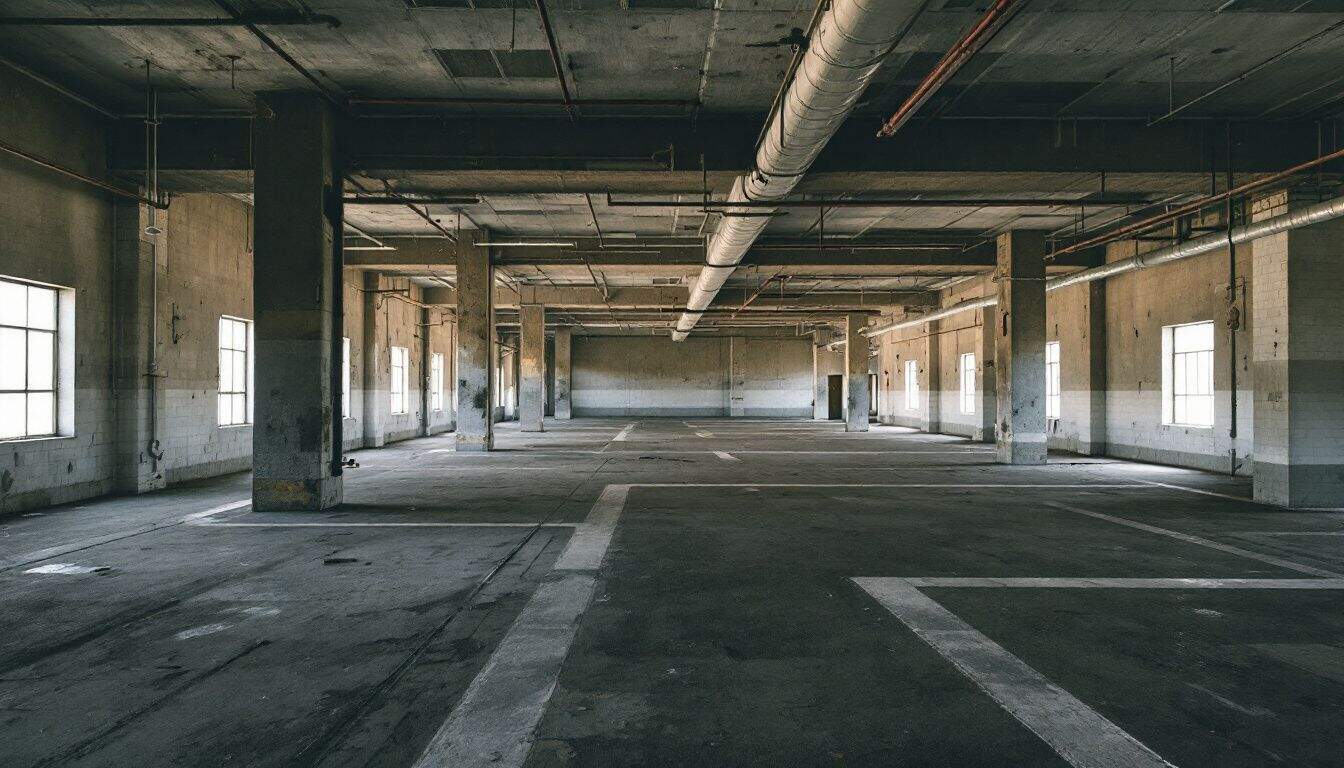
Shared car parks — particularly those within or attached to the building — and external structures such as bin stores, covered walkways, and outbuildings that form part of the premises also fall within the common area definition. Asbestos cement panels and roofing materials are frequently found in these locations, and their condition can deteriorate faster due to weathering.
Communal Toilets and Welfare Facilities
Shared toilet facilities, kitchenettes, and welfare areas used by multiple occupants or employees are common areas. Floor tiles and adhesives in these spaces — particularly those laid before the mid-1980s — frequently contain asbestos. The adhesive beneath intact-looking vinyl tiles can be friable and hazardous even when the surface appears undamaged.
Service Risers and Utility Cupboards
Vertical service risers carrying pipework, electrical cables, and ductwork through a building are shared infrastructure and therefore common areas. Pipe lagging and thermal insulation within these risers are high-priority inspection targets. Utility cupboards housing shared meters and distribution equipment fall into exactly the same category.
What Type of Survey Do Common Areas Require?
The type of survey required depends on the current use of the building and what you’re planning to do with it. These survey types are not interchangeable, and using the wrong one will not satisfy your legal obligations.
Management Surveys for Occupied Buildings
A management survey is the standard survey for any non-domestic building that is occupied and in normal use. For common areas specifically, this means the surveyor will inspect all accessible shared spaces, take samples where appropriate, and produce a report that forms the basis of your asbestos register and management plan.
Management surveys are not fully intrusive — they won’t involve breaking open walls or lifting every floor. Areas that cannot be accessed during the survey will be given a presumed score, indicating that ACMs should be treated as present until proven otherwise. This presumption must be reflected in your management plan.
Refurbishment Surveys Before Any Building Work
If you’re planning any structural work in common areas — whether a full lobby refurbishment, replacement of corridor ceilings, or targeted renovation — you need a refurbishment survey before work begins. This is a far more intrusive process. The survey area should be vacated, and surveyors will access voids, break into surfaces, and inspect concealed spaces to identify all ACMs that could be disturbed during the works.
Any ACMs identified must be removed by a licensed contractor before the refurbishment proceeds. This is not optional under the Control of Asbestos Regulations — it is a legal requirement.
Demolition Surveys for Full or Partial Demolition
Where common areas — or the entire building — are to be demolished, a demolition survey is required. This is the most intrusive survey type and must be completed before any demolition work commences. Every part of the building that will be affected needs to be fully investigated, with no assumptions made about inaccessible areas.
The Role of Sample Analysis in Common Area Surveys
Asbestos surveys are not simply visual inspections. A competent surveyor will take bulk samples from suspected ACMs and send them to a UKAS-accredited laboratory for analysis. This is the only reliable way to confirm whether asbestos is present and, if so, which fibre type.
The three main types — chrysotile (white asbestos), amosite (brown asbestos), and crocidolite (blue asbestos) — carry different risk profiles, and your management approach may vary accordingly. Sample analysis results form part of the asbestos register, which must be kept up to date and made available to anyone who may disturb the fabric of the building.
If you suspect a specific material in a common area and want a preliminary indication before commissioning a full survey, a testing kit can provide a fast result from a UKAS-accredited laboratory. This can be a useful initial check, but it does not replace a full professional survey and does not satisfy your legal obligations as a duty holder.
Keeping Common Areas Compliant: Re-Inspections and Ongoing Management
Having a management survey completed and an asbestos register in place is the starting point — not the finish line. ACMs left in place in common areas need to be monitored regularly, because their condition can deteriorate over time as materials age, get damaged, or are disturbed by maintenance activity.
A re-inspection survey should be carried out at regular intervals — typically annually, though the frequency may vary depending on the condition and type of ACMs present. These surveys check whether previously identified materials have deteriorated and whether any new ACMs have been uncovered since the last inspection.
Skipping re-inspections is one of the most common compliance gaps among building managers. It leaves duty holders legally exposed and, more importantly, means that a material that has begun to deteriorate in a busy corridor or stairwell could go undetected for months or years.
Your Legal Obligations as a Duty Holder
If you manage or own a non-domestic building built before 2000, the Control of Asbestos Regulations places clear legal duties on you. In relation to common areas specifically, this means:
- Commissioning a management survey from a UKAS-accredited surveyor to cover all common areas
- Maintaining an up-to-date asbestos register that includes all ACMs identified in shared spaces
- Putting in place a written asbestos management plan that addresses how identified ACMs in common areas will be managed
- Ensuring all contractors working in common areas are informed of the location and condition of any ACMs before starting work
- Arranging a refurbishment or demolition survey before any structural work in common areas begins
- Having ACMs re-inspected periodically to monitor their condition
The Health and Safety Executive takes enforcement of these obligations seriously. Prosecution is a real possibility where negligence results in exposure, and the health consequences of asbestos exposure — mesothelioma, asbestosis, and lung cancer — are severe and irreversible, typically manifesting decades after the original exposure occurred.
Common Areas in Residential Buildings
Residential landlords managing blocks of flats, converted houses, or sheltered housing need to understand that the common areas of those buildings fall squarely within the duty holder obligations under the Control of Asbestos Regulations. The entrance hall, stairwells, corridors, shared plant rooms, and roof voids of a residential block are all common areas — and all require the same level of attention as those in a commercial building.
This is an area where confusion is common. Some landlords mistakenly believe that because their tenants live in the building, rather than work in it, the regulations don’t apply in the same way. That’s not correct. The duty to manage applies to the non-domestic common parts of domestic premises, and failure to comply carries the same legal consequences.
If your portfolio includes residential properties across the country, it’s worth knowing that our team covers locations nationwide. We regularly carry out surveys for property managers requiring an asbestos survey in London and those needing an asbestos survey in Manchester, as well as many other areas across the UK.
What HSG264 Says About Common Area Surveys
HSG264 is the HSE’s guidance document that sets out how asbestos surveys should be planned, conducted, and reported. It provides detailed guidance on the scope of surveys, the competence required of surveyors, and how findings should be recorded.
For common areas specifically, HSG264 is clear that surveys must cover all accessible areas within the duty holder’s control. Where access is restricted at the time of the survey — a locked plant room, a sealed service riser — the surveyor must record this and apply a presumption that ACMs are present. That presumption must then be managed accordingly.
HSG264 also makes clear that surveyors must be competent, and that UKAS accreditation of the surveying organisation is the recognised benchmark of competence in the UK. Commissioning a survey from an unaccredited provider may not satisfy your legal obligations, regardless of what the survey report says.
Practical Steps for Duty Holders Managing Common Areas
If you’re working through your obligations as a duty holder, here’s a practical sequence to follow:
- Establish whether your building was constructed before 2000. If it was, treat it as potentially containing ACMs until a survey says otherwise.
- Commission a management survey from a UKAS-accredited surveyor covering all common areas within your control.
- Review the survey report carefully. Note all confirmed ACMs, all presumed ACMs, and any areas that could not be accessed.
- Create or update your asbestos register to reflect the survey findings.
- Produce a written asbestos management plan that sets out how each ACM will be managed — whether through monitoring, encapsulation, or removal.
- Inform contractors of all ACMs in common areas before any maintenance or building work begins.
- Schedule annual re-inspections to monitor the condition of ACMs left in place.
- Commission a refurbishment or demolition survey before any structural work or demolition in common areas begins.
Following this sequence won’t just keep you compliant — it will give you a clear, documented record of how you’ve managed your duty, which is exactly what the HSE or a court will want to see if questions are ever raised.
Get Expert Help from Supernova Asbestos Surveys
Understanding which of the following areas are considered common areas under the Control of Asbestos Regulations is the first step. Acting on that understanding is where the legal and moral obligation lies. Supernova Asbestos Surveys has completed over 50,000 surveys nationwide, working with landlords, facilities managers, local authorities, housing associations, and commercial property owners across the UK.
Whether you need a management survey for an occupied building, a refurbishment survey before planned works, or a programme of annual re-inspections across a property portfolio, our UKAS-accredited team can help. We also offer fast-turnaround asbestos testing services for individual materials where a targeted result is needed quickly.
Call us on 020 4586 0680 or visit asbestos-surveys.org.uk to discuss your requirements or book a survey.
Frequently Asked Questions
Which areas are considered common areas under the Control of Asbestos Regulations?
Common areas are any shared spaces not under the exclusive control of a single occupant. This includes entrance lobbies, corridors, stairwells, lift shafts, plant rooms, roof voids, basement areas, communal toilets, service risers, utility cupboards, shared car parks, and external structures forming part of the premises. In residential buildings, the non-domestic common parts — such as hallways and shared plant rooms — are also included.
Do the Control of Asbestos Regulations apply to residential buildings?
Yes, but specifically to the non-domestic common parts of domestic premises. If you manage a block of flats, converted house, or sheltered housing scheme, the shared areas — entrance halls, stairwells, corridors, plant rooms — fall within your duty to manage asbestos. The individual flats themselves are generally not covered, but the common areas are.
What type of asbestos survey do I need for common areas?
For occupied buildings in normal use, a management survey is the appropriate starting point. If you’re planning refurbishment work in any common area, you need a refurbishment survey before work begins. If demolition is planned, a demolition survey is required. These survey types are not interchangeable — using the wrong one will not satisfy your legal obligations.
How often do common areas need to be re-inspected for asbestos?
ACMs identified in common areas and left in place should typically be re-inspected annually, though the frequency can vary depending on the type and condition of the materials. The re-inspection checks whether previously identified ACMs have deteriorated and whether any new materials have been disturbed or uncovered. This ongoing monitoring is a legal requirement, not an optional extra.
Can I use a testing kit instead of commissioning a full survey?
A testing kit can provide a useful preliminary indication of whether a specific material contains asbestos, with results analysed by a UKAS-accredited laboratory. However, it does not replace a full professional survey and does not satisfy your legal obligations as a duty holder. If your building was constructed before 2000, a management survey covering all common areas within your control is required.