What Is P401 — and Why Does It Underpin Every Asbestos Survey in the UK?
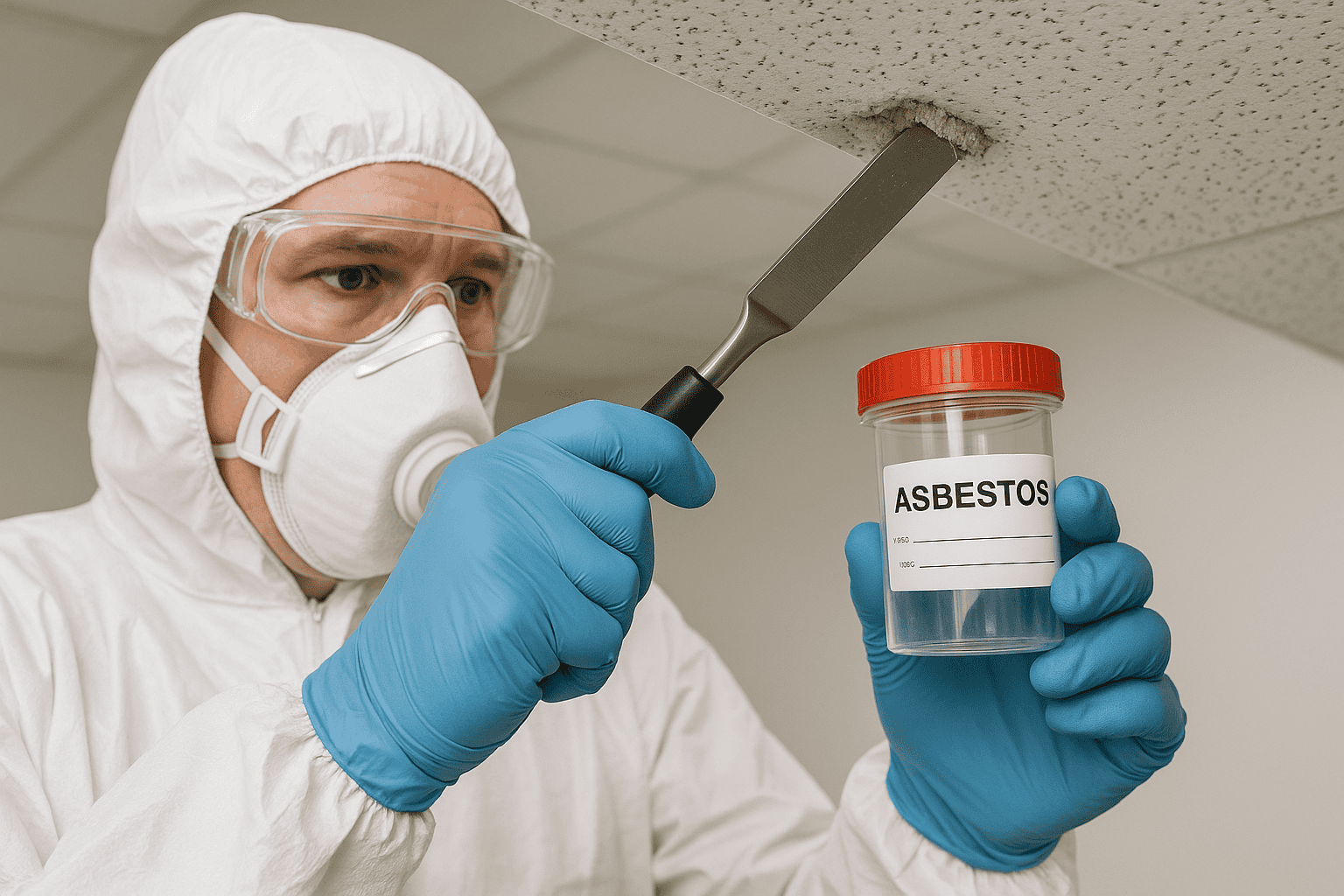
Asbestos cannot be identified by sight alone. A suspect material might look like ordinary floor tile, ceiling board, or textured coating — and without laboratory analysis, no one can say for certain whether it contains asbestos fibres. That is where the P401 qualification becomes essential. Awarded by the British Occupational Hygiene Society (BOHS), P401 is the recognised UK standard for the identification of asbestos in bulk samples using polarised light microscopy. Without analysts who hold this qualification, the entire chain of asbestos management in the UK would break down.
For property managers, building owners, and anyone commissioning an asbestos survey, understanding what P401 means helps you ask the right questions, choose the right provider, and trust the results you receive.
What Is the BOHS P401 Qualification?
P401 is a professional qualification that trains laboratory analysts to identify asbestos in bulk material samples. It covers polarised light microscopy (PLM) and dispersion staining — two specialist techniques used to reveal the optical properties of mineral fibres and confirm whether asbestos is present, and which type.
The qualification is relevant to laboratory analysts, occupational hygienists, asbestos bulk analysts, and anyone working toward a role in an accredited testing laboratory. It sits within the broader BOHS proficiency framework for asbestos work, alongside qualifications such as P402, which covers asbestos surveying.
Completing P401 demonstrates that an analyst can:
- Prepare samples safely using correct fume cupboard technique
- Operate a polarised light microscope to the required standard
- Apply dispersion staining to identify fibre types accurately
- Produce clear, accurate analytical reports
- Work in line with HSE guidance and UK regulatory requirements
How P401 Fits Into UK Asbestos Regulation
The Control of Asbestos Regulations places legal duties on those who manage non-domestic premises. Where asbestos-containing materials are suspected, bulk samples must be collected and analysed. That analysis must be carried out by a competent analyst — and P401 is the benchmark qualification that demonstrates that competence.
Bulk sample analysis must be conducted in a laboratory operating to ISO/IEC 17025 standards, which govern the technical competence and management systems of testing laboratories. P401 training is built around these standards, so qualified analysts are ready to work within accredited laboratory environments from the outset.
When a surveyor carries out a management survey and collects bulk samples, those samples must be sent to a laboratory where P401-qualified analysts carry out the identification work. The surveying and analysis roles are legally and professionally linked — one cannot substitute for the other.
What Does the P401 Course Cover?
The course blends taught theory with hands-on practical laboratory work. It is not a desk-based qualification — the practical elements are central, because asbestos identification is a physical skill that demands repetition and precision.
Total learning time is approximately 18 hours: around 14 hours of taught content and around 4 hours of independent study. This is a focused, intensive programme designed to build genuine competence rather than surface-level awareness.
Core Topics in the P401 Syllabus
- Asbestos fibre types: Chrysotile, amosite, crocidolite, anthophyllite, tremolite, and actinolite — their properties, optical characteristics, and associated health risks
- Polarised light microscopy (PLM): Setting up, aligning, and operating a polarised light microscope for bulk sample analysis
- Dispersion staining techniques: Using Cargille liquids to produce optical colour effects that help identify fibre types
- Sample preparation: Safe handling and preparation of bulk materials inside a fume cupboard to control airborne fibre release
- Fibre extraction methods: Techniques for isolating fibres from complex bulk materials including textured coatings, floor tiles, and insulation
- Report writing: Producing clear, accurate certificates and reports that meet regulatory and laboratory standards
- Quality control: Understanding quality control schemes and how they protect the integrity of results
- Regulatory framework: Duties under the Control of Asbestos Regulations, with reference to HSG248 — the HSE’s Analysts’ Guide
The Role of HSG248 in P401 Training
HSG248, Asbestos: The Analysts’ Guide, is the primary HSE guidance document for asbestos bulk analysis. P401 training is built around it, and Appendix 2 in particular provides the technical framework for polarised light microscopy.
Candidates are expected to study HSG248 in depth — not as background reading, but as a working reference they will use throughout their career. Familiarity with this document before the course begins gives candidates a significant practical advantage.
How Is the P401 Qualification Assessed?
Assessment has three distinct parts, each testing a different dimension of competence. Candidates must pass all three to earn the Proficiency Certificate in P401 Identification of Asbestos in Bulk Samples.
Written Theory Examination
This closed-book examination tests knowledge of asbestos fibre types, laboratory practice under ISO/IEC 17025, optical theory relevant to PLM, and the regulatory duties set out in the Control of Asbestos Regulations. Solid preparation across the full syllabus is required — there are no shortcuts here.
Practical Assessment
Candidates prepare and analyse real bulk samples in a controlled laboratory environment, under invigilator supervision. Safe technique, correct use of equipment, and accurate identification are all assessed. This is not a simulation — it reflects genuine laboratory conditions.
Practical Examination
This is an open-book examination lasting four hours. Candidates identify asbestos types from six prepared bulk material samples using PLM and dispersion staining. The open-book format reflects real laboratory conditions where reference materials are available — but speed, accuracy, and method still matter considerably.
All three assessments must be completed within twelve months of starting the course. BOHS provides written guidance to help candidates prepare, and feedback is given after each stage.
UKAS Accreditation and Its Relationship With P401
UKAS — the United Kingdom Accreditation Service — is the national body that assesses and accredits inspection bodies and laboratories in the UK. For asbestos work, UKAS accreditation is not optional; it is a legal and professional requirement.
Only UKAS-accredited inspection bodies can lawfully carry out management, refurbishment, demolition, and reinspection surveys in the UK. Bulk samples collected during those surveys must be analysed in a laboratory holding ISO/IEC 17025 accreditation. Analysts working in those laboratories are expected to hold qualifications such as P401 to demonstrate individual competence.
UKAS document RG 8 sets out the specific requirements for inspection bodies operating in the asbestos sector. It covers independence, fair practice under ISO/IEC 17020, report confidentiality, and the requirement to retain inspection reports for at least six years.
When you commission a reinspection survey from an accredited provider, the bulk samples collected are analysed by qualified analysts — often holding P401 — in accredited laboratories. That chain of competence is what makes the results legally defensible.
P401 and the Broader Asbestos Surveying Process
P401 sits on the analytical side of asbestos work. But it connects directly to the surveying side, because surveyors collect the bulk samples that analysts examine. Asbestos surveyors typically hold qualifications such as BOHS P402 or the RSPH Level 3 Certificate in Asbestos Surveying.
Together, P402 and P401 represent the two core competencies in asbestos identification: collection and analysis. When suspect materials are sampled during a survey, those samples go through sample analysis carried out by a P401-qualified analyst. The surveyor identifies where to sample; the analyst confirms what is present. Neither role can substitute for the other.
What Asbestos-Containing Materials Might Be Found in UK Buildings?
Any building constructed or refurbished before the year 2000 may contain asbestos-containing materials (ACMs). The range of materials that can harbour asbestos is wider than most people expect — which is precisely why laboratory analysis, not visual inspection, is the only reliable method of confirmation.
Common locations and materials include:
- Textured coatings such as Artex on ceilings and walls
- Floor tiles and associated adhesives
- Pipe lagging and boiler insulation
- Cement sheets used in roofing, soffits, and cladding
- Ceiling tiles and partition boards
- Rope seals around boilers and furnaces
- Sprayed coatings on structural steelwork
- Bitumen-based roofing felts and damp-proof courses
None of these materials can be confirmed as containing asbestos without laboratory analysis. Visual inspection alone is not sufficient — and that is precisely why P401-qualified analysts are indispensable to the process.
Tips for Passing the P401 Qualification
P401 is a demanding qualification. The practical examination in particular requires a level of technical fluency that only comes from repeated, deliberate practice. Candidates who treat the course as a rehearsal for real laboratory work consistently perform better than those who approach it purely as an exam to pass.
Study Recommendations
- Read HSG248 in full before the course begins, with particular attention to Appendix 2 on PLM methods
- Aim for the full 18 hours of learning — do not skip the independent study component
- Use BOHS sample questions to prepare for the written examination
- Join or observe a quality control scheme if you have the opportunity — it builds confidence and speed
- If you are new to asbestos training, consider the P400 foundation module as a first step before attempting P401
- Review every stage of sample preparation and fibre identification until each step feels natural
Practical Preparation
- Practise sample preparation under a fume cupboard until safe technique becomes automatic
- Learn fibre extraction methods and practise mounting with Cargille liquids for dispersion staining
- Simulate the four-hour practical examination by working through bulk sample identification under timed conditions
- Ask a colleague, mentor, or invigilator to review your identification work and give honest feedback
- Use eLearning platforms to build skills between formal training sessions
- If any aspect of dispersion staining or quality control is unclear, contact BOHS or your training provider for clarification before the examination
Why P401-Qualified Analysts Protect Property Owners and Managers
For property managers and building owners, P401 is not just an internal concern for laboratories. It directly affects the quality and legal defensibility of the asbestos information you receive.
When bulk samples are analysed by a P401-qualified analyst working in an ISO/IEC 17025 accredited laboratory, the results are traceable, auditable, and produced to a nationally recognised standard. That matters when you are making decisions about refurbishment, demolition, or ongoing asbestos management.
Analysis carried out outside accredited frameworks — or by unqualified individuals — may not hold up to regulatory scrutiny. The Health and Safety Executive expects duty holders to use competent, accredited providers. Choosing an unaccredited laboratory is not a cost saving; it is a liability.
Whether you manage a single commercial property or a large portfolio, the principle is the same: the quality of your asbestos data is only as good as the qualifications of the people who produced it.
Supernova Asbestos Surveys: Qualified Professionals Nationwide
Supernova Asbestos Surveys operates across the UK, providing surveys conducted by qualified professionals and backed by full UKAS accreditation. Every survey we carry out feeds into a properly managed analytical process — meaning the results you receive are legally sound, professionally produced, and genuinely useful for managing your duty of care.
We cover the length and breadth of the country. If you need an asbestos survey in London, our local team is ready to assist. For clients in the North West, our asbestos survey service in Manchester delivers the same standard of accredited work. And for properties in the Midlands, our asbestos survey team in Birmingham provides fast, professional coverage across the region.
With over 50,000 surveys completed nationwide, we have the experience and the qualifications to handle any property type — from a single commercial unit to a complex multi-site portfolio.
To discuss your requirements or book a survey, call us on 020 4586 0680 or visit asbestos-surveys.org.uk.
Frequently Asked Questions
What is the P401 qualification?
P401 is a professional qualification awarded by the British Occupational Hygiene Society (BOHS). It qualifies laboratory analysts to identify asbestos in bulk material samples using polarised light microscopy and dispersion staining techniques. It is the recognised UK standard for this type of analytical work and is required by analysts working in UKAS-accredited laboratories.
Who needs to hold a P401 qualification?
P401 is required by laboratory analysts who carry out bulk sample analysis for asbestos. This includes analysts working in ISO/IEC 17025 accredited laboratories that receive samples from asbestos surveys. It is not a qualification for surveyors — that role is covered by qualifications such as BOHS P402 or the RSPH Level 3 Certificate in Asbestos Surveying.
How is the P401 qualification assessed?
Assessment consists of three parts: a closed-book written theory examination, a supervised practical assessment involving real bulk sample preparation and analysis, and a four-hour open-book practical examination in which candidates identify asbestos types from six prepared samples. All three parts must be passed within twelve months of starting the course.
Why does P401 matter to property owners and managers?
When bulk samples collected during an asbestos survey are analysed by a P401-qualified analyst in an accredited laboratory, the results are traceable and legally defensible. If samples are analysed outside accredited frameworks or by unqualified individuals, those results may not satisfy the Health and Safety Executive’s expectations of competence — creating potential liability for the duty holder.
Do all asbestos survey companies use P401-qualified analysts?
Not necessarily. Only companies operating within UKAS-accredited frameworks are required to demonstrate that their analysts hold appropriate qualifications such as P401. When commissioning a survey, always ask whether the company is UKAS-accredited and whether bulk samples are analysed by qualified analysts in an ISO/IEC 17025 accredited laboratory. Supernova Asbestos Surveys operates within a fully accredited framework across all its survey work.