How to Test for Asbestos Safely: Precautions, Procedures, and When to Call a Professional
Asbestos testing is not something you approach casually. Disturb asbestos-containing materials (ACMs) without the right precautions in place, and you risk releasing microscopic fibres linked to mesothelioma, asbestosis, and lung cancer — diseases that may not surface until decades after exposure. If you need to know how to test for asbestos safely and legally, this is what you need to understand before anyone touches a material.
Why Asbestos Testing Carries Real Risk
Asbestos was widely used in UK construction until its full ban in 1999. Any commercial, industrial, or residential building constructed before 2000 could contain ACMs — in insulation, ceiling tiles, floor tiles, pipe lagging, textured coatings like Artex, and more.
The danger is not asbestos sitting undisturbed. It is asbestos that gets cut, drilled, broken, or sampled incorrectly. When fibres become airborne, they are invisible, odourless, and extremely easy to inhale. Even a simple material sample must be taken with full awareness of this risk.
Before You Begin: Identify and Assess the Material
Check Whether Asbestos Is Likely Present
Before any sampling takes place, establish whether ACMs are reasonably expected. Check the building’s asbestos register if one exists. If the building was constructed or refurbished before 2000 and no register exists, treat suspect materials as asbestos-containing until proven otherwise.
Common locations for ACMs include:
- Pipe and boiler insulation
- Ceiling and floor tiles
- Textured wall and ceiling coatings
- Asbestos cement roofing and cladding panels
- Soffit boards and partition walls
- Gaskets and rope seals in older plant rooms
If you are unsure whether a material contains asbestos, do not guess. Get it tested properly using a professional asbestos testing service rather than attempting to identify materials by sight alone.
Assess the Type and Condition of the Material
Not all asbestos poses equal risk. The three main types found in UK buildings — chrysotile (white), amosite (brown), and crocidolite (blue) — each have different fibre characteristics, but all are classified as hazardous.
Condition matters enormously. Damaged, friable, or deteriorating ACMs release fibres far more readily than materials that are intact and sealed. A visual assessment before testing helps determine the level of precaution required and whether full containment is needed during sampling.
Legal Requirements Under the Control of Asbestos Regulations
Asbestos testing and management in the UK is governed by the Control of Asbestos Regulations, enforced by the Health and Safety Executive (HSE). These regulations place clear duties on employers, building owners, and self-employed individuals.
Who Has a Legal Duty?
- Dutyholders (owners or managers of non-domestic premises) must manage asbestos risk, which includes commissioning surveys and maintaining an asbestos register
- Employers must protect workers from asbestos exposure and provide appropriate training, equipment, and safe working procedures
- Self-employed workers are subject to the same obligations as employers where their work could expose themselves or others to asbestos
Licensing and Accreditation
High-risk asbestos work — including most work with sprayed coatings, lagging, and some insulating board — requires a licence from the HSE. While bulk sampling for testing purposes can fall outside licensed work, it must still be carried out by a competent person using proper procedures.
Always use a UKAS-accredited laboratory for sample analysis. Accreditation ensures the results you receive are reliable and legally defensible. Health records for workers exposed to asbestos must be retained for 40 years, and any qualifying exposure incident must be reported under RIDDOR.
Personal Protective Equipment (PPE) for Asbestos Testing
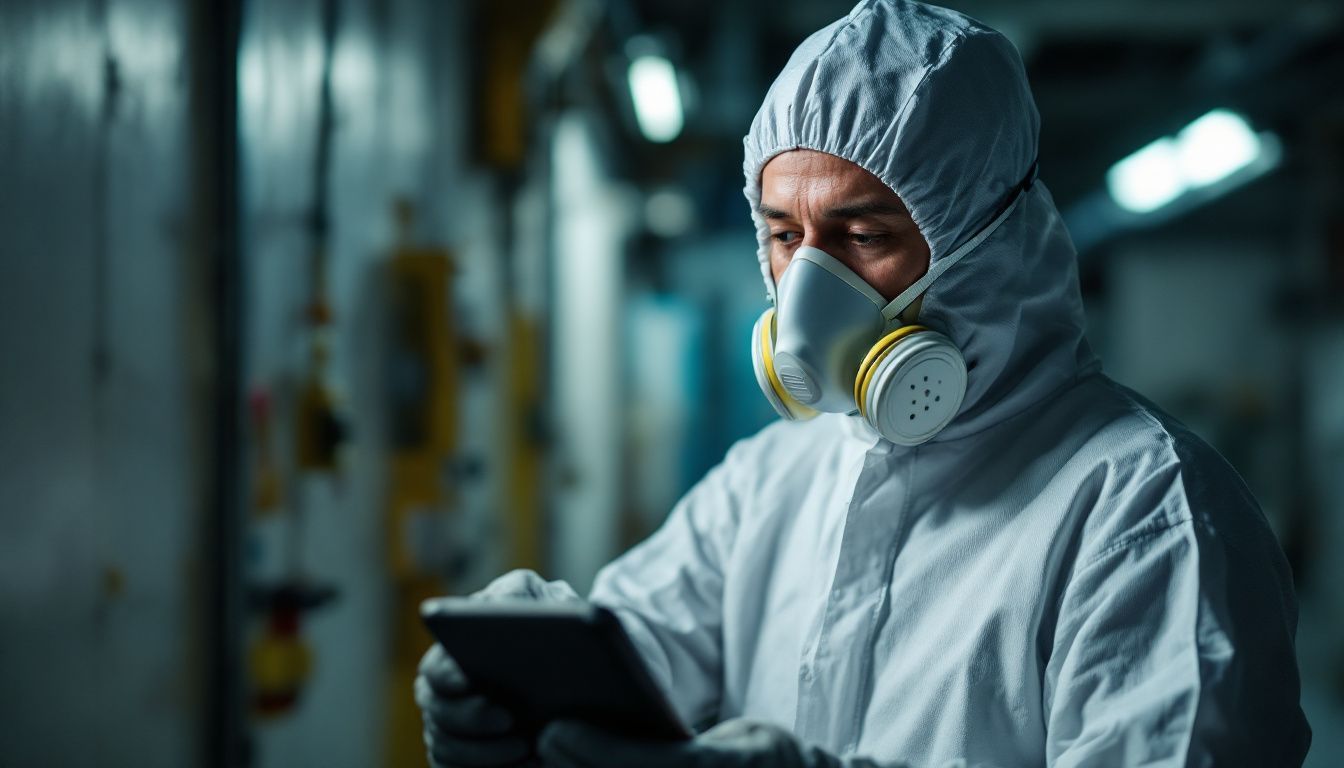
PPE is non-negotiable during asbestos sampling. The right equipment prevents fibre inhalation and skin contamination — the two primary exposure routes.
Respiratory Protective Equipment (RPE)
A standard dust mask is wholly inadequate for asbestos work. You need a correctly fitted, face-seal-tested respirator. For most sampling tasks, a half-face FFP3 disposable mask or a half-face respirator with a P3 filter is the minimum standard. Higher-risk work may require a full-face respirator or powered air-purifying respirator (PAPR).
RPE must fit the individual wearing it. Fit testing is a legal requirement — an ill-fitting mask provides almost no protection, regardless of its specification.
Protective Clothing
- Disposable coveralls (Type 5/6) — single-use, never worn again after an asbestos job
- Disposable nitrile gloves, changed between tasks
- Disposable boot covers or dedicated footwear kept on-site
Single-use PPE must be disposed of as asbestos waste after use. It cannot be taken home for laundering or reused on another job — this is both a regulatory requirement and basic common sense.
How to Test for Asbestos: Controlling the Work Area
Containment and Ventilation
For anything beyond very minor sampling, isolate the work area before testing begins. Use heavy-duty polythene sheeting to seal air vents, doorways, and any gaps where fibres could migrate to adjacent areas.
Proper ventilation is about control — not opening windows to let air flow freely. In enclosed spaces where significant disturbance is expected, a negative pressure unit (NPU) fitted with a HEPA filter should be used to extract contaminated air and prevent fibres escaping the work zone.
Minimising Dust and Fibre Release
The goal during sampling is to take the smallest representative sample possible with the least disturbance. Practical steps include:
- Wet the material lightly before sampling — water suppresses fibre release significantly
- Use sharp, purpose-designed sampling tools rather than cutting tools that abrade or grind the material
- Never dry sweep or use compressed air to clean up — both actions disperse fibres into the breathing zone
- Use a HEPA-filtered vacuum cleaner for surface cleaning before and after sampling
- Avoid power tools on suspect materials unless fitted with on-tool extraction and H-class dust control
Safe Sample Collection: Step by Step
Good technique during sample collection protects the tester, others in the building, and the integrity of the sample itself. If you are using a testing kit for a straightforward suspected material, the same principles apply — do not cut corners on PPE or containment.
Before Collecting the Sample
- Don all PPE before entering the work area
- Seal the area and ensure adequate ventilation or negative pressure is in place
- Prepare labelled, sealable sample bags — double-bagging is standard practice
- Have a HEPA vacuum and damp wipes ready for immediate clean-up
During Collection
- Dampen the sampling point with water using a fine mist spray
- Take the sample using a sharp implement — a core cutter, scalpel, or chisel depending on material type
- Collect a sample large enough for analysis (typically around 1–2cm²) without over-disturbing the material
- Immediately place the sample into the first sealed bag, then into the second
- Seal the sampling point with an appropriate filler or adhesive tape to prevent ongoing fibre release
After Collection
- Clean the immediate area with damp wipes and HEPA vacuum
- Remove PPE carefully — peel off coveralls from the outside inward to trap surface contamination
- Bag and seal all used PPE as asbestos waste
- Label samples clearly with location, date, material description, and sample reference number
Transporting and Analysing Samples
Samples must be transported in sealed, rigid, airtight containers — not loose in a bag. Label containers clearly as containing asbestos and follow the relevant guidance for transporting hazardous materials.
For analysis, always use a UKAS-accredited laboratory. Results from non-accredited labs may not be accepted by regulators, insurers, or in future property transactions. Analysis is typically carried out using polarised light microscopy (PLM) or transmission electron microscopy (TEM), depending on the level of detail required.
Training and Competence Requirements
Asbestos testing should never be carried out by untrained personnel. The Control of Asbestos Regulations require that anyone liable to disturb asbestos during their work receives appropriate asbestos awareness training.
For those collecting samples, training must cover:
- Identification of ACMs and their common locations
- Health risks associated with asbestos fibre inhalation
- Correct use and disposal of PPE
- Safe sampling techniques to minimise disturbance
- Emergency procedures if asbestos is inadvertently disturbed
- Correct sample handling, labelling, and transport
Professionals carrying out formal asbestos surveys should hold a recognised qualification such as the BOHS P402 certificate or equivalent, and ideally work for a company registered with UKAS or a recognised trade body.
Emergency Procedures: If Asbestos Is Accidentally Disturbed
Even with careful planning, accidental disturbance can happen — particularly in older buildings where ACMs are not always where you expect them to be. Knowing what to do immediately is critical.
Immediate Steps
- Stop all work immediately in the affected area
- Evacuate all non-essential personnel from the zone
- Do not attempt to clean up without proper RPE and equipment in place
- Isolate the area — close doors and switch off HVAC systems that could spread fibres
- Alert the building owner or responsible person without delay
- Contact a licensed asbestos contractor to assess and remediate
- Report the incident under RIDDOR if the exposure threshold is met
Decontamination After Disturbance
Anyone present during an accidental disturbance should decontaminate before leaving the area:
- Use a HEPA vacuum on outer clothing and PPE before removing
- Remove coveralls carefully, rolling inward, and bag immediately as asbestos waste
- Shower and change into clean clothing as soon as possible
- Do not take potentially contaminated clothing home
When to Commission a Professional Survey Instead
There are situations where DIY sampling — even carefully done — is simply not appropriate. You should commission a professional survey when:
- Materials are heavily damaged or friable
- Large areas need to be assessed
- The results will be used to plan significant building work or demolition
- A building is being bought or sold and due diligence requires a formal asbestos report
- You have any doubt about the type, extent, or condition of suspected ACMs
A management survey is the standard starting point for most non-domestic buildings — it identifies ACMs that could be disturbed during normal occupation and maintenance.
If you are planning refurbishment work, a refurbishment survey is required before work begins, as it involves more intrusive inspection of areas likely to be disturbed.
For properties due to be demolished, a demolition survey is a legal requirement to locate all ACMs before any structural work takes place.
If you already have an asbestos register in place, a periodic re-inspection survey ensures the condition of known ACMs is monitored and your register stays current and legally compliant.
Where asbestos is confirmed and poses a risk, professional asbestos removal by a licensed contractor is the appropriate next step — not something to manage informally.
It is also worth noting that asbestos surveys and fire risk assessments often go hand in hand for commercial property managers. If your building requires both, combining them with a single provider saves time and avoids gaps in your compliance documentation.
How Supernova Asbestos Surveys Can Help
At Supernova Asbestos Surveys, our qualified surveyors carry out management, refurbishment, demolition, and re-inspection surveys across the UK. Every survey follows HSE guidelines and results in a clear, accurate asbestos register you can act on confidently.
We also provide UKAS-accredited sample analysis and postal testing kits for straightforward suspected materials, giving you flexible options depending on your situation and budget.
With over 50,000 surveys completed nationwide, we have the experience and accreditation to handle everything from routine management surveys to complex multi-site programmes. Our surveyors are fully trained, hold recognised qualifications, and work to the standards set out in HSG264 and the Control of Asbestos Regulations.
Call us today on 020 4586 0680 or visit asbestos-surveys.org.uk to discuss your requirements or book a survey.
Frequently Asked Questions
Can I test for asbestos myself at home?
You can use a postal testing kit to collect a small sample from a suspected material and send it to a UKAS-accredited laboratory for analysis. However, you must follow strict precautions — correct PPE, wet sampling technique, double-bagging, and proper disposal of all materials used. If the material is damaged, friable, or in a large area, commission a professional survey instead.
How long does asbestos testing take?
Laboratory turnaround for sample analysis is typically two to five working days for standard results, with faster options available if urgent. A professional on-site survey, depending on the size of the property, is usually completed within a few hours to a full day, with the written report issued shortly afterwards.
What PPE do I need to test for asbestos?
At minimum, you need a correctly fit-tested FFP3 respirator or half-face respirator with a P3 filter, disposable Type 5/6 coveralls, disposable nitrile gloves, and boot covers. All PPE must be disposed of as asbestos waste after use — it cannot be laundered or reused.
What happens if asbestos is found during testing?
Finding asbestos does not automatically mean it needs to be removed. The material’s condition, type, and location all influence the appropriate response. Intact, well-sealed ACMs in low-disturbance areas are often managed in place with regular monitoring. Damaged or high-risk materials may require encapsulation or removal by a licensed contractor.
Do I need a licensed contractor to take an asbestos sample?
Bulk sampling for testing purposes does not always fall within licensed work, but it must be carried out by a competent person who has received appropriate asbestos awareness training. High-risk asbestos work — such as work with sprayed coatings, lagging, or certain insulating boards — does require an HSE licence. If in doubt, use a qualified professional to avoid putting yourself or others at risk.