One stopped contractor can wipe out a week’s programme. One suspect ceiling tile can delay a fit-out, trigger emergency controls and turn a tidy job into a costly problem. That is why asbestos testing cost matters so much in commercial property: not just the headline fee, but whether the testing or survey is the right one, carried out safely, and robust enough to support compliance and keep work moving.
If you manage offices, retail units, warehouses, schools, industrial premises or mixed-use buildings, cost should never be looked at in isolation. A low quote that misses suspect materials, excludes laboratory fees or produces a weak report often becomes the expensive option. The better approach is to understand what drives asbestos testing cost, what service you actually need, and what information contractors and dutyholders will expect to see.
What affects asbestos testing cost for commercial properties?
Asbestos testing cost varies because commercial buildings vary. A small lock-up shop and a multi-storey office block may both need asbestos information, but the time on site, access arrangements, number of samples and reporting requirements can be very different.
When comparing prices, look beyond the headline figure. Ask what is included, what assumptions have been made, and whether the quote reflects the real complexity of the premises.
Main factors that influence cost
- Property size and layout – more rooms, risers, voids, plant rooms and service areas usually mean more inspection time
- Type of premises – offices, schools, warehouses, shops and industrial units bring different access and risk issues
- Age of the building – older premises often contain a wider range of suspect asbestos-containing materials
- Accessibility – locked rooms, basements, ceiling voids, roof spaces and ductwork can increase labour and planning
- Survey type – management, refurbishment and demolition surveys involve different levels of intrusion
- Number of samples – more suspect materials usually mean higher laboratory charges
- Turnaround time – urgent reporting can increase the total asbestos testing cost
- Site restrictions – permits, inductions, escorts, security clearance and out-of-hours access all affect price
Practical tip: always ask whether travel, reporting, sample analysis and any return visits are included. A quote can look attractive until the extras are added.
How do you test for asbestos in a commercial building?
You cannot confirm asbestos by sight alone. A material may look harmless and still contain asbestos, while another may resemble asbestos and test negative. The only reliable route is controlled sampling and laboratory analysis, or a survey carried out by a competent asbestos surveyor with sampling where appropriate.
For commercial premises, professional attendance is usually the right choice. It provides a proper inspection, safe sampling, traceable records and a report that can be used for compliance, contractor control and project planning.
Your main options
- Targeted sampling and analysis
Useful when you need one or more specific materials checked, such as a ceiling tile, floor tile, insulation board or cement sheet. - management survey
Suitable for occupied non-domestic premises where asbestos needs to be located and managed during normal occupation and routine maintenance. - refurbishment survey
Needed before intrusive works such as opening walls, replacing services, removing ceilings or reconfiguring internal areas. - demolition survey
Required before demolition of a building or part of a building.
If the planned works are intrusive, testing a single material will not replace a full survey. Matching the service to the work planned is one of the simplest ways to control asbestos testing cost and avoid paying twice.
Sampling asbestos safely: what should happen on site?
Sampling sounds simple, but it needs care. Done properly, it is controlled, targeted and recorded. Done badly, it can release fibres, contaminate an area and leave you with results that are difficult to rely on.
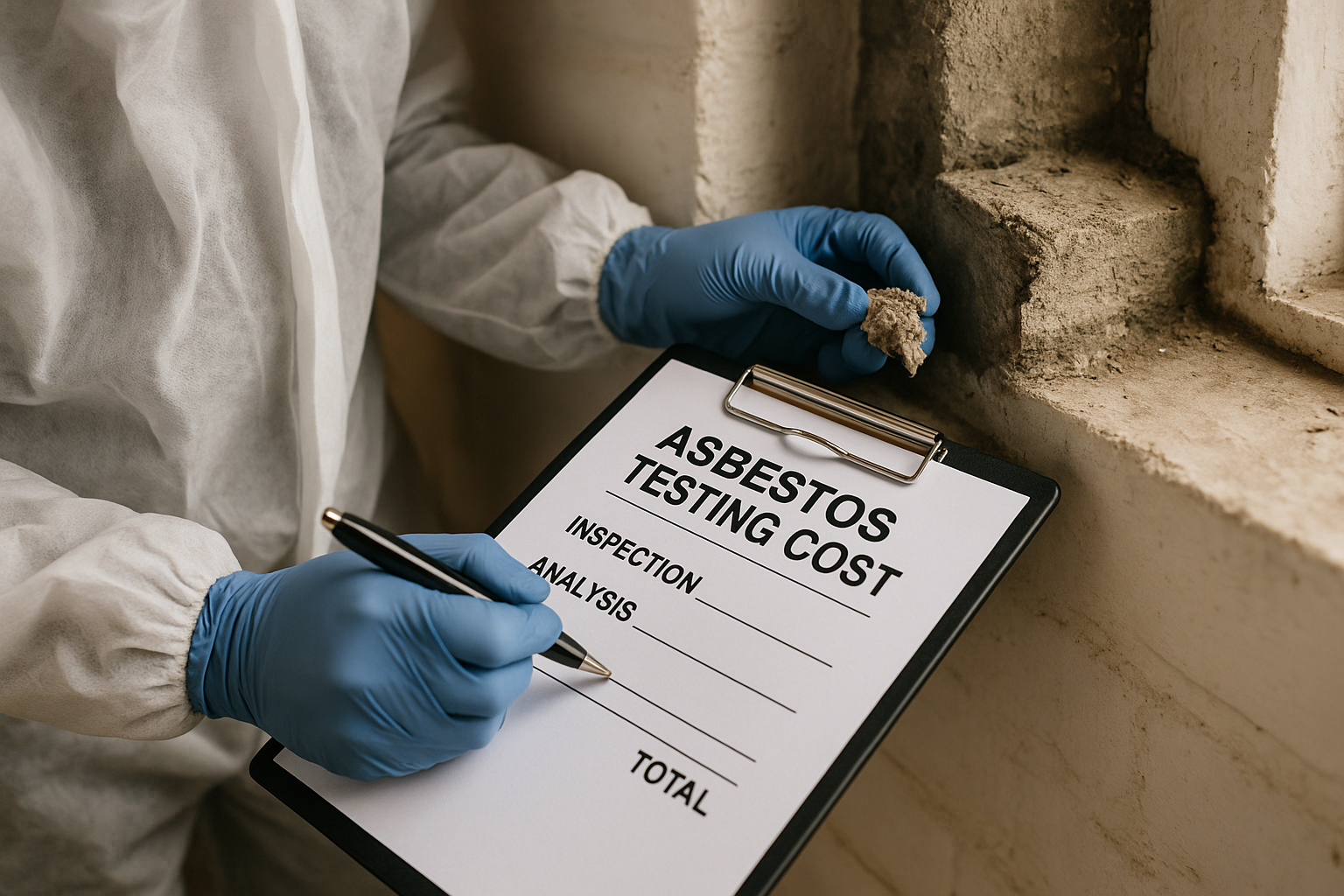
A competent surveyor will identify suspect materials, assess whether sampling is appropriate, take a representative piece safely, seal and label it correctly, and record the exact location. In commercial properties, that traceability matters. Similar materials may appear across several floors, plant areas or separate tenancies.
Common materials that may be sampled
- Textured coatings
- Vinyl floor tiles and bitumen adhesive
- Asbestos insulating board
- Pipe insulation and thermal debris
- Cement sheets, flues and rainwater goods
- Ceiling tiles and panels
- Gaskets, ropes and millboard
- Sprayed coatings and insulation residues
If you only need laboratory confirmation for a specific item, professional sample analysis can be a sensible option. Where a broader picture is needed, a survey is usually more appropriate than isolated testing.
Action point: do not allow contractors to cut, drill, sand or remove suspect materials before they have been assessed. A short delay for proper testing is far cheaper than dealing with contamination and a stopped job.
Is self-sampling worth it to reduce asbestos testing cost?
Some building managers look at postal kits and assume self-sampling will lower asbestos testing cost. In commercial settings, that is rarely the best decision. Dutyholders need reliable records, precise locations and a process that stands up to scrutiny.
There is also the safety issue. Disturbing asbestos-containing materials can release fibres, especially where the material is damaged, friable, overhead or close to ventilation systems. In those cases, leave the material alone and arrange professional attendance.
Self-sampling is particularly unsuitable where:
- The material is damaged or deteriorating
- The item could be asbestos insulating board, lagging or sprayed coating
- The area is occupied by staff, tenants or the public
- You need records for contractors, insurers or compliance purposes
- There are multiple suspect materials across the site
If you need a formal record, use a professional asbestos testing service rather than relying on an ad hoc sample with no proper context.
Survey types and their impact on asbestos testing cost
Choosing the wrong survey is one of the most expensive mistakes a property manager can make. You may pay for testing, only to find the report cannot be used for the work you actually need to carry out.
Under the Control of Asbestos Regulations, dutyholders in non-domestic premises must manage asbestos risk. HSE guidance and HSG264 make it clear that surveys must be suitable for their purpose. That is why survey type has such a direct effect on asbestos testing cost.
Management survey
A asbestos management survey is designed for normal occupation, routine maintenance and ongoing asbestos management. It aims to locate, as far as reasonably practicable, the presence and condition of asbestos-containing materials that could be disturbed during everyday use or foreseeable maintenance.
For many occupied commercial buildings, this is the starting point. It is usually the least intrusive option and often the most cost-effective where the building remains in use.
Refurbishment survey
If you are altering a unit, replacing services, opening walls, changing ceilings or carrying out intrusive maintenance, you will usually need a refurbishment survey. This is more intrusive because the surveyor must inspect the affected areas in greater depth.
That extra intrusion, planning and access usually means a higher asbestos testing cost. To keep spending under control, define the work area clearly before booking.
Demolition survey
Before a structure is demolished, a demolition survey is required. This is fully intrusive and intended to identify all asbestos-containing materials, as far as reasonably practicable, within the area due for demolition.
Because of the level of access and investigation involved, demolition work often carries the highest asbestos testing cost of the main survey types.
What should a commercial asbestos report include?
A proper commercial survey is more than a list of sample results. In line with HSG264 and HSE guidance, it should be planned, carried out by competent people and reported in a way that helps the dutyholder manage risk.
You should generally expect:
- A clear survey scope and purpose
- Inspection of accessible areas within that scope
- Sampling of suspected materials where appropriate
- Material assessments and condition notes
- Photographs or clear location references
- A register of identified or presumed asbestos-containing materials
- Recommendations for management, remedial action or further investigation
Ask whether the report is suitable to issue to contractors. A technically correct report is not enough if the information is difficult to use on site.
Budgeting for asbestos testing cost: what are you actually paying for?
The phrase cost of the test sounds simple, but commercial asbestos work is rarely one flat fee. A better way to budget is to break the likely spend into stages so you can compare providers on a like-for-like basis.
1. Survey or sampling attendance
This covers the site visit, inspection and sample collection. Complex access, multi-occupancy sites and out-of-hours attendance can increase the price.
2. Laboratory analysis
Some quotes include a set number of samples, while others charge per sample. Ask how many are included and what happens if more suspect materials are found during the visit.
3. Report preparation
A proper report is part of the value. If the report is too basic, you may need a second visit or a replacement survey later, which pushes up the true asbestos testing cost.
4. Follow-up actions
Testing is only the first step. If asbestos is confirmed, you may need management actions, encapsulation, repair, licensed removal, air monitoring or further investigation depending on the material and the planned works.
5. Access and administrative requirements
Commercial sites often involve permits, inductions, escorts, RAMS reviews, tenant liaison and restricted working hours. These are real costs and should be allowed for upfront.
How to get accurate quotes and avoid surprise costs
The more detail you provide at enquiry stage, the more realistic the price will be. Vague requests often lead to vague pricing, and that is where surprise costs start to appear.
When asking for a quote, provide:
- Property address and type of premises
- Approximate size and number of floors
- Age of the building if known
- Type of work planned
- Required deadline
- Known suspect materials or previous asbestos records
- Access restrictions, permits or induction requirements
- Whether the building is occupied
If you are managing a site in the capital, a local asbestos survey London service can help with faster attendance and practical knowledge of access constraints. The same applies regionally, whether you need an asbestos survey Manchester appointment or support with an asbestos survey Birmingham project.
Why cheap asbestos testing can become expensive
Low quotes are not always poor value, but they should be examined carefully. In commercial property, the cheapest option often relies on narrow assumptions: limited sample numbers, restricted access, basic reporting or exclusions for return visits.
Problems usually appear when:
- The survey scope does not match the planned works
- Too few samples are included
- Laboratory analysis is charged as an extra
- Reports are not detailed enough for contractors
- Access issues were not factored into the quote
- Urgent turnaround is needed after the booking is made
Practical advice: ask for a written breakdown. If two quotes are far apart, the difference is usually in scope, sample allowances, access assumptions or reporting standard.
Asbestos testing cost and legal compliance
Commercial clients are often less worried about the test fee than the risk of getting compliance wrong. That is sensible. Under the Control of Asbestos Regulations, the duty to manage asbestos in non-domestic premises sits with the dutyholder. Testing and surveys are part of meeting that duty, not a box-ticking exercise.
HSE guidance expects asbestos information to be current, relevant and available to those who need it. If maintenance teams or contractors are likely to disturb materials, they need suitable asbestos information before work starts.
In practice, that means you should:
- Know whether asbestos is present, presumed or has been ruled out in the work area
- Use the correct survey type for the task
- Keep records accessible and up to date
- Share relevant information with contractors before intrusive work
- Review findings when the building changes or new areas are opened up
A cheap test that does not answer the real compliance question is not good value.
Common commercial scenarios and the right approach
Routine occupation and minor maintenance
If the building is occupied and you need to manage asbestos during normal use, a management-focused approach is usually appropriate. This helps you maintain an asbestos register and plan routine works safely.
Strip-out, fit-out or services upgrades
If walls, ceilings, risers or service routes will be opened, a refurbishment survey is usually required for the affected area. Relying on old management information can lead to missed materials and costly delays.
Single suspect item
If you only need one material checked, targeted asbestos testing may be enough. This works well when the scope is narrow and the location is clear.
Building removal or major structural works
Where demolition is planned, a demolition survey is the correct route. This is not the point to save money by choosing a lighter-touch service.
Practical ways to keep asbestos testing cost under control
You cannot always make asbestos work cheap, but you can make it efficient. The key is planning.
- Define the work area clearly before requesting a survey
- Gather existing asbestos records, plans and previous reports
- Arrange access to locked rooms, roof spaces and plant areas in advance
- Coordinate surveys before contractors are booked to start
- Bundle multiple areas or sites where practical
- Be clear if urgent turnaround is needed from the outset
- Choose a provider that can explain what is and is not included
One of the best cost-saving steps is simply booking the right service first time. A narrowly scoped test followed by a second survey usually costs more than getting the correct survey at the start.
Frequently Asked Questions
How much does asbestos testing cost for a commercial property?
There is no single fixed price because asbestos testing cost depends on the size of the property, the number of suspect materials, the type of survey needed, access arrangements and reporting timescales. The most accurate quotes come from clear site information and a defined scope of work.
Is asbestos testing the same as an asbestos survey?
No. Testing usually refers to taking and analysing samples from specific suspect materials. A survey involves inspection, assessment and reporting for a defined purpose, such as management, refurbishment or demolition. In many commercial settings, a survey is the more suitable option.
Do I need a survey before refurbishment works?
If the works are intrusive, a refurbishment survey is usually required for the affected area. A management survey or isolated sample result is not normally enough where walls, ceilings, floors or service routes will be opened.
Can I take my own asbestos sample at work premises?
It is rarely advisable in commercial buildings. Self-sampling can create risk, weaken traceability and leave gaps in your records. Professional sampling is the safer and more defensible route for dutyholders.
How quickly can asbestos test results be returned?
Turnaround depends on the service booked, the number of samples and laboratory workload. If timing is critical, raise it at the quotation stage so urgent reporting can be planned and priced properly.
If you need clear advice on asbestos testing cost, the right survey scope, or urgent commercial sampling, speak to Supernova Asbestos Surveys. We provide nationwide surveys, testing and reporting for dutyholders, landlords and property managers. Call 020 4586 0680 or visit asbestos-surveys.org.uk to arrange a quote.