One asbestos test result can stop a job, reshape a refurbishment plan, or confirm that a suspect material can be managed safely in place. The problem is that many property owners and dutyholders receive a lab certificate, see a technical term or two, and still do not know what to do next.
That is where clear interpretation matters. A proper asbestos test is not just about finding out whether asbestos is present. It is about understanding what was sampled, how reliable the result is, what risk the material presents, and what action is sensible under the Control of Asbestos Regulations and relevant HSE guidance.
If you are managing a commercial building, overseeing maintenance, planning works, or checking a material in a home, the key is to turn the result into a practical decision. Done properly, that means fewer delays, better compliance, and less chance of accidental fibre release.
What an asbestos test actually tells you
An asbestos test on a material sample is designed to confirm whether the item sampled contains asbestos. If asbestos is identified, the report should also state the asbestos type found and describe the material tested.
That sounds simple, but the result only applies to the sample taken. It does not automatically confirm that every similar-looking material elsewhere in the building is the same. This is why representative sampling matters, especially in larger or altered properties.
A typical material asbestos test report should include:
- A sample reference number
- A description of the material sampled
- The sample location
- The analytical result
- The asbestos type, if present
- The method used for analysis
- Laboratory accreditation details where applicable
If any of that is missing, pause before making decisions. Contractors, managing agents, and dutyholders need enough detail to rely on the result properly.
How an asbestos test works in practice
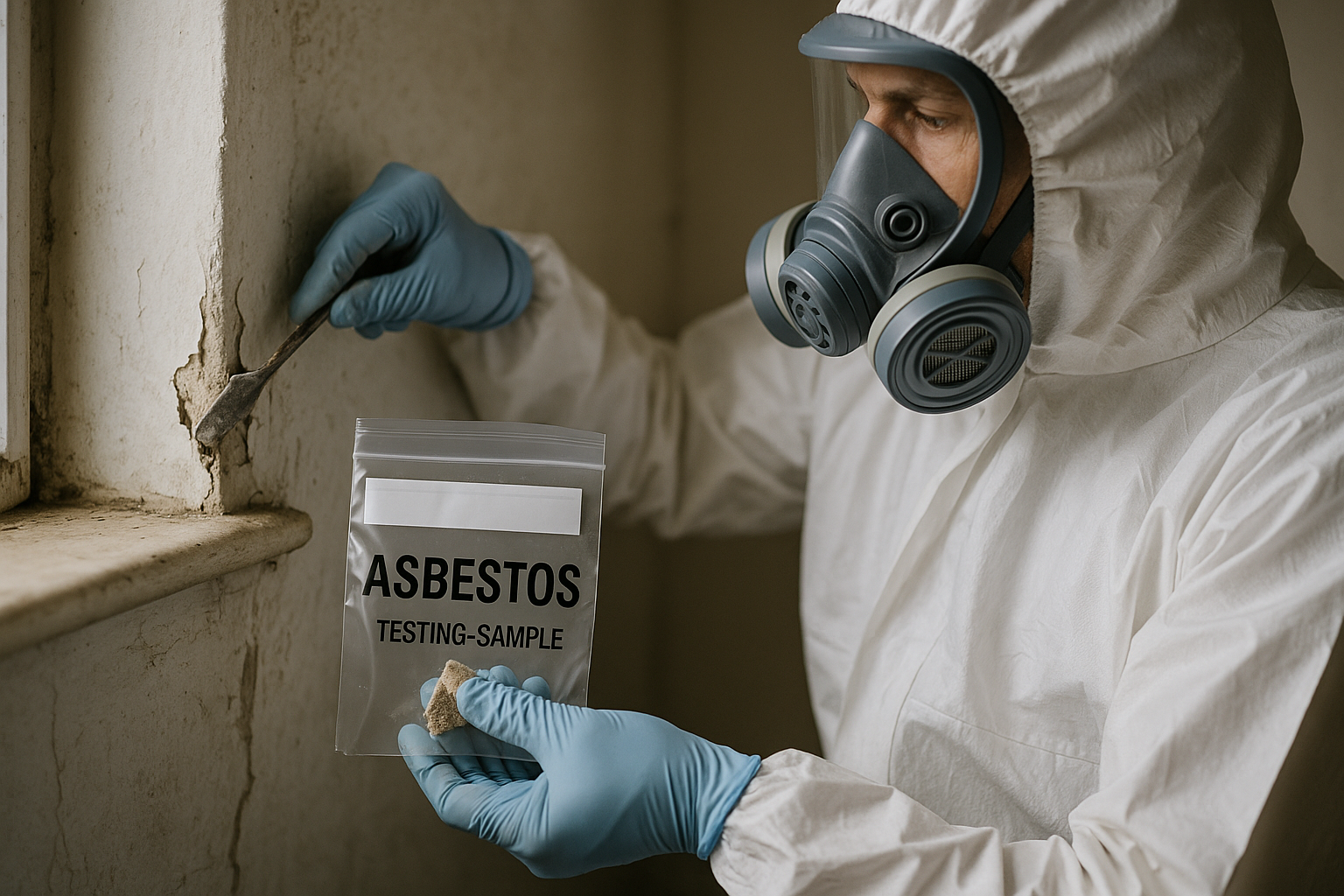
In most cases, an asbestos test involves taking a small piece of suspect material and sending it to a laboratory for bulk analysis. The lab examines the sample and reports whether asbestos is present.
This can be done as a one-off targeted sampling exercise or as part of a wider survey. For a single suspect item, targeted testing may be enough. For a non-domestic property, or where there are legal duties to manage asbestos, testing is often best carried out during a professional survey.
Bulk sample analysis
Bulk analysis is the most common form of asbestos test. A small sample is taken from the suspect material, carefully packaged, and analysed by a laboratory.
This method is commonly used for:
- Textured coatings
- Asbestos insulating board
- Cement sheets and roof panels
- Vinyl floor tiles
- Bitumen adhesive
- Ceiling tiles and soffits
- Pipe insulation and lagging
If you need laboratory confirmation for a specific material, professional asbestos testing is usually the most reliable route.
Material testing is not air testing
A common misunderstanding is assuming that an asbestos test and air test are the same thing. They are not.
Material testing tells you whether a product contains asbestos. Air monitoring measures airborne fibres and is used in specific circumstances, such as reassurance monitoring, licensed work, or clearance procedures after asbestos removal.
If you are trying to identify whether a board, coating, panel, tile, or cement product contains asbestos, you need material sampling rather than air monitoring.
Why the asbestos type and material type both matter
When an asbestos test comes back positive, the report may identify chrysotile, amosite, crocidolite, or a combination. All asbestos types are hazardous and must be managed in line with HSE guidance.
In practice, though, the material itself and its condition often drive the urgency of the response. An intact cement sheet generally presents a different level of risk from damaged asbestos insulating board, even if both contain asbestos.
Chrysotile
Chrysotile, often called white asbestos, is commonly found in cement products, floor tiles, textured coatings, and some composite materials. It appears in both domestic and commercial premises.
Amosite
Amosite, often called brown asbestos, is frequently associated with asbestos insulating board and some thermal insulation products. It can be found in fire protection panels, partitions, service risers, and ceiling systems.
Crocidolite
Crocidolite, often called blue asbestos, is less common but may still be present in older buildings. It has been used in some insulation products, spray coatings, and specialist materials.
What matters most after a positive asbestos test is this:
- Is the material damaged?
- Is it likely to be disturbed?
- Is it accessible to occupants or contractors?
- Is it a higher-risk product, such as insulating board or lagging?
If the answer to any of those is yes, get professional advice before work continues.
How to read asbestos test results properly
Many people jump straight to the words positive or negative. That is understandable, but it is not enough. You need to read the whole certificate in context.
Use this order when reviewing an asbestos test report:
- Check the sample reference and location
- Read the material description carefully
- Confirm whether asbestos was detected
- Note the asbestos type if present
- Review any comments or limitations
- Match the result to the actual material on site
What a positive result means
A positive asbestos test means asbestos has been identified in that sample. It does not automatically mean immediate removal is required.
The next step is to assess the risk presented by the material in its current condition. Depending on the material and how it is used, the right response may be management in place, encapsulation, repair, restricted access, or removal.
Practical actions after a positive result include:
- Stop any work that could disturb the material
- Prevent access if the area is unsafe
- Record the material in the asbestos register where applicable
- Label or communicate the presence of asbestos to relevant contractors
- Seek competent advice before deciding on treatment or removal
What a negative result means
A negative asbestos test means asbestos was not detected in that specific sample. It does not always prove that all similar materials nearby are asbestos-free.
Some products were not manufactured uniformly. Repairs, patching, changes in finish, or different installation phases can mean one area tests negative while another contains asbestos.
If there is still strong suspicion, more sampling may be needed. This is especially true where refurbishment is planned.
How many samples are enough?
This is one of the most practical questions around any asbestos test. The answer depends on the material, its consistency, the size of the area, and the level of certainty required.

HSG264 is clear on the principle: enough samples should be taken to characterise the material properly. In other words, the sampling strategy must be representative.
When one sample may be enough
One sample may be sufficient where the material is clearly homogeneous. For example, a small area of one consistent floor tile type in one room may reasonably be represented by a single sample.
When multiple samples are needed
More than one asbestos test is usually needed where:
- The material varies in appearance
- Different construction phases are involved
- Repairs or patching are visible
- Large areas are being assessed
- Textured coatings appear across multiple rooms
- The first result is negative but suspicion remains
For larger buildings, a surveyor may need to take several samples to build an accurate picture. If asbestos-containing materials have already been identified, a re-inspection survey helps confirm whether those materials remain in good condition and whether the existing records still reflect what is on site.
When to use a testing kit and when to book a professional
Some people searching for an asbestos test are deciding between a DIY route and professional attendance. A kit can be useful in limited situations, but it is not a substitute for a survey where legal duties apply.
If you are a dutyholder, managing agent, landlord of non-domestic premises, or planning intrusive works, professional help is usually the safer option.
Sample analysis only
If you are confident the material can be sampled safely and you only need the laboratory result, you may choose direct sample analysis. This is best suited to straightforward, low-complexity situations.
For example, a homeowner checking one suspect panel before minor work may find this practical. It is less suitable where there are multiple materials, damaged products, or uncertainty about the sampling method.
Asbestos testing kit options
A mail-in asbestos testing kit can be useful if you need packaging, instructions, and submission paperwork in one place. Some people also search for a general testing kit when they are not yet sure which service they need.
Even with a kit, you still need to think about safety. Protective equipment does not remove the hazard, and it does not replace a careful sampling method.
Before using any kit, ask yourself:
- Can the sample be taken without damaging a friable material?
- Do you know how to minimise fibre release?
- Can you package the sample safely?
- Do you know how to clean the area afterwards?
- Are you certain this is a one-off material check rather than a wider asbestos issue?
If the answer to any of those is no, book a professional instead.
When professional attendance is the right choice
A professional asbestos test is usually the better option where:
- The material is damaged or deteriorating
- The product is friable, such as lagging or insulating board
- The area is hard to access
- Multiple suspect materials are present
- Refurbishment or demolition is planned
- The property is non-domestic
- You need records suitable for compliance and contractor use
If you need a local service, Supernova can help with asbestos testing across a wide range of property types and project sizes.
What to do after an asbestos test result
The right next step depends on what was tested, where it is, and how likely it is to be disturbed. The result itself is only the starting point.
If the result is positive
Take these steps in order:
- Stop any work that could disturb the material
- Keep people away from the area if there is a risk of damage
- Check whether the material is already recorded in an asbestos register
- Assess the condition and accessibility of the material
- Seek advice on management, encapsulation, or removal
Do not assume that every positive asbestos test means urgent removal. In many cases, asbestos-containing materials can remain in place safely if they are in good condition and properly managed.
If the result is negative
Review whether the sample was representative. If the material varies across the building, further testing may still be required.
Where refurbishment is planned, a negative result on one isolated sample should not be treated as blanket clearance for every similar-looking item nearby.
If the result is unclear or disputed
Occasionally, clients receive historic paperwork that is vague, incomplete, or difficult to match to the material on site. In that case, do not rely on assumptions.
Arrange fresh sampling or a survey so the result can be tied clearly to the correct material and location. This is often quicker and cheaper than dealing with project delays later.
Asbestos test results and legal responsibilities
An asbestos test does not sit in isolation from your wider duties. For non-domestic premises, the duty to manage asbestos means you need to know whether asbestos is present, where it is, and what condition it is in.
That is why testing is often only one part of compliance. Depending on the property and planned works, you may also need an asbestos management survey, refurbishment survey, asbestos register, and ongoing re-inspection process.
Practical compliance points include:
- Keep records of all sampling and results
- Make sure contractors can access relevant asbestos information before work starts
- Review whether the result changes the risk assessment for planned works
- Update the asbestos register where required
- Reassess materials periodically if they remain in place
For buildings in major urban areas, Supernova also provides local support including asbestos survey London, asbestos survey Manchester, and asbestos survey Birmingham.
Common mistakes people make with an asbestos test
Most problems do not come from the laboratory. They come from poor assumptions before or after the result arrives.
Watch out for these common mistakes:
- Assuming one negative sample clears every similar material in the building
- Sampling damaged or friable materials without proper precautions
- Confusing material testing with air monitoring
- Ignoring the condition of the material after a positive result
- Failing to update the asbestos register
- Letting contractors start work before the result is reviewed properly
- Using a kit where a professional survey is clearly needed
The simplest way to avoid delays is to decide early what question needs answering. Are you checking one material, building an asbestos register, or clearing the way for refurbishment? The correct testing approach follows from that.
Practical advice before arranging an asbestos test
If you want the process to run smoothly, a little preparation makes a big difference. Whether you are booking a surveyor or submitting a sample, gather the key details first.
Useful information includes:
- The property address
- The age and use of the building
- The exact location of the suspect material
- Photos of the material if available
- Whether the material is damaged
- Whether works are planned
- Any previous asbestos reports or registers
This helps the analyst or surveyor advise on the right scope. It also reduces the risk of incomplete testing and repeat visits.
If a project is time-sensitive, say so at the start. Fast decisions are easier when the sampling strategy is right from day one.
Why expert interpretation matters as much as the test itself
An asbestos test is only useful if the result leads to the right action. A certificate on its own does not tell you whether to manage, monitor, encapsulate, or remove a material.
That decision depends on the material type, location, accessibility, condition, and the work planned around it. This is where experienced advice saves time and prevents costly mistakes.
For example, a positive result in a sealed cement panel may require recording and periodic review. A positive result in damaged insulating board near active maintenance work may require immediate controls and specialist removal planning. Same hazard family, very different response.
If you are unsure what your asbestos test result means in practice, get it reviewed before any contractor proceeds.
Need help with an asbestos test?
If you need a reliable asbestos test, clear interpretation of results, or support with surveys, sampling, and next steps, Supernova Asbestos Surveys can help. We provide testing, surveys, re-inspections, and advice for domestic, commercial, and public-sector properties across the UK.
Call 020 4586 0680 to speak to our team, or visit asbestos-surveys.org.uk to book Supernova’s services online.
Frequently Asked Questions
What does a positive asbestos test mean?
A positive asbestos test means the sampled material contains asbestos. It does not always mean immediate removal is required, but it does mean the material must be managed correctly in line with the Control of Asbestos Regulations and HSE guidance.
Can one asbestos test cover the whole building?
No. One asbestos test only applies to the material sampled. If similar materials appear in different areas, or if the material varies in age or appearance, additional samples may be needed to make the findings representative.
Is an asbestos testing kit safe to use?
An asbestos testing kit can be suitable for some low-complexity situations, such as a single accessible material in a domestic property. It is not the right choice for damaged, friable, or multiple suspect materials, or where legal compliance records are required.
What should I do after receiving asbestos test results?
First, match the result to the exact material and location sampled. If the result is positive, avoid disturbing the material and seek advice on management or removal. If the result is negative but suspicion remains, ask whether further sampling is needed.
Do I need a survey as well as an asbestos test?
Often, yes. An asbestos test confirms whether a sample contains asbestos, but a survey helps identify where asbestos-containing materials are located, what condition they are in, and how they should be managed across the property.