Asbestos Surveys Explained: What They Are, When You Need One, and What the Law Requires
Asbestos remains the single largest cause of work-related deaths in the UK — killing more people every year than any other occupational hazard. The overwhelming majority of those deaths are entirely preventable. If you own, manage, or hold responsibility for a building constructed before 2000, an asbestos survey isn’t optional. It’s the foundation of your legal duty of care to everyone who enters that building.
Here’s what you need to know: what asbestos surveys are, the different types available, who legally needs one, and what happens if you don’t commission one.
Why Asbestos Is Still a Live Issue in UK Buildings
Asbestos wasn’t fully banned in the UK until 1999. Before that, it was used extensively across the construction industry — and for good reason. It’s fire-resistant, chemically stable, an excellent insulator, and extraordinarily durable. For decades, it was considered a wonder material.
The danger emerges when asbestos-containing materials (ACMs) are disturbed, damaged, or deteriorate over time. They release microscopic fibres into the air that, once inhaled, lodge permanently in lung tissue. The diseases they cause — mesothelioma, asbestosis, asbestos-related lung cancer, and pleural thickening — can take 20 to 40 years to develop. By the time symptoms appear, it’s almost always too late.
Any building built or refurbished before 2000 could contain asbestos. That includes schools, hospitals, offices, warehouses, flats, and commercial properties of every kind. It’s sitting in walls, ceilings, floor tiles, pipe insulation, and roof panels across the country right now — and it isn’t going anywhere without professional intervention.
Where Asbestos Is Commonly Found
Asbestos was incorporated into an enormous range of building products. In older properties, you might find it in:
- Ceiling tiles and textured coatings such as Artex
- Pipe and boiler lagging
- Insulating board used in partitions, soffits, and door linings
- Roof sheets and guttering, particularly asbestos cement
- Floor tiles and the adhesive used beneath them
- Sprayed coatings on structural steelwork and concrete
- Loose-fill insulation in cavity walls and loft spaces
- Water tanks and older cisterns
- Fire doors and fire-resistant panels
The critical problem is that many of these materials look identical to their non-asbestos counterparts. You cannot identify asbestos by sight alone. That’s precisely why professional asbestos surveying exists — and why guesswork is never an acceptable substitute.
The Legal Duty to Manage Asbestos in Non-Domestic Buildings
If you’re responsible for a non-domestic building — as an owner, landlord, facilities manager, or employer — you have a legal duty to manage asbestos under the Control of Asbestos Regulations. This applies to offices, shops, schools, churches, leisure facilities, warehouses, and all other non-residential premises.
That duty requires you to:
- Identify whether asbestos is present in your premises
- Assess the condition and risk level of any ACMs found
- Produce and maintain an asbestos management plan
- Ensure anyone who might disturb ACMs is made aware of their location
- Monitor ACMs and act if their condition deteriorates
An asbestos survey is the essential first step in meeting this duty. Without one, you have no documented evidence of what’s in your building — and no legal defence if something goes wrong.
Failure to comply can result in prosecution by the Health and Safety Executive (HSE), unlimited fines, and in serious cases, imprisonment. The HSE’s guidance document HSG264 sets out the standards surveyors must follow when conducting asbestos surveys. Any reputable surveying company will work in accordance with this guidance.
What About Residential Properties?
Homeowners living in their own property don’t carry the same statutory duty. However, if you’re a landlord — including those letting domestic properties — you have responsibilities under health and safety law to ensure tenants are not exposed to asbestos risks.
For anyone buying, selling, or renovating an older home, commissioning an asbestos survey before work begins is strongly advisable. Tradespeople carrying out renovation work are among the groups most frequently exposed to asbestos — often without realising it until it’s too late.
The Different Types of Asbestos Survey
There are several types of asbestos survey, each designed for a specific situation. Choosing the right one depends on what’s happening with the building and what you need to know.
Management Survey
A management survey is the standard survey for buildings in normal use. Its purpose is to locate and assess the condition of any ACMs that could be disturbed during routine activities — day-to-day occupation, minor maintenance, or small-scale repairs.
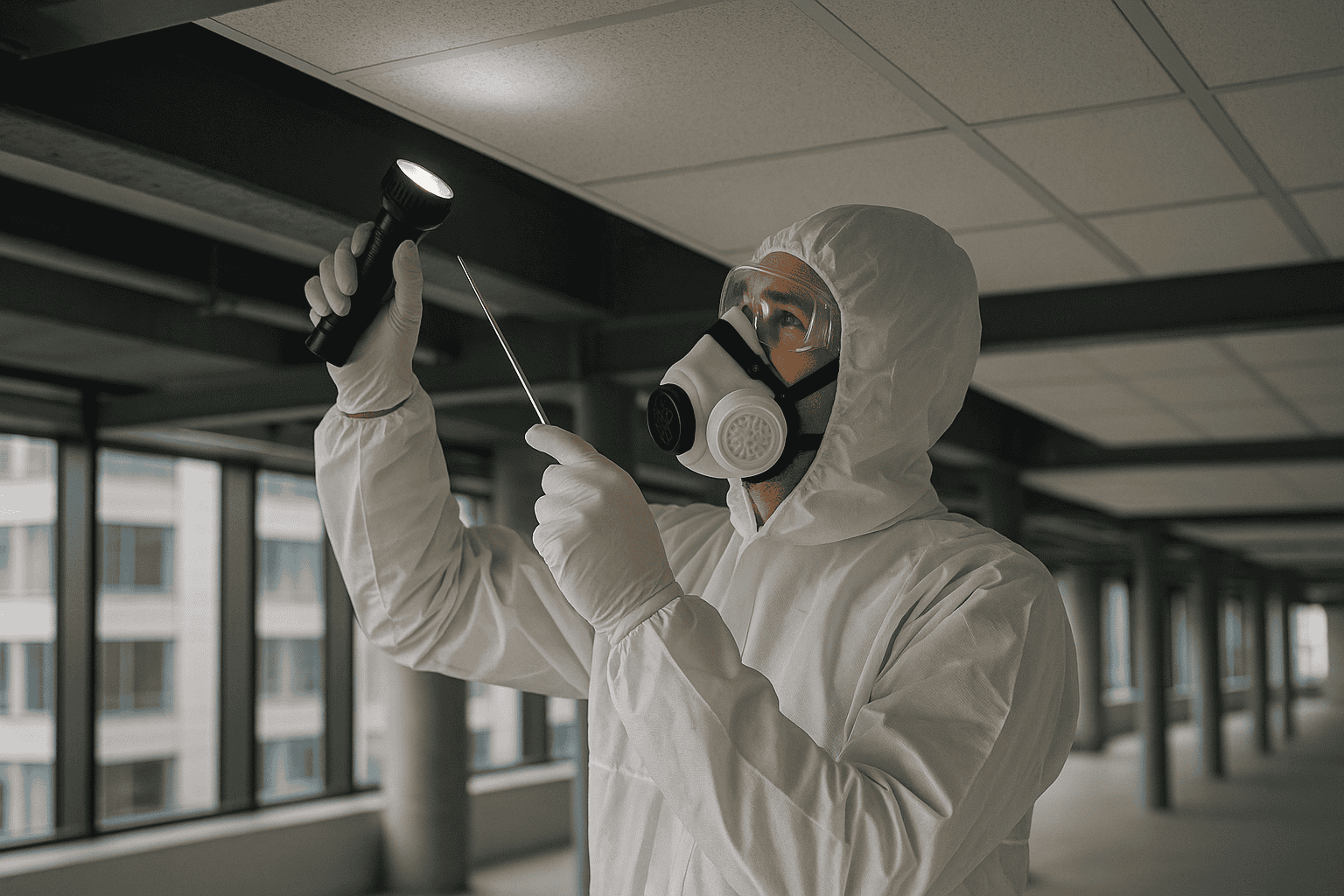
During a management survey, a qualified surveyor carries out a systematic room-by-room inspection of all accessible areas. Where materials are suspected to contain asbestos, samples are taken and sent to an accredited laboratory for analysis.
The result is a detailed asbestos register — a document recording the location, type, condition, and risk rating of every identified ACM. This register forms the foundation of your asbestos management plan and must be kept up to date.
A management survey is not intrusive: surveyors work within the limits of what’s reasonably accessible without causing significant disruption. It’s the survey most duty holders will need to commission first, and the one required when you take on responsibility for a new building or when an existing register is out of date.
Refurbishment Survey
If you’re planning significant refurbishment work — structural alterations, major fit-outs, or anything that will disturb the building fabric — a management survey isn’t sufficient. A refurbishment survey is required before any such work begins.
This is a more thorough and intrusive investigation than a management survey. The surveyor will access areas not normally inspected during routine use — inside wall cavities, above suspended ceilings, beneath floor finishes, within service ducts. Destructive sampling techniques are used to ensure nothing is missed.
Because this survey involves destructive investigation, it must be carried out when the affected areas are unoccupied. The building, or the relevant section of it, needs to be vacated during the survey process.
Demolition Survey
Where a full demolition is planned, you need a demolition survey — the most thorough and intrusive type of asbestos survey available. Every part of the structure is investigated, with no area considered off-limits.
Under the Control of Asbestos Regulations, this survey must be completed before demolition work begins. Starting work without one exposes both contractor and client to serious legal liability. ACMs that are in good condition and pose no risk when left alone become extremely hazardous the moment they’re cut, broken, or demolished.
Re-Inspection Survey
Once ACMs have been identified and recorded, the duty to manage doesn’t end there. Materials being managed in situ — left in place rather than removed — must be monitored regularly to ensure their condition hasn’t deteriorated. A re-inspection survey does exactly that.
A qualified surveyor revisits previously identified ACMs, assesses whether their condition has changed, identifies any new risks that have emerged, and determines whether the management plan needs updating. How frequently re-inspections are needed depends on the risk rating assigned during the original survey. As a general rule, most management plans include annual re-inspections as a minimum.
What Happens During an Asbestos Survey?
Understanding the process helps you prepare properly and ensures the survey delivers the most accurate results possible.
Before the survey, you’ll be asked to provide any existing information about the building — previous asbestos records, building plans, or records of past refurbishment work. This helps the surveyor plan their approach and prioritise areas of concern.
On the day, the surveyor carries out a systematic inspection, examining all suspect materials. Where sampling is required, small samples are taken using appropriate PPE and containment procedures to prevent fibre release. Sample points are sealed and made safe immediately after sampling.
Samples are then sent to a UKAS-accredited laboratory for sample analysis. The method used is polarised light microscopy (PLM), which identifies the type and presence of asbestos fibres with precision.
The final survey report will include:
- A complete record of all suspected and confirmed ACMs
- Their precise location within the building
- The type of asbestos identified where confirmed
- An assessment of condition and risk
- Recommended actions — whether management in place, encapsulation, or removal
- Photographic evidence and floor plan markings where applicable
This report becomes your legal record. It must be kept accessible and made available to any contractor carrying out work in the building.
Who Should Carry Out an Asbestos Survey?
Asbestos surveys must be carried out by competent, qualified surveyors. In practice, this means using a company whose surveyors hold the relevant qualifications — typically the British Occupational Hygiene Society (BOHS) P402 certificate — and whose laboratory holds UKAS accreditation for asbestos sample analysis.
This is not an area to cut corners on. An inaccurate survey doesn’t just create a legal problem — it creates a safety problem. If ACMs are missed or incorrectly assessed, the consequences can be fatal.
At Supernova Asbestos Surveys, all our surveyors are fully qualified and experienced across all building types — from domestic properties and small commercial premises to large industrial sites and public buildings. We’ve completed over 50,000 surveys nationwide and deliver clear, actionable reports that satisfy your legal obligations and give you genuine peace of mind.
What Happens After the Asbestos Survey?
The survey report isn’t the end of the process — it’s the beginning of your management responsibility.
If no ACMs are found, you’ll receive a clean report confirming this. Keep it on file and review it if you undertake any significant changes to the building.
If ACMs are identified, you’ll need to decide on the appropriate course of action based on the risk assessment in the report. The options are:
- Manage in place: If the material is in good condition and unlikely to be disturbed, it may be appropriate to leave it and monitor it through regular re-inspections.
- Encapsulation: Damaged or deteriorating ACMs may be encapsulated — sealed with a specialist coating to prevent fibre release — as a medium-term solution.
- Removal: Where ACMs are heavily damaged, in high-risk locations, or where planned work will disturb them, asbestos removal by a licensed contractor is the safest long-term solution.
For higher-risk removal work, only a contractor licensed by the HSE can legally carry out the work. Supernova offers removal services alongside our surveying work, meaning you can manage the entire process through a single trusted provider.
Asbestos Testing: When You Need More Than a Survey
In some situations, you may need targeted asbestos testing rather than — or in addition to — a full survey. This might apply when you have a specific material you’re concerned about, or when you want to verify the findings of an existing report.
If you’re a homeowner or tradesperson who needs a quick, cost-effective way to check a specific material, our asbestos testing kit allows you to collect a sample safely and send it to our UKAS-accredited laboratory for professional analysis. It’s a practical option when a full survey isn’t warranted but you need certainty about a particular material.
For a broader overview of your testing options, our dedicated asbestos testing page covers everything from bulk sampling through to air monitoring and clearance testing.
How to Prepare for Your Asbestos Survey
A little preparation goes a long way in ensuring your survey runs smoothly and delivers the most thorough results possible.
Before the surveyor arrives, gather any existing building documentation you have — original construction drawings, previous asbestos records, maintenance logs, or records of any past refurbishment work. Even partial information is useful. It helps the surveyor focus their attention and avoid duplicating work that’s already been done properly.
Make sure all areas of the building are accessible on the day. Locked rooms, blocked access hatches, and restricted plant areas can all result in incomplete coverage — and an incomplete survey is a liability, not an asset. If certain areas genuinely can’t be accessed, a competent surveyor will flag this clearly in their report rather than simply ignoring it.
For refurbishment and demolition surveys, ensure the relevant areas are vacated before the surveyor begins. Destructive sampling in occupied spaces isn’t safe or appropriate — and your surveyor will not proceed if this condition isn’t met.
How Much Does an Asbestos Survey Cost?
Survey costs vary depending on the size and type of the building, the type of survey required, and the number of samples taken for laboratory analysis. A management survey for a small commercial property will cost considerably less than a full demolition survey for a large industrial site.
What you should never do is choose a surveyor on price alone. The cheapest quote rarely reflects the most thorough investigation. An asbestos survey that misses ACMs isn’t just poor value — it’s dangerous. The cost of getting it wrong, in human and legal terms, far outweighs any saving made on the survey fee.
Supernova Asbestos Surveys offers competitive, transparent pricing across all survey types. Contact us for a quote tailored to your specific building and requirements.
Frequently Asked Questions
Do I legally need an asbestos survey for my building?
If you’re responsible for a non-domestic building constructed or refurbished before 2000, you have a legal duty under the Control of Asbestos Regulations to manage asbestos. An asbestos survey is the essential first step in fulfilling that duty. Residential landlords also have obligations under health and safety law to protect tenants from asbestos risks.
What’s the difference between a management survey and a refurbishment survey?
A management survey is designed for buildings in normal use — it identifies ACMs that could be disturbed during routine occupation and maintenance. A refurbishment survey is required before any significant building work takes place and involves more intrusive investigation, including destructive sampling in areas not normally accessible. The right survey depends on what you’re planning to do with the building.
How long does an asbestos survey take?
The duration depends on the size and complexity of the building. A management survey for a small commercial premises might take two to three hours. A large industrial site or a demolition survey could take one or more full days. Your surveyor will give you a realistic time estimate before the work begins.
Can I collect my own asbestos samples instead of having a full survey?
For specific materials you’re concerned about, a DIY sample collection using a proper testing kit and professional laboratory analysis is a practical option. However, it isn’t a substitute for a full asbestos survey carried out by a qualified surveyor. If you have a legal duty to manage asbestos in a non-domestic building, you need a proper survey — not just individual sample results.
What happens if asbestos is found during the survey?
Finding asbestos doesn’t automatically mean it needs to be removed. The survey report will include a risk assessment for each ACM identified. Materials in good condition that are unlikely to be disturbed can often be safely managed in place and monitored through regular re-inspections. Where removal is necessary, it must be carried out by an HSE-licensed contractor. Supernova can advise on the most appropriate course of action based on your specific survey findings.
Need an asbestos survey? Supernova Asbestos Surveys has completed over 50,000 surveys across the UK. Our fully qualified surveyors work in accordance with HSG264 and deliver reports that meet your legal obligations. Call us on 020 4586 0680 or visit asbestos-surveys.org.uk to get a quote or book your survey today.
Leave a Reply