How to Prevent Asbestos Contamination During and After a Survey
Asbestos contamination is one of the most serious risks associated with surveying older buildings — and the danger doesn’t stop at the survey area boundary. When fibres become airborne, they can travel through ventilation systems, cling to clothing, and settle in spaces far removed from where the work took place. Occupants, neighbouring workers, and future visitors can all be put at risk if contamination isn’t properly controlled.
This isn’t a matter of good practice versus cutting corners. Contamination control during and after an asbestos survey is a legal obligation — one that falls on both the surveying contractor and the duty holder responsible for the building. Whether you manage a commercial property, a school, a healthcare facility, or a residential block, understanding what responsible surveyors do to contain asbestos fibres is essential knowledge.
Preparing Properly Before the Survey Begins
Good contamination control starts long before a surveyor sets foot on site. The preparation phase is where the foundations of a safe survey are laid, and cutting corners here creates problems that are difficult to undo later.
Reviewing Historical Records and the Asbestos Register
Where historical records or a previous asbestos register exist, surveyors should review them thoroughly before arriving on site. This allows the team to anticipate where asbestos-containing materials (ACMs) are likely to be located — partition walls, ceiling tiles, floor tiles, pipe lagging, textured coatings, and roofing materials are all common locations in buildings constructed before the UK’s ban on asbestos use.
A thorough pre-survey review also informs decisions about the level of PPE required, which areas need to be sealed off, and whether the planned work falls under licensed, notifiable non-licensed, or non-licensed categories under the Control of Asbestos Regulations.
An outdated or incomplete register can leave surveyors encountering materials they weren’t expecting, significantly increasing the risk of accidental disturbance and uncontrolled asbestos contamination. Keeping the register current is a duty holder responsibility — not just an administrative task.
Scheduling to Minimise Exposure Risks
Timing matters considerably when it comes to preventing asbestos contamination from affecting building users. Where possible, surveys should be scheduled during periods of low occupancy — evenings, weekends, or school holidays are often preferred for this reason.
For properties requiring a more intrusive approach — such as a refurbishment survey ahead of planned renovation work — scheduling becomes even more critical. These surveys involve deliberate disturbance of materials, which carries a higher risk of fibre release if not managed carefully. Clearing the affected areas of non-essential personnel before work begins is a basic but vital step.
Safety Measures During the Asbestos Survey
Once the survey is underway, a range of practical measures must be in place to prevent asbestos contamination from spreading beyond the immediate work area. These are standard requirements under HSE guidance and the Control of Asbestos Regulations — not optional extras.
Personal Protective Equipment (PPE)
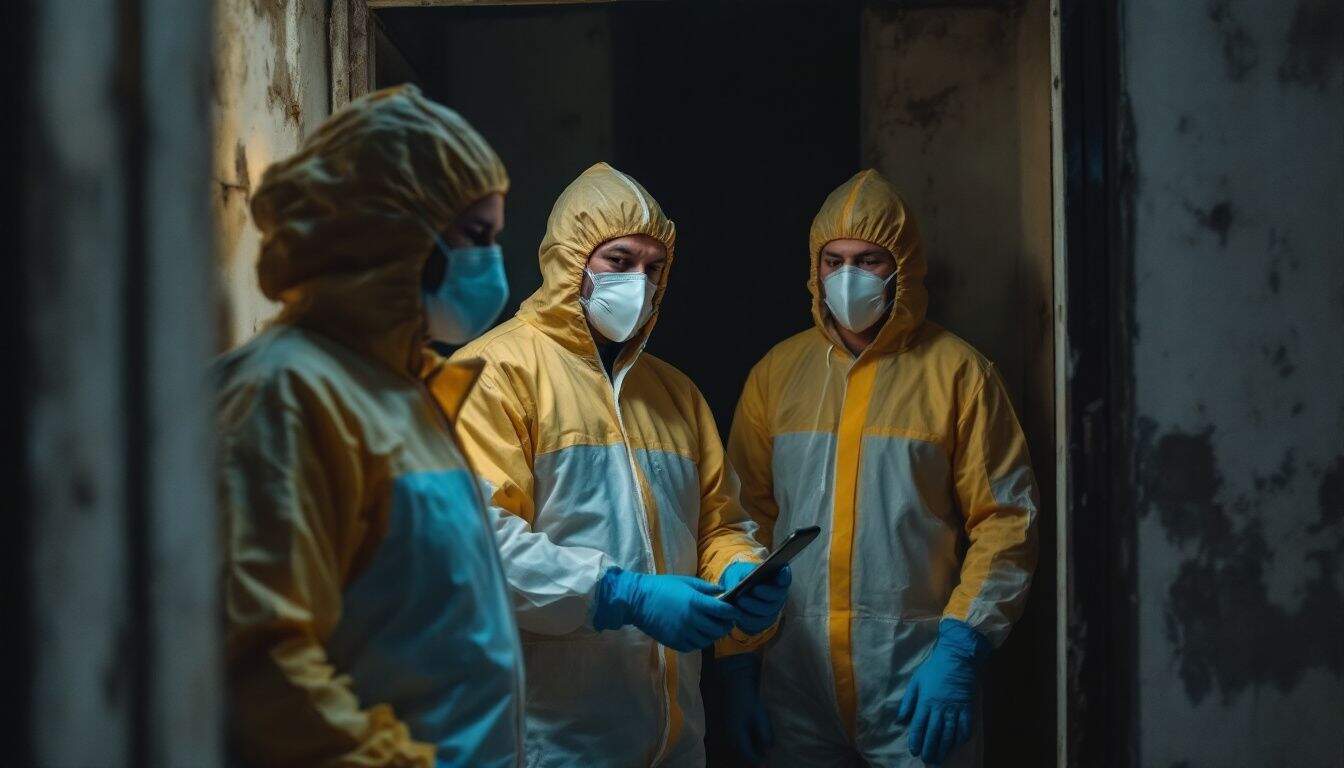
Every surveyor working with or near ACMs must wear appropriate PPE. The specific requirements depend on the nature of the work, but typically include:
- Respiratory protective equipment (RPE) — typically a full-face mask with a P3 filter, which captures the fine fibres that pose the greatest health risk
- Disposable coveralls — to prevent fibres from adhering to clothing and being carried out of the survey area
- Gloves — to protect the hands and prevent fibre transfer
- Eye protection — particularly where overhead materials are being assessed
PPE is not a tick-box exercise. Employers must ensure that all personnel are properly trained in how to put on, use, and remove protective equipment. Incorrect removal — known as doffing — is one of the most common ways fibres are inadvertently spread beyond the controlled area.
Wetting Techniques to Suppress Dust
Where ACMs need to be disturbed during a survey, wetting techniques are used to suppress dust and reduce the number of fibres that become airborne. Water sprays — and in some cases chemical binding agents — are applied to dampen the material before it is disturbed.
Keeping materials damp throughout the process is a straightforward but highly effective method of controlling asbestos contamination. It is a standard requirement under HSE guidance for any work involving ACMs and should be applied consistently, not just at the start of the task.
Ventilation and Air Filtration
HEPA (High Efficiency Particulate Air) filtration units should be used in enclosed work areas to capture airborne fibres before they can travel to adjacent spaces. These units draw contaminated air through filters capable of capturing particles as small as 0.3 microns — well within the size range of asbestos fibres.
The building’s own ventilation systems should be assessed before work begins and, where necessary, isolated during the survey. If building ventilation continues to operate while ACMs are being disturbed, fibres can be drawn into ductwork and distributed throughout the building — turning a localised issue into a building-wide asbestos contamination problem.
Strategies for Containing Asbestos Contamination
Physical containment is the backbone of contamination prevention. Even with excellent PPE and wetting techniques in place, fibres can still spread if the survey area isn’t properly sealed off from the rest of the building.
Sealing Off Survey Areas
Surveyors should use heavy-duty plastic sheeting and strong adhesive tape to seal off the areas being surveyed. This creates a physical barrier that prevents fibres from migrating into adjacent rooms, corridors, or ventilation systems during the work.
For intrusive surveys involving significant disturbance of ACMs, a full enclosure with an airlock entry point may be required. The HSE’s Asbestos Essentials task sheets provide detailed guidance on appropriate containment measures for different types of non-licensed work, and any competent surveyor should be familiar with them.
HEPA-Filtered Vacuuming
Standard vacuum cleaners must never be used in areas where asbestos is present. Ordinary vacuums simply recirculate fibres back into the air, making the situation considerably worse. HEPA-filtered vacuums are specifically designed for asbestos work and are capable of capturing fibres that would otherwise remain suspended in the air.
HEPA vacuuming should be used throughout the survey to clean surfaces as work progresses, and again during the post-survey decontamination phase. This two-stage approach ensures that residual fibres are captured before the area is reopened to building users.
Our teams carrying out asbestos survey London work use fully equipped, HEPA-compliant equipment on every job as standard — not as an optional upgrade.
Post-Survey Decontamination Procedures
The survey itself is only part of the picture. What happens immediately afterwards is just as important in preventing asbestos contamination from spreading beyond the site. Post-survey decontamination is where many less experienced operators fall short.
Decontaminating Personnel
Before leaving the survey area, all personnel must go through a structured decontamination process. The correct sequence is:
- HEPA vacuuming of coveralls while still within the work area
- Careful removal of coveralls, rolling them inward to trap any surface fibres
- Removal and bagging of all disposable PPE items for disposal as asbestos waste
- Washing of hands, face, and any exposed skin at a dedicated washing station
- Removal of RPE last — after all other decontamination steps are complete
The order of these steps matters significantly. Removing RPE too early — before coveralls and other items have been dealt with — exposes the face and airways to any fibres disturbed during doffing. Rushing or skipping steps is how fibres end up in vehicles, offices, and homes.
Cleaning Tools and Equipment
All tools and equipment used during the survey must be thoroughly decontaminated before being removed from site. This involves wet wiping to remove surface fibres, followed by HEPA vacuuming. Equipment should then be stored in sealed containers or bags until it can be properly inspected and cleaned again off-site.
Reusable equipment that cannot be fully decontaminated should be treated as asbestos waste and disposed of accordingly. This is a non-negotiable requirement under the Control of Asbestos Regulations.
Proper Disposal of Asbestos Waste
All waste generated during an asbestos survey — including contaminated materials, used PPE, plastic sheeting, and cleaning materials — must be treated as hazardous waste. Specifically, it must be:
- Double-bagged in clearly labelled asbestos waste sacks
- Sealed securely to prevent any release of fibres during transport
- Transported only by licensed waste carriers
- Disposed of at a licensed waste facility
Improper disposal of asbestos waste is a criminal offence. Property managers should always request a waste transfer note from the contractor as documented evidence that waste has been disposed of legally and correctly.
For properties requiring full remediation following a survey, our asbestos removal service handles all waste disposal in full compliance with current regulations.
Air Monitoring and Documentation
Measuring and recording asbestos fibre levels during and after a survey is both a safety requirement and a legal obligation. It also provides the evidence base that duty holders need to demonstrate compliance if questions are ever raised.
Air Monitoring During and After the Survey
Air monitoring should be carried out throughout the survey to ensure that fibre concentrations remain within safe limits. The HSE’s control limit for asbestos is 0.1 fibres per cubic centimetre of air, averaged over a four-hour period.
Personal air samples — taken at the breathing zone of workers — provide the most accurate measure of actual exposure during the work. Clearance air testing should also be conducted after the survey and decontamination are complete, before the area is reopened to building users. This provides documented evidence that fibre levels have returned to background levels and that the space is safe to reoccupy.
Maintaining Accurate Records
Detailed records must be kept for all asbestos survey work. For licensed work, health records must be retained for a minimum of 40 years. Survey findings, air monitoring results, exposure levels, and waste disposal records should all be documented and stored securely.
These records are not just a regulatory requirement — they are a vital resource for future surveyors, contractors, and property managers who need to understand the asbestos history of a building. An up-to-date asbestos register, maintained in line with the Control of Asbestos Regulations, is the cornerstone of any effective asbestos management plan.
Legal and Compliance Requirements
Understanding the regulatory framework helps duty holders know what to expect from their surveyors — and what their own responsibilities are. Ignorance of the regulations is not a defence if something goes wrong.
The Control of Asbestos Regulations
The Control of Asbestos Regulations set out the legal duties for managing asbestos in non-domestic premises. They require duty holders to identify the presence and condition of ACMs, assess the risk they pose, and put a management plan in place to control that risk over time.
The HSE’s HSG264 guidance document provides detailed practical advice on how surveys should be planned, conducted, and documented. Any surveyor operating in the UK should be working in accordance with HSG264 as a minimum standard — if yours isn’t, that’s a serious concern worth addressing immediately.
Notifiable Non-Licensed Work (NNLW)
Some survey and maintenance activities involving ACMs fall into the category of Notifiable Non-Licensed Work. These activities must be formally notified to the relevant enforcing authority before they begin. Employers must also arrange medical surveillance for workers involved in NNLW, including lung function tests and regular health checks.
Understanding whether your planned work falls under licensed, NNLW, or non-licensed categories is essential before any survey begins. Getting the classification wrong — and applying insufficient controls as a result — can lead to enforcement action and, more critically, to preventable asbestos contamination.
What to Expect From a Competent Surveying Contractor
Not all asbestos surveyors operate to the same standard. Knowing what to look for when appointing a contractor can make the difference between a well-controlled survey and one that leaves your building — and its occupants — at risk.
A competent surveying contractor should be able to demonstrate:
- UKAS-accredited laboratory analysis for any samples taken
- Surveyors holding a recognised qualification such as the P402 certificate
- A documented method statement covering contamination control measures before work begins
- Clear procedures for PPE, wetting, containment, decontamination, and waste disposal
- Air monitoring capability or access to an accredited hygienist for clearance testing
- Professional indemnity and public liability insurance appropriate to the scope of work
Don’t be reluctant to ask for evidence of these before appointing. A reputable contractor will welcome the questions — it demonstrates you understand what good looks like.
Our teams working on asbestos survey Manchester and asbestos survey Birmingham projects follow the same rigorous contamination control protocols on every job, regardless of the scale or complexity of the work involved.
After the Survey: Ongoing Asbestos Management
Preventing asbestos contamination doesn’t end when the surveyor leaves. The findings of a survey must be translated into a live, actively managed asbestos management plan — one that is reviewed regularly and updated whenever work is carried out on the building.
ACMs that are in good condition and unlikely to be disturbed can often be safely managed in place. Those that are damaged, deteriorating, or located in areas where future work is planned may need to be remediated or removed before that work begins. This ongoing risk assessment is a continuous duty holder responsibility under the Control of Asbestos Regulations — not a one-off exercise.
Regular condition monitoring of known ACMs, combined with clear procedures for contractors working in the building, is the most effective way to prevent accidental asbestos contamination after the survey is complete.
Frequently Asked Questions
What is asbestos contamination and why is it dangerous?
Asbestos contamination occurs when asbestos fibres are released into the air or deposited on surfaces beyond the immediate area where ACMs are located. When inhaled, these microscopic fibres can become permanently lodged in the lungs, causing serious diseases including mesothelioma, asbestosis, and lung cancer. The danger is that fibres are invisible to the naked eye and have no smell, meaning contamination can occur without anyone being aware of it at the time.
How do surveyors prevent asbestos contamination from spreading during a survey?
Competent surveyors use a combination of physical containment measures — including plastic sheeting and airlocks — alongside wetting techniques to suppress dust, HEPA filtration to capture airborne fibres, and full PPE including P3-rated respiratory protection. Ventilation systems are isolated where necessary to prevent fibres from being distributed through ductwork. All of these measures must be in place before any ACMs are disturbed.
What happens to asbestos waste after a survey?
All waste generated during an asbestos survey — including used PPE, plastic sheeting, and any sampled materials — must be treated as hazardous waste. It must be double-bagged in labelled asbestos waste sacks, transported by a licensed waste carrier, and disposed of at a licensed waste facility. The contractor should provide a waste transfer note as evidence that disposal has been carried out legally. Improper disposal of asbestos waste is a criminal offence under UK law.
Do I need air monitoring after an asbestos survey?
Yes. Clearance air testing should be carried out after the survey and decontamination are complete, before the area is reopened to building users. This confirms that fibre levels have returned to background levels and provides documented evidence that the space is safe to reoccupy. For licensed work, this clearance certificate is a legal requirement. For non-licensed work, it remains strongly recommended as evidence of due diligence.
What are my responsibilities as a duty holder when an asbestos survey is carried out?
As a duty holder, you are responsible for ensuring that only competent, appropriately qualified surveyors are appointed, that the asbestos register is kept up to date, and that the findings of any survey are incorporated into your asbestos management plan. You must also ensure that contractors working in your building are made aware of any known ACMs before they begin work. These obligations are set out in the Control of Asbestos Regulations and apply to all non-domestic premises.
Speak to Supernova Asbestos Surveys
Supernova Asbestos Surveys has completed over 50,000 surveys across the UK, working with property managers, local authorities, schools, healthcare organisations, and commercial landlords to ensure that asbestos contamination is identified, controlled, and managed properly.
Our surveyors are fully qualified, our laboratory analysis is UKAS-accredited, and every survey is carried out in full compliance with HSG264 and the Control of Asbestos Regulations. Whether you need a management survey, a refurbishment survey ahead of planned works, or specialist advice on contamination control, we’re here to help.
Call us on 020 4586 0680 or visit asbestos-surveys.org.uk to request a quote or speak to one of our team.