
One damaged ceiling tile or crumbling panel can turn a routine job into a legal and safety problem very quickly. Asbestos sampling is what separates suspicion from evidence, helping property managers, landlords and dutyholders make the right decision before maintenance, refurbishment or occupation puts anyone at risk.
Visual checks alone are not enough. A material can look harmless and still contain asbestos, which is why asbestos sampling plays such a central role in compliant asbestos management across offices, schools, warehouses, shops, communal residential areas and industrial sites.
Why asbestos sampling matters
At its core, asbestos sampling tells you whether a suspect material actually contains asbestos. That sounds simple, but the result affects everything that follows, from your asbestos register to contractor controls, maintenance planning and whether remedial work or removal is needed.
Under the Control of Asbestos Regulations and HSE guidance, including HSG264, suspect asbestos-containing materials should either be presumed to contain asbestos or be sampled and analysed. That means asbestos sampling is not a paperwork exercise. It is a practical step that supports defensible decision-making.
Good asbestos sampling helps answer key questions:
- Is asbestos present in the material?
- Which asbestos fibre type has been identified?
- Is the material likely to release fibres if disturbed?
- Can it remain in place and be managed safely?
- Does the material need sealing, repair or asbestos removal?
If you are responsible for a non-domestic property or the common parts of a residential building, these answers shape your legal duties and your next steps on site.
When asbestos sampling is used
Asbestos sampling is commonly carried out during surveys, but it can also be arranged as targeted testing where one suspect item needs investigation. The right scope depends on what is happening in the building and how much of the property may be affected.
Asbestos sampling during a management survey
In occupied buildings, asbestos sampling is often part of a management survey. The aim is to locate, as far as reasonably practicable, the presence and extent of asbestos-containing materials that could be damaged or disturbed during normal occupation, routine maintenance or foreseeable installation work.
A competent surveyor will not sample every surface. They use judgement, building knowledge and HSG264 principles to identify representative suspect materials and avoid unnecessary disturbance.
Targeted asbestos sampling without a full survey
Sometimes a full survey is not the immediate need. If one damaged board, textured coating or pipe insulation section has raised concern, standalone asbestos testing may be the most efficient first step.
That said, isolated asbestos sampling should not be used as a shortcut where a proper survey is required. If larger works are planned, or the building records are poor, you may need a formal asbestos management survey instead of a single sample visit.
Before refurbishment or demolition
If the building is being upgraded, stripped out or structurally altered, the level of inspection changes. A more intrusive inspection is needed because hidden materials may be affected by the works. In these cases, asbestos sampling is usually part of a refurbishment or demolition survey.
This is especially important where works will disturb voids, risers, service ducts, plant rooms, partition walls, floor build-ups or older linings. Sampling in these areas helps prevent accidental exposure once contractors begin.
Common materials that may need asbestos sampling
Asbestos was used in a wide range of products, so asbestos sampling may be needed in many different parts of a building. Some materials are obvious suspects, while others are easy to miss until maintenance opens up the area.
Common examples include:
- Textured decorative coatings
- Asbestos insulating board
- Ceiling tiles and ceiling void linings
- Floor tiles and bitumen adhesive
- Pipe lagging and thermal insulation
- Sprayed coatings
- Cement sheets, flues, gutters and roof panels
- Roofing felt
- Gaskets, rope seals and packings
- Fire door cores
- Service riser panels and internal linings
- Soffits, boxing and partition boards
Material appearance can be misleading. A cement sheet may be relatively easy to suspect, but a board hidden behind a heater cupboard or above a suspended ceiling may only become apparent during inspection.
How asbestos sampling is carried out safely
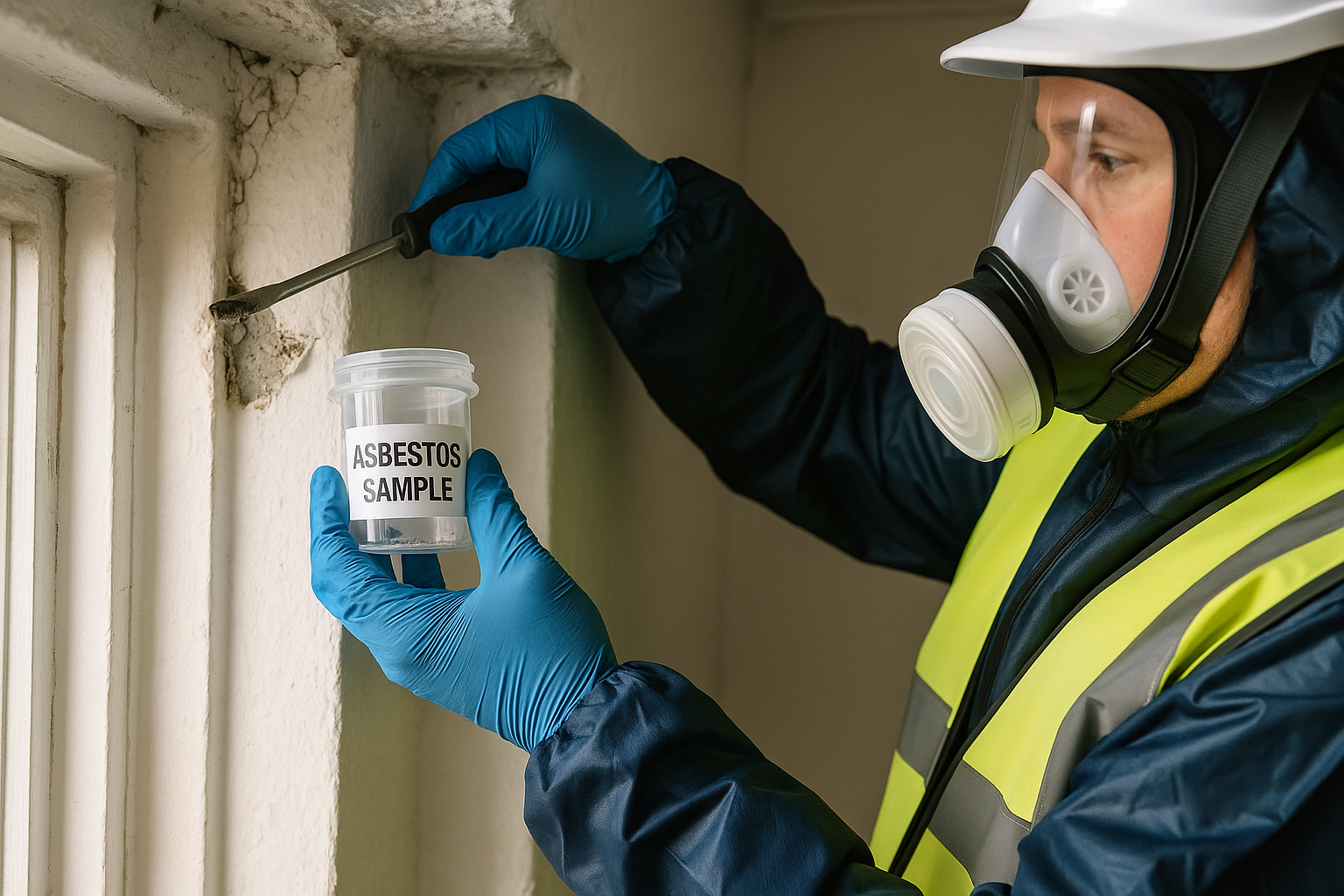
Proper asbestos sampling is controlled, deliberate and designed to keep disturbance to a minimum. Done badly, sampling can release fibres. Done properly, it provides the information you need while keeping risk tightly managed.
Preparation before the sample is taken
Before collecting a sample, the surveyor assesses the immediate area, the condition of the material and the likelihood of fibre release. They also consider whether occupants need to be kept away briefly while the sample is taken.
Typical controls may include:
- Suitable respiratory protective equipment
- Disposable gloves and coveralls where needed
- Dampening the sampling point to suppress dust
- Using wipes or polythene to catch small debris
- Restricting access to the area during sampling
- Using suitable tools for the material type
These measures are straightforward, but they matter. The aim is to collect enough material for analysis without creating avoidable contamination.
Taking a representative sample
Asbestos sampling is not just about taking any fragment from the surface. The sample needs to be representative of the material being assessed. Many products are layered, coated or made up of different components, and asbestos may only be present in one part.
For example:
- A textured coating sample should include the coating itself, not just the paint on top
- A board sample should come from the board material, not loose debris nearby
- A floor sample may need both the tile and the adhesive if both are suspect
- Lagging may need careful sampling from the correct depth and section
The surveyor will choose an appropriate hand tool based on the material, such as a scalpel, pliers, corer or chisel. Only a small amount is usually needed.
Sealing and cleaning afterwards
Once asbestos sampling is complete, the exposed sampling point is normally sealed. Depending on the product, that may involve tape, filler, encapsulant or another suitable sealant.
The immediate area is then cleaned using appropriate methods, often damp wiping. Waste and disposable items are handled as asbestos waste where required. This final step is just as important as the sample itself, because it prevents the sampling point becoming a future source of fibre release.
Labelling and chain of custody
A sample result is only useful if it can be traced back to the exact material and location it came from. Every sample should therefore be labelled clearly and linked to site notes, photographs or plans.
Typical sample records include:
- Unique sample reference
- Building and room location
- Material description
- Date of collection
- Surveyor or project reference
This creates a clear chain of custody from site to laboratory and ensures the final report can map results accurately.
Bulk asbestos sampling and air testing are not the same
People often use the term asbestos sampling to describe any kind of asbestos test, but there are two very different processes involved in asbestos work. Knowing the difference helps you commission the right service.
Bulk asbestos sampling
Bulk asbestos sampling means taking a small piece of suspect material for laboratory identification. This is the standard method used during surveys and targeted material testing. It answers one key question: does this material contain asbestos?
Air testing
Air testing measures airborne fibre concentration. It is used for reassurance monitoring, leak testing, background testing and the clearance process following certain asbestos removal work. It answers a different question: are asbestos fibres present in the air, and at what level?
For routine building investigation, bulk asbestos sampling is usually what you need. Air monitoring has a different role and does not replace material sampling when the issue is identifying a suspect product.
What happens in the laboratory after asbestos sampling
Once collected, samples are transported securely to a laboratory for analysis. This is where asbestos sampling becomes evidence rather than assumption. For reliable results, analysis should be carried out by an appropriately accredited laboratory using recognised UK methods.
Initial examination and preparation
The analyst first checks the sample details against the submission paperwork. The sample may then be separated or broken down so that different layers and components can be examined properly.
This matters because a single site sample may contain more than one material. A floor finish, for example, may include the tile, backing and adhesive, each of which may need individual attention.
Polarised Light Microscopy
For bulk material identification in the UK, Polarised Light Microscopy is widely used. The analyst studies the optical properties of fibres and compares them with the known characteristics of regulated asbestos types.
This method can identify asbestos types including:
- Chrysotile
- Amosite
- Crocidolite
- Anthophyllite
- Actinolite
- Tremolite
In many routine cases, this provides a clear and dependable answer for the materials found during asbestos sampling.
When further analysis may be needed
Some samples are more difficult to interpret. Low fibre content, contamination, unusual binders or complex product composition can make identification less straightforward.
Where a result is inconclusive, further analytical work may be needed rather than forcing a result. If you need direct material checks outside a full survey, Supernova can assist with sample analysis where appropriate.
How asbestos sampling results affect decisions on site
The outcome of asbestos sampling should feed directly into practical management decisions. A positive result does not always mean urgent removal, and a negative result does not remove the need for proper records.
If asbestos is confirmed
Where asbestos is identified, the next issue is risk. The material type, condition, treatment, accessibility and likelihood of disturbance all matter. A sealed cement sheet in good condition presents a very different management issue from damaged insulating board near regular contractor access.
Possible responses include:
- Leaving the material in place and monitoring it
- Encapsulating or sealing the surface
- Restricting access to the area
- Updating the asbestos register and management plan
- Arranging remedial works or removal
If the material is damaged, friable or likely to be disturbed, take advice promptly before any further work continues.
If asbestos is not detected
A negative result is useful, but it should be read carefully. The report should state exactly what was sampled and where it came from. If only one item in a group of similar materials was tested, you may still need professional advice on whether the result can be applied to the wider area.
Good record keeping matters here. Assumptions should be documented, not guessed, especially where future contractors may rely on the information.
How results appear in reports
In a formal survey report, asbestos sampling results are tied to specific locations, material assessments and recommendations. They then feed into the asbestos register, action plan and any permit-to-work controls you operate on site.
If you need a formal inspection in the capital, Supernova can help with an asbestos survey London service tailored to occupied commercial and residential properties. We also support regional portfolios through our asbestos survey Manchester and asbestos survey Birmingham teams.
Practical advice for arranging asbestos sampling
If you are commissioning asbestos sampling, a few sensible steps at the start will save time and reduce disruption later. The quality of the information you give the surveyor often affects the quality of the outcome.
- Be clear about the reason for the work. Are you investigating damage, planning maintenance, updating records or preparing for refurbishment? The answer affects whether you need targeted testing or a full survey.
- Share existing documents early. Previous surveys, asbestos registers, floor plans and refurbishment records help the surveyor target the right materials and avoid duplication.
- Sort access in advance. Locked risers, roof voids, plant rooms and tenanted spaces are common causes of delay.
- Tell occupants what to expect. Sampling is usually quick, but brief access restrictions may be needed while the material is taken and sealed.
- Do not take your own samples. Scraping suspect material yourself can create exposure risk and may also produce a poor or untraceable sample.
- Act on the findings. Asbestos sampling only adds value if the results are reflected in your asbestos register, contractor briefings and maintenance controls.
Common mistakes to avoid with asbestos sampling
Problems with asbestos sampling rarely start in the laboratory. They usually begin on site, with poor planning, weak records or the wrong scope of work.
Watch out for these common mistakes:
- Using one negative sample to clear a whole building without justification
- Commissioning isolated testing when a survey is actually required
- Allowing untrained staff or contractors to disturb suspect materials
- Failing to record the exact sample location
- Not updating the asbestos register after results are received
- Starting works before sample results have been reviewed
- Assuming all low-risk materials can be ignored
If you are unsure what level of investigation is appropriate, ask before works begin. That is always easier than dealing with accidental disturbance after the event.
Choosing the right asbestos service
Not every building issue needs the same response. The right service depends on what you need to know and what is planned for the property.
As a quick rule:
- Choose targeted asbestos testing when one or a few suspect materials need identification
- Choose a survey when you need a structured inspection and formal records for the building
- Choose a more intrusive survey before refurbishment, strip-out or demolition
If you manage multiple sites, standardising how asbestos sampling is commissioned can make life much easier. Use the same reporting expectations, insist on clear sample references and ensure every result feeds back into your central compliance records.
Frequently Asked Questions
How long does asbestos sampling take?
Small-scale asbestos sampling can often be completed quickly, especially where access is straightforward and only a few materials need checking. Larger properties or more complex materials may take longer, particularly if multiple areas need to be inspected and recorded properly.
Can asbestos sampling be done in an occupied building?
Yes, asbestos sampling is often carried out in occupied buildings. A competent surveyor will use suitable controls, keep disturbance to a minimum and manage access to the immediate area while the sample is taken and the point is sealed.
Does a positive asbestos sampling result always mean removal?
No. If asbestos is in good condition and unlikely to be disturbed, it can often be managed in place. Removal is usually considered where the material is damaged, friable, difficult to protect or likely to be disturbed by planned works.
Can I take a sample myself and send it for testing?
It is not advisable. Taking your own sample can disturb the material and create unnecessary exposure risk. Professional asbestos sampling is safer, more reliable and gives you a proper chain of custody and location record.
What is the difference between asbestos sampling and asbestos surveys?
Asbestos sampling is the act of taking a material sample for laboratory identification. A survey is a wider inspection process that identifies suspect materials, assesses their condition and location, records findings and makes recommendations for management or further action.
If you need clear, reliable asbestos sampling backed by experienced surveyors, Supernova Asbestos Surveys can help. We provide testing, surveys and advice for commercial, residential and public-sector properties across the UK. Call 020 4586 0680 or visit asbestos-surveys.org.uk to arrange the right service for your building.