
A poor asbestos survey report causes problems long before anyone notices the wording. Contractors are left guessing, maintenance teams work around uncertainty, and planned projects stall when hidden asbestos turns up halfway through the job. A good report does the opposite: it tells you what is present, where it is, how reliable the findings are, and what needs to happen next.
For property managers, landlords, duty holders and project teams, that clarity matters. Under the Control of Asbestos Regulations, those responsible for non-domestic premises must identify and manage asbestos risks. HSE guidance and HSG264 set out what a suitable survey should achieve and what useful reporting looks like in practice.
If you have received an asbestos survey report and are not sure how to read it, or you need to commission one and want to know what to expect, the key is simple: match the report to the building, the planned use and the level of work involved. The report is only as good as the survey scope behind it.
What is an asbestos survey report?
An asbestos survey report is the formal document produced after an asbestos survey has been carried out. It records the survey type, the areas inspected, any limitations, the materials identified or presumed to contain asbestos, sample results where relevant, and recommendations for management or further action.
In practical terms, it should answer four questions:
- What suspect or confirmed asbestos-containing materials are present?
- Where are they located?
- What condition are they in, and how likely are they to be disturbed?
- What should happen next to manage the risk properly?
If an asbestos survey report leaves you unsure about any of those points, it is not doing enough. The document should be clear enough for facilities teams, contractors and project managers to use without having to interpret vague statements or chase missing detail.
Why an asbestos survey report matters for compliance and safety
Asbestos management is not just paperwork. The report supports day-to-day decisions about maintenance, contractor control, refurbishment planning and, where necessary, removal. Without a reliable asbestos survey report, the asbestos register can be incomplete, the management plan can be weak, and avoidable exposure risks can develop.
For occupied buildings, the report helps duty holders manage asbestos-containing materials that remain in place. For refurbishment or demolition work, it helps ensure intrusive works do not begin until asbestos risks have been identified and dealt with appropriately.
A usable report helps you:
- Brief contractors before they start work
- Update the asbestos register accurately
- Prioritise damaged or vulnerable materials
- Plan maintenance around known risks
- Avoid delays caused by unexpected discoveries during works
- Demonstrate a sensible approach to compliance
That last point matters. If there is ever scrutiny over how asbestos was managed, a detailed asbestos survey report is one of the first documents people will look at.
How the asbestos survey process leads to the final report
The finished report starts with decisions made before the surveyor arrives. The purpose of the survey, the areas to be included, the building status and the level of access all affect the quality and usefulness of the final document.
Step 1: Define the purpose of the survey
The first question is why the survey is needed. Is the property occupied and being managed in normal use? Are minor maintenance works planned? Is there a major strip-out or demolition project ahead? The answer determines the survey type and shapes the final asbestos survey report.
Step 2: Confirm the scope and access arrangements
Surveyors need access to the right areas. Locked rooms, service risers, plant spaces, loft voids, ceiling voids and roof areas can all contain asbestos-containing materials. If they cannot be inspected, the report must say so clearly.
Uninspected areas should never be assumed to be asbestos-free. That is one of the most common misunderstandings when people skim a report rather than read the limitations section properly.
Step 3: Inspection and sampling
The surveyor inspects accessible areas and identifies suspect materials. Where appropriate and safe, samples may be taken for laboratory analysis. If a material is not sampled, it may be recorded as presumed asbestos, which means it should be managed as though it contains asbestos unless analysis proves otherwise.
Step 4: Laboratory analysis and assessment
Samples are analysed by a UKAS-accredited laboratory. The report then combines those results with the survey findings, material assessment information, photographs, location references and recommendations.
Step 5: Issue the asbestos survey report
The final asbestos survey report should include enough detail for you to act on it. That means not just listing materials, but explaining limitations, identifying locations accurately and setting out practical next steps.
Choosing the right survey so the asbestos survey report is actually useful
Many reporting problems begin with the wrong survey being instructed. The report may be technically correct for that survey type, but still unhelpful for the work you need to do.
For example, a management survey is not designed to support major refurbishment. If walls, ceilings, floors, ducts or voids will be opened up, a more intrusive survey is usually required. If you commission the wrong type, the asbestos survey report may still leave major gaps.
Management survey
For occupied buildings in normal use, a management survey is usually the starting point. Its purpose is to locate, as far as reasonably practicable, asbestos-containing materials that could be disturbed during normal occupation, routine maintenance or foreseeable minor works.
This survey is not fully destructive. It focuses on accessible areas and reasonable inspection methods, which makes it suitable for ongoing management but not for major intrusive works.
Demolition or refurbishment survey
If a building or part of it is being stripped out, significantly altered or demolished, a more intrusive survey is needed. A demolition survey is intended to identify all reasonably accessible asbestos-containing materials in the relevant work area before structural work starts.
This type of survey often involves destructive inspection because hidden materials behind finishes, inside risers or within construction voids need to be identified before work begins.
Re-inspection survey
If you already have known asbestos-containing materials recorded in an asbestos register, a re-inspection survey helps confirm whether their condition has changed. This is useful when asbestos remains in place and needs periodic review as part of ongoing management.
A re-inspection does not replace the original survey. It updates condition information so you can decide whether existing controls are still suitable.
What an asbestos survey report should contain
A strong asbestos survey report is structured, specific and easy to use. You should be able to hand it to a competent contractor or facilities manager and have them understand the findings without guesswork.
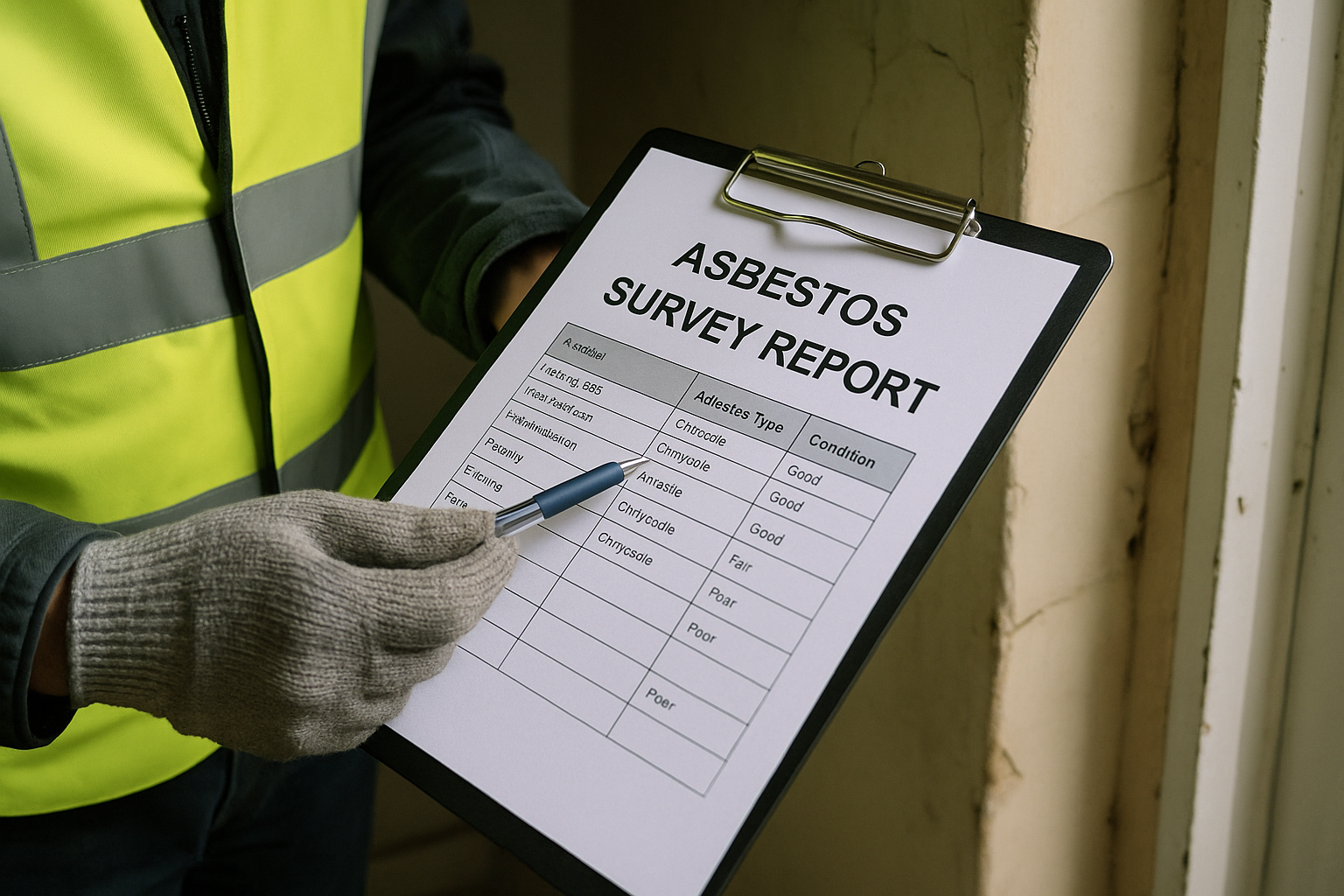
Core sections usually include:
- Survey details such as the address, client, survey type and date of inspection
- Scope of survey explaining what was included and why
- Methodology showing how the inspection was carried out in line with HSE guidance and HSG264
- Limitations identifying areas that were inaccessible, excluded or not inspected
- Asbestos register entries for each suspect or confirmed item
- Sample results where materials were tested
- Material assessments based on product type, condition, surface treatment and asbestos type where known
- Photographs and plans to help locate materials accurately
- Recommendations such as manage, monitor, repair, encapsulate or remove
Good reports are not overloaded with jargon. They use clear room references, practical descriptions and enough visual detail to help people find the materials in the real building.
How to read the key sections of an asbestos survey report
Not every reader needs to understand every technical term, but you do need to know which sections affect decisions on site. These are the parts worth checking carefully.
Survey scope
The scope tells you what the survey was meant to achieve. This matters because the findings only apply to the areas and level of inspection described. If your works extend beyond that scope, the asbestos survey report may not be enough for your project.
Limitations and exclusions
This section is often overlooked. It should list locked rooms, obstructed areas, unsafe access points or any client-imposed restrictions. If a ceiling void was not opened or a plant room was unavailable, that should be stated clearly.
If limitations are significant, you may need follow-up inspection before relying on the report.
Asbestos register entries
Each item should have a location, material description, extent or approximate quantity, condition and recommendation. Vague wording such as “possible asbestos in various areas” is not enough. A usable asbestos survey report should identify each item precisely.
Sample results
Where sampling has taken place, the report should show what was sampled and the laboratory result. If certainty is needed for specific materials before works begin, targeted asbestos testing may be the right next step.
Recommendations
Recommendations should be practical rather than generic. You want clear direction on whether the material should remain in place, be monitored, be repaired, be encapsulated or be removed before planned works.
Common asbestos-containing materials listed in reports
Many materials named in an asbestos survey report are easy to miss if you are not used to reading one. Some look harmless, and many are part of ordinary building fabric. That is why visual assumptions are unreliable.
Common asbestos-containing materials found in UK properties include:
- Textured coatings on ceilings and walls
- Asbestos insulating board in partitions, soffits, risers and fire protection
- Pipe lagging and thermal insulation
- Floor tiles and bitumen adhesive
- Cement sheets, gutters, downpipes and roof coverings
- Ceiling tiles and backing boards
- Sprayed coatings and insulation products
- Gaskets, rope seals and plant room components
The report may describe a material as presumed or sampled and confirmed. Presumed means the material has not been laboratory-confirmed but should be treated as asbestos unless analysis proves otherwise. If you only need one suspect item checked rather than a full survey, direct sample analysis can be useful when arranged safely.
What the recommendations in an asbestos survey report usually mean
Recommendations are where the report becomes actionable. They should tell you what to do, not just what was found.
Typical recommendations include:
- Manage in place if the material is in good condition and unlikely to be disturbed
- Monitor through periodic review where asbestos remains present but stable
- Repair if there is minor damage that can be controlled
- Encapsulate where sealing the surface is an appropriate control measure
- Remove where damage is significant or disturbance is likely during planned works
Removal should not be treated as the default answer. In many cases, managing asbestos in place is the safest and most proportionate option. But where refurbishment or demolition is planned, or where condition is poor, asbestos removal may be necessary before work can proceed.
How to check whether an asbestos survey report is reliable
You do not need to be a surveyor to spot weak reporting. A few checks will tell you whether the document is likely to support real-world decisions.
Use this checklist:
- Does the survey type match the reason it was commissioned?
- Are all inspected and non-inspected areas clearly identified?
- Are room references and photographs specific enough to locate each item?
- Are sample results included where samples were taken?
- Do the findings make sense for the building layout and age?
- Are recommendations clear and prioritised?
- Are any major areas missing because of access issues?
- Is the wording precise, or does it rely on vague statements?
If the report notes that materials were presumed rather than sampled, ask why. That may be entirely reasonable, but the reason should be clear. It could be due to access restrictions, safety concerns, material condition or client instruction.
If you need further confirmation for localised works, additional asbestos testing can help resolve uncertainty before contractors start.
What to do after receiving an asbestos survey report
The report itself does not control the risk. What happens next is what matters.
For routine management
If the asbestos survey report is for an occupied building, take these steps:
- Update or create the asbestos register
- Review recommendations and prioritise damaged materials
- Share relevant findings with staff, contractors and maintenance teams
- Label materials where appropriate
- Schedule monitoring or re-inspection where asbestos remains in place
- Keep the report accessible, not buried in a file no one checks
A report that sits in a drawer offers no protection if someone drills into a known asbestos board six months later.
For refurbishment or demolition
If intrusive works are planned, act before the project starts:
- Check the survey covers the full work area
- Do not let contractors begin until asbestos risks are addressed
- Provide the report to the principal contractor and design team
- Arrange removal of affected materials where required
- Keep records of actions taken alongside the project file
This is where delays often happen. Work is scheduled, strip-out begins, then hidden suspect materials are discovered because the original asbestos survey report was not designed for that level of intrusion.
When an old asbestos survey report is no longer enough
Age alone does not automatically make a report invalid, but buildings change. Areas get refurbished, access improves, layouts are altered and materials deteriorate. An old asbestos survey report may no longer reflect the current condition of the property or the scope of planned works.
You should review the report carefully if:
- The building has been altered since the survey
- Parts of the property were inaccessible at the time
- The report was only for management, but intrusive works are now planned
- Known asbestos-containing materials have not been reviewed for some time
- There is uncertainty over whether the register is up to date
Where asbestos remains in place, regular review is part of sensible management. Where works are changing, the survey strategy may need to change too.
Property types that commonly rely on asbestos survey reports
Asbestos survey reports are used across a wide range of buildings, not just industrial sites. Any non-domestic premises can require one, and some domestic projects need them too where work is planned or communal areas are involved.
Typical settings include:
- Commercial offices
- Retail units and shopping parades
- Schools, colleges and nurseries
- Healthcare premises and care environments
- Warehouses and factories
- Hotels, pubs and leisure venues
- Public sector buildings
- Residential blocks with shared areas
If you manage sites across multiple regions, consistent reporting makes life easier. Supernova supports clients needing an asbestos survey London service, as well as projects requiring an asbestos survey Manchester team or an asbestos survey Birmingham appointment.
Practical mistakes to avoid with an asbestos survey report
Most asbestos reporting issues are not caused by the presence of asbestos. They are caused by assumptions, poor communication or using the wrong document for the job.
Avoid these common mistakes:
- Assuming a management survey is enough for refurbishment work
- Ignoring limitations and inaccessible areas
- Failing to share the asbestos survey report with contractors
- Relying on appearance instead of sample results or presumption
- Letting the asbestos register fall out of date
- Starting intrusive work before recommendations have been acted on
If you are ever unsure whether the report is suitable, pause the work and check. That is far cheaper and safer than finding out halfway through a project that the wrong survey was commissioned.
Frequently Asked Questions
What is included in an asbestos survey report?
An asbestos survey report usually includes the survey scope, methodology, limitations, asbestos register entries, sample results where applicable, material assessments, photographs, plans and recommendations. It should tell you what was found, where it is, and what action is advised.
How do I know if my asbestos survey report is suitable for refurbishment works?
Check the survey type first. A management survey is generally for normal occupation and routine maintenance, not major intrusive works. If refurbishment is planned, the report must reflect a survey designed for that level of disturbance.
What does presumed asbestos mean in a report?
Presumed asbestos means a material was not laboratory-confirmed but should be treated as containing asbestos unless analysis shows otherwise. This approach is often used where sampling was not appropriate or not possible at the time of survey.
How often should asbestos materials be re-inspected?
There is no single fixed interval that suits every building. Re-inspection should be based on the material, its condition, the likelihood of disturbance and your management arrangements. The asbestos register and management plan should be reviewed regularly.
What should I do if my asbestos survey report recommends removal?
Do not start work until the recommendation has been reviewed and planned properly. If removal is required, arrange competent follow-up action and keep records of what was done before refurbishment or demolition proceeds.
If you need a clear, practical asbestos survey report, Supernova Asbestos Surveys can help. We carry out management, demolition and re-inspection surveys nationwide, along with testing, sample analysis and follow-up support. Call 020 4586 0680 or visit asbestos-surveys.org.uk to book a survey or discuss an existing report.