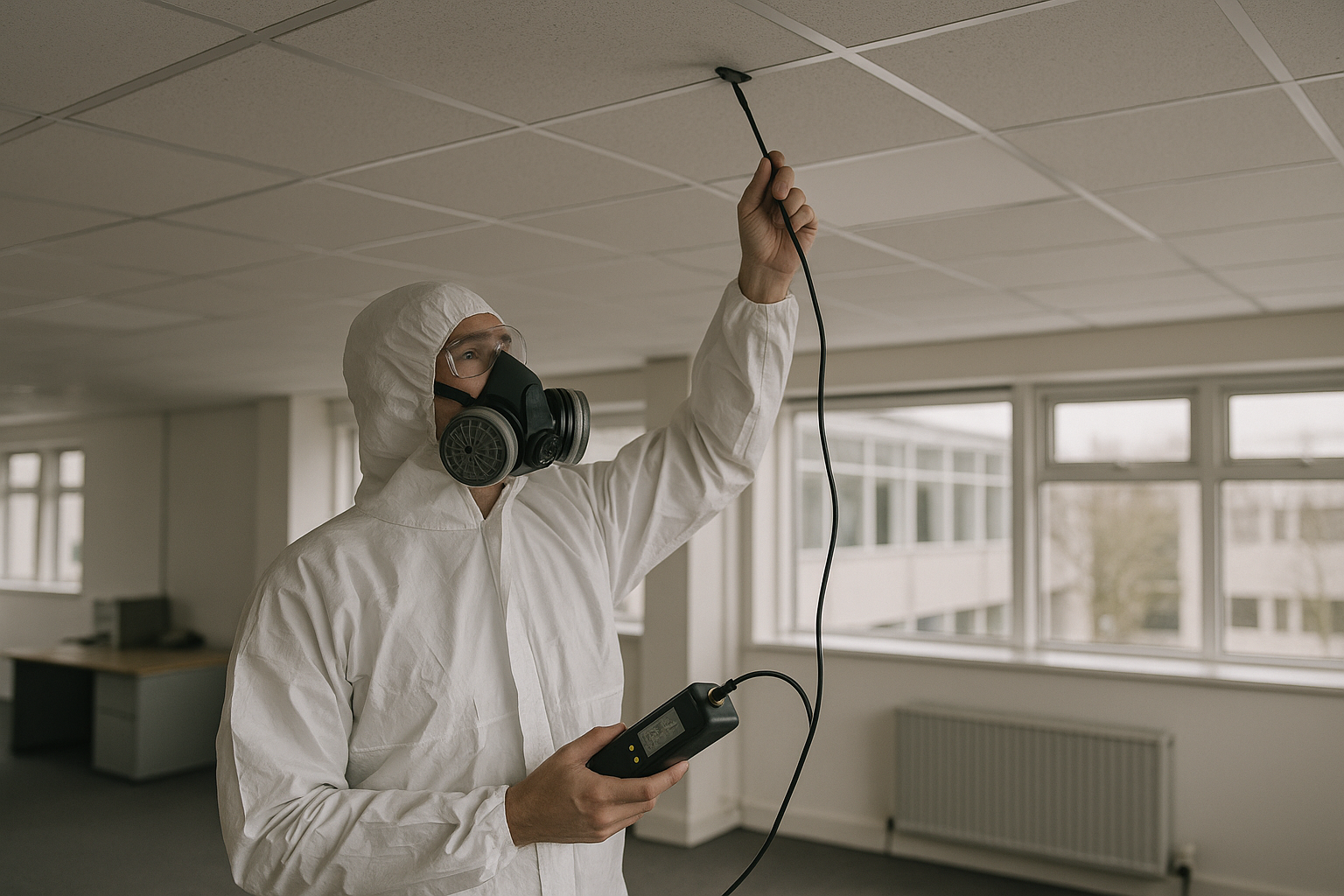
You do not need to panic when you discover a suspicious ceiling tile, pipe wrap, garage roof sheet or old floor covering. You do need to know what to do when you find asbestos, because the wrong reaction can turn a manageable issue into contamination, delays, extra cost and unnecessary exposure.
Across the UK, asbestos is still found in homes, offices, schools, shops, warehouses and the common parts of residential blocks. The main rule is simple: asbestos is most dangerous when it is damaged or disturbed. If you suspect it, stop work, keep people away and get competent advice before anything else happens.
What to do when you find asbestos straight away
The first few minutes matter. If a material could contain asbestos, treat it as asbestos until a competent surveyor or analyst says otherwise.
Stop work immediately
If DIY, cleaning, maintenance, refurbishment or strip-out work is in progress, stop at once. Turn off tools and do not carry on for another few minutes just to finish the task.
Activities that commonly disturb asbestos include:
- Drilling into walls or ceilings
- Sanding, scraping or cutting boards
- Lifting old floor tiles or vinyl
- Removing boxing, panels or soffits
- Breaking up cement sheets
- Pulling down textured coatings or ceiling finishes
Keep people out of the area
Restrict access straight away. Keep children, tenants, staff, contractors and visitors away until the material has been assessed.
If you can do so without disturbing anything, close doors and place a simple warning notice nearby. In shared buildings, tell other occupants so nobody wanders into the area by mistake.
Do not touch, clean or sample it yourself
If you are unsure what to do when you find asbestos, this is the most useful rule to remember: leave it alone. Disturbance is what releases fibres.
Do not:
- Drill, cut or break the material
- Snap off a piece to inspect it
- Sweep up dust or debris
- Use a domestic vacuum cleaner
- Mop the area
- Put debris into normal rubbish bags
Even minor disturbance can spread fibres into nearby rooms, onto clothing and across surfaces.
Reduce movement and air disturbance
If debris is already present, avoid walking through it. Do not use fans or ventilation systems that could move dust elsewhere.
Opening windows is not always the right answer either. In some buildings, it can help fibres travel further rather than keeping them contained.
Where asbestos is commonly found in UK properties
A big part of knowing what to do when you find asbestos is recognising the places it often turns up. You cannot confirm asbestos by sight alone, but some materials and locations should always trigger caution.
Asbestos was widely used for insulation, fire resistance and durability. That means it can appear in more places than most people expect.
Common asbestos-containing materials
- Textured coatings on ceilings and walls
- Asbestos insulating board in partitions, risers, soffits and service cupboards
- Pipe lagging and thermal insulation
- Asbestos cement sheets on garages, sheds and outbuildings
- Corrugated roofing and wall cladding
- Rainwater goods such as gutters and downpipes
- Floor tiles and bitumen adhesive
- Vinyl flooring backing
- Bath panels and airing cupboard linings
- Fuse board backing panels
- Boiler surrounds, flues and heater components
- Loose fill insulation in some roof voids
Higher-risk materials
Some materials release fibres more easily when damaged. These include pipe lagging, loose fill insulation, sprayed coatings and asbestos insulating board.
They are generally more hazardous than asbestos cement because the fibres are less tightly bound. If these materials are broken, drilled or handled badly, airborne fibre release is more likely.
Lower risk does not mean no risk
Asbestos cement and some floor products are often described as lower risk when in good condition. That does not mean they are safe to break, drill or remove without proper controls.
A cracked garage roof sheet or damaged floor tile can still create a serious problem if someone tries to deal with it casually.
How to tell if a material might contain asbestos
One of the biggest mistakes people make when deciding what to do when you find asbestos is assuming they can identify it by colour, texture or age. You cannot reliably do that.

Many non-asbestos materials look similar, and many asbestos-containing materials look completely ordinary. The only reliable way to confirm asbestos is through competent inspection and, where appropriate, sampling and laboratory analysis.
Clues that should make you cautious
- The building was constructed or refurbished before the UK ban on asbestos use
- You are opening hidden voids during refurbishment
- The material appears original to the building
- The product resembles insulating board, cement sheeting, old floor tiles or lagging
- The property has never had an asbestos survey
These signs do not prove asbestos is present. They do mean you should stop work and get advice before going further.
Why online guesswork is risky
Photos on the internet are not enough to identify asbestos safely. Visual comparison often creates false reassurance or unnecessary panic.
If the material affects a project, tenancy issue, purchase, maintenance plan or building safety decision, you need a professional opinion rather than a guess from a forum.
Why DIY sampling is a bad idea
Taking your own sample can release fibres and contaminate clothing, tools and nearby surfaces. It can also make later clean-up more difficult and more expensive.
A competent surveyor knows how to take samples with minimal disturbance, choose the right sampling point and work in line with HSG264 and current HSE guidance.
Who to call after finding suspected asbestos
Once the area is secure, the next step in what to do when you find asbestos is contacting the right professional. In most cases, that means a competent asbestos surveyor.
The right surveyor will assess the suspect material, explain the level of risk and advise whether you need sampling, a survey, management, encapsulation or removal.
Choose a competent asbestos surveyor
Look for a company that understands the Control of Asbestos Regulations, follows HSG264 for surveying and works in line with current HSE guidance. Competence matters more than speed or the cheapest quote.
If the building is occupied, tell the surveyor:
- What material has been found
- Whether it has been disturbed
- Whether debris is visible
- What work was taking place
- Who may have been in the area
Clear information at the start helps the surveyor scope the visit properly.
The survey type matters
There is no one-size-fits-all survey. The right survey depends on what you are doing in the property.
For routine occupation and normal maintenance, a management survey is used to locate, as far as reasonably practicable, asbestos-containing materials that could be damaged or disturbed during normal use.
If intrusive work is planned, you may need a demolition survey before refurbishment or demolition begins. This type of survey is more intrusive because hidden materials need to be identified before work can proceed safely.
Booking the wrong survey wastes time and can leave asbestos undiscovered until the project is already under way. That is when delays and costs usually escalate.
Local support can speed things up
For landlords, agents, dutyholders and facilities teams, local coverage helps. If you need a fast response in the capital, arranging an asbestos survey London appointment can help get a competent surveyor on site quickly.
For regional portfolios, local support is just as useful. You can book an asbestos survey Manchester visit for North West properties or arrange an asbestos survey Birmingham service for sites across the Midlands.
What happens after asbestos is confirmed
Finding asbestos does not automatically mean there is an emergency. Many people asking what to do when you find asbestos assume every asbestos material must be removed immediately, but that is not how asbestos risk is managed in practice.
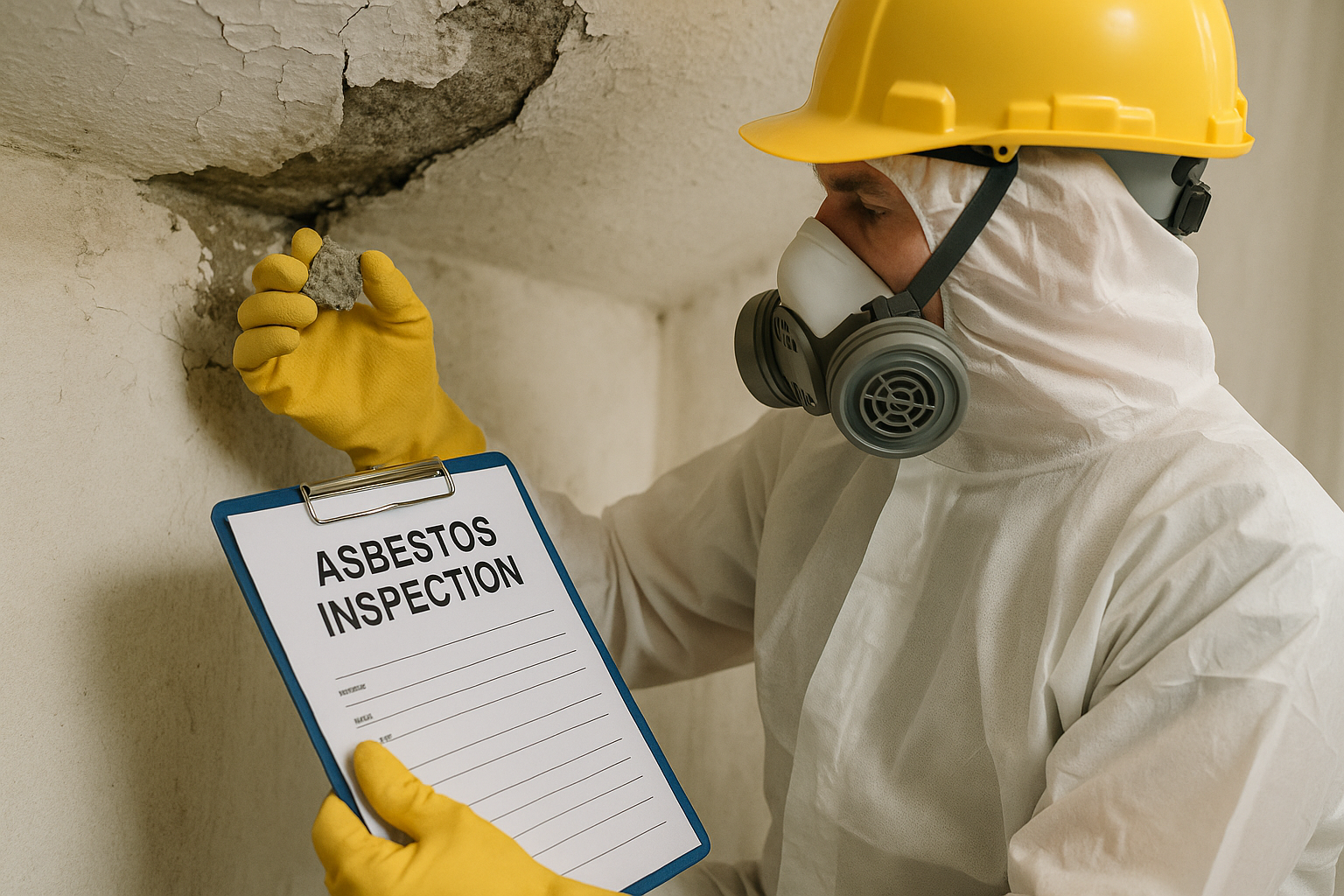
The right response depends on the material type, its condition, where it is located and how likely it is to be disturbed.
Option 1: Leave it in place and manage it
If asbestos-containing material is in good condition and unlikely to be disturbed, it may be safest to leave it where it is and manage it properly. This is a common and lawful approach.
Management can include:
- Recording the location and condition
- Assessing the risk of disturbance
- Labelling where appropriate
- Informing contractors and maintenance staff
- Inspecting the material periodically
- Updating the asbestos register in non-domestic premises
This approach is often suitable for stable materials in low-risk locations. Removing intact asbestos unnecessarily can create more risk than managing it in place.
Option 2: Encapsulation
Encapsulation means sealing or enclosing the asbestos-containing material to reduce the chance of fibre release. It can be appropriate where the material is in fair condition and can be protected without major disturbance.
This is not a DIY paint-over job. Suitability should be assessed by a competent professional, because poor encapsulation can hide deterioration rather than solve it.
Option 3: Repair or removal
If the asbestos is damaged, friable, exposed in a vulnerable area or likely to be disturbed by planned works, repair or removal may be necessary. Some work must be carried out by a licensed contractor, depending on the material and task.
If removal is recommended, use a specialist asbestos removal service that can advise on method, controls, waste handling and any clearance requirements.
Legal duties and UK rules you need to know
Anyone working out what to do when you find asbestos should understand that this is not only a safety issue. It can also involve clear legal duties.
The main legal framework is the Control of Asbestos Regulations. These regulations set out duties relating to asbestos work, training, prevention of exposure, licensing and the duty to manage asbestos in non-domestic premises.
Domestic property and non-domestic premises are treated differently
For owner-occupied homes, there is no formal duty to manage asbestos in the same way as there is for a commercial building. Even so, asbestos still has to be handled safely, and contractors working in the home still have legal duties to prevent exposure.
For non-domestic premises, including offices, shops, schools and the common parts of blocks of flats, there is a duty to manage asbestos. That usually means identifying asbestos-containing materials, assessing risk, keeping records and making sure anyone likely to disturb asbestos has the information they need.
Why HSG264 matters
HSG264 sets out the recognised standard for asbestos surveying. It explains how surveys should be planned, carried out and reported.
A poor survey can miss hidden materials, misidentify products or fail to give contractors clear enough information. That creates risk for occupants and can stop projects halfway through.
Why HSE guidance matters for asbestos work
HSE guidance explains when asbestos work is licensed, notifiable non-licensed or non-licensed. That distinction affects who can carry out the work, what controls are needed and whether notification is required.
Do not assume a general builder, maintenance operative or handyman can remove asbestos legally. Always check competence and whether the planned task falls into a category that requires a licensed contractor.
Practical mistakes to avoid when you find asbestos
Most asbestos incidents are avoidable. They usually happen because someone tries to save time, cut cost or keep work moving when they should have stopped.
If you want a practical answer to what to do when you find asbestos, it helps to be very clear about what not to do.
- Do not keep working. Continuing after spotting a suspect material is one of the fastest ways to spread contamination.
- Do not rely on appearance. A harmless-looking board or tile can still contain asbestos.
- Do not send untrained staff to inspect it. Curiosity often causes disturbance.
- Do not sweep, vacuum or wipe debris. Domestic cleaning methods are unsuitable.
- Do not put waste in general bins. Asbestos waste has specific handling and disposal requirements.
- Do not ask your regular tradesperson to remove it casually. The work category and controls must be assessed properly.
- Do not forget the paperwork. In non-domestic settings, records, risk information and communication are essential.
Practical advice for homeowners, landlords and property managers
The right response varies slightly depending on your role, but the core principle stays the same: stop disturbance and get competent advice.
For homeowners
If you uncover a suspect material during DIY, stop immediately and keep family members away. Avoid cleaning up and call a competent asbestos surveyor for advice on inspection and sampling.
If asbestos is confirmed, do not assume removal is the only answer. In many homes, stable asbestos-containing materials can be left in place and managed safely until planned works make action necessary.
For landlords and managing agents
If a tenant reports possible asbestos, take it seriously and respond quickly. Ask them not to disturb the material and arrange an inspection.
For common parts and non-domestic areas, you may have duty-to-manage responsibilities under the Control of Asbestos Regulations. Make sure survey information, records and contractor communication are up to date.
For property managers and facilities teams
Have a simple internal procedure ready before an incident happens. Staff should know who to call, how to isolate an area and how to prevent contractors from carrying on with work.
A practical response plan should include:
- Stop the task
- Isolate the area
- Report the discovery internally
- Check existing asbestos records
- Arrange competent inspection or surveying
- Communicate clearly with contractors and occupants
- Record the outcome and next steps
What to do when asbestos has already been disturbed
Sometimes the material has already been drilled, broken or removed before anyone realises what it may be. If that happens, the same principle applies: stop, isolate and get specialist advice quickly.
If debris is visible, keep everyone out of the area and avoid spreading it further on shoes, tools or clothing. Do not attempt to clean it with a household vacuum or standard cleaning kit.
When speaking to a surveyor or asbestos contractor, explain exactly what happened. Useful details include:
- What work was being done
- How long the disturbance lasted
- What the material looked like
- Whether dust or fragments are visible
- How many people were in the area
- Whether tools, clothing or waste may be contaminated
The next step may involve inspection, sampling, advice on cleaning by a specialist contractor, or arranging licensed work if the material and circumstances require it.
Frequently Asked Questions
Should I leave the house if I find suspected asbestos?
Not always. If the material is intact and undisturbed, the safest step is usually to leave it alone, keep people away from that area and arrange professional advice. If it has been badly damaged and debris is present, isolate the area and speak to a competent asbestos professional immediately.
Can I identify asbestos just by looking at it?
No. Many asbestos-containing materials look like non-asbestos products, and many non-asbestos materials look suspicious. Reliable identification requires competent inspection and, where needed, sampling and laboratory analysis.
Does asbestos always need to be removed?
No. If asbestos-containing material is in good condition and unlikely to be disturbed, it can often be left in place and managed safely. Removal is usually considered when the material is damaged, deteriorating or likely to be disturbed by planned work.
What survey do I need if I suspect asbestos?
That depends on what you are doing in the property. A management survey is typically used for normal occupation and routine maintenance. If you are planning intrusive refurbishment or demolition, a more invasive refurbishment or demolition-type survey may be required before work starts.
Who should I call if I find asbestos?
Start with a competent asbestos surveyor or asbestos consultant. They can assess the material, arrange sampling where appropriate and advise whether management, encapsulation or removal is the right next step.
If you have found a suspicious material and need clear advice on what to do when you find asbestos, Supernova Asbestos Surveys can help. We provide asbestos surveys, sampling support and practical guidance for homeowners, landlords, managing agents and commercial dutyholders across the UK. Call 020 4586 0680 or visit asbestos-surveys.org.uk to arrange the right service.