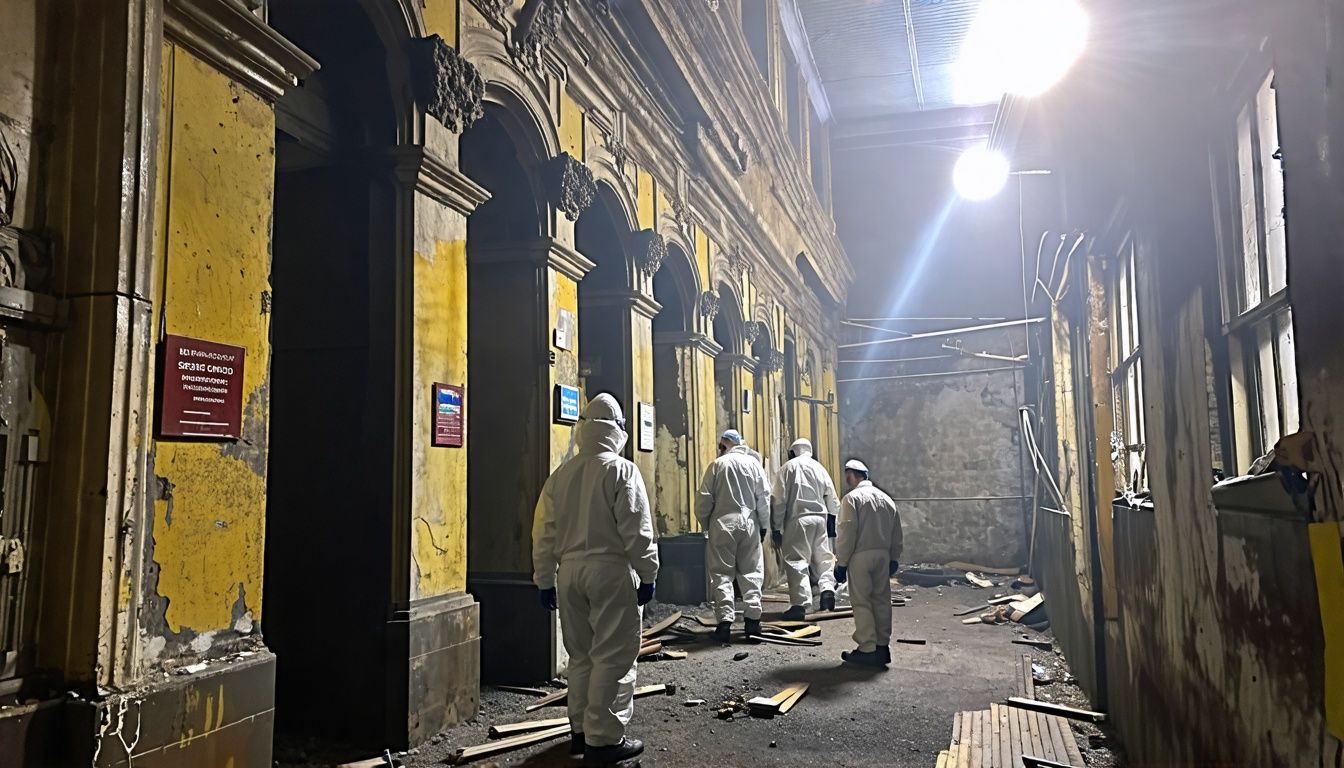
Asbestos Surveying in Liverpool: What Every Property Owner and Duty Holder Needs to Know
If your Liverpool property was built before 2000, there is a realistic chance it contains asbestos-containing materials (ACMs). Asbestos surveying in Liverpool is not a box-ticking exercise — it is the legally required foundation for understanding what is in your building, where it sits, and what risk it poses. Without a professional survey, you are operating blind, and potentially in breach of the law.
Liverpool’s architectural heritage means the city has a substantial stock of older commercial, industrial, and residential buildings. From Victorian warehouses in the docklands to 1970s office blocks and converted factories, asbestos was used extensively across the construction industry during the decades these buildings were built and refurbished. That legacy has not disappeared.
Why Asbestos Surveying in Liverpool Matters
Asbestos was used in hundreds of building products throughout most of the twentieth century. It was cheap, fire-resistant, and highly effective as an insulator — which is exactly why it ended up in everything from ceiling tiles and floor coverings to pipe lagging, roof sheeting, and textured wall coatings.
Liverpool’s commercial and residential building stock reflects this history. The city’s docklands and industrial heritage produced a dense concentration of warehouses, factories, civic buildings, and terraced housing — many of which were constructed or refurbished at the height of asbestos use.
Age alone does not determine risk. An ACM that is in good condition and left completely undisturbed poses a low risk. The same material, deteriorating or about to be cut through by a maintenance contractor who has not been informed of its presence, is an entirely different matter.
Types of Asbestos Survey Available in Liverpool
Not every survey is the same. The type of survey you need depends on how the building is being used and what work is planned. Getting this right from the outset is essential — using the wrong type of survey can leave you non-compliant and expose workers to unnecessary risk.
Management Survey
A management survey is the standard survey for occupied buildings undergoing normal use. It is a non-intrusive inspection carried out by a qualified surveyor whose job is to locate ACMs that could be disturbed during routine maintenance, minor repairs, or everyday building occupation.
The surveyor will visually inspect all accessible areas, take samples of suspect materials, and submit those samples to a UKAS-accredited laboratory for analysis. The resulting report covers the location of all identified or presumed ACMs, the type of asbestos present where confirmed, the condition and risk rating of each material, and recommendations for management, monitoring, or remediation.
This report forms the backbone of your asbestos management plan — a document that is legally required for any non-domestic property where ACMs are present or suspected. If you manage an occupied commercial building in Liverpool, an asbestos management survey is almost certainly the right starting point.
Refurbishment Survey
If you are planning significant building works, a standard management survey is not sufficient. A refurbishment survey is a more intrusive inspection designed to locate all ACMs in areas that will be disturbed or affected by the planned works. It may require destructive access to areas that a management survey would not touch.
Using a management survey when a refurbishment survey is required is a common and potentially dangerous mistake. If you are planning works on a Liverpool property, speak to a qualified surveyor before any work begins — not after.
Demolition Survey
Before any building is demolished, a demolition survey must be completed. This is the most thorough and intrusive type of asbestos survey, designed to locate every ACM within the structure so that all asbestos can be safely removed prior to demolition work starting.
A demolition survey is a legal requirement under the Control of Asbestos Regulations. No licensed demolition contractor should proceed without one.
Re-Inspection Survey
An asbestos survey is not a one-off exercise. Once ACMs have been identified in a building, their condition must be monitored over time. A re-inspection survey revisits previously identified ACMs to assess whether their condition has changed, whether any new risks have emerged, and whether your management plan needs updating.
Annual re-inspections are standard practice for many commercial property types, though the appropriate frequency will depend on the nature and condition of the materials involved.
The Legal Framework: What Liverpool Duty Holders Must Understand
The Control of Asbestos Regulations place a clear legal duty on those who own, manage, or have responsibility for non-domestic premises. This is known as the duty to manage asbestos. It is not optional, and ignorance of it is not a defence.
Under these regulations, duty holders must:
- Take reasonable steps to find ACMs in their premises
- Assess the condition and risk of those materials
- Produce and maintain a written asbestos management plan
- Provide information about ACMs to anyone who may disturb them
- Review and monitor the plan regularly
An asbestos management survey is the standard mechanism for fulfilling the first two of those duties. Without one, you have no documented basis for your management plan — and no defence if something goes wrong.
The Health and Safety Executive (HSE) takes asbestos regulation seriously. Prosecution for breaches of the Control of Asbestos Regulations can result in unlimited fines and, in serious cases, custodial sentences. Beyond criminal penalties, failing to have an up-to-date survey can invalidate insurance, complicate property transactions, and expose you to civil liability if an occupant or contractor is harmed.
What About Residential Properties in Liverpool?
The formal duty to manage applies to non-domestic premises. However, landlords of residential properties — particularly houses in multiple occupation (HMOs) and properties with communal areas — do have responsibilities under wider health and safety legislation.
If you are a residential landlord in Liverpool and your property was built before 2000, carrying out a survey is the sensible and legally defensible course of action. It protects your tenants, your contractors, and yourself.
Common Asbestos-Containing Materials Found During Liverpool Surveys
Surveyors working across Liverpool regularly encounter ACMs in locations that many property owners simply do not anticipate. The following materials are among those most commonly identified:
- Artex and textured coatings — applied to ceilings and walls in domestic and commercial buildings throughout the 1970s and 1980s
- Asbestos insulating board (AIB) — used in ceiling tiles, partition walls, fire doors, and service ducts
- Pipe and boiler lagging — particularly in older heating systems and plant rooms
- Corrugated cement roofing — common on industrial and agricultural buildings across Merseyside
- Floor tiles and adhesives — thermoplastic floor tiles from the mid-twentieth century frequently contain chrysotile asbestos
- Soffit boards and external cladding — especially on properties built in the 1960s and 1970s
- Rope seals and gaskets — found around boilers, furnaces, and pipe joints in older plant rooms
This is not an exhaustive list. A professional surveyor will assess all suspect materials systematically rather than relying on visual identification alone. Sampling and laboratory analysis is the only reliable way to confirm the presence or absence of asbestos fibres.
Building Types in Liverpool Where ACMs Are Frequently Found
Asbestos surveying in Liverpool covers a wide range of property types. The following building categories are among those where ACMs are most commonly identified:
- Pre-2000 office buildings and commercial premises
- Schools and educational buildings
- NHS and healthcare facilities
- Industrial units, factories, and warehouses
- Retail premises with older fit-outs
- Housing association and council properties
- Churches, community halls, and civic buildings
- Victorian and Edwardian terraced housing
- Converted dockland and warehouse properties
If your property falls into any of these categories and was built or significantly refurbished before 2000, an asbestos survey should be a priority — not an afterthought.
What Happens During an Asbestos Survey in Liverpool?
Understanding the process helps you prepare your property and staff, and ensures the survey is completed as efficiently as possible.
Before the Survey
You will need to provide the surveyor with access to all relevant areas of the building. Having building plans or floor drawings available is useful but not always essential. Inform any occupants or staff that a survey is taking place — while management surveys are non-intrusive, surveyors will need to access plant rooms, roof voids, and service areas where practical.
During the Survey
The surveyor will systematically inspect all accessible areas, recording the location and condition of any materials suspected to contain asbestos. Where sampling is required, a small sample is taken using appropriate PPE and containment methods to prevent fibre release. Sample points are sealed after sampling.
Where sampling is not practical — for example, in areas that cannot be safely accessed without intrusive work — the surveyor will presume that certain materials contain asbestos. These presumed ACMs are treated as if they contain asbestos until proven otherwise.
After the Survey
Samples are submitted to a UKAS-accredited laboratory for sample analysis. You will receive a detailed written report that typically includes:
- A full register of all identified and presumed ACMs
- Photographic evidence of each location
- Risk assessments and priority scores for each material
- Clear recommendations for each ACM — whether to manage in place, repair, encapsulate, or remove
- A site plan or drawing showing ACM locations where available
This report should be kept on site and made available to any contractor working in the building. It forms the basis of your legally required asbestos management plan.
Asbestos Testing and Sampling in Liverpool
In some situations, you may need asbestos testing carried out on specific materials rather than a full building survey. This might apply where a suspect material has been identified during works, where a previous survey left certain materials as presumed rather than confirmed, or where you want to verify the status of a particular area before maintenance begins.
For those who need fast, reliable results, professional asbestos testing services provide UKAS-accredited analysis without the need for a full survey. However, sample collection should always be carried out by a competent person using appropriate precautions — disturbing a suspected ACM without proper controls can create a risk where none previously existed.
What Happens If Asbestos Is Found?
Finding asbestos in your building does not automatically mean it needs to be removed. In many cases, the recommended approach is to manage ACMs in place — monitoring their condition, ensuring they are not disturbed, and keeping the information on record for anyone who might work in the building.
Removal is typically recommended when:
- The material is in poor condition and deteriorating
- It will be disturbed by planned refurbishment or maintenance works
- The risk of disturbance during normal building use is high
- The building is due for demolition
Where removal is necessary, it must be carried out by a licensed contractor for most ACM types, with appropriate notification to the HSE. For certain lower-risk materials, non-licensed work may be permissible — but this should always be assessed by a qualified professional. Supernova provides professional asbestos removal services where required, working with licensed contractors to ensure all work is carried out safely and in full compliance with the Control of Asbestos Regulations.
How Liverpool Compares to Other UK Cities
Liverpool shares many of the same asbestos challenges as other major UK cities with significant pre-2000 building stock. The scale of industrial activity during the twentieth century, combined with the city’s extensive port and manufacturing heritage, means ACMs are present across a broad cross-section of property types — not just obviously industrial sites.
Supernova operates nationally, and our surveyors bring the same rigorous, HSG264-compliant approach to asbestos surveying in Liverpool as they do to every other location we cover. Whether you manage a single commercial unit in the city centre or a portfolio of properties across Merseyside, our team has the expertise and local knowledge to support you. We also carry out asbestos survey London work and across all major UK regions, so multi-site clients can rely on a single, consistent provider.
Choosing a Qualified Asbestos Surveyor in Liverpool
Not all asbestos surveyors are equal. When selecting a surveyor for your Liverpool property, look for the following:
- UKAS-accredited laboratory analysis — all sample results should be processed by a laboratory accredited by the United Kingdom Accreditation Service
- Surveyors holding P402 qualification — the recognised industry qualification for asbestos surveying under the British Occupational Hygiene Society (BOHS) framework
- Clear, compliant reporting — reports should align with HSG264, the HSE’s guidance document on asbestos surveying
- Professional indemnity and public liability insurance — essential for any contractor working on your premises
- Transparent pricing with no hidden costs — you should know exactly what is included before the survey begins
Supernova Asbestos Surveys has completed over 50,000 surveys across the UK. Our surveyors are fully qualified, our laboratory partners are UKAS-accredited, and our reports are produced to the standard required by the HSE and the Control of Asbestos Regulations.
Frequently Asked Questions
Do I legally need an asbestos survey for my Liverpool property?
If you own, manage, or have responsibility for a non-domestic premises built before 2000, you have a legal duty under the Control of Asbestos Regulations to manage asbestos. An asbestos management survey is the standard way to fulfil this duty. Residential landlords also have responsibilities under wider health and safety legislation, particularly where communal areas or HMOs are involved.
How long does an asbestos survey take in Liverpool?
The duration depends on the size and complexity of the property. A small commercial unit may take two to three hours, while a large industrial building or multi-floor office block could take a full day or more. Your surveyor will provide an estimated timeframe when the survey is booked. Laboratory results typically take between three and five working days, after which your full written report is issued.
What is the difference between a management survey and a refurbishment survey?
A management survey is designed for occupied buildings in normal use. It is non-intrusive and focuses on materials that could be disturbed during routine maintenance or occupation. A refurbishment survey is required before any significant building works and is more intrusive — it may involve destructive access to locate all ACMs in areas that will be affected by the planned works. Using the wrong survey type can leave you non-compliant and workers at risk.
Can I take my own asbestos samples and send them for testing?
Technically, samples can be submitted for laboratory analysis by a non-specialist, but this is strongly discouraged. Disturbing a suspected ACM without the correct PPE, containment, and disposal procedures can release fibres and create a risk where none previously existed. Sample collection should always be carried out by a competent person with appropriate training and equipment. Supernova offers professional sampling services as part of both full surveys and standalone testing.
How often should I have my Liverpool property re-inspected for asbestos?
Once ACMs have been identified and recorded, their condition should be monitored regularly. Annual re-inspections are standard practice for most commercial properties, though the appropriate frequency depends on the type, condition, and location of the materials involved. Your asbestos management plan should specify the re-inspection schedule, and this should be reviewed whenever significant changes occur in the building or its use.
Get Your Liverpool Asbestos Survey Booked Today
Supernova Asbestos Surveys provides professional asbestos surveying in Liverpool and across the UK. Whether you need a management survey for an occupied building, a refurbishment survey ahead of planned works, or a demolition survey before a site is cleared, our qualified surveyors are ready to help.
With over 50,000 surveys completed nationwide, UKAS-accredited laboratory partners, and reports produced in full compliance with HSG264 and the Control of Asbestos Regulations, Supernova is the trusted choice for property owners, managers, and duty holders across Merseyside.
Call us on 020 4586 0680 or visit asbestos-surveys.org.uk to request a quote or find out more about our services.