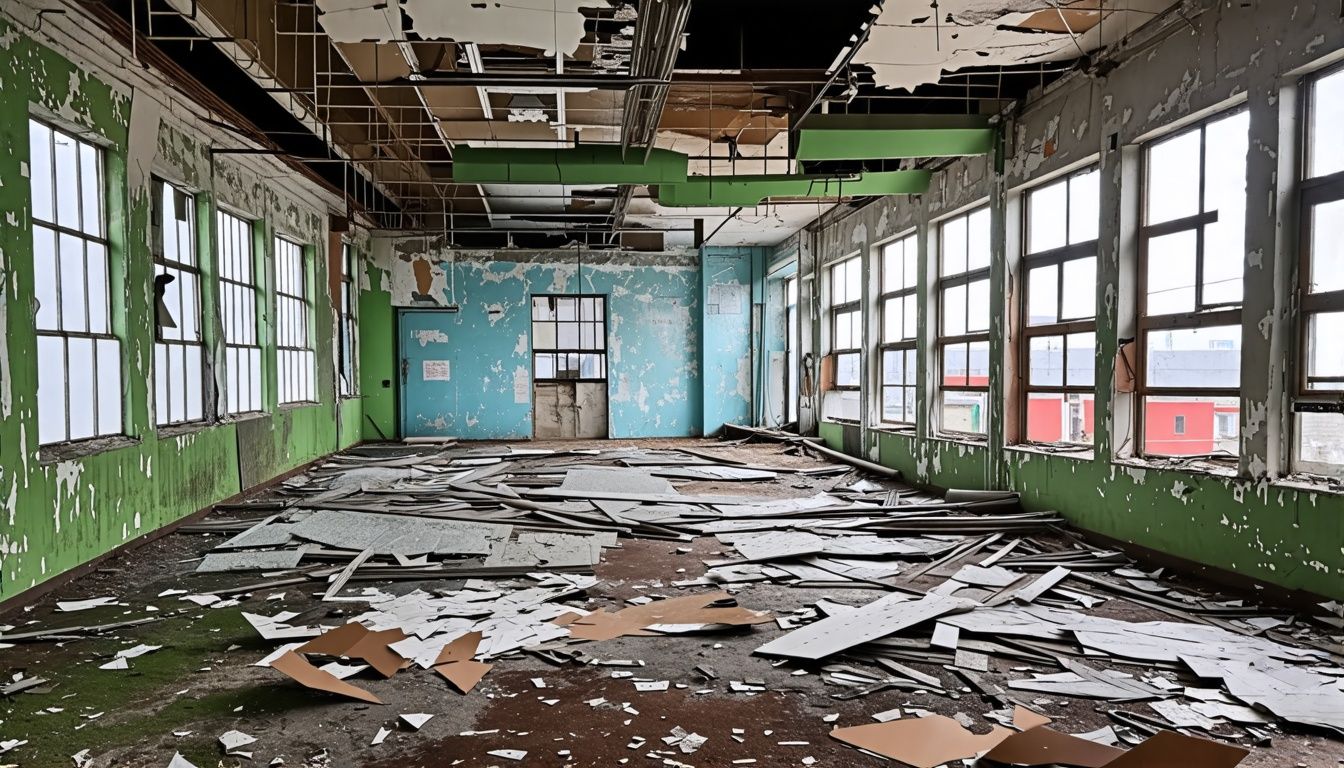
If Your Building Predates 2000, Here’s What You’re Legally Required to Do
Asbestos was woven into UK construction for decades. The Health and Safety Executive estimates that millions of tonnes of asbestos-containing materials (ACMs) remain in buildings across the country — and if your property was built before 2000, there is a realistic chance some of those materials are present right now.
An asbestos management survey is the legally recognised starting point for understanding exactly what you are dealing with — and what your obligations are as a duty holder. Whether you are a commercial landlord, a facilities manager, or an estates professional, the duty to manage asbestos is not discretionary. Getting it wrong carries serious legal, financial, and human consequences.
What Is an Asbestos Management Survey?
A management survey is a standard inspection of an occupied or in-use building, designed to locate — as far as reasonably practicable — the presence, location, and condition of any ACMs. It is the survey type used for buildings that continue to operate normally, where routine maintenance and occupation are ongoing.
During the inspection, a qualified surveyor will visually examine all accessible areas of the building, take bulk samples from suspected ACMs where appropriate, and assess the condition and risk of any materials identified. The findings feed directly into your asbestos register and asbestos management plan — both of which are legal requirements under the Control of Asbestos Regulations.
A management survey is not intrusive. Surveyors will not lift floorboards, break into wall cavities, or dismantle plant and equipment. It is designed to work around a building in normal use, not to disrupt it.
How Does an Asbestos Management Survey Differ From Other Survey Types?
This is one of the most frequently misunderstood areas of asbestos compliance. Each survey type has a specific purpose, and using the wrong one leaves you legally exposed.
Refurbishment Survey
A refurbishment survey is required before any work that will disturb the fabric of the building — fit-outs, extensions, structural alterations, or significant maintenance work. It is far more intrusive than a management survey, involving destructive inspection techniques to access concealed areas.
If you are planning any building work, you need this survey type, regardless of whether you already have a management survey in place.
Demolition Survey
A demolition survey is the most thorough type of asbestos inspection and is mandatory before any demolition work begins. It must identify every ACM in the building — including those in areas that would be inaccessible during a standard inspection. No demolition contractor should be on site without this survey having been completed first.
Each survey type serves a distinct purpose. A management survey manages ongoing risk in an occupied building. A refurbishment survey protects workers before intrusive work. A demolition survey ensures complete identification before a building is taken down.
Who Needs an Asbestos Management Survey?
The Control of Asbestos Regulations place a legal duty to manage asbestos on anyone responsible for a non-domestic building, or the common areas of a domestic building such as a block of flats. If you fall into that category, the duty applies to you — and commissioning a management survey is typically the first step in discharging it.
In practical terms, this includes:
- Commercial landlords and property owners
- Facilities managers and building managers
- Housing associations and local authorities
- School and college estates teams
- NHS trusts and healthcare estate managers
- Factory and warehouse operators
- Owners and managers of churches, community halls, and other public buildings
- Managing agents responsible for shared residential areas
Residential homeowners are not subject to the same duty in their own homes. However, if you are a private landlord with common areas — a shared hallway, communal plant room, or roof space — the duty to manage applies to those spaces.
The HSE’s guidance document HSG264 sets out the surveying requirements in detail and is the definitive reference for duty holders. Any surveying company you commission should be working to this standard as a baseline.
What If My Building Already Has an Asbestos Register?
An existing register is only useful if it is current and accurate. If the building has been refurbished since the last survey, if areas were inaccessible during the original inspection, or if the register is several years old, it may no longer reflect the true situation.
An outdated or incomplete register gives you a false sense of security — and no legal protection if something goes wrong. If there is any doubt about the completeness of your existing documentation, commissioning a fresh survey is the right course of action.
What Does an Asbestos Management Survey Actually Involve?
The Site Inspection
A qualified asbestos surveyor will carry out a thorough visual inspection of all accessible areas of the building. This includes plant rooms, service ducts, ceiling voids where accessible without disruption, floor finishes, wall boards, pipe lagging, and any other areas where ACMs were commonly installed during construction.
Common locations where ACMs are found include:
- Pipe and boiler insulation
- Ceiling tiles and suspended ceiling systems
- Textured coatings such as Artex on ceilings and walls
- Floor tiles and their adhesives
- Roof sheets and soffits
- Partition boards and wall panels
- Insulating board around fire doors and lift shafts
- Roofing felt and bitumen products
The surveyor will record the location, extent, and accessibility of each suspected ACM. Where safe and appropriate, they will take a small bulk sample for laboratory analysis.
Sample Analysis
Samples are sent to a UKAS-accredited laboratory for sample analysis under polarised light microscopy. This identifies not only whether asbestos is present, but which type — chrysotile (white asbestos), amosite (brown asbestos), or crocidolite (blue asbestos) — each of which carries a different risk profile.
At Supernova Asbestos Surveys, all laboratory analysis is carried out by UKAS-accredited facilities, ensuring results are legally defensible and meet the standards required by the HSE and regulators.
Condition Assessment and Risk Scoring
Finding asbestos does not automatically mean there is an immediate problem. What matters is the condition of the material and the likelihood of it being disturbed.
Your surveyor will assess each ACM against a range of factors:
- The physical condition of the material — intact, damaged, or deteriorating
- The type of asbestos present
- Whether it is friable or bound within another material
- Its location and how accessible it is
- The likelihood of disturbance during normal building use
Each material is assigned a risk score, which determines what action — if any — is required. Materials in good condition with a low disturbance risk may simply need to be monitored. Damaged or friable ACMs in high-traffic areas will require more urgent attention.
The Asbestos Register and Management Plan
The survey findings are compiled into a formal report that includes your asbestos register — a complete record of all ACMs found, their location, condition, and risk score. This register must be kept on site and made available to anyone who might disturb those materials: contractors, maintenance staff, and emergency services.
Alongside the register, you will need an asbestos management plan setting out how each ACM will be managed going forward. This covers monitoring schedules, maintenance procedures, responsibilities, and actions required for any higher-risk materials.
Both documents are live records — they need to be reviewed and updated regularly, not filed away and forgotten.
How Much Does an Asbestos Management Survey Cost?
Survey costs vary depending on the size and complexity of the building, its age, and the number of samples required. Here is a realistic guide to what you can expect:
- Small commercial premises (up to 200 sq m): Typically £300–£600
- Medium commercial buildings (200–1,000 sq m): Typically £600–£1,500
- Large or complex buildings: £1,500–£5,000+
- Portfolio pricing for multiple properties: Usually available on request
Factors that can increase the cost include poor accessibility such as confined spaces or high-level plant, a large number of suspect materials requiring sampling, the age and complexity of the building’s construction, and the urgency of turnaround required.
The cost of a survey is modest compared to the potential consequences of non-compliance. HSE enforcement action, prohibition notices, and the cost of emergency remediation all far outweigh the investment in a properly conducted survey. More importantly, asbestos-related disease remains a serious and very real risk for building occupants and the people who work in your building.
Getting the Best Value From Your Survey
Always use a company whose surveyors hold the relevant P402 qualification and whose laboratory analysis is UKAS-accredited. Do not choose purely on price — a survey that misses ACMs, or produces a report that does not stand up to regulatory scrutiny, is worse than useless.
If you manage a portfolio of properties, ask about combined survey packages. Supernova Asbestos Surveys works with landlords, local authorities, and facilities management companies across the UK, offering competitive rates for multiple sites.
What Happens After the Survey?
The survey report is a working document, not something to file away. Once you have your findings, here is what you need to do:
- Review and prioritise. Work through the surveyor’s recommendations based on risk score. High-priority ACMs may require immediate remediation — either encapsulation or removal by a licensed contractor.
- Update your asbestos register. Keep the register on site in an accessible format. Any changes — materials removed, areas re-inspected, new surveys commissioned — should be recorded promptly.
- Communicate the findings. Anyone working in or on the building needs to know where ACMs are located before they start work. Sharing the register with contractors, maintenance staff, and emergency services is a legal requirement, not a courtesy.
- Arrange asbestos awareness training. Any employee who might encounter ACMs in the course of their work requires appropriate awareness training. They must be able to recognise potential ACMs and know what to do if they encounter them unexpectedly.
- Schedule re-inspections. Your asbestos management plan should include a schedule for periodic re-inspections of known ACMs. Annual re-inspections of in-situ materials are standard practice for most commercial buildings.
- Arrange remediation where required. If the survey identifies materials that need to be removed or encapsulated, this work must be carried out by a licensed contractor for higher-risk materials. Our asbestos removal service can assist, and our team can advise on the appropriate course of action.
Other Asbestos Testing Options Available to You
If you are not yet ready to commission a full survey, or you want a preliminary indication before proceeding, there are additional options worth knowing about.
Our professional asbestos testing service allows samples to be collected and analysed by a UKAS-accredited laboratory, giving you a clear answer on whether a specific material contains asbestos. This can be a useful first step when you have a single suspect material and want clarity before deciding on next steps.
For those who want to collect a sample themselves before sending it for professional analysis, we also offer an asbestos testing kit through our online shop. The testing kit includes everything you need to safely collect a sample and send it to our laboratory for analysis.
Neither of these options replaces a full asbestos management survey. If you are a duty holder with obligations under the Control of Asbestos Regulations, a management survey is what you need — not a single sample test. But for homeowners, or for anyone who wants to understand a specific material before commissioning a full survey, these services offer a practical and cost-effective first step.
Our full asbestos testing service is also available for more detailed investigations where individual materials need to be assessed quickly and accurately.
Choosing the Right Surveying Company
Not all asbestos surveys are equal. The quality of the report you receive depends entirely on the competence of the surveyor carrying out the inspection and the accreditation of the laboratory analysing your samples.
When selecting a surveying company, look for the following:
- Surveyors qualified to P402 standard as a minimum
- UKAS-accredited laboratory analysis for all samples
- Reports that comply with HSG264 guidance
- Clear, accessible report formats that your team can actually use
- Willingness to explain findings and advise on next steps
- Experience with your building type and sector
Supernova Asbestos Surveys has completed over 50,000 surveys nationwide. Our surveyors are fully qualified, our laboratory partners are UKAS-accredited, and our reports are designed to be practical working documents — not just compliance paperwork.
Frequently Asked Questions
How long does an asbestos management survey take?
The duration depends on the size and complexity of the building. A small commercial premises might be completed in two to three hours. A large or multi-storey building could take a full day or more. Your surveyor will give you an estimated timeframe before the inspection begins, and the survey is designed to cause minimal disruption to your normal operations.
Do I need an asbestos management survey if my building was built after 2000?
The use of asbestos in UK construction was effectively banned from 1999. Buildings constructed entirely after this date are very unlikely to contain ACMs, and in most cases a management survey would not be required. However, if there is any uncertainty about when construction took place, or if the building incorporates older materials or components, it is worth seeking professional advice.
How often should an asbestos management survey be updated?
There is no fixed legal interval for re-surveying a building, but your asbestos management plan should include a schedule for periodic re-inspections of known ACMs — typically annually for materials that remain in situ. A full re-survey should be commissioned if the building has been significantly altered, if areas were inaccessible during the original inspection, or if the existing register is substantially out of date.
Can I carry out an asbestos management survey myself?
No. An asbestos management survey must be carried out by a competent person with the appropriate qualifications and training — typically P402-qualified surveyors working to HSG264 standards. Attempting to carry out a survey without the relevant competence exposes you to significant legal risk and, more importantly, puts building occupants and workers at risk if ACMs are missed or incorrectly assessed.
What is the difference between an asbestos register and an asbestos management plan?
Your asbestos register is a record of all ACMs identified in the building — their location, type, condition, and risk score. Your asbestos management plan sets out how those materials will be managed going forward, including monitoring schedules, responsibilities, and any remediation actions required. Both documents are legal requirements under the Control of Asbestos Regulations and must be kept up to date.
Get Your Asbestos Management Survey Booked Today
Supernova Asbestos Surveys has helped thousands of duty holders across the UK understand their asbestos obligations and put the right management measures in place. With over 50,000 surveys completed, fully qualified surveyors, and UKAS-accredited laboratory analysis, we are equipped to handle everything from a single small premises to a complex multi-site portfolio.
Call us on 020 4586 0680 to discuss your requirements, or visit asbestos-surveys.org.uk to request a quote or find out more about our full range of services. Our team is ready to help you meet your legal obligations and protect the people in your building.