
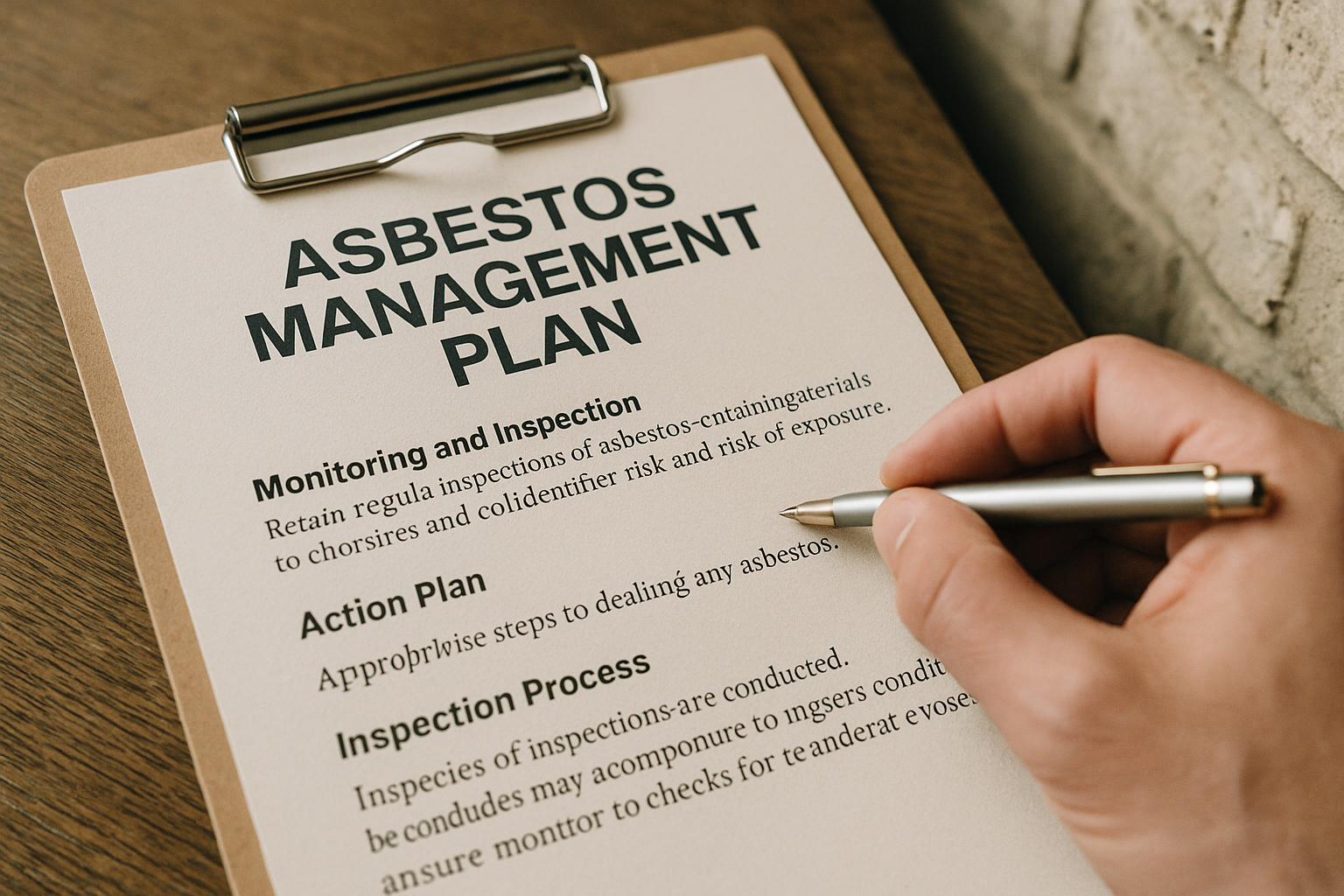
Miss one damaged ceiling tile, brief the wrong contractor, or rely on an out-of-date register after maintenance work, and a manageable asbestos issue can turn into a serious compliance and safety problem very quickly. an asbestos management plan is very important. it includes details on monitoring and inspection, the action plan for dealing with any asbestos, and… the practical controls that stop accidental disturbance in day-to-day building use.
For duty holders, this is not paperwork for a drawer. Under the Control of Asbestos Regulations, asbestos in non-domestic premises must be managed actively. That means knowing where it is, assessing the risk, keeping records current, and making sure anyone who could disturb it has the right information before work starts.
Why an asbestos management plan is very important
an asbestos management plan is very important. it includes details on monitoring and inspection, the action plan for dealing with any asbestos, and… the arrangements for communication, review and emergency response. Without those elements, even a good asbestos register can fail in practice.
Buildings change constantly. Lights are replaced, cables are rerouted, partitions are altered, leaks are repaired and contractors move through the site. If asbestos information is vague, buried in old reports or not shared properly, routine work can disturb materials that were stable and safe when left alone.
A well-run plan helps you:
- Know where asbestos is, or where it is presumed to be
- Assess which materials present the greatest practical risk
- Prevent accidental disturbance during maintenance
- Decide whether to monitor, repair, encapsulate or remove
- Brief staff and contractors clearly
- Show the HSE that asbestos is being managed properly
- Reduce delays to projects and reactive works
Just as importantly, it gives your team a clear process. When everyone knows where to look, who is responsible and what to do next, mistakes are far less likely.
Who needs an asbestos management plan
The duty usually sits with the duty holder. Under the Control of Asbestos Regulations, that is the person or organisation responsible for maintenance or repair of non-domestic premises, whether through ownership, tenancy or contract.
Depending on the property, that may be:
- Commercial landlords
- Facilities managers
- Managing agents
- Employers occupying their own buildings
- Trustees or governors of public buildings
- Organisations with contracted maintenance responsibilities
Shared responsibility is common, especially in larger portfolios or multi-let buildings. If that applies to your site, set it out in writing. One party may hold the register, another may arrange inspections, and another may control contractor access. If those lines are blurred, actions get missed.
The duty to manage commonly applies to offices, schools, shops, factories, warehouses, hospitals, hotels and communal areas of residential blocks. Private domestic homes are generally outside this duty, but corridors, risers, stairwells and plant rooms in residential buildings are not.
What an asbestos management plan should do in practice
an asbestos management plan is very important. it includes details on monitoring and inspection, the action plan for dealing with any asbestos, and… the working arrangements that turn survey data into safe decisions on site.

In practical terms, the plan should answer a few simple questions:
- What asbestos-containing materials are known or presumed to be present?
- Where are they?
- What condition are they in?
- How likely are they to be disturbed?
- What controls are in place?
- Who needs the information?
- When will the information be reviewed?
If your current document cannot answer those questions quickly, it is probably not doing the job it should.
The plan must be site-specific
A generic template is rarely enough. A school, warehouse and office block may all contain asbestos, but the pattern of use, access arrangements and maintenance activity will be completely different.
Your plan should reflect the actual building, not an idealised version of it. That includes the layout, occupancy, maintenance routines, vulnerable areas, contractor controls and any previous remedial work.
The plan must be usable
The best plan is one that people can use under pressure. If maintenance staff cannot find the relevant room reference, if contractors are not shown marked-up plans, or if the register is too old to trust, the document becomes a liability rather than a control measure.
The survey information your plan depends on
No asbestos management plan is stronger than the survey information behind it. Surveying should follow HSE guidance and the approach set out in HSG264, with the survey type matched to the building and the work proposed.
For most occupied premises, the starting point is a professional management survey. This identifies, as far as reasonably practicable, asbestos-containing materials that could be disturbed during normal occupation, routine maintenance or foreseeable installation work.
If refurbishment is planned, the survey requirement changes. A standard management survey is not enough in the affected area. You will usually need a more intrusive refurbishment survey so hidden asbestos can be identified before work begins.
Where a building or part of it is due to be taken down, a fully intrusive demolition survey is required. This is designed to locate asbestos-containing materials so they can be dealt with before demolition proceeds.
If asbestos has already been identified and left in place, condition checks should not be left to chance. A formal re-inspection survey helps confirm whether materials remain in the condition recorded and whether your existing controls are still suitable.
When sampling is needed
Sometimes the issue is not location but uncertainty. A suspect board, textured coating, insulation debris or floor tile may need sampling to confirm whether asbestos is present.
In those cases, professional asbestos testing can prevent guesswork. It helps you avoid unnecessary removal of non-asbestos materials and, just as importantly, stops genuine asbestos risks being dismissed without evidence.
If you need a standalone option for a specific material or area, independent asbestos testing can support maintenance decisions, damage investigations and pre-work checks.
The asbestos register at the heart of the plan
The asbestos register is central to effective management. It records known or presumed asbestos-containing materials, their location, extent, product type, condition and any action taken.
A useful register should be easy to understand on site. If a contractor cannot quickly tell whether asbestos is present near the work area, the register is not doing its job.
Your register should usually include:
- Room or area references
- Description of the material
- Extent or approximate quantity
- Product type
- Condition
- Material assessment details
- Accessibility and likelihood of disturbance
- Recommended action
- Date of last inspection
- Photographs or marked-up plans where helpful
It also needs updating whenever circumstances change. If materials are removed, encapsulated, damaged, sampled again or affected by building work, the register must be revised. An old register can be more dangerous than no register at all because people assume it is reliable.
What your asbestos management plan should contain
an asbestos management plan is very important. it includes details on monitoring and inspection, the action plan for dealing with any asbestos, and… the supporting procedures that make the register work in real life.
HSE guidance is clear that the plan should set out how the risks from asbestos will be managed. In practice, that means including the following sections.
1. Details of the premises and responsible person
Start with the building address, a short description of the premises and the name of the duty holder. Include contact details for the person managing asbestos day to day.
If responsibility is shared, say so clearly. Do not assume everyone already knows who arranges inspections, who updates records or who signs off contractor access.
2. The asbestos register
The register should be attached to or integrated with the plan. It should show all known or presumed asbestos-containing materials and cross-reference room numbers, plans, photos or drawings where possible.
3. Risk assessments and priorities
Each material should be considered not only for what it is and what condition it is in, but also for how likely it is to be disturbed. A cement sheet in a locked external compound does not present the same practical risk as damaged insulation board in a busy service corridor.
This is where prioritisation matters. Budget and time should go first to the materials most likely to cause exposure.
4. The action plan for dealing with any asbestos
This is the operational core of the document. For each item, state what will happen next, who is responsible and what timescale applies.
Actions may include:
- Leave in place and monitor
- Label where appropriate
- Restrict access
- Repair minor damage
- Encapsulate
- Arrange licensed or non-licensed removal as appropriate
- Carry out further sampling or investigation
Avoid vague wording such as “review later” or “monitor as needed”. If an item is high priority, the action should be specific and dated.
5. Monitoring and inspection arrangements
This is one of the most important sections. an asbestos management plan is very important. it includes details on monitoring and inspection, the action plan for dealing with any asbestos, and… a clear schedule for checking whether materials remain in the condition recorded.
The inspection frequency should reflect risk. Materials in exposed, busy or damage-prone areas may need more frequent checks than sealed materials in low-access locations.
Your plan should state:
- What will be inspected
- How often inspections will take place
- Who will carry them out
- How findings will be recorded
- What triggers escalation or remedial action
6. Communication arrangements
Anyone liable to disturb asbestos must be told where it is and what controls apply. That includes maintenance staff, electricians, plumbers, fire alarm contractors, data installers, cleaners in sensitive areas and external fit-out teams.
Practical controls include:
- Contractor sign-in procedures that include asbestos information
- Permit-to-work systems linked to the register
- Site inductions covering asbestos risks
- Marked plans available before intrusive work starts
- Clear escalation routes if suspect materials are found
7. Training and awareness
The plan should explain what asbestos training is required for relevant staff. Awareness training helps prevent accidental disturbance, but it does not qualify anyone to remove asbestos.
Staff who authorise maintenance or refurbishment should also understand when existing survey information is no longer enough. That is a common weak point in otherwise well-managed buildings.
8. Emergency procedures
If asbestos is damaged unexpectedly, there should be a simple, written response. People should know how to stop work, isolate the area, prevent access, seek competent advice and arrange any necessary sampling, cleaning or remedial action.
An emergency procedure should cover:
- Immediate stop-work instruction
- Isolation of the affected area
- Prevention of further access
- Notification to the responsible person
- Assessment by a competent asbestos professional
- Arrangements for remedial work and record updates
9. Review arrangements
The plan should not sit unchanged for years. It needs review at suitable intervals and whenever there is a significant change, such as damage, removal work, refurbishment, changes in occupancy or updated survey findings.
Monitoring and inspection: where many plans fail
Many asbestos plans look acceptable on paper but fall down on follow-through. The register is created, the survey report is filed, and then inspections drift. Months later, damage is found in an area that should have been checked routinely.
Monitoring does not need to be complicated, but it does need to be disciplined. A good approach is to classify materials by practical risk and set inspection frequencies accordingly.
Examples of sensible inspection triggers
- Known asbestos in plant rooms visited regularly by engineers
- Materials close to access panels or service routes
- Areas with a history of leaks, impact damage or unauthorised works
- Asbestos-containing materials in schools or public buildings with high footfall
- Items previously recorded as slightly damaged but stable
Inspections should be recorded properly. A tick-box with no notes is rarely enough if the condition has changed or if action is required.
If you manage multiple properties, use a simple central tracking system. Record last inspection dates, next due dates, actions raised and actions completed. That gives you a clear audit trail and makes it much easier to spot missed reviews.
Choosing the right action for asbestos-containing materials
Not all asbestos needs to be removed. In many cases, the safest option is to leave the material in place and manage it properly, provided it is in good condition and unlikely to be disturbed.
The right action depends on the material, its condition, its location and the likelihood of disturbance.
Leave in place and monitor
This is often suitable for stable materials in low-risk locations. The key is that monitoring must actually happen, and the information must be available to anyone working nearby.
Repair or encapsulate
Where minor damage is present, repair or encapsulation may reduce the immediate risk. This should only be specified where it is appropriate for the material and the wider condition of the area.
Remove
Removal may be the right option where materials are damaged, vulnerable, difficult to manage, or likely to be disturbed during planned works. The work category depends on the material and task, so always seek competent advice before assuming what can be done and by whom.
The mistake to avoid is treating every asbestos item the same. Effective management is based on proportionate decisions backed by reliable information.
Practical advice for property managers and duty holders
If you are responsible for a building, the biggest improvements usually come from tightening the basics rather than creating more paperwork.
Focus on these actions first:
- Check your survey status. Make sure the survey type matches the building use and any planned works.
- Review the register. Confirm it reflects the site as it exists now, not as it looked before the last round of works.
- Test your contractor process. Ask how an electrician or plumber would access asbestos information before starting work.
- Set inspection dates. If no one can tell you when key materials were last checked, fix that immediately.
- Clarify responsibilities. Put names against actions, not just job titles.
- Plan before projects start. Refurbishment and strip-out work should trigger a survey review at the earliest planning stage.
If your portfolio spans more than one city, consistency matters. Whether you need an asbestos survey London service, support with an asbestos survey Manchester, or a local team for an asbestos survey Birmingham, the standard of information feeding into your management plan should be the same across every site.
Common mistakes that weaken an asbestos management plan
Most failures are not caused by a complete lack of documents. They happen because the documents are incomplete, outdated or not used properly.
Watch for these common problems:
- Using a generic template with no building-specific detail
- Relying on an old register after refurbishment or maintenance work
- Assuming a management survey is enough for intrusive works
- Failing to tell contractors where asbestos is before they start
- Not setting inspection frequencies
- Leaving actions open with no owner or timescale
- Ignoring damaged materials because they were previously classed as low risk
- Not updating records after removal, encapsulation or sampling
If any of those sound familiar, the fix is usually straightforward. Review the survey information, update the register, assign responsibilities and make the plan part of the work process rather than an isolated compliance file.
When to review or rewrite your plan
You should review the plan at suitable intervals and whenever there is a reason to think it may no longer reflect the building accurately. Waiting for a major issue is the wrong approach.
Typical review triggers include:
- Completion of removal, repair or encapsulation work
- Damage to known or presumed asbestos materials
- Changes to occupancy or use of the building
- Planned maintenance that may affect hidden areas
- Refurbishment or strip-out proposals
- Updated survey findings or sample results
- Missed inspections or gaps identified during audit
A short annual management review is sensible for many premises, but higher-risk sites may need closer oversight. The right frequency depends on the materials present and how the building is used.
Frequently Asked Questions
Who is responsible for an asbestos management plan?
The duty holder is usually responsible. That is the person or organisation with responsibility for maintenance or repair of non-domestic premises. In some buildings the duty is shared, so responsibilities should be defined clearly in writing.
Does every building need an asbestos management plan?
Non-domestic premises and communal areas of residential buildings may need one where asbestos is present or presumed to be present. The duty to manage does not generally apply to private domestic homes, but it often applies to common parts of flats and similar properties.
How often should asbestos be inspected?
There is no single interval that suits every material. Inspection frequency should be based on risk, including condition, accessibility and likelihood of disturbance. Higher-risk or more exposed materials usually need more frequent checks.
Is a management survey enough before refurbishment work?
No. A management survey is intended for normal occupation and routine maintenance. If refurbishment is planned, the affected area will usually need a refurbishment survey because asbestos may be hidden behind finishes or within the building fabric.
What should happen if asbestos is damaged accidentally?
Work should stop immediately, the area should be isolated, access prevented and the responsible person informed. Competent asbestos advice should then be obtained so the material can be assessed and any necessary sampling, cleaning or remedial work arranged.
If your asbestos records are outdated, your inspections have slipped, or you need the right survey before works begin, Supernova Asbestos Surveys can help. We provide surveys, re-inspections, sampling and practical support for duty holders across the UK. Call 020 4586 0680 or visit asbestos-surveys.org.uk to arrange expert advice and fast nationwide service.