
What Should Be Included in an Asbestos Management Plan Report?
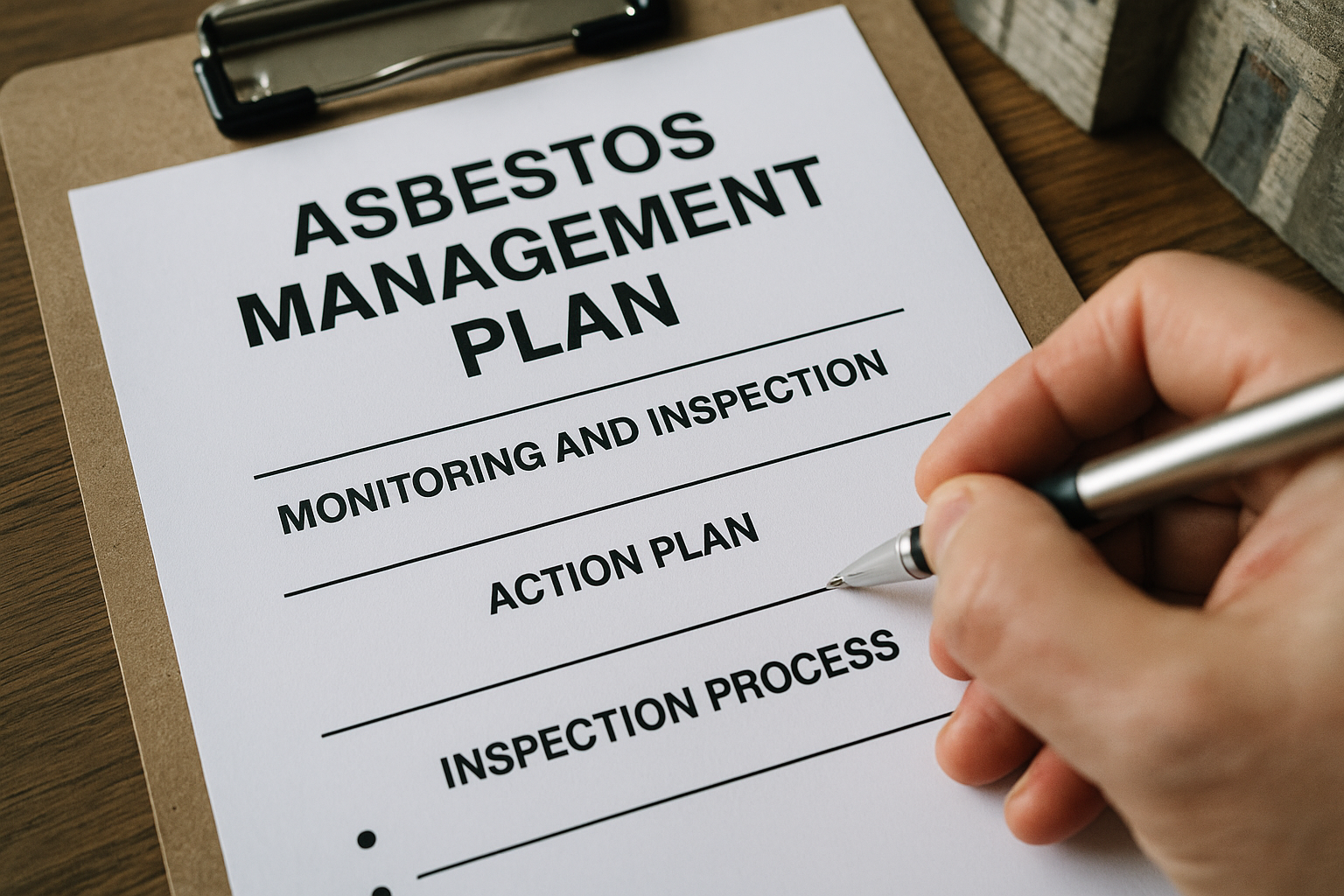
Miss a damaged asbestos insulating board panel, or hand a contractor incomplete information before they start work, and a routine maintenance job becomes a serious compliance failure very quickly. An asbestos management plan is very important — it includes details on monitoring and inspection, the action plan for dealing with any asbestos, and the clear responsibilities, records and communication steps that keep people safe in a real building, not just on paper.
For property managers, landlords, schools, healthcare estates teams and facilities professionals, the asbestos management plan is where legal duty meets day-to-day control. Under the Control of Asbestos Regulations, the duty holder must identify asbestos risks, assess them properly, and put arrangements in place to manage asbestos-containing materials so that nobody is exposed.
What Is an Asbestos Management Plan?
An asbestos management plan is the written system for managing known or presumed asbestos in a non-domestic property. It sets out what asbestos is present or suspected, where it is, what condition it is in, how the risk is controlled, who is responsible, and what happens next.
That is precisely why an asbestos management plan is very important — it includes details on monitoring and inspection, the action plan for dealing with any asbestos, and the practical controls that stop accidental disturbance during maintenance, cleaning, fit-outs and minor works.
A good plan is not a generic template downloaded once and forgotten. It is a live document built around the building, its occupancy, its maintenance patterns and the findings of the asbestos survey.
Why the Plan Matters in Practice
If asbestos is in good condition and unlikely to be disturbed, it may be safer to leave it in place and manage it carefully. But that only works if your plan tells people exactly what is there, what they must not disturb, when it will be inspected again, and what to do if the material is damaged.
Without that structure, even low-risk asbestos can become a high-risk issue. A contractor drilling into a riser panel or opening a ceiling void without checking the register first is one of the most common routes to accidental exposure.
Buildings That Typically Need an Asbestos Management Plan
The duty to manage asbestos applies to non-domestic premises and the common parts of some domestic buildings. In practice, that includes:
- Offices and business parks
- Schools, colleges and nurseries
- Hospitals, clinics and care settings
- Shops, retail units and shopping centres
- Factories, warehouses and workshops
- Hotels, leisure sites and entertainment venues
- Blocks of flats where communal areas are managed
- Public buildings and community premises
If the building was constructed before the asbestos ban took full effect, asbestos should be treated as a realistic possibility unless there is reliable evidence to the contrary.
Who Is Responsible for the Asbestos Management Plan?
The person responsible is the duty holder. Under the Control of Asbestos Regulations, this is usually the person or organisation with responsibility for maintenance and repair of the non-domestic premises, or the person in control of that part of the building.

Depending on the lease and management arrangements, the duty holder might be:
- The freeholder or building owner
- A landlord
- A managing agent
- An employer occupying the premises
- A facilities management company with defined repair responsibilities
- More than one party, where responsibilities are formally shared
This is one area where assumptions cause real trouble. If lease documents are unclear, establish who holds the duty before work starts — not after an incident forces the question.
What the Duty Holder Must Do
The duty holder is expected to take reasonable steps to find out whether asbestos is present, determine its amount and condition, and presume materials contain asbestos unless there is strong evidence otherwise. They must assess the risk and prepare a plan for managing that risk.
They must also make sure that information is shared with anyone liable to disturb asbestos — including staff, contractors and sometimes tenants. That sharing of information is not optional; it is a legal requirement under the Control of Asbestos Regulations.
Day-to-Day Responsibility Within the Plan
Even where the duty holder is legally accountable, the plan should name the people who actually carry it out. Clear roles make the plan workable in practice. Your asbestos management plan should identify:
- The duty holder
- The asbestos manager or responsible person
- Who maintains the asbestos register
- Who briefs contractors before work starts
- Who arranges re-inspections and periodic reviews
- Who authorises remedial action
- Who keeps training and communication records
If these roles are vague or unassigned, the plan will fail at exactly the moment it is needed most.
The Survey: The Foundation of the Asbestos Management Plan
You cannot manage what you have not identified. The survey is the starting point for the asbestos register and, by extension, the management plan itself.
For occupied premises where the aim is to manage asbestos during normal occupation and routine maintenance, the standard requirement is an management survey. This is designed to locate, as far as reasonably practicable, the presence and extent of any suspected asbestos-containing materials that could be disturbed during normal use of the building. The survey should follow HSE guidance and the methodology set out in HSG264.
What a Management Survey Records
A management survey aims to find asbestos-containing materials that might be disturbed or damaged during routine occupancy, including foreseeable maintenance. The survey report should record:
- The location of each suspected or confirmed ACM
- The product type and asbestos type where known
- Extent and quantity
- Accessibility
- Condition and surface treatment
- Material assessment information
- Photographs and plans where useful
- Recommendations for management actions
This information feeds directly into the asbestos register and then into the management plan. The quality of the survey directly affects the quality of everything that follows.
When a Management Survey Is Not Enough
If you are planning intrusive work, a management survey is not sufficient on its own. Before major alterations, you will need a refurbishment survey, which is designed to locate asbestos in the specific area where works will take place.
If the building, or part of it, is due to be demolished, a demolition survey is required before any demolition begins. This is more intrusive because the purpose is to identify all ACMs so they can be dealt with safely ahead of the work.
Using the wrong survey type is a common compliance failure — it creates unnecessary risk for contractors and often leads to delays, emergency sampling and unexpected costs.
How to Create an Asbestos Management Plan
Creating the plan is a structured process. The best plans are straightforward to read, specific to the building and easy to follow during everyday operations. Here is the practical route most duty holders should follow.
Step 1: Gather Building and Responsibility Information
Start with the basics. Record the address, building description, occupancy type, approximate period of construction, and the parties responsible for maintenance and repair. Identify who the duty holder is and who will manage the plan day to day.
If there are several tenants or multiple contractors working on site, note how asbestos information will be shared with each of them.
Step 2: Commission the Right Survey
Use a competent surveying provider and make sure the survey scope reflects the building and the way it is used. A poor brief leads to a poor survey, and a poor survey leads to an unreliable management plan.
If the property is occupied and you are managing ongoing risk, an asbestos management survey is usually the right starting point. If works are planned, the survey type must match the nature and extent of those works.
Step 3: Create the Asbestos Register
The asbestos register is the working record of all known or presumed ACMs in the premises. It should be easy to access and easy to understand. Each entry should normally include:
- Exact location
- Description of the material
- Extent or quantity
- Condition
- Material assessment score where available
- Presumed or confirmed status
- Photographs or marked-up plans where useful
- Recommended action
- Date of last inspection
The register is not separate from the plan in any practical sense. It is one of the core tools the plan depends on, and it must be kept current.
Step 4: Assess the Risk and Prioritise Action
Not every ACM needs immediate removal. The right response depends on the material, its condition, its accessibility, the occupancy pattern and the likelihood of disturbance. When prioritising actions, consider:
- Whether the material is damaged or deteriorating
- How friable it is
- Whether it is in a high-traffic or vulnerable area
- How often maintenance work takes place nearby
- Whether contractors are likely to disturb it
- Whether occupants could accidentally damage it
A sealed asbestos cement sheet in a locked service yard is managed very differently from damaged insulation board near a frequently accessed plant area. Your plan must reflect those differences.
Step 5: Decide the Control Measures
For each ACM or presumed ACM, your plan should state clearly what will be done. Typical options include:
- Leave in place and monitor
- Label where appropriate
- Protect from accidental damage
- Restrict access to the area
- Repair or encapsulate
- Arrange licensed or non-licensed removal, depending on the material and task
Where removal is required, it should be coordinated through competent specialists. Professional asbestos removal should always be planned alongside the survey findings, method statements and site-specific controls — not treated as an afterthought.
What Your Asbestos Management Plan Report Must Contain
If you are asking what should be included in an asbestos management plan report, the answer is straightforward: enough detail for the building to be managed safely and consistently by anyone who picks it up. The exact format can vary, but the core content must be present every time.
Essential Sections
- Property details — address, use, occupancy and description of the premises
- Duty holder details — who has legal responsibility and who manages the plan
- Survey information — type of survey, scope and relevant limitations
- Asbestos register — all known or presumed ACMs with locations
- Risk assessment and priorities — how each item is ranked and why
- Action plan — what will be done, by whom and by when
- Monitoring and inspection arrangements — re-inspection intervals and triggers for review
- Communication procedures — how staff, contractors and tenants are informed
- Emergency procedures — what to do if asbestos is damaged or disturbed
- Training records or training arrangements — who needs awareness and how it is recorded
- Review process — when the plan will be updated and who signs it off
Monitoring, Inspection and the Action Plan: The Working Core
Because an asbestos management plan is very important — it includes details on monitoring and inspection, the action plan for dealing with any asbestos, and the triggers for escalation — these sections deserve particular attention. They are the parts that prove the plan is actually being followed, not just filed.
Monitoring and Inspection Arrangements
Your inspection section should be specific, not generic. That means setting out:
- Which ACMs need periodic re-inspection
- How often they will be checked
- Who carries out the inspection
- What condition changes must be recorded
- What happens if damage is found
- How the asbestos register is updated afterwards
Inspection intervals vary depending on risk. Materials in good condition and protected locations may need less frequent review than materials in vulnerable or frequently accessed areas. The plan should reflect that variation rather than applying a single blanket interval to everything.
The Action Plan for Dealing With Asbestos
The action plan is not a vague intention to deal with things eventually. It is a prioritised list of specific tasks, each with a named person responsible, a timescale, and a record of completion. For each ACM that requires action beyond monitoring, the plan should specify:
- What action is required
- The priority level and why
- Who is responsible for arranging it
- The target completion date
- How completion will be verified and recorded
Actions should be reviewed at every plan update. Completed items should be recorded with the date and method of completion. Outstanding items should be escalated if they have not been addressed within the agreed timescale.
Communication: Making Sure the Right People Know
The plan must explain how asbestos information reaches the people who need it. That includes your own maintenance team, external contractors, cleaning staff, and any tenants or occupiers who might carry out work in the building.
In practice, your communication procedures should cover:
- How contractors access the asbestos register before starting work
- What briefing is given before any maintenance, repair or installation task
- How permit-to-work systems interact with the asbestos register
- How tenants are notified of ACMs relevant to their areas
- How changes to the register are communicated to relevant parties
Verbal briefings are not enough on their own. The plan should include a system for recording that information has been shared and acknowledged.
Emergency Procedures
Every asbestos management plan should include clear instructions for what happens if asbestos is accidentally disturbed or damaged. These procedures should be immediately accessible — not buried at the back of a large document.
Emergency procedures should cover:
- Stop work immediately and prevent further disturbance
- Clear the area and prevent re-entry
- Notify the responsible person named in the plan
- Seek advice from a competent specialist before re-entering
- Arrange air monitoring and clearance testing where required
- Report to the HSE if required under RIDDOR
- Update the asbestos register and plan records
Having this procedure written down, accessible and understood by staff is part of what makes a management plan functional rather than decorative.
Keeping the Plan Current: Reviews and Updates
An asbestos management plan is not a one-off exercise. It must be reviewed and updated regularly, and whenever circumstances change. The plan should set out when it will be formally reviewed and who is responsible for signing it off.
Triggers for an immediate review or update include:
- A change in the condition of any ACM
- Completion of any remedial or removal work
- Planned refurbishment or alteration works
- A change in building use or occupancy
- A change in duty holder or management responsibility
- An incident involving potential asbestos disturbance
- New survey findings that affect the register
At minimum, most plans should be formally reviewed on an annual basis. High-risk buildings or those undergoing frequent maintenance activity may need more regular attention.
Asbestos Surveys Across the UK
Supernova Asbestos Surveys carries out asbestos surveys and supports duty holders with asbestos management plan preparation across the country. Whether you need an asbestos survey London for a commercial property in the capital, an asbestos survey Manchester for an industrial or office site, or an asbestos survey Birmingham for a managed building in the West Midlands, our surveyors work to HSG264 methodology and provide clear, usable reports.
With over 50,000 surveys completed nationwide, we understand what duty holders actually need from a survey and a management plan — not just what satisfies a checklist, but what works in practice when a contractor turns up unannounced and needs to know what is in the ceiling void above them.
Get Your Asbestos Management Plan Right
A well-constructed asbestos management plan protects people, demonstrates compliance and gives everyone working in or on the building the information they need. A poorly constructed one creates false confidence and real risk.
If your current plan is out of date, incomplete or based on a survey that no longer reflects the building accurately, now is the time to address it. Supernova Asbestos Surveys can carry out the survey, provide the register and support you in building a plan that actually does what it is supposed to do.
Call us on 020 4586 0680 or visit asbestos-surveys.org.uk to speak to a surveyor or request a quote.
Frequently Asked Questions
What is the purpose of an asbestos management plan?
An asbestos management plan sets out how known or presumed asbestos-containing materials in a non-domestic building will be managed safely. It records what is present, where it is, what condition it is in, who is responsible for managing it, and what actions are required. The plan provides the structure that prevents accidental disturbance and demonstrates that the duty holder is meeting their legal obligations under the Control of Asbestos Regulations.
Who is legally required to have an asbestos management plan?
The duty holder for any non-domestic premises, or the common parts of certain domestic buildings, is required to manage asbestos under the Control of Asbestos Regulations. This typically means the building owner, landlord, managing agent or employer in control of the premises. The duty holder must produce and maintain an asbestos management plan as part of fulfilling that duty.
How often should an asbestos management plan be reviewed?
Most plans should be formally reviewed at least annually. However, the plan must also be updated whenever circumstances change — for example, if the condition of an ACM deteriorates, if remedial work is completed, if refurbishment is planned, or if there is a change in building use or management responsibility. The plan should specify the review interval and name the person responsible for carrying it out.
What is the difference between an asbestos register and an asbestos management plan?
The asbestos register is the record of all known or presumed asbestos-containing materials in the building — their location, condition, type and assessment. The asbestos management plan is the broader document that explains how those materials will be managed, who is responsible, what actions are required, how monitoring will be carried out, and how information will be communicated. The register sits within the plan and is one of its essential components.
Can I manage asbestos in place rather than removing it?
Yes, in many cases managing asbestos in place is the appropriate and legally acceptable approach — particularly where materials are in good condition and unlikely to be disturbed. The Control of Asbestos Regulations do not require removal simply because asbestos is present. However, managing in place only works if your asbestos management plan clearly records what is there, sets out the monitoring arrangements, and ensures that anyone working in the building has access to that information before starting work.