
What Should Be Included in an Asbestos Management Plan Report?
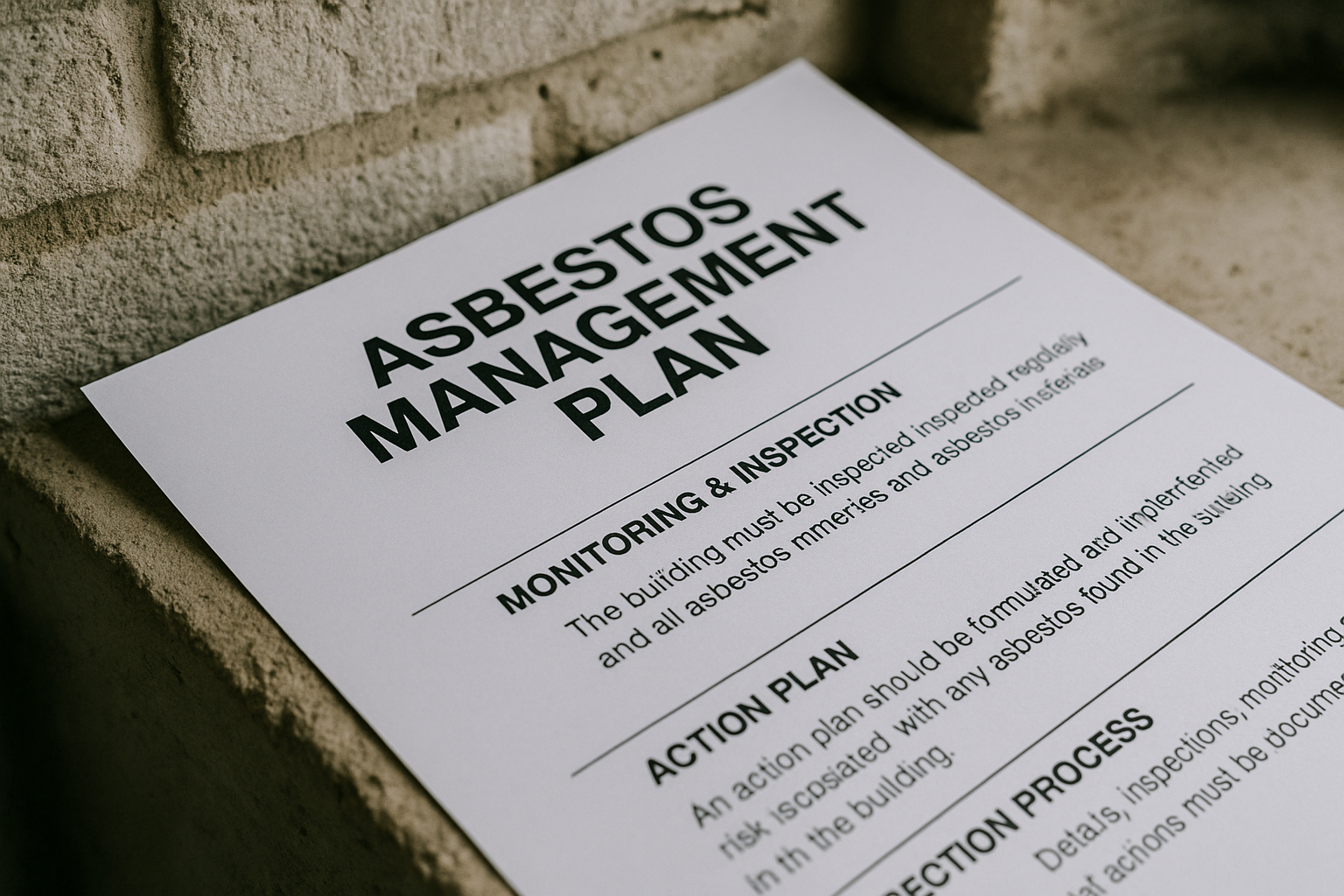
One missing document can turn routine maintenance into a serious legal and health risk overnight. An asbestos management plan is very important — it includes details on monitoring and inspection, the action plan for dealing with any asbestos, and the practical controls needed to prevent accidental disturbance. If you manage a non-domestic property, or the common parts of a residential building, that plan sits at the centre of your asbestos duties.
For many duty holders, the challenge is not recognising asbestos as a hazard. It is knowing what the plan should contain, who is responsible for it, how it links to the survey and register, and how to keep it active rather than letting it gather dust in a compliance folder.
Why an Asbestos Management Plan Is Very Important
An asbestos management plan is the written system for controlling asbestos-containing materials — or presumed asbestos-containing materials — within a building. It takes the findings from a survey and turns them into day-to-day instructions that people can actually follow.
That is why an asbestos management plan is very important. It includes details on monitoring and inspection, the action plan for dealing with any asbestos, and communication arrangements for anyone who could disturb the building fabric. Without that structure, even a thorough survey can fail to protect staff, contractors and occupants.
Under the Control of Asbestos Regulations, the duty holder must identify asbestos or presume it is present, keep an up-to-date record, assess the risk, and prepare a plan for managing that risk. HSE guidance and HSG264 make clear that asbestos management is an ongoing process, not a one-off exercise.
In practical terms, the plan should help you answer three straightforward questions:
- What asbestos is present, or presumed to be present?
- What is the risk of it being disturbed?
- What exactly are you doing to control that risk?
If those answers are unclear, the plan is not doing its job.
Who Needs an Asbestos Management Plan and Who Is Responsible?
The person responsible is usually the duty holder — the person or organisation with responsibility for maintenance or repair of non-domestic premises, or access to them for that purpose. Depending on the property and lease arrangements, that could be a landlord, managing agent, employer, facilities manager, housing association or public sector estate team.
In shared arrangements, responsibilities must be clearly allocated. If everyone assumes someone else is checking the register or briefing contractors, that is where risk creeps in.
Typical Duty Holders
- Commercial landlords
- Managing agents
- Facilities managers
- Employers occupying their own buildings
- Housing associations managing common parts
- Local authorities
- Schools, trusts and healthcare estate teams
What the Duty Holder Must Do
The duty holder does not need to carry out every task personally, but they must ensure suitable systems are in place. That usually means:
- Arranging a suitable asbestos survey where needed
- Maintaining an asbestos register
- Assessing the risk from known or presumed asbestos
- Preparing and implementing the management plan
- Providing information to anyone liable to disturb asbestos
- Reviewing and updating the plan regularly
Many organisations appoint an asbestos coordinator or asbestos manager to handle the day-to-day process. That can work well, but delegation does not remove the underlying legal duty.
The Survey Is the Foundation of the Plan
You cannot write a useful plan unless you know what is in the building. The normal starting point for occupied premises is a management survey carried out by a competent surveyor in line with HSG264. The purpose of the survey is to locate, as far as reasonably practicable, the presence and extent of suspect asbestos-containing materials that could be damaged or disturbed during normal occupation, including foreseeable maintenance and installation work.
What a Survey Should Provide
- Locations of suspect asbestos-containing materials
- Description of the product or material
- Assessment of condition
- Extent and accessibility
- Sampling results where appropriate
- Presumptions where sampling has not been undertaken
- Information that can be used to create the register and plan
The survey is not the same as the management plan. It is the evidence base. The plan then uses that evidence to set controls, assign responsibilities and establish review arrangements.
If you need a fresh asbestos management survey, make sure it is detailed enough to support real decision-making. Vague location notes or incomplete access information make the next stage much harder.
When Survey Information May Need Updating
Survey information can become outdated. A plan built on old or incomplete data is unreliable, even if the document itself looks polished. You may need a review, targeted re-inspection or further survey work when:
- Previously inaccessible areas become accessible
- Building fabric is altered
- Materials deteriorate
- New suspect materials are found
- Planned works go beyond routine maintenance
If refurbishment or demolition is planned, a management survey will not be sufficient. More intrusive survey work is usually required before work starts.
Core Contents of an Asbestos Management Plan Report
An asbestos management plan is very important — it includes details on monitoring and inspection, the action plan for dealing with any asbestos, and the procedures needed to keep people safe during routine occupation, maintenance and minor works. A strong report should be practical, property-specific and easy for others to follow.

At minimum, the plan should bring together the survey findings, asbestos register, risk assessments, control measures, communication procedures and review arrangements. It should also make clear who is responsible for each step.
What the Report Must Include
- Property details — address, building use and areas covered by the plan
- Duty holder information — named responsible persons and contact details
- Scope statement — what the plan applies to and any limitations
- Summary of survey information — date, type and key findings
- Asbestos register — listing known or presumed asbestos-containing materials
- Risk assessment information — material assessment and priority considerations
- Control measures — labelling, encapsulation, access restrictions and permit procedures
- Monitoring and inspection arrangements — frequencies and recording methods
- Action plan — repairs, removal, encapsulation or further investigation
- Contractor communication procedures — how anyone likely to disturb asbestos is informed before work begins
- Emergency arrangements — for accidental disturbance or suspected fibre release
- Review process — when and how the plan will be updated
If any of these parts are missing, the plan becomes much harder to use on site — and much harder to defend if something goes wrong.
How to Create an Asbestos Management Plan That Works in Practice
Creating the plan is not just a writing exercise. It is a process of collecting accurate information, assessing real-world risk and setting controls that people can follow without guesswork. The best plans are tailored to the building. Generic templates often miss critical details such as exact locations, named responsibilities and clear inspection intervals.
Step 1: Gather the Latest Asbestos Information
Start with the most recent survey, sampling results, re-inspection records and any removal or remedial work documents. Check whether the information is still current and whether inaccessible areas are clearly identified.
If the data is old, contradictory or incomplete, resolve that before drafting the plan. A tidy report built on weak information is still a weak report.
Step 2: Create or Update the Asbestos Register
The asbestos register is the working record that supports maintenance, repairs and contractor control. Each item should be clear enough for someone on site to identify it without confusion. A good register will usually include:
- Exact location
- Material or product description
- Asbestos type if known
- Extent or quantity
- Condition
- Surface treatment or sealing
- Accessibility
- Risk assessment notes
- Recommended action
- Date of inspection or review
If a material has not been sampled but is presumed to contain asbestos, say so clearly. Presumed asbestos still needs to be managed as asbestos.
Step 3: Assess the Real Risk of Disturbance
The survey may include a material assessment, but the plan also needs to consider priority risk in the context of the building and how each area is actually used. Ask practical questions such as:
- Is the material in a busy corridor or a locked plant room?
- Can staff, cleaners or contractors reach it easily?
- Is the area subject to impact, vibration or routine maintenance?
- Are future works likely to disturb it?
A sealed asbestos cement sheet in a low-risk external area does not need the same response as damaged insulation board in a service cupboard visited every week.
Step 4: Decide the Action for Each Item
There is no single answer for every asbestos-containing material. The right action depends on condition, location and likelihood of disturbance. Common actions include:
- Leave in place and monitor
- Label or sign where appropriate
- Restrict access
- Repair minor damage
- Encapsulate to protect the surface
- Arrange removal where risk cannot be adequately controlled
Removal is not automatically the best option. If a material is in good condition and unlikely to be disturbed, careful management may be the most proportionate approach.
Step 5: Record Responsibilities and Communication Routes
The plan should name the people responsible for maintaining the register, arranging inspections, approving works, briefing contractors and responding to incidents. If no one is named, tasks are more likely to be missed.
It should also explain how asbestos information is shared before any work starts. Contractors should never be left to discover asbestos by accident.
Step 6: Set Review and Monitoring Arrangements
Writing the document is only half the job. The plan must explain when materials will be re-inspected, how findings will be recorded, and what events trigger an immediate review. This is where many plans fall short.
Monitoring and Inspection: The Part Many Plans Get Wrong
An asbestos management plan is very important — it includes details on monitoring and inspection, the action plan for dealing with any asbestos, and the triggers for changing course if material condition worsens. Without regular monitoring, the plan becomes a static document rather than a live control system.
Inspection frequencies should reflect risk. There is no single interval that suits every building. Materials in vulnerable or busy areas may need more frequent checks than those in secure, low-traffic spaces.
What to Check During Monitoring Visits
- Whether the material condition has changed
- Whether labels, barriers or encapsulation remain effective
- Whether the use of the area has changed
- Whether any work has been carried out nearby
- Whether the register and plan still match what is on site
Every inspection should be recorded. If condition has worsened, update the action plan straight away rather than waiting for a scheduled annual review.
Practical Inspection Advice
Keep inspection records simple and consistent. Use location references that match the register, note any visible damage clearly, and photograph changes where helpful.
If your building has multiple floors, plant areas or risers, map out an inspection route so nothing is missed. For larger estates, assign responsibility site by site rather than assuming one central team will spot every issue.
The Action Plan for Dealing With Any Asbestos
The action plan is the working part of the report. It explains what needs to happen, who will do it, and how quickly. If the action section is vague, the rest of the plan loses value. A practical way to structure actions is by priority:
- Immediate action — materials in poor condition that pose a risk now. These should be addressed before further occupation or maintenance work continues in that area.
- Short-term action — materials that are deteriorating or in areas where disturbance is likely. Set a clear deadline and assign a named person.
- Planned action — materials that are currently stable but will need attention as part of future works or planned maintenance cycles.
- Monitor and review — materials in good condition in low-risk areas. These remain on the register and are checked at each inspection.
Each action entry should include the location, the material, the recommended action, the person responsible and a target date. Without those details, the action plan is just a list of intentions.
Contractor Communication and Permit to Work Procedures
One of the most common points of failure in asbestos management is the handover of information to contractors. The duty holder has a legal obligation to provide relevant asbestos information to anyone who could disturb asbestos-containing materials during their work.
That means before any contractor starts work, they should be given:
- Access to the relevant sections of the asbestos register
- Information on the location of any asbestos in their work area
- Confirmation of any restrictions or special precautions that apply
- A clear point of contact if they have questions or discover something unexpected
A permit-to-work or pre-work asbestos check system formalises this process. It creates a record that information was shared and that the contractor acknowledged it before starting. That record matters if something goes wrong.
Emergency Arrangements and Accidental Disturbance
Every asbestos management plan should include a clear procedure for accidental disturbance or suspected fibre release. This is not a section to leave vague. People need to know exactly what to do if something unexpected happens.
A basic emergency procedure should cover:
- Stopping work immediately and leaving the area
- Preventing others from entering
- Contacting the named responsible person
- Not attempting to clean up without specialist advice
- Arranging air monitoring if required
- Reporting the incident in line with your reporting obligations
The plan should include emergency contact details and make clear who has authority to decide next steps. Delay in responding to a disturbance incident can significantly increase health risk and regulatory exposure.
Keeping the Plan Current: Review and Update Requirements
An asbestos management plan that is not reviewed regularly is not managing anything. The plan should be treated as a live document, not an archive. Under HSE guidance, the plan should be reviewed and updated whenever there is reason to believe it may no longer be valid.
Common triggers for an immediate review include:
- A change in the condition of any asbestos-containing material
- Planned or completed building works
- A change in building use or occupancy
- An incident involving suspected asbestos disturbance
- A change in the duty holder or responsible persons
- New survey findings or sampling results
Beyond those triggers, a scheduled annual review is good practice for most properties. Larger or more complex estates may need more frequent checks.
Asbestos Management Across Different Property Types
The principles of an asbestos management plan apply across all non-domestic premises, but the practical details vary considerably depending on the building type, age, use and condition.
Office buildings, schools, hospitals, industrial units, retail premises and housing association common areas all present different challenges. A school with high footfall in corridors containing textured coatings needs a different monitoring approach to a low-occupancy warehouse with asbestos cement roofing panels.
Location also affects how surveys and management plans are structured. Whether you need an asbestos survey London, an asbestos survey Manchester, or an asbestos survey Birmingham, the underlying regulatory requirements are the same — but local surveyors with knowledge of regional building stock can add real practical value.
Frequently Asked Questions
What is an asbestos management plan and who needs one?
An asbestos management plan is a written system for controlling asbestos-containing materials or presumed asbestos-containing materials in a building. It is required under the Control of Asbestos Regulations for duty holders of non-domestic premises, and for those responsible for the common parts of residential buildings. Duty holders include landlords, managing agents, employers, facilities managers, housing associations and public sector estate teams.
What must be included in an asbestos management plan?
At minimum, the plan must include property and duty holder details, a summary of survey findings, the asbestos register, risk assessments, control measures, monitoring and inspection arrangements, an action plan for each material, contractor communication procedures, emergency arrangements and a review process. Each section should be specific to the building and assign named responsibilities.
How often should an asbestos management plan be reviewed?
The plan should be reviewed whenever there is reason to believe it may no longer be valid — for example, after building works, a change in material condition, an incident or a change in building use. An annual review is good practice for most properties. HSE guidance treats asbestos management as an ongoing process rather than a one-off compliance exercise.
Does an asbestos management plan require a survey first?
Yes. The plan depends on accurate information about what is present in the building. For occupied premises, the starting point is usually a management survey carried out by a competent surveyor in line with HSG264. The survey findings form the evidence base for the register, risk assessments and control measures in the plan. If planned works involve refurbishment or demolition, more intrusive survey work will also be required.
Can I manage asbestos in place rather than removing it?
Yes, and in many cases that is the most appropriate approach. The Control of Asbestos Regulations do not require removal unless the risk cannot be adequately controlled by other means. Materials in good condition that are unlikely to be disturbed can often be left in place, labelled, monitored and managed through the plan. Removal becomes necessary when materials are in poor condition, are at risk of disturbance, or when refurbishment or demolition work is planned.
Work With Supernova Asbestos Surveys
Supernova Asbestos Surveys has completed over 50,000 surveys across the UK and works with duty holders of all types — from single-site landlords to large multi-site estate teams. Whether you need an initial management survey, a re-inspection, or help reviewing an existing plan, our surveyors provide clear, practical reports that support real compliance rather than just paperwork.
Call us on 020 4586 0680 or visit asbestos-surveys.org.uk to arrange a survey or discuss your asbestos management requirements.